What Is Testimonial Evidence: Your 2026 Guide
Discover what is testimonial evidence and its role in grant proposals. This 2026 guide covers legal standards, reliability, and best practices for nonprofits.


Abdifatah Ali
Co-Founder
Testimonial evidence is a statement from a person sharing their direct experience, and in legal settings it requires three elements: a competent witness with direct knowledge, a formal oath or affirmation of truthfulness, and communication of that knowledge. For nonprofits, that matters because funders rarely decide on numbers alone. They want proof that your outcomes happened in real people's lives.
You probably know the feeling. Your team has attendance logs, outcome reports, and a spreadsheet full of program activity. But when you sit down to write a grant, something still feels flat. The data shows movement, yet it doesn't fully show what changed for the people you serve.
That gap is where testimonial evidence becomes useful.
In court, testimony helps recreate what happened when a judge or jury wasn't there to see it. In nonprofit work, testimonials do something similar. They help a grant reviewer understand what your program looked like on the ground, how a participant experienced it, and why the outcome matters beyond a chart or table.
That doesn't mean every moving quote is equally persuasive. Some are strong. Some are weak. Some sound heartfelt but raise questions the moment a reviewer reads them. If you've ever inserted a client story into a proposal and wondered whether it helped your case, you're asking the right question.
A good testimonial works a lot like good evidence. It comes from the right person, speaks to the right issue, and can stand beside your records without contradicting them. That same principle also shapes nonprofit storytelling in annual reports, board packets, and donor updates. If you're reworking how your organization presents impact, this guide on annual report format for nonprofits can help you connect stories and supporting documentation more clearly.
Introduction The Human Story Behind Your Data
Why numbers often need a witness
Most executive directors don't struggle to collect activity data. They struggle to make that data feel credible, human, and urgent to someone outside the organization.
A grant reviewer can read that your workforce program served families, or that your after-school initiative improved attendance. But those facts land differently when a participant explains what changed in plain language. A parent describing a new routine at home or a student explaining why they stayed in school gives shape to the outcome.
That's the practical value of testimonial evidence in nonprofit work. It turns abstract impact into lived experience.
Testimony doesn't replace your metrics. It gives your metrics a human voice.
Where nonprofit teams get confused
A lot of people use the word “testimonial” loosely. They treat any nice quote as proof. Legally, the idea is stricter. Testimonial evidence has rules because courts know human statements can be powerful and flawed at the same time.
That's a helpful mindset for fundraising too.
If a donor says, “Your program seems meaningful,” that's encouraging. If a participant explains what happened, when it happened, and how they know it happened, you're closer to evidence. If a partner organization confirms what they observed from its own role, you've strengthened the picture further.
For funders, the question usually isn't whether your story is emotionally compelling. It's whether the story is believable, relevant, and tied to the result you're claiming.
A better way to think about testimonials
Think of your proposal like a case file. Your data tables are one part. Your documents are another. Your testimonials are the witness statements.
Used well, they answer questions your spreadsheets can't:
- What changed: What did the participant experience before and after the program?
- How it changed: What service, support, or intervention made the difference?
- Why it matters: Why should a reviewer care about this outcome in practical terms?
That's what makes testimonial evidence worth understanding. It isn't decoration. It's part of how you prove impact.
Defining Testimonial Evidence Clearly
The legal definition in plain English
In law, testimonial evidence has a specific structure. Testimonial evidence legally requires three elements: a competent witness with direct knowledge, a formal oath or affirmation of truthfulness, and the communication of that knowledge. The witness must be able to perceive, recall, and articulate the events in question, as explained in Cornell Law School's definition of testimonial evidence.
The person has to know what they're talking about because they experienced it directly. They also must be under an obligation to tell the truth, and they have to communicate what they know.
For a nonprofit leader, the easiest analogy is a site visit.
If a funder visits your program and asks what happened, the strongest answer usually comes from someone who was there, remembers the details, and can explain them clearly. A second-hand summary from someone who “heard about it from staff” is weaker. A polished statement with no real connection to the event is weaker still.
The three parts nonprofits should borrow
You won't place people under oath in a grant application. But the legal model still gives you a useful filter.
Direct knowledge
A strong testimonial comes from the participant, volunteer, staff member, or partner who observed the event or lived through the outcome.
If your youth program helped a student return to school, the best testimony may come from the student, caregiver, or case manager with firsthand involvement. It's not as strong coming from a board member who only heard the story in a meeting.
Truthfulness
In court, this piece is the oath. In nonprofit practice, the equivalent is ethical documentation. You want consent, accurate wording, and a clear record of when and how the statement was collected.
That process signals seriousness. It tells a reviewer you didn't just grab a dramatic quote and shape it into something convenient.
Communication
A story only works if the person can explain it. Rambling, vague, or overly edited testimonials often lose force. The best ones are specific enough to be understood quickly.
Practical rule: The closer the speaker is to the event, the stronger the testimonial usually is.
Types of evidence compared
| Evidence Type | What It Is | Nonprofit Example |
|---|---|---|
| Testimonial evidence | A person's account based on direct experience | A participant describing how your housing counseling changed her situation |
| Documentary evidence | Written or recorded materials | Case notes, attendance reports, letters of support, annual reports |
| Physical evidence | Tangible items or visible conditions | Photos of a renovated community space or materials distributed at an event |
The important point isn't that one type always beats the others. It's that each does a different job.
A participant quote can explain lived impact. A report can confirm dates, services, or outputs. A photo can show a visible result. Strong proposals often combine all three.
Why Legal Standards of Credibility Matter for Grants
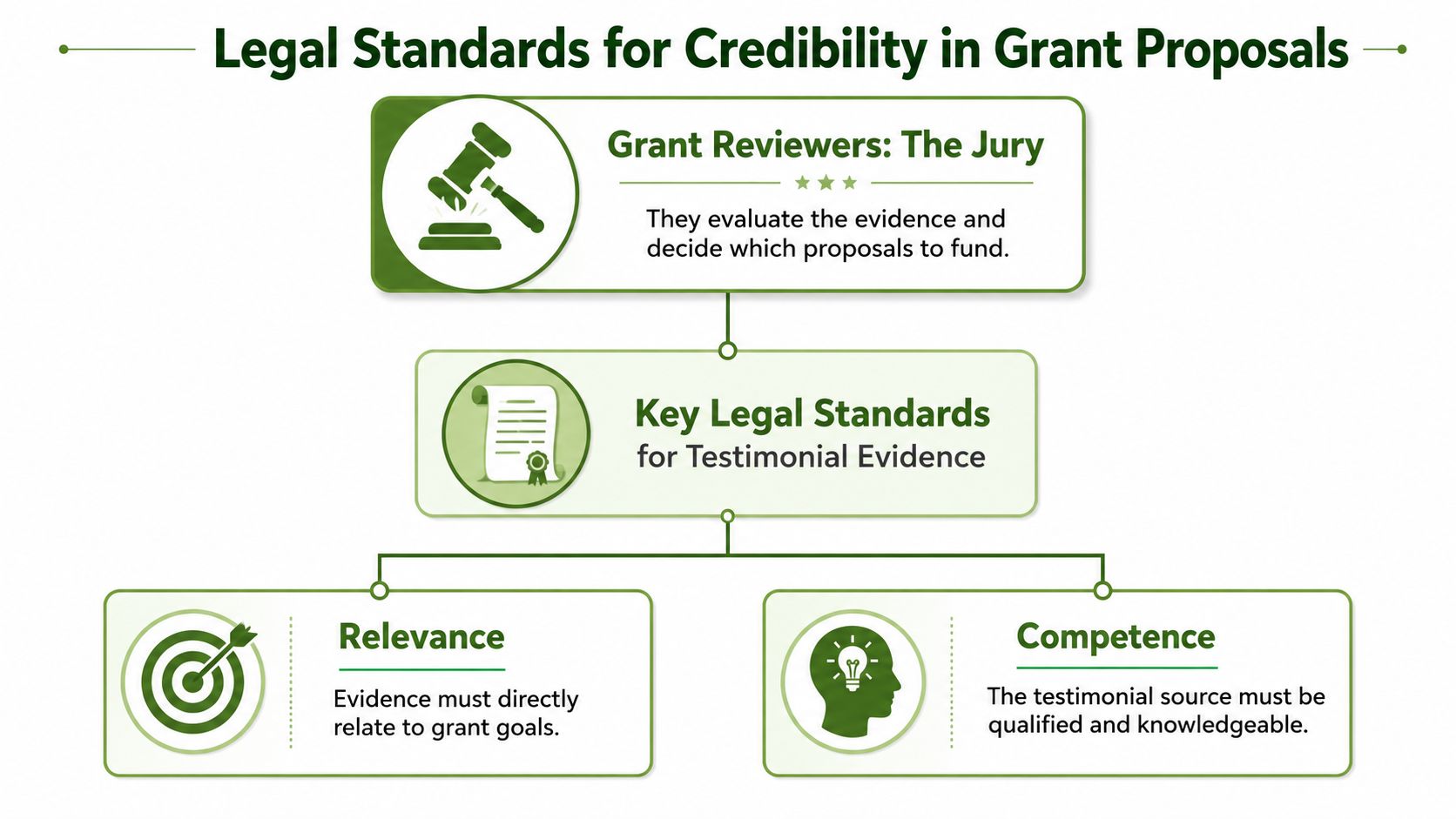
Grant reviewers aren't judges, but they still screen evidence. They decide what sounds reliable, what feels inflated, and what deserves confidence. That's why legal credibility standards are so useful outside the courtroom.
In U.S. law, expert testimony is governed by Federal Rule of Evidence 702 and the standards set by Daubert v. Merrell Dow Pharmaceuticals, which require courts to act as “gatekeepers,” ensuring expert testimony is based on sufficient data and reliable methods, as summarized in this overview of Rule 702 and Daubert. If you've ever watched a funder ask for source documentation, logic models, or supporting attachments, you've seen a similar instinct at work.
Relevance and competence in proposal language
Courts often ask whether evidence is material, relevant, and competent. For grants, that translates into a simpler set of questions:
- Does this story match the claim? If you're seeking support for mental health services, a testimonial about your food pantry may be moving but off point.
- Did this person observe the outcome? A direct participant usually carries more weight than someone repeating what staff told them.
- Can the reviewer trust the source? A community clinician, school leader, or partner agency may add authority because of the role they play.
These aren't legal hoops for nonprofits. They're credibility checks.
Why authority changes how testimony lands
Research summarized in this article on how credibility affects reliance on testimony found that testimony is weighted more heavily when it comes from a perceived expert or authority. That has an immediate nonprofit application.
A client quote may show emotional truth. A letter from a principal, public health professional, or coalition leader may show external validation. One demonstrates lived experience. The other can demonstrate informed judgment.
The strongest grant narratives often pair them.
How to think like a reviewer
When I coach nonprofit teams, I tell them to read every testimonial as if they didn't write the proposal.
Ask:
- Why this person?
- How do they know this?
- Why does this matter to the grant purpose?
- Can anything in the file support what they said?
That's the same reason governance and documentation matter across the organization. If your internal processes are loose, your evidence usually is too. A practical companion to this mindset is a clear conflict of interest policy for nonprofits, because reviewers often judge credibility through the organization's systems as much as through its stories.
If you also collect video stories, borrow a lesson from legal evidence handling. This guide to documenting video evidence is useful because it shows how careful recordkeeping strengthens trust in recorded material. The same habit helps when you archive participant interviews, consent records, and file versions for future grants.
The quote itself matters less than the chain of trust around the quote.
Navigating Reliability Concerns and Red Flags
Testimonial evidence can be central and still be imperfect. That tension matters.
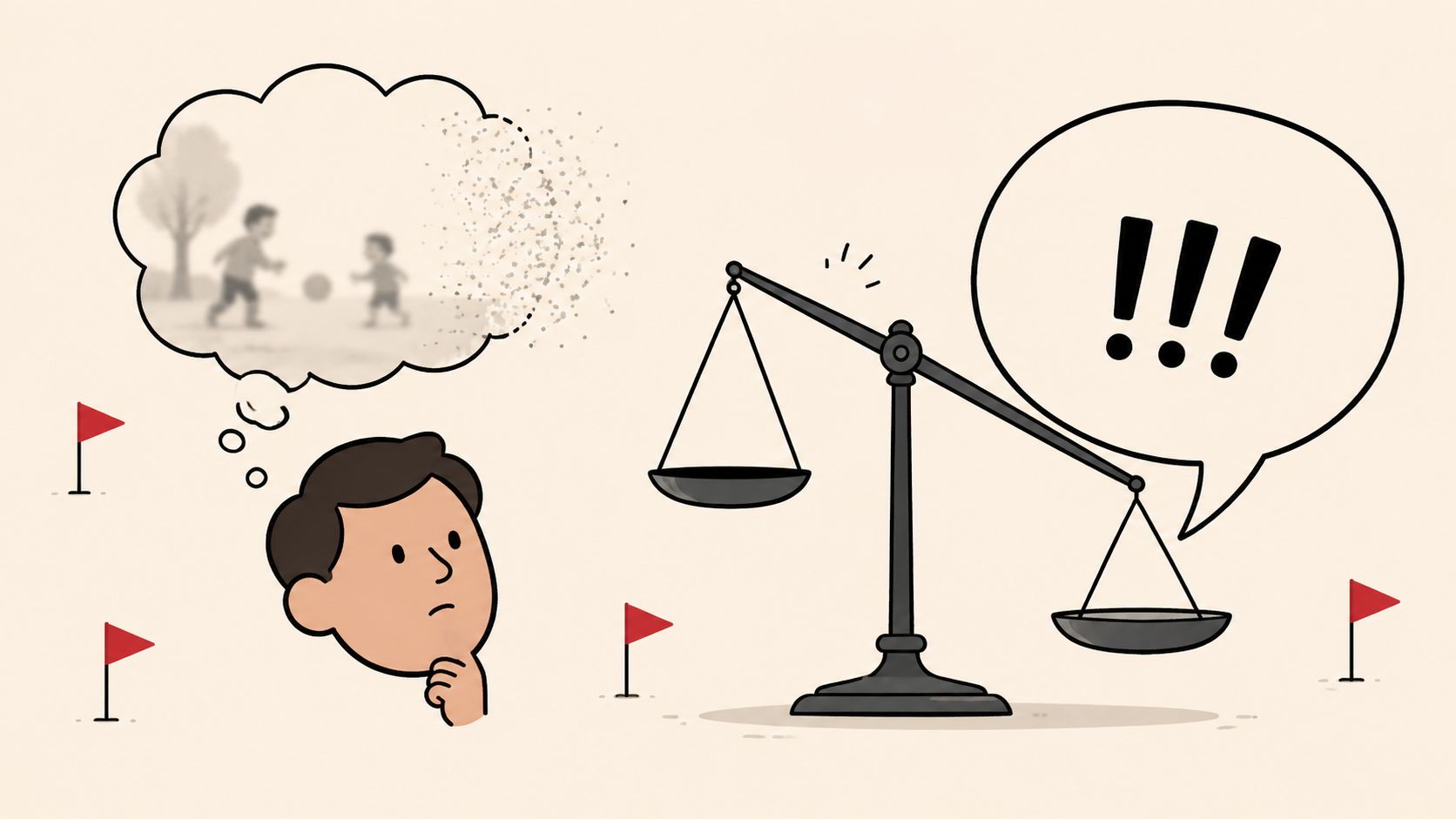
In legal practice, testimony is often decisive in cases where it may be the only proof available, such as domestic battery or robbery, yet it's also highly subjective and dependent on memory, which is why careful credibility assessment matters, as discussed in this overview of testimonial evidence in practice. Nonprofits face a similar reality. Sometimes the most important outcome in your work is a personal experience that won't show up neatly in a database.
Why sincere stories can still be weak evidence
A testimonial doesn't become reliable just because the speaker is honest. People forget details. They compress timelines. They mix what they saw with what they later learned.
That doesn't make testimony useless. It means you should treat it carefully.
Here are common red flags in nonprofit testimonials:
- Vague chronology: “Everything changed after your program” sounds nice, but it doesn't tell the reviewer when, how, or in what way.
- Overwritten language: If every participant suddenly sounds like a communications director, the quote may feel manufactured.
- No connection to the speaker: A statement from someone with only indirect contact with the program raises questions.
- Claims that outrun the evidence: If a quote suggests dramatic transformation but the rest of the file is thin, the reviewer may trust both less.
How to lower the risk
You don't need courtroom formality. You need disciplined storytelling.
Use a few habits consistently:
- Corroborate key claims: If a participant says attendance improved, line that up with attendance records or case notes when possible.
- Keep source notes: Record who gave the statement, when, and in what context.
- Use more than one voice: A participant account and a partner observation can reinforce each other without sounding repetitive.
- Avoid leading edits: Clean up grammar if needed, but don't change the meaning or insert claims the speaker didn't make.
A testimonial should sound like a person, not like copywriting.
Reliability also includes verification of supporting materials
A lot of organizations now use photos, short videos, and social content alongside written stories. That can help, but it also adds risk if your team doesn't verify what it collects and stores.
For example, if a volunteer submits images or profile information for a campaign, it's wise to use basic screening habits similar to those in this guide on how to verify photos to avoid catfishing. The fundraising lesson is simple. Before you publish a story, make sure the identity, context, and materials match the person and event you think they do.
That sounds obvious. It's also where busy teams make preventable mistakes.
Putting Testimonial Evidence to Work for Your Mission
A grant reviewer reads your outcome table, nods, and keeps going. Then they reach a short quote from a parent who explains that your after-school program gave her child the first place he felt safe enough to ask for help. Suddenly, the numbers have a face.
That is where testimonial evidence earns its place in nonprofit work. In legal settings, testimony helps a decision-maker understand what a witness personally saw, heard, or experienced. In grants and fundraising, it serves a similar purpose. It gives human context to facts that might otherwise feel abstract.
The practical question is not whether testimonials are useful. The practical question is which voice fits which claim.
Example one, the client story inside the narrative
A domestic violence program applies for support for counseling and safety planning. The proposal includes a brief participant quote about what it felt like to speak with an advocate and make a safety plan for the first time.
That quote adds something service numbers cannot supply on their own. It shows the lived meaning of the intervention.
Placement matters here. A client quote usually works best after you establish the problem or after you explain what your program does. In proposal terms, it works like a sharply chosen case example in a needs statement. It should clarify the point, not take over the page.
Example two, the partner letter in the appendix
Now shift to a community health project. The nonprofit includes a letter of support from a clinic director who explains how the partnership works, what needs the clinic sees, and why the nonprofit fills a practical gap.
This kind of testimonial answers a different question from a client quote. A participant can show impact from the inside. A partner can confirm capacity and community fit from the outside. Reviewers often look for both. One shows lived experience. The other shows that credible people around your organization see the same value.
That is why strong appendices often include letters from schools, clinics, agencies, or coalition partners. If your team needs a model, this guide on how to write letters of support for grants shows the elements that make those statements more useful to reviewers.
Example three, the staff or volunteer video for fundraising
A volunteer or frontline staff member might describe what they observed during meal delivery, outreach, or tutoring. For donor communications, that can work well because the speaker combines firsthand observation with organizational context.
Video can be especially persuasive in that setting. A short clip can convey tone, pace, and sincerity faster than a paragraph can. It also requires process. If your team collects stories through online intake forms, this end-to-end form developer guide offers a useful starting point for building cleaner submission workflows.
Match the testimonial to the decision you want the reader to make
A courtroom and a grant review panel ask different final questions, but they judge statements in similar ways. They want to know who is speaking, what that person directly knows, and why the statement helps resolve the issue in front of them.
Use that logic in your materials:
- Client voice: Best for showing lived impact, barriers, and change over time.
- Partner voice: Best for confirming collaboration, local need, and outside trust.
- Staff or volunteer voice: Best for describing what was observed in service delivery.
- Board or donor voice: Best for showing confidence in leadership, but usually weaker for proving program outcomes.
A simple rule helps. Match the speaker to the claim the same way you would match evidence to a budget line. If you want to prove community need, use someone close to that need. If you want to prove execution, use someone who saw the work happen. If you want to prove credibility, use someone who can speak to your organization's role from an informed position.
That is how the legal idea becomes useful in nonprofit practice. Testimonial evidence is not decoration. It is selected proof, presented through the right voice, in the right place, for the right purpose.
A Practical Guide to Collecting and Presenting Testimonials
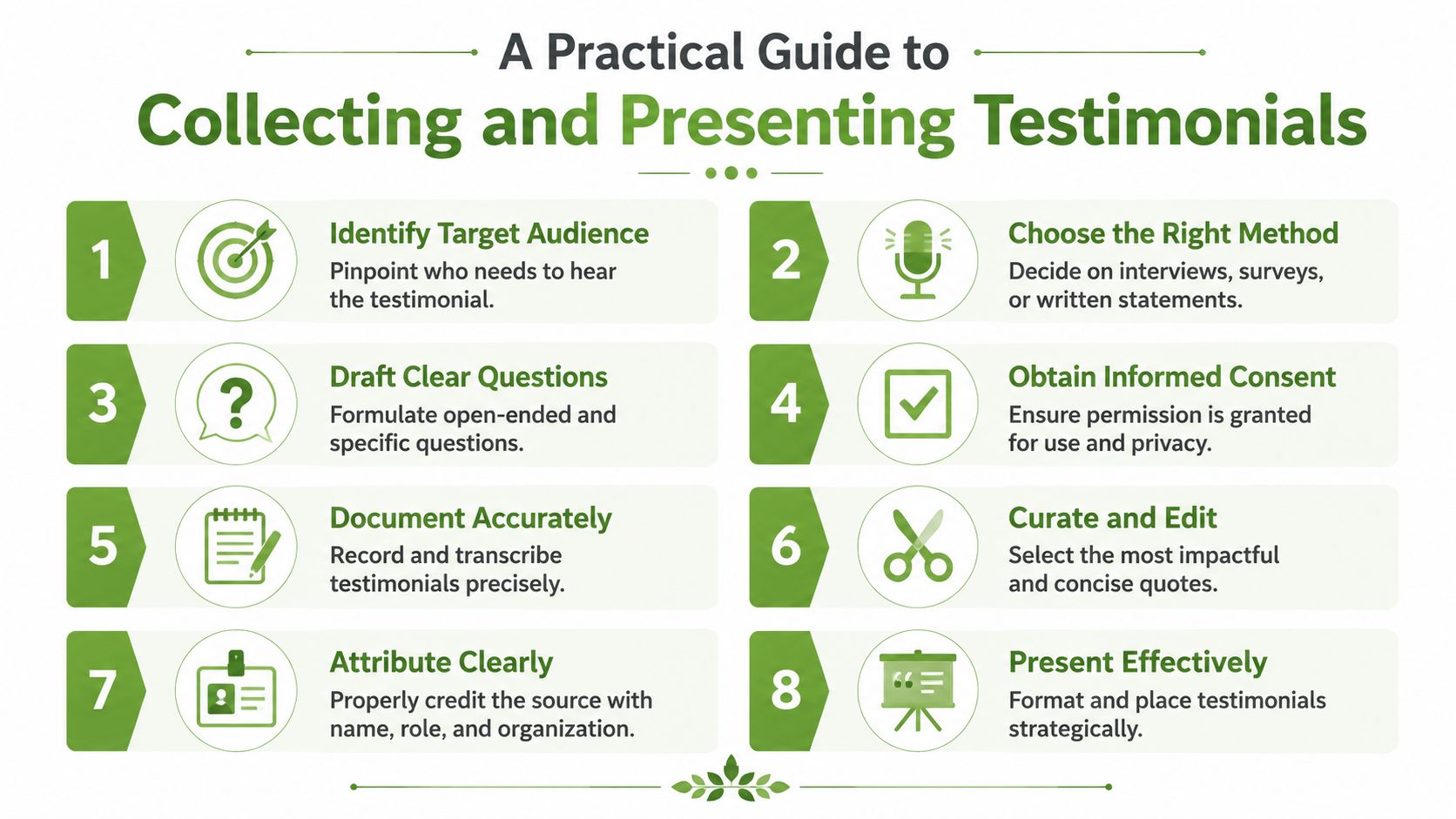
A good testimonial rarely happens by accident. Teams get stronger results when they build a repeatable collection process.
Start with consent and direct sourcing
One of the most useful legal ideas for nonprofit storytellers is the hearsay rule. In law, hearsay generally bars out-of-court statements offered to prove the truth of what they assert. In nonprofit practice, the lesson is practical. Get the story directly from the source whenever possible, as explained in Cornell Law School's hearsay overview.
So before anything else, make sure you have informed consent.
Your basic checklist should cover:
- Permission to use the statement: Clarify whether the quote can appear in grants, donor materials, social media, or reports.
- Name and identification preferences: Ask whether the person wants full name, first name only, initials, role, or anonymity.
- Image and video permission: Get separate clarity if photos or recordings will be used.
- Right to decline: People should know participation is voluntary and won't affect services.
Ask questions that produce usable testimony
Weak questions create weak testimonials. If you ask, “Did our program help you?” you'll likely get a short yes.
Ask open questions instead:
- What was happening before you connected with our organization?
- What support did you receive?
- What changed afterward?
- What stands out most when you think about that experience?
- What would you want someone funding this work to understand?
If you collect stories through your website, a structured intake form can help standardize quality. For teams building that workflow, this end-to-end form developer guide is a useful reference for thinking through form structure, submission flow, and data capture.
Document carefully, then edit lightly
Record the interview if you have permission. Transcribe accurately. Save the original version.
Then edit for clarity, not drama.
That means you can remove filler words, tighten long answers, or fix obvious grammar issues if the meaning stays intact. You should not add outcomes the speaker didn't mention or combine statements from different people into one polished quote.
Key test: If the speaker read the final quote back, would they say, “Yes, that's what I meant”?
This is also where a system helps. Some teams store stories in a shared drive. Others use CRM notes, spreadsheets, or proposal libraries. Fundsprout is one example of a grant platform that lets nonprofits use uploaded source materials, including beneficiary testimonials, when drafting proposal content. The important point isn't the tool. It's keeping your evidence organized, attributable, and easy to retrieve.
Present the testimonial where it supports the argument
A testimonial should strengthen your case, not derail it. Place it where the reviewer already needs proof.
Use a short participant quote in a statement of need. Use a partner statement in collaboration sections. Use a volunteer or staff observation when you need to clarify how services are delivered. If you need external validation documents, this guide on how to write letters of support is a practical complement to testimonial gathering.
A short video can also help when your audience needs a more personal introduction to the work. Used well, it adds context rather than replacing written evidence.
The strongest nonprofit testimonials do three things at once. They sound human, they stay close to firsthand experience, and they fit neatly beside the rest of your evidence.
Fundsprout helps nonprofits organize the pieces that make proposals more credible, including impact data, supporting documents, and firsthand stories that can be woven into a grant narrative with citations and version control. If your team wants a more disciplined way to turn lived experience into usable proposal evidence, you can learn more at Fundsprout.
Try 14 days free
Get started with Fundsprout so you can focus on what really matters.