How to Write Letters of Support That Actually Win Grants
Discover how to write letters of support that make grant proposals undeniable. Get practical strategies and real-world examples to secure funding.


Abdifatah Ali
Co-Founder
A truly effective letter of support does more than just give your project a thumbs-up. It's a piece of specific, credible evidence that proves your project is not only important but also has a real shot at success.
Your goal is to get a compelling testimonial from a third party that shows your project has deep community roots, speaks directly to what the funder cares about, and confirms your organization has what it takes to get the job done.
Why a Great Letter of Support Is Your Secret Weapon
Let’s be honest—grant writing is a grind. You’ve poured countless hours into building the perfect narrative and crunching the budget numbers. At that point, rounding up letters of support can feel like just one more tedious task. But treating them as an afterthought is a huge mistake. A well-written letter of support isn't just a box to check; it’s a strategic tool that can make your proposal stand out from the pile.
These letters provide powerful external validation. They take the claims you make in your proposal and turn them into proven facts. Suddenly, it’s not just you saying your project has community buy-in; a respected community leader is saying it, too. For a grant reviewer sifting through stacks of applications, that kind of third-party credibility can be the tiebreaker.
Turning a Requirement into a Strategic Advantage
A thoughtfully gathered collection of support letters shows more than just your network. It actively pushes back against common reasons grants get denied, like a weak connection to the community or an unproven track record. Instead of just saying you collaborate with other groups, a letter from a partner detailing your shared history offers concrete proof.
Think of each letter as a piece of evidence that strengthens your case. When you assemble a diverse set of specific, enthusiastic letters, you build a compelling story around your proposal. It tells the funder that:
- Your project is truly embedded in the community you aim to serve.
- Influential stakeholders are confident you can deliver.
- The problem you're solving is real, verified, and urgent.
- You already have the relationships needed to execute the plan smoothly.
The numbers back this up. Proposals that include strong, customized letters of support see their success rates climb. It’s not uncommon for established programs with letters from trusted partners to achieve success rates as high as 90%, while generic applications often fail to make an impact.
A letter of support is your proposal's voice amplifier. It takes the promises you make in your application and echoes them through the credible voices of community leaders, partners, and beneficiaries, making your message impossible to ignore.
This is exactly why knowing how to write letters of support is a core fundraising skill, not just an administrative one. If you’re just starting out, getting this part right can give you a major leg up. To see how these letters fit into the broader strategy, our grant writing for beginners guide is a great place to start. A simple shift in perspective can turn this requirement into your proposal’s most powerful secret weapon.
Choosing Supporters Who Amplify Your Message
Before you even think about writing, the most critical decision you'll make is who will write your letters of support. The real power of a letter doesn't come from a fancy title—it comes from the author's credibility and their genuine connection to your work. Honestly, a heartfelt, specific endorsement from a grassroots partner often carries more weight than a generic letter from a high-profile official.
Your goal here is to assemble a portfolio of support that tells a complete, compelling story. Think of it like casting a play. You need different voices to highlight your project's various strengths, creating a chorus of validation that a grant reviewer simply can't ignore.
Who Should Be on Your Roster?
Not all supporters are created equal, and they certainly don't all serve the same purpose. To be strategic, you need to think beyond just who you know and start mapping potential advocates to the specific arguments you’re making in your proposal. This ensures every letter adds a unique and valuable piece of evidence.
Start by brainstorming and sorting potential supporters into a few key groups:
- Community Leaders: This could be anyone from an elected official to the head of a neighborhood association or a respected local elder. Their letters are pure gold for demonstrating broad community buy-in and confirming your project addresses a real, recognized need.
- Partner Organizations: A letter from an organization you collaborate with is powerful proof that you can build coalitions and deliver on complex projects. They can speak directly to your reliability and the real-world impact of your work together.
- Subject Matter Experts: Getting a nod from an academic, a leading practitioner in your field, or a respected consultant lends serious technical credibility to your approach. Their endorsement tells funders your plan is sound, well-researched, and built to succeed.
- Direct Beneficiaries: This might be the most powerful voice of all. A personal story from someone whose life you’ve changed provides an emotional, human-scale testament to your impact that raw data can never capture.
Going through this mapping exercise helps you spot both your strengths and your gaps. For example, if your proposal hangs its hat on an innovative methodology, you know that a letter from a subject matter expert isn't just nice to have—it's a must.
Aligning Supporters with What Funders Actually Care About
Once you have your list, the next step is to play matchmaker between your supporters and the funder's specific priorities. A foundation laser-focused on economic development will be far more impressed by a letter from a local business owner who hired your program graduates than one from a distant academic.
A great letter of support directly echoes a funder's priorities, but it's spoken through the credible voice of a third party. When a supporter validates the exact outcomes a funder wants to see, their letter becomes undeniable proof of alignment.
Let's walk through a quick scenario. Imagine you're applying for a grant from a foundation that prioritizes collaborative solutions to community health issues.
See how that works? This strategic selection ensures your letters aren't just repetitive pats on the back. Instead, they weave together a multi-faceted case, proving your project has professional credibility, community relevance, and a real human impact.
Making the "Ask" Easy and Effective
Let's be real: even your most enthusiastic supporters are busy people. Your job is to make saying "yes" to your request as painless as possible. The key is to respect their time by being organized, clear, and doing most of the legwork for them.
When you reach out, don't bury them in paperwork. Give them a concise package with just the essentials:
- A one-page summary of your project and the specific grant you're targeting.
- A few key bullet points you'd love them to touch on, tailored to their unique perspective.
- A clear deadline, making sure to give them at least two to three weeks' notice. More is always better.
- A draft letter they can easily edit and pop onto their own letterhead. Trust me, most supporters will be incredibly grateful for this, as it saves them a ton of time.
By doing this heavy lifting, you not only boost your chances of getting a "yes," but you also gently guide the content to make sure it’s strategic and persuasive. This thoughtful approach is fundamental when you're figuring out how to write letters of support that truly move the needle.
The Anatomy of a Truly Persuasive Letter
A strong letter of support follows a familiar structure, but the real impact comes from the details, not the template. Think of it less as a formula and more as a strategic testimony. To build a letter that actively champions your project, you need to understand what each section—the opening, the body, and the close—is meant to accomplish.
The overall flow is straightforward. Your intro needs to hook the reader by establishing immediate credibility. The body then has to deliver the goods with real, tangible proof. Finally, the closing should stick the landing, leaving the funder with a confident and memorable final impression.
Crafting an Introduction That Commands Attention
The first few sentences are your most valuable real estate. They must immediately answer two critical questions for the grant reviewer: who is this person, and why should I care what they think? A vague opening that just states a name and a generic endorsement is a missed opportunity. It feels robotic and fails to build any real credibility.
A powerful introduction, on the other hand, sets the stage perfectly. It should, of course, state the writer's name, title, and organization. But crucially, it must also define their relationship to your project and your team. How long have they known you? In what capacity have they worked with you? This context gives their endorsement its weight.
For instance, instead of "I am writing to support Project ABC," a much stronger start would be, "As the Director of the Oakwood Community Center for the past decade, I have collaborated closely with the leaders of Project ABC on three successful youth initiatives." Right away, the funder knows this endorsement is rooted in a long-standing, proven partnership.
Building the Body with Concrete Evidence
This is where the persuasion really happens. The body of the letter has to go beyond general praise and offer specific, concrete evidence that your project is the real deal. Vague compliments like "they do great work" are forgettable and, frankly, unconvincing. Grant reviewers are digging for data, stories, and examples that back up the claims you made in your proposal.
To make this section hit hard, encourage your supporters to include:
- Specific Data: Numbers add instant credibility. If a partner can mention that referrals from their agency to your program have jumped by 40% in the last year, it proves a real and growing need.
- A Personal Anecdote: A short, relevant story can be more powerful than a page of statistics. A community leader could share a brief, firsthand account of seeing your project’s impact, bringing a much-needed human element to the application.
- Alignment with Funder Goals: This is a pro move. If the letter can echo the funder’s own priorities—like a focus on collaboration or community-led solutions—it shows you’ve all done your homework.
This is where your guidance makes all the difference. When you request the letter, give your supporters a few key bullet points or data nuggets they can weave into their own words. It ensures the content is not only specific but also strategically aligned with your proposal's core arguments.
The right supporters create a network of credibility around your project, validating it from multiple angles.
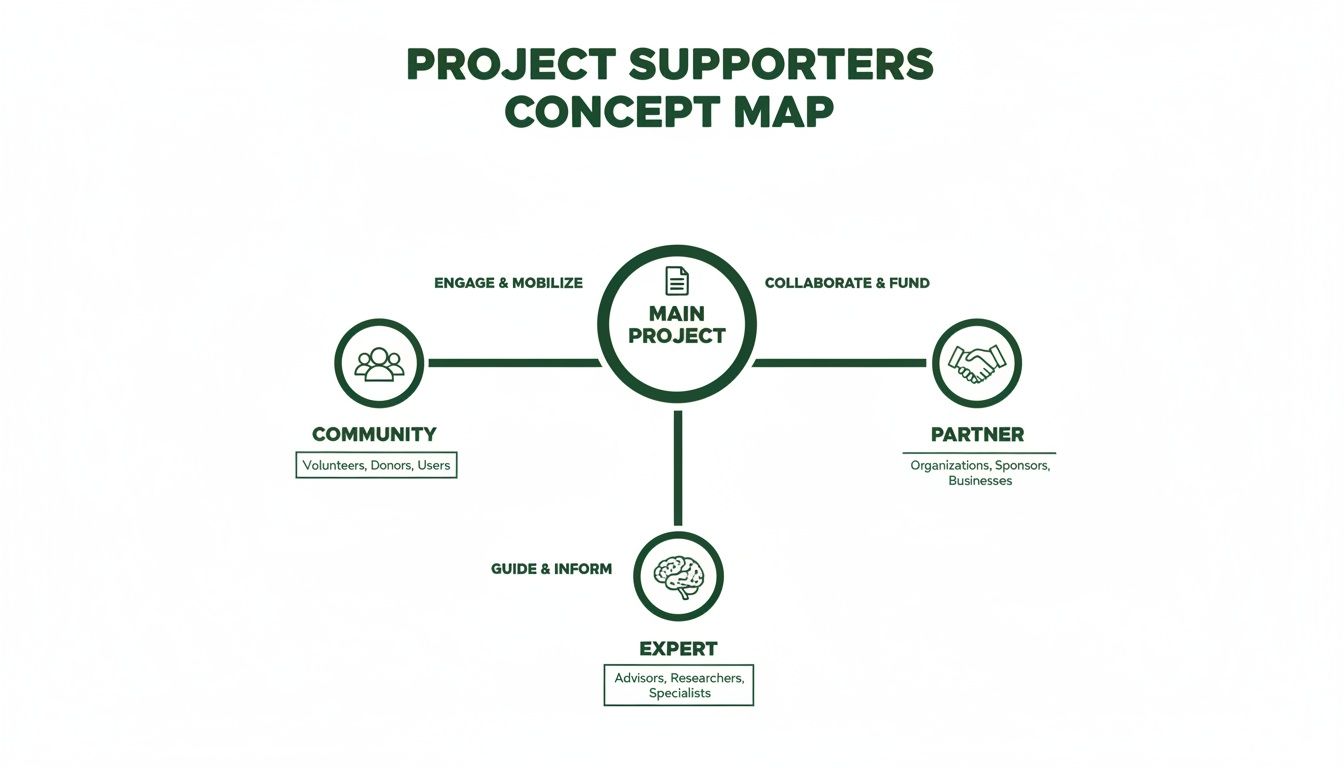
This kind of multi-faceted support shows a funder that your project isn't just a good idea—it's an integrated part of the community with a broad base of buy-in.
To help you guide your supporters, here’s a breakdown of what makes each component of the letter effective.
Key Components of an Effective Letter of Support
Using strong, specific language like in the examples above transforms a generic letter into a powerful piece of evidence for your proposal.
The Power of a Strong Closing and Signature
The end of the letter is your final chance to leave a lasting, positive impression. It should be clear, confident, and direct. A solid conclusion summarizes the supporter's belief in your project's potential and, just as importantly, provides their contact information for any follow-up questions.
This simple offer to be a resource signals a deep level of commitment and transparency—two things funders absolutely love to see. The letter should then end with a professional closing, the supporter's signature, and their full typed name, title, and organization.
These details really do matter, especially in the hyper-competitive world of federal grants. With NIH success rates hovering at just 19% in 2024, a stellar letter of support can be the critical differentiator. In fact, proposals with strong, collaborative letters often see 10-15% higher approval rates. Those that can cite quantifiable partnerships can even lift their success from a baseline of 10% to 25% for nonprofits.
A persuasive letter closes the loop. It starts by establishing authority, builds a case with specific evidence, and ends with a confident endorsement that invites further conversation. Each part builds on the last to create a seamless, convincing argument.
Mastering this kind of professional communication is a skill that pays dividends far beyond grant writing. For a deeper dive into the fundamentals, this guide on how to write a professional email is a great resource. While the format is different, the core principles of clarity, credibility, and persuasion are exactly the same.
These principles also apply when you're putting together the rest of your proposal package; for more on that, check out our guide on writing a compelling cover letter for a grant proposal.
Tailoring Each Letter to Funder Priorities
Sending out a generic, one-size-fits-all letter of support is one of the biggest missed opportunities in grant writing. Sure, it technically checks a box on the application, but it does absolutely nothing to build a compelling case for your project. A truly powerful letter speaks the funder’s language, turning a standard endorsement into a personalized message that hits on their specific mission and goals.
The first thing you need to do is put on your detective hat. Before you even think about drafting talking points for your supporters, you have to dissect the funder’s priorities. Go way beyond their mission statement—dig into their annual reports, recent press releases, and, most importantly, the list of projects they’ve recently funded. This is where you’ll find the real story of what they value, not just what their website says they value.
Decoding Funder DNA
Your mission here is to spot the key themes, phrases, and outcomes that pop up again and again in their materials. Are they constantly backing projects that focus on data-driven decision-making, grassroots community engagement, or long-term sustainability? Those are your keywords.
Once you’ve zeroed in on these core priorities, you can strategically guide your supporters. Your job is to connect the dots for them, showing how their unique perspective can validate the exact outcomes the funder is looking for.
Let's say you're applying for a federal grant focused on workforce development and collaboration. A letter from a corporate partner could be good, but a great one will highlight:
- Specific Hiring Outcomes: Mentioning that they hired five graduates from your program last year.
- Collaborative Success: Describing a joint training initiative you ran together that directly improved job readiness for participants.
- Economic Impact: Connecting your program directly to filling a critical local skills gap in their industry.
This targeted approach transforms a simple recommendation into a potent piece of evidence that directly addresses the funder’s objectives. It’s a proactive strategy to avoid one of the most common reasons grants get denied.
"A tailored letter of support acts as a mirror, reflecting the funder's own priorities back at them through the credible voice of a community partner. It’s the ultimate proof that your project is a perfect fit for their investment."
The statistics don't lie: poor alignment is a top cause of grant rejection. Tailoring your support letters is a direct countermeasure. I've seen new applications with five or more tailored letters achieve up to a 15% higher success rate than those with generic or no letters, especially when working with established partners. You can find more insights on grant success odds on GrantWatch.com.
From Generic Praise to Strategic Proof
Let’s walk through another real-world scenario. You're seeking funding from a local family foundation that’s passionate about environmental stewardship and youth education. A generic letter from the local school principal might say something like, "This is a wonderful program for our students." It’s nice, but it lacks any real punch.
Instead, you arm the principal with the funder’s focus and a few targeted bullet points. The letter that comes back now includes powerful, specific statements:
- "Our science curriculum lacks a hands-on sustainability component. This project fills that critical gap for over 200 students."
- "By transforming the unused courtyard into a native plant garden, the project directly aligns with the foundation’s commitment to urban green spaces."
- "I was particularly impressed with the plan to track water usage and biodiversity, providing the real-world data experience our students need."
This kind of detail shows the funder that your entire support network is aligned with their mission. It proves you have a deep understanding of what they want to achieve and that you have the right partners in place to make it happen. This alignment is also a cornerstone of a strong statement of need, which your letters should always reinforce. At the end of the day, knowing how to get customized, specific letters of support is what separates a forgettable application from a funded one.
Common Mistakes That Can Sink Your Proposal
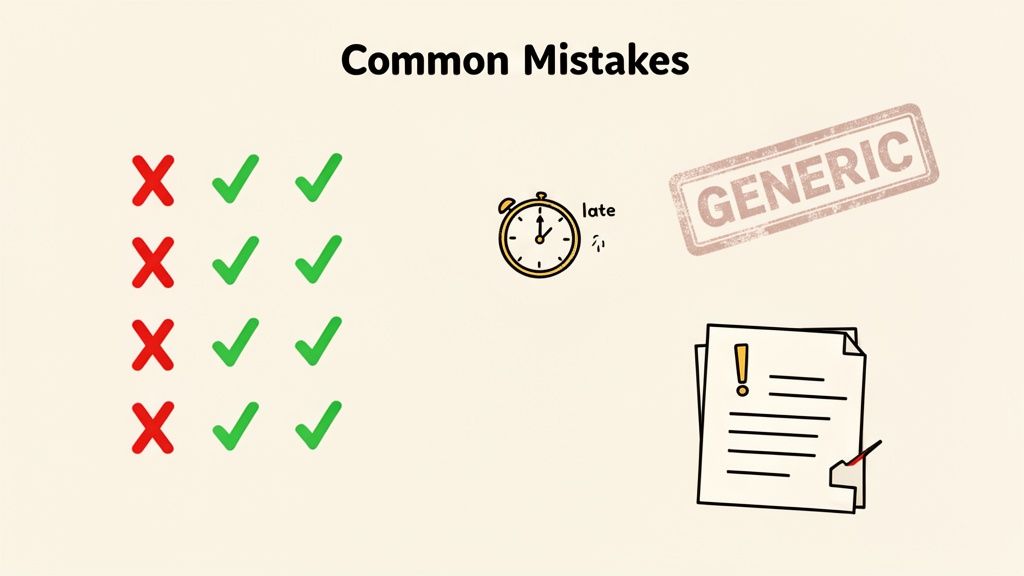
Even with the best intentions and rock-solid community relationships, simple process errors can completely undermine your letters of support. A great letter makes your proposal shine. A sloppy or rushed one, on the other hand, raises red flags for a grant reviewer and hints at disorganization.
Knowing what not to do is just as important as knowing the right steps to take. Let’s walk through the most common blunders I see and, more importantly, how to sidestep them so every letter you get actually strengthens your case for funding.
The Last-Minute Scramble
This is probably the most frequent and damaging mistake out there. Hitting up a key partner for a letter just a few days before the grant is due puts everyone in a terrible spot. It’s disrespectful to their time and screams that their support was an afterthought.
What do you get in return? A rushed, generic, and ultimately useless letter.
Busy professionals simply need time to craft a thoughtful endorsement. A last-minute ask forces them to rely on a quick template instead of providing the authentic, compelling testimony you really need.
My Advice: Always ask for letters of support at least three to four weeks before the deadline. If you’re approaching a high-level official like a mayor or a university president, give them six weeks. This buffer builds goodwill and gives your partners the space they need to deliver something powerful.
Providing Vague or No Direction
Never assume your supporters will instinctively know what to write. When you send a request without any context, project details, or talking points, you’re basically asking them to do your homework.
The result is almost always a letter full of empty praise like, "They do great work," which adds zero value. Your partners are experts in their own fields, not in the fine print of your project or the funder’s specific priorities.
You have to guide them. Put together a simple support package that includes:
- A one-page summary of your project and the grant you're targeting.
- A short list of 3-4 key bullet points you’d love for them to hit on.
- A well-written draft they can easily adapt and pop onto their letterhead.
This small bit of prep work ensures the final letter is rich with the data and strategic language that will actually catch a grant reviewer’s eye.
Using the Same Generic Template for Every Funder
Sending the same letter out for every grant application is a huge missed opportunity. A letter that wows a local community foundation won't do much for a federal agency that cares about economic impact data. Each funder has its own mission, and your support letters have to speak their language.
Generic letters show you haven't done your homework. A reviewer can spot a recycled, one-size-fits-all letter from a mile away, and it instantly makes your application look weak.
My Advice: For each grant, create a unique set of talking points for your supporters based on your research into that specific funder. Guide them to connect their endorsement directly to the funder’s stated goals, using keywords and themes you've pulled from the grant guidelines.
Ignoring the Funder’s Submission Rules
This is a technical mistake, but it can be an instant killer. Funders are often very specific about their requirements for letters of support.
They might dictate things like:
- A maximum number of letters they'll accept.
- Specific formatting rules (e.g., must be signed, on official letterhead).
- How the letters need to be submitted (e.g., uploaded as individual PDFs).
Ignoring these rules shows a lack of attention to detail—a major red flag. Sending ten letters when the limit was three won't impress anyone; it will just annoy the reviewer and could get your proposal tossed out for being non-compliant.
Always read the guidelines carefully and make a simple submission checklist. This final step ensures all your hard work doesn't go to waste over a preventable error.
Common Questions (and Expert Answers) About Letters of Support
Even with the best plan, you're bound to run into some tricky situations when gathering support letters. Let's tackle some of the most common questions that come up in the grant-seeking world. Think of this as a "what the experts do" guide to help you navigate the process like a seasoned pro.
Getting these details right can make a huge difference. Each answer here is designed to give you a clear, practical strategy you can put to work immediately.
How Much Lead Time Should I Give Someone for a Letter?
My rule of thumb is to give your supporters at least three to four weeks' notice. This is a sign of respect for their packed schedules, and it gives them the space to write something genuinely thoughtful. If you rush them, you’ll likely get a rushed, generic letter—and that won't help your proposal.
Keep in mind, for very high-profile people like a university president or a mayor, you'll want to double that. Plan on giving them six to eight weeks of lead time. Their offices often have layers of review and formal approval processes. You can speed things up and increase your chances of success by giving them a clear deadline, a draft or detailed talking points, and a one-page summary of your project right from the start.
Is It Okay for Me to Write a Draft for Them?
Yes, and honestly, you absolutely should. Most busy leaders and partners will be grateful for it. Providing a solid draft or even a detailed outline is a huge time-saver for them. More importantly, it ensures the letter contains the exact data, phrasing, and key arguments you need to align with your proposal.
When you send the draft, make it clear they have complete freedom to edit it, put it in their own words, and make it their own. This isn't about being deceptive; it's a collaborative way to get a strong, authentic letter that perfectly supports your project's goals.
This approach makes it incredibly easy for them to say "yes" and deliver a powerful letter that hits all the right notes for the funder.
How Many Letters of Support Do I Really Need?
This is a classic case of quality over quantity. The very first thing you should do is check the funder’s guidelines. Some will specify a maximum number, and ignoring that is an easy way to get your application tossed out for not following directions.
If the guidelines don't specify, aim for three to five powerful, distinct letters. The key is diversity. You want each letter to showcase a different angle of your project's strength. For instance, you could gather one from:
- A project partner, which demonstrates a solid collaborative foundation.
- A community leader, which validates the project's importance and need.
- A program beneficiary, whose personal story brings the human impact to life.
Resist the urge to flood the reviewer with a dozen letters that all say the same thing. That just creates noise. A few strategically chosen voices will always be more compelling.
It's also useful to know how these letters differ from other forms of documentation. For those wanting to dive deeper into supportive documents, there's a clear line between a persuasive letter and a formal legal statement; a good starting point is understanding affidavits of fact. While letters of support build a narrative of partnership, affidavits are sworn statements used in official proceedings, and knowing the difference is key.
At Fundsprout, we believe that a well-prepared proposal, complete with powerful support letters, is the key to securing the funding your mission deserves. Our AI-powered platform helps you manage every step of the grant lifecycle, from finding the perfect opportunity to crafting a winning application. Let us handle the complexities so you can focus on making an impact. Explore how Fundsprout can elevate your grant-seeking strategy today.
Try 14 days free
Get started with Fundsprout so you can focus on what really matters.