Write a Statement of Need That Wins Grants
Learn to write a compelling statement of need that secures funding. This guide covers data-driven storytelling and funder alignment with proven examples.

Abdifatah Ali
Co-Founder
Your statement of need is the heart of your grant proposal. It's where you make the case, not just for your organization, but for the community you serve. This is your chance to create a sense of urgency, showing funders why this problem needs to be solved and why it needs to be solved now. It's a blend of hard data and human stories.
Why the Statement of Need is Everything
Think of your grant proposal as a crucial conversation. The statement of need is your opening. It's the moment you grab the funder's attention, convince them a serious problem exists, and position your organization as the one that can tackle it.
This section truly sets the stage for your entire proposal, from the project plan to the budget. A weak or confusing needs statement is a dealbreaker—it can make a funder lose interest before they even get to the good stuff.

Here, you're building both a logical and an emotional foundation for your request. The goal is to shift the reviewer from simply being curious to being genuinely concerned and ready to act. That requires a careful balance of objective evidence and a narrative that puts a human face on the problem.
It's About Them, Not You: Community Need vs. Organizational Need
I've seen this mistake countless times: nonprofits confuse their own needs with the community's needs. Funders want to invest in solving community problems, not in fixing your organization’s internal challenges.
Pitching your need as "we need a new van" or "we need to hire more staff" is a surefire way to get your proposal tossed aside. You have to reframe the problem from the perspective of the people you serve. It's a subtle but critical shift.
- Weak (Organizational Need): "Our after-school program needs funding to expand our facility."
- Strong (Community Need): "Over 200 middle school students in our district are on a waiting list for safe, structured after-school programs, leaving them unsupervised during high-risk hours."
See the difference? The first statement is all about an operational gap. The second one focuses on the real community problem: at-risk kids without a safe place to go. Suddenly, the facility expansion becomes the solution, not the problem itself.
Expert Tip: Always frame your statement of need around the external problem your community faces. Your organization’s needs are only relevant as a means to solve that larger issue.
The Building Blocks of a Powerful Argument
A persuasive statement of need isn’t just a jumble of sad stories and big numbers. It’s a carefully constructed argument where every piece builds on the last to create a complete and convincing picture.
The table below breaks down the essential ingredients you'll need to weave together.
Core Components of a Persuasive Statement of Need
By weaving these elements together, you move beyond simply presenting facts. You tell the story of a community challenge that demands a response, proving you’ve done your homework and are ready to make a real difference.
Gathering Evidence to Build Your Case
A powerful statement of need doesn’t just describe a problem; it proves it with undeniable evidence. This is where you shift from making assumptions to speaking with authority. Your goal is to build such a solid case that the funder sees the problem just as clearly as you do, backed by both hard data and real human context.

This isn't about cherry-picking a few scary statistics. It’s about strategically layering different types of proof to paint a rich, multi-dimensional picture of why your work matters. Let's break down how to find both the quantitative (the numbers) and the qualitative (the stories) evidence you’ll need.
Finding Your Quantitative Proof
Quantitative data gives your argument scale and scope. It’s the objective, concrete evidence that grounds your statement in reality and shows funders you’ve done your homework. They absolutely expect to see it, as it adds a layer of credibility that anecdotes alone can't provide.
You can find potent data in several key places:
- Government Sources: This is your gold standard. Agencies like the U.S. Census Bureau, the Centers for Disease Control and Prevention (CDC), and the Bureau of Labor Statistics are treasure troves of reliable demographic, health, and economic data.
- Academic and Research Institutions: Universities and think tanks are constantly publishing studies on specific social issues. A quick search on Google Scholar can often uncover relevant research that offers deep insights and validated statistics.
- Reputable Nonprofits and Foundations: Large, national organizations in your field often publish their own research and annual reports. For example, if you're tackling food insecurity, referencing data from Feeding America is a great way to frame the national context before drilling down to your local need.
When you use this data, be specific. Instead of saying, "many children are hungry," you need to say something like, "According to the latest county health report, 23% of children in our service area live in food-insecure households." That precision makes the problem tangible and, importantly, measurable.
If you want to go deeper on this initial research phase, our guide on how to write a needs assessment offers a really structured approach.
Uncovering the Human Story with Qualitative Evidence
Numbers tell part of the story, but qualitative evidence gives it a soul. These are the personal experiences, direct quotes, and lived realities that illustrate the human impact of the problem. This is how you make an emotional connection with the person reading your proposal.
This evidence comes directly from your community, and it's what makes your statement of need uniquely yours.
Key Takeaway: While quantitative data answers "how many," qualitative data answers "what does this feel like?" You need both to build a complete and compelling case for support.
Collecting these stories requires getting out there and engaging. Here are a few effective ways to do it:
- Community Surveys: Ask your target population for direct feedback on their challenges and priorities.
- Focus Groups: Facilitate small group discussions to explore specific issues in more depth. This is where you get the rich, nuanced conversations.
- Stakeholder Interviews: Talk one-on-one with community leaders, clients, staff, and partner organizations to gather expert perspectives and personal anecdotes.
- Testimonials and Case Studies: Collect powerful quotes or write short, anonymized narratives about individuals affected by the problem.
Weaving Data and Stories Together
The real magic happens when you blend the numbers with the narratives. This combination creates an argument that is both logically sound and emotionally resonant. One without the other always feels incomplete.
Let’s say you’re writing a statement of need for a youth mental health program. You could structure your argument like this:
- Start with a big-picture statistic to establish the national or regional scope. For example, "The CDC reports a 40% increase in persistent feelings of sadness or hopelessness among adolescents in the past decade."
- Drill down to the local level with data for your community. "In our own school district, recent surveys show that 1 in 4 high school students now reports symptoms of anxiety."
- Humanize that number with a direct quote or a short, anonymized story. This is where you show the real-world consequence of that statistic.
This technique guides the reader from a broad, intellectual understanding of the issue to a personal, visceral connection with the need in your community. When you organize your evidence this way, you prove that the problem isn't just widespread and serious—it's happening right here, to real people who need help now. That’s the foundation of an unforgettable statement of need.
Connecting Global Issues to Local Realities
Funders want to back solutions to big, important problems. That's a given. But here’s the thing: they don’t write checks to solve abstract global crises. They fund tangible, on-the-ground work that makes a real difference in a specific community. Your job is to build a rock-solid bridge between the headline-grabbing global issue and the urgent, specific challenges your neighbors are facing right now.
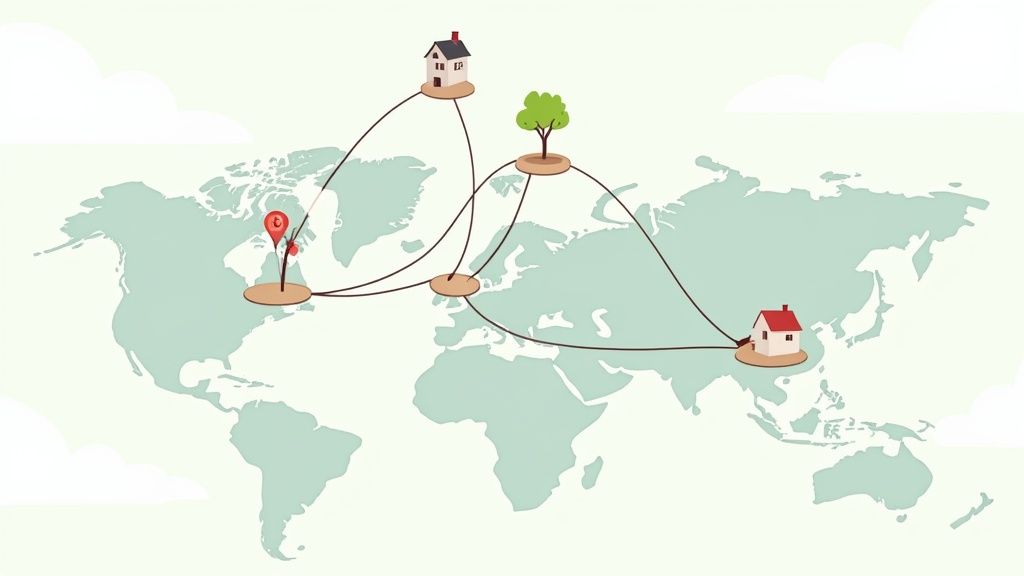
When you get this right, you create a powerful sense of scale and urgency. You show the funder that their local investment isn't just a drop in the bucket; it’s a critical piece of a much larger movement to solve a pressing societal problem. It elevates your work beyond your city limits and frames it as part of the solution.
Start Broad, Then Bring It Home
The most persuasive way I’ve seen this done is with a "funnel" approach. You start with a macro-level statistic or trend that everyone recognizes. This immediately grounds your argument in a context the funder already understands and cares about. Then, you methodically narrow the focus down, step-by-step, until you land squarely in your own backyard.
This method is so effective because it creates a logical, undeniable path from a big, scary problem to a manageable, local solution you're equipped to provide.
Let’s say you’re tackling food insecurity. You could start with the big picture. The Global Hunger Index 2025 paints a stark picture of global food security, showing hunger remains a severe challenge despite decades of international effort. In fact, progress toward the UN's goal of Zero Hunger has all but stopped. According to Concern USA, at this rate it could take over a century to achieve.
That global context sets a dramatic and urgent stage. Now, it's time to bring that drama home.
Localizing the Data
Once you’ve established the big picture, you have to show how that global or national trend is playing out locally. This is the crucial step where you connect the dots for the funder, making an abstract problem feel concrete and immediate.
Your goal is to find local data points that mirror the larger trend.
- National Statistic: You might start with, "Nationally, the youth unemployment rate for ages 16-24 hovers at a concerning 12%."
- Local Data: Then you bring it home: "Here in our city, that figure is far worse. Youth unemployment has soared to 19%, nearly double the rate of the surrounding counties."
This direct comparison is powerful. It shows the funder that not only is the problem real, but it's hitting your community disproportionately hard. It transforms a national talking point into a local crisis that demands an immediate response.
A Real-World Scenario: An organization I worked with provided digital literacy training for seniors. They started their statement of need by citing a national Pew Research study on the "digital divide" among older adults. They followed that up with their own community survey data, which showed 60% of local seniors felt they lacked the skills to access online health services. Suddenly, a national problem became a local, life-or-death issue.
The Power of Personal Stories
You've got the global context and the local data. Now, you need to give the problem a human face. A statistic like "19% youth unemployment" is impactful, but a story about a real young person’s struggle to find a job makes that number unforgettable.
This is where you weave in the qualitative evidence you've gathered. Share a brief, anonymized anecdote or a powerful quote from someone you serve. This emotional anchor is what a funder will remember long after they’ve finished reading. It shows them the real people behind the percentages.
This logical flow—from broad data to local data to human impact—is a core principle of good grant writing. It’s the same thinking that goes into building a solid logic model for program evaluation, as you’re clearly mapping out the problem and how your activities will lead to change.
By connecting the global to the local, you demonstrate a sophisticated understanding of the field while proving your deep connection to the community. It makes your statement of need more than just a request for money—it becomes a compelling invitation to solve a critical problem together.
Weaving a Story That Connects
You've done the heavy lifting—you have the data, you've connected the dots from big-picture trends to what's happening on your streets, and you’ve built a solid case. Now for the fun part. This is where you get to breathe life into the numbers and tell the story.
A truly powerful statement of need is more than a dry recitation of facts. It’s a narrative that grabs the reader by the heart and the head, making the issue impossible to ignore.
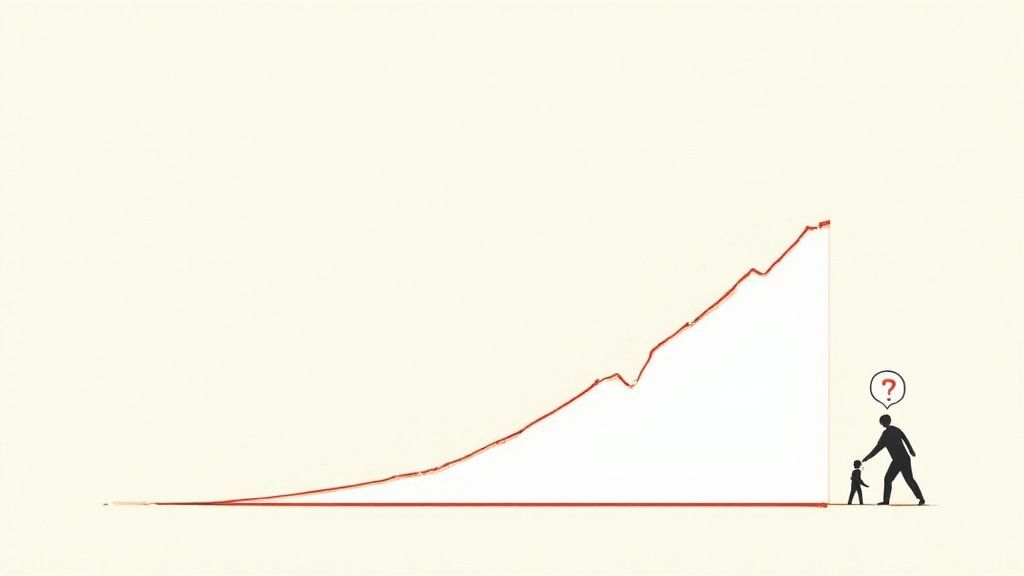
This is your chance to translate cold statistics into a warm, compelling story about the real people you serve. The goal is to make the problem feel urgent, tangible, and deeply personal to the person reading your proposal.
Start with a Powerful Hook
You've got about ten seconds to capture a funder's attention. Don't waste that precious window with a generic opening. Pull them right into the world of the problem you're trying to solve.
A killer hook can be a startling statistic, a short and poignant quote from someone in your community, or a brief, vivid story that puts a human face on the issue. You want the reader to pause and think, "Wow, this is a real problem."
- Statistic Hook: "Every night in our city, over 300 children go to sleep without a home to call their own—a number that has jumped by 15% in just two years."
- Anecdote Hook: "Maria, a single mother of two, told us last week, 'I have to choose between my daughter's asthma medication and putting food on the table.' It's a choice no parent should ever have to make."
Both hooks work because they immediately ground your proposal in a specific, urgent reality.
Give Your Data a Human Face
Numbers show the scale of the problem, but stories give it a soul. Remember, a person is reading your proposal, and people are hardwired to connect with stories. Weaving personal narratives throughout your statement of need is the single best way to build empathy and make your case memorable.
These stories don't have to be long-winded. A few well-chosen sentences can hit like a punch. The trick is to pick a story that perfectly illustrates the statistic you just presented.
For instance, after sharing that 40% of seniors in your county report feeling profoundly isolated, you can bring that number to life. Introduce someone like "Robert, an 82-year-old widower whose children live out of state," and briefly describe how that isolation impacts his physical and mental health. Suddenly, an abstract percentage becomes a relatable human being.
A Quick Note on Ethics: When you share someone's story, their dignity and privacy come first. Always get consent, and use anonymized details or create a composite character that represents the experiences of many.
Structure Your Narrative for Maximum Impact
Every good story has a beginning, a middle, and an end. Your statement of need should follow a similar arc, guiding the reader logically and emotionally from the problem to the implied solution.
Think of it as building a case, one piece at a time.
- Introduce the 'Protagonist': This is the community or the type of individual you serve. Paint a quick picture of who they are.
- Define the Conflict: This is the problem. Use your blend of data and stories to clearly show the challenges they're up against.
- Raise the Stakes: This is where you reveal the consequences of doing nothing. What happens if this problem isn't solved? This step is what creates that critical sense of urgency.
This simple structure turns a list of problems into a compelling call to action. It helps the funder see not just a need, but a story they can become a hero in.
Show, Don't Just Tell, the Consequences
One of the most persuasive tools in your writer's toolkit is illustrating the cost of inaction. Funders are driven by the desire to make an impact, and showing them the grim future that awaits if the problem goes unchecked is a powerful motivator.
Use specific, vivid language. Instead of a vague statement like "the situation will get worse," show them exactly how.
- "Without intervention, we project an additional 50 families in our community will face eviction by the end of the fiscal year."
- "If these teens don't get the academic support they need now, their graduation rates are on track to fall below 50%, drastically limiting their future."
This technique reframes the funder's investment. It's no longer just a "nice thing to do"—it's a critical intervention needed to prevent a worse outcome. You shift the conversation from opportunity to necessity, which is the heart of every great statement of need.
Connecting Your Cause to Funder Priorities
Submitting a generic, one-size-fits-all statement of need is the fastest way to land in the "no" pile. Think of grantmakers as mission-driven investors. They're looking for a direct, undeniable line connecting what they care about with what you do.
Tailoring your message isn’t about changing your mission. It's about strategically framing your work to show how you help them achieve their specific goals. This process starts long before you write a single word and requires a bit of detective work to really get inside a funder’s head.
Put on Your Funder Researcher Hat
Your first job is to immerse yourself in the funder's world. Treat it like investigative journalism—you’re looking for clues that reveal their unique DNA. Every foundation leaves a trail of breadcrumbs pointing to its priorities, passions, and even its preferred language.
Start by digging deep into their website. Don't just skim the homepage. Read their mission and vision statements, of course, but also find their annual reports, press releases, and any published strategic plans. These documents are absolute gold.
Pay close attention to the specific words and phrases they use over and over.
- Do they talk about “economic empowerment” or “workforce development”?
- Is their focus on “early childhood education” or “K-12 academic achievement”?
- Do they emphasize “community resilience” or “environmental justice”?
Jot down these keywords. When you mirror their language in your proposal, it creates an immediate, subconscious connection. It shows the reviewer you've done your homework and that you genuinely understand their world.
Analyze Past Grants for the Real Story
The best predictor of a funder's future interests is their past behavior. Get your hands on their list of previously funded projects and scrutinize it. This is where their priorities become undeniably clear.
Don't just look at who they funded—look for the patterns. What kinds of projects do they consistently back? What’s the typical grant size they award? Are there specific geographic areas they clearly favor? This analysis not only confirms that your project is a good fit but also helps you frame your request appropriately.
Expert Tip: Pay special attention to the descriptions of the projects they've funded. This shows you exactly how successful grantees framed their own needs to align with the foundation's goals. It’s like getting a peek at the answer key before the test.
Reframe Your Need for Different Audiences
Let's say your organization runs a fantastic youth arts program for at-risk teens. The core problem you're solving—teens lacking positive, constructive outlets—can be framed in several different ways to match different funder priorities.
This isn't about being dishonest. It's about shining a spotlight on the specific facet of your work that will resonate most deeply with each potential partner.
Here’s how you could tailor that single program:
See how that works? The core program doesn't change one bit, but the lens through which you present it does. Each version of your statement of need would lead with different data points and personal stories to make the most compelling case for that specific funder. This thoughtful alignment shows a funder that you see them as a strategic partner, not just a piggy bank.
Common Questions on Writing a Statement of Need
Even with the best outline, you're bound to hit a few snags when you're in the thick of writing. Crafting a truly powerful statement of need means navigating those tricky gray areas that most templates don't cover. This section is your quick reference for those common hurdles and "what if" moments.
Think of it as a way to stress-test your draft. Working through these questions now will help you sharpen your argument, get ahead of a funder’s potential doubts, and make sure your final draft is as strong as it can be.
How Long Should My Statement of Need Be?
This is probably the most common question I get, and the honest-to-goodness answer is: it depends entirely on the funder. There's no magic number. Some applications give you a strict character count, while others leave the door wide open.
When you aren't given a specific limit, think concise and potent. A good rule of thumb is to dedicate about 15-20% of your total proposal narrative to this section. If you're writing a standard 10-page proposal, that puts you in the ballpark of one and a half to two pages.
A few tips for keeping it tight:
- Be ruthless with your edits. Every single sentence must earn its place. If a statistic is interesting but doesn't directly prove your point, it has to go.
- Let formatting do the heavy lifting. Bullet points and simple tables can pack a ton of information into a small, readable space.
- Lead with the good stuff. Don't bury your most compelling data or your most moving story. Get straight to the point.
What if We Lack Hard Local Data?
This happens all the time, especially for nonprofits in rural areas or those working on newly emerging issues. While hyper-local, specific data is the gold standard, not having it doesn't have to be a deal-breaker. You just have to get a little more creative.
When local stats are thin on the ground, you can build a compelling case using proxy data. This just means finding data from a comparable community—one with similar demographics, economic realities, or social challenges—and using it to draw a logical conclusion about your own.
Here's what that looks like: Let's say your rural county has no specific data on teen mental health. You could start with state-level data for rural counties. Then, you bring it home by weaving in qualitative evidence you've gathered yourself, like powerful quotes from local school counselors or the results of a simple survey you ran with your own program participants.
This approach actually shows the funder you're resourceful and that you truly understand your community's context, even without a pile of official reports.
Can We Address More Than One Need?
It's so tempting to throw in every single problem your organization is working to solve. The risk? You dilute the power of your core argument. A truly effective statement of need is laser-focused on one primary, urgent problem. Tackling too much at once can make your proposal feel scattered and leave the funder wondering, "So, what's the real priority here?"
If your program naturally addresses several interconnected issues, frame them as the root causes or consequences of a single central problem. This creates a much cleaner, more logical story. For example, a workforce development program might also help with food insecurity and housing instability, but the core need you're hammering home is unemployment.
A focused approach helps the funder see a straight line from the problem to your solution. Technology can also be a huge help here. Using AI for grant writing can help you organize complex information and refine your story for maximum punch.
How Do We Balance Urgency with Hope?
This is a delicate dance. Your statement of need has to create a real sense of urgency without sounding completely bleak. Funders want to back solutions, not pour money into problems that seem impossible to fix.
The key is to paint a clear, stark picture of what will happen if nothing is done, but immediately follow it with the promise that a solution—your solution—is within reach.
Look at the global health sector, for example. The statement of need is incredibly urgent. The WHO projects a shortfall of 11.1 million health workers by 2030, a gap that could lead to 700,000 otherwise preventable maternal deaths. That data creates urgency, but it also perfectly frames the opportunity for targeted investments to make a life-saving impact. You can read more about the WHO's findings on global health gains.
Your goal is to leave the reader feeling genuinely concerned, but also inspired and ready to be part of the change you're creating.
Try 14 days free
Get started with Fundsprout so you can focus on what really matters.