What Is Competitive Intelligence? a Guide for Nonprofits
Learn what is competitive intelligence and why it's a game-changer for grantseeking. Our guide helps nonprofits use CI to win more funding.

Abdifatah Ali
Co-Founder
You submit the renewal. You know the funder. Your team has delivered the program. The outcomes are real. Then the notice arrives, and the grant goes elsewhere.
That moment rattles even experienced nonprofit leaders. It's not just the loss of revenue. It's the feeling that you missed a signal you should have seen earlier. A new funding priority. A shift in language. A different kind of partner suddenly winning attention.
That's where competitive intelligence becomes useful. Not as corporate jargon. Not as spying. As a practical way to read the funding environment before it turns against you.
The Grant You Thought Was a Sure Thing
A community-based nonprofit had received support from the same local foundation for years. The relationship was warm. The reports were on time. The program had strong stories and credible impact. Renewal felt likely.
Then the foundation funded another organization.
The rejection note was polite and thin on detail. “Strong application.” “Difficult decisions.” “Shifting priorities.” None of that helped the development director explain what transpired. Had the funder changed its strategy? Did another applicant present a stronger partnership model? Had the language around impact moved in a direction the team hadn't noticed?
This is common in grantseeking. A proposal can be solid and still miss the mark because the conditions changed first.
In the corporate world, teams use competitive intelligence to avoid getting blindsided. For nonprofits, the same idea applies, but the cast of characters changes. Your “competitors” are often peer organizations applying to the same funders. Your “market shifts” are changes in foundation interests, public funding priorities, policy language, and the kinds of outcomes funders now want to see.
The painful part of a lost grant isn't only the loss. It's realizing the clues were public, but nobody was collecting them in one place.
Think about donor prospecting. A good fundraiser doesn't wait for a donor to say no before researching giving history, board ties, interests, and timing. Grant intelligence works the same way. You don't just write the proposal in front of you. You study the environment around it.
When you do that consistently, you build an early warning system. You start noticing which peer organizations are expanding, which funders are naming new focus areas, and which partnerships keep appearing in recent awards. The surprise doesn't disappear entirely. But it happens less often, and your next move gets much sharper.
What Competitive Intelligence Really Means for Nonprofits
What is competitive intelligence? In plain language, it's the disciplined habit of gathering and interpreting outside information so your organization can make better strategic decisions.
The formal definition matters because it clears up a common fear. The Society of Competitive Intelligence Professionals defines it as the legal and ethical collection and analysis of information regarding the capabilities, vulnerabilities, and intentions of a business competitor. For nonprofits, that means public, appropriate research about peer organizations, funders, partners, and sector shifts. It does not mean deception.
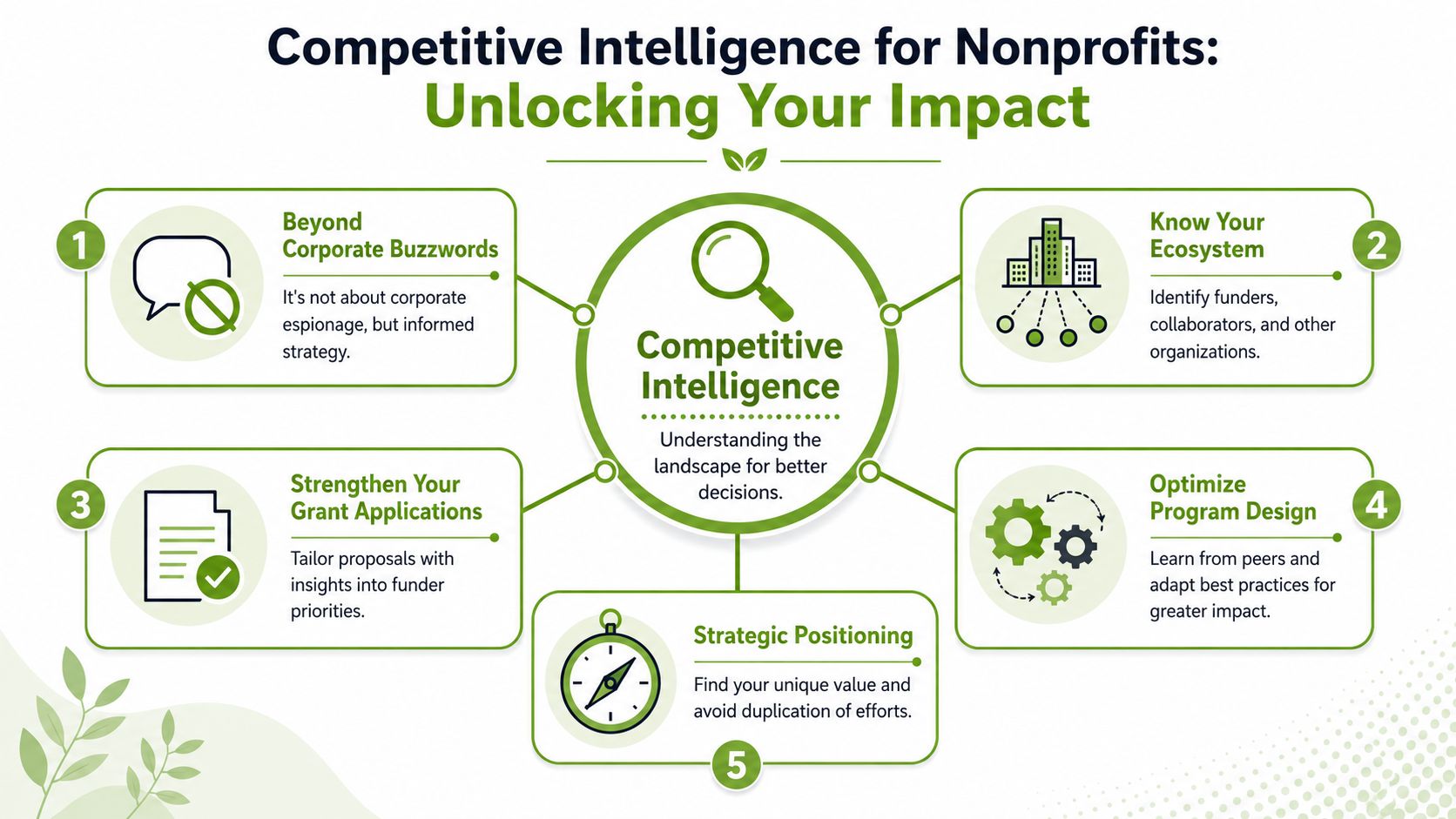
Translate the business language
In nonprofit work, the terms can sound more intimidating than the practice really is.
- Competitors are usually peer nonprofits pursuing the same grants, contracts, or donors.
- Market means the funding ecosystem around you. Foundations, government agencies, giving trends, policy shifts, and community needs.
- Signals are clues that tell you where the money and attention are moving. New award lists, revised eligibility rules, board appointments, partnership announcements, and changes in the language funders use.
If you've ever done donor prospect research, you already understand the logic. Competitive intelligence is like prospect research for the whole funding environment, not just one donor file.
How it differs from ordinary research
Many teams already gather information. They read guidelines. They scan websites. They review old grants. That's useful, but it isn't always competitive intelligence.
Basic research tells you what exists now. Competitive intelligence asks a harder question. What is likely to happen next, and how should we respond before the next deadline arrives?
For example, market research might tell you a foundation funds youth workforce development. Competitive intelligence goes further. It notices that the foundation's newest grants emphasize employer partnerships, rural access, and mental health supports. That changes how you frame your next proposal and whether you need a collaborator at the table.
A simple nonprofit example
Suppose your organization runs after-school programming. You notice three peers winning recent grants from the same regional funder. A closer look shows that each winner highlights family engagement, school district MOUs, and measurable attendance improvement.
That doesn't mean you copy them. It means you learn what the funder appears to reward, then decide how your organization can respond authentically and distinctively.
If you want a practical companion to this work, this guide on how to use competitor benchmarking is useful for turning scattered observations into structured comparison.
Practical rule: Competitive intelligence isn't about collecting more information. It's about collecting the information that changes a decision.
For nonprofits, those decisions are concrete. Which grants deserve pursuit. Which partnerships to build. Which program elements to emphasize. Which opportunities to walk away from because the fit isn't strong enough.
Why CI Is Your Grantseeking Superpower
The value of competitive intelligence shows up when time is tight and choices matter. A small development team can't chase every grant, rewrite every program, or monitor every funder. CI helps you focus effort where it has the best chance of paying off.
Experts describe CI as the early signal analysis process that makes an organization more competitive relative to its entire environment, including customers, distributors, technologies, and macro-economic data, not just its direct competitors. In nonprofit terms, that means you're watching more than peer organizations. You're watching the full system around funding decisions.
It strengthens proposal writing
A stronger proposal usually starts before the writing starts.
When you review who a funder has supported lately, how those organizations describe their impact, and what kinds of partnerships they highlight, your team stops guessing. You begin to shape the narrative around what the funder appears to care about now, not what it cared about three years ago.
A common example is language drift. A nonprofit may still be describing its work in terms of “service delivery” while newer winners frame similar work around community-based outcomes, cross-sector coordination, or preventative impact. The program may be solid. The framing may be stale.
It helps you anticipate priority shifts
Many grant teams work reactively. The RFP appears. Everyone scrambles. By then, some important decisions are already too late.
CI gives you a chance to move earlier. If a foundation begins spotlighting systems change, equity-centered design, or regional partnerships in its news releases and award announcements, that's not background noise. It may be telling you what future applications will need to reflect.
This matters beyond one proposal. It may shape staffing, evaluation plans, coalition work, or which pilot programs deserve investment.
If your organization only studies the grant guidelines, you're preparing for the exam after the teacher has already changed the syllabus.
It reveals gaps others overlook
One of the most useful CI habits is looking for what isn't being funded clearly enough yet.
Sometimes the crowded opportunity is obvious. Everyone sees it. Everyone applies. The better opening may sit one layer deeper. Which populations are mentioned in need statements but rarely centered in award lists? Which geographies are consistently referenced but thinly served? Which program models keep getting funded, and which important needs seem to lack a strong lead organization?
Nonprofit CI evolves beyond competition tracking. It becomes a way to spot underserved need.
You can apply the same thinking to peers' churn points. If another organization had a promising grant relationship that faded, what changed? If a funder keeps selecting coalitions over single applicants, what does that suggest? If recent winners all offer implementation capacity that others don't, is that a signal to refine your operating model?
CI doesn't make grantseeking easy. It makes it less blind.
Where to Find Actionable Grant Intelligence
Most nonprofit teams already have access to useful intelligence. The problem isn't scarcity. It's that the data sits in too many places and nobody has turned it into a repeatable habit.
The good news is that actionable grant intelligence usually comes from public, low-cost sources.
Start with the obvious public records
A funder's website often tells you more than the guidelines alone.
Look at past grantees, annual reports, press releases, leadership messages, and any pages describing strategy or learning priorities. Pay attention to patterns in wording. If the same phrases keep appearing across multiple announcements, they probably reflect what decision-makers are emphasizing internally.
Peer organizations also leave a paper trail. Their websites, annual reports, strategic plans, and program pages can reveal where they're expanding, how they position outcomes, and which funders appear central to their growth.
Use nonprofit-specific documents
IRS Form 990 filings are especially useful for understanding peer organizations.
You can often learn:
- Revenue mix by seeing whether an organization leans heavily on government funding, foundation grants, events, or major gifts
- Program spending through expense categories and reported activities
- Leadership and governance by reviewing board names and key staff
- Growth signals from shifts in revenue, staffing, or new program descriptions
This isn't gossip research. It's context. If a peer recently built capacity in evaluation, policy work, or regional expansion, that may explain why it's becoming more competitive for certain opportunities.
Watch people movement and public signals
Foundation staff changes can matter. So can new board members, cross-sector partnerships, and conference appearances.
A program officer changing foundations, a new executive director at a peer organization, or a university partnership announced in local media can all signal future movement. LinkedIn, newsletters, webinars, and press coverage help you track these shifts. If your team is also trying to improve how it finds opportunities in the first place, these grant discovery platforms can complement your manual monitoring.
Here's a simple way to organize sources.
Nonprofit CI data sources
| Data Source | Type | Key Insights |
|---|---|---|
| Funder website and annual report | Public external | Current priorities, language patterns, recent grantees, preferred program models |
| Grant award announcements | Public external | Who is winning, what gets emphasized, geography and population focus |
| Peer nonprofit Form 990 | Public external | Revenue mix, scale, staffing direction, program emphasis |
| Peer websites and strategic plans | Public external | Messaging, expansion plans, partnerships, service model |
| LinkedIn profiles and updates | Public external | Staff moves, hiring trends, institutional focus shifts |
| Local news and sector newsletters | Public external | Partnerships, public commitments, community need signals |
| Internal win-loss notes | Internal | Why you won, why you lost, what objections or themes keep repeating |
| Program staff and community feedback | Internal | Emerging needs, service gaps, field-level changes that funders may soon prioritize |
Field note: Your internal knowledge is part of CI too. Program managers, executive directors, and frontline staff often spot environmental changes before the grant team writes them down.
A weekly scan of a small set of these sources is usually more valuable than a giant spreadsheet nobody updates.
The Ethical Approach to Gathering Intelligence
For many nonprofit leaders, the word “intelligence” sounds out of character with mission-driven work. It can feel aggressive or manipulative. In practice, ethical CI is the opposite. It's structured curiosity with clear boundaries.
The core rule is simple. The practice relies on legal and ethically sourced data from publicly available sources or third-party research firms. If you wouldn't be comfortable explaining your method to your board, don't do it.
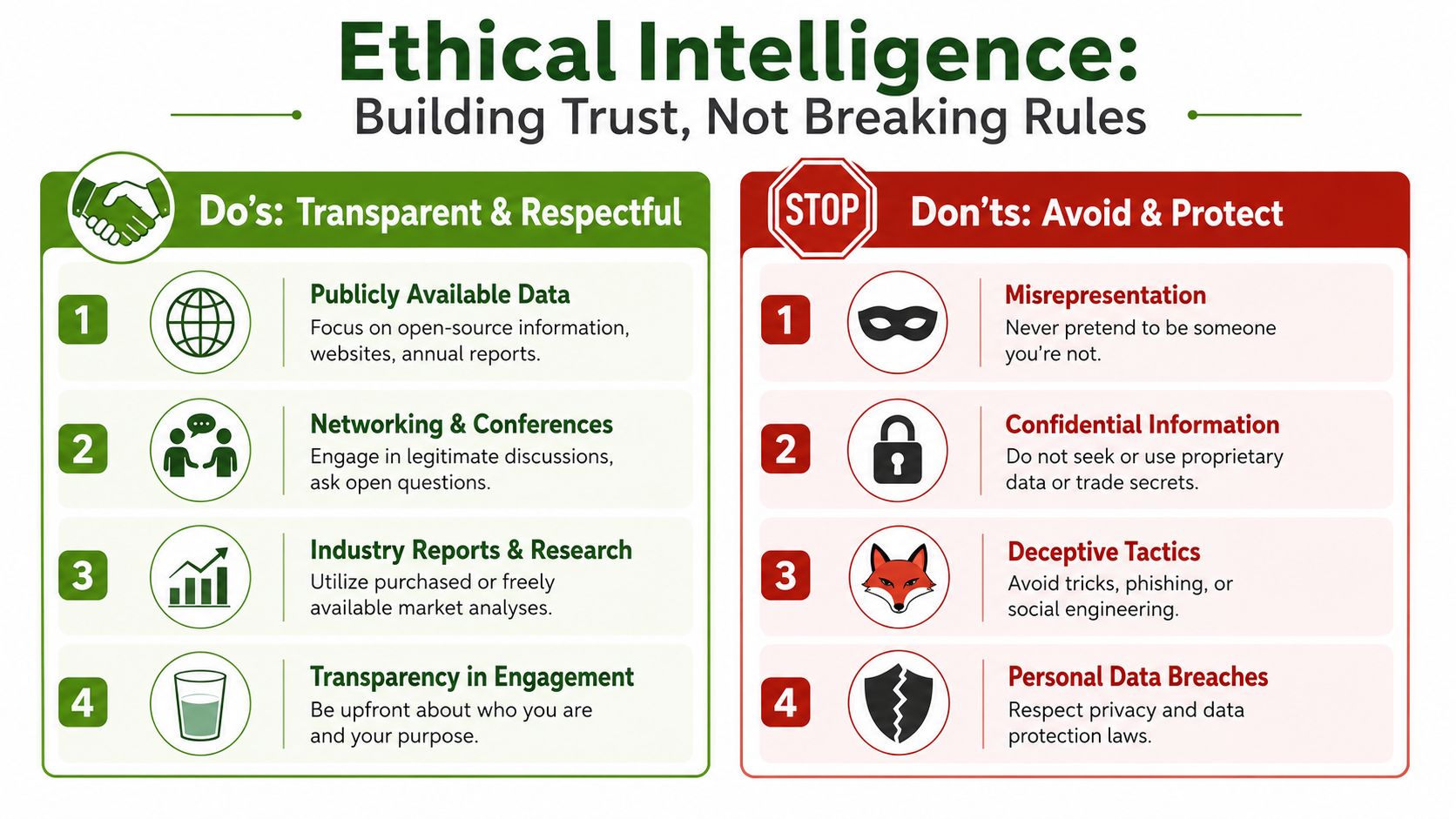
What ethical CI looks like
- Use public information such as annual reports, websites, recorded webinars, grant announcements, public filings, and conference sessions.
- Be transparent in conversations if you're networking at an event or asking a peer about their work.
- Focus on trends and positioning rather than trying to extract private or proprietary details.
- Keep records of sources so your team knows where a conclusion came from.
What crosses the line
- Misrepresenting who you are to get information
- Requesting confidential documents or encouraging someone to share them
- Using deceptive digital tactics to bypass protections on websites or systems
- Collecting personal data carelessly or ignoring privacy obligations
A useful way to think about this is donor research. Your team probably reviews public giving histories, board affiliations, and public bios. You don't impersonate someone to access private records. Grant intelligence follows the same ethical logic.
The technical side matters too. Some teams are tempted to automate website collection without understanding the boundary between permitted access and abusive behavior. If you want to understand the mechanics and risks around automated collection, this overview of web scraping anti-bot techniques helps explain why technical access isn't the same thing as ethical permission.
A quick visual reminder helps keep teams aligned.
Good intelligence protects your reputation while improving your judgment.
If you set a public-data rule, document your sources, and train staff not to blur ethical lines, CI becomes a clean, defensible part of strategy.
How to Start Your CI Practice in 30 Days
You don't need an analyst, a giant budget, or a new department to begin. A small pilot works better because it forces focus.
Treat the first month as a practical experiment tied to one funding goal.
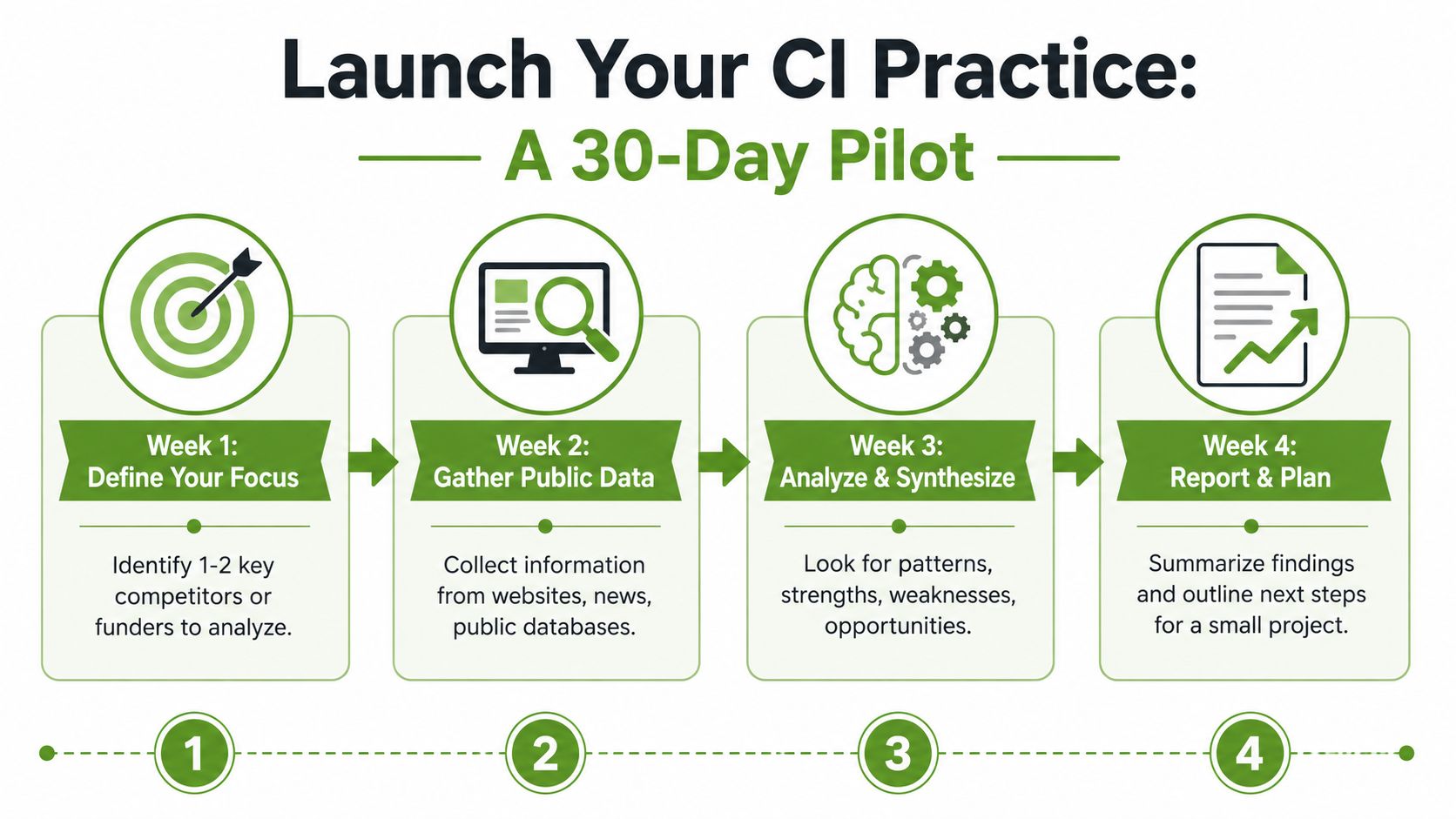
Week one, define the questions
Start with three to five Key Intelligence Questions. These are not broad research topics. They are decision questions.
Examples:
- Which outcomes does this funder seem to reward most often in recent awards?
- What kinds of partnerships appear in winning proposals?
- Which peer organizations keep receiving support from this funder?
- Has the language of eligibility or priority shifted over time?
- What capability do recent winners appear to have that we don't yet show clearly?
Good CI starts with questions sharp enough to guide action.
Week two, pick a small watchlist
Choose:
- One priority funder your team cares about now
- Two peer organizations that often compete in the same funding space
- One internal owner who can spend a small block of time each week gathering updates
Many teams go wrong by trying to monitor everything. Don't. Small scope makes the practice sustainable.
Create one shared document or spreadsheet. If your team needs a simple system for staying organized while proposals move, this grant tracking spreadsheet template is a useful companion.
Week three, log findings in plain English
Don't paste random links into a folder and call it intelligence. Each entry should answer three questions:
- What happened
- Why it might matter
- What we should do next
For example:
Peer organization announced a school district partnership. This may strengthen its position for youth funding that favors systems collaboration. We should assess whether our existing school relationships are visible enough in proposals.
That format turns raw observation into strategy.
Week four, review and decide
Hold a short meeting. Thirty minutes is enough if the notes are clear.
Discuss:
- What signals repeated
- What surprised the team
- Which assumptions changed
- What action belongs in the next proposal, partnership plan, or funder outreach
You're not trying to produce a perfect report. You're trying to improve the next decision.
Keep the pilot lightweight
A workable routine usually includes:
- A fixed cadence with one quick scan each week
- A named owner so the task doesn't disappear
- A narrow scope tied to current grants
- A feedback loop so findings affect live decisions
Most nonprofits don't need a formal CI program on day one. They need a habit. Once that habit exists, the quality of grant choices improves fast because the team starts seeing context, not just deadlines.
Using AI to Automate Your Grant Intelligence
Manual competitive intelligence works. It also eats time.
A development team can review funder pages, watch peer announcements, scan opportunity databases, compare award language, and log findings by hand. The problem isn't whether that process is valuable. It's whether busy staff can keep doing it consistently while also writing, reporting, and managing relationships.
That's where AI changes the workflow.
AI-powered competitive intelligence is described as a paradigm shift where machine learning, natural language processing, and predictive analytics fuse with traditional market intelligence to continuously scan, analyze, and interpret vast information streams, compressing the time between signal and insight. For nonprofits, that means less time hunting and sorting, and more time deciding.
What AI can take off your plate
AI is especially helpful with repetitive monitoring tasks such as:
- Scanning large volumes of grant opportunities and filtering for fit
- Flagging changes in funder language that suggest shifting priorities
- Tracking peer activity across news, websites, and public updates
- Summarizing long RFPs into usable requirements and task lists
- Surfacing patterns that a busy human reviewer might miss across many documents
For a small nonprofit, this matters because consistency is usually the hardest part of CI. The issue isn't knowing what to do. It's having the staff time to do it every week without dropping something else.
What humans should still own
AI can collect, sort, summarize, and highlight. Your team still has to judge.
Humans decide:
- whether an opportunity fits the mission
- which partnerships are worth pursuing
- how to accurately frame impact
- when a signal is meaningful versus distracting
- how to balance strategy with relationships and community trust
That division of labor is the key benefit. AI handles the mechanical work. People handle context and judgment.
If you want to see how AI fits specifically into funding research, this guide on using AI to find grants for business offers a helpful starting point, even if your work sits in the nonprofit sector rather than the business world.
Competitive intelligence doesn't replace good fundraising instincts. It sharpens them. And when AI supports the process, your team can spend less time chasing scattered information and more time building funder relationships, improving proposal quality, and making better calls earlier.
Fundsprout brings this kind of grant intelligence into one workflow. If your team wants help finding relevant funding, tracking shifts in funder priorities, organizing deadlines, and turning RFPs into structured proposal plans, explore Fundsprout. It's built for mission-driven teams that need better visibility without adding more manual research to an already full week.
Try 14 days free
Get started with Fundsprout so you can focus on what really matters.