How to Use AI to Find Grants for Business and Nonprofits
A practical guide on how to use AI to find grants for business and nonprofit success. Learn to discover opportunities and streamline your proposal workflow.


Abdifatah Ali
Co-Founder
Using AI to find grants for business isn't just a minor upgrade; it's a complete shift from a manual, often frustrating chore to a strategic, data-driven operation. Smart platforms now use intelligent algorithms to perfectly match your organization's mission with the best funding opportunities out there, saving time and seriously boosting your chances of success.
The New Era of Grant Seeking
Anyone who's been in the trenches of grant seeking knows the feeling. It can feel like you're searching for a needle in a haystack, especially for small businesses or nonprofits without a full-time grant writer. The hours you pour into sifting through massive databases can be crushing. This is exactly where AI changes the game.
It's time to move past the old-school keyword searches that dump thousands of irrelevant results on your plate. Modern AI-powered platforms, like Fundsprout, are turning grant seeking from a reactive burden into a proactive, intelligent strategy.
From Manual Labor to Strategic Matching
These tools dig so much deeper than a basic search engine ever could. They run on sophisticated algorithms that actually read and understand your organization's key documents—your mission statement, program descriptions, and even past proposals. By getting to the core of who you are and what you do, the AI builds a detailed, authentic profile of your organization.
This profile is what fuels the search. The system then scans countless federal, state, local, and foundation opportunities, but it’s not just looking for keywords. It's matching funders against your specific needs, geographic location, and program goals.
The outcome isn't just a bigger list of grants. It's a highly curated, prioritized pipeline of the right grants—the ones you have a real shot at winning. This level of precision can easily save you dozens of hours.
A Level Playing Field for All Organizations
This is about more than just efficiency; it’s about leveling the playing field. Smaller organizations can finally tap into the same kind of powerful prospecting that used to be reserved for huge institutions with massive budgets. The explosive growth in AI funding is a clear signal of the technology's potential. For mission-driven organizations, AI is no longer some far-off concept—it’s a practical tool for securing critical funding.
Think about the impact of AI in accounting, which is already taking over so many routine financial tasks. AI for grant seeking does the same for the discovery process, giving you a huge advantage. It's not about finding more grants; it's about finding the best-fit funders faster and with more confidence.
This is a stark contrast to the old way of doing things. Let's break down just how different the process looks.
Traditional vs AI-Powered Grant Seeking
The table below really highlights the efficiency gains. What used to take days or even weeks of manual work can now be accomplished in a fraction of the time, allowing your team to focus on what truly matters: crafting a compelling proposal.
Ultimately, AI empowers organizations of all sizes to compete effectively for the resources they need to not just survive, but to truly thrive.
Setting Up Your AI Grant-Seeking Engine
This is where the magic happens—moving from theory to practice. Getting your AI-powered system set up correctly from the jump is the difference between a glorified search engine and a true grant prospecting partner. The whole point is to build a rich, detailed profile of your organization so the AI can find those perfect-fit funding opportunities for you.
Think of it less as an upload task and more as a teaching moment. You're showing the AI the heart of your mission, the nitty-gritty of your programs, and the real-world impact you have. A well-trained AI will meticulously sift through thousands of grants, saving your team from the soul-crushing burnout of manual searches.
First Things First: Get Crystal Clear on Your Funding Needs
Before you even think about logging into a platform, you need to do some internal homework. Simply saying "we need more funding" is a recipe for disaster. The AI needs specifics to do its job well.
Sit down with your team and get granular. What, exactly, is this money for? Are you looking to:
- Launch a new pilot program? You'll need to define its scope, who it serves, and what the budget looks like.
- Scale up a successful initiative? Be ready to share current outcomes and spell out what you need for the expansion.
- Cover general operating costs? Pinpoint which expenses need support, like staff salaries, rent, or program supplies.
- Buy a crucial piece of equipment? Explain what the equipment does and how it helps you achieve your mission.
This clarity is everything. When you feed these precise needs into an AI platform, it can immediately filter out project-based grants if you're looking for operational support, or vice versa. That simple step alone cuts out a massive amount of noise.
This is how AI completely changes the grant-seeking game. You go from a wide, manual search to a precise, AI-driven match that brings the best opportunities right to you.
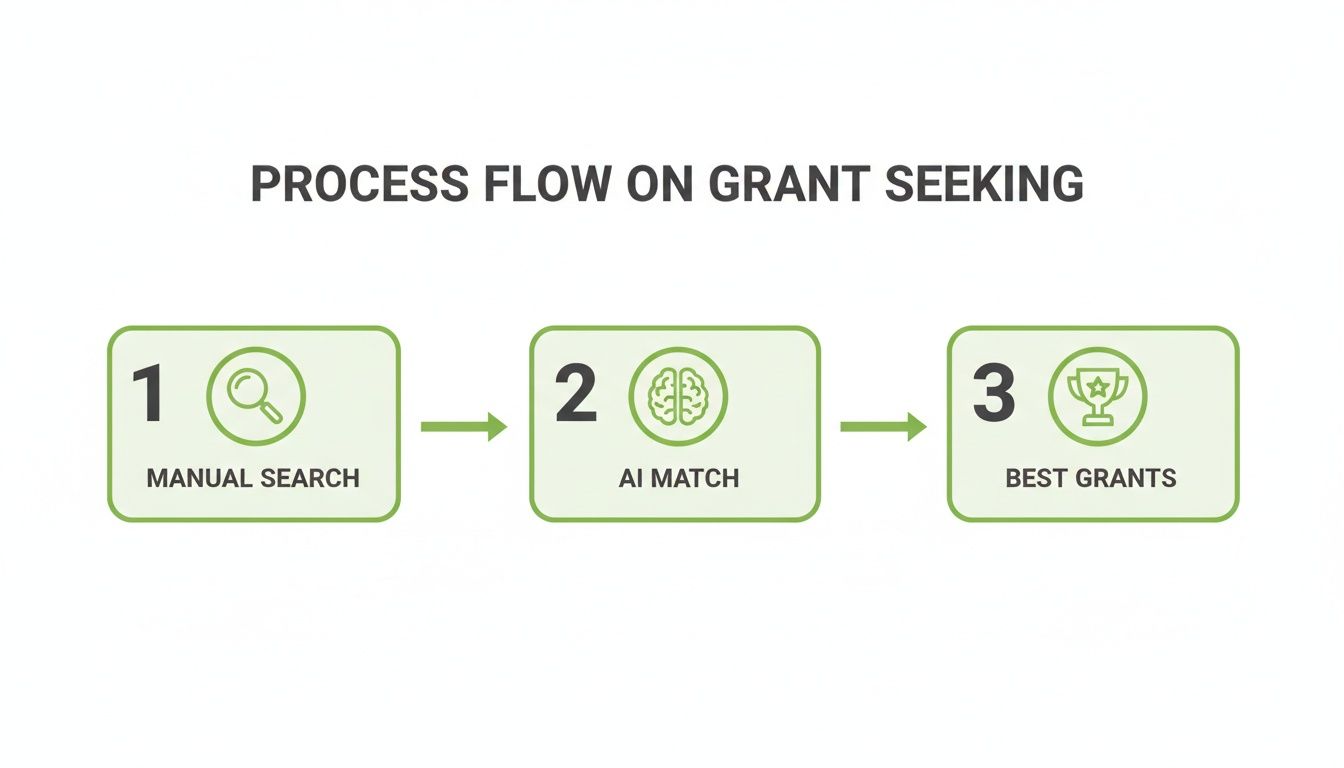
The real win here is the massive reduction in wasted effort and the huge jump in the quality of your leads. The AI does the heavy lifting, so you can focus on building relationships and writing.
Teaching the AI Your Organization's DNA
With your funding needs defined, it’s time to feed the system. You’re essentially creating a digital brain that knows your organization inside and out. The more comprehensive and high-quality information you give it, the smarter and more accurate its recommendations will be.
Don’t be shy here. The AI learns your unique voice, your priorities, and your impact from the content you provide. The must-have documents include:
- Mission and Vision Statements: These are the bedrock. They give the AI a foundational understanding of your purpose.
- Past Grant Proposals (both won and lost): Winning proposals show the AI what a successful application looks like for you. Lost ones are just as important—they contain valuable data the AI can learn from.
- Annual Reports and Impact Summaries: These are goldmines of data, stories, and keywords that prove your track record.
- Program Descriptions and Logic Models: This is where you get into the how. This content gives the AI a detailed look at your methods and activities.
- Strategic Plans: Your roadmap for the future helps the AI find funders who are excited about your long-term vision.
By poring over these materials, the AI develops an understanding that goes way beyond simple keywords. It starts to grasp your language, your key metrics, and the core themes of your work. For a deeper dive into this initial setup, our guide on how to find grants for nonprofits has some great additional tips.
Remember, the AI is a mirror reflecting the data you provide. High-quality, detailed inputs lead to a curated, actionable pipeline of funders. Low-effort inputs will only get you generic, unhelpful results.
Fine-Tuning Your Prospect Pipeline
The last piece of the puzzle is refining what the AI gives you. No tool is perfect right out of the gate. The platform will serve up a ranked list of opportunities, but it’s your feedback that makes the system smarter and more valuable over time.
As you go through the AI-generated list, you’re actively training the algorithm.
- Look at the Match Score: Platforms like Fundsprout often give you a match score. Dig into why a top-ranked grant is a great fit and what makes a lower-ranked one miss the mark.
- Give Direct Feedback: Use the built-in tools to mark grants as "not a good fit" or "highly relevant." This feedback loop is incredibly powerful. It’s like giving the AI a performance review.
- Tweak Your Profile: If you notice the AI is consistently off on a certain type of grant, go back to your profile and uploaded documents. You might need to add more specific language or another document that better explains that part of your work.
This back-and-forth process is what turns the AI from a static tool into a dynamic, learning partner. Before long, it will become incredibly good at surfacing the best-fit opportunities with almost no effort on your part, freeing you up to do what really matters: write compelling proposals that get funded.
From Opportunity Discovery to Proposal Outline
So, you've got a list of promising grants. That’s a huge win, but let's be honest, it’s just the starting line. The real challenge—the one that makes even seasoned pros groan—is cracking open that dense, jargon-filled Request for Proposal (RFP). This is where momentum grinds to a halt. Teams can easily burn dozens of hours just trying to figure out what the funder wants before a single word of the proposal gets written.
This is exactly where the next wave of AI support comes in, and it's a game-changer. Instead of just finding opportunities, the best platforms now act as a strategic partner. They deconstruct those complex funder documents and turn them into a clear, actionable roadmap for your team. This doesn't just save an incredible amount of time; it dramatically cuts the risk of missing a tiny requirement that gets your application tossed out before it's even read.

Instantly Analyze Complex RFPs
Picture this: you're a program manager at a community health nonprofit. You’ve just found what looks like a perfect federal grant, but the NOFO (Notice of Funding Opportunity) is a beast—a staggering 75 pages long. In the past, your team would have to clear their calendars for the better part of a week just to read, highlight, and build a compliance checklist.
With a modern AI tool, you can shrink that entire process down to a few minutes. You upload the RFP, and the AI gets to work. It’s not just scanning for keywords; it uses Natural Language Processing (NLP) to actually understand the context, identify the critical sections, and pull out the information that matters most.
The AI essentially reads the document for you, extracting the guts of the application:
- Eligibility Criteria: It flags every single mandatory requirement your organization must meet.
- Evaluation Rubric: It finds the scoring matrix, showing you exactly how your proposal will be judged and where to focus your energy.
- Key Deadlines: All submission dates are automatically pulled out and organized.
- Required Attachments: You get a clean, definitive list of every single supporting document you need.
This instant analysis is a massive advantage. It frees your team from the administrative quicksand and lets them jump straight into strategy and writing.
Instead of asking, "What does this RFP want?" your team can start with, "How can we best demonstrate our impact based on these clear requirements?" This subtle shift in focus makes a world of difference in the quality of your final proposal.
We're seeing this trend across the board. The growth of specialized AI tools in fields like healthcare ($12.1 billion in funding, a 41% jump) and fintech ($8.9 billion, up 34%) shows how tailored solutions are taking off. Nonprofits working in community health or social services can see similar benefits from AI-driven matching and proposal generation. For program managers who aren't grant writing experts, this means AI can analyze the RFP, create a solid outline, and even draft initial sections using your impact data—all with built-in version control. You can dig deeper into these AI startup investment trends on SecondTalent.com.
Generate a Structured Proposal Outline
Once the AI has dissected the RFP, its next trick is to build your game plan. It automatically generates a structured proposal outline that perfectly mirrors the funder's exact requirements and formatting. This isn't some generic template; it’s a custom-built skeleton for this specific application.
A typical AI-generated outline might break down like this:
- 1.1 Statement of Need: (Based on RFP Section 4.2a)
- 1.2 Program Goals and Objectives: (Based on RFP Section 4.2b, tied to scoring criteria)
- 1.3 Activities and Timeline: (Corresponds to RFP requirements for a Gantt chart)
- 1.4 Evaluation Plan: (Mirrors the metrics requested in RFP Section 5.1)
- 2.1 History and Mission: (Requirement from RFP Attachment B)
- 2.2 Key Personnel Resumes: (Lists specific roles mentioned in the RFP)
- 3.1 Detailed Budget Table: (Uses the funder’s required template)
- 3.2 Justification of Costs: (Provides prompts for each line item as per RFP guidance)
- IRS Determination Letter
- Audited Financials
- Letters of Support (minimum of 3 required)
This outline becomes your team's single source of truth. It gets everyone on the same page and ensures no piece of the puzzle gets overlooked. Using AI to find grants for business and then to structure the application removes the guesswork and aligns your entire effort with what the funder wants to see, right from the start.
Real-World Scenario: A Community Health Grant
Let’s go back to our community health nonprofit. By feeding that 75-page federal NOFO into an AI analyzer, the program manager gets a detailed, section-by-section outline in less than five minutes. The AI immediately flags a subtle but critical requirement buried on page 47: all partner organizations must submit a signed Memorandum of Understanding (MOU), not just a standard letter of support.
Without the AI, that detail could have been easily missed, leading to an automatic rejection. Instead, the team knows from day one they need to get the MOU process started with their partners. The AI-generated outline saves them at least 20-30 hours of tedious manual work and, more importantly, prevents a fatal error. This is the practical power of AI in action—turning a daunting document into a manageable, winnable project.
Crafting Compelling Narratives with an AI Assistant
The moment you bring up AI in a grant writing context, you can almost feel the skepticism in the room. There’s a real fear that pops up: "Will my grant proposal sound like a robot wrote it?"
It’s a fair question. Funders are looking for passion and a genuine human connection to your mission. They don't want to read sterile, algorithm-generated text.
But this fear usually comes from a misunderstanding of how to use these tools effectively. An AI writing assistant isn't here to replace your team's insight or expertise. Think of it more like a brilliant research partner that handles the tedious parts of drafting. This frees you up to focus on the high-level strategy—the storytelling and persuasion that actually win grants.
The goal is never to just hit "generate" and copy-paste the output. The real magic happens when you use AI to build a strong, well-structured first draft that's already infused with your organization’s voice and most critical data. It’s about turning that intimidating blank page into a solid foundation, ready for your team’s final, human touch.
Teaching Your AI to Write in Your Voice
So, how do you avoid that generic, robotic tone? You have to give the AI the right raw materials to work with.
Just like you fed the AI information to help it find the right grants, you now have to teach it how to sound like your organization. This is where you move beyond simple prompts and start feeding it specific, high-quality inputs. An AI assistant, like the one built into Fundsprout, learns directly from the documents you provide. The trick is to be strategic about what you give it.
Here’s what I mean:
- Impact Data and Hard Numbers: Don't just tell the AI your program is effective. Give it the proof. For example: "Our literacy program improved reading scores for 87% of participants, and on average, they jumped 1.5 grade levels."
- Real Quotes from Beneficiaries: These are the heart and soul of a great story. Upload powerful, firsthand accounts like, "Before this program, I couldn't help my daughter with her homework. Now, we read together every night."
- Core Phrases from Your Mission: Pull key sentences from your strategic plan that define who you are. The AI will learn to weave these core messages seamlessly into the proposal.
When you provide these specific ingredients, the AI doesn't have to guess what's important. It can draft entire sections that are already packed with the evidence and emotion that connect with funders, all while sticking to the required proposal outline.
A Quick Before-and-After
Let’s see what this looks like in practice. Imagine a nonprofit running a community garden needs to write its "Statement of Need."
Generic AI Draft (without any good inputs):
"Food insecurity is a significant problem in urban areas. Our community garden program aims to address this issue by providing residents with access to fresh produce. This program will improve health outcomes and foster community engagement."
It’s not wrong, but it’s completely forgettable. It has no punch and won't stand out in a pile of applications.
Now, let’s see what happens when the team first gives the AI some specific data points and a real quote.
AI-Assisted Draft (with rich inputs):
"In the Elmwood district, over 40% of families live in a designated food desert, more than a mile from the nearest grocery store. As Maria, a local mother, told us, 'Trying to find fresh vegetables is a daily struggle.' Our community garden directly addresses this gap, providing 300+ residents with access to organic produce. Last year alone, we grew over 2,500 pounds of vegetables, improving nutritional access and fostering vital neighborhood connections."
The difference is night and day. The second version is concrete, data-driven, and human. The AI did the heavy lifting of structuring the paragraph, but the powerful content—the stats and the human voice—came directly from the organization. From here, your team can easily refine this draft, adding even more nuance and storytelling.
We cover a lot more of these strategies in our comprehensive guide on using AI for grant writing.
The Human Touch Is Still Essential
At the end of the day, using AI to draft narratives is about working smarter, not handing over control. It’s an incredible tool for breaking through writer's block and making sure you’ve covered every single point in a complicated RFP. If you're curious about how this plays out in the broader business world, it’s worth looking into how teams are leveraging AI assistants like Microsoft Copilot to build new collaborative workflows.
The final proposal must always pass through human hands. This is where your team checks the tone, strengthens the emotional hooks, and ensures the entire narrative aligns with your funder relationship strategy.
Key Takeaway: Let the AI handle the first 80% of the grunt work. That frees up your team's limited time and energy to focus on the final 20%—the part that truly makes a proposal shine.
This is exactly how you can use AI to find grants for business and then follow through with applications that are both perfectly compliant and incredibly compelling.
Managing Your Grant Lifecycle with AI
Winning the grant is a huge victory, but it’s really just the beginning of the journey. The hard work of managing compliance, tracking outcomes, and reporting back to the funder starts now.
This post-award phase is where many organizations, especially small businesses and nonprofits, get bogged down in administrative tasks, spreadsheets, and calendar reminders. It’s also where an AI tool to find grants can transform into an AI tool to manage them, helping you turn one-time wins into lasting funding relationships.
Successfully managing the entire grant lifecycle is about more than just checking boxes. It’s about proving you’re a reliable steward of the funder's investment, which builds the trust needed for future support. AI-powered tools extend their value far beyond the initial application, creating a sustainable ecosystem for long-term success.

Visualizing Your Compliance Roadmap
Once a grant is awarded, a cascade of deadlines and deliverables begins. Forgetting a single quarterly report or missing a key milestone can jeopardize your funding and damage your reputation. This is where AI-powered dashboards become your command center.
Instead of a chaotic collection of spreadsheets and calendar invites, these tools create a clear, visual timeline for each grant. They can automatically extract key dates and reporting requirements from the grant agreement, plotting everything onto an interactive calendar.
- Automated Deadline Tracking: The AI identifies all reporting deadlines—quarterly, semi-annual, and final—and sets up automated reminders for your team.
- Milestone Visualization: It breaks down the entire grant period into manageable project milestones, assigning tasks and owners directly within the platform.
- Centralized Document Hub: All relevant documents, from the original proposal to the signed grant agreement, are stored in one place, accessible to the entire team.
This moves your team from a reactive, often frantic state to a proactive, organized one. Everyone knows what’s due, when it’s due, and who is responsible.
Streamlining Funder Reporting
Funder reporting can be one of the most time-consuming parts of grant management. Each funder often has its own unique template and specific data requirements. Compiling this information manually can take countless hours, pulling your team away from mission-critical work.
AI reporting features can automate much of this process.
By connecting to your program data, the AI can help auto-populate these funder templates. For instance, if a report requires you to detail the number of beneficiaries served and key demographic data, the AI can pull this information directly from your records and insert it into the correct fields.
This not only saves an immense amount of time but also significantly reduces the risk of human error in data entry. This structured approach is central to following grant management best practices and maintaining funder confidence.
Pro Tip: Set up your AI to track both quantitative data (like the number of people served) and qualitative data (like beneficiary testimonials). When it's time to report, the AI can help you draft compelling narratives that combine hard numbers with powerful stories, making your reports far more impactful.
Building a Digital Audit Trail for Renewals
Perhaps the most powerful long-term benefit of using AI is the creation of a seamless digital audit trail. Every action, every report submitted, and every milestone achieved is logged within the system. This creates an unimpeachable record of your performance and compliance.
This audit trail is invaluable for two key reasons:
- Compliance and Accountability: Should a funder ever have questions or conduct an audit, you can instantly provide a comprehensive record of your activities, demonstrating transparency and meticulous management.
- Data-Driven Renewal Applications: When it's time to apply for a renewal, you have a goldmine of data at your fingertips. The AI can analyze your performance on the previous grant and help you build a renewal proposal that is grounded in proven success.
Instead of starting from scratch, you can ask the AI to generate a report summarizing your key achievements, challenges, and outcomes from the previous funding cycle. This data-backed narrative makes your renewal application exponentially stronger, showing the funder exactly what their investment accomplished and why they should continue to support your work. By managing the full lifecycle, AI ensures your grant-seeking efforts build upon each other, creating a sustainable funding engine for your organization.
Got Questions About Using AI for Grants? You're Not Alone.
Whenever a new technology shows up, especially one that touches something as vital as your organization's funding, it’s natural to have questions. I hear the same handful of concerns from nearly every nonprofit and small business leader I talk to about using AI to find grants for business or mission-driven work.
Let's cut through the noise and tackle these common worries head-on. The biggest hesitation usually boils down to one thing: authenticity. Will an AI-assisted proposal lose its human touch? It’s a great question, but it’s often based on a small misconception of what these tools are built to do.
Will AI Make Our Proposals Sound Generic?
This is, without a doubt, the number one fear I hear. And my answer is always a confident no—as long as you treat the AI as a smart assistant, not a ghostwriter. The best tools out there are designed to be your partner, learning your organization's specific voice and style.
Think of it as training a new team member. You teach the AI what makes your work unique by feeding it your best materials:
- Past winning proposals: This shows the AI what a successful narrative looks like for your organization.
- Annual reports and impact summaries: This provides the concrete data, key terminology, and proof points that define your success.
- Beneficiary testimonials: This infuses the AI with the powerful, human-centered language that truly connects with funders.
The AI doesn't just invent content out of thin air. It uses your documents to produce a solid first draft that’s already grounded in your tone and data. This is a game-changer. It frees your team from staring at a blank page, letting them jump straight to the high-value work of refining the story, adding personal touches, and making the proposal truly shine.
Is AI Grant Software Affordable for a Small Nonprofit?
It’s easy to assume that powerful technology comes with a hefty price tag, putting it out of reach for organizations on a shoestring budget. But the reality is that most modern AI platforms are built as subscription services, specifically designed to be accessible for small to mid-sized nonprofits.
When you look at the cost, you have to consider the return. A good AI tool can slash the time your team spends researching and writing grants by over 75%. That's not just a small efficiency boost; it's a massive shift in capacity. It means you can pursue more high-quality, best-fit grants, which directly increases your odds of winning new funding.
The monthly or annual fee for an AI platform is often a fraction of the cost of hiring a dedicated grant writer or even a short-term consultant. It's a strategic investment in your organization's financial health.
For many, it's simply a smarter financial move that builds long-term fundraising muscle.
How Secure Is Our Data on an AI Platform?
This is another big one. You're thinking about uploading sensitive information—strategic plans, budgets, program details. It’s absolutely right to ask about security. Any AI provider worth their salt has made data privacy and security their top priority.
As you evaluate different tools, look for a commitment to enterprise-grade security. This isn't just marketing fluff; it means specific, verifiable features are in place:
- End-to-end data encryption to protect your information as it moves and while it's stored.
- Secure cloud infrastructure built on trusted platforms like AWS or Google Cloud.
- Strict access controls ensuring only authorized people on your team can see your data.
Reputable companies build their entire business model on trust. They know their success depends on keeping your strategic information confidential and using it only for the purpose you signed up for. Always take a few minutes to read through a provider’s security and privacy policies before you upload a single document.
Ready to transform your grant-seeking process from a manual chore into a strategic advantage? Fundsprout uses AI to match your mission with the perfect funders, streamline your proposal writing, and manage your entire grant lifecycle. Discover your next funding opportunity today.
Try 14 days free
Get started with Fundsprout so you can focus on what really matters.