What Is Audit Trail: Guide for Nonprofit Compliance
Understand what is audit trail and why it's critical for nonprofit compliance in 2026. Learn to create reliable records for reporting, renewals, & transparency.

Abdifatah Ali
Co-Founder
A funder's follow-up question rarely arrives at a convenient time. It lands when your program team is busy, your finance manager is closing the month, and your development staff is already chasing the next deadline.
The question sounds simple. Who approved the budget revision? When was the reporting milestone marked complete? Which version of the narrative was submitted? If your team has to dig through email threads, shared drives, and several spreadsheet versions to answer it, you don't have a documentation problem alone. You have an audit trail problem.
For nonprofits, that matters far beyond internal neatness. It affects grant compliance, report accuracy, renewal conversations, and the confidence a funder has in your stewardship. If you've ever asked, what is an audit trail, the practical answer is this: it's the record that lets your organization prove what happened, instead of trying to remember it later.
Your Grant Funder Is Asking Questions You Can't Answer
A nonprofit receives a grant for a youth program. Six months later, the funder asks for support behind a budget adjustment and wants to know who approved the change before funds were reallocated. The Executive Director remembers discussing it in a meeting. The program manager thinks the approval happened by email. Finance has a revised spreadsheet, but no one is fully sure which version became official.
That scramble is familiar in nonprofit life. The work gets done, but the record of how decisions were made is scattered across inboxes, folders, and verbal conversations. When that happens, your team spends hours rebuilding history instead of serving the funder with a clear answer.
An audit trail solves that problem by acting as the organization's black box. It creates a time-stamped, chronological record of activity so you can see who changed something, what changed, and when it happened. According to Onspring's explanation of audit trails, this kind of record is tamper-evident and captures the “who, what, when, where, and why” of transactions or data modifications. The same source notes that the Sarbanes-Oxley Act of 2002 made audit trails a foundational part of corporate governance for public companies, which shows how central they are to accountability and fraud prevention.
Nonprofits may not think of themselves in the same category as public companies, but the stewardship issue is similar. Your board, your funders, and your auditors all want the same thing. They want to know your organization can show how money was managed and how decisions were made.
What the panic is really telling you
When a team can't answer a funder quickly, the underlying issue usually falls into one of these buckets:
- Approvals live in too many places and no one system shows the final decision.
- Version history is unclear so staff can't tell draft from approved record.
- User accountability is weak because edits aren't tied to a specific person.
- Timing is fuzzy because there's no reliable timestamp attached to key actions.
Your credibility rises when your answers come from records, not memory.
That's why audit trails matter in grant management. They don't just help during a formal audit. They help every time someone asks for proof.
The Anatomy of an Audit Trail
A good way to think about an audit trail is a library checkout history for one book. You can see who borrowed it, when they took it, when they returned it, and whether anything about its status changed along the way. For grants, the “book” might be a budget file, a progress report, or a submitted proposal.
The difference is that a modern audit trail is more detailed. It doesn't just show movement. It records the sequence of actions inside a system.
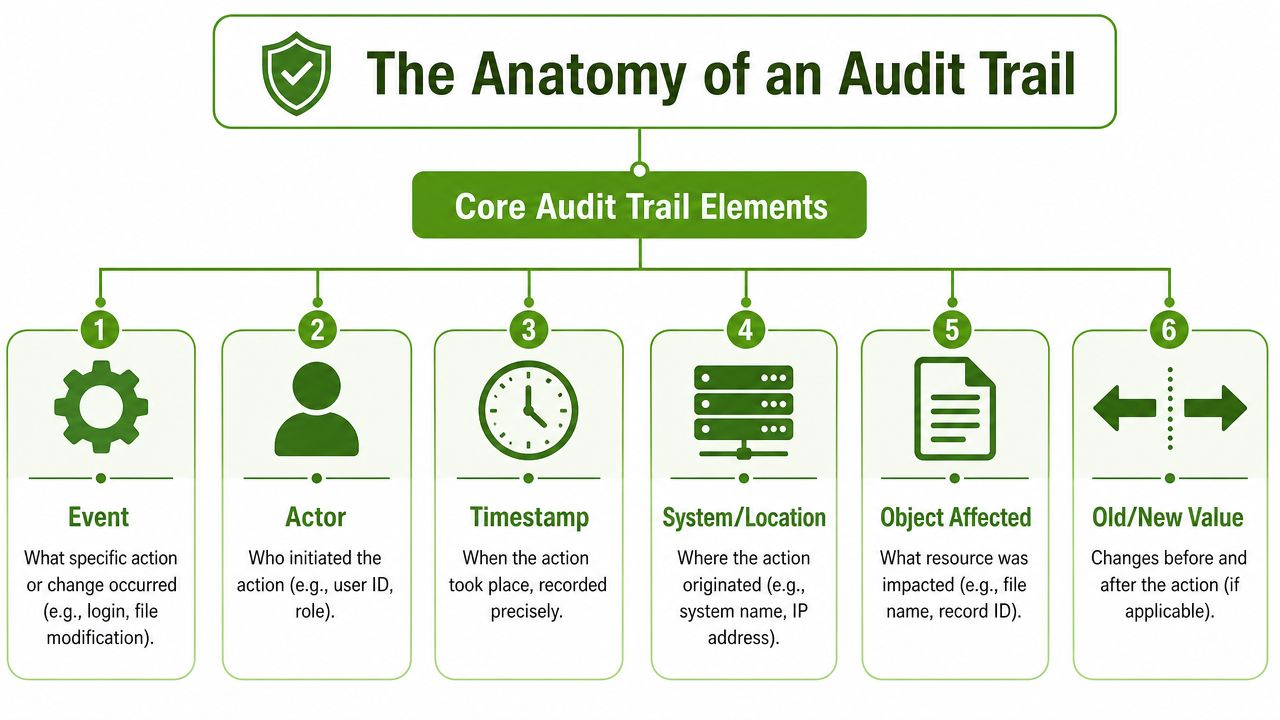
The six pieces you need to recognize
At minimum, an audit trail becomes useful when it captures a full event, not just a note that “something happened.”
| Element | What it tells you | Nonprofit example |
|---|---|---|
| Actor | Who performed the action | Program Director updated an outcomes report |
| Event | What action occurred | Budget line edited, document approved, report submitted |
| Timestamp | When it happened | Exact date and time of the budget revision |
| System or location | Where the action originated | Grants platform, accounting system, or document repository |
| Object affected | What record was touched | Grant file, record ID, budget worksheet, narrative draft |
| Old and new value | What changed | Travel budget replaced with supplies budget |
This is why a plain activity list isn't enough. If your system only says “record updated,” that won't help much when a funder asks what changed.
The National Institute of Standards and Technology defines an audit trail as a “record of system activity by system or application processes and by user activity” in this overview of audit trail fundamentals. That definition matters because it emphasizes both parts of the story. Human actions matter, and system actions matter too.
What people usually confuse
Many nonprofit teams mix up these three ideas:
- Version history shows how a document changed over time.
- Activity logs show actions that occurred in a system.
- An audit trail ties those events into a chronological record you can use to reconstruct what happened.
If you want a security-focused perspective on how these records are evaluated in mature environments, this audit trail guide for CISOs gives helpful context. The language is more technical, but the underlying lesson applies to grant operations too. A record only helps if it can be trusted and reconstructed.
For nonprofit finance teams, that becomes especially relevant when grants touch accounting workflows. This overview of accounting for grants is useful because it shows how financial control and documentation have to work together.
A short explainer can make the idea easier to visualize:
Practical rule: If you can't tell who changed a record, what they changed, and when they changed it, you don't yet have a reliable audit trail.
Why Audit Trails Are Crucial for Nonprofits
For a nonprofit, an audit trail isn't just about satisfying an auditor. It protects funding relationships.
A funder wants confidence that your organization follows approved processes, uses grant funds as intended, and reports results accurately. An audit trail helps you demonstrate all three. When your team can produce a clear, chronological record, review conversations become easier and less defensive.
Compliance becomes easier to prove
Grant compliance often comes down to documentation discipline. Did the right person approve the expense? Was the report submitted on time? Did staff revise the target activities after approval or before it? Without a system record, those answers become vulnerable to doubt.
That's why the standard set by stricter regulated environments is useful, even for nonprofits. Under FDA 21 CFR Part 11 requirements for audit trails, an audit trail must be a secure, computer-generated, time-stamped electronic record. That source also explains that failure to provide an immutable log can lead to rejection of data. Most nonprofits aren't dealing with FDA submissions, but the principle is worth borrowing. If the record can't be trusted, the data behind it becomes harder to defend.
Renewals depend on trust
Funders don't renew grants only because they like your mission. They renew when they trust your organization to manage funds responsibly and explain results clearly.
An audit trail supports that trust in several practical ways:
- It shortens response time when funders ask for documentation after submission.
- It reduces internal disagreement because staff can refer to the same record.
- It strengthens reporting by linking milestones, approvals, and spending decisions.
- It supports leadership transitions because knowledge stays in the system, not only in one employee's memory.
A strong audit trail tells a funder that your nonprofit has control, not just good intentions.
This matters even more when scrutiny increases
Some nonprofits face state-specific review requirements, independent financial audits, or grantor monitoring visits. If you need a starting point for that broader compliance environment, this summary of 2026 audit rules for nonprofits can help frame the questions leadership should ask.
An Executive Director doesn't need to become a compliance technician. But you do need to know whether your systems create records you can stand behind. If they don't, every reporting cycle becomes harder than it has to be.
An Audit Trail Through the Grant Lifecycle
Let's follow one fictional award: the Community Arts Program grant.
At first, the grant looks like any other opportunity. A staff member identifies it, a team builds the proposal, leadership approves the budget, and everyone moves on once the application is submitted. In reality, each of those moments creates a trail that later becomes evidence.
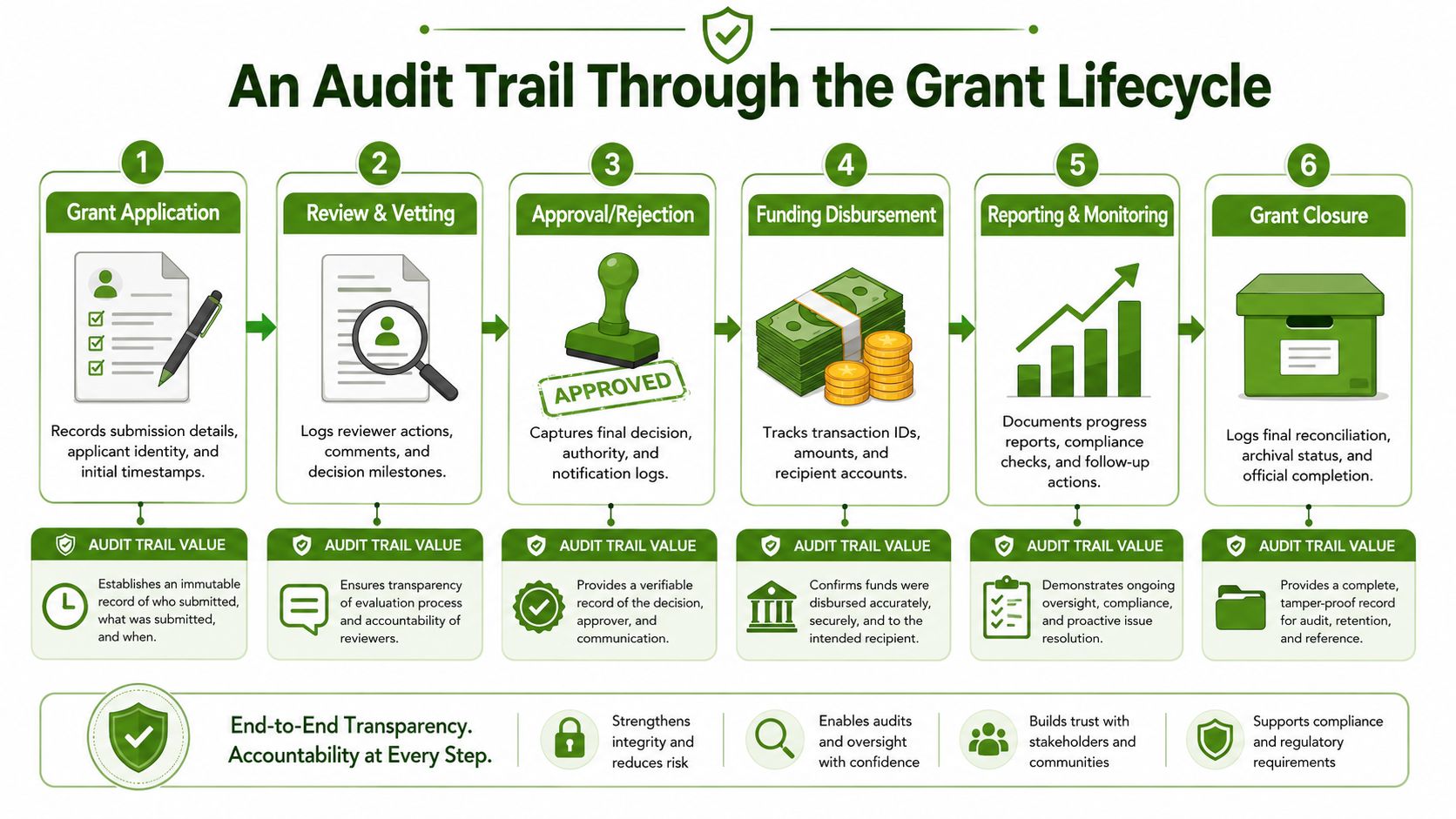
Before the award
The first entries in the trail are often easy to overlook. Someone researched the opportunity, saved the guidelines, noted eligibility, and assigned next steps. If those actions happen in a shared system, your organization can later show how it determined fit and who owned the early work.
Then the draft phase starts. The development manager uploads a prior narrative. A program lead edits the outcomes section. Finance revises the budget assumptions. The Executive Director gives final approval before submission. Every one of those actions matters more than people realize at the time.
During implementation
After award, the trail becomes even more valuable.
A reimbursement request is prepared. A reporting deadline is shifted. A milestone is marked complete. A staff member uploads attendance data to support outcomes. Another person updates the grant calendar after receiving clarification from the funder. None of these actions should rely on memory alone.
Here's what a nonprofit should be able to reconstruct for a live grant:
- Who submitted the original application
- Which budget version was approved
- When reporting materials were uploaded
- Who marked deliverables complete
- When a change request was documented and by whom
That's where a centralized workflow helps. Teams evaluating tools for this work often look for software that connects deadlines, documents, and activity history in one place. This guide to grant compliance tracking software is useful for seeing what that kind of setup can look like in practice.
At closeout and renewal time
Closeout is where strong documentation pays off. Instead of recreating the year by hand, staff can review a chronology of approvals, uploads, edits, submissions, and reporting actions.
That same history helps during renewal. If a funder asks how your organization handled prior deliverables, you're not left offering a general reassurance. You can point to the actual sequence of work.
The best grant files don't just store documents. They preserve the decision history around those documents.
For busy nonprofits, that changes the rhythm of reporting. Staff stop treating compliance as detective work and start treating it as record retrieval.
How to Create and Maintain Reliable Audit Trails
Reliable audit trails come from two things working together. The first is policy. The second is platform. If either is missing, the record gets weak.
A policy tells staff what must be documented, who can approve changes, and where official records live. A platform captures that activity consistently enough that you can retrieve it later.
Start with controls your team can actually follow
Most nonprofits don't need a complicated framework. They need a few clear rules that people will use every week.
- Define approval authority so staff know who can authorize budget changes, submissions, or revised deliverables.
- Limit editing access to the people who need it. Too many editors create confusion.
- Set one official system of record for grant files, approvals, and reporting materials.
- Require version discipline so teams stop saving final, final-v2, and final-real files across multiple folders.
- Review records periodically instead of waiting until an audit or renewal deadline exposes gaps.
This is also where records management becomes part of the conversation. If your filing structure is messy, your audit trail will be messy too. This article from Receipt Router on how records systems are explained in practice offers a helpful plain-language lens on why retention and retrieval matter.
Use software that captures evidence automatically
The stronger option is software that records activity in the background while your team does normal work. That means the trail isn't dependent on someone remembering to write down what happened.
In modern governance, risk, and compliance frameworks, an audit trail is treated as tamper-evident evidence infrastructure. Optro's discussion of modern audit trail requirements notes that mature trails should include before-and-after values and features like cryptographic hashing to prove integrity, and that inability to trace an action to a unique user and timestamp is a primary cause of audit failure.
For nonprofit leaders, you don't need to obsess over the technical jargon. You do need to ask practical product questions.
What to look for in a grants platform
When evaluating software, ask whether it can do these things:
| Question | Why it matters |
|---|---|
| Can it tie actions to a specific user? | Accountability breaks down without user attribution |
| Does it time-stamp edits, approvals, and submissions? | Timelines matter in reporting and disputes |
| Can it show before-and-after changes? | You need to know what changed, not just that something changed |
| Is version history easy to retrieve? | Staff turnover makes retrieval critical |
| Can reports be exported for auditors or funders? | A trail that stays trapped in the system is less useful |
One example in the nonprofit space is Fundsprout's audit support resources for small organizations. The platform itself is designed to help nonprofits find funding, draft proposals, manage deadlines, and maintain an audit trail around submissions, communications, and reporting activity. What matters most is the design principle. The system should capture the history while staff work, rather than forcing them to maintain a separate manual log.
Common Pitfalls and a Simple Checklist
Most audit trail problems don't come from bad intentions. They come from patchwork habits that seemed harmless at the time.
A nonprofit might store grant files in one drive, approvals in email, spending notes in accounting software, and reporting drafts in another folder. That setup works until someone needs a single verified answer.
Pitfalls to watch for
- Incomplete records that capture the document but not the approval behind it
- Editable logs that can be changed without detection
- Inconsistent naming and data entry that make retrieval harder
- Disconnected systems that split one grant story across multiple tools
- Weak retention habits that leave staff unsure what should still exist
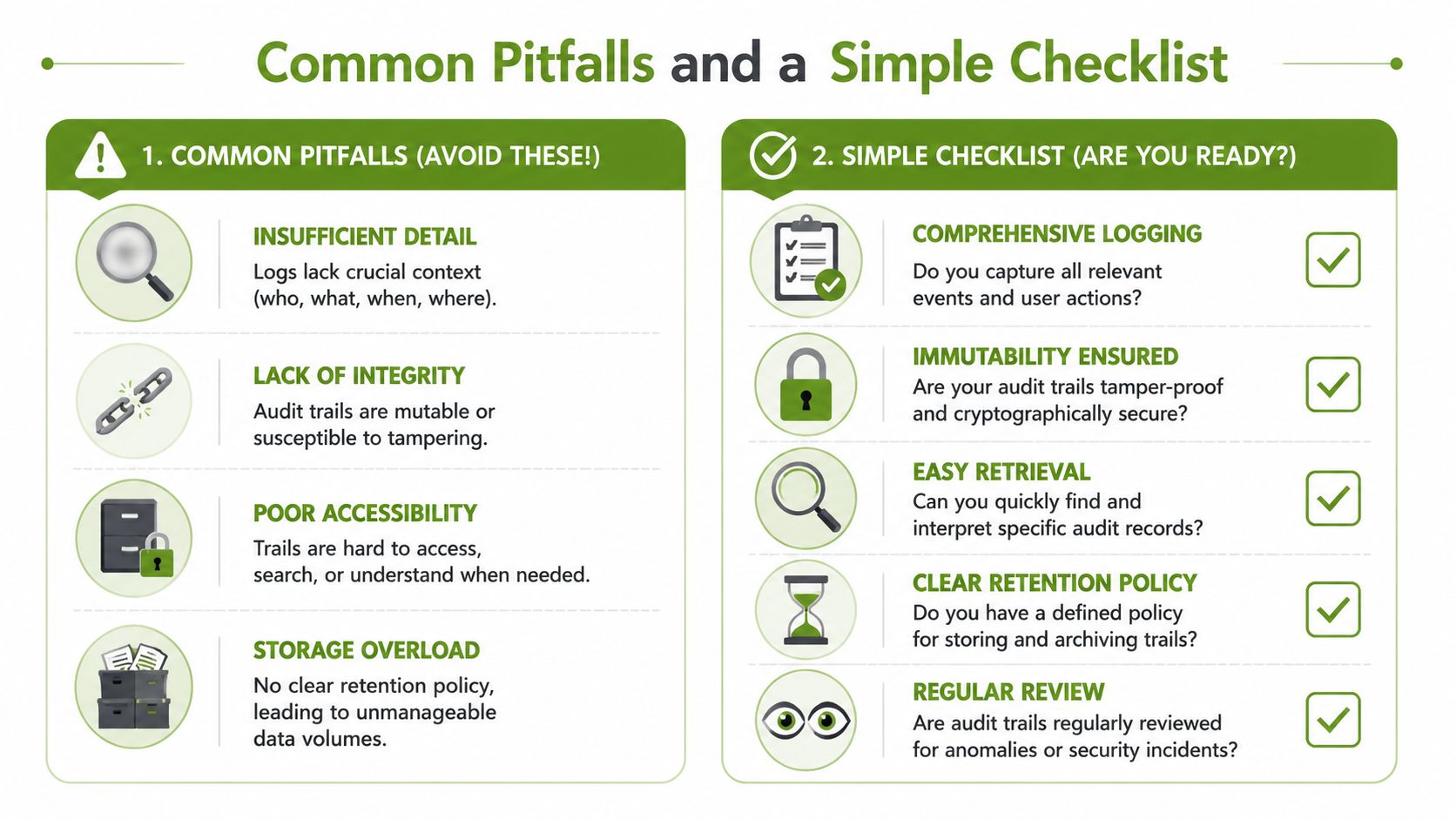
A quick readiness check
Ask yourself these questions:
- Can we prove who approved our last grant budget and when?
- Can staff identify the final submitted version of each grant file without guessing?
- Do our systems show who edited key records and what changed?
- Can we retrieve supporting history quickly during a funder review?
- Are grant records stored in a secure system with reliable version history?
- Do we know how long to retain grant-related documentation?
If you answered “no” or “I'm not sure” to several of those, the problem is fixable. Start by choosing one grant workflow and making the record visible from beginning to end.
Funders rarely ask for less accountability over time. They ask for clearer proof. Fundsprout helps nonprofits manage that reality by combining grant discovery, proposal development, deadline tracking, reporting support, and audit trail visibility in one workflow. If your team is tired of chasing answers across email, folders, and spreadsheets, it's worth looking at a system built to preserve the history while the work is happening.
Try 14 days free
Get started with Fundsprout so you can focus on what really matters.