Audit for small organizations: A Practical Guide
Audit for small organizations: Master the audit process with a practical guide on preparation, auditor selection, and turning findings into growth.

Abdifatah Ali
Co-Founder
For a lot of small nonprofits, the mere mention of an "audit" can cause a wave of anxiety. But what if we stopped seeing it as a dreaded chore and started treating it for what it really is? A powerful tool for growth. An audit for small organizations isn't just about compliance; it's an independent review of your financial story, a stamp of approval that builds incredible trust with donors and opens doors to bigger funding opportunities.
Why Audits Are a Tool for Growth, Not Fear
Let's shift the perspective here. An audit isn't a punishment; it's a strategic investment in your nonprofit's health and future. Think of it as a deep-dive diagnostic for your financial operations, uncovering blind spots and highlighting opportunities you might have missed in the day-to-day grind.
A clean audit report is one of the most compelling documents you can hand to a grantmaker or major donor. It’s an immediate signal of high-level accountability and financial integrity, telling them their money will be managed with care. For many funders weighing their options, that external validation can be the single thing that tips the scales in your favor.
Building Trust and Unlocking Opportunities
Often, the push to get an audit comes from an external requirement. Many states, for example, require an audit once a nonprofit's annual revenue crosses a certain line—often around $500,000. If you receive federal grants, you'll face a "Single Audit" if you spend more than $750,000 of that federal money in a year.
But even if you aren't required to have one, a proactive audit offers some serious upsides:
- Stronger Internal Controls: The process naturally puts your financial procedures under a microscope. An auditor can quickly spot weaknesses, like a lack of segregated duties or poor record-keeping, helping you shore up your defenses against fraud and simple errors.
- Better Operational Efficiency: Auditors have seen it all. They can often point out clunky or redundant workflows in your financial processes, giving you practical recommendations that save precious staff time and money.
- Smarter Board Governance: An independent review gives your board of directors the confidence that the organization's finances are on solid ground. This empowers them to step up and make better, more informed strategic decisions for the future.
At its core, an independent financial audit is a learning opportunity. No matter the reason for it or what the final report says, remember your auditor is there to help your organization succeed.
A Growing Demand for Accountability
When you see audits as a tool, you start to recognize their critical role in effective Compliance Risk Management. As regulatory goalposts keep moving, the demand for this kind of professional assurance is only going up.
The global market for auditing services is expanding fast, with the U.S. market alone projected to hit $76.84 billion in revenue by 2026. You can learn more about the trends driving the auditing services market on fortunebusinessinsights.com. This isn't just a random statistic; it shows just how much donors, funders, and the public value transparency and verified financial health. Leaning into this trend positions your nonprofit as a trustworthy, forward-thinking leader in its field.
Decoding the Different Types of Audits
Not all audits are created equal, and figuring out which one you need is the first real step toward a smooth process. The right audit for your small nonprofit really depends on your specific situation—where your money comes from, what your bylaws say, and what your goals are.
Choosing correctly means you're meeting your obligations without spending precious time and money on an audit you don't actually need.
The Standard Financial Statement Audit
This is the one most people picture when they hear the word "audit." A financial statement audit is a broad look at your organization's financial health. An independent CPA dives into your key financial statements—like your statement of financial position and statement of activities—to give their professional opinion on whether they're accurate and fairly presented.
They don't check every single transaction. That would be impossible. Instead, they test samples of your data and review your internal controls to get "reasonable assurance" that your financial story is free of major errors. This is the kind of audit a local arts group might need to satisfy a requirement in its bylaws or to reassure its board.
Key Takeaway: A financial statement audit is all about validating the integrity of your financial reporting. It sends a powerful signal to donors, board members, and banks that your numbers are reliable.
For instance, a community theater with a $600,000 annual budget might be required by state law to have an annual financial audit. The auditors would look at everything from ticket sales and donation records to production costs and payroll to confirm the financial statements paint an accurate picture.
This flowchart can help you visualize the common triggers that might mean it's time for an audit.
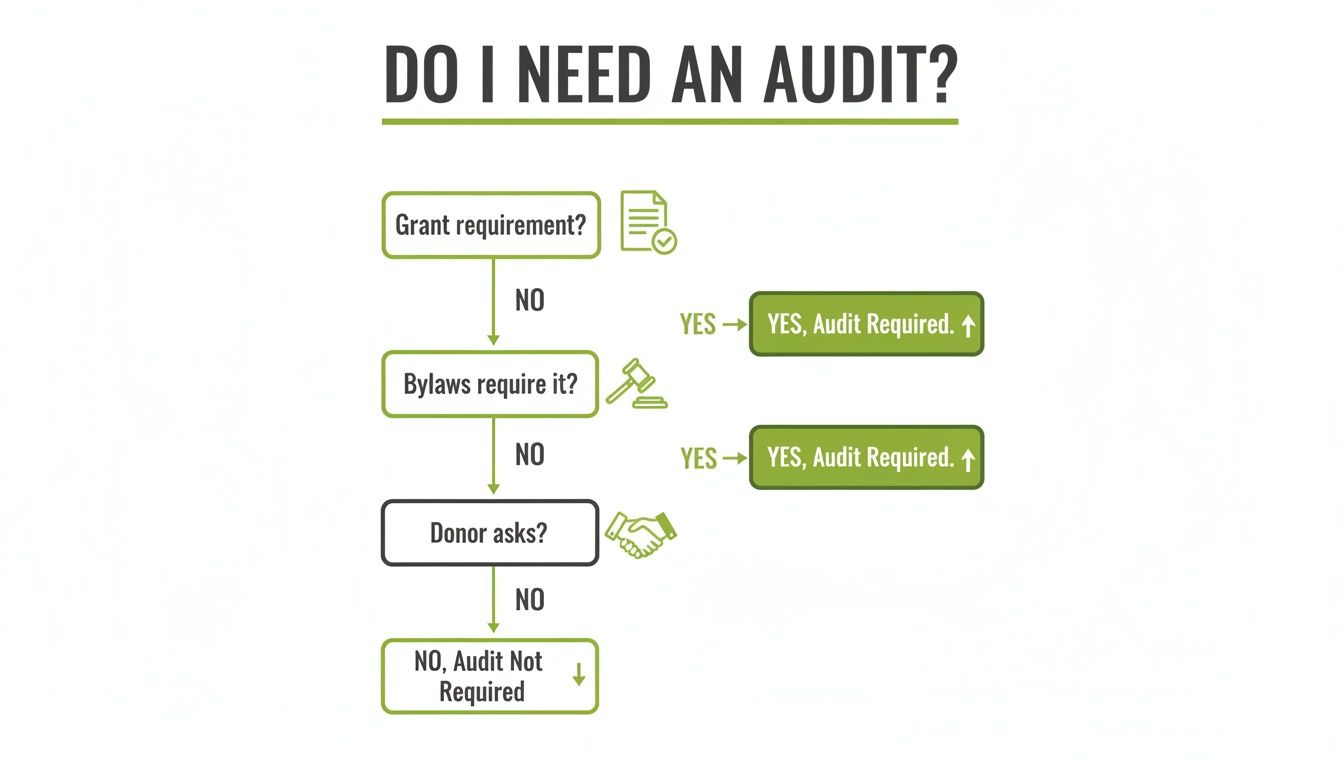
As you can see, the push for an audit often comes from outside funders or your own internal governance rules.
To help you get a clearer picture, here’s a quick breakdown of the most common audits you might encounter.
Audit Types at a Glance
Each audit serves a unique purpose, from giving a high-level financial health check to a deep dive into very specific rules.
Grant and Compliance Audits
While a financial audit looks at the big picture, a compliance audit zooms in on a very specific set of rules. This type of audit is all about determining whether your organization has followed the specific terms of a grant, contract, or government regulation. It's less about your overall financial accuracy and more about sticking to the promises you made.
A common trigger is a grant from a private foundation. Let's say a foundation gives your nonprofit a $100,000 grant for a specific youth program. They'll likely require a compliance audit to verify that the money was spent exactly as you said it would be and didn't just get absorbed into general operating costs.
Getting this right is a huge part of good stewardship. If you want to dig deeper, our guide on grant management best practices has more tips.
The Federal Single Audit
This one is the big one. A Single Audit is a much more intensive audit required for any organization that spends $750,000 or more in federal funds during its fiscal year. It's called a "Single Audit" because it's meant to be a one-and-done review that satisfies all the federal agencies that fund you.
A Single Audit has two main parts:
- A complete financial statement audit, just like the one we already covered.
- A detailed compliance audit of your federal awards, where auditors test your adherence to the complex rules in the federal Uniform Guidance.
Imagine a community health clinic that gets grants from both the Department of Health and Human Services (HHS) and the Department of Agriculture (USDA). If its combined spending from those federal sources tops the $750,000 threshold, it will have to undergo a Single Audit. The auditors will check not only the clinic's financials but also its compliance with very specific rules on everything from participant eligibility to reporting and allowable costs for each federal program. Failing to meet these strict standards can put future funding at serious risk.
Your Roadmap for a Painless Audit Preparation
A smooth audit begins weeks, or even months, before the auditors walk through your door. The real secret to a stress-free experience isn't some magic trick; it's treating preparation as a steady, organized process instead of a last-minute scramble.
Think of it this way: the more organized you are upfront, the less time your auditors will spend digging for documents—and that directly translates into a more efficient, cost-effective audit for your nonprofit. You're essentially setting the stage for a collaborative project, not an interrogation.
Assembling Your Core Documents
Your auditors will eventually send over a "Prepared by Client" (PBC) list, which is their formal request for documents. Getting a head start on this is the single best thing you can do to make the process easier on everyone.
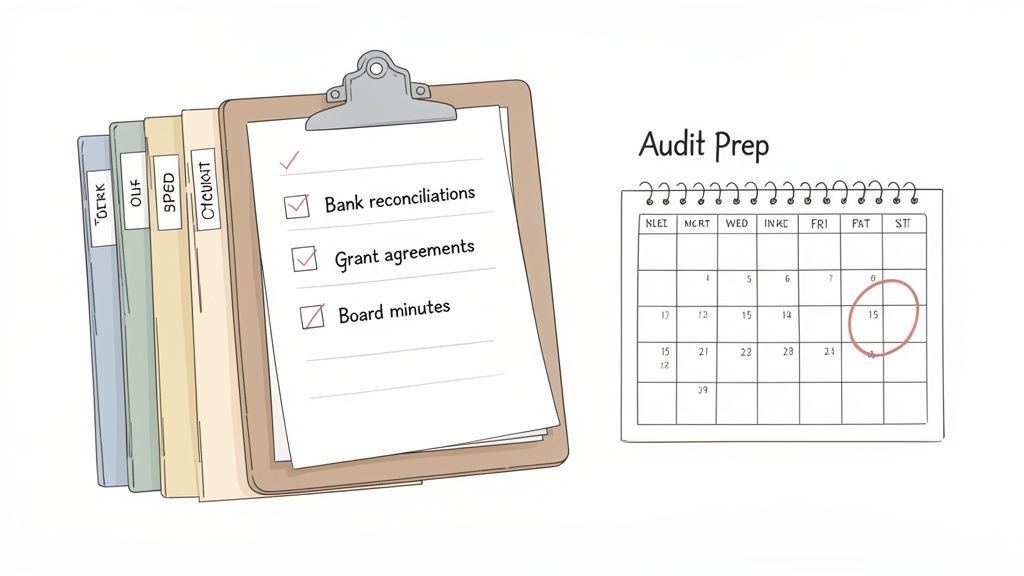
While every audit is a little different, the core documents they ask for are pretty standard. Start pulling these together now:
- Financial Statements: You'll need the statements from the year being audited and the prior year for comparison. This includes your statement of financial position (balance sheet), statement of activities (income statement), and cash flow statement.
- Bank Records: Gather every bank statement for the fiscal year, along with the corresponding monthly bank reconciliations.
- Grant Agreements: Pull together every single grant agreement, contract, and any important emails or letters that spell out funder requirements or spending restrictions.
- Key Legal Documents: This is your foundational paperwork—articles of incorporation, bylaws, and your official IRS tax-exempt determination letter.
- Board and Committee Minutes: Auditors read through these to understand the year's major financial decisions and to see evidence of proper governance and oversight.
This is also a great time to dust off your internal policies. If you don't have a solid conflict of interest policy, for example, you can find a good conflict of interest policy sample for non-profit organizations on fundsprout.ai to shore up your governance.
Preparing Key Schedules and Analyses
Beyond the basic documents, auditors rely on specific schedules that break down the high-level numbers on your financial statements. When you prepare these accurately, you save them a ton of time.
Here are the most common schedules you'll be asked for:
- Accounts Receivable Aging: This is just a list of everyone who owes you money, neatly categorized by how long the invoice has been outstanding (e.g., 0-30 days, 31-60 days, etc.).
- Accounts Payable Aging: The flip side of the coin. This is a list of all the bills your organization owes, sorted by their due dates.
- Fixed Asset Schedule: A detailed inventory of your major assets, like computers, furniture, or vehicles. It needs to show the purchase date, original cost, accumulated depreciation, and current book value for each item.
- Schedule of Restricted Net Assets: This is crucial for nonprofits. It tracks all the funds that donors have restricted for a specific purpose, showing how much you started with, what came in, what was spent, and the remaining balance.
An organized digital filing system isn't just a convenience; it's a strategic asset during an audit. Creating a secure, shared folder with clearly labeled subfolders for each PBC list item allows for a seamless and transparent information exchange with your audit team.
While you're at it, don't forget your digital security. Running through a cybersecurity audit checklist before your official audit begins shows proactive risk management and can help you spot vulnerabilities before your auditors do.
Documenting Your Internal Controls
One of the most critical parts of any audit is the review of your internal controls. These are simply the everyday procedures you follow to protect your assets and ensure your financial reporting is accurate.
Don't wait for the auditors to ask you to explain everything on the spot. Get ahead by writing down a simple, clear narrative for your key financial processes.
- How does money come in? Detail the process for cash and check receipts. Who opens the mail? Who prepares the bank deposit? Who records the revenue in your accounting system?
- How does money go out? Map out your cash disbursement process. How are bills approved for payment? Who has the authority to sign checks? Do you require two signatures over a certain dollar amount?
- How do you handle payroll? Explain how timesheets are approved, who processes the payroll itself, and how payroll taxes are filed and paid on time.
Having these processes written down demonstrates that you take financial oversight seriously. It proves that even with a small team, you have thoughtful checks and balances in place to prevent errors and reduce the risk of fraud. This documentation isn't just for the audit; it's the foundation of a stronger financial operation for years to come.
How to Choose and Partner with the Right Auditor
Think of your auditor as more than just a vendor who checks boxes. They should be a critical partner on your organization's financial journey. The right firm will go beyond simple compliance, offering insights that can actually strengthen your operations and build deeper trust with your funders. The goal here is to find a team that genuinely gets the nonprofit world and can turn the audit from a dreaded interrogation into a productive partnership.
Finding this kind of partner takes a deliberate, thoughtful approach. You aren't just buying a service; you're investing in a relationship that should pay dividends long after the final report is filed. It all starts with knowing what you’re looking for and how to ask for it.
Drafting a Request for Proposal That Attracts Talent
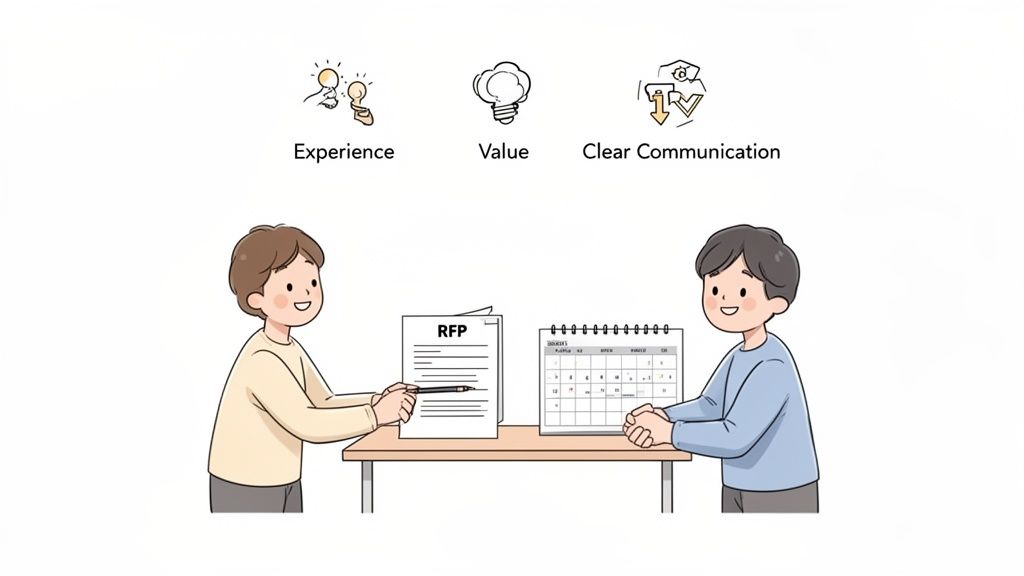
A well-crafted Request for Proposal (RFP) is your single most important tool for getting qualified auditors to the table. It sets clear expectations from the get-go and lets you compare firms on an even playing field. A good RFP doesn't just ask for a price—it asks firms to prove they know what they're doing.
Make sure your RFP includes these key pieces:
- Organizational Overview: Briefly lay out your mission, programs, annual budget, and major funding sources. This context helps auditors understand your specific operational reality.
- Scope of Services: Be crystal clear about what you need. Are you looking for a standard financial statement audit, a more intensive Single Audit, or something else entirely?
- Timeline: State your fiscal year-end and the timeline you're hoping for, including when you need fieldwork done and the final report in hand.
- Submission Requirements: Detail exactly what their proposal should contain, like bios for the engagement team, a list of similar nonprofit clients, and at least three solid references.
Think of your RFP as a job description for a crucial team member. The more specific and professional it is, the higher the caliber of candidates you'll attract. Vague requests almost always lead to generic, uninspired proposals.
Evaluating Proposals Beyond the Price Tag
When the proposals start trickling in, it’s so tempting to flip straight to the pricing page. Resist that urge. While your budget is obviously a factor, the cheapest option is rarely the best value, especially for a specialized service like a nonprofit audit.
Instead, you need to evaluate each proposal more holistically:
- Relevant Experience: Does the firm have a dedicated nonprofit practice? Have they worked with organizations of a similar size and with similar funding, like federal grants or multi-year foundation support?
- Team Qualifications: Who will actually be doing the work? Look at the experience of the partner, manager, and senior staff who will be assigned to your account.
- Understanding of Your Mission: Does their proposal feel like a copy-paste job, or does it show they've actually taken the time to understand what your organization does?
- Value-Adds: Do they offer anything extra? This could be training for your board or management letter recommendations that are genuinely insightful, not just boilerplate.
This careful vetting process is more important than you might think. The quality of audits can vary wildly, and picking an unqualified firm can create serious headaches down the road. Audit deficiency rates have been climbing, especially for smaller firms. In fact, PCAOB data shows that deficiency findings for smaller U.S. firms jumped from 49.2% in 2021 to 54.9% in 2023. Those numbers really highlight how crucial it is to pick a highly competent partner. You can find more insights about rising audit deficiency rates on tellen.ai.
Building a Collaborative Auditor Relationship
Once you've picked your firm, the real work of building a strong partnership begins. The foundation for this relationship is clear, consistent communication right from day one.
Kick things off with a meeting to set expectations on both sides. This is your chance to nail down the ground rules before the real work starts.
- Define Communication Channels: Agree on who the primary points of contact will be for both your team and the audit firm. Decide if you'll stick to email, schedule regular calls, or use a secure portal.
- Establish a Realistic Timeline: Work together to map out key dates. This includes the deadline for your team to provide all requested documents, the planned dates for fieldwork (whether remote or onsite), and the target date for getting the draft and final reports.
- Discuss Logistics: Talk through the nitty-gritty details. If auditors are coming to your office, where will they sit? Who will be their go-to person for questions during the day? Clarifying these small things early prevents a lot of frustration later.
A successful audit for small organizations truly hinges on this collaborative spirit. By treating your auditor as a respected partner and keeping the lines of communication wide open, you can ensure the process is not just compliant but a genuinely valuable experience that helps your organization grow stronger.
Turning Audit Findings into Actionable Improvements
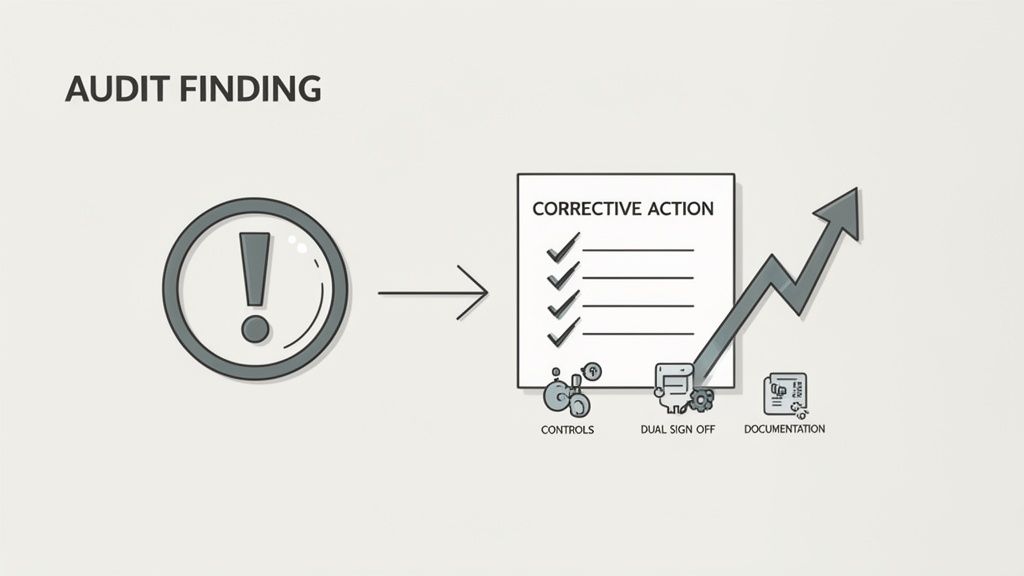
Getting an audit finding can feel like a punch to the gut. But it’s not a failure—it’s a roadmap for getting stronger. When an auditor flags something, they’re handing you a very specific, actionable way to tighten up your financial processes, improve your controls, and build even more trust with your funders.
The trick is to see these findings not as a critique, but as free advice from an expert who wants you to succeed. For most small nonprofits, the issues that pop up are rarely scandalous. They’re the normal growing pains that come from having a small-but-mighty team and limited resources. Tackling them head-on is one of the best ways to show everyone you're serious about good governance.
Addressing Common Audit Findings
Let's break down some of the most common findings I see in an audit for small organizations and turn them into simple action steps. These issues surface all the time, but the solutions are usually surprisingly straightforward.
Finding 1: Inadequate Segregation of Duties
- The Scenario: At a small community center, one person handles everything: opening the mail, logging donations into the books, and taking the cash to the bank. The auditor flags this as a significant weakness.
- The 'Why': When one person controls a financial process from beginning to end, the risk of both honest mistakes and fraud goes way up. There are simply no checks and balances.
- The Solution: You have to implement a dual-control system, even if your team is tiny. Get creative. Maybe a trusted board member or a dedicated volunteer can be the one to open the mail and make a list of incoming checks. Then, your bookkeeper can make the deposit. Just that one change creates an immediate and powerful check.
Finding 2: Missing Documentation for Transactions
- The Scenario: Your auditors pull a sample of expenses, and for several credit card charges for program supplies, all you have are the credit card slips—no itemized receipts.
- The 'Why': A credit card slip only proves that a payment was made. It doesn't prove what was purchased, which is essential for showing the funds were used for legitimate, allowable expenses.
- The Solution: Create a crystal-clear expense policy that mandates itemized receipts for absolutely everything. Make it easy for your team—set up a shared digital folder where they can instantly upload photos of receipts from their phones. No more "I lost it" excuses.
The real goal here is to show your board and funders that you're committed to continuous improvement. A well-documented plan to fix these things turns a potential negative into a story of responsible leadership.
Improper Expense Allocations
Another classic challenge is how costs get spread across different programs or grants. This is where the details really, really matter for keeping your funders happy.
For example, your after-school program might be funded by three different grants, each with its own specific budget. An auditor might find that the program director’s entire salary was charged to just one of those grants, even though she works on all three. That’s an improper allocation.
The fix is all about tracking time and expenses more granularly. Using simple timesheets that break down hours by program or grant allows you to allocate payroll costs accurately. The same logic applies to shared costs like rent and supplies. Setting up a solid budget from the start makes this much easier; our guide on creating a nonprofit program budget template can be a huge help here.
Creating Your Corrective Action Plan
Once the audit report is in your hands, the next step is to draft a formal Corrective Action Plan, or CAP. This doesn’t need to be a 20-page novel, but it does need to be professional and clear. It’s your official response that shows you’re taking the findings seriously and have a concrete plan to prevent them from happening again.
For each finding, your CAP should have a few key elements:
- The Finding: Briefly summarize the issue just as the auditor described it.
- The Corrective Action: Explain the exact steps you will take to solve the problem. Use direct, action-focused language.
- Responsible Person: Name the person or role in charge of making it happen.
- Target Completion Date: Set a realistic deadline for getting the fix in place.
This simple document does more than just satisfy your auditor. It becomes your internal project plan to make sure these important changes actually get made. Presenting this plan to your board is a fantastic way to show proactive leadership and boost their confidence in your financial stewardship.
Common Questions We Hear About Nonprofit Audits
If you're gearing up for an audit for your small organization, you probably have a lot of questions. We get it. The process can feel intimidating, especially the first time. From figuring out the cost to just understanding the lingo, it’s a lot to take in.
We’ve pulled together the most common questions we hear from nonprofit leaders just like you. Our goal is to give you straightforward, practical answers so you can walk into your audit with confidence.
How Much Is This Going to Cost Us?
This is usually the first thing everyone wants to know, and the honest answer is: it varies. For a small or mid-sized nonprofit, you can expect an audit to cost anywhere from $5,000 to over $25,000. The final bill really comes down to a few key things.
- Your Size and Scope: An organization with a larger budget and more complex programs simply takes more time for an auditor to review.
- Your Funding Mix: Are you working with a handful of simple foundation grants? That's going to be less expensive to audit than an organization juggling multiple, complex federal awards with strict compliance rules.
- How Clean Your Books Are: This is the big one. If your financial records are organized, accurate, and easy to access, the audit will be faster—and cheaper. Messy books mean more billable hours for the auditor, plain and simple.
Your best bet is to get quotes from at least three different CPA firms that specialize in nonprofits. This lets you compare not just the price, but how well they seem to understand your organization's specific challenges.
What’s the Difference Between an Audit, a Review, and a Compilation?
These terms get thrown around a lot, but they mean very different things. Picking the right one can save you a significant amount of money and time.
Always check your grant agreements, bylaws, or state regulations first. They will almost always tell you exactly which level of service you need.
Can We Just Audit Ourselves to Save Money?
I love the spirit behind this question—it’s smart and cost-conscious. But when it comes to the official, external financial audit, the answer is a firm no.
The entire value of an audit comes from the auditor's independence. A credible audit report must be issued by an independent, licensed Certified Public Accountant (CPA). That objectivity is what gives funders, banks, and your own board confidence in the results.
That said, you absolutely can—and should—conduct an internal audit readiness assessment. Think of it as a dress rehearsal. You review your own records, processes, and controls to find and fix problems before the auditors show up. This is the single best way to make the real audit go smoother and potentially lower your final bill.
How Can Technology Make the Audit Process Less Painful?
This is where things have really changed for the better. The right software can turn audit prep from a month-long paper chase into a task you can knock out in a few clicks. Instead of digging through filing cabinets, you can pull up what an auditor needs instantly.
For instance, platforms designed for nonprofits automatically create a clear, chronological audit trail for every dollar you spend.
- Document Management: Key files like grant agreements, funder reports, and important emails are all stored in one central, accessible place.
- Instant Reporting: You can generate the exact financial summaries and grant-specific schedules auditors ask for, on demand.
This kind of automation doesn't just cut down on the staff time spent gathering documents. It also dramatically reduces the chance of human error and signals to your auditor that your organization is well-managed and transparent.
An audit doesn't have to be a source of stress. With the right preparation and the right tools, it can become a smooth process that actually makes your organization stronger. Fundsprout was built for this, with features designed to create a perfect audit trail and make finding documents effortless.
Try 14 days free
Get started with Fundsprout so you can focus on what really matters.