Conflict of Interest Policy Sample for Non Profit Template
Discover a practical conflict of interest policy sample for non profit with a ready template, clear roles, disclosures, and FAQs to protect your nonprofit


Abdifatah Ali
Co-Founder
A solid conflict of interest policy is really the bedrock of good nonprofit governance. It's what protects your organization from ethical pitfalls and keeps you on the right side of compliance. Think of this guide as your toolkit—it has a ready-to-use policy template and an annual disclosure form to get your leadership team set up for success right from the start.
Your Essential Nonprofit Conflict of Interest Policy Kit
So, what exactly is a conflict of interest policy? It's the formal, written rules of the road that help your organization navigate situations where personal interests might improperly influence professional decisions. It’s an absolutely critical tool for protecting your tax-exempt status, maintaining donor trust, and, most importantly, staying true to your mission.
Without clear guidelines, a nonprofit can easily find itself in a tough spot. Imagine a board member steering a lucrative contract to their own company or a manager hiring a relative who isn't the best person for the job. These scenarios aren't just hypotheticals; they can lead to serious legal trouble, IRS penalties, and a devastating loss of public confidence.
Why Every Nonprofit Needs This Policy
Putting a formal policy in place isn’t just a nice-to-have—it’s a non-negotiable part of ethical leadership. When you look at what makes successful nonprofits tick, these policies are always a cornerstone of their compliance and governance.
In fact, the data backs this up. Over 85% of nonprofit organizations in the U.S. have a formal conflict of interest policy, and the vast majority require key leaders to sign a disclosure form every single year. You can dig deeper into these nonprofit governance trends in this detailed guide.
To help you get there, let's break down the essential pieces of a strong policy.
Key Components of an Effective Conflict of Interest Policy
A truly effective policy isn't just a piece of paper; it's a living document with several crucial parts. The table below outlines the core components you need to include to ensure your policy is comprehensive and clear.
Having these components in place creates a robust framework that not only meets legal standards but also builds a foundation of trust with everyone your organization touches.
The resources in this guide are designed to help you immediately strengthen your governance. By using the template and disclosure form provided, you’ll be setting clear, professional expectations from day one.
A strong conflict of interest policy does more than just meet legal requirements; it builds a culture of transparency and accountability. It sends a clear message to your stakeholders—from donors to the community you serve—that your organization is committed to ethical conduct and responsible stewardship of its resources. This commitment is vital for long-term sustainability and impact.
Defining What Counts as a Conflict of Interest

Before you can put any policy into practice, your entire team needs to be on the same page about what a "conflict of interest" actually means. At its core, a conflict of interest pops up whenever a person's private interests—or those of a close family member—could get in the way of their duty to act in the best interest of the nonprofit.
It's a common misconception that this is all about illegal or corrupt behavior. The truth is, conflicts are often subtle and unintentional. But even the appearance of a conflict can damage your organization's reputation and the public's trust, which is why a solid policy has to cover every possibility.
The Three Types of Conflicts
Breaking down conflicts into three distinct categories helps everyone spot red flags and handle them before they escalate. Think of it as a framework for proactive governance.
- Actual Conflicts: This is the most straightforward type. It’s when a board member or staffer’s personal interests have a direct and immediate impact on their decisions for the nonprofit, usually leading to some kind of personal benefit. The classic example? A board member voting to give a big, no-bid contract to a company they own.
- Potential Conflicts: Here, we're talking about a situation that could easily turn into an actual conflict down the road. For instance, if a senior manager’s spouse is a finalist for a high-paying job at the organization, that’s a potential conflict. Even if the hiring process is perfectly fair, the situation is ripe for a problem.
- Perceived Conflicts: This one is all about appearances. It's a situation where an outsider might reasonably think there’s a conflict, even if one doesn't technically exist. Imagine a board member who’s also a major donor having constant private meetings with the Executive Director. This could create the perception of undue influence, shaking public confidence.
It's crucial to remember that having a conflict of interest doesn't automatically make someone a bad person. It's simply a set of circumstances that needs to be managed. The goal isn't to forbid anyone from having a life outside the nonprofit; it's to make sure those outside interests are disclosed and managed with total transparency so they never compromise the mission.
Real-World Scenarios in Nonprofits
Let's ground these definitions in some real-world examples. The way your organization is set up can often highlight where conflicts are most likely to surface. If you're curious about these dynamics, it can be helpful to learn more about a typical nonprofit organizational structure and how different roles interact.
Common Examples of Conflicts:
- Financial Conflicts: A board treasurer who runs their own investment firm strongly pushes for the nonprofit to hire their company to manage its endowment. The potential for personal financial gain is a textbook conflict.
- Nepotism: An Executive Director hires their under-qualified nephew for a key role without opening the position to other candidates. This move undermines fairness, hurts staff morale, and can lead to serious performance issues.
- Dual Loyalties: A board member serves on the boards of two separate environmental nonprofits that are both applying for the same high-value grant. Their loyalty to one organization is now directly at odds with their duty to the other.
By clearly defining what a conflict is and providing concrete examples, you give your team the tools they need to confidently uphold their duty of loyalty to the organization.
The Annotated Conflict of interest Policy Template
A policy is more than just a legal document—it’s a hands-on guide that builds a culture of transparency in your organization. To make this as straightforward as possible, we’ve put together a comprehensive conflict of interest policy sample for non profit organizations. Think of this not just as a template to copy, but as an educational tool.
After each section of the policy, you'll find our annotations. These line-by-line notes break down the "why" behind each clause, explaining what it means from both a legal and a practical standpoint. Our goal is to empower your board to not just adopt the policy, but to truly understand and champion it.
[Your Nonprofit's Name]
Conflict of Interest Policy
Article I: Purpose
The purpose of this conflict of interest policy is to protect the interests of [Your Nonprofit's Name] (the "Organization") when it is contemplating entering into a transaction or arrangement that might benefit the private interest of an officer or director of the Organization or might result in a possible excess benefit transaction. This policy is intended to supplement but not replace any applicable state and federal laws governing conflict of interest applicable to nonprofit and charitable organizations.
Annotation: This opening paragraph sets the entire tone. It makes it clear that the policy’s main job is to protect the organization, not to police individuals. It also immediately introduces "excess benefit transactions"—a critical IRS term related to private benefit that, if violated, can put your tax-exempt status at risk.
Article II: Definitions
1. Interested Person
Any director, principal officer, or member of a committee with governing board delegated powers, who has a direct or indirect financial interest, as defined below, is an interested person.
Annotation: We’re casting a wide net here, and for good reason. The definition needs to cover more than just the board of directors; it must include anyone with real influence over organizational decisions. By including committee members with delegated powers, you make sure that people steering key areas like finance or executive hiring are also covered.
2. Financial Interest
A person has a financial interest if the person has, directly or indirectly, through business, investment, or family:
(a) An ownership or investment interest in any entity with which the Organization has a transaction or arrangement;
(b) A compensation arrangement with the Organization or with any entity or individual with which the Organization has a transaction or arrangement; or
(c) A potential ownership or investment interest in, or compensation arrangement with, any entity or individual with which the Organization is negotiating a transaction or arrangement.
Compensation includes direct and indirect remuneration as well as gifts or favors that are not insubstantial. A financial interest is not necessarily a conflict of interest. Under Article III, Section 2, a person who has a financial interest may have a conflict of interest only if the appropriate governing board or committee decides that a conflict of interest exists.
Annotation: This section gets specific about what a "financial interest" really is, covering everything from direct ownership to ties through family or other business ventures. Pay close attention to that last sentence—it's vital. It clarifies that simply having a financial interest isn’t automatically a problem. The policy is about disclosing and managing these interests, not banning them outright.
Article III: Procedures
1. Duty to Disclose
In connection with any actual or possible conflict of interest, an interested person must disclose the existence of the financial interest and be given the opportunity to disclose all material facts to the directors and members of committees with governing board delegated powers considering the proposed transaction or arrangement.
Annotation: Here we have the bedrock principle of the entire policy: proactive disclosure. The responsibility is placed squarely on the individual to raise their hand and bring a potential conflict to the board's attention. The phrase "all material facts" is key—it means you need more than a simple "yes, I have an interest." It demands total transparency so the board can make a fully informed decision.
2. Determining Whether a Conflict of Interest Exists
After disclosure of the financial interest and all material facts, and after any discussion with the interested person, he/she shall leave the governing board or committee meeting while the determination of a conflict of interest is discussed and voted upon. The remaining board or committee members shall decide if a conflict of interest exists.
Annotation: This is a crucial procedural step that guarantees objectivity. Requiring the interested person to physically leave the room prevents them from swaying the discussion or the vote, whether intentionally or not. This separation is a powerful, practical symbol of the organization’s commitment to fairness and is a best practice that regulators and auditors always look for.
Article IV: Procedures for Addressing the Conflict of Interest
- An interested person may make a presentation at the governing board or committee meeting, but after the presentation, he/she shall leave the meeting during the discussion of, and the vote on, a transaction or arrangement involving the possible conflict of interest.
- The chairperson of the governing board or committee shall, if appropriate, appoint a disinterested person or committee to investigate alternatives to the proposed transaction or arrangement.
- After exercising due diligence, the governing board or committee shall determine whether the Organization can obtain with reasonable efforts a more advantageous transaction or arrangement from a person or entity that would not give rise to a conflict of interest.
- If a more advantageous transaction or arrangement is not reasonably possible under circumstances not producing a conflict of interest, the governing board or committee shall determine by a majority vote of the disinterested directors whether the transaction or arrangement is in the Organization’s best interest, for its own benefit, and whether it is fair and reasonable. In conformity with the above determination, it shall make its decision as to whether to enter into the transaction or arrangement.
Annotation: This article lays out the "what now?"—a clear, step-by-step process for handling a disclosed conflict.
- Step 1 doubles down on the recusal process.
- Step 2 gives the board an investigative tool, showing it is actively looking for other options.
- Step 3 is the due diligence test. The board must be able to show—in writing—that it looked for better, conflict-free alternatives. This is your defense if the decision is ever questioned.
- Step 4 sets the final bar for approval: the deal must be fair, reasonable, and genuinely in the organization's best interest. This decision can only be made by the disinterested directors.
Article V: Violations of the Conflict of Interest Policy
- If the governing board or committee has reasonable cause to believe a member has failed to disclose an actual or possible conflict of interest, it shall inform the member of the basis for such belief and afford the member an opportunity to explain the alleged failure to disclose.
- If, after hearing the member’s response and after making further investigation as warranted by the circumstances, the governing board or committee determines the member has failed to disclose an actual or possible conflict of interest, it shall take appropriate disciplinary and corrective action.
Annotation: A policy without teeth is just a suggestion. This section creates a clear and fair process for enforcement. It guarantees due process by giving the person a chance to respond before any action is taken. The phrase "appropriate disciplinary and corrective action" is deliberately flexible, which allows the board to tailor its response to the situation, from a simple warning to removal from the board.
Article VI: Records of Proceedings
The minutes of the governing board and all committees with board delegated powers shall contain:
(a) The names of the persons who disclosed or otherwise were found to have a financial interest in connection with an actual or possible conflict of interest, the nature of the financial interest, any action taken to determine whether a conflict of interest was present, and the governing board’s or committee’s decision as to whether a conflict of interest in fact existed.
(b) The names of the persons who were present for discussions and votes relating to the transaction or arrangement, the content of the discussion, including any alternatives to the proposed transaction or arrangement, and a record of any votes taken in connection with the proceedings.
Annotation: In an audit, meticulous records are your best friend. This clause requires that the entire process—from the initial disclosure to the final vote—is documented in the meeting minutes. These notes prove the board followed its own rules, did its homework, and acted in the organization's best interest. You're creating an essential paper trail for compliance.
Article VII: Compensation
A voting member of the governing board who receives compensation, directly or indirectly, from the Organization for services is precluded from voting on matters pertaining to that member’s compensation.
Annotation: This is a very specific, but very common, type of conflict. Board members should never, ever vote on their own pay. It might seem obvious, but putting it in black and white removes any gray area and guards against one of the most classic forms of private benefit.
Article VIII: Annual Statements
Each director, principal officer, and member of a committee with governing board delegated powers shall annually sign a statement which affirms such person:
(a) Has received a copy of the conflict of interest policy,
(b) Has read and understands the policy,
(c) Has agreed to comply with the policy, and
(d) Understands the Organization is charitable and in order to maintain its federal tax exemption it must engage primarily in activities which accomplish one or more of its tax-exempt purposes.
Annotation: The annual disclosure form is what brings this policy to life. This article mandates an annual sign-off, which keeps the policy top-of-mind for every leader, every year. That signed piece of paper is proof that everyone covered by the policy knows their responsibilities—an invaluable piece of documentation for both good governance and compliance.
Article IX: Periodic Reviews
To ensure the Organization operates in a manner consistent with charitable purposes and does not engage in activities that could jeopardize its tax-exempt status, periodic reviews shall be conducted. The periodic reviews shall, at a minimum, include the following subjects:
(a) Whether compensation arrangements and benefits are reasonable, based on competent survey information, and the result of arm’s-length bargaining.
(b) Whether partnerships, joint ventures, and arrangements with management organizations conform to the Organization’s written policies, are properly recorded, reflect reasonable investment or payments for goods and services, and further charitable purposes.
Annotation: This final piece turns the policy from a static document into a living governance tool. It schedules regular, proactive check-ins on high-risk areas like executive compensation and partnerships. This forward-thinking approach helps the board spot and solve potential problems before they escalate, showing a truly mature approach to managing risk.
How to Adopt and Implement Your New Policy
Getting the policy written is a huge accomplishment, but the job isn't done. For your conflict of interest policy to have any real teeth, you need to officially adopt it and make it a part of your organization's daily life. This is the step that turns a document on a computer into a practical tool for making sound, ethical decisions.
Without a formal adoption, your policy is just a set of suggestions. It lacks the authority needed for enforcement, leaving your nonprofit vulnerable. So, let’s get down to the brass tacks of making it official.
The Board Adoption Process
The most important step is bringing the final policy to your board for a vote. This isn't just a rubber-stamp exercise; it's a formal process that should be handled with care and properly documented.
Customize and Review: First, take the template and adapt it to your nonprofit’s specific needs. Once you have a solid draft, send it to all board members with plenty of time to read it before the meeting.
Present and Discuss: During the board meeting, formally present the policy. This is the moment for board members to ask questions, raise concerns, and get clarity on their responsibilities.
Hold a Formal Vote: A board member needs to make a motion to adopt the policy. Once another member seconds the motion, the board chair can call for a vote.
Document in the Minutes: This is absolutely critical. The meeting minutes must clearly state that a motion was made, who seconded it, and the final vote count. This entry creates the official, permanent record of the policy's adoption, which is essential for any future audits or legal questions.
Putting the Policy into Action
Once the board has given its official approval, it’s time to shift from planning to practice. A policy that just sits in a binder is worthless.
This simple workflow shows the three key actions your policy is built around: defining what constitutes a conflict, disclosing any that arise, and managing them effectively.
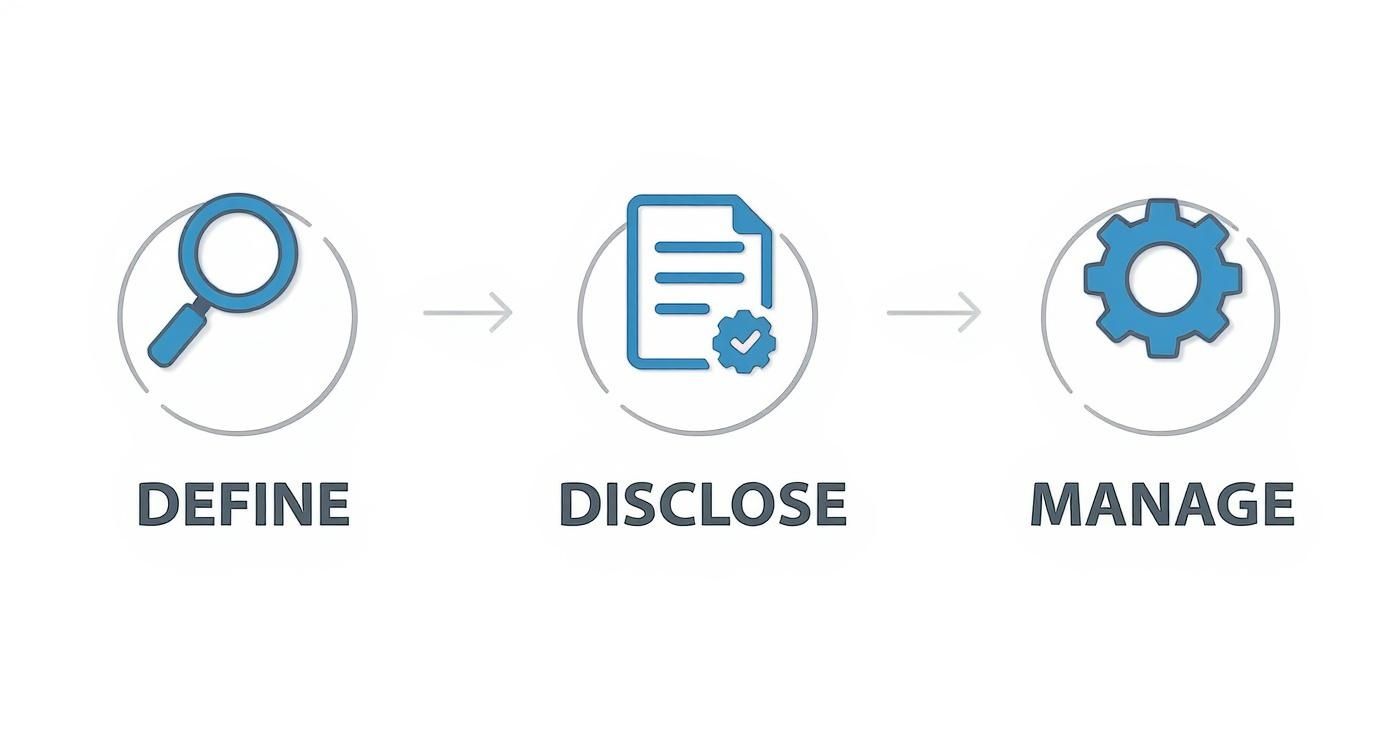
As the visual makes clear, disclosure is the linchpin. It connects the initial identification of a problem with its ultimate resolution and underscores why transparency is so important.
To make sure your policy sticks, you'll need to focus on consistent implementation:
- Distribute Widely: Get a copy of the adopted policy into the hands of every board member, officer, and key employee. Have each person sign the annual disclosure form to confirm they've read and understood it.
- Conduct Training: Never assume everyone gets it. A quick training session to walk through the policy and discuss a few real-world examples can make a huge difference.
- Establish Clear Procedures: Everyone should know exactly what to do when a potential conflict comes up, especially how to recuse themselves from a discussion or vote. Managing these records is also vital; tools like nonprofit grant management software can be a big help in keeping compliance documents organized.
By following through with these steps, you transform your conflict of interest policy from a document into a cornerstone of your nonprofit's ethical culture.
Using the Annual Disclosure Form for Compliance
A conflict of interest policy is only as good as its implementation. Proactive disclosure is what brings that policy to life, and the annual disclosure form is the single most important tool for making it happen. Think of it as a yearly check-up, an affirmation that your leadership team has reviewed their obligations and is committed to putting the nonprofit’s interests first.
This isn't just about ticking a box. Each signed form is a critical piece of your governance records. By having every director, officer, and key employee complete it annually, you build a powerful habit of transparency. This simple process can unearth potential conflicts long before they become actual problems, protecting your organization’s reputation and keeping you on the right side of regulators.
What the Disclosure Form Must Collect
A strong disclosure form should be clear, concise, and thorough. It needs to prompt your people to really think through their various connections—professional, financial, and even familial—to ensure nothing gets missed.
At a minimum, your form should ask each person to:
- Acknowledge Receipt of Policy: Confirm they’ve received, read, and fully understand the organization’s conflict of interest policy.
- List Business Interests: Detail any businesses where they (or a close relative) have a major ownership stake or serve in a leadership role like officer or director.
- Identify Financial Relationships: Disclose any compensation, loans, or significant gifts they’ve received from any person or company that has a business relationship with your nonprofit.
- Disclose Other Nonprofit Affiliations: List any board or committee positions they hold at other nonprofits, particularly those with overlapping missions or operating in the same community.
This annual ritual does more than just collect information; it’s a powerful reminder of the duty of loyalty that every leader owes to the organization. It formalizes the expectation of transparency and creates a paper trail proving the board is actively managing its oversight responsibilities.
The Growing Importance of Formal Policies
Putting these formal processes in place is no longer optional—it's standard practice. The push has come from all sides, including regulators and major funders who have seen what happens when ethical guardrails are missing. For instance, recent guidance from the U.S. Office of Management and Budget (OMB) now requires any organization receiving federal funds to maintain a written conflict of interest policy and provide regular training.
That single rule has had a huge impact. According to one report, 92% of federally funded nonprofits now have a formal policy in place, a significant leap from just 70% before the rule. You can get more details on key risks and compliance trends for nonprofits here.
This kind of external pressure from government agencies and foundations highlights why strong internal practices are so crucial. Your annual disclosure forms are your front-line evidence of compliance. They show everyone—the public, your donors, and grantmakers—that you take your ethical duties seriously. It’s a cornerstone of building and maintaining trust.
Meeting State Laws and Funder Expectations
While our conflict of interest policy sample for non profit organizations is built around federal best practices and IRS guidelines, think of it as a foundation, not the entire house. You've got to consider the specific rules laid down by your state and your major funders—they add a crucial layer of compliance you can't afford to miss.
Your organization's primary legal duties are dictated by the state where you're incorporated. These laws can differ quite a bit from one state to another. They might spell out exactly how to handle a conflict, get specific about who counts as an "interested person," or even set the rules for quorum when a vote involves a conflict. Your best bet is always to have a legal expert review your policy to make sure it ticks all the local boxes.
Aligning with Funder Due Diligence
For major funders, whether they're private foundations or government agencies, a solid conflict of interest policy is a big deal. They see it as a hallmark of a well-run, trustworthy organization. In fact, many won't even cut a check until they've reviewed your policy and are satisfied that it meets their standards for transparency and accountability.
Here's what you need to keep in mind:
- Review Grant Agreements: Get into the habit of reading the fine print on every single grant agreement. Funders often slip in specific clauses that require you to have and actively enforce a conflict of interest policy.
- Anticipate Scrutiny: Government funders are especially rigorous. They have strict rules to prevent public money from being misused, so a comprehensive, well-enforced policy is non-negotiable. It shows them you're serious about being a good steward of their funds.
Making sure your policy is up to snuff and properly documented is just smart stewardship. For a deeper dive into this, take a look at our guide on grant management best practices.
Got Questions About Your COI Policy? We Have Answers.
It's completely normal to have questions when you're working through the details of a conflict of interest policy. For most nonprofit leaders, this isn't something you deal with every day. Let's tackle some of the most common questions that come up.
Think of this as your quick-reference guide for handling those tricky situations and making sure your conflict of interest policy sample for non profit works as intended to protect your organization.
What's the Real Difference Between a "Potential" and "Actual" Conflict?
This is a great question, and the distinction really boils down to timing.
A potential conflict is on the horizon. It's a situation where a conflict could arise depending on future decisions. For instance, if a board member’s brother owns a catering company, that's a potential conflict. No decision is being made right now, but it's a relationship to be aware of.
An actual conflict is happening now. It emerges when a specific decision is on the table, and a leader's personal interests are in direct opposition to the nonprofit's best interests. To continue our example, if the board is now voting on which company to hire for its annual gala, and the brother's catering company is one of the bidders, the potential conflict has just become an actual one.
How Often Should We Revisit Our COI Policy?
Treat your conflict of interest policy as a living document. It's not something you can just file away and forget about. The widely accepted best practice is for your board to review the policy annually.
This yearly check-in is crucial. It gives you a dedicated time to make sure the policy still fits your nonprofit's activities, reflects any changes in state law, and meets the requirements of your key funders. A regular review keeps good governance at the forefront for everyone involved.
One question we get a lot is, "Does an all-volunteer nonprofit really need a formal policy?" The answer is a definite yes. Conflicts of interest aren't about salaries or compensation; they're about any scenario where personal interests might sway decisions away from the organization's mission. Volunteers have business dealings, family members, and outside relationships just like paid staff. A solid policy is about protecting the nonprofit's integrity, plain and simple, no matter who is making the decisions.
Ready to build a grant strategy that funders trust? Fundsprout is an AI-powered platform that helps you find the right funding, write compelling proposals, and manage compliance seamlessly. Discover how our tools can strengthen your nonprofit's governance and fundraising at https://www.fundsprout.ai.
Try 14 days free
Get started with Fundsprout so you can focus on what really matters.