A Guide to the Harry & Jeanette Weinberg Foundation
Discover how to secure funding from The Harry & Jeanette Weinberg Foundation. Our guide covers its mission, grant priorities, and how to align your nonprofit.


Abdifatah Ali
Co-Founder
With over $3.1 billion in assets, The Harry & Jeanette Weinberg Foundation isn't just a big name in philanthropy—it's a giant. For any nonprofit focused on direct services, this is a foundation you need to understand inside and out. It's one of the largest private foundations in the United States, and its mission is crystal clear: meet the basic needs of vulnerable people and families.
A Profile of This Philanthropic Powerhouse
It helps to think of the Weinberg Foundation not just as a funder, but as a strategic partner for organizations working on the front lines of poverty. Their entire philosophy revolves around supporting low-income and vulnerable populations, with a laser focus on work that creates stability and real opportunity.
The foundation’s approach is direct and no-nonsense. They concentrate their giving on nonprofits delivering tangible results in very specific program areas and geographic regions. This isn't scattershot funding; it's a deliberate strategy to ensure their considerable resources produce measurable, meaningful change.
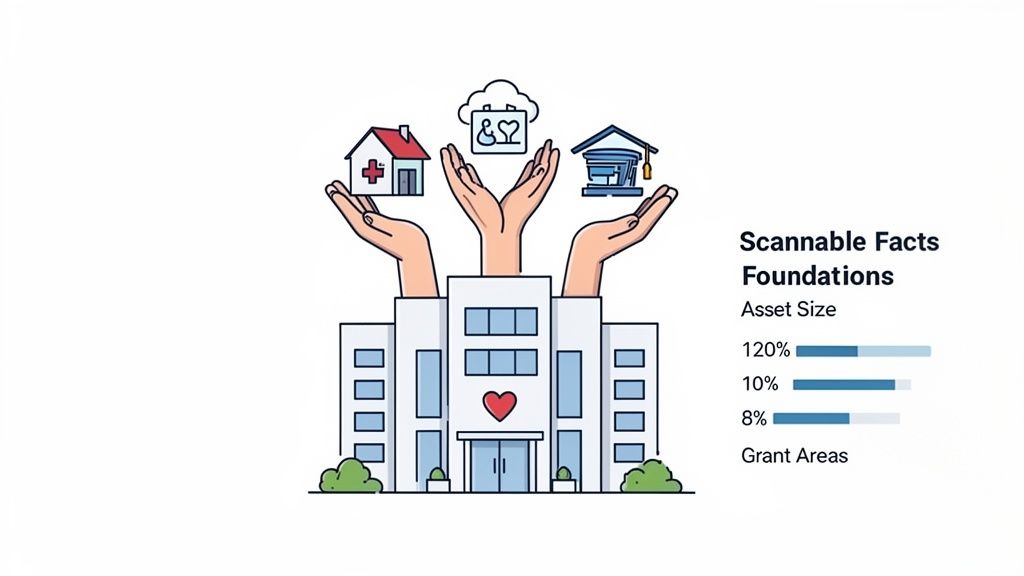
Key Areas of Focus
The Weinberg Foundation directs its grants into several well-defined portfolios. If your work falls into one of these buckets, you're on the right track.
- Housing: This includes everything from homelessness prevention to creating stable, affordable housing.
- Health: They fund programs that open up access to quality healthcare for people who can't otherwise afford it.
- Jobs: A major focus is on workforce development and job training that leads to genuine economic stability.
- Education: They support educational initiatives that give people a real pathway out of poverty.
- Community Services: This is a broad but important category covering crucial support for older adults, people with disabilities, and veterans.
For grant seekers trying to quickly gauge if there's a good fit, getting a snapshot of the foundation's core details is the best place to start.
The table below gives you a scannable summary of the foundation's most important details.
The Harry & Jeanette Weinberg Foundation at a Glance
| Metric | Details |
|---|---|
| Total Assets | Over $3.1 Billion |
| Primary Mission | Meeting basic needs and improving the quality of life for low-income and vulnerable people. |
| Core Grant Areas | Housing, Health, Jobs, Education, and Community Services (with a focus on older adults). |
| Geographic Focus | Priority communities, including Greater Baltimore, Israel, Hawai'i, and several others. |
| Application Process | Primarily invitation-only, which means relationship-building is essential. |
| Typical Grant Style | Direct support for programs and services. They generally don't fund research or advocacy. |
As you can see, the foundation’s priorities are specific and consistent. Knowing these details upfront can save you a tremendous amount of time and effort.
The key takeaway here is that the Weinberg Foundation is not just a checkbook; it's an active participant in solving complex social problems. Its focus on direct services means it wants partners who are hands-on, delivering immediate and essential aid to those in need.
The Mission Behind Billions in Philanthropy
To really get a handle on the Harry & Jeanette Weinberg Foundation, you have to start with the people behind the name. This isn't just some corporate mission statement—the foundation's entire identity is a direct extension of its founders' lives. Their story is the very bedrock on which $3.1 billion in philanthropic assets now stands.
Harry Weinberg was a classic self-made man, a real estate mogul known for his sharp business mind and an equally strong commitment to helping people who were struggling. Despite their incredible wealth, he and Jeanette lived simply. Their giving was personal and direct, focused on providing tangible aid to those in need—never abstract, always aimed at easing poverty and suffering.
This personal mission went into overdrive when they established the foundation in 1959. For decades, it was a fairly modest operation. The game-changing moment came in 1990 after Harry's death, when he left nearly his entire $900 million fortune to the organization. That single act took a small family foundation and turned it into a national philanthropic powerhouse, almost overnight. You can dig into the foundation's growth and financial details on ProPublica's nonprofit explorer.
Translating Personal Values into a Lasting Mandate
The DNA of Harry and Jeanette's personal charity is baked right into the foundation’s charter. Their focus was always on meeting the most basic needs of the poor and vulnerable. Today, that principle remains the unwavering north star for every grant the foundation makes.
Specifically, the charter mandates that the foundation must support four key groups:
- Low-income individuals and families: This is the absolute core of their work, aimed at breaking the cycle of poverty.
- Older adults: A significant portion of their funding is dedicated to helping older adults maintain their dignity and independence.
- People with disabilities: The foundation is committed to funding programs that create new opportunities and improve the quality of life for individuals with disabilities.
- The Jewish community: As a reflection of the Weinbergs' own heritage, the foundation is a major pillar of support for Jewish communities in its priority areas.
This isn't just a wish list; it's a binding mandate. Understanding this history helps you frame your work not as just another social program, but as a direct continuation of the founders' deeply personal mission.
For grant seekers, this means your proposal must connect with the story of a couple who believed their wealth should be used to provide basic human necessities—a safe place to live, access to healthcare, and the dignity of a job.
The Charter’s Rule for Balanced Giving
Here’s a critical piece of intel for any nonprofit looking to approach the Harry & Jeanette Weinberg Foundation: its charter requires a very specific balance in its giving. This isn't a minor detail. It's a foundational rule that dictates exactly how grant dollars are split up each year.
The charter stipulates that 25% of annual grant distributions must go to projects that specifically serve the Jewish community. The remaining 75% is then allocated to the general community, supporting individuals from all backgrounds who fall into the foundation's other target populations.
This rule is a powerful echo of the Weinbergs' dual commitment to their heritage and their broader community. For nonprofits, this provides crucial context. If you run a Jewish organization, you're competing for a dedicated pool of funds. If you're a secular or non-Jewish faith-based organization, your proposal will be considered within that larger 75% pot. Knowing where you fit helps you understand the funding landscape and position your request much more strategically.
Understanding Core Grantmaking Programs
Alright, let's get to the most important question for any grant seeker: what does the Harry & Jeanette Weinberg Foundation actually fund? Knowing their five core grantmaking programs is the first step, but the real key is understanding the why behind each one. This is how you align your work with their vision and avoid a quick rejection.
These programs aren't just a random list of interests. Think of them as five interconnected pillars propping up the foundation's single, overarching goal: to fight poverty. Each program is a different route toward providing stability and opportunity, whether that means putting a roof over someone's head or giving them the skills for a new career.
Housing and Health: The Foundations of Stability
For the Weinberg Foundation, everything starts with a safe place to live. Their housing grants aren’t just about funding shelters; they’re about a whole-picture approach.
- Homelessness Prevention: They support programs that step in before a family loses their home.
- Stable Housing Creation: They help fund the construction of affordable housing for vulnerable people.
- Supportive Services: They back organizations that wrap housing assistance with other essentials, like case management and financial coaching.
That same logic applies to their Health program. The core idea is simple but powerful: no one should have to choose between their health and their financial survival. The foundation makes huge investments in community clinics, mental health services, and programs that bring affordable healthcare directly to low-income communities. They see it as a way to stop a medical problem from turning into a devastating financial crisis.
The foundation sees housing and health as two sides of the same coin. You can't focus on getting healthy without a safe place to sleep, and you can't hold onto your housing if you're battling untreated health issues. The most successful proposals show a deep understanding of this link.
Jobs and Education: Pathways to Opportunity
While housing and health provide immediate stability, the foundation's Jobs and Education programs are all about the long game—creating real pathways out of poverty. It’s not just about getting people a job; it’s about giving them a chance at economic mobility. One program director, for example, oversees more than $15 million in grants each year, all aimed at job-training programs that lead to real, industry-recognized credentials.
Their focus on jobs is squarely on workforce development that gets results. This means funding for:
- Vocational training that lines up with what local employers are actually looking for.
- Career coaching and job placement for people who are often overlooked.
- Initiatives that give youth (ages 14-24) hands-on experience, opening doors to careers early on.
Their education grants work the same way, backing programs that offer a direct route to a better future. The foundation looks for initiatives that can prove they are improving outcomes for low-income students, giving them the tools they need to succeed.
Community Services: A Focus on Vulnerable Populations
The Community Services bucket is where the Harry & Jeanette Weinberg Foundation targets its support for specific groups, with a major emphasis on older adults. This focus is a cornerstone of their giving and comes directly from the founders' commitment to ensuring seniors can live with dignity.
And this isn't a small part of their portfolio. Since 2018, the foundation has pumped a massive $157.9 million into aging initiatives through 266 separate grants. This money supports everything from independent living programs to accessible health services, all designed to help older adults stay engaged and healthy. You can dig deeper into their investments in aging and other areas with insights from Hinchilla.
Typical Grant Sizes and Setting Realistic Goals
Finally, you have to talk money. What’s a realistic ask? The foundation’s awards run the gamut, from smaller grants around $20,000 to major, multi-year commitments of over $2 million. This range gives them the flexibility to fund everything from a small grassroots project to a massive capital campaign.
Looking at their past awards is the best way to figure out where your request should land. If you're a small community organization, asking for a multi-million-dollar grant is a non-starter. If you’re a large institution planning a new building, a small request won't make sense. Matching your ask to their established giving patterns shows you’ve done your research and respect their process. For more on this, check out our guide on securing foundation grants for nonprofit organizations.
Mapping The Foundation's Geographic Priorities
When it comes to getting a grant from the Harry & Jeanette Weinberg Foundation, let’s get one thing straight: geography is everything. It’s not just a box to check on the application; it's the very first hurdle. Think of it this way: the foundation has a handful of "hometowns" it is fiercely loyal to. While they know great work happens everywhere, they’ve made a strategic choice to invest deeply and consistently in these specific places.
This isn't a random decision. It's rooted in the Weinbergs' personal and business histories. The foundation believes that by concentrating its massive resources in communities where it has deep roots, it can create more meaningful and lasting change. This "hometown" strategy allows them to build relationships, understand the nuances of local problems, and see the tangible impact of their funding over generations. If you’re not operating in one of these designated areas, you’re essentially trying out for the wrong team.
The Core Priority Communities
The foundation is refreshingly upfront about where its money goes. To even be considered, your nonprofit must provide direct services within one of these specific communities. While a few national grants exist, the overwhelming majority of funding is reserved for these priority locations:
- Greater Baltimore, MD: This is the foundation's home turf. As its headquarters city, Baltimore receives an outsized commitment, accounting for roughly 25% of all grants. You can’t drive far in the city without seeing the Weinberg name, a testament to its deep investment.
- Hawaiʻi: A nod to Harry Weinberg’s significant business legacy, the islands are a major focus area for the foundation.
- Northeastern Pennsylvania: Primarily focused on the areas surrounding Scranton and Wilkes-Barre.
- Chicago, IL
- New York City, NY
- San Francisco, CA
- Israel: The foundation provides significant support for programs serving the Jewish poor and older adults across the country.
The chart below shows how the foundation's grants are typically allocated across its primary program areas within these communities.
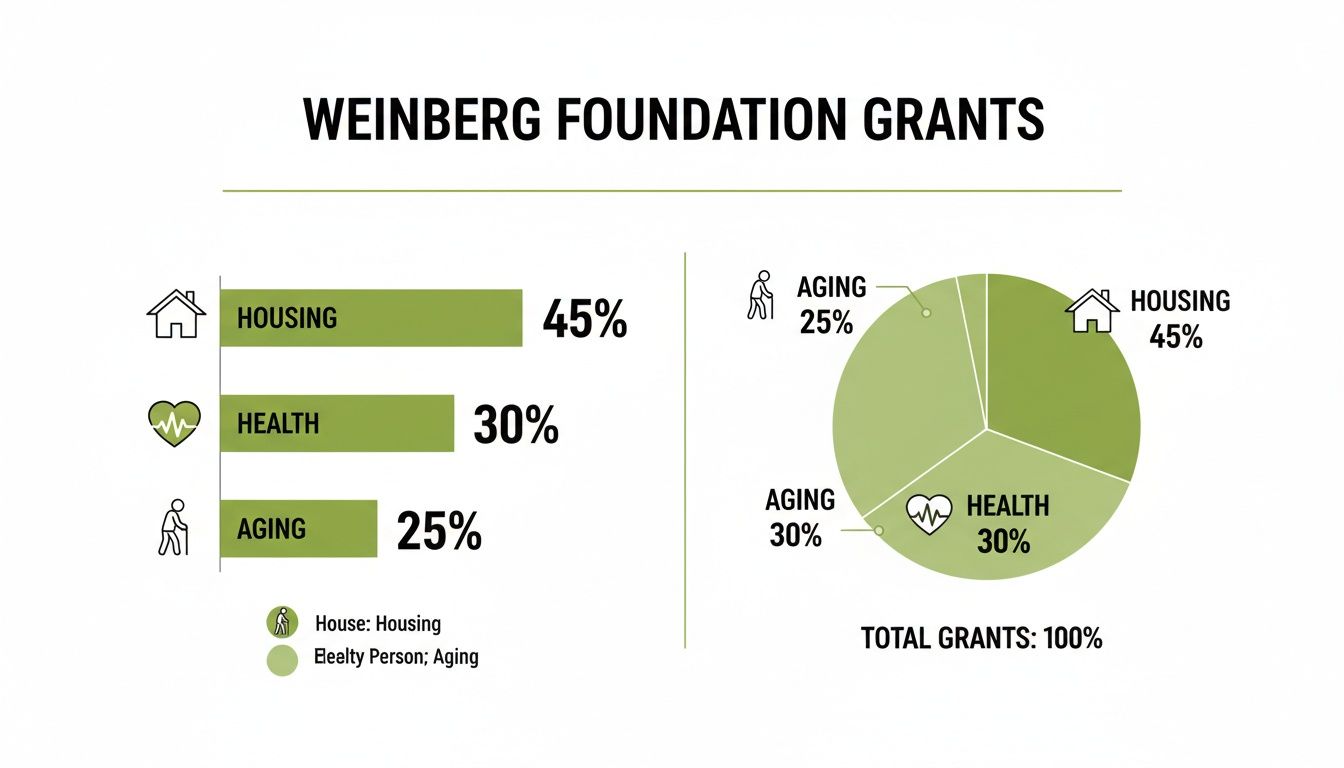
It’s clear from this breakdown that fundamental needs—stable housing, quality healthcare, and support for aging with dignity—are the bedrock of the foundation's work in its priority zones.
An organization's physical service area is one of the first things a Weinberg program officer will look at. Being outside these priority communities is an immediate dealbreaker, so confirming your geographic fit is the single most important first step you can take.
An Overlooked Nuance: Rural Communities
Now, while the focus is clearly on major cities, there’s a small exception that many grant seekers miss. The foundation may consider funding organizations in certain rural communities in the U.S.
Don’t get too excited just yet—this isn't an open invitation for all rural nonprofits. The key is proximity. These rural communities must be adjacent to one of the foundation's main priority cities. For instance, a nonprofit in a rural county just outside Baltimore could potentially be eligible if it serves low-income residents who are part of the greater regional ecosystem. The foundation gets that need doesn't neatly stop at a city's edge.
Proving You Belong
If you've confirmed you're in the right place, your job is to prove it convincingly in your application. They need to see, without a doubt, that you are part of the community they are committed to serving.
- Get Granular: Don't just list "New York City." Specify the exact boroughs, neighborhoods, and even blocks where your services are delivered.
- Bring the Data: Use hard numbers. How many clients do you serve within the priority boundaries? What percentage of your total service delivery happens there?
- Show Your Roots: Demonstrate that you're woven into the local fabric. Talk about your partnerships with other local organizations, your staff's community ties, and your long-term engagement.
Understanding the foundation’s geography-first mindset is crucial. It can save you countless hours writing an application that's dead on arrival. For the Harry & Jeanette Weinberg Foundation, all impact is local. Your task is to prove you're one of their locals.
How to Navigate The Invitation-Only Application
Let's be direct: one of the biggest challenges in securing funds from the Harry & Jeanette Weinberg Foundation is its “invitation-only” application. For many nonprofits, this sounds like a closed door. It's not. Think of it more like a series of locks, and your job is to find the right keys.
What this really means is the foundation doesn't accept unsolicited proposals. You can’t just go to their website, fill out a form, and hope for the best. Instead, a program officer has to personally invite your organization to apply. This approach lets the foundation zero in on nonprofits that are already doing incredible work that fits perfectly with its mission and geographic focus. It’s a system built on proven impact and real relationships, not cold outreach.
So, your goal isn't to find some hidden application portal. It's to become so visible and effective in your community that an invitation is the logical next step. It's less about proposal writing and more about earning your seat at the table.
Getting on the Foundation's Radar
Since you can't just apply out of the blue, how do you get noticed? The answer lies in a long-term strategy of building a reputation that a Weinberg program officer simply can't ignore.
Think of it this way: The foundation's program officers are its eyes and ears on the ground. They are constantly networking, showing up at community events, and speaking with local leaders to find the most effective organizations in their regions. Your mission is to be one of those organizations they keep hearing about.
Here are the most effective ways to position your nonprofit for that invitation:
- Go Deep in Your Community: Pour your energy into delivering outstanding direct services in one of their key areas, like Baltimore or Hawaiʻi. A strong reputation for excellence is the best marketing you can have; word travels.
- Form Smart Alliances: Partner with other respected nonprofits, especially those that might already have a relationship with the foundation. Program officers often discover new, high-impact groups through their current grantees.
- Tell Your Story with Data: Don't just do great work—shout it from the rooftops. Use your website, annual reports, and local media to share compelling stories of the lives you're changing, always backing it up with hard numbers.
The secret to the invitation-only model is this: The foundation is designed to find you, not the other way around. Make your work so impactful and visible that they have no choice but to take notice.
The Letter of Inquiry (LOI)
Even within this system, the first formal step is often a Letter of Inquiry, or LOI. While the foundation doesn't openly ask for them, a program officer who has taken an interest in your work will likely request one. This is your foot in the door—your first official chance to make a case.
An LOI is just a short, two-to-three-page document that gives a snapshot of your organization and the project you need funded. It's your elevator pitch on paper. To make yours count, it needs to be clear, concise, and absolutely compelling. If you want a masterclass on this crucial document, it’s worth learning how to write a powerful Letter of Inquiry for grant funding.
Life After the Grant Award
Getting a grant from the Harry & Jeanette Weinberg Foundation isn’t the finish line; it’s the beginning of a real partnership. This comes with clear expectations for reporting and open communication.
This isn't just about bureaucracy. It's about stewardship. The foundation has a duty to ensure its dollars are making the intended difference, and your reports are the primary way they measure that impact.
Here’s what you can generally expect:
- Financial Reports: You'll need to provide a clear, detailed accounting of how every grant dollar was spent.
- Narrative Reports: This is where you tell the story behind the numbers. You’ll share your progress, highlight success stories, and be honest about any roadblocks you hit along the way.
- Site Visits: Don't be surprised when a program officer schedules a visit. They want to see your work firsthand and meet the people on your team and in your community.
Treat every report and site visit as another chance to strengthen your relationship. Honesty about both your wins and your struggles builds immense trust. It’s what positions you for future renewals and can turn a one-time grant into a lasting, powerful partnership.
Positioning Your Nonprofit for Funding Success
When you're dealing with a funder as focused as the Harry & Jeanette Weinberg Foundation, getting a grant isn't just about having a great program. It's about having the right program. Think of it like a key for a very specific lock—a "close enough" fit just won't turn. Your nonprofit's mission, location, and the results you deliver have to line up perfectly with their strategy.

This is where you have to turn the lens inward and ask the same tough questions a Weinberg program officer would. True success comes from doing this honest self-assessment long before you ever reach out. It's about making sure your story and their goals are a natural fit, much like what’s described in A Winning Branding and Positioning Strategy.
Your Pre-Engagement Checklist
Before you spend a single minute drafting a proposal, run through this checklist with your team. This is your internal gut-check to see if you meet the foundation's non-negotiable requirements. Your answer to every single question needs to be a confident "yes."
- Mission Alignment: Is our core mission to directly fight poverty by meeting basic human needs?
- Direct Service Model: Is our work centered on providing hands-on services to people, not on research or policy advocacy?
- Geographic Priority: Do we operate exclusively for people inside one of the foundation’s specific priority communities?
- Population Focus: Do we specifically serve low-income individuals, older adults, people with disabilities, or the Jewish community?
- Programmatic Fit: Do our programs fit neatly into Housing, Health, Jobs, Education, or Community Services, exactly as the foundation defines them?
Being brutally honest here is the most valuable thing you can do. It gives you a clear "go" or "no-go" and saves you from pouring energy into an application that was never going to fly.
If you can't check every one of these boxes, the Weinberg Foundation probably isn't the right fit for you right now. It is so much better to realize this early and pivot to funders who are a stronger match. The smartest grant seekers know which doors not to knock on.
Getting a Leg Up with the Right Tools
Once you’ve confirmed you're a perfect match, your next job is to operate with a level of professionalism that makes you stand out. In a sea of applications, showing up organized and prepared isn't just a nice-to-have; it's how you signal that you’re ready for a serious partnership.
This is where grant management platforms like Fundsprout can give you a real advantage. They help you keep your opportunities organized, track every deadline, and pull together the data you need to tell a powerful story. Using a system like this sends a clear message to the Harry & Jeanette Weinberg Foundation: you’re a sophisticated, reliable organization that can handle a major grant and report on its impact. It's how you go from being just another applicant to a top-tier candidate they want to invite.
If you're looking to sharpen your process, our guide on how to find winnable grant opportunities is a great place to start.
Frequently Asked Questions
Working with a foundation as significant as Harry & Jeanette Weinberg can feel intimidating, and it's natural to have questions. Let's walk through some of the most common ones we hear from nonprofits trying to navigate their funding process.
What Is the Typical Grant Amount?
This is a classic "it depends" situation, but we can narrow it down. Grants from the Weinberg Foundation can be as modest as a $20,000 one-time award or as substantial as a multi-year commitment topping $2 million.
The biggest factor is the type of request. A capital grant for a new building or a major renovation will naturally be on the higher end of that spectrum. Program grants, on the other hand, tend to be smaller. A smart move is to dig into the foundation's past awards to organizations like yours—it’s the best way to get a real-world feel for what a reasonable ask might be.
Does the Foundation Fund Outside Its Priority Communities?
This is a crucial one, and the answer is simple: almost never. The foundation is built on a "hometown" philosophy, which means they pour their resources into specific geographic areas like Greater Baltimore, Hawaiʻi, and Chicago. They are deeply committed to this model.
While you might spot a rare national grant, those are major exceptions to the rule. For virtually everyone else, your organization must be providing direct services within one of their designated priority communities. If your work is outside those zones, your time and energy are better spent researching other funders who are a better fit.
How Do I Apply If It Is Invitation-Only?
That’s the million-dollar question, isn't it? You don't "apply" in the traditional sense. Instead, your goal is to become so effective and well-known in your community that a program officer has no choice but to notice you and reach out.
Think of it this way: the foundation's program officers are their eyes and ears on the ground. Your job is to give them a compelling success story to discover. Here’s how:
- Be the Best at What You Do: Focus on becoming a recognized leader for direct service within a Weinberg priority community.
- Build Your Network: Connect and partner with other community leaders, especially organizations that might already have a relationship with the foundation.
- Show Your Impact: Use solid data and powerful stories to make your results impossible to ignore.
The foundation's invitation-only process is designed to reward organizations that have already proven their value on the ground. It prioritizes demonstrated impact over a perfectly polished, unsolicited proposal.
What Kind of Proposals Are Most Successful?
The proposals that get funded are the ones that perfectly mirror the foundation's mission of direct service. They are laser-focused on creating tangible, measurable outcomes for vulnerable people in areas like housing, health, jobs, and education.
Of course, a great idea is only half the battle. No matter who you're applying to, mastering how to write a grant proposal is a fundamental skill that will serve your nonprofit for years to come.
Are you ready to stop chasing grants and start building a predictable funding pipeline? Fundsprout uses AI to match your nonprofit with the right funders, streamline your proposal writing, and manage your compliance—all in one place. Discover your next grant at https://www.fundsprout.ai.
Try 14 days free
Get started with Fundsprout so you can focus on what really matters.