Winning Your First Impression A Guide to LOI for Grants
Learn how to write a compelling LOI for grants that captures funder attention. Our guide offers practical tips, real-world examples, and proven strategies.

Abdifatah Ali
Co-Founder
A Letter of Intent, or LOI, is a quick, preliminary document you send to a potential funder. Its goal is simple: introduce your project and see if they're interested enough to see a full proposal. Think of it as a critical screening tool for funders and a smart first move for your nonprofit that saves everyone a ton of time.
Your First Handshake: The Role of an LOI in Grant Seeking
The whole grant-seeking game is really about building relationships. You wouldn't walk into a first meeting and launch into a 30-page monologue, right? Of course not. You'd start with a firm handshake and a quick, clear introduction.
That's exactly what an LOI is. It’s your handshake—your chance to make a strong, positive first impression that shows you're a serious contender.
Funders are often buried under hundreds, if not thousands, of applications. The LOI is their first line of defense, letting them quickly sort through the noise and see which projects genuinely align with their mission. This pre-application step is a massive time-saver. Funders don't have to wade through long proposals that are a poor fit, and you don't waste precious hours writing a full application for a foundation that was never going to fund you in the first place.
The Strategic Purpose of an LOI
Don't fall into the trap of thinking an LOI is just a grant proposal on a diet. Yes, it has some of the same ingredients, but its purpose is completely different. A full proposal is built to persuade and is packed with exhaustive detail. An LOI, on the other hand, is designed to qualify and inquire. Its only job is to get a "yes" to one question: "Is this project a good enough match to learn more?"
The brevity of the LOI is actually its biggest advantage. It forces you to get crystal clear on your project's core message. You have to boil everything down to the most compelling points: the problem you're solving, your unique solution, and why your organization is the one to do it. This sharp focus helps the funder immediately grasp the value of your work.
A well-crafted LOI doesn't just check a box on an application checklist; it opens a door. It's a strategic tool that initiates a conversation, demonstrates professionalism, and respectfully values a funder's time.
When you master the art of the LOI, you move from just following directions to strategically positioning your organization for a win. To make the distinction even clearer, let's break down how an LOI stacks up against a full-blown proposal.
LOI vs Full Grant Proposal At a Glance
The table below really highlights the fundamental differences in purpose, length, and detail between these two critical documents. Understanding these distinctions is key to getting your approach right at each stage.
As you can see, one is a query, and the other is the full argument. Each plays a distinct and important role in the grant funding journey.
Mapping the Modern Grant Funding Landscape
Before you even think about writing your LOI, you need to know who you're talking to. The world of grant funding isn’t one big, monolithic entity. Instead, it’s a dynamic ecosystem made up of federal agencies, private foundations, and corporate givers, each with its own culture and priorities. Getting this right from the start is half the battle.
The federal government is, without a doubt, the biggest player in the game. When you’re writing an LOI for a federal agency like the NIH or NSF, think formal, data-driven, and buttoned-up. They want to see your homework—rigorous methodology and a rock-solid alignment with their specific program goals are paramount.
On the other hand, independent foundations and corporate funders often have a bit more wiggle room. They tend to lean more into mission-driven narratives. If you're approaching a local community foundation, a personal, story-driven tone that clearly illustrates how your project will change lives can be incredibly effective.
Understanding the Key Players
As you start to map out potential funders, it’s essential to be clear on everyone's role. A solid grasp of understanding the roles of grantee and grantor is fundamental. Knowing what’s expected from both sides helps you build a strong, professional relationship right out of the gate.
A one-size-fits-all LOI is a ticket straight to the "no" pile. Taking the time to really dig into a funder’s mission, past awards, and strategic priorities is the most important prep work you can do.
To give you a sense of scale, the federal government is the single largest grant source in the United States, with 26 different grant-making agencies.
Now, compare that to the nation's 86,000+ independent foundations. While they account for a hefty 17% of all charitable giving, they are still dwarfed by federal funding. Corporations chip in a smaller but vital share, making up 3% of grant funding.
This concept map helps visualize how the LOI functions as a critical bridge, connecting your organization’s needs with the funder's mission, paving the way for a full proposal.
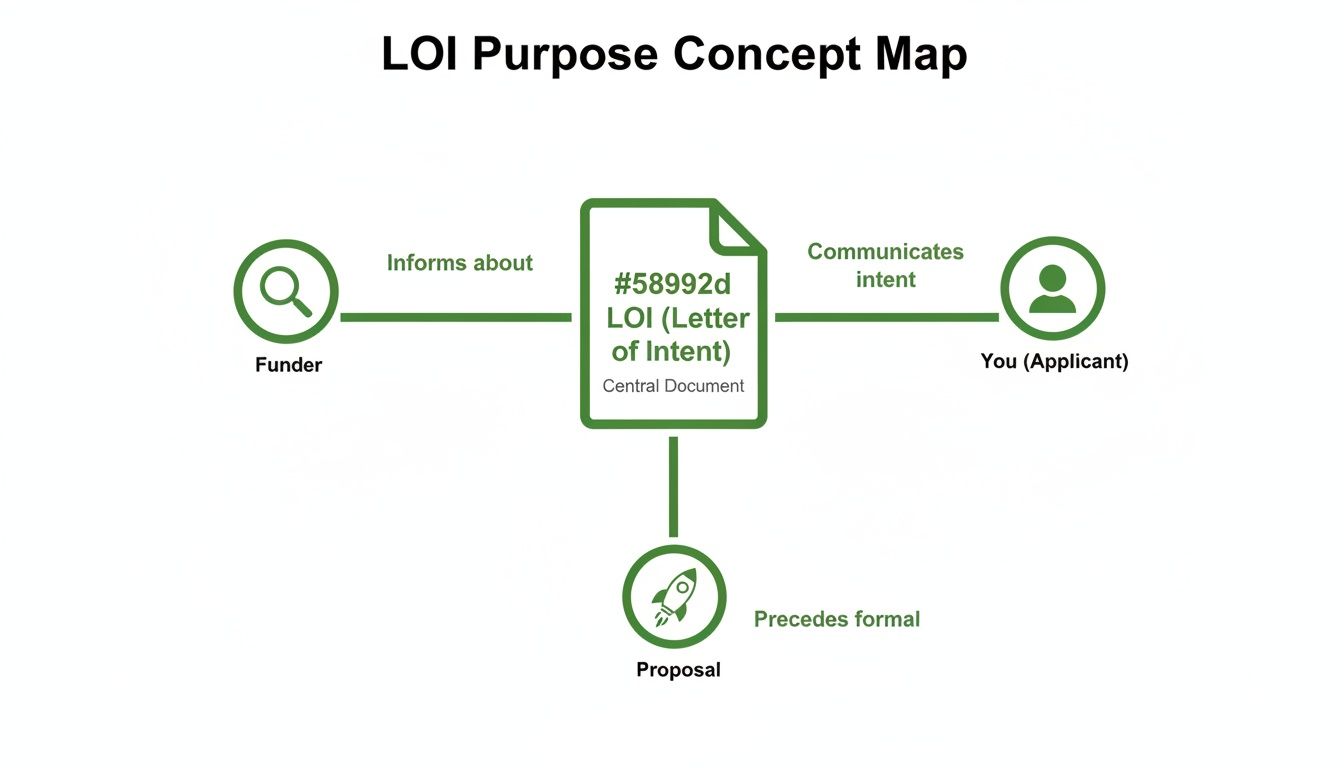
Think of the LOI as a strategic filter for the funder and a relationship-starter for you. Your ability to recognize which funding stream you're tapping into—and to adapt your communication style—can make all the difference in whether you get that coveted invitation to submit a full proposal.
Putting the Pieces of Your LOI Together
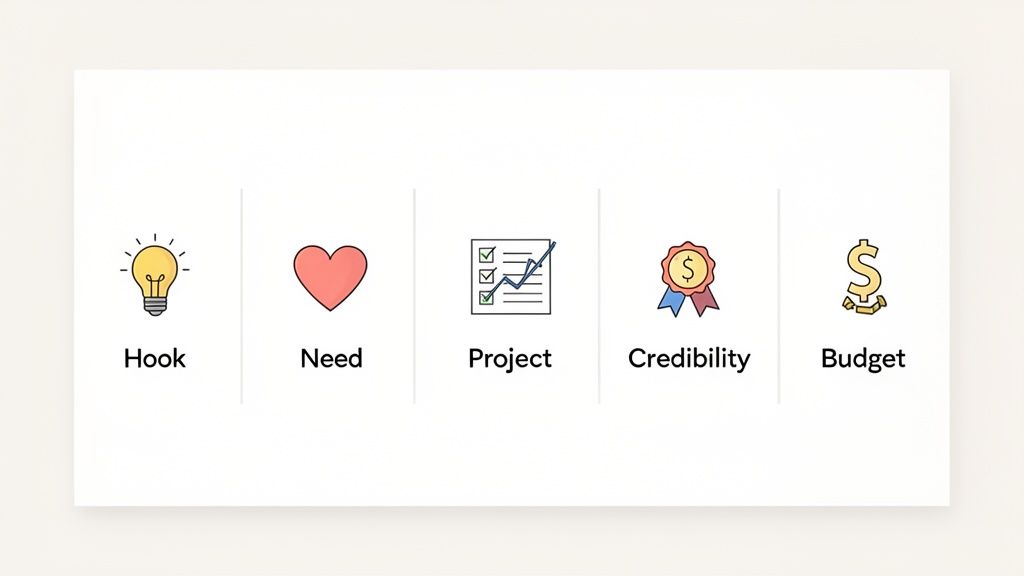
Alright, you know who you’re talking to. Now it’s time to actually build the LOI. Think of it less like filling out a form and more like building a compelling case, piece by piece, that gets the funder excited about what you're doing.
A solid structure is everything here. Before you even start writing prose, it’s a smart move to craft a powerful outline that lays out your main arguments for each section.
To make this real, let’s walk through this with a fictional nonprofit, the "Northwood Youth Center." They're seeking a grant for a new after-school STEM program aimed at at-risk middle schoolers.
The Introduction: Your Make-or-Break First Impression
This is your opener, your hook. You have maybe one or two sentences to grab the reader and make them care. You need to say who you are, how much you need, and why it's important—immediately. Cut the fluff and get straight to the point.
Here’s how Northwood Youth Center could do it:
"Northwood Youth Center respectfully requests a grant of $25,000 from the Community Forward Foundation to launch our 'Future Innovators' after-school STEM program. This initiative will provide 50 at-risk middle school students with hands-on learning in robotics and coding, directly addressing the growing educational gap in our city’s underserved neighborhoods."
See how that works? It's direct, it's specific, and it instantly connects the money to a real-world problem. The funder isn't left guessing.
Making the Case: Why This, Why Now?
You’ve got their attention. Now you have to convince them there’s a genuine, urgent problem that needs solving. This is where you bring in the hard data to back up your claims. Vague statements won’t cut it.
Your statement of need has to be built on a foundation of credible evidence. If you want to really nail this part, our guide on writing a powerful https://www.fundsprout.ai/resources/statement-of-need is packed with detailed strategies.
Northwood Youth Center’s data-driven approach:
"Currently, only 22% of students from Northwood's lowest-income district meet state proficiency standards in mathematics, and fewer than 15% pursue advanced science courses in high school. This disparity creates a significant barrier to future academic and career success for our community’s youth."
Those numbers paint a stark, undeniable picture of the problem. It’s not just an opinion; it’s a fact.
The Solution: Your Project and Its Payoff
Okay, you’ve outlined the problem. Now, what’s your solution? In this section, you'll briefly explain what your project actually involves and what you plan to achieve. The key is to show the funder you have a well-thought-out, actionable plan.
Your project description needs to be a direct answer to the need you just laid out.
What You'll Do:
- Recruit 50 students from three local middle schools.
- Provide 90 minutes of STEM instruction twice a week.
- Host a final "Innovation Fair" where students can showcase their projects.
What You'll Achieve:
- Increase participants' confidence in STEM subjects by 40%.
- Improve math test scores by an average of 15%.
- Give students a solid foundation in coding and robotics skills.
When you clearly tie your activities to measurable outcomes, you signal that you're a serious organization. It shows funders you’re not just planning to be busy—you’re planning to make a real, quantifiable difference.
To wrap things up, you’ll add a quick note on your organization's track record and a high-level budget snapshot. These final elements reassure the funder that you’re a capable and trustworthy partner for their investment, bringing your persuasive LOI full circle.
LOI Examples and Templates That Actually Work
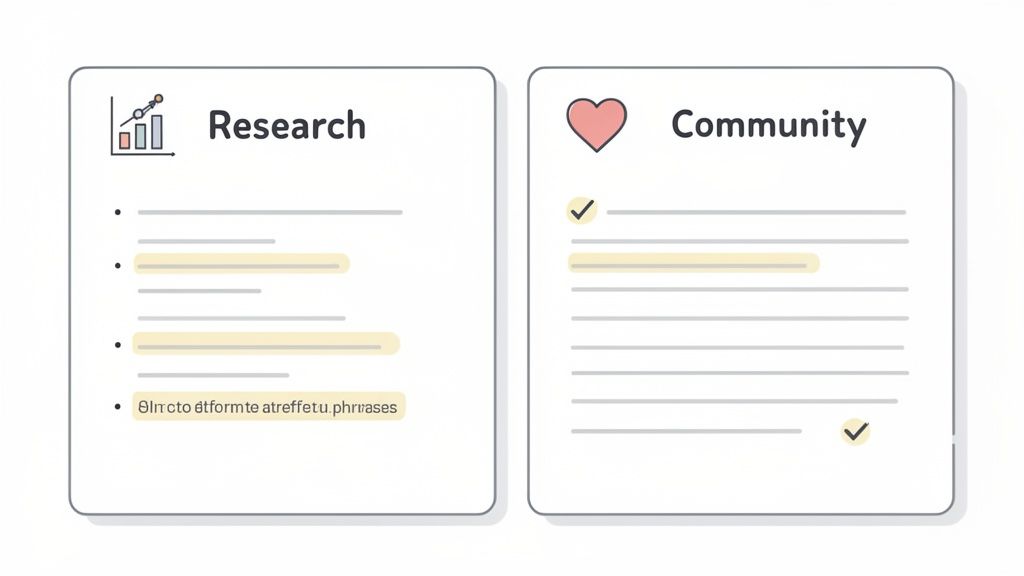
Theory is one thing, but seeing a successful Letter of Intent in the wild is another. The best way to get a feel for the rhythm and tone of an effective LOI for grants is to see how others have done it. The language, the structure, even the persuasive angle—it all shifts depending on the funder and the project.
Let's dive into two very different scenarios to see how the approach changes: a research-heavy LOI for a national foundation versus a community-focused letter for a local arts council.
Example 1: The Research-Heavy LOI
Suppose you’re pursuing a major research grant to study educational inequality. The funder in this case is all about rigorous methods, clear theoretical frameworks, and a solid evidence base. Your LOI has to speak their language with academic precision.
- Introduction: You’d get straight to the point, stating your intent to study a specific program's impact and citing the grant program by name. No fluff.
- Problem Statement: This is where you bring the data. You’ll present hard statistics on the educational gap your study targets, referencing established literature to prove you’ve done your homework.
- Project Description: Here, you’ll briefly outline your methodology—maybe it’s a mixed-methods approach or a cluster randomized trial—and explain how it will produce the strong empirical evidence the funder needs to see.
- Organizational Capacity: You’ll lean heavily on your Principal Investigator’s expertise and your institution’s track record in conducting similar large-scale studies.
The tone here is formal, objective, and completely data-centric. Every claim you make is backed by evidence, building a case that your team can execute a methodologically sound project.
Example 2: The Community-Focused LOI
Now, let's switch gears. Imagine you're writing to a local arts council for a project bringing public art to underserved neighborhoods. This funder cares deeply about direct community impact, engagement, and the human story. Your LOI needs to be passionate and people-focused.
A community-focused LOI thrives on storytelling. It connects the funder’s investment directly to the human impact, painting a vivid picture of how their support will transform lives and strengthen the local fabric.
- Introduction: Your hook shouldn't be a statistic, but a compelling story about the neighborhood and its need for creative expression.
- Problem Statement: Forget national data. You’d use local survey results, powerful testimonials from residents, or quotes from community leaders to show the need on a human scale.
- Project Description: You would describe the collaborative process of creating the art, emphasizing how community members will be involved from concept to installation. It's about co-creation, not just delivery.
- Organizational Capacity: Your credibility comes from your deep roots in the community and a history of successful projects that prove you can engage residents authentically.
This letter is narrative-driven and emotionally resonant. It connects with the heart, not just the head.
Putting It All Together: A Framework for Success
Even though the tone and content can be worlds apart, the underlying structure of a strong LOI is remarkably consistent. Having a solid framework is essential for organizing your thoughts. To get you started, we’ve put together a comprehensive guide with a sample letter of inquiry for grants that you can adapt to your own project and funder.
A good template ensures you hit all the key components in a logical, persuasive order. The table below offers some general word count guidelines. This is a crucial part of the process—brevity and focus are everything in an LOI.
Key LOI Elements and Word Count Guidelines
This table gives you a quick snapshot of how to allocate your precious space in a standard one-page Letter of Intent. Sticking to these recommendations helps keep your message crisp and to the point.
Think of these word counts not as rigid rules, but as guardrails to ensure every single word earns its place on the page.
How to Navigate a Shifting Global Funding Environment
The grant funding world doesn't operate in a bubble. It's deeply tied to economic waves, policy shifts, and changing global priorities, meaning the landscape is always in flux. Keeping a finger on the pulse of these changes isn’t just good practice—it's absolutely vital for your organization's strategic planning and, frankly, its survival.
A major trend we’re all watching right now is the tightening of international aid budgets. This volatility has a direct and immediate impact on nonprofits that depend on these funds for critical humanitarian and development work. Before you even think about writing your LOI for grants, you need to know which funding streams are holding steady and which are shrinking.
This is especially critical for organizations that rely on Official Development Assistance (ODA), a cornerstone of global development funding. The outlook is tough. The OECD is projecting sharp declines for 2025, forecasting a drop of 9-17% after an already significant 9% decrease in 2024. This could push ODA's share of Gross National Income (GNI) down to 0.27%, a level we haven't seen since 2007. I highly recommend reading the full OECD report on the cuts in official development assistance to grasp the full picture.
Adapting Your LOI for a Competitive Climate
When the market tightens, funders naturally become more selective. Your LOI has to do more than just pitch a great idea; it needs to signal that your organization is resilient and has real foresight. Funders are actively looking for partners who get the financial reality of the situation and have a solid plan to navigate it.
Proving your project’s sustainability is no longer a "nice-to-have" feature. It's a non-negotiable. Your LOI must, even if briefly, show how your project will create lasting impact long after the grant money is spent.
In today's funding environment, an LOI that shows you understand the broader economic context will immediately stand out. It tells the funder you're not just a project manager but a strategic partner who can handle uncertainty.
Emphasizing Stability and Diverse Funding
So, how do you actually bake this awareness into a compelling LOI? The trick is to subtly weave in details that build a funder’s confidence in your organization's stability and strategic thinking.
Here’s how you can position your project to win:
- Mention your diversified funding. If you have support from multiple sources, say so. A simple sentence like, "This project is supported by a blend of community donations, corporate sponsorships, and earned income," signals that you aren't putting all your eggs in one basket.
- Lean into efficiency. Frame your budget request around cost-effectiveness. Use language that shows you’re committed to maximizing every single dollar to get real, measurable results.
- Align with their latest priorities. Do your homework. Has the funder recently shifted its strategic focus? Pointing out how your work directly supports their newest initiatives shows you’re proactive, attentive, and a perfect fit.
By strategically addressing the current funding climate, your LOI will do more than just tick the boxes. It will prove a level of professional savvy that puts you miles ahead of the competition.
Common LOI Mistakes That Lead to Rejection
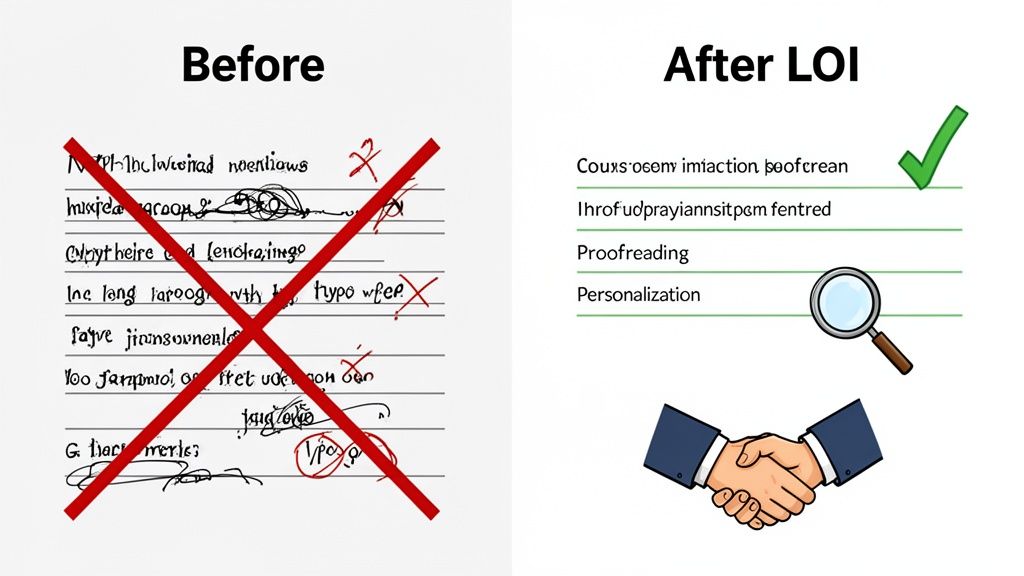
I’ve seen it happen too many times: a brilliant, world-changing project gets tossed aside because of a few simple, avoidable mistakes in the Letter of Intent. In today's hyper-competitive funding world, there's just no room for error. That first impression your LOI makes is often the only one you'll get.
The funding landscape is tightening, to put it mildly. We're looking at a projected 21% drop in development assistance for health between 2024 and 2025, largely due to a massive 67% cut from the U.S. This isn't just a number on a page; it's already led to a 23% funding loss for many NGOs and forced even major organizations to downsize. You can read more about the state of global health funding at Think Global Health.
What does this mean for you? It means your LOI has to be absolutely flawless to even get a second look.
Failing the First Test: Ignoring Instructions
The single most common—and easily fixable—mistake is failing to follow the funder's guidelines. To the letter.
If a foundation asks for a two-page LOI with a specific font and margin, that's not a suggestion. It’s the very first test of your ability to follow directions. Disregarding these rules signals a lack of attention to detail and, frankly, a lack of respect for the funder's process. Program officers are always looking for easy ways to narrow the applicant pool, and this is a gift to them.
The Dangers of Vague Language and Jargon
Your passion for your project is your greatest asset, but it can also lead you down a path of using insider jargon or overly broad statements that mean nothing to an outside reviewer. Ambiguity is the enemy of a successful LOI for grants.
Just look at the difference:
Before: "Our program will empower at-risk youth to achieve their full potential through holistic interventions."
After: "Our program will improve high school graduation rates for 150 first-generation students by providing 3 hours of weekly, one-on-one academic tutoring."
The second example is powerful because it's specific, measurable, and clear. It replaces feel-good buzzwords with concrete numbers and outcomes. For more tips on sharpening your message, our guide on how to write a letter of inquiry is a great place to start.
One of the quickest ways to lose a funder's interest is to send a generic, one-size-fits-all LOI. Customization isn't just a best practice; it's a fundamental requirement for showing genuine alignment and effort.
Small Errors That Cause Big Problems
Finally, the small stuff can completely undermine your credibility. Typos, grammatical mistakes, or addressing the letter to the wrong person scream one thing: this wasn't important enough for you to double-check.
These are the instant disqualifiers I see all the time:
- Wrong Funder Name: A copy-paste error that will get your LOI deleted in seconds.
- Budget Mismatches: The amount requested in your intro paragraph doesn't match the budget summary.
- Broken Links: You include a link to your website for more info, but it leads to a 404 page.
Before you even think about hitting submit, have at least two other people read your LOI. A fresh set of eyes will catch the little mistakes you’ve become blind to. Polishing these details shows the professionalism a funder expects from a future partner.
Answering Your Top LOI Questions
Even with the best guide, you're bound to have a few questions as you start writing your LOI. It's just part of the process. Let's tackle some of the most common ones we see from nonprofits trying to navigate the grant world.
What's the Ideal Length for an LOI?
Keep it short and sweet. The sweet spot for a letter of intent is usually between one and three pages.
But here's the most important rule: always check the funder's guidelines first. If they ask for a two-page maximum, don't send three. They set those limits for a reason, and respecting them shows you're detail-oriented. The goal isn't to tell your entire story, but to give them just enough to be intrigued and want to learn more.
Think of it like a movie trailer. Your LOI should showcase the highlights and get the funder excited to see the full feature film—which is your full proposal.
Should I Reach Out to the Funder Before I Send Anything?
This is a great question, and the answer comes down to one thing: what do their guidelines say?
If the foundation encourages or allows contact, a quick, professional call or email to the right program officer can be a game-changer. It shows you've done your homework and gives you a chance to make sure your project is truly a good fit before you invest the time in writing.
On the other hand, if the guidelines explicitly say "no contact," then you absolutely must follow that rule. Ignoring it is a red flag for funders and an easy way to get your LOI tossed aside without a second glance.
Okay, I Hit Submit. What Now?
After you send your LOI, the waiting game begins. The funder's review team takes over, and you can typically expect one of three outcomes:
- The Green Light: You'll get an invitation to submit a full grant proposal. This is the best-case scenario!
- The Polite "No": You'll receive a notification letting you know they've decided not to move forward with your project this time.
- The Sound of Silence: Sometimes, especially with larger foundations that are swamped with submissions, you might not hear back at all if it's not a fit.
Don't panic while you wait. Most funders are good about providing a timeline in their guidelines, so you should have a general idea of when you can expect to hear from them.
Ready to stop chasing grants and start winning them? Fundsprout uses AI to match you with the right funders, streamline your writing process, and manage deadlines so you can focus on your mission. Discover your next funding opportunity.
Try 14 days free
Get started with Fundsprout so you can focus on what really matters.