Discover how to find winnable grants
Discover how to find winnable grants more efficiently by evaluating eligibility, competition, and funder fit to secure funding.

Abdifatah Ali
Co-Founder
Tired of the grant-seeking hamster wheel? We’ve all been there. You spend countless hours digging through databases, writing proposals until your eyes glaze over, and hitting "submit" again and again, only to be met with a flood of rejections. It’s a frustrating cycle that leads to serious burnout and pulls precious time away from your actual mission.
The root of the problem is a common one: many nonprofits get stuck chasing every grant they find instead of zeroing in on the right ones. This guide is your playbook for breaking that cycle for good. We're ditching the stressful, low-return strategy of applying for anything and everything. Instead, we'll build a smart, repeatable process to find, vet, and prioritize the funding opportunities your organization is genuinely positioned to win.
From Chasing Grants to Winning Them
Let's be honest, the funding world has gotten incredibly competitive. Nonprofits that are systematically targeting the best-fit grants are the ones who are weathering today's volatility. Consider the numbers: while over 70% of nonprofits rely on government funding and 81% get support from private foundations, nearly half (48%) have seen their average grant sizes shrink.
At the same time, 93% of organizations are actively seeking out new funders, which means more competition for every single dollar. Simply cranking up your application volume isn't just ineffective—it's a recipe for failure in this environment. You can dig into more of these funding trends in this comprehensive survey report.
"A winnable grant isn't just one you can get; it's one you should get. It aligns perfectly with your mission, builds on your strengths, and doesn't force you to become something you're not."
This is all about working smarter, not harder. It starts with an honest look at what your organization does best and a deep dive into what a funder truly wants to achieve. By concentrating your energy, you don't just boost your win rate; you build real, lasting relationships with funders who are genuinely invested in your work.
Differentiating Winnable from Long-Shot Opportunities
The first crucial skill is learning to spot the difference between a golden opportunity and a time-wasting long shot. This isn't always clear just from reading an RFP. A truly winnable grant feels like a natural extension of what you already do. A long shot, on the other hand, often forces you to twist your mission or stretch your resources to an uncomfortable, unsustainable degree.
To help you quickly tell them apart, here's a look at what separates a grant you should go after from one you should probably pass on.
Winnable Grants vs Long-Shot Grants: A Comparison
Keep these distinctions in mind as you start your search. Being brutally honest with yourself at this stage will save you an incredible amount of time and energy down the line, freeing you up to focus on the applications that truly count.
Building Your Grant Prospecting Pipeline
Let’s be honest: creating a grant prospecting pipeline isn't about finding one magical database. It's about building a smart, multi-channel system that consistently feeds you qualified opportunities. The real goal isn't to build a massive, overwhelming list of every grant out there. It's to cultivate a dynamic, manageable flow of prospects that are actually worth your time. A passive "wait-and-see" approach just doesn't cut it anymore; you need to be actively pulling from a handful of diverse, high-quality sources.
This shift in strategy is what takes you from chasing any and every dollar to consistently winning grants that are a perfect fit for your mission. It’s a simple but powerful process.
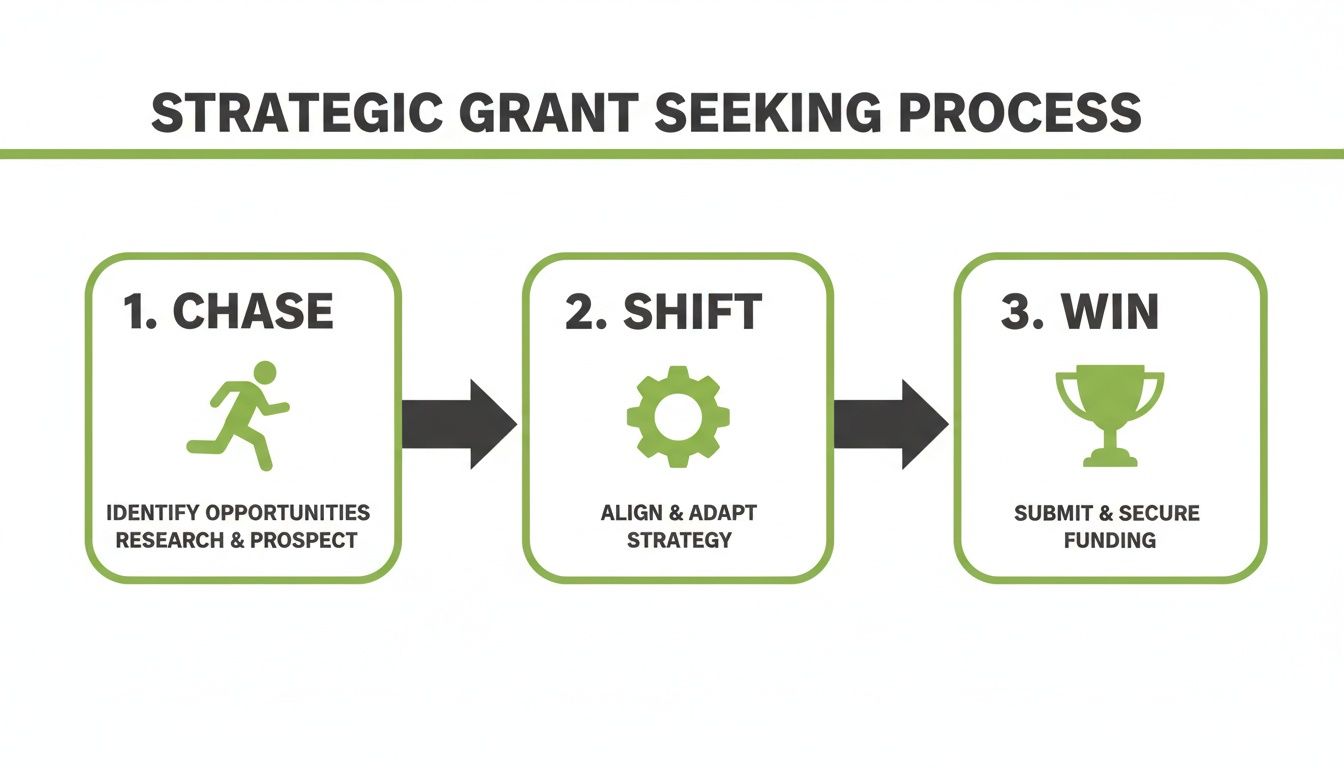
This really breaks down the journey from chaotic grant chasing to a focused, strategic approach that gets results. That middle step—the "shift"—is where the real work happens.
Master Government Grant Portals
Federal funding is a huge piece of the pie, but trying to navigate the official portals can feel like a full-time job. The secret is to stop doing one-off searches and start using automated, targeted alerts. A site like Grants.gov should be your home base for all federal opportunities.
Don't just plug a few keywords into the search bar and call it a day. Spend a little extra time setting up saved searches based on your nonprofit’s specific focus, the geographic areas you serve, and the types of activities you’re eligible for. This simple action turns a passive library into an active prospecting machine that drops relevant opportunities right into your inbox.
Dive Deep into Foundation Directories
While government grants are great, private foundations offer a different flavor of funding—often with more flexibility. This is where getting comfortable with foundation directories pays off big time. Think of them as treasure troves of information, provided you know where to dig.
Platforms like Candid and Instrumentl give you an incredible look into a foundation's giving history, their current priorities, and even who works there. But don't just skim their mission statement. The real gold is in analyzing their past grantees. Who are they actually funding? What’s the average check they write? This historical data is the single best predictor of what they'll do next and helps you find winnable grants by pinpointing funders who already love work just like yours. If you're just getting started, you might want to check out the options we've gathered in our guide to the best free grant databases for nonprofits.
Your secret weapon here is the funder’s 990-PF tax form. It’s a public document that lists every single grant they awarded in a year, including the organization and the exact amount. This is raw, unfiltered data on where their money truly goes.
Tap into Local and Community Foundations
Never, ever underestimate the power of funding in your own backyard. Community foundations are literally designed to support the geographic area you serve, making them a prime source for winnable grants. Plus, their program officers are usually deeply connected to local issues and far more accessible than their counterparts at massive national foundations.
To prospect effectively at the local level, you need to get in the mix:
- Get on their list: Subscribe to the newsletters of every community foundation in your service area. This is non-negotiable.
- Show up: Attend their workshops, pop into their webinars, and participate in community forums. Face time matters.
- Read the local news: Keep an eye on local business journals. They often report on new corporate giving programs or family foundations being set up right in your region.
This "local-first" strategy often uncovers grants that are not only a great fit but also help build your credibility right where it counts—within your community.
Employ Unconventional Prospecting Methods
Beyond the big databases, some of the absolute best opportunities are found on paths less traveled. This is where you can get a serious competitive edge. One of my favorite tactics is to do a little friendly snooping on organizations similar to yours in mission and size. Check out the "Our Supporters" page on their website or flip through their annual report. They are literally handing you a list of foundations that are already pre-qualified to be interested in your work.
Social media can also be a surprisingly powerful tool. Follow program officers and foundations you admire on platforms like LinkedIn and X (formerly Twitter). They often drop hints, announce new funding cycles, and discuss their priorities, giving you an invaluable inside look. To make your entire grant search more efficient, it's worth reading these 9 tips to improve your sales pipeline; you’ll find that many of the same principles for nurturing leads apply perfectly to cultivating relationships with funders.
Vetting Funder Alignment and Eligibility
Finding a grant in a database is just the first step. The real work starts when you have to figure out if it's actually a good fit. This is where you switch gears from being a prospector to a detective, using a two-part vetting process to make sure you're not wasting a single second on a dead end.
This approach helps you quickly weed out the non-starters so you can focus your energy on the opportunities that truly hold promise.
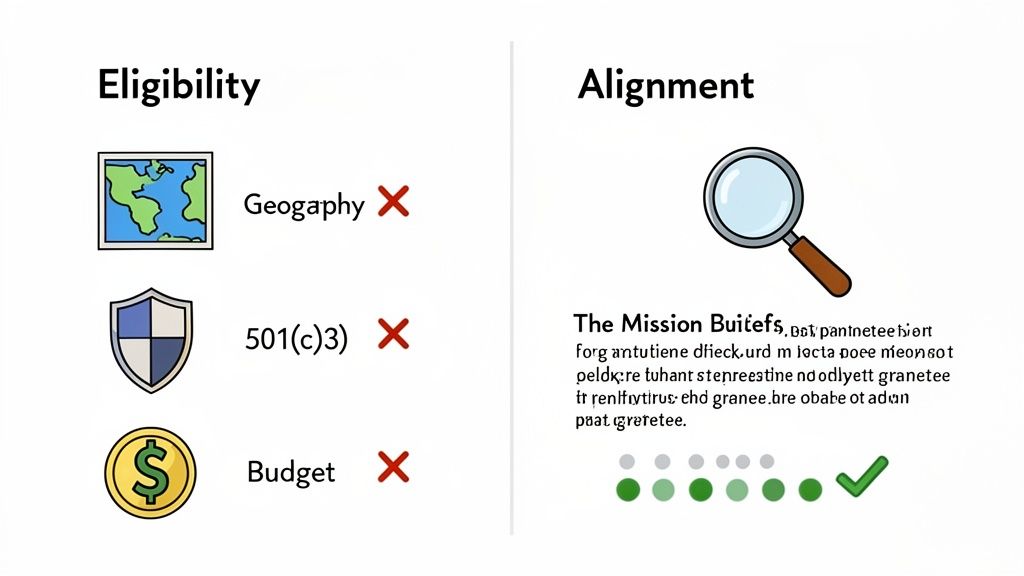
The first check is all about the non-negotiables. The second is a much deeper dive into whether you and the funder are truly on the same page. Think of it like a funnel: you start wide with a bunch of possibilities and systematically narrow them down to the grants you have the best shot at winning.
The Fast-Track Eligibility Screen
Before you even start dreaming about how you'll use the funding, you need to clear the basic hurdles. These are the black-and-white requirements that funders use to filter out most applicants right away. If you don't tick these boxes, nothing else you do will matter.
This initial screen shouldn't take you more than 30 minutes. Your only goal here is to find a reason to say "no" as fast as you can and move on.
Key Eligibility Checks:
- Geographic Focus: Does the funder only support work in a specific city, state, or region? If you’re outside that zone, it's an immediate "no."
- 501(c)(3) Status: Most foundations require this specific tax-exempt status. If you have a different designation or use a fiscal sponsor, you absolutely must confirm they’re open to that.
- Organizational Budget Size: Some funders have strict rules about the size of organizations they’ll support (e.g., "annual budget under $1 million"). Don't try to fudge these numbers—it's an easy thing for them to verify.
- Population Served: Are they focused on a specific group, like seniors, at-risk youth, or military veterans? Make sure the people you help are the people they want to fund.
Failing one of these checks isn't a knock against your organization's great work. It's just a sign of a mismatch, and catching it early saves you dozens of hours. This is where a tool like Fundsprout can be a huge help, as it can automatically flag these mismatches before a grant even hits your radar.
Decoding True Funder Alignment
Once a grant passes that first quick check, the real investigation begins. This is where you move beyond the checklist and start reading between the lines. True alignment isn't just about matching keywords; it’s about getting a feel for a funder’s personality, their real priorities, and even their unwritten rules.
A funder's past giving is the single best predictor of their future giving. Their portfolio of past grantees is a roadmap to what they truly value, far more than any beautifully written mission statement.
Think of this deeper dive as a strategic intelligence mission. You're trying to answer one core question: Does our story actually resonate with what they care about?
Analyzing Past Grantees for Clues
Start by digging into the list of organizations they've recently funded. You can usually find this in their annual report or on their website. Don't just scan the names.
Let's say you run an after-school arts program. You find a foundation that says it funds "youth enrichment." That sounds promising, right? But then you look at their recent grantees and see three youth sports leagues, a STEM summer camp, and a debate club. They haven't given a single dollar to an arts program in three years. That’s a major red flag. While you technically fit their description, their actions show their priorities are elsewhere.
On the other hand, if you see they've funded two other arts programs in neighboring towns, that’s a fantastic green light. It tells you they get it—they understand and value the specific kind of work you do.
Reading Between the Lines of Funder Language
Pay close attention to the specific words a funder uses in their guidelines and on their site. Do they talk about "innovative, scalable solutions" or do they emphasize "long-term, community-based support"? Their vocabulary is a window into their worldview.
- "Innovative" or "Pilot" suggests they want to fund something new and unproven.
- "Evidence-Based" or "Proven Models" means they want programs with a documented track record.
- "Capacity Building" signals an interest in strengthening your organization itself, not just a specific project.
- "Systems Change" tells you they’re looking for big-picture solutions that tackle root causes, not just symptoms.
Mirroring their language in your proposal is crucial. If they want innovation, don't just pitch them your most stable program. Frame it as a new adaptation or a pilot expansion. For those tackling federal grants, which have their own very specific language, our guide on how to find federal grants offers more tips for navigating those complex requirements.
By mastering this two-step vetting process, you’ll stop chasing long shots and start building a pipeline full of grants you can actually win.
Auditing Your Capacity and Competitive Edge
So, you've found a grant that seems to align with your mission and you meet the basic eligibility rules. Great start. But now comes the reality check. This is where you have to get brutally honest with yourself and ask two critical questions: can we really compete for this, and can we actually handle it if we win?
This is a two-part audit. First, you'll need to do a little detective work to see who you're up against. Then, you'll take a hard look in the mirror to make sure you have the internal horsepower to follow through on your promises without burning everyone out.
Sizing Up the Competition
Before you even think about writing a proposal, you have to understand the playing field. Who has this funder given money to before? Looking at their past grantees is the single best way to figure out what they consider a “winning” organization and whether you can realistically stand out from the crowd.
Let’s say you’re a small community food bank with an annual budget of $300,000. You find a grant from a massive national foundation that looks like a perfect match. But a quick peek at their past awards shows they only fund multi-million dollar, statewide hunger relief networks. That one piece of information tells you everything. Your mission aligns, but your scale doesn't. This isn't a failure—it's intelligence that helps you find winnable grants from funders who actually support organizations your size.
Key Questions for Your Competitive Analysis:
- What’s their type? Look at the budget size, staff count, and geographic reach of past winners. Are they scrappy local groups or established national players?
- What’s the real award size? If a funder’s maximum award is $100,000, but their average grant is only $15,000, that should probably inform your request.
- Is there a pattern here? Do they seem to have a soft spot for organizations in a certain city, those using a specific program model, or nonprofits they've funded before?
Doing this homework stops you from wasting time on a race you can't win. It’s about redirecting your precious energy toward funders who have a track record of supporting organizations just like yours.
Conducting an Internal Capacity Audit
Just as crucial as sizing up the competition is taking an honest look at your own organization. Let me be clear: winning a grant you can’t manage is a catastrophe waiting to happen. It can wreck your reputation, fry your staff, and put future funding at risk. Think of an internal capacity audit as a proactive gut check to make sure you’re ready.
This isn’t about being perfect; it’s about being prepared. Do you have the staff, the systems, and the financial stability to handle the extra work and reporting that always comes with new money? To help structure and present your operational and financial strategy clearly, it can be useful to review some solid business plan examples.
A grant should be a catalyst for your mission, not a burden on your operations. If winning means your team will be overwhelmed and your core programs will suffer, it's not a winnable grant.
The funding landscape is massive, but the money isn't spread evenly. This makes precision in finding the right grants more important than ever. Giving USA reports that total U.S. charitable giving hit a record $592.50 billion, with foundation grantmaking topping $100 billion. At the same time, 87% of foundation leaders say demand for their funding is up. This pressure-cooker environment means that well-targeted, high-quality proposals are the ones that break through. Nonprofits that can quickly spot which foundations are increasing their payouts or offering more flexible grants can focus their efforts on those higher-probability opportunities.
A simple checklist can be a game-changer for this self-assessment. Cover your core operational areas to be sure you’re ready to apply and succeed. If you find gaps, don't panic. Strengthening these areas is often the exact purpose of nonprofit capacity building grants, which might be a smart first step.
How to Prioritize Your Grant Pipeline with a Scoring Matrix
So, you’ve done the hard work. You've built a solid list of prospects, vetted them for alignment, and made sure you have the capacity to deliver. Your grant pipeline is now full of opportunities that are actually worth your time.
But let’s be real—with limited hours in the day, the big question is always: where do you start? Trying to tackle them all at once is a classic recipe for burnout and a stack of rushed, mediocre proposals.
This is where a simple scoring matrix can be a game-changer. Instead of just going with your gut or frantically chasing the nearest deadline, this tool helps you systematically rank each opportunity. It turns a jumbled to-do list into a strategic action plan, ensuring your team’s precious energy is focused on the applications you're most likely to win.
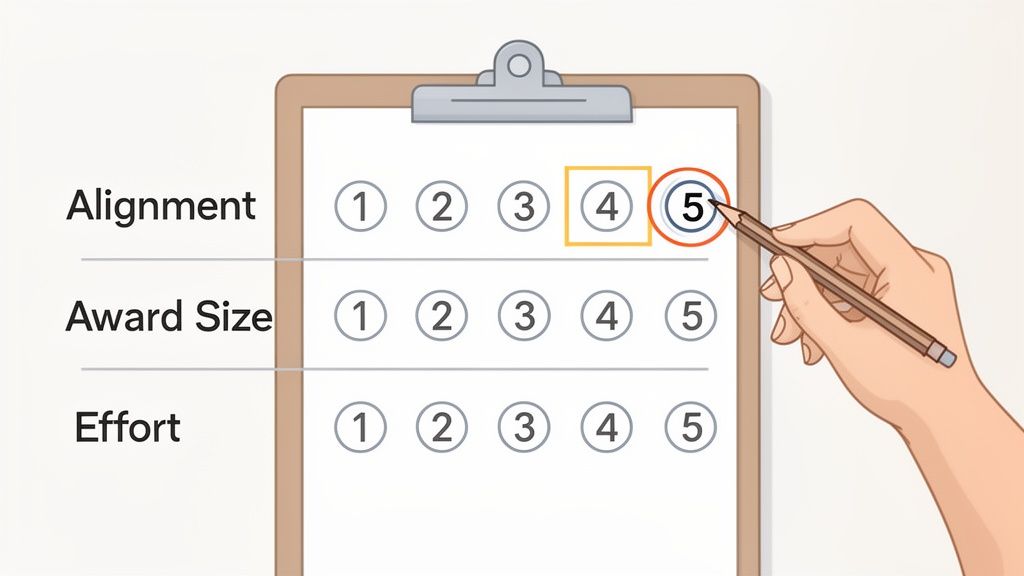
The goal here is to get an objective snapshot of each grant, making your "yes" or "not right now" decisions logical and easy to explain. It’s a powerful way to find winnable grants because you’re quantifying what "winnable" actually means for your specific organization.
What Should You Be Scoring?
A great scoring matrix doesn’t need to be complicated. In my experience, it’s best to focus on the handful of factors that truly dictate a grant’s value and your odds of success. You can always customize these, but I recommend starting with these four pillars.
For every grant in your pipeline, assign a score from 1 (very low) to 5 (very high) for each of these areas:
- Funder Alignment: How perfectly does this grant’s purpose match your mission, programs, and the community you serve? A 5 means it feels like the RFP was written just for you. A 1 means you'd have to twist your programs into a pretzel to make them fit.
- Award Potential: This isn't just about the dollar amount. Think about the award size relative to your budget and the type of funding. Unrestricted general operating support is often worth more than a heavily restricted project grant, so it should score higher.
- Ease of Application: Let's be honest about the workload. How much effort will this application realistically take? A 5 could be a simple letter of inquiry or a renewal with a funder you already know well. A 1 is that massive federal application with dozens of attachments and a clunky submission portal.
- Competitive Edge: How strong is your position compared to other likely applicants? You get a 5 if you have a warm relationship with the program officer or a truly unique program model. A 1 means you're a brand-new applicant in a crowded, competitive field.
Weighing What Matters Most to You
Here’s the crucial part: not all these criteria are created equal. You need to customize the matrix to reflect what your organization needs right now. A startup nonprofit, for instance, might be focused on building relationships and securing smaller, easier wins to get some momentum. For them, "Ease of Application" might be the most important factor.
On the other hand, an established organization with a healthy budget might be hunting for large, multi-year grants to scale a proven program. They can afford to invest more time in competitive, effort-intensive applications, so "Award Potential" would carry more weight.
Your scoring matrix should be a living document that reflects your organization's immediate needs. What makes a grant a '10/10' today might be different six months from now as your priorities evolve.
This is especially true when you're looking at government funding. While it's the largest source out there, it can be volatile. Recent data shows that about one-third of nonprofits lost government funding amid sharp disruptions. Federal grants are structurally complex, spread across 26 separate agencies. For small teams, this makes rigorous pre-screening essential before you sink dozens of hours into an application. You can dig deeper into this in a great analysis of nonprofit government grantees.
Bringing It All Together in a Matrix
Once you have your criteria and weights, you can build a simple table to score each opportunity.
This sample matrix shows how you might structure it. You would fill this out for each grant prospect on your list.
Sample Grant Scoring Matrix
After you've scored each criterion, you just multiply the score by the weight to get a final, objective number for each grant.
Sorting your pipeline by this final score gives you a clear, data-informed priority list. It takes the guesswork out of the equation and empowers your team to start with the grant that offers the best possible mix of alignment, impact, and likelihood of success. This is how you stop chasing grants and start strategically winning them.
Common Questions About Finding Winnable Grants
Moving to a more strategic grant-seeking process always brings up a few practical questions. It’s a big shift to go from a high-volume, low-success numbers game to a focused, data-driven approach. Let's walk through some of the most common hurdles you'll face as you start to zero in on truly winnable grants.
How Much Time Should I Spend Researching a Grant?
I always tell people to follow the "Two-Hour Rule." If you can't get to a confident go/no-go decision within two hours of focused research, it's probably not the right fit. Sinking more time than that into an initial look is often a sign that the alignment just isn't there or the funder isn't being clear.
Here’s how you can break down those two hours for maximum effect:
- First 30 Minutes: The Eligibility Screen. This is all about the non-negotiables. Are you in the right state or county? Do you have the right 501(c)(3) status? Is your budget within their stated range? If you hit a hard "no" on any of these, you stop right there and move on.
- Next 60 Minutes: The Alignment Deep Dive. Okay, now you're digging in. Comb through the funder’s website, their annual reports, and—most importantly—their list of past grantees. Is there a gap between their mission statement and who they actually fund? Do they give money to organizations your size, or do they only write checks to massive institutions? This is where you get a real feel for their priorities.
- Final 30 Minutes: The Capacity Gut-Check. Time for a quick, honest conversation with your team. Do we actually have the staff and systems to manage this grant if we win it? Does the reporting seem reasonable, or is it going to crush our small team?
If you're still on the fence after this two-hour sprint, it’s almost always better to archive the opportunity. Your time is better spent on a prospect that feels like a slam dunk.
What Is the Biggest Mistake Nonprofits Make?
Without a doubt, the most common and costly mistake is "mission drift." This is when you start twisting your programs to fit what you think a grantmaker wants to see. It’s a tempting trap, especially when money is tight and you feel the pressure to bring in funding.
This approach almost never works. Seasoned program officers can spot inauthenticity a mile away. They can tell when you’re not genuinely connected to the work you're proposing. And in the rare case you do win the grant, you're now stuck running a program that doesn't serve your core mission, pulling precious time and resources away from what you do best.
A truly winnable grant is one that accelerates the work you’re already doing, not one that diverts it. The goal is to find a funder who wants to invest in your vision, not convince you to adopt theirs.
Should We Contact a Program Officer Before Applying?
Yes, but only if you have a real strategy. The first thing you absolutely must do is read the funder's guidelines. Some foundations will say in no uncertain terms, "Do not contact us." Respecting their process is the first, and easiest, way to show you're a professional.
If they do allow contact, don't ever call or email to ask a question that’s already answered on their website or in the RFP. It’s a huge red flag that you haven't done your homework. Instead, your goal is to prepare one or two insightful questions that prove you've done your research and help you get a better sense of alignment.
For example, a great question sounds something like this: "I saw that you recently funded Project X, which shares a similar goal to our initiative. Our program, however, focuses on a specific demographic that wasn't mentioned in their scope. I was wondering if expanding services to this group aligns with your current priorities?" A question like that shows you're thinking critically, builds rapport, and might just give you the competitive edge you need.
How Can New Nonprofits Find Winnable Grants?
If you're a new organization without a long track record, your most winnable grants are almost always going to be local and relationship-based. It’s incredibly difficult to jump right in and compete for those big, national foundation grants. You need to focus your energy where you have a natural advantage: your own backyard.
- Start with your community foundation. These funders exist to support your specific city or region. They know the local landscape and are often much more open to funding new and emerging nonprofits.
- Look for smaller family foundations in your area. Their application process is often less bureaucratic, and they tend to value a direct, personal connection over a long list of past grant awards.
- Prioritize building a history of success. Winning those first few small grants—even just $1,000 to $5,000—is a massive milestone. These early wins prove you can manage money and deliver on your promises. They create the foundation you can then use to go after larger, more competitive grants down the road.
Ready to stop chasing grants and start winning them? The Fundsprout platform uses AI to build you a pipeline of perfectly matched funding opportunities. It automates eligibility screening, analyzes funder priorities, and gives you the intelligence you need to focus only on the grants you can win. See how Fundsprout can transform your grant-seeking strategy today.
Try 14 days free
Get started with Fundsprout so you can focus on what really matters.