A Guide to Foundation Grants for Nonprofit Organizations
Unlock your nonprofit's potential with our guide to foundation grants for nonprofit organizations. Learn to find, write, and manage grants successfully.

Abdifatah Ali
Co-Founder
If you're running a nonprofit, foundation grants are one of the most important funding sources you can tap into. Think of them as a formal investment from a foundation directly into your mission—whether for a specific project or to keep the lights on. It’s a partnership, complete with an agreement and reporting to show how you're making a difference with their support.
Getting to Know the World of Foundation Grants
Stepping into the world of grants can feel overwhelming, but a simple analogy helps. Imagine the funding world is a giant garden. Each foundation is like a different type of soil, offering unique nutrients. Your nonprofit is a plant, and your job is to find the soil where you’ll thrive.
The good news? There's a lot of nourishment out there. In the U.S. alone, foundation giving recently hit a massive $109.81 billion. That’s a 2.4% increase and the third year in a row it has topped the $100 billion mark. This growth shows just how much potential funding is available if you know where to look and how to ask. For a deeper dive, the Giving USA 2024 report offers some fantastic insights.
Getting a grant isn't just about cashing a check; it's about finding a partner. Every foundation has its own mission and priorities that drive every single funding decision they make. Your goal is to find the ones that align with your work.
The Main Types of Grantmaking Foundations
So, who are these potential partners? Grantmaking foundations generally fall into three main categories. Understanding the differences is the first step to finding the right fit for your organization.
Independent Foundations: These are the most common type, usually started by a single person or family. They are run by a board of trustees and often have a wide range of interests, from supporting local arts to tackling global climate change.
Corporate Foundations: These are the charitable arms of for-profit companies. It makes sense that their giving priorities are often connected to their business goals, brand image, or the local communities where their employees live and work.
Community Foundations: These are public charities with a laser focus on a specific geographic area. They collect donations from many different sources and use that pool of money to support local nonprofits. They know their community inside and out, which makes them incredible allies for local organizations.

Here's a quick cheat sheet to help you tell them apart.
Types of Grantmaking Foundations at a Glance
This table breaks down the key characteristics of each foundation type to help you quickly identify which ones are most likely to support your cause.
Knowing who's who helps you tailor your approach. An application for a local community foundation will look very different from one submitted to a large, national corporate foundation.
The real secret to grant success is a mindset shift. Stop seeing the process as a huge hurdle and start seeing it as building a relationship. When you can connect your nonprofit's story directly to a foundation's mission, it stops being a transaction and becomes a genuine partnership. This guide will walk you through exactly how to do that.
Finding the Right Foundation Funding Opportunities
Securing a foundation grant isn't about casting the widest net possible and hoping for the best. That’s a recipe for burnout. The real secret is to think like a funding detective, uncovering the foundations that are a perfect match for your mission and programs. It's a strategic hunt, and a focused approach is what separates the nonprofits that get funded from those that don't.
Instead of chasing every foundation you hear about, the first step is to build a highly targeted list of prospects. This means going way beyond a foundation's mission statement on their website. You have to dig into their actual giving history—that's where the real story is.

Uncovering Funder Priorities
Your detective work begins with a foundation’s public records. The single most valuable clue you’ll find is a document called the Form 990-PF. This is simply the tax return that private foundations are legally required to file with the IRS, and it’s an absolute goldmine of information.
By looking through a 990-PF, you can see exactly which organizations a foundation gave money to, the size of each grant, and sometimes even a brief description of its purpose. This reveals patterns that their website might gloss over. For example, a foundation might say it funds "youth education," but its 990-PF shows it almost exclusively supports after-school arts programs for high schoolers. If you run an early childhood literacy program, you immediately know it’s not a strong match.
Think of the 990-PF as a foundation's financial diary. It tells you not what they say they care about, but what they actually invest in. Aligning your ask with this proven history drastically increases your odds of success.
Building Your Prospect List
With your detective hat on, it’s time to use the right tools to build out your list. These resources are designed to help you efficiently find foundations whose giving patterns genuinely align with your work.
Online Grant Databases: Subscription services like Candid's Foundation Directory Online are indispensable. They basically do the hard work of compiling and analyzing 990-PF data for you, letting you filter foundations by location, subject area, grant size, and keywords.
Professional Networks: Never underestimate the power of who you know. Talk to your board members, dedicated volunteers, and community partners. A warm introduction from a trusted source can immediately elevate your proposal above a cold submission.
AI-Powered Platforms: Modern tools like Fundsprout act like a super-sleuth for your organization. They continuously scan thousands of sources—federal, state, and foundation opportunities—to deliver a curated pipeline of your best-fit funders, saving hundreds of hours of manual research.
Private foundations are really the backbone of this world. They make up the largest slice of non-governmental grant funding, with over 86,000 of them in the U.S. alone. What's even more impressive is that 92% of these are independent foundations, which shows just how much opportunity is out there when you know where to look. You can find more grant statistics like these over at Instrumentl.
Prioritizing Your Best Matches
Once you have a solid list of potential funders, you need to rank them. Not all opportunities are created equal, and your time is precious. A simple scoring system can help you prioritize your prospects based on a few key factors.
For a deeper dive into this process, check out our complete guide on finding grants for nonprofit organizations.
Key Factors for Prioritizing Funders
By using this structured approach, you shift from hopeful guessing to a data-driven strategy. It’s the best way to ensure every application you pour your heart into has the highest possible chance of getting funded.
Crafting a Grant Proposal That Wins Funding
A great grant proposal is more than just a request for money. It's a story. It’s your chance to paint a vivid picture of the future you’re trying to build and invite a foundation to become a key character in that story. Forget thinking like just a grant writer; you need to be a storyteller for your cause.
Your real job is to blend hard data with human impact, weaving them together into a compelling argument for why your organization is the right one to solve a specific problem. Every section should flow into the next, building a case so convincing that the foundation sees your work not as a cost, but as a smart investment.
The Anatomy of a Winning Proposal
While every foundation has its own little quirks and specific questions, almost every successful proposal is built on the same foundational structure. Think of these as the essential chapters in your story, each one playing a specific role in guiding the reader from "who are you?" to "where do we sign?"
Here are the non-negotiable building blocks:
- Executive Summary: This is your elevator pitch, a powerful, one-page snapshot of your entire proposal. You'll write it last, but it goes right at the front. Its only job is to hook the reader and make them want to know more.
- Statement of Need: Here’s where you set the stage. You'll use data, research, and real-world examples to explain the problem you’re tackling and, crucially, why it needs to be addressed right now.
- Project Description: This is the "how." In this section, you'll lay out your brilliant plan—your goals, your activities, the people you’ll serve, and a clear timeline showing how it all gets done.
- Organizational Background: Why you? This is where you build trust. Briefly share your nonprofit’s history, mission, and major accomplishments to prove you have the experience and stability to deliver on your promises.
- Evaluation Plan: How will you know if you've succeeded? Here, you define what success looks like in clear, measurable terms. Funders want to see that you're focused on results.
- Budget: This is the financial blueprint of your project. It needs to be detailed, realistic, and show exactly how every dollar of the grant will be put to work.
From Blank Page to Compelling Narrative
Once you have the structure down, the real magic happens. This isn't about writing a dry academic paper; it's about crafting a narrative that connects with the people reading it. Think of it like a lawyer presenting a case to a jury—you need to present evidence that appeals to both logic and emotion.
Kick things off with a powerful statement of need. Don’t just state that a problem exists; make the reader feel its urgency. Use a startling statistic to show the scale of the issue, then immediately follow it up with a short, anonymized story of a real person affected by it. That one-two punch of head and heart is incredibly persuasive.
A classic rookie mistake is focusing on what your organization needs ("We need a new van to transport clients"). Flip the script. Focus on the community's need ("Seniors in our community are missing critical medical appointments because they lack reliable transportation"). That simple shift makes your proposal about them, not you.
Articulating Clear and Measurable Outcomes
Let’s be blunt: foundations don’t fund activities, they fund outcomes. They aren’t paying for you to run a program; they’re investing in the change that program creates. A grant reviewer must see a direct, unbreakable line between the work you’re doing and the results you’ll achieve. A vague goal like “we want to improve literacy” just won’t cut it.
The SMART goal framework is your best friend here:
- Specific: What, exactly, will change? (e.g., "Improve the reading proficiency of third-graders.")
- Measurable: How will you prove it? (e.g., "Using the official DIBELS assessment tool.")
- Achievable: Can you actually pull this off? (e.g., "Our pilot program showed we can.")
- Relevant: Does this fit your mission and the funder’s goals? (e.g., "This directly supports the foundation's focus on early childhood education.")
- Time-bound: By when? (e.g., "By the end of the 2025-2026 school year.")
A goal that gets funded sounds something like this: "By May 2026, 70% of the 50 third-grade students in our tutoring program will increase their reading scores by one full grade level, as measured by pre- and post-program DIBELS assessments." Now that’s an outcome a foundation can get behind.
Building a Budget That Inspires Confidence
Your budget is far more than a spreadsheet of expenses. It's the financial translation of your project narrative. Every single line item must clearly and directly support the activities you've described. A transparent, well-reasoned budget screams competence and tells the foundation that you are a responsible steward of their money. Knowing how to create a comprehensive budget is a skill that pays for itself many times over.
To make sure you cover all your bases, starting with a solid template is always a smart move. It provides a proven framework that ensures your story is structured logically. Feel free to use our nonprofit grant proposal template to walk you through each critical section.
And when you’re ready to speed up the process, modern tools like Fundsprout can act as a grant writer’s co-pilot. Its AI can help you dissect a complex grant application, suggest ways to structure your story, and even help draft sections that speak directly to what a funder wants to hear. This frees you up to focus less on the busywork and more on telling the story of your mission.
Managing the Grant Lifecycle After You Hit Submit
Submitting your proposal feels like crossing the finish line, but in the world of foundation grants for nonprofit organizations, it’s really just the start of the next leg of the race. The time after you click "submit" is a critical—and often overlooked—phase where your professionalism and planning can make all the difference. This part of the journey is all about patient follow-up, handling decisions with grace, and, most importantly, turning a single grant into a lasting partnership.
The waiting period can be agonizing. Foundations work on their own schedule, which is usually tied to quarterly board meetings. It's completely fine to send a brief, polite email a week or two after the submission deadline just to confirm they received your proposal. After that, it’s best to step back and respect their process. Constant pestering can come across as impatient, not professional, and that's not the impression you want to make.
Navigating the Funder’s Decision
Whether you get a "yes" or a "no," how you respond sets the stage for your future relationship with the foundation. Think of every outcome as a chance to learn and strengthen your organization's grant-seeking strategy for the long haul.
If You're Approved: Fantastic news! First things first, send a prompt and genuinely gracious thank-you note. Then, it's time to dive into the formal grant agreement. This is a legal document, so read it carefully. It will spell out everything from reporting deadlines and spending restrictions to how they expect to be acknowledged. Paying close attention to these details from day one is non-negotiable.
If You're Declined: Rejection is just part of the game; it's not a verdict on your mission's worth. Send a thank-you note anyway, showing your appreciation for their time and consideration. If the foundation is open to it, politely ask if they can share any feedback. Understanding why you weren't the right fit this time around provides priceless intel for your next application.
The journey to getting that decision in the first place starts with a solid proposal.
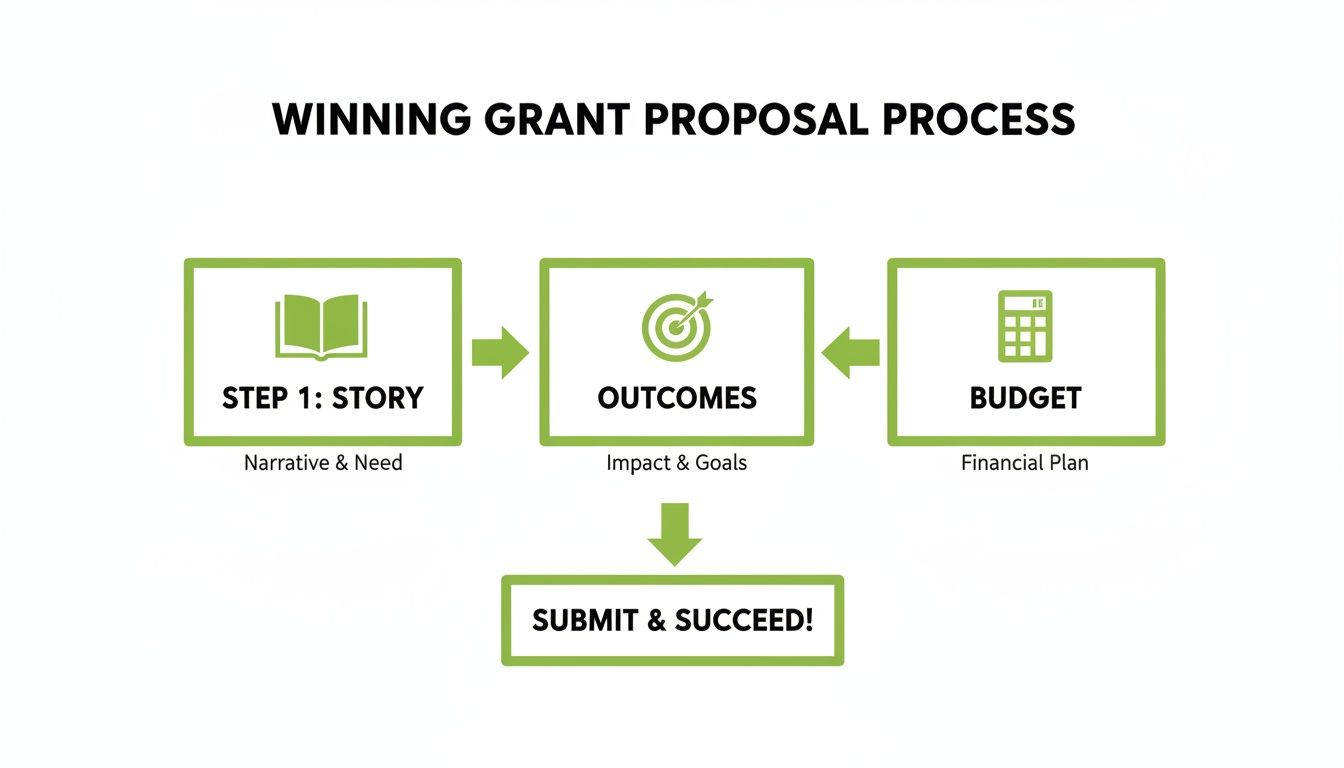
It's the flow from a compelling story to clear outcomes and a sound budget that captures a funder's attention and kicks off this entire post-submission cycle.
The Art of Grant Stewardship
Winning a grant isn't a simple transaction; it's the beginning of a real relationship. Grant stewardship is how you nurture that relationship, build trust, and prove that the foundation made a brilliant investment. When you do it well, one-time funders often become long-term partners who are far more likely to renew—and even increase—their support down the road.
As soon as a grant is awarded, your team should also be following effective gift acceptance policies to make sure every dollar is handled properly. This shows the funder your internal processes are as solid as your programs.
Think of a grant report not as a chore, but as an opportunity. It's your chance to share the incredible stories of impact that the foundation's support made possible. It’s how you keep them connected to the mission they chose to invest in.
Great stewardship is all about consistent, meaningful communication. It goes way beyond just submitting reports on time.
Key Practices for Strong Funder Relationships
Acknowledge Support Publicly: Follow the grant agreement's rules for acknowledging the funder. This could mean adding their logo to your website, mentioning them in your annual report, or giving them a shout-out on social media.
Communicate Proactively: Don't let the grant report be the only time they hear from you all year. Share good news as it happens—a major project milestone, some positive press, or a powerful client testimonial. On the flip side, if you hit a major roadblock, let your program officer know. Honesty and transparency are the bedrock of trust.
Deliver Flawless Reports: Submit every report on time and exactly in the format they asked for. Use this as a chance to showcase your wins with both hard data and compelling stories. A well-crafted report doesn't just check a box; it reinforces their decision to fund you and builds a strong case for future support.
Juggling all these moving parts can be a real headache, especially for smaller teams. For a deeper dive into staying organized, check out our guide on grant management best practices.
This is where tools like Fundsprout come in handy. They are built to help you track deadlines, automate parts of your reporting, and keep a clean record of your communications and successes with every funder. This creates a powerful institutional memory that makes securing that all-important renewal funding a much smoother process.
Common Grant Seeking Mistakes and How to Avoid Them
Chasing down foundation grants for nonprofit organizations can feel like an endless marathon. It’s a path full of exciting possibilities but also littered with common tripwires that can stop even the most dedicated teams in their tracks. Learning to spot these mistakes before you make them is one of the best ways to boost your success rate. It’s not just about winning money—it’s about saving precious time, preventing burnout, and building a stellar reputation with funders.
The grant world is huge and getting bigger. As other funding sources ebb and flow, foundation giving remains a strong, steady source of support. The U.S. industry is projected to hit $245.9 billion after growing at a 6.3% compound annual rate over five years, with 36,831 grant-making entities in the mix. You can find more insights about the grantmaking industry to get a sense of the scale. With this much competition and opportunity, you can't afford to make rookie mistakes.
The "One-Size-Fits-All" Proposal
The quickest way to get your proposal tossed is to send the same generic draft to every foundation on your list. This is easily the most common and damaging mistake we see. Picture a program officer sifting through a mountain of applications every single day. If your proposal doesn't speak directly to their mission, their priorities, and their language, it sticks out for all the wrong reasons.
Instead of a shotgun approach, think of each application as a custom conversation with a specific person.
- Mirror Their Language: Do they talk about "at-risk youth" or "youth experiencing barriers"? Use the exact phrases they do. It shows you’ve done your homework.
- Connect to Their Goals: Spell out exactly how your project helps them achieve the goals they’ve published in their strategic plan or annual report.
- Tailor Your Story: Emphasize the parts of your work that you know will resonate with that funder's specific history and interests.
Submitting a generic proposal is like sending the same cover letter for every job application. It signals a lack of genuine interest and respect for the funder's unique mission, making it easy for them to say no.
Mismatched Mission and Poor Prospect Research
Another frequent misstep is applying to foundations that are just not a good fit. This almost always comes down to lazy, surface-level research. A foundation might say it funds "education," but a quick look at their past grantees shows they exclusively fund universities. If you run a K-12 after-school program, you’re wasting your time and theirs.
A truly focused approach means digging deep to make sure there's real alignment before you even think about writing a single word.
Here’s a classic example:A small animal shelter applies for a grant from a huge national foundation focused on environmental conservation. The shelter does amazing work, but its mission has nothing to do with protecting ecosystems. The rejection was inevitable because the two missions were fundamentally out of sync.
A Vague or Unrealistic Budget
Your budget isn't just a spreadsheet—it's the financial blueprint of your project. Funders read it as a story of your planning and competence. A vague, incomplete, or wildly unrealistic budget is a massive red flag. It screams poor planning and raises serious questions about your ability to manage their money responsibly.
Common budget blunders include forgetting to add indirect costs, underestimating how much staff time a project really takes, or submitting numbers that don't match the activities you described.
A budget that gets funded is:
- Detailed: Every single line item is clearly explained and justified in the budget narrative. No mystery numbers.
- Aligned: The expenses you list directly support the activities you laid out in the proposal. It all has to connect.
- Realistic: Your costs are based on real-world quotes, past project data, or industry standards. No guessing.
Steering clear of these common blunders shifts you from being just one more applicant in the pile to a serious contender. It shows funders you’re a strategic, professional partner they can trust with their investment.
Answering Your Top Questions About Foundation Grants
As you dive into the world of foundation grants for nonprofit organizations, you're bound to have some practical questions. It's only natural. This section tackles the most common ones we hear from nonprofit leaders, with straightforward answers to help you feel more confident on your grant-seeking journey.
How Long Does It Take to Secure a Foundation Grant?
If there's one thing you need in the grant world, it's patience. The timeline from finding a grant to getting a check can be surprisingly long—anywhere from three months to well over a year. It’s not a single waiting period, but a series of steps, each with its own timeline.
First, just finding the right funders can take several weeks of solid research. Then, crafting a compelling, well-researched proposal isn't something you can knock out over a weekend; budget at least a month to get it right. But the longest and most unpredictable part is the foundation's review process. They often make decisions based on their board meeting schedule, which might only be quarterly or even just twice a year.
A small family foundation might be nimble and get back to you in a few weeks. But a large, national foundation with layers of review committees will have a much more formal and extended cycle. The best advice? Always check the funder's website for their specific deadlines and decision timelines so you can build a realistic calendar.
What's the Real Difference Between a Grant and a Donation?
This is a great question because it gets to the heart of how different funding streams work. People often use the terms interchangeably, but they're fundamentally different.
Think of it this way: a donation is a gift, while a grant is a formal investment.
When an individual gives you a donation, it's often unrestricted. It's a gift you can use wherever it's needed most, with few strings attached beyond a sincere thank you.
Grants, on the other hand, are awarded by an institution for a specific purpose. They come with a formal grant agreement—a contract, really—that spells out exactly what's expected. This typically includes:
- How the money must be spent: It will detail the approved budget and what expenses are allowed.
- Project timelines: You'll be accountable for hitting key milestones.
- Reporting requirements: You’ll have to report back on your progress and results.
With a grant, you're entering a formal partnership where you're accountable to the funder for delivering on the outcomes you promised.
Can a Small Nonprofit with No Grant History Get Funding?
Absolutely. It's a common worry for new or grassroots organizations, but many funders—especially community foundations and smaller family foundations—love to support emerging nonprofits. They see it as a chance to get in on the ground floor and help a promising organization grow its impact.
Of course, if you don't have a track record of managing grants, you have to build trust in other ways. Your proposal is your chance to shine.
A lack of grant history isn't a dealbreaker. It just means you need to play to your other strengths. Your deep community roots, your team's unique expertise, and the passion driving your mission can be just as powerful as a long list of past funders.
To build a strong case, be sure to highlight:
- Deep Community Connection: Show how you’re led by and for the community you serve.
- Team Expertise: Showcase the professional and lived experience of your staff and board.
- Powerful Letters of Support: Endorsements from community partners and local leaders act as a powerful vote of confidence.
Start by targeting smaller, local grants. Every grant you win, no matter the size, becomes a building block. It creates a track record of success that you can use as a stepping stone to bigger funding opportunities down the road.
What Is Unrestricted Funding and Why Does It Matter?
Unrestricted funding, often called general operating support, is the holy grail for most nonprofits. This is money a foundation gives you to support your core mission, covering everything from program supplies to the less glamorous (but essential) costs like salaries, rent, and electricity.
It's the complete opposite of restricted funding, which is earmarked for a specific project and can only be used for expenses in that project's budget.
Unrestricted funding is so valuable because it’s the ultimate sign of a funder’s trust. It says, "We believe in your mission and trust you to know how to best use these resources." This kind of flexibility allows you to respond to unexpected needs, invest in your infrastructure, and plan for the long term. It’s the fuel for stability and resilience, letting you focus on making an impact, not just keeping one specific program afloat.
Ready to stop spending countless hours on manual research and start winning more grants? Fundsprout is an AI-powered success platform that finds your best-fit funders, helps you write winning proposals, and simplifies grant management. Discover your next funding opportunity at https://www.fundsprout.ai.
Try 14 days free
Get started with Fundsprout so you can focus on what really matters.