Target Population Definition for Grant Proposals
Master the target population definition for your next grant proposal. Learn what funders look for, how to use data, and craft a compelling narrative that wins.

Abdifatah Ali
Co-Founder
You're moving fast on a grant application. The fit looks strong. The program aligns. The budget is defensible. Then you hit the prompt that slows everything down: Describe your target population.
That's where many nonprofit leaders and program staff start to wobble. They know who they help in real life. They can describe the people who come through the door, call the hotline, or show up at outreach events. But translating that lived knowledge into funder-ready language is harder than it looks.
The problem usually isn't lack of mission clarity. It's lack of precision. Grant applications don't reward broad intention. They reward a clear statement of who the program is for, who qualifies, who can realistically be reached, and who the organization is prepared to be accountable for.
A strong target population definition does more than satisfy one application question. It shapes the rest of the proposal. It affects the need statement, outreach plan, program design, outcome measures, and evaluation approach. If this one piece is vague, the whole application starts to feel loose.
Busy funders notice that quickly. So do reviewers.
The Question That Stops Every Grant Writer
A familiar version of this happens in small and mid-sized nonprofits all the time. The executive director opens the draft and sees a sentence like, “Our organization serves vulnerable community members in need.” Everyone on staff knows what that means internally. A reviewer won't.
The next draft often swings too far in the other direction. Staff pile on every descriptor they can think of. The result becomes cluttered, defensive, and hard to follow. The target population ends up sounding like a list assembled to please the funder rather than a group the organization understands.
Here's what usually works better. Start with the operating question: Who is this program designed for, specifically, and who will you be judged on helping?
That shift matters because a funder isn't asking for a poetic description. They're assessing whether your organization has made disciplined choices. They want to see that the people you name match the problem you describe, the intervention you propose, and the outcomes you promise.
Practical rule: If your target population statement could fit almost any nonprofit in your field, it's too broad for a competitive proposal.
Two weak versions show up often:
- Overgeneralized language: “low-income families,” “at-risk youth,” “underserved residents”
- Operational language without accountability: “anyone who needs help,” “community members who contact us,” “people in crisis”
Neither tells the reviewer enough. A stronger answer identifies a defined group, in a defined place, with defined needs or conditions that make them appropriate for the program.
That doesn't mean your wording has to sound academic. It should sound operational. The best target population definition reads like something your intake team, program manager, and evaluator could all use without guessing.
What Is a Target Population in Grant Writing
In grant writing, a target population is the specific group your program is designed for and the group for whom you're accountable for outcomes. That's the version that matters in proposals.
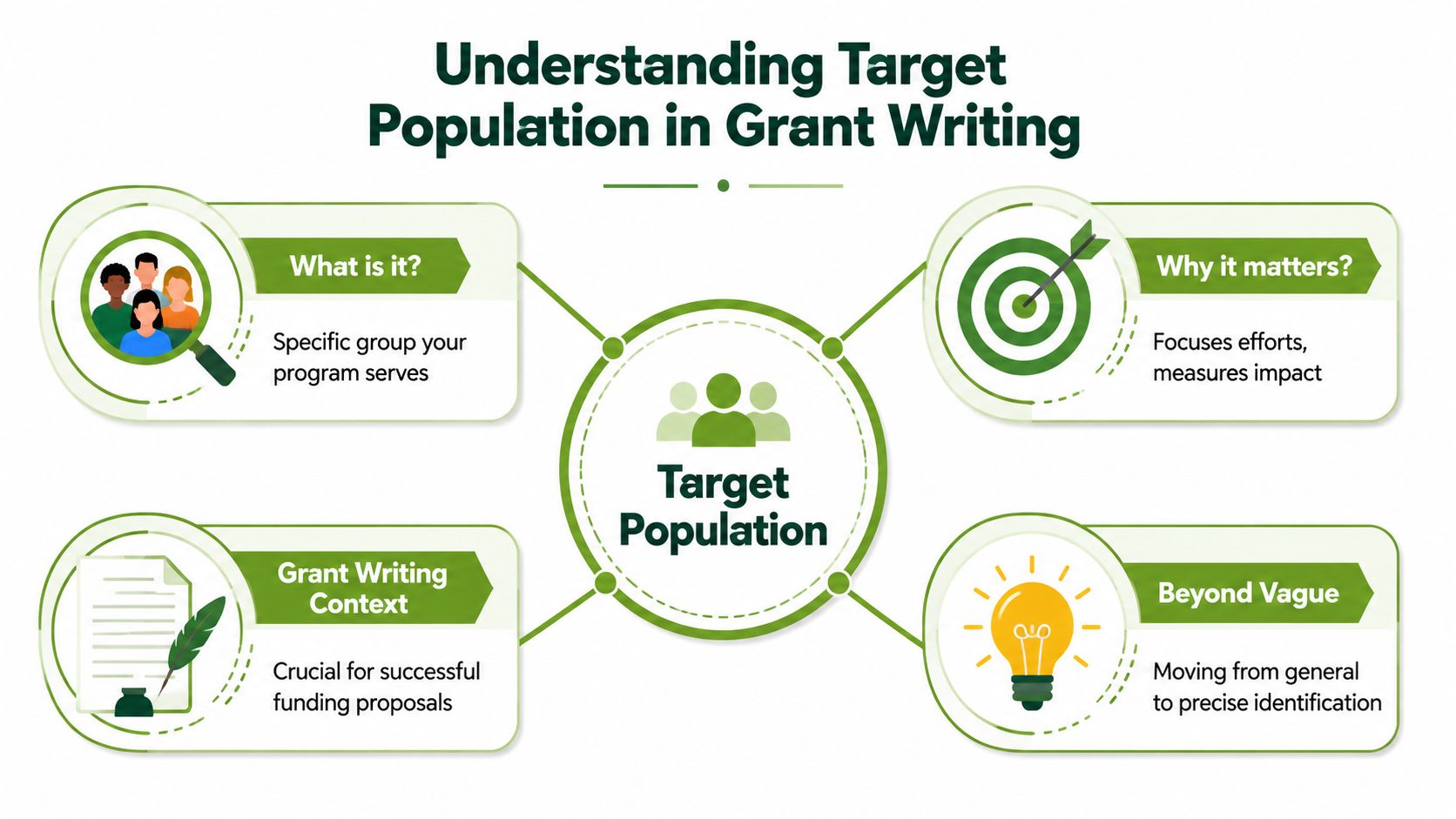
Many nonprofits confuse this with their broader service population. That's a costly mistake. A Learning for Action guide on defining the target population draws a useful distinction: the target population is the subset for whom a program is accountable for outcomes, while the service population can be much wider. When organizations stay vague, eligibility rules and outcome measurement get weaker.
The bullseye test
Think of your community as a target board.
The full board is everyone your organization might touch. That includes people who attend events, receive referrals, ask for information, or benefit indirectly from your work. The bullseye is the target population. It's the group your funded program is built to serve directly and intentionally.
Funders want the bullseye.
If your proposal says the program serves “families across the county,” the reviewer still doesn't know whether you mean parents of toddlers, kinship caregivers, newly arrived immigrants, households facing eviction, or families referred by a school district. Those are very different populations, and they require different recruitment plans, staffing, partnerships, and success measures.
What belongs in the definition
A practical target population definition usually answers a short set of questions:
- Who are they: age, family role, condition, or other relevant qualifiers
- Where are they: neighborhood, county, school district, service area
- Why this group: the specific need, barrier, or risk the program addresses
- How do you know they fit: eligibility or screening criteria
A helpful way to sharpen your language is to borrow audience-work techniques from communications and outreach. If your team needs a fast method to identify your target audience, that process can help surface behaviors, motivations, and access barriers that make your grant narrative more concrete. In proposals, though, you still need to convert audience insight into a clear program population.
Your service footprint can be broad. Your grant-funded target population shouldn't be.
One more discipline matters here. Don't define the target population as everyone you can reach. Define it as the group the program is intended to help. Reach comes later. That distinction keeps your proposal honest and easier to evaluate.
Why Your Definition Matters to Funders
Funders read target population language as a signal. It tells them whether the applicant has a focused plan or just a worthy mission.
A precise definition reduces ambiguity in three places that matter to reviewers most: program fit, implementation risk, and credibility of results. That's why this isn't a throwaway field in the application. It's one of the quickest ways to show disciplined thinking.
It shows your program matches a real problem
When a target population definition is specific, the rest of the proposal becomes easier to believe. The need statement feels anchored. The activities feel customized. The staffing model makes sense. Reviewers can see that the organization didn't start with a generic intervention and then search for people to attach it to.
A broader methodological point supports this. A summary of NIH-linked guidance on target population definition notes that defining the target population is an essential part of protocol development, and that clear eligibility criteria improve relevance to the intended group. In grant terms, that's exactly what reviewers are checking. Relevance.
It makes your plan feel feasible
Funders don't just ask, “Is this important?” They ask, “Can this team do it?”
A vague population makes your outreach plan look thin because no one knows who must be recruited. It makes your timeline look optimistic because there's no bounded group to plan around. It makes partnerships look generic because the referral sources aren't tied to a specific population.
A focused definition does the opposite. It tells the reviewer you know where the people are, what barriers they face, and what operational steps are needed to engage them.
For teams drafting outcomes, this also improves the quality of impact language. If you need help tightening that part of the proposal, Fundsprout has a guide on how to write impact statements that pairs well with target population work because the two sections should describe the same group.
It gives funders a cleaner line of sight to results
Reviewers want to know whose lives will be different if they award the grant. Not the whole community. Not every person your nonprofit may encounter. The defined population for this funded intervention.
A crisp target population definition gives them that line of sight.
| What funders see | What it suggests |
|---|---|
| Broad, fuzzy wording | Unclear scope and weak planning |
| Overloaded wording | A team trying to sound precise without making choices |
| Clear eligibility and boundaries | Stronger management and better evaluation discipline |
When this section is done well, it lowers the reviewer's cognitive burden. They don't have to interpret your program for you.
The Four Core Components of a Strong Definition
Strong target population definition usually rests on four components. Not every proposal needs all four at the same level of detail, but skipping one often creates avoidable confusion.
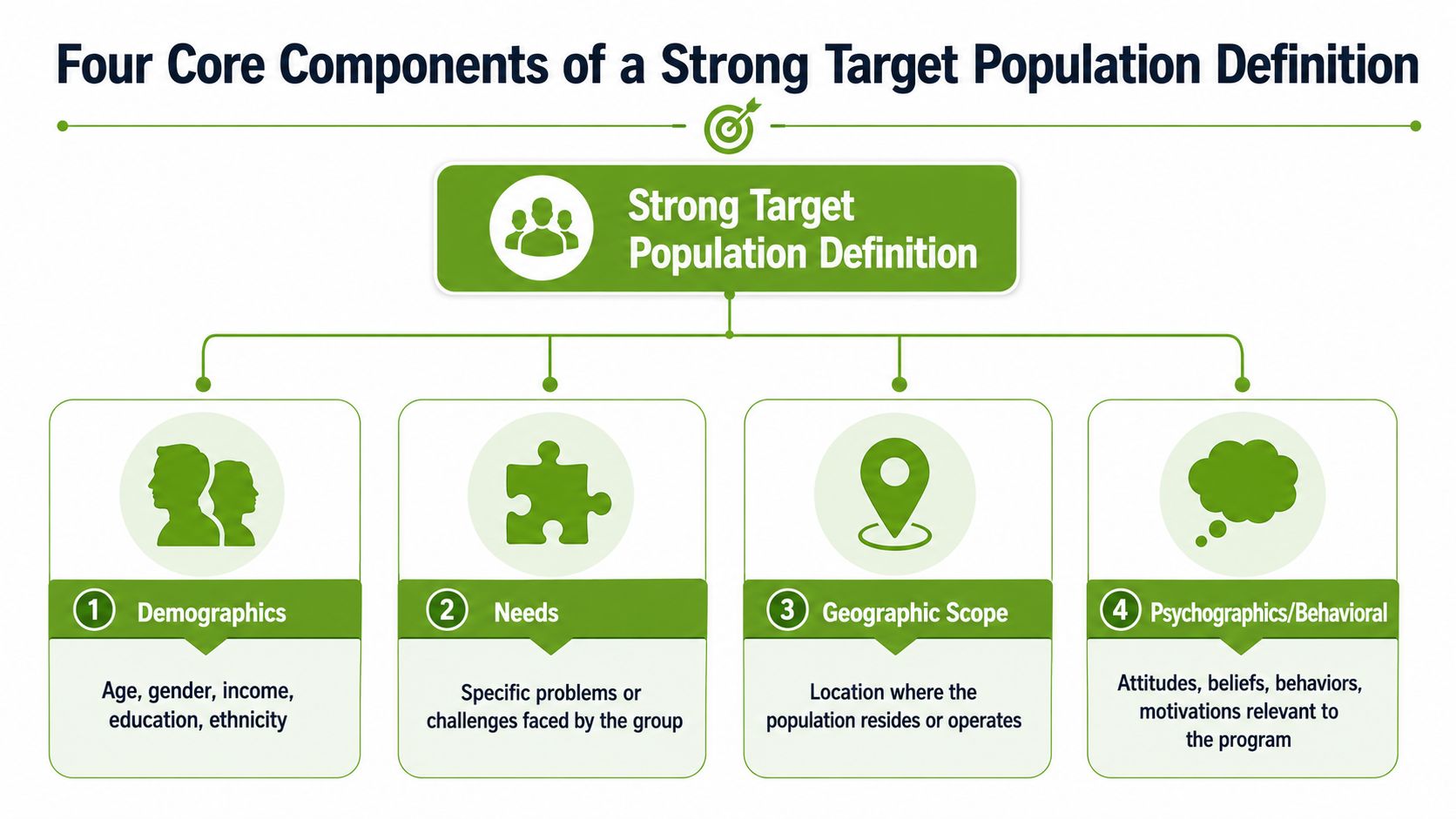
Guidance for program design backs up the importance of explicit eligibility criteria. A clinical research methods article on eligibility criteria notes that criteria such as age, condition, and geography improve recruitment feasibility, and it recommends expressing them as concise bullets to reduce mis-enrollment risk and align recruitment with program goals. That advice transfers neatly into grant writing.
Demographics and roles
Start with the human descriptors that matter to the program.
That may include age range, caregiver status, income threshold, school enrollment status, housing status, veteran status, or primary language. Don't dump in every demographic variable your database happens to track. Use the ones tied to eligibility, outreach, or intervention design.
Good demographic wording sounds purposeful. “Youth” is vague. “Middle school students enrolled in district schools” is useful. “Families” is broad. “Grandparents raising school-age children” is specific enough to shape services.
Geography and place
Place matters more than many proposals admit.
Your geography can be a county, cluster of ZIP codes, school catchment area, tribal service area, neighborhood corridor, or transportation-accessible radius around a service site. The key is that the geography should reflect where the program is delivered and where the intended participants are.
If your proposal says you serve a whole region but your recruitment channels only exist in one city, reviewers will see the mismatch.
Field note: The best geographic definition is rarely the biggest one. It's the one your team can explain and reach.
Needs and barriers
Many proposals either become compelling or drift into cliché at this point.
Name the actual challenge that makes this population appropriate for the program. That could be unstable housing, lack of childcare, justice involvement, disconnection from school, chronic absenteeism, language barriers, transportation barriers, or a condition relevant to your intervention.
Avoid turning the population into a problem statement by itself. People aren't the problem. The conditions and barriers are.
Size and practical boundaries
A target population also needs a workable sense of scale.
You don't always need a highly technical estimate inside the definition itself, but you do need to show that the group is bounded. Reviewers should be able to tell whether you're discussing a realistic population for the proposed budget, staffing, and timeline.
Here's a simple build sequence many teams use:
- Start with who qualifies
- Add where they live or enroll
- Add the need or condition
- Check whether the group matches program capacity
That final step is where discipline shows up. If your capacity supports intensive case management, your target population definition should reflect a group you can realistically recruit and serve at that level.
From Vague to Vivid Examples and Sample Wording
The fastest way to improve a target population definition is to rewrite weak phrases into operational ones.
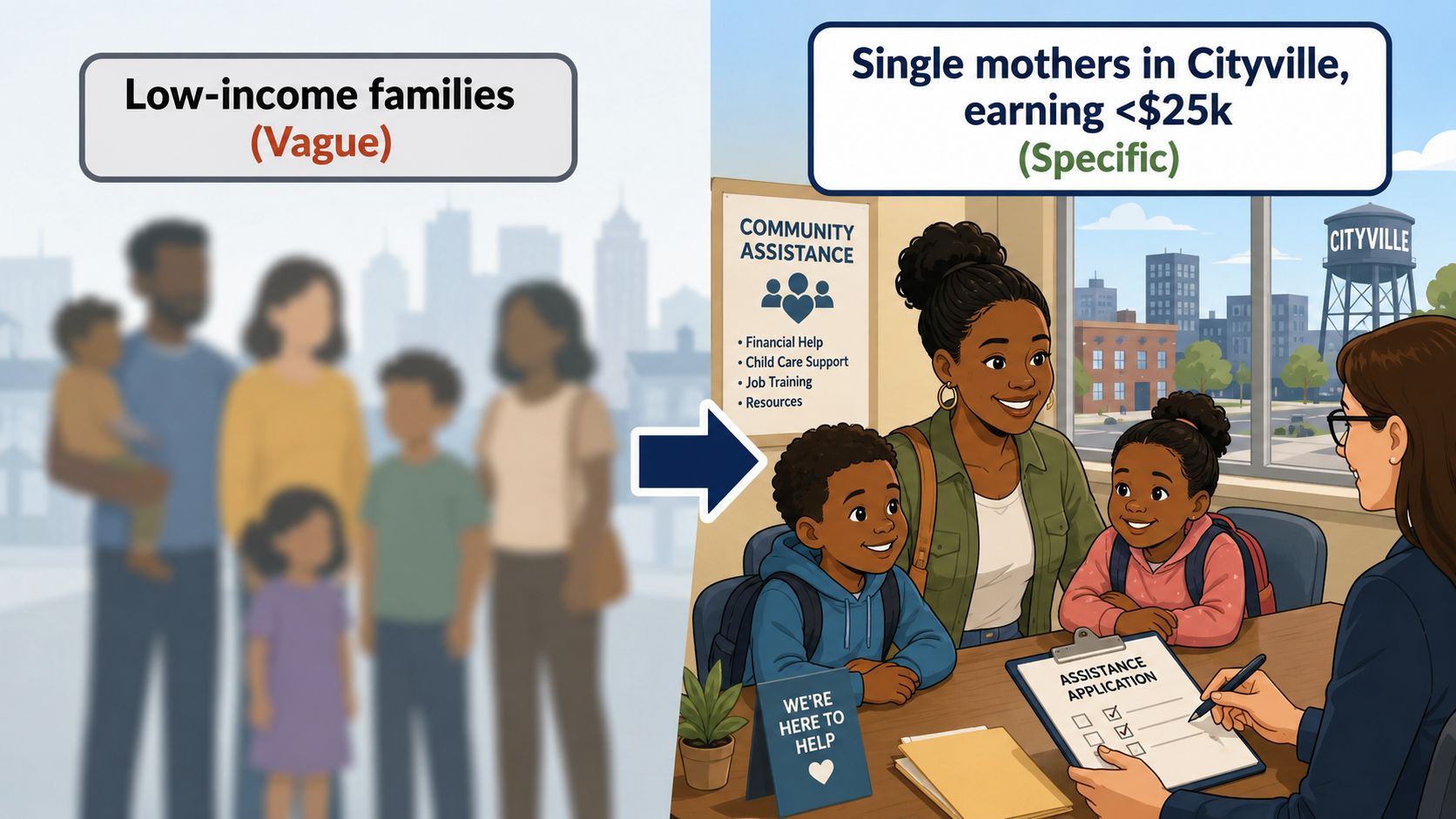
Most weak definitions have one of two problems. They're too broad to guide action, or they rely on labels that sound familiar but mean different things to different reviewers.
Before and after examples
Here are grant-ready rewrites that sharpen scope without sounding stiff.
| Before | Better wording |
|---|---|
| We serve at-risk youth. | The program serves adolescents enrolled in local public schools who face persistent barriers to academic engagement, including chronic absenteeism, unstable housing, or school referral for behavioral support. |
| We help low-income families. | The program is designed for caregivers with limited financial resources who are raising young children and need support accessing stable food, early learning resources, and family navigation services. |
| Our services support seniors. | The project targets older adults living in the organization's service area who experience mobility, isolation, or difficulty accessing benefits and routine support services. |
| We work with underserved residents. | The program focuses on residents in the service area who face specific barriers to access, including transportation limitations, language access needs, or lack of connection to existing support systems. |
Notice what changed. The stronger versions don't rely on a single label. They identify a group, a setting, and the reason that group is the right fit for the intervention.
Sentence starters you can adapt
Use these when the application asks for a short narrative response.
- Our target population consists of individuals or households who meet the following criteria and are appropriate for the proposed service model.
- This program is designed for people in our service area who share a defined set of characteristics, needs, and access barriers.
- For this grant, the organization will focus on a narrower subgroup within our broader service population for whom we can deliver and measure direct outcomes.
- Eligible participants include community members who meet the program's location, demographic, and need-based criteria.
- The proposed intervention is intended for those most likely to benefit from this service because of the specific barriers identified in our community assessment and program records.
One practical companion task is aligning this wording with the need statement. If the need section describes one group and the population section names another, the proposal starts to wobble. This collection of need statement examples is useful for checking whether those two sections are describing the same people.
A quick explainer can also help your team train newer staff on the difference between audience language and proposal language.
A simple formula that works
A reliable formula is:
[Who] + [where] + [what need or barrier] + [why this program]
Example:
The program serves caregivers of school-age children in the organization's service area who face barriers to stable housing, school engagement, and access to coordinated support services.
That sentence won't win the grant by itself. But it gives the reviewer something usable. It sounds like a population your team can identify, recruit, serve, and evaluate.
Finding and Using Data to Define Your Population
A target population definition becomes more convincing when your wording matches the data you can access and defend.
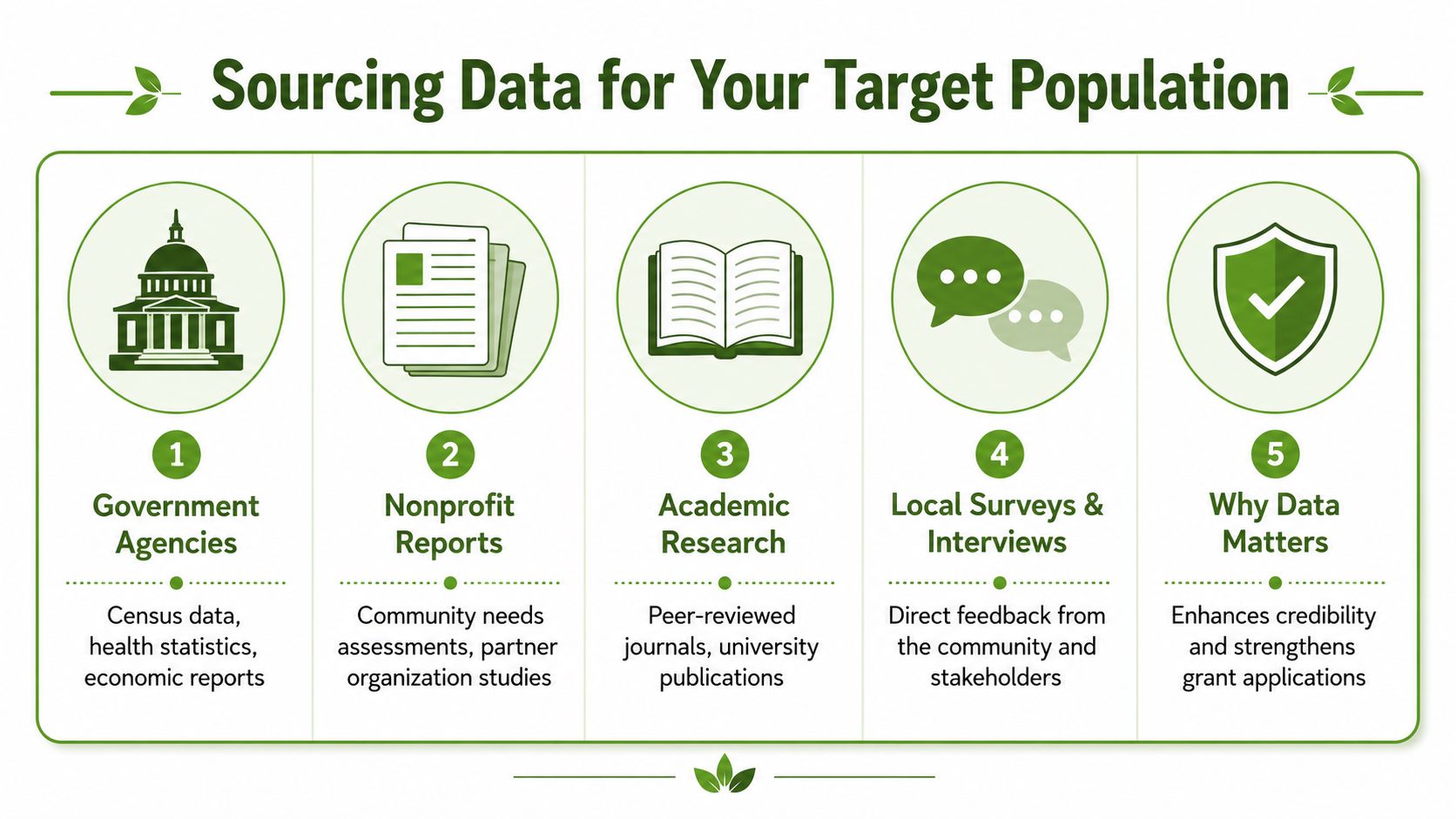
Many nonprofits make one of two data mistakes. They either rely only on broad public statistics that don't match their actual program population, or they rely only on internal anecdotes that reviewers can't place in context. Strong proposals usually combine both.
A useful concept from evaluation design helps here. The Learning Data Science explanation of target population, access frame, and sample distinguishes the group you want to make inferences about from the subset you can observe. When those don't line up, coverage error can result. In grant writing, that often shows up when an organization claims to serve a broad population but only has data from the people already easiest to reach.
Where to get usable population data
Public sources often provide the outer frame. Internal sources provide local specificity.
- Government datasets: Census products, county health departments, state education agencies, labor departments, and local housing authorities can help define who lives in the service area and what conditions affect them.
- Administrative records: Intake forms, referral logs, attendance records, case notes, and waitlists show who is showing up for services.
- Community listening: Interviews, surveys, and partner feedback can clarify barriers that numbers alone don't capture.
- Partner agencies: Schools, clinics, shelters, and workforce partners may have relevant program-level trends, even when data-sharing is limited.
If your team is building the broader case for need at the same time, this guide on how to write a needs assessment can help connect population definition to the rest of the narrative.
How to use data without overclaiming
Use data to narrow and substantiate. Don't use it to inflate.
A practical sequence looks like this:
- Define the intended group first
- Find data sources that approximate that group
- Name any limitations
- Use internal records to refine the picture
- Keep the proposal language aligned with what the data can support
If your records only describe current participants, don't present them as if they represent the whole community.
That doesn't weaken the proposal. It strengthens trust. Reviewers know no dataset is perfect. They care more about whether your organization understands the difference between the broader community need and the population it can credibly describe.
Common Mistakes and Ethical Considerations
The worst target population definitions usually fail in one of two directions. They either try to include everyone, or they get so narrow that the program sounds artificial.
Both approaches create trouble.
Mistakes that weaken proposals
Being too broad is the more common problem. Phrases like “underserved populations,” “community members in need,” or “families facing challenges” don't help a reviewer understand who qualifies for services.
Being too narrow can also backfire. In research, populations can be defined very tightly. One example described the target population as the 1% most active contributors to Wikipedia, which shows that populations can be bounded by behavior and time window, not just demographics. That level of specificity can be methodologically appropriate, but in grants it can look contrived if the boundaries exist only to sound impressive.
Watch for these common missteps:
- Label-first writing: Terms like “high-risk,” “hard to serve,” or “disconnected” without explaining the actual condition or barrier
- Eligibility drift: The proposal names one group, but outreach and activities clearly target another
- Aspirational geography: The service area is larger than the organization's real reach
- Deficit-only framing: The population is described only by what it lacks
The ethics of naming a population
Defining a population is never just a technical exercise. It shapes how staff talk about participants, how boards understand community need, and how funders imagine the people behind the proposal.
A good definition should be precise without being demeaning.
That means using language tied to program relevance, not shorthand that reduces people to a hardship. “Residents experiencing barriers to transportation access” is more respectful and more informative than “transportation-poor residents.” “Caregivers seeking stable housing support” is better than “unstable families.”
It also means checking whether the definition was shaped with community knowledge rather than imposed from the outside. Intake staff, community partners, and participants themselves often know which labels are accurate, outdated, stigmatizing, or are unhelpful.
The strongest target population definition is specific enough for funders and respectful enough for the people named in it.
If your proposal can meet both standards, it will read as more credible and more grounded.
Fundsprout helps nonprofits turn messy grant requirements into usable proposal language. If your team needs a faster way to align target population wording with eligibility rules, need statements, deadlines, and supporting documentation, Fundsprout is one option to review alongside your current grant workflow.
Try 14 days free
Get started with Fundsprout so you can focus on what really matters.