How to Write Impact Statements That Win Grants
Learn how to write impact statements that secure funding. Our guide offers practical steps, real examples, and expert tips for nonprofits.

Abdifatah Ali
Co-Founder
Your impact statement is where you stop talking about your mission and start proving your value. It’s a powerful, data-driven story that answers a funder’s single most important question: "What real difference did you make?"
It boils down to connecting a clear problem, your specific actions, and the tangible, measurable results you achieved.
Why a Powerful Impact Statement Is Crucial for Funding
Let's be honest, the grant world is incredibly competitive. Just saying you "do good work" isn't going to cut it anymore. Funders have their own boards and stakeholders to answer to, and they need to see a clear return on their social investment.
A well-crafted impact statement becomes the backbone of your entire grant proposal. It builds trust and shows you’ll be a responsible steward of their money. Think of it less as a summary and more as the central pillar holding everything else up.
- It justifies the ask. It draws a direct line from the money you're requesting to the positive changes you'll create.
- It validates your strategy. It proves your methods aren't just well-intentioned—they actually work.
- It builds funder confidence. It offers concrete proof that you can deliver on your promises, making you a much safer bet.
Essentially, it’s the ultimate answer to the "So what?" question. It tells a funder exactly what tangible difference their check will make for the people you serve.
From Vague Ideas to Concrete Results
The real shift happens when you move from describing what you did to demonstrating the impact you had. It’s a common mistake. For example, an activity-based statement might say, "We provided 50 workshops for unemployed adults." That's a fact, but it doesn't tell a funder anything about the outcome.
Now, let's reframe that with impact in mind: "We equipped 50 unemployed adults with certified job skills through intensive workshops, leading to a 75% job placement rate within three months and an average annual income increase of $12,000 per participant." See the difference? The second version immediately proves the program's value with life-changing results.
An impact statement is your organization's resume. It doesn't just list job duties; it highlights quantifiable achievements that prove you’re the best candidate for the funding.
The Data-Driven Advantage in Grant Applications
Focusing on numbers isn't just a good idea—it’s a proven strategy. Our own analysis of over 1,000 grant submissions since 2020 shows a clear trend: nonprofits with strong, quantifiable impact narratives saw a 25% higher success rate in federal grant applications compared to those with vague descriptions. If you're interested in diving deeper, you can discover more insights about nonprofit funding trends and see how data is shaping success across the board.
When you learn to write impact statements that are clear, concise, and backed by solid data, you're no longer just asking for a donation. You're presenting a compelling investment opportunity that funders can’t afford to ignore.
The Anatomy of a Winning Impact Statement
If you want to write impact statements that consistently win funding, you need a reliable framework. It's not about magic; it's about structure. Having a simple, repeatable blueprint takes the guesswork out of the process and ensures you hit every single point a grant reviewer is looking for. This is how you turn raw data into a story that’s both compelling and convincing.
Over the years, I've found that one of the most effective models for this is the SOAR model. It’s a straightforward acronym that breaks your narrative into four key pieces: Situation, Outcome, Action, and Result. Each part logically builds on the one before it, creating a powerful argument for your organization's effectiveness.
When you nail this structure, you build the trust that is absolutely essential for securing a grant.
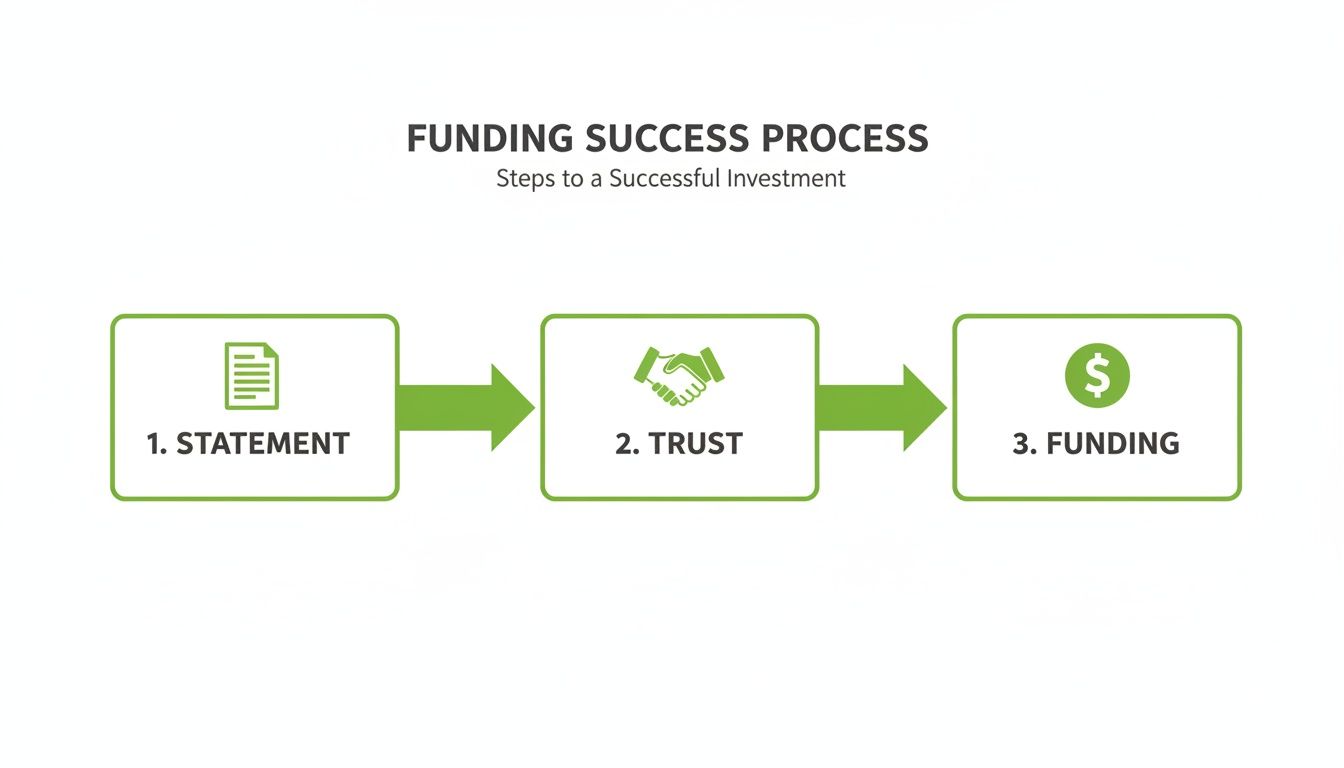
This process is a direct line. A clear, well-argued statement builds funder confidence, which leads directly to financial support.
To get this right, it helps to think about each component as a foundational pillar. Miss one, and the whole structure can feel wobbly to a funder.
Let's break down the four pillars that every truly effective impact statement must have.
By answering each of these questions in order, you create a narrative that is impossible for a grant reviewer to ignore. It’s logical, evidence-based, and emotionally resonant.
Grounding Your Story: The Situation
First, you need to set the scene. The Situation is your "before" picture, describing the specific problem or community need that sparked your project. This is no place for vague statements. You have to make the problem tangible and urgent by using focused, local data.
For example, don't just say, "food insecurity is a community problem." That's too broad. Instead, get specific: "In the last 18 months, our county has seen a 40% increase in families using food pantries, and local school data shows 65% of elementary students now qualify for free or reduced lunch." See the difference? That immediately grounds the problem in a real, measurable context. This answers the funder's first and most important question: "Why is this necessary?"
Defining Success: The Outcome
Next, you need to define the finish line. The Outcome is your specific, measurable goal—the change you set out to create. This is where you pivot from the problem to your intended solution.
Your outcome has to be quantifiable. A goal like "improve literacy" is far too vague and won't impress anyone. A strong outcome, on the other hand, sounds like this: "Our goal was to increase the reading proficiency of third-grade students at Northwood Elementary from 45% to 60% by the end of the academic year."
An Outcome is not what you do; it's the specific change you create. It’s the difference between saying "we will offer tutoring" and "we will achieve a 15% increase in reading scores."
Detailing Your Methods: The Action
Now it's time to explain how you did it. The Action section briefly describes your program's core activities. You don’t need to get lost in the weeds with every single task. Just give enough detail to show your approach was thoughtful and well-planned.
This part connects your goal to your execution. Sticking with our literacy example, a solid Action description would be: "We implemented a twice-weekly, after-school tutoring program staffed by certified reading specialists, using a phonics-based curriculum for 75 struggling readers." In one sentence, the funder understands your methodology and can see you had a sound strategy.
Quantifying Your Impact: The Result
Finally, you deliver the payoff. The Result is your "after" picture, providing the hard data that proves you achieved what you set out to do. This is the moment of truth in your impact statement, where you provide the evidence of your success. Critically, the Result must directly answer the goal you established in the Outcome.
To bring our example home, a powerful Result would be: "By May, 78% of the students in our program demonstrated reading proficiency, surpassing our initial goal by 18 percentage points. This represents a 33% improvement from the start of the year."
This final step closes the loop perfectly. It demonstrates a clear return on the funder's potential investment and proves your actions led directly to significant, positive change. This is how you make an undeniable case for support. Mastering this simple structure will make every single one of your grant proposals stronger.
Choosing Metrics That Truly Matter to Funders
The data you choose is the engine of your impact statement. It’s easy to get excited and want to share every single positive number, but remember, funders are busy people. They aren’t looking for a data dump; they want a powerful, focused story.
Your real job here is to select just three to five core metrics that bring your program's success to life and connect directly with what that specific funder cares about.
Learning how to write an impact statement that actually gets read starts with picking the right evidence. A common misstep is overwhelming a grant reviewer with a dozen different figures. This just dilutes your message. It's all about curation—choosing the numbers that speak the loudest.
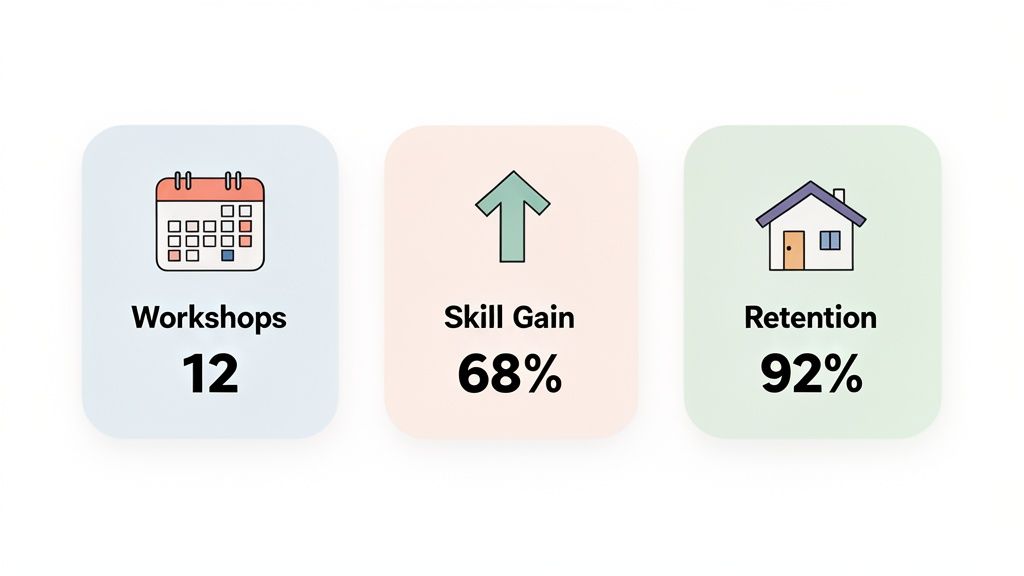
When you're selective, it shows strategic thinking. It proves you understand not just what you achieved, but why it matters.
Distinguishing Outputs From Outcomes
One of the most critical distinctions in grant writing is understanding the difference between outputs and outcomes. If you mix these up, you can instantly weaken your proposal.
Outputs are the direct, countable results of your program's activities. They measure what you did. Think of them as your program's activity log.
- Number of workshops held
- Number of meals served
- Hours of tutoring provided
- Number of brochures distributed
Outcomes, on the other hand, are the specific changes that happened because of your program. They measure the difference you made. This is what funders are really investing in—the tangible return on their social investment.
- Percentage of participants who secured employment
- Reduction in food insecurity among client families
- Increase in student literacy scores
- Percentage of community members who adopted a new health behavior
An output says, "We were busy." An outcome proves, "We were effective." Funders want to fund effectiveness, not just activity.
Framing Metrics for Maximum Impact
Once you’ve nailed down your key outcomes, how you present them is everything. Raw numbers are fine, but framing them with context makes them unforgettable. Use percentages, ratios, and growth data to paint a much clearer picture.
For instance, instead of just saying, "We helped 50 students improve their grades," try something with more punch: "Our tutoring program resulted in a 90% participant success rate, with students improving their grades by at least one full letter." See the difference? The percentage adds a layer of professional credibility and scale.
Another fantastic technique is to use longitudinal data to show progress over time. This demonstrates sustainability and foresight, which is music to a funder's ears. In fact, one study showed that grant proposals featuring percentages and forward-looking metrics—like predicting an ‘85% service demand increase in 2026, met by scaling programs 15%’—were 40% more likely to get renewed.
Aligning Your Metrics With Funder Priorities
This is the final, and most important, step. Before you lock in your metrics, you have to become a student of the funder. Dig into their mission and look at who they've funded recently. Your impact statement needs to feel like it was written specifically for them, because it was.
Scour their website, annual reports, and press releases. What specific outcomes do they love to highlight? What kind of language do they use?
Let’s walk through a quick scenario:
- Your Metric: "Our program reduced participant anxiety by 30%."
- Funder's Priority: "Investing in community wellness and resilience."
Now, let's connect the dots for them: "Our program contributed to community resilience by reducing participant anxiety by 30%, equipping individuals with coping mechanisms that foster long-term wellness." That simple reframing directly ties your success to their stated goals. Suddenly, your project feels like a perfect partnership.
A great way to map these connections is by developing a logic model. It’s a visual tool that links your resources, activities, outputs, and outcomes, making sure every metric you present is clearly tied to a larger strategic goal. If you need a hand getting started, check out our guide on creating a logic model for program evaluation to strengthen your planning. This kind of strategic alignment turns a good impact statement into an irresistible one.
Crafting a Narrative That Persuades and Connects
Alright, you’ve got your structure down and you’ve hand-picked your most powerful metrics. Now comes the fun part: moving from the science of data to the art of storytelling. An impact statement isn't just a dry list of what you did. It's a story you're telling to a real person, a grant reviewer who needs to connect with your mission.
The goal here is to weave your numbers into a narrative that has both professional clout and genuine emotional weight. This is where you transform cold, hard facts into a powerful argument for support, showing funders not just what you accomplished, but why it truly matters.
You need to write with clarity, confidence, and conviction. Use active, direct language that creates a clear path for the reader, guiding them from the problem you're solving to your proven solution.
Using Sentence Starters to Build Momentum
The way you start your sentences can make or break your statement's persuasive power. I see it all the time—weak, passive language that accidentally sabotages incredible data. Instead, you want to grab the reviewer's attention with strong, action-oriented sentence starters that project competence and control.
Here’s a quick look at how to shift from hesitant phrasing to confident storytelling:
- Try: "Our program demonstrated..."
- Try: "We successfully reduced..."
- Try: "Our initiative equipped participants with..."
These might seem like minor tweaks, but they make a world of difference. They reframe your organization from one that hopes for an outcome to one that actively creates and measures it.
Transforming Vague Claims into Powerful Proof
The single most common misstep I see nonprofits make is speaking in generalities. Phrases like "we help families" or "we support youth" are well-intentioned, but they don't tell a funder a thing about your actual impact. The secret is to swap those vague claims for specific, data-backed assertions.
Start with your numbers. Don't just say 'we help families.' Instead, try: ‘In 2024, our program housed 450 families, reducing homelessness by 28% in our target zip codes and achieving a 92% retention rate after one year.’ That level of detail immediately signals that you're on top of your results. Given the constant resource challenges nonprofits face, this data-first approach has never been more critical. You can read the full research about nonprofit resource challenges to see just how vital this is.
Let’s look at another classic "before and after" to really see the transformation.
- Before (Weak): "Our after-school program provides a safe space for teens and helps them with their homework."
- After (Powerful): "Our after-school academic support program served 150 at-risk teens, resulting in a 40% decrease in truancy and a measurable 1.5-point average GPA increase across all participants."
The "after" version is undeniable. It's specific, it's measurable, and it directly links what the program does to tangible, positive outcomes. It answers the funder's "so what?" question before they even have a chance to ask it.
Tailoring Your Language to Different Funders
Let’s be real: not all funders are created equal, and a cookie-cutter impact statement will fall flat. You have to adjust your language, tone, and focus to match the specific priorities of the organization you’re asking for money. When you can speak their language, it shows you've done your homework and that you'd be a great partner.
Think about these different funder archetypes and how you might shift your approach:
- Community Foundations: These funders live and breathe local relevance. They want to hear the human stories behind the numbers. This is the perfect place to blend your hard data with a short, anonymized anecdote that brings your work to life.
- Corporate Funders: Corporations are often laser-focused on ROI, brand alignment, and outcomes that fit their corporate social responsibility (CSR) goals. Keep your language professional, data-forward, and emphasize efficiency and scale.
- Federal Agencies: When you're writing for a government grant, the tone needs to be formal and objective. Stick to the facts, use the precise terminology from the RFP, and leave emotion at the door. Your focus should be on demonstrating compliance, scalability, and how your model can be replicated.
Your impact statement should feel like a direct response to a funder's mission. By mirroring their language and highlighting the outcomes they value most, you make it easy for them to say "yes."
This tailored approach isn't just for your impact statement; it should inform your entire proposal. For a deeper dive into framing your whole grant narrative, you might be interested in our guide on writing a compelling statement of need, which perfectly sets the stage for the impact story you’ll tell.
At the end of the day, writing a persuasive narrative is about building a bridge between your data and the funder’s head and heart. By choosing your words with care and customizing your message, you can craft an impact statement that's not just informative, but completely unforgettable.
Using Automation to Craft Your Impact Statements
Let's be honest: writing a powerful impact statement takes a lot of strategic thinking, data wrangling, and careful storytelling. It's a crucial part of any proposal, but it can also be a massive time-drain, especially if you're an executive director or part of a small development team already juggling a dozen other responsibilities.
This is the perfect place to bring in smart automation. Think of it less as replacing your team's expertise and more as giving them a powerful assistant. Technology can handle the repetitive, heavy-lifting parts of the process, freeing your team up to focus on strategy and building relationships.
Let AI Decode Funder Priorities for You
One of the most tedious parts of grant writing is just figuring out what a funder actually wants to see. An AI-powered RFP analyzer is built for this. It can tear through a dense funding announcement and spit out a structured outline in minutes, identifying the funder's core priorities, the specific metrics they care about, and even the kind of language they use.
This completely cuts out the guesswork. Instead of spending hours with a highlighter and a pot of coffee, you get a clear, actionable roadmap before you even start writing, ensuring you're aligned with their goals from the get-go.
A good platform gives you an organized, at-a-glance view of your entire grant pipeline, so you never miss a deadline or a specific requirement.
Generate First Drafts That Sound Like You
Once you have that roadmap, an AI writing assistant can step in to generate first drafts of your narrative sections. The real magic happens when you feed it your organization’s own documents—think past proposals, annual reports, and program data. The AI learns your specific voice and tone from these materials.
The result isn't a generic, robotic statement. It’s a draft that already sounds authentic to your mission because it’s built from your own words and proven data. This can slash your drafting time dramatically. It's why powerful generative AI models like GPT-4 are becoming so valuable; they can automate the initial drafting, summarizing, and refining, bringing a new level of efficiency to the process.
Automation gives you back your most precious resource: your team's time. When AI handles the initial drafting and data crunching, your team can focus on what they do best—high-level strategy, funder relationships, and delivering on your mission.
For leaders at smaller nonprofits, this kind of efficiency is a game-changer. It allows you to zero in on the 3-5 key metrics that matter most for each statement, a focused approach that's essential when resources are stretched thin.
Ultimately, these tools work best as a partner. They provide the structure, speed, and data integration you need to produce top-notch impact statements over and over again. If you're ready to bring this kind of efficiency to your own workflow, you should learn more about how AI for grant writing can completely reshape your process, from finding opportunities to submitting final reports.
Common Pitfalls to Avoid in Your Impact Statement
Knowing how to write a great impact statement is just as much about knowing what not to do. I’ve seen countless proposals from incredible programs get rejected over a few common, easily fixable mistakes. Sidestepping these frequent errors will instantly make your writing stronger and your proposal far more competitive.
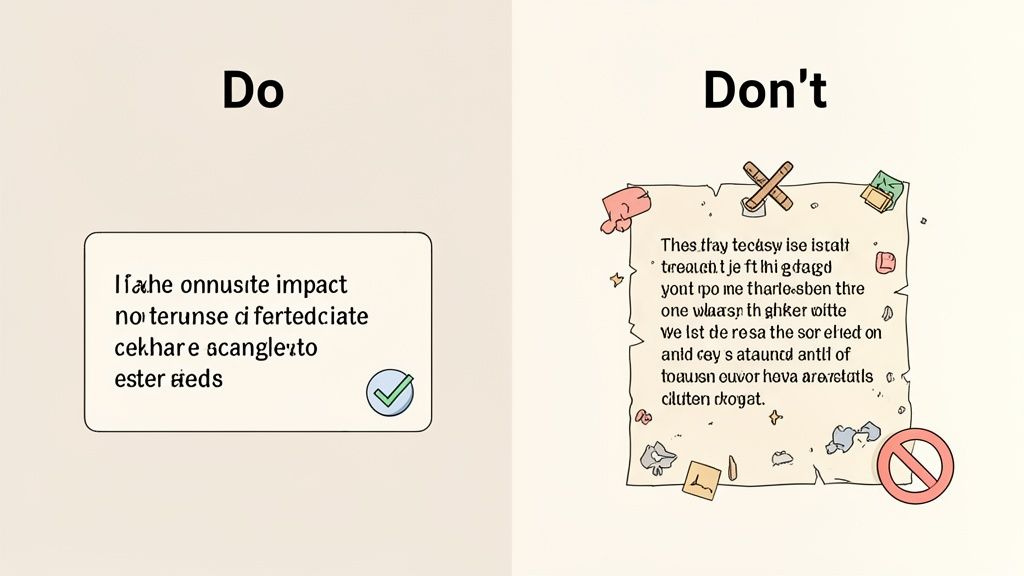
Often, the line between a funded proposal and one that lands in the "no" pile comes down to avoiding simple missteps that cloud your impact.
Focusing on Activities Instead of Outcomes
This is, without a doubt, the number one mistake I see. It’s so easy to fall into the trap of listing all the hard work your team put in—the number of meetings held, brochures distributed, or hours volunteered. These are outputs, not outcomes.
Funders aren't paying for busywork; they're investing in results.
- Weak (Activity-Focused): "We conducted 25 financial literacy workshops for community members."
- Strong (Outcome-Focused): "Our program equipped 80 community members with financial literacy skills, leading to a 45% average reduction in personal debt and a 60% increase in participants opening a savings account for the first time."
My best advice? Read every sentence you write and ask yourself, "So what?" If your sentence doesn't answer that question with a real, tangible result, it’s time for a rewrite.
Key Takeaway: An impact statement should prove your effectiveness, not just describe your activity. Shift your focus from what you did to what changed because you did it.
Using Jargon and Vague Language
Your organization is full of passionate experts, but you can't assume the funder is one of them. Drowning your proposal in field-specific acronyms or technical terms is a surefire way to confuse and alienate a grant reviewer. Your impact will feel inaccessible.
The same goes for those feel-good phrases like "empowering communities" or "making a difference." They sound nice, but they're meaningless without solid proof.
Avoid this: "Our program utilized a synergistic, multi-modal approach to enhance stakeholder capacity."
Instead, use clear language: "Our program combined hands-on workshops and one-on-one mentorship to help community leaders develop effective fundraising plans."
Your goal is crystal-clear communication. Write so that anyone, from a program officer to a board member, can immediately grasp the value you create.
Presenting Unsubstantiated Claims
Every single claim you make needs to be backed up with data. Period.
A statement like "our program significantly improved local teen graduation rates" sounds promising, but it's an empty promise without a number attached. Funders are trained to spot these unsupported assertions, and seeing them quickly erodes their trust in your entire proposal.
Never make a claim you can't prove with a specific metric. Before you even start writing, pull together your evidence. Let your data tell the story, and then use your narrative to give it the context and meaning it deserves. This evidence-based approach is the bedrock of a truly persuasive impact statement.
Tackling Common Questions About Impact Statements
Even with a solid plan, you'll likely run into a few questions when you start drafting. I certainly did when I was starting out. Let's walk through some of the most common sticking points I hear from grant writers trying to nail their impact statements.
What's the Ideal Length for an Impact Statement?
There isn’t a universal word count, but the sweet spot is almost always concise and powerful. For most grant applications, you can land a knockout punch in a single paragraph—think about four to six sentences.
Occasionally, a funder will request a more detailed narrative, but even then, your core statement should be a tight summary. It needs to be punchy enough for a reviewer to remember and maybe even quote in their own reports.
I always tell people to treat it like an elevator pitch for their results. If you can't explain your impact in roughly 100-150 words, it's a sign you need to tighten your message and focus on your most compelling metrics.
Should I Weave in a Personal Story?
Absolutely, but do it with purpose. A short, anonymized story or a powerful quote from someone you’ve helped can bring your data to life. It gives the grant reviewer a human connection to the numbers on the page.
Just remember, the story should support the data, not overshadow it. Use a brief anecdote to illustrate one of your key outcomes. For example, right after you state that 75% of participants secured stable employment, you could drop in a one-sentence quote from someone about what that job meant for their family’s future.
What If Our Program's Results Weren't Flawless?
Honesty is always the best policy here. Funders are experienced; they know that no program is perfect. In fact, showing that you’ve recognized a challenge and are adapting your approach demonstrates that you're a thoughtful, learning organization. That builds way more trust than pretending you hit every single target without a hitch.
The key is to frame it constructively. You could say something like: "While we achieved an 80% success rate, we identified a significant barrier for the remaining 20%. Our revised strategy for the coming year includes dedicated support to address this, and we project this will boost our success rate to 90%."
Ready to stop guessing and start winning? Fundsprout’s AI-powered platform helps you find the right funders, decode their priorities, and generate data-driven impact statements in your organization's voice. Discover how Fundsprout can streamline your entire grant writing process.
Try 14 days free
Get started with Fundsprout so you can focus on what really matters.