The 10-Point RFP Requirements Checklist for Nonprofits
Master your next grant application with our comprehensive RFP requirements checklist for nonprofits. Covers 10 key areas from eligibility to submission.

Abdifatah Ali
Co-Founder
A meticulously crafted program, a passionate team, and a pressing community need can still stall at the same place: the RFP. You know the work matters. Your staff knows the work matters. The families, students, patients, or neighbors you serve know it too. But the funding decision often turns on whether your proposal meets every technical requirement, proves your case cleanly, and gives reviewers confidence that your nonprofit can execute.
That's where many teams lose momentum. One attachment is outdated. One requirement is answered indirectly instead of explicitly. One budget line doesn't match the narrative. A reviewer can admire your mission and still score your submission poorly.
A solid RFP requirements checklist fixes that. It turns a stressful document chase into a controlled process. It also helps nonprofit teams address issues that generic procurement advice often skips, like documenting community need, explaining equity commitments, and showing what happens after grant funding ends.
The process is stricter than many organizations assume. One industry checklist says 60% of proposals fail and recommends bidding only when you meet 80% or more of mandatory requirements, while also confirming portal access at least 48 hours before submission and separating pass/fail requirements from weighted criteria in a compliance matrix (Arphie's RFP submission checklist). That's not a writing problem. It's a systems problem.
The checklist below is built for nonprofits that need both. It focuses on what funders look for, where teams usually stumble, and how to organize the evidence so your proposal reads like a serious implementation plan instead of a last-minute plea.
1. Organizational Eligibility and Compliance Requirements
A surprising number of nonprofit proposals fail before the program description is ever read. If your registration, tax status, filings, or required policies are incomplete, the rest of the application may not matter.
This is the first gate in any practical RFP requirements checklist. Reviewers use it to determine whether your organization can legally receive funds, manage them properly, and operate without preventable compliance risk. For nonprofits, that usually means confirming core legal status, recent filings, insurance, audit readiness, and any state or local registration tied to fundraising or service delivery.
What to verify before you write
Create one folder that holds current versions of the documents your team gets asked for repeatedly. That includes your IRS determination letter, recent Form 990 filing, board list, audit or financial review, insurance certificates, organizational policies, and accessibility-related documents. If you serve the public online, include your ADA compliant accessibility statement with the same care you give your financial attachments.
A community clinic, for example, may be fully capable of delivering services but still hit delays if its insurance certificate is expired or if a named subcontractor hasn't completed required registration. A youth arts nonprofit may have a strong program model but lose points if it can't quickly produce proof of current governance documents or financial controls.
Practical rule: Treat compliance documents like program assets. Store expiration dates, owners, and renewal reminders in one place.
What works and what doesn't
What works is assigning one person to own compliance tracking, even if grant writing is shared across the team. What doesn't work is assuming finance, operations, and development are each tracking “their part” without a single final check.
Useful habits include:
- Track renewals in a calendar: Put filing, insurance, and registration deadlines on a shared calendar with advance reminders.
- Label every document with dates: File names should show version date so staff don't attach old materials by mistake.
- Screen early for eligibility gaps: Tools like Fundsprout can help teams flag missing requirements before they spend time drafting a full response.
If the RFP has mandatory conditions you can't meet, stop there. A disciplined no-bid decision saves time, morale, and credibility.
2. Program Design, Goals, and Measurable Outcomes
Most nonprofit teams care significantly about this section, but many still write it too broadly. Reviewers aren't only asking whether your mission is worthy. They're asking whether the proposed work is specific, manageable, and measurable.
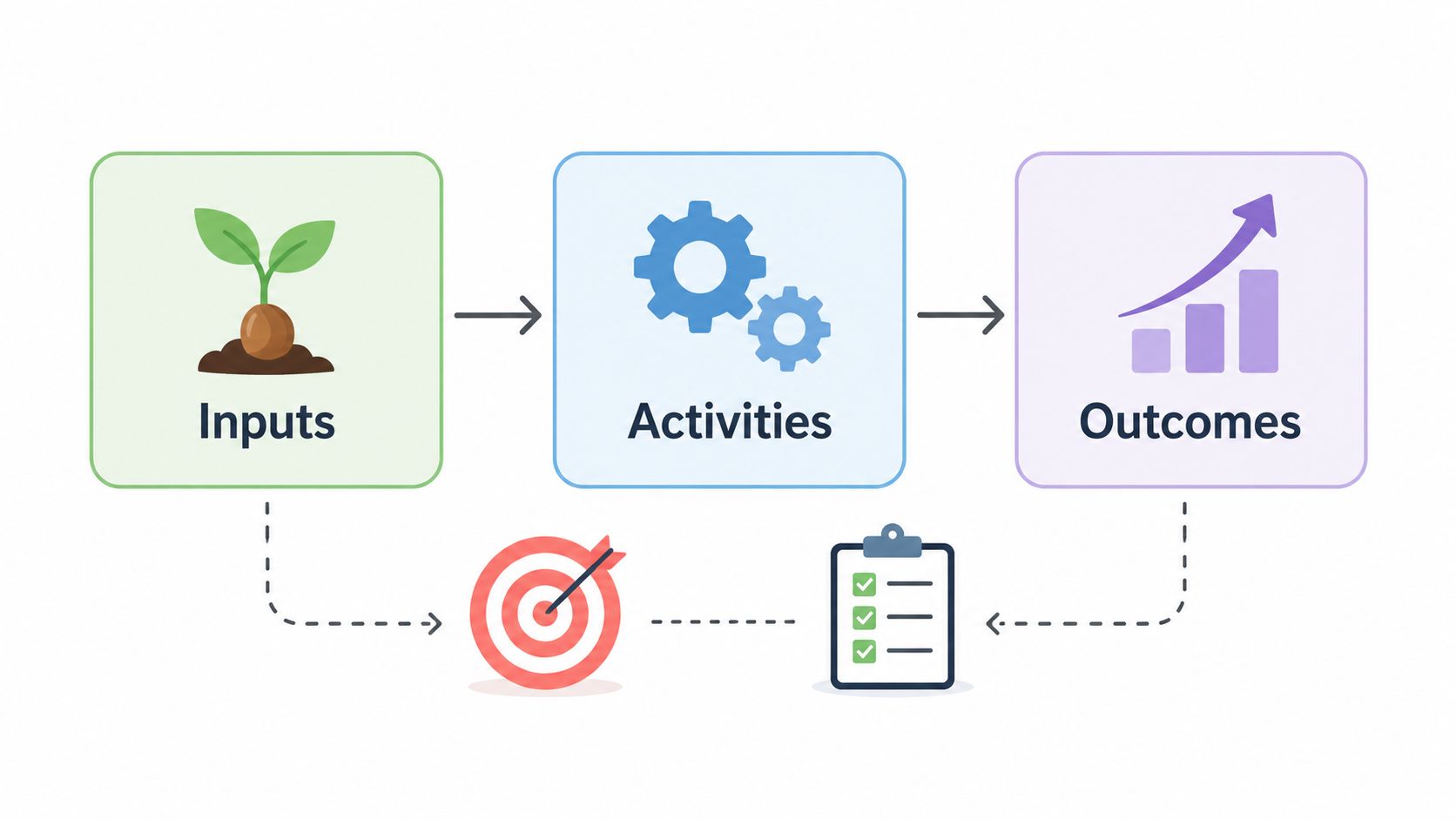
Your program design should show a straight line from need to activity to outcome. If that line is fuzzy, the proposal feels risky. If it's clear, the reviewer can picture implementation.
Here's a simple visual way to consider this:
Build outcomes the reviewer can score
A technically strong checklist should include explicit sections for project scope, timelines, evaluation criteria, and scoring methodology because those fields convert vague requirements into measurable vendor comparisons and improve shortlist quality in complex buys, as noted by Ivalua's guidance on vendor selection. For nonprofits, the same principle applies. Your proposal should let a funder compare your plan against others without guessing what success looks like.
If you run a workforce program, don't stop at “provide job readiness support.” Name the services, the sequence, who receives them, and how progress will be tracked. If you operate a mentoring program, explain how mentors are recruited, screened, trained, matched, and supervised. If your work focuses on food access, define what distribution looks like, who qualifies, and how follow-up happens.
Strong outcomes for nonprofit proposals
Good outcome writing usually includes:
- A clear beneficiary group: Name who will be served and how they're identified.
- A practical service model: Show what staff will do, in what order, and through which delivery channels.
- A measurement plan: Tie each intended result to a concrete data source.
What doesn't work is promising sweeping transformation with no operating detail behind it. Reviewers notice when goals sound polished but implementation sounds improvised.
A good internal habit is to have program managers validate every stated outcome before submission. Development staff can shape the language, but operations staff need to confirm that targets, staffing, and timelines are realistic. That one step prevents a lot of future reporting pain.
3. Budget and Financial Narrative
Budgets don't lose proposals because the math is hard. They lose proposals because the story and the spreadsheet don't agree.
A nonprofit budget section needs to answer two questions at once. First, what will this project cost? Second, why are these costs necessary for the outcomes you just promised? If either answer is weak, reviewers get nervous.
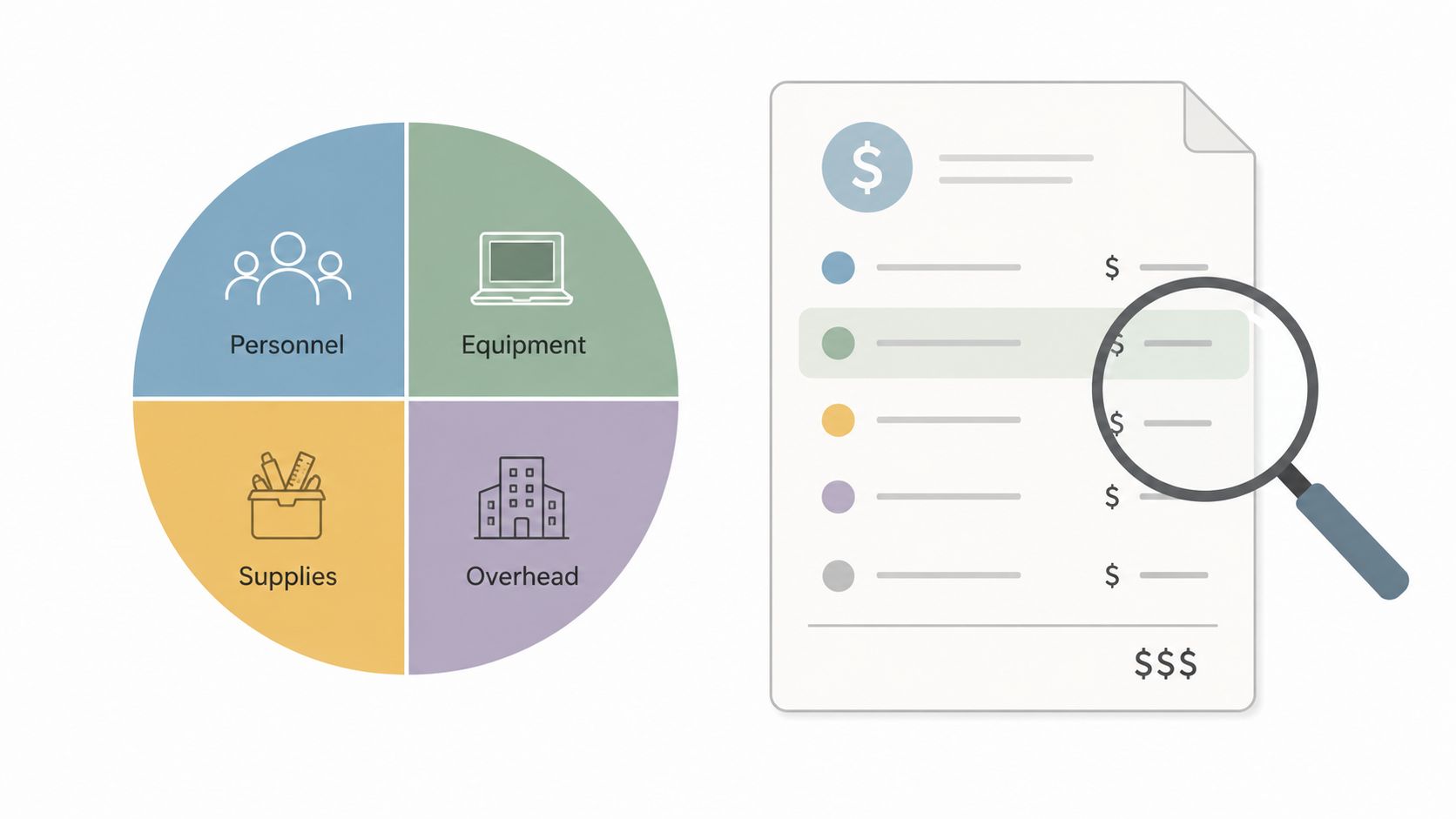
The easiest way to tighten this section is to draft the budget narrative line by line against the actual work plan. If the proposal says you'll launch outreach in the first phase, the budget should show who does that work and what materials they need. If the project relies on data collection, the budget should reflect staff time, software, consultant support, or other evaluation costs.
Here's the kind of visual reviewers appreciate when numbers and categories are easy to scan:
Make the budget defendable
Broader RFP guidance increasingly pushes teams to address total cost of ownership, risk assessment, and post-submission learning rather than treating budget as a cheapest-price exercise, and USAC's checklist shows that “requirements” often include contract details, weighted bid criteria, service-provider IDs, site lists, and SLA language where needed (USAC's RFP checklist). For nonprofits, that means your budget section should document not just expenses, but also proof that the spending model is operationally sound.
A youth-serving nonprofit buying laptops for a tutoring program should justify why those devices are necessary, who will use them, where they'll be stored, and how replacement or support will be handled. A housing organization proposing outreach staff should explain caseload assumptions, supervision, travel, and the reporting workload that comes with grant-funded service delivery.
Reviewers don't mind reasonable costs. They mind unexplained costs.
For teams that need to tighten their financial systems before applying, Fundsprout's guide to accounting for grants is a useful starting point.
Common budget mistakes
- Unlinked expenses: A line item appears in the spreadsheet but nowhere in the narrative.
- Underpriced administration: Reporting, supervision, and compliance work are real costs.
- Hidden sustainability problem: The first-year budget looks workable, but there's no explanation of what happens later.
Your finance lead should review the budget before submission. Not after the narrative is done. Before. That's how you catch unrealistic staffing structures, mismatched indirect costs, and expenses the program team forgot to mention.
4. Organizational Capacity and Management
Funders don't just fund ideas. They fund organizations that can carry them out under deadline, under scrutiny, and under reporting requirements.
This section is where many nonprofits undersell themselves. They describe mission beautifully, then give only a thin summary of staff, systems, and governance. That leaves reviewers wondering whether the organization can manage the grant once awarded.
Show operating strength, not just passion
Strong capacity writing answers practical questions. Who is responsible for delivery? Who supervises the work? Who handles finance, compliance, and reporting? What systems are already in place?
Harvard's GovLab guidebook reflects how structured this has become. It notes that a widely used RFP checklist structure now emphasizes at least six performance metrics in the proposal itself, with each metric assigned an owner, a data-collection method, and a collection frequency. The same guidebook also recommends including the percentage weight or points for each evaluation criterion and describing what a top score looks like, while its sample outline includes key project dates, contact information, and a terms of payment section (GovLab RFP guidebook). The lesson for nonprofits is straightforward: reviewers want evidence that your team has named responsibilities, internal controls, and clear accountability.
A domestic violence organization, for example, should name the program director overseeing delivery, the finance role managing drawdowns or reimbursements, the data lead handling reporting, and the executive approver responsible for contract compliance. A food bank should explain warehouse operations, volunteer management, procurement controls, and board oversight where relevant.
Capacity proof that carries weight
Use evidence like:
- Short staff bios: Focus on relevant experience, not full resumes.
- Governance documents: Mention board oversight, financial review practices, and key policies.
- Implementation ownership: Show which staff positions own which deliverables.
What doesn't work is vague language such as “our experienced team will ensure success.” Reviewers need names, functions, and systems.
If you have a capacity gap, address it directly. Maybe a new grant requires stronger evaluation support or formalized data governance. It's better to state how you'll fill that gap than pretend it doesn't exist.
5. Sustainability and Funding Plan
Nonprofit proposals often drift into fantasy. Reviewers can tell when a sustainability section was written to satisfy a prompt rather than reflect a real plan.
A credible sustainability strategy doesn't promise that every successful pilot will continue forever at the same scale. It explains what parts of the work are core, what funding paths are plausible, and what decisions the organization will make if future revenue changes.
What a believable plan looks like
For some nonprofits, sustainability means diversifying funding. For others, it means embedding the program into contracts, school partnerships, health reimbursements, municipal support, or a phased internal operating budget. Sometimes sustainability means narrowing the model after the grant period instead of maintaining every activity.
That honesty helps. A reviewer would rather see a realistic continuation plan than a generic sentence about “seeking additional grants.”
A strong version of this section usually includes a funding roadmap, a partnership strategy, and a decision point tied to evaluation findings. If the program works, what happens next? If only part of it works, what gets retained? If outside funding doesn't materialize, what can the organization absorb and what can't it absorb?
For teams shaping that answer, Fundsprout's resource on what a sustainability plan is can help organize the thinking.
Field note: Sustainability isn't the same as permanence. It means you've made a plan for continuation, adaptation, or orderly wind-down.
Pitfalls to avoid
- Overclaiming future support: Don't imply partner funding unless it has been discussed seriously.
- Ignoring staffing realities: Temporary grant-funded roles need a post-grant plan.
- Separating sustainability from outcomes: Future funding usually depends on evidence of results.
A neighborhood-based education nonprofit might explain that grant funds will support pilot implementation, outcome tracking, and partner training, while long-term continuation will depend on district integration and philanthropic support. That reads as strategic. Saying “we will continue through community support” without details does not.
6. Needs Assessment and Community Problem Documentation
Many nonprofits understand their community thoroughly but still struggle to document need in a way that satisfies formal review. That's because lived experience alone, while essential, usually isn't enough in an RFP response. You need evidence, context, and a clear connection between the problem and your proposed solution.
This part of an RFP requirements checklist is especially important for nonprofits because funders want to see both data and community voice. If one is missing, the proposal weakens. Data without community input can feel detached. Community stories without broader documentation can feel anecdotal.
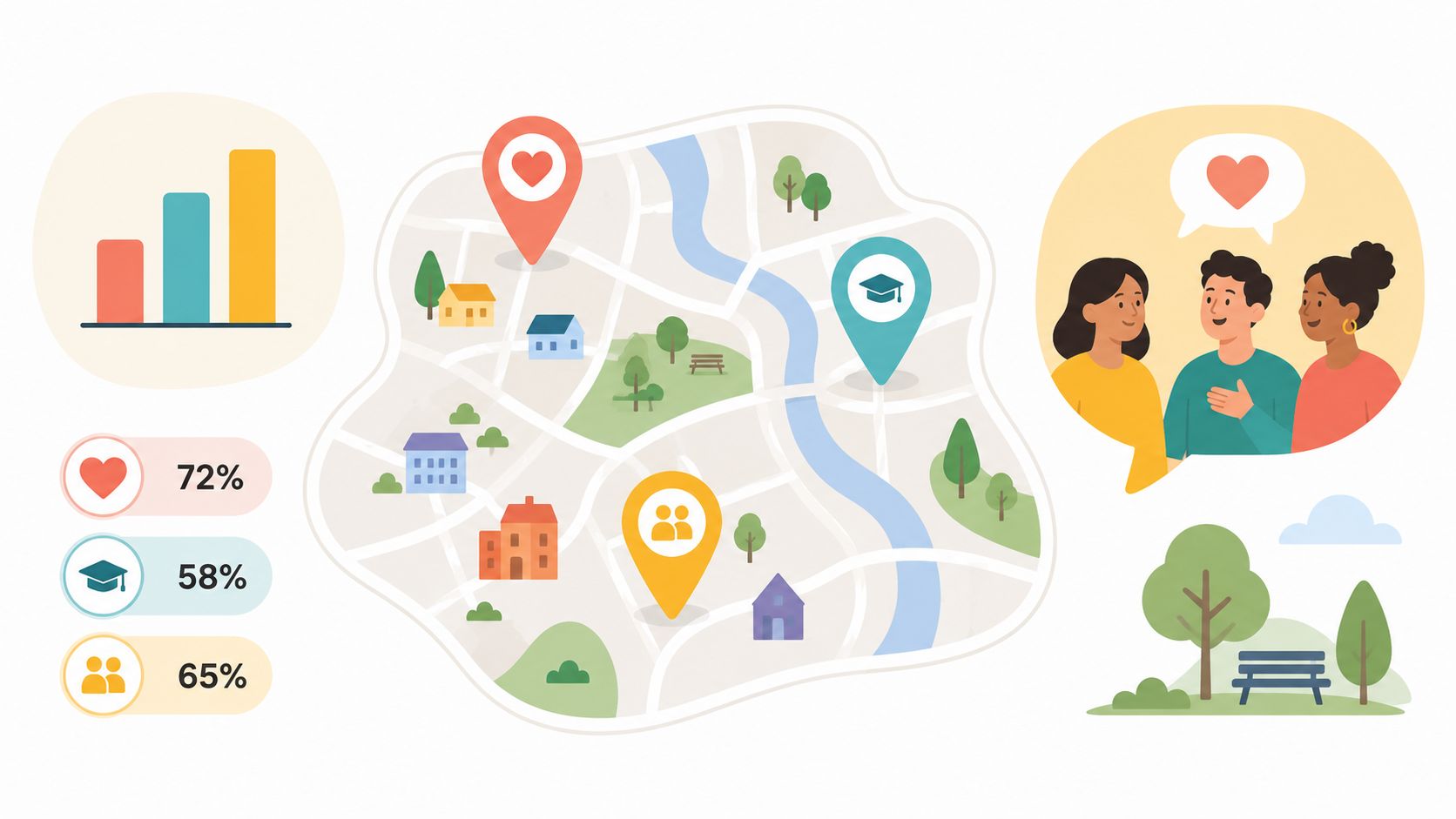
A useful visual can help teams think geographically and operationally about need:
Build the case from multiple angles
A practical nonprofit needs assessment often combines public data, service data, partner insight, and direct input from people affected by the issue. A reentry program might use county justice data, waiting-list information from providers, and listening sessions with returning residents. A rural health nonprofit might combine clinic access data, transportation barriers, and patient interviews.
This is also where many teams should slow down and check alignment. If your needs section focuses on one population but your program section serves another, reviewers notice. If your problem statement emphasizes language access but your budget contains no interpretation or translation support, that gap hurts credibility.
Fundsprout's guide on how to write a needs assessment is helpful if your team is trying to turn scattered data into a coherent case.
Community input should shape the proposal
Use direct input in ways that affect design, not just tone. Community voice should influence service hours, location, staffing, language, outreach, and barriers addressed.
What works well:
- Local specificity: Show what the issue looks like in your service area.
- Community validation: Explain how residents or participants helped define the need.
- Program fit: Make the proposed intervention a logical response to the documented problem.
What doesn't work is importing a national problem statement and dropping your nonprofit's name into it. Reviewers want to know why this issue matters here, now, and for the people you serve.
7. Evaluation and Performance Metrics Plan
If your outcomes section says what success is, your evaluation plan proves you can track it. Many nonprofit proposals often become vague in this section. They mention reports, surveys, and participant feedback, but they don't explain who collects what, how often, or what happens when data shows a problem.
That gap matters because many modern RFPs increasingly expect structured reviews, clear scoring rubrics, and internal approval workflows rather than a simple document-completion checklist, and several government and procurement checklists stress that requirements should be separated into mandatory versus desirable and aligned to evaluation criteria so the final award is fair and auditable (Santa Fe procurement guidance). The nonprofit version of that lesson is simple: every promised result should have a matching measure, and every measure should have a reason for being there.
Use fewer metrics, but define them better
I've seen proposals hurt themselves by listing too many indicators with no collection plan. A better approach is to choose a focused set of measures and define each one clearly.
That usually means naming:
- The metric owner: Which staff role is responsible.
- The collection method: Intake form, attendance log, case note review, survey, database pull, or interview.
- The collection frequency: Ongoing, monthly, quarterly, at exit, or after follow-up.
A reentry nonprofit might track enrollment, service completion, housing placement, and participant-reported readiness. A school-based mental health program might use referral numbers, attendance, service utilization, and post-service feedback. The point isn't to sound technical. The point is to sound operational.
Make evaluation useful internally
The strongest evaluation sections don't treat reporting as a burden imposed by the funder. They show how staff will use the information to improve delivery. If attendance drops, who notices? If one site is underperforming, what changes? If participants face barriers, how is the program adjusted?
Good evaluation plans help staff manage the program. Great ones also help reviewers trust the organization.
What doesn't work is attaching a logic model and assuming the job is done. Logic models are useful, but they don't replace a practical collection and review process.
8. Partnerships and Collaboration Agreements
Partnership language is cheap. Partnership documentation is not. Reviewers know the difference.
Nonprofits often mention schools, clinics, coalitions, faith communities, agencies, or employers in broad terms. That can help establish credibility, but it won't carry much weight unless the proposal shows what each partner is doing.
Be specific about roles and proof
If a school district is providing space, say that. If a health system is sending referrals, explain the process. If a workforce partner is hosting internships, identify how placements are coordinated and supervised. If a coalition partner is helping with outreach, say which neighborhoods or populations they reach.
The most useful partnership materials are often simple. A clean letter of commitment, a memorandum of understanding, or a role summary attached to the proposal can do more than a full page of generic praise. Specificity is what matters.
For example, a maternal health nonprofit might partner with a hospital, a doula collective, and a transportation provider. That's promising. But the stronger proposal shows who handles clinical referral, who provides culturally responsive support, who solves transportation barriers, and how information is shared across the collaboration.
What reviewers want to see
- Defined contributions: Cash, in-kind support, referrals, facilities, staff time, or data-sharing.
- Operational fit: Why this partner matters to service delivery.
- Commitment evidence: Signed letters, draft agreements, or documented collaboration history.
What doesn't work is listing recognizable community names with no attached role. That reads like borrowed credibility.
Fundsprout can be useful here because partnership documents get messy fast. If your team stores letters, draft MOUs, renewal dates, and partner contact records in one place, proposal prep becomes much more manageable.
9. Timeline, Milestones, and Project Management
A weak timeline is one of the fastest ways to make a good proposal feel unrealistic. Nonprofit teams often know the work well but still underestimate setup time, staff onboarding, procurement delays, partner coordination, and reporting cycles.
Your project plan should show sequence, responsibility, and pacing. That means more than dropping activities into a generic month-by-month grid.
Build the timeline around dependencies
Start with the activities that must happen before service delivery begins. Hiring. Training. procurement. partner agreements. data system setup. intake design. referral workflows. Then map what can overlap and what cannot.
A family stabilization program, for example, shouldn't show full enrollment in the same early phase where it's still hiring case managers and finalizing referral protocols. A tutoring initiative can't credibly promise immediate outcome reporting if the assessment tools aren't selected and staff aren't trained.
Success hinges on project management discipline, rather than optimism. Assign each milestone to a role, not just a department. A good work plan says who owns hiring, who owns partner onboarding, who owns data reporting, and who signs off at each stage.
Milestones should be observable
Use milestones that someone can verify. “Outreach launched” is better than “engagement underway.” “Data system configured and staff trained” is better than “evaluation process developed.”
Useful milestone categories include:
- Startup tasks: Hiring, contracts, orientation, system setup
- Service delivery markers: Recruitment, enrollment, launch, implementation cycles
- Reporting points: Internal review dates, funder reports, partner check-ins
One practical habit makes a big difference here. Build in buffer time. Nonprofits often write the best-case timeline because they want to sound capable. A more credible timeline includes room for delay without collapsing the entire work plan.
10. Impact, Equity, and Diversity Commitments
For nonprofits, this section shouldn't be treated as a values statement pasted into the back half of the proposal. Funders increasingly expect equity to show up in design, staffing, access, measurement, and accountability.
That means your equity commitments need to be visible in the actual mechanics of the project. Who can access services easily? Who faces barriers? Who helped shape the approach? Which outcomes are being tracked across different groups? Where might the model unintentionally leave people out?
Move from statement to structure
An equity-focused RFP requirements checklist asks harder questions than “Do we care about equity?” It asks whether interpretation is budgeted, whether materials are accessible, whether service hours fit community realities, whether intake processes deter participation, and whether people with lived experience influence decisions.
A legal aid nonprofit serving immigrants might show how language access is embedded into outreach, intake, service delivery, and follow-up. A disability-focused organization might explain physical accessibility, digital accessibility, transportation support, and advisory input from participants. A youth program might show how staff recruitment, training, and retention connect to the community served.
Evidence matters here too
The strongest equity sections usually include:
- Population clarity: Who the organization serves now, not just who it hopes to serve.
- Barrier removal: Specific operational changes that improve access.
- Shared accountability: Community input, advisory structures, disaggregated review, and staff responsibility.
What doesn't work is writing a strong DEI paragraph while submitting a proposal with no translated materials, no transportation plan, no accessibility approach, and no evidence that affected communities helped shape the program.
Equity also belongs in the evaluation plan. If your outcomes improve overall but one population is still being left behind, the proposal should show how you'll detect that and respond.
RFP Requirements: 10-Point Comparison
| Component | Implementation Complexity 🔄 | Resource Requirements ⚡ | Expected Outcomes 📊⭐ | Ideal Use Cases 💡 | Key Advantages ⭐ |
|---|---|---|---|---|---|
| Organizational Eligibility and Compliance Requirements | Moderate to high, documentation and verification steps required | Low–moderate administrative effort; possible legal/insurance costs | Enables grant acceptance; reduces legal and reputational risk | Initial screening for all grant applications; federal/state funding | Creates objective eligibility baseline; easily verifiable |
| Program Design, Goals, and Measurable Outcomes | High, requires theory of change, SMART goals, and logic models | High, staff time, data collection, evaluation resources | Clear, measurable impact that differentiates applicants | New programs, scaling initiatives, competitive RFPs | Demonstrates strategy, accountability, and comparability |
| Budget and Financial Narrative | Moderate to high, detailed line-items and justifications | Moderate, finance staff time, accounting systems, documentation | Shows fiscal responsibility and funding feasibility | Any grant requiring transparent budgets; multi-year grants | Builds funder confidence and prevents misalignment |
| Organizational Capacity and Management | Moderate, compile governance, staff, systems evidence | Moderate, HR/operations documentation and possible credentials | Signals ability to implement and manage grant funds | Grants that evaluate organizational readiness or large projects | Demonstrates stability, track record, and management bandwidth |
| Sustainability and Funding Plan | Moderate, multi-year planning and revenue modeling | Moderate, planning time, partnership development, revenue analysis | Reduces funder risk by showing post-grant viability | Multi-year grants; pilot-to-scale transitions | Shows long-term thinking and attracts additional partners |
| Needs Assessment and Community Problem Documentation | Moderate, gathers quantitative and qualitative data | Moderate–high, research, surveys, community engagement | Validates problem severity; builds urgency and trust | New proposals, community-driven initiatives, place-based grants | Grounds proposals in evidence and community voice |
| Evaluation and Performance Metrics Plan | High, rigorous methodology, baselines, and QA measures | High, evaluator costs, data systems, staff time (5–10% typical) | Enables learning, accountability, and evidence for continuation | Impact-focused funders, randomized or comparison studies | Drives continuous improvement and credible reporting |
| Partnerships and Collaboration Agreements | Moderate, negotiate MOUs, define roles and data-sharing | Low–moderate, coordination time; formalize in-kind valuations | Extends reach and resources; demonstrates community buy-in | Multi-agency initiatives, referral networks, resource-sharing | Leverages external expertise and reduces implementation risk |
| Timeline, Milestones, and Project Management | Moderate, detailed schedules, critical-path analysis | Moderate, PM tools, staff assignment, contingency buffers | Shows realistic implementation and accountability | Grants requiring Gantt charts or phased rollouts | Clarifies deliverables, deadlines, and responsible parties |
| Impact, Equity, and Diversity Commitments | High, requires data disaggregation and policy alignment | Moderate–high, training, data upgrades, DEI budgeting | Aligns with funder priorities; improves relevance and trust | Equity-focused funders; programs serving marginalized groups | Strengthens community trust and opens equity funding opportunities |
From Checklist to Check Systemize Your Success
An RFP can feel like a pile of administrative demands standing between your nonprofit and the work it's ready to do. That's the wrong frame. A strong RFP is a test of organizational readiness. It asks whether your team can define the problem clearly, design a realistic program, manage funds responsibly, document impact, and carry the work forward in a way a funder can trust.
That's why a good RFP requirements checklist shouldn't live as a one-time Word document on someone's desktop. It should become part of how your organization operates. The best nonprofit teams don't rebuild everything from scratch every time an opportunity appears. They maintain current compliance files, refresh core narratives, store updated budgets and attachments, and keep partnership documents, data points, and staff bios in reusable form.
That shift matters even more as procurement and grant workflows become more digitized. Global demand for RFP software is projected to grow from USD 3.19 billion in 2026 to USD 7.84 billion by 2035, according to Business Research Insights' RFP software market report. For nonprofits, that projection reflects a broader reality. Funders expect cleaner workflows, standardized documentation, and faster, more defensible responses.
In practice, that means building systems around the ten areas above. Keep eligibility documents current. Maintain a library of needs assessment material. Store approved outcome language. Create budget templates that finance has already reviewed. Track partner commitments centrally. Draft timelines from actual implementation experience, not wishful thinking. And make equity visible in operations, not just rhetoric.
A lot of proposal stress comes from trying to remember everything under deadline. Systems remove that pressure. When your team has a repeatable process, the proposal becomes less about panic and more about fit. You can spot weak opportunities earlier. You can respond faster to strong ones. You can spend more time tailoring strategy and less time chasing the same attachments for the fifth time.
That's also how you improve quality. Not by writing more grandly, but by reducing preventable errors. The strongest nonprofit submissions usually feel calm on the page. They answer the question asked. They attach the right proof. They show ownership. They connect budget to delivery. They treat evaluation seriously. And they make it easy for a reviewer to say yes.
Use this checklist as a working tool, not a reading exercise. Adapt it for your organization, assign owners for each section, and revisit it before every major application cycle. Done well, it turns the RFP from a recurring fire drill into a durable grantmaking system.
If your team is tired of rebuilding proposals from scratch, Fundsprout can help you turn this checklist into an actual workflow. It gives nonprofits one place to track opportunities, screen for eligibility, organize core documents, analyze RFP requirements, draft customized narratives, manage deadlines, and keep a clean record from submission through renewal.
Try 14 days free
Get started with Fundsprout so you can focus on what really matters.