What Is a Sustainability Plan? A Guide for Nonprofit Longevity
Learn what is a sustainability plan and why it’s vital for your nonprofit. Discover key components, funder expectations, and practical steps to build one.

Abdifatah Ali
Co-Founder
Let's be honest, for many nonprofits, "sustainability" sounds like a vague corporate buzzword. But what it really means is building an organization that can stick around long enough to see its mission through. A sustainability plan is your roadmap for doing just that.
It's not just another document to gather dust on a shelf. It’s the blueprint for resilience, showing exactly how you’ll gather the money, people, and community support needed to not just survive, but truly thrive.
What a Sustainability Plan Really Is (and Isn't)
Think of it this way: your strategic plan sets the destination—the big, ambitious change you want to create in the world. Your sustainability plan is the vehicle you'll use to get there. It's the engine, the fuel tank, the maintenance schedule, and the GPS, all rolled into one. It answers the fundamental question every leader has to ask: How are we going to keep this important work going, year after year?
A true sustainability plan looks far beyond immediate financial needs. It’s a holistic strategy designed to help your organization weather the inevitable storms—economic slumps, leadership transitions, or shifts in community needs—without losing sight of its mission. It forces you to stop thinking grant-to-grant and start building for the long haul.
It's Much More Than a Fundraising Document
This is a common misconception. People hear "sustainability" and immediately think "fundraising." While bringing in money is obviously a massive part of the equation, a real sustainability plan is so much more comprehensive.
It weaves together every aspect of your organization’s health. This shifts the entire mindset from a short-term scramble for cash to a long-term strategy for building strength and deepening your impact.
A sustainability plan is the ultimate expression of confidence in your mission. It tells funders, staff, and your community that you aren't just hoping to make a difference today—you are building an organization that is designed to make a difference for decades to come.
The Three Pillars of Lasting Impact
A truly robust sustainability plan stands on three core pillars. Like a three-legged stool, if one leg is weak or missing, the whole thing comes crashing down, no matter how strong the other two are.
Here’s a quick look at how these pillars work together to create a stable and enduring organization.
The Three Pillars of Nonprofit Sustainability
By addressing all three of these areas, you move beyond simply keeping the lights on. You start building an organization that is truly built to last.
The Core Components of a Powerful Sustainability Plan
A truly solid sustainability plan isn't a single document you create once and file away. It’s a living framework, built on several pillars that all support each other. Getting this right is what allows your organization not just to survive the tough times, but to keep delivering on its mission year after year.
Think of it like building a house. You wouldn't rely on just one support beam, would you? The same goes for your nonprofit. A comprehensive plan makes sure the entire structure is sound and built to last. Let's break down those load-bearing walls.
Financial Resilience and Diversification
This is the one everyone thinks of first, but financial resilience is so much more than just having a budget. It's about intentionally building a diverse and stable financial base so you're not overly dependent on a single income source. Relying on one big grant is a classic mistake—if that funder’s priorities shift, your entire operation is at risk.
A financially resilient nonprofit works to cultivate a healthy mix of revenue streams:
- Individual Giving: A loyal base of monthly donors or major gift contributors who believe in your work.
- Corporate Sponsorships: Mutually beneficial partnerships with businesses that share your values.
- Earned Income: Fee-for-service programs or products that bring in unrestricted revenue.
- Grant Funding: Pursuing grants as one strategic piece of the puzzle, not the whole pie.
Having this mix gives you the flexibility to navigate economic downturns or unexpected funding cuts. For a deeper dive into structuring these revenue goals, check out our guide on the nonprofit fundraising plan format.
Leadership and Operational Strength
Your people and your processes are the engine that drives your mission forward. This component is all about strong internal capacity, which covers everything from leadership development and succession planning to simply having efficient systems. A key, but often overlooked, part of this is implementing effective knowledge retention strategies so critical information doesn't walk out the door when a key staff member leaves.
This diagram really shows how these core pillars are the foundation for your entire mission.
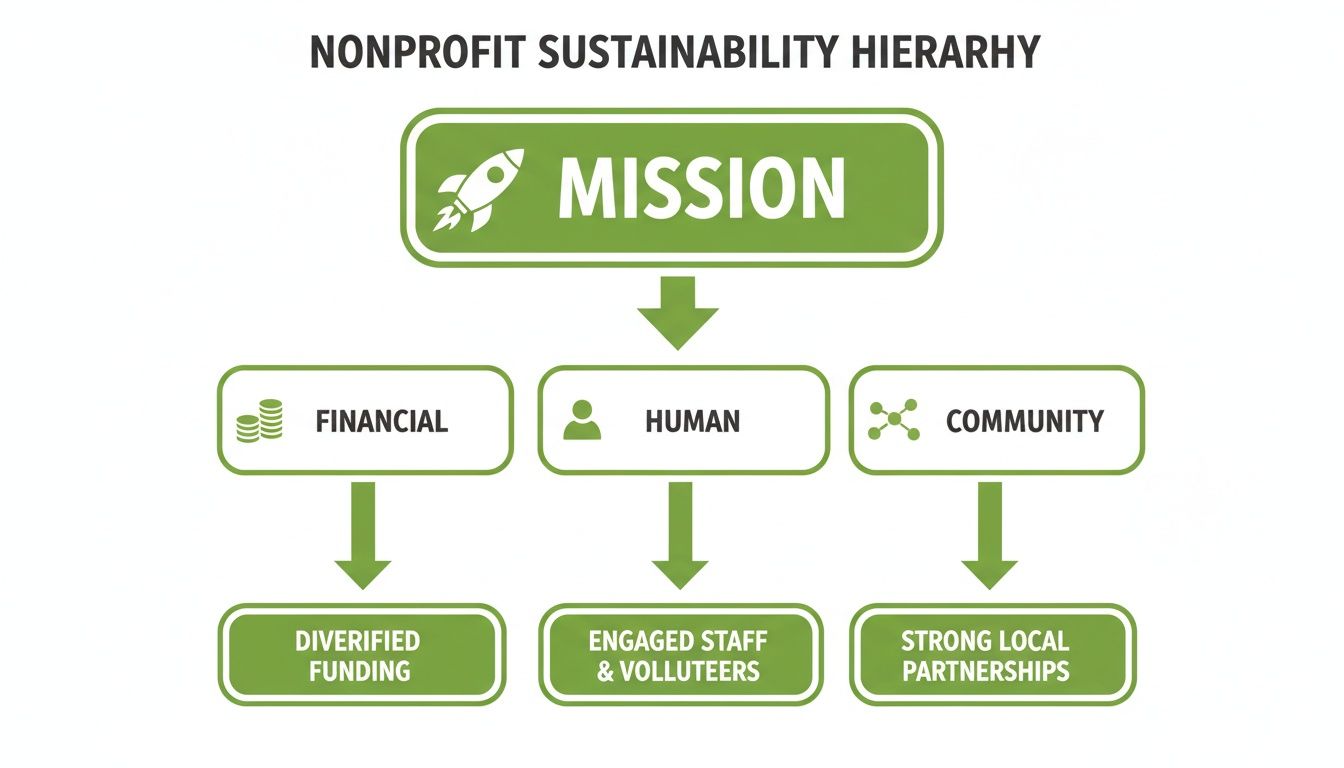
As you can see, a powerful mission needs a solid base of financial health, strong human capital, and deep community engagement to stand on.
Programmatic Durability and Adaptation
To earn long-term support, your programs have to stay relevant and effective. Programmatic durability means you're constantly using data and feedback from the community to evaluate and refine what you do. This ensures your work continues to meet real, evolving needs instead of becoming stale.
A sustainable program is an adaptable one. It’s built on a cycle of listening, learning, and improving. This proves to funders that you’re a responsible steward of their investment and truly committed to making a difference.
Strategic Partnerships and Community Support
Finally, no nonprofit can succeed in a vacuum. A strong sustainability plan spells out how you'll build and nurture a network of strategic partnerships. This includes collaborations with other nonprofits, government agencies, local leaders, and volunteers. These relationships provide so much more than money—they offer expertise, in-kind support, advocacy, and crucial community buy-in.
This idea of showing tangible, long-term impact isn't just a nonprofit trend; it's an expectation across the board. By 2024, for instance, 91% of companies by market cap were reporting on their own sustainability efforts, often with specific targets. As funders and regulators demand more quantifiable results from the corporate world, they expect the same rigor from the nonprofits they support.
Why Grant Funders Demand a Sustainability Plan
Have you ever noticed that almost every grant application, buried somewhere in the questions, asks about your plan for the future? It’s not just a formality or a box to check. For funders, your sustainability plan is a critical window into your nonprofit's health and long-term vision.
It’s their way of asking the big, unspoken question: “What happens to our investment after the grant money is gone?”
Grantmakers don’t just see themselves as donors; they see themselves as investors in your mission. And like any smart investor, they want to back an organization that’s well-managed, thinks ahead, and is truly built to last. A solid plan shows them you’re a responsible steward of their funds—not just a temporary project that will fade away when the funding cycle ends.
It proves you have strategic foresight and a credible roadmap for what’s next.
Moving Beyond a Single Investment
Funders get it. They know the nonprofit world is full of uncertainty and that one grant, no matter how generous, can’t fuel your mission forever. They ask for a sustainability plan because it proves you're actively building a resilient organization that can weather the inevitable ups and downs.
A good plan shows them you are:
- Diversifying Your Revenue: You’re not putting all your eggs in one basket. You're actively pursuing a healthy mix of funding streams—from individual donors and corporate sponsors to earned income—to avoid a dangerous dependency on any single source.
- Building Your Capacity: You’re investing in the nuts and bolts of your organization—your people, your systems, your leadership—to ensure you have the operational muscle to keep going long after their grant is spent.
- Engaging Your Community: You’re nurturing deep roots with partners, volunteers, and stakeholders who believe in your cause and will champion it for years to come.
Ultimately, you’re showing them that their grant is a catalyst. It's not a lifeline to keep you afloat; it's high-octane fuel for a well-built engine that will eventually run on its own power.
A sustainability plan turns your grant proposal from a simple request for money into a compelling investment opportunity. It frames the funder as a partner in building something permanent and impactful.
Demonstrating Viability and Reducing Risk
From a funder's point of view, a nonprofit without a clear sustainability plan is a high-risk investment. It signals a reactive, grant-to-grant survival mode that can lead to mission drift or, in the worst-case scenario, shutting the doors.
A well-crafted plan completely changes that perception. It gives them concrete, reassuring evidence of your long-term viability.
Think of it as your organization's plan of record for financial and programmatic stability; it’s the official blueprint that shows how you’ll maintain your impact over time. To dig deeper into this idea, you can learn more about creating a plan of record to formalize and communicate your strategic commitments.
This approach proves to funders that your passion for the mission is backed by a practical strategy to sustain it, making your proposal far more trustworthy and compelling.
Bringing Your Sustainability Plan to Life with Examples
It's one thing to talk about a sustainability plan in theory, but seeing real-world examples is what makes the concept finally click. This is the point where high-level ideas start to become concrete, documented goals—and where your strategy really begins to take shape.

The whole process starts by writing down specific, measurable goals tied to a timeline. You have to move past vague hopes like "raise more money." A strong sustainability goal provides clarity and a roadmap. It’s the difference between merely wishing for success and actually planning for it.
Crafting Actionable Goal Statements
Think of well-defined goals as the backbone of your plan. They give your team clear targets to aim for, and just as importantly, they signal to funders that you have a thoughtful, realistic approach to building a resilient organization.
Here are a few examples you can adapt for your own nonprofit:
- Financial Goal: "Our objective is to grow our monthly donor base by 30% within 18 months. This will increase unrestricted funds and reduce our reliance on the annual gala from 60% to 45% of our operating budget."
- Partnership Goal: "We will secure three new corporate sponsorships at the $5,000 level by the end of the fiscal year to underwrite our youth literacy program, diversifying our program-specific funding."
- Capacity Goal: "To ensure leadership continuity, we will identify and train two internal staff members for management roles over the next 24 months, creating a clear succession pipeline."
Notice how each statement connects a specific action to a strategic outcome? That’s what makes a sustainability plan a practical tool you can actually use for daily decision-making.
A great sustainability plan doesn't just list aspirations; it outlines the specific, measurable steps you'll take to achieve them. It transforms the question "How will we survive?" into a confident statement: "Here's how we will thrive."
Mini Case Study: The Meadowbrook Arts Council
Let’s look at a fictional nonprofit, The Meadowbrook Arts Council. For years, they've coasted on a single, large government grant that covers nearly 70% of their expenses. The problem? They just heard the grant might not be renewed next year, and panic is setting in.
Realizing how vulnerable they are, they quickly develop a simple, two-pronged sustainability plan:
- Develop a Community Partnership Program: They decide to launch a tiered membership for local businesses, offering visibility at events in exchange for annual support. The goal is to sign up 20 local partners in the first year, which would bring in $15,000 in new revenue.
- Launch a "Friends of the Arts" Donor Circle: At the same time, they create an initiative to cultivate major donors from their existing pool of supporters. The target is to recruit five founding members at $2,500 each, building a strong foundation for future individual giving.
By focusing on these two tangible goals, Meadowbrook shifts from a reactive panic to a proactive strategy. They now have a clear path to diversify their funding and build a more resilient future—which, by the way, makes them a much stronger candidate for multi-year funding from other foundations.
This kind of ambitious, forward-looking planning is critical everywhere, especially in fields like climate action. The State of Climate Action 2025 assessment found that no key indicators are on track to meet 2030 targets, showing a huge gap between pledges and actual progress. To turn things around, plans need concrete, near-term targets instead of just relying on distant goals. You can dig deeper into this urgent need for ambitious planning in the World Resources Institute's 2025 assessment.
How to Measure the Success of Your Sustainability Plan
A plan without clear metrics is just a collection of good intentions. Turning your sustainability goals into measurable actions is what transforms your plan from a static document into a dynamic management tool. This data-driven approach gives you—and your funders—compelling evidence that your nonprofit is built to last.
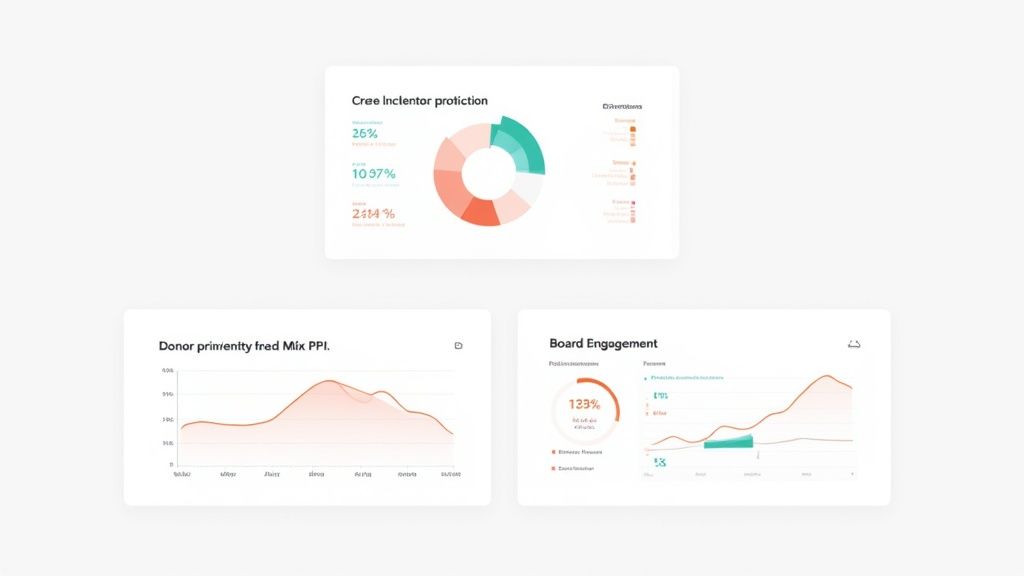
Think of these metrics as the dashboard in your car. It tells you your speed, your fuel level, and if the engine is running smoothly. Without it, you’re just driving blind and hoping for the best. For nonprofits, these numbers provide much-needed clarity and focus, guiding every strategic decision you make.
Identifying Your Key Performance Indicators
The first step is to pick a handful of Key Performance Indicators (KPIs) that genuinely reflect your organization's health. Vague goals like "improve fundraising" just won't cut it. You need to get specific and focus on quantifiable indicators that connect directly to the core parts of your sustainability plan.
Your metrics should give you a holistic view of your operations:
- Financial Health: The percentage of your budget covered by diverse revenue streams is a critical KPI. Tracking this shows you whether you're successfully weaning yourself off of a single grant or fundraising event. Our guide on creating a budget example for a nonprofit can help you structure these financial goals.
- Donor Engagement: Your donor retention rate is a powerful indicator of how much your community believes in you. A rising rate shows you’re building lasting relationships, not just processing one-time transactions.
- Leadership Involvement: Measuring board member engagement in fundraising activities—like the number of introductions made or events attended—is a great way to track the commitment of your leadership team.
The gap between having a plan and actually making progress is a universal challenge. Just look at the UN's 2030 Agenda for Sustainable Development. Despite 190 of 193 member states creating national sustainability plans, a recent report warned that none of the 17 goals were on track. It's a stark reminder that simply having a plan isn't enough; consistent execution and measurable progress are what truly matter.
Creating a Simple Tracking Dashboard
You don’t need expensive or complicated software to monitor your progress. A simple dashboard, even one built in a basic spreadsheet, can bring your data to life. It creates a visual snapshot of how you're doing, making it easy to share updates with your board and funders.
To ensure your sustainability plan stays on track, you need a clear system for tracking your metrics. You can find some practical guidance on tracking operational performance indicators that can help translate your KPIs into a functional dashboard.
Your dashboard should answer a simple question at a glance: "Are we on track to meet our sustainability goals?" If the answer is no, the data will help you pinpoint exactly where you need to adjust your strategy.
By setting realistic, time-bound targets and tracking them consistently, you give your organization the ability to learn and adapt on the fly. This data-driven approach shows funders that you are not just passionate about your mission—you are a sophisticated, well-managed organization capable of creating lasting impact.
Still Have Questions About Sustainability Plans?
Even after you've got the basics down, putting together a sustainability plan for the first time can feel a little daunting. It's totally normal to wonder how this new document fits with everything else you're already doing, especially if you're a smaller organization. Let's walk through some of the most common questions that pop up.
Getting these cleared up now will help you move forward with confidence and create a plan that genuinely works for you.
How Is a Sustainability Plan Different From a Strategic Plan?
This is easily the most frequent question we hear, and the confusion makes sense. The simplest way to think about it is to imagine you're planning a big cross-country road trip.
Your strategic plan is the map. It shows your ultimate destination (your mission and vision) and highlights the major stops you want to make along the way (your big-picture goals for the next three to five years). The strategic plan answers the question, "Where are we going?"
Your sustainability plan, on the other hand, is all about the car you're driving. It covers how you'll pay for gas (financial resources), keep the engine in good shape (programmatic and operational capacity), and know who to call if you break down (partnerships). It answers the vital question, "How will we keep this journey going for the long haul?" One focuses on what you'll achieve; the other outlines how you'll have the resources to get it done.
We're a Small Nonprofit. Do We Really Need One?
Yes, without a doubt. In fact, a sustainability plan might be even more important for a small nonprofit. When you're running lean, the loss of a single grant or a key staff member can feel like a seismic event. A sustainability plan is your shock absorber.
This doesn't mean you need to create some massive, 50-page binder. Not at all.
For a smaller team, a focused two-page document can be incredibly powerful. It just needs to provide clear answers to your most pressing questions:
- How are we going to find and welcome our next great board member?
- What's our game plan for raising the first $10,000 in flexible, unrestricted funds this year?
- What steps can we take to prevent our amazing founder or ED from burning out?
Even a simple plan gives you direction and a sense of stability, making sure your small-but-mighty organization is built to last.
How Often Should We Update This Plan?
Think of your sustainability plan as a living, breathing document—not a "set it and forget it" project you complete just to check a box on a grant application. It's meant to be used.
Your sustainability plan is a dynamic guide for making smart decisions. Reviewing it regularly keeps it relevant and useful as you navigate new challenges and seize new opportunities.
As a best practice, give it a solid review once a year, right around the time you're building your annual budget. This is the perfect time to see how you're tracking against your goals and make tweaks for the year ahead. Then, plan for a more thorough overhaul every two or three years. You'll also want to revisit it anytime something big changes, like new leadership, a major shift in your strategic direction, or a disruption in the funding environment. This ensures your plan always reflects your reality.
Ready to build a grant strategy that funders will love? Fundsprout is your AI-powered partner for nonprofit success. Find the perfect funding opportunities, write winning proposals in your organization's voice, and manage deadlines effortlessly. Stop chasing grants and start building a sustainable future. Discover how at https://www.fundsprout.ai.
Try 14 days free
Get started with Fundsprout so you can focus on what really matters.