Nonprofit Youth Grants: A Step-by-Step Playbook
Your complete guide to winning nonprofit youth grants. Learn to find funders, write persuasive proposals, and build lasting partnerships for your youth program.

Abdifatah Ali
Co-Founder
You're probably in one of two situations right now. Either your youth program is doing meaningful work and you need funding fast, or you've already started searching and found yourself drowning in deadlines, eligibility rules, and applications that all seem to ask for the same thing in slightly different ways.
That's where most nonprofit teams lose time.
They chase too many opportunities, write from scratch too often, and treat each application like an isolated event instead of part of a system. With nonprofit youth grants, the teams that win consistently usually aren't the ones writing the prettiest prose. They're the ones that screen hard, organize early, and only pursue opportunities that fit their program, geography, capacity, and evidence.
Youth funding is active, but it's rarely casual. Many funders are passionate about young people, yet they still run narrow, scheduled, and competitive grant rounds. If you want better results, the answer isn't more applications. It's a tighter process.
Aligning Your Mission with Funder Priorities
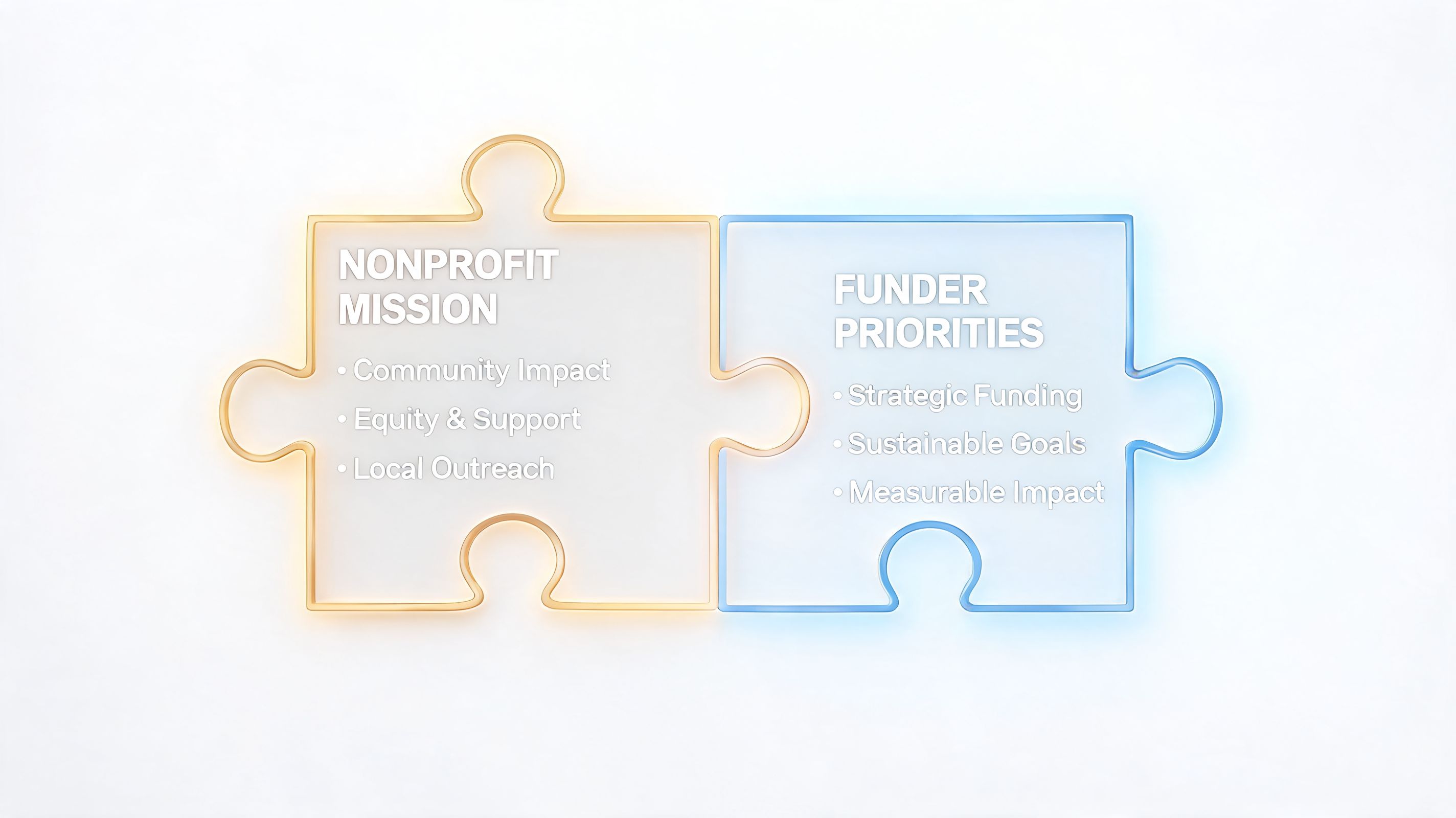
Grant readiness starts inside your organization. Before you search for a single opportunity, you need a fundable story that is specific enough for a program officer to understand quickly and strong enough for a reviewer to defend internally.
Candid reports that only 35% of foundations fund 50% or more of the requests they receive, and about one-third of funders received fewer than 50 proposals, while 38% of those funded at least half. That's a useful reminder that volume alone doesn't explain outcomes. Selectivity and application quality matter just as much, often more, according to Candid's funded proposals analysis.
Build your grant-ready package
Three pieces have to be clear before you apply.
Your problem statement
Name the youth population you serve, the barrier they face, and the gap your program addresses. “We support youth” is too broad. “We provide afterschool mentoring and conflict-resolution programming for middle school students struggling with peer conflict and school engagement” is much easier to fund.
Your intervention
Explain what you do when a young person enters the program. Funders want a line from need to service to result. If your program includes mentoring, family engagement, social-emotional learning, or workforce readiness, describe the sequence plainly.
Your proof
Gather the evidence you already have. That may include participant demographics, attendance trends, pre/post surveys, staff observations, school or community partner feedback, pilot outcomes, and brief testimonials.
- Eligibility fit: Are you the right type of applicant, with the right tax status, location, and budget profile?
- Program fit: Does the funder support your exact kind of youth work, such as afterschool, mentoring, workforce readiness, or subgroup-specific programming?
- Geographic fit: Is your service area clearly inside the funder's footprint?
- Capacity fit: Can your team manage the application, reporting, documentation, and award restrictions?
- Timing fit: Can you submit a strong proposal before the deadline without damaging other priorities?
- Broad mission, narrow reality: The language sounds open, but the actual examples or restrictions point elsewhere.
- Heavy lift, small return: The reporting burden is high relative to the likely value for your team.
- No proof path: You can't credibly document the outcomes the funder cares about.
- Deadline mismatch: You'd be forcing a rushed proposal.
- Need
Identify the youth population, the challenge, and the local context. - Program
Describe services, staffing, partners, and delivery model. - Outcomes
Name what will change for participants. - Evaluation
Explain how you'll track implementation and results. - Budget
Show what the grant pays for and why those costs are necessary. - Legal and governance files: determination letter, board list, bylaws summary if needed
- Financial records: operating budget, latest financial statements, audit or review if available
- Organizational materials: mission, history, staff bios, program summaries, partner letters
- Program evidence: outcomes summaries, evaluation tools, participant stories, standard data points
- Go or no-go decision
- Narrative first draft
- Budget review
- Attachment collection
- Executive approval
- Portal upload and final check
- Submission date
- Program or project proposed
- Amount requested if applicable in your records
- Funder type
- Decision status
- Feedback received
- Follow-up date
- Next action
- Early confirmation: A prompt thank-you and internal kickoff once the award is accepted
- Useful updates: Short notes when the program launches, reaches an important milestone, or adapts to a challenge
- Responsible transparency: If staffing changes, recruitment shifts, or implementation gets delayed, the funder hears it from you early
- Context, not just compliance: Reports explain what happened, what changed, and what the funder's support made possible
Practical rule: A grantmaker is not funding your passion. They're funding your ability to produce outcomes for a clearly defined youth population.
Write from the funder's viewpoint
Most weak applications fail before the writing even starts. The organization hasn't decided what its strongest case is, so the narrative shifts from one proposal to the next.
A better approach is to create a reusable core packet that includes your mission, program summary, community need, leadership bios, financial documents, standard attachments, and a short bank of outcome statements. If you need help tightening the evidence behind your need statement, these community needs assessment tools are a practical place to start.
For examples of how mission language can stay values-driven while remaining concrete, review Our mission and vision statements. The useful lesson isn't the wording alone. It's the discipline of saying exactly what the organization exists to change.
What funders usually respond to
Use this filter when reviewing your own materials:
| Question from the funder | What your organization should have ready |
|---|---|
| Who are you serving? | A clearly defined age group and community |
| What problem are you solving? | A concise need statement tied to lived conditions |
| Why this program? | A practical explanation of your model |
| Why your team? | Credible staff, partners, and execution history |
| How will you know it worked? | A simple outcomes and tracking plan |
If your answers are vague, your grant strategy will be vague too. Tightening your internal story is often the fastest way to improve your external results.
Building Your High-Impact Grant Pipeline
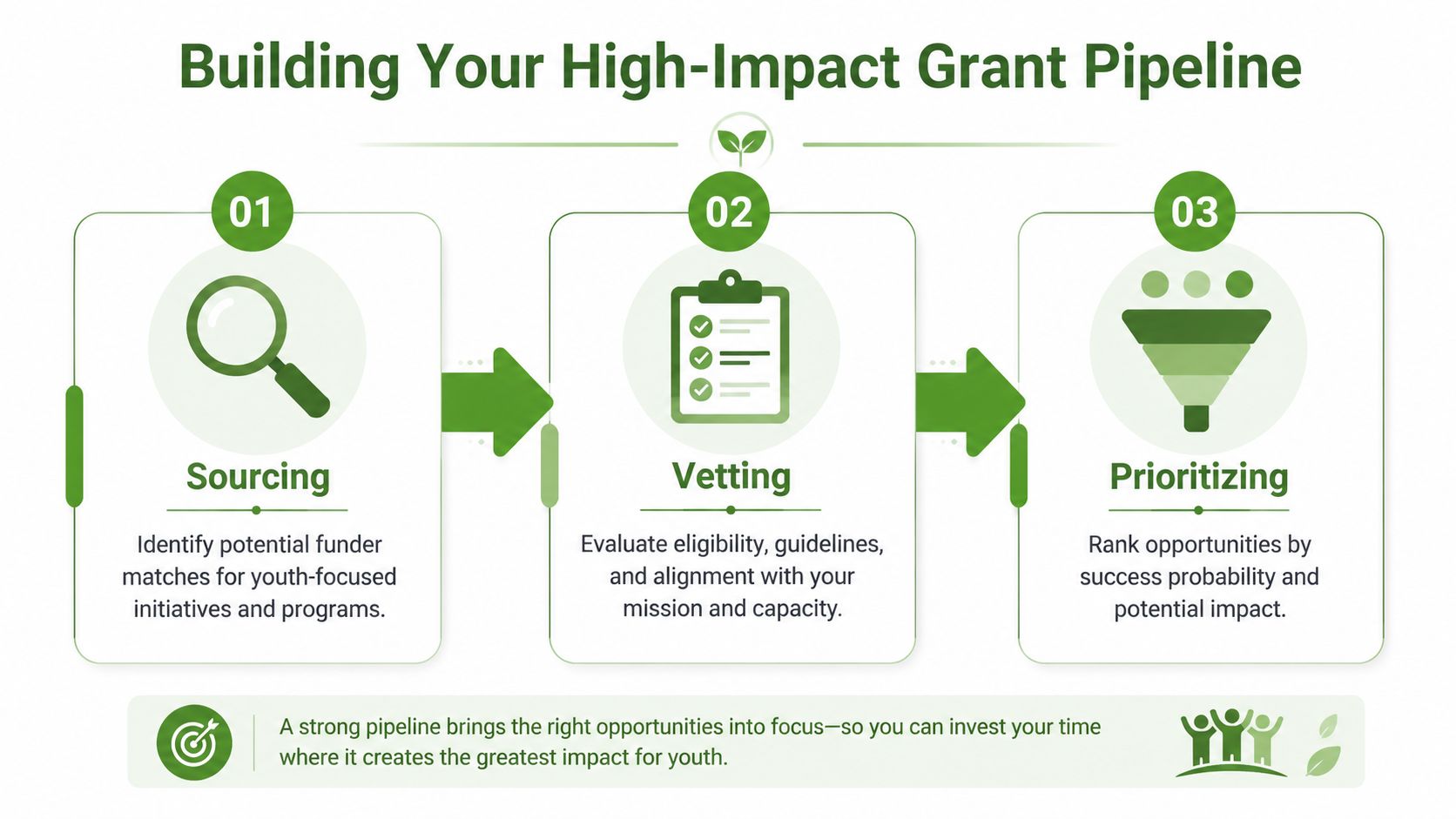
Most nonprofit youth grants are lost in the research phase, not the writing phase. Teams pull huge lists, save dozens of opportunities, and mistake activity for strategy. A long list feels productive. It usually isn't.
The better method is a funnel. Start broad, screen aggressively, and keep only the opportunities that deserve staff time.
Start with fit, not hope
A youth grant may look perfect on the surface and still be a poor target. One strong example is the William T. Grant Foundation's Youth Service Improvement Grants in New York City. The program typically receives 25 to 35 applications each year and funds about six organizations, which puts the award rate at roughly 17% to 24%. It also requires applicants serving youth only to have a prior-year budget between $250,000 and $5 million, according to the Foundation's 2025 overview of Youth Service Improvement Grants.
That tells you something important about nonprofit youth grants. A mission match is not enough. You also need a capacity match, geographic match, and program-design match.
Use a screening matrix
When I coach nonprofit teams, I tell them to score opportunities before they draft anything. A simple matrix works:
If a grant scores weakly on any of those, drop it.
Weak-fit grants consume the same internal energy as strong-fit grants. They just return less.
Narrow your annual target list
A useful pipeline is not a giant spreadsheet full of possibilities. It's a ranked short list you can manage. That means a smaller set of prospects with real odds, clear deadlines, and obvious alignment.
Track them in one place. A structured grant tracking spreadsheet template can help teams log deadlines, stage, owner, attachments, and follow-up status without overcomplicating the process.
You can also use tools like Grants.gov, state portals, foundation directories, and platforms that rank opportunities based on fit. Fundsprout is one option for this kind of workflow. It scans grant opportunities, screens eligibility, and helps teams organize a ranked pipeline around program area, geography, and capacity.
What to cut first
If your list is still too long, remove opportunities that show these signs:
The discipline to decline marginal opportunities is what makes a high-impact pipeline possible.
From Outline to Narrative Crafting a Winning Proposal
A strong proposal doesn't start with paragraphs. It starts with answers.
Reviewers are usually trying to determine five things fast. Who needs help, what your program does, why your model is credible, how you'll measure progress, and whether the budget makes sense. If your draft doesn't answer those in a clean sequence, the application feels harder to score.
Draft the skeleton before the prose
Build the proposal in parts before you write full narrative. That keeps the logic tight.
A workable outline for nonprofit youth grants often looks like this:
That outline sounds obvious, but many drafts scramble these elements. They spend too much time on organization history and too little time showing how services lead to measurable change.
Strong language sounds operational
Weak grant language is usually broad, padded, and abstract.
Here's the difference:
| Weak | Strong |
|---|---|
| We help at-risk youth succeed | We provide structured mentoring, conflict-resolution support, and family engagement for youth facing school disengagement |
| Our program changes lives | Our staff deliver weekly sessions, track attendance, and coordinate referrals with school and family partners |
| We are passionate about equity | The program is designed for a clearly defined youth subgroup and addresses barriers that standard services often miss |
The stronger version gives the reviewer something to visualize and evaluate. It doesn't rely on emotional claims alone.
Reviewers don't need bigger adjectives. They need a clearer chain from need to activity to result.
Match the narrative to the funder's lens
The same youth program can be framed differently depending on the grant. A workforce funder may care about readiness, coaching, and pathways. An afterschool funder may care more about attendance, engagement, and safe out-of-school time. A mental health-oriented funder may focus on support structure, trauma awareness, and access barriers.
That doesn't mean changing your mission. It means emphasizing the part of your program that fits the funder's stated purpose.
If you need to sharpen your outcomes language, this guide on how to write impact statements is useful for turning broad claims into statements a reviewer can score.
Make the program feel real
Youth proposals improve when they sound lived-in. Include the details that show execution. How youth are recruited. What staff are trained to do. How parents or caregivers are engaged. What happens when a participant misses sessions. Which partners refer youth. How you adapt services for a subgroup with specific barriers.
Those details create credibility.
Supporting media can help too, especially when a funder allows attachments or digital supplements. If your team is exploring that route, Moonb blog on nonprofit videos offers a useful look at how nonprofits can use video strategically without turning it into a vanity project.
Budget like an operator
A good budget explains choices. It shows why staffing levels, supplies, transportation, consultant support, or program materials are necessary to deliver the work promised in the narrative.
Don't let the budget read like it was built in a separate universe. If your narrative emphasizes mentoring and individualized support, the budget should show the people and systems required to deliver that. If it highlights outreach to an underserved youth subgroup, the budget should reflect the operational reality of that outreach.
The proposal gets stronger when every section agrees with every other section.
Mastering Grant Project Management
Good grant writing won't save a disorganized process. Teams miss attachments, submit old budgets, forget signature requirements, and lose days chasing down board lists that should've been stored centrally from the start.
That's why grant seeking needs an operating system.
Build the backbone once
Your first move is to stop treating every application like a one-off emergency.
Create one central repository for the documents you submit repeatedly:
Store them in folders that match how grants are assembled. “Admin” and “Miscellaneous” are useless under deadline pressure.
Assign owners early
Even if you're a team of one, every task still needs an owner. That owner may be you, your finance director, your executive director, or a program manager. What matters is that nobody assumes someone else has it.
Use a simple workflow with stages such as research, qualification, draft, review, attachments, approval, and submission. If your team struggles with competing deadlines, a practical reference like the Match My Assistant project management playbook can help you think through prioritization and task flow across multiple active projects.
Put deadlines on the calendar before writing
A grant due date is not the actual deadline. Your actual deadline is the last day you can still fix a missing piece without chaos.
Map backward from the submission date and assign internal milestones for:
That schedule protects quality. It also prevents the common mistake of finishing the narrative and discovering too late that the portal requires additional forms, registrations, or formatting.
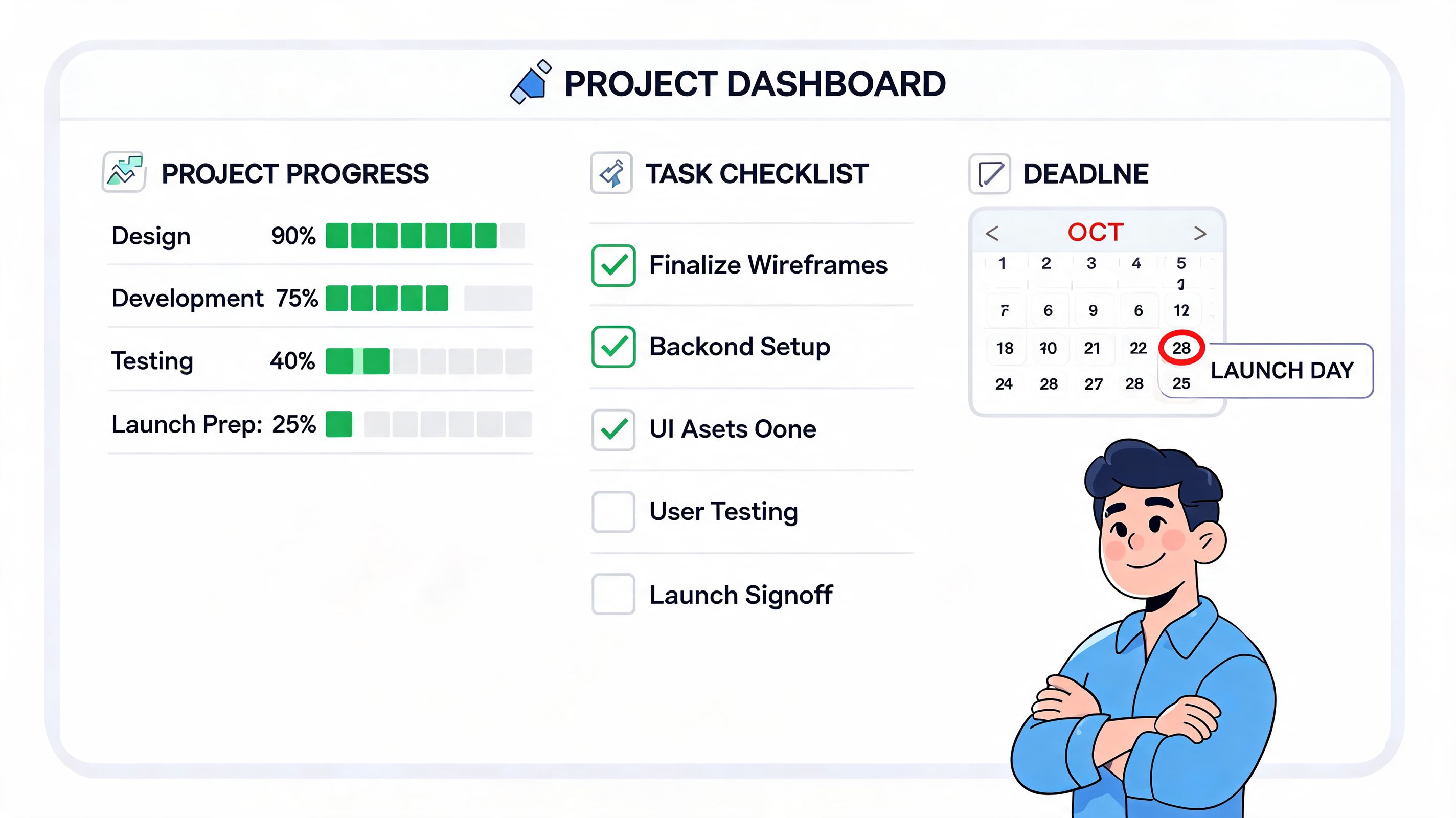
A short visual overview helps teams keep those stages visible:
Why this matters more than most teams think
Project management is the operational backbone of grant success because it protects both your time and your credibility. Funders may forgive a proposal that isn't elegant. They won't fund an application that is late, incomplete, internally inconsistent, or careless.
A grant process that feels frantic usually isn't underfunded. It's under-structured.
That's fixable. The teams that submit clean applications consistently usually aren't calmer by personality. They're calmer because their process does more of the remembering for them.
After You Click Submit What Happens Next
Submission is not the end of the grant cycle. It's the point where your tracking system starts proving its value.
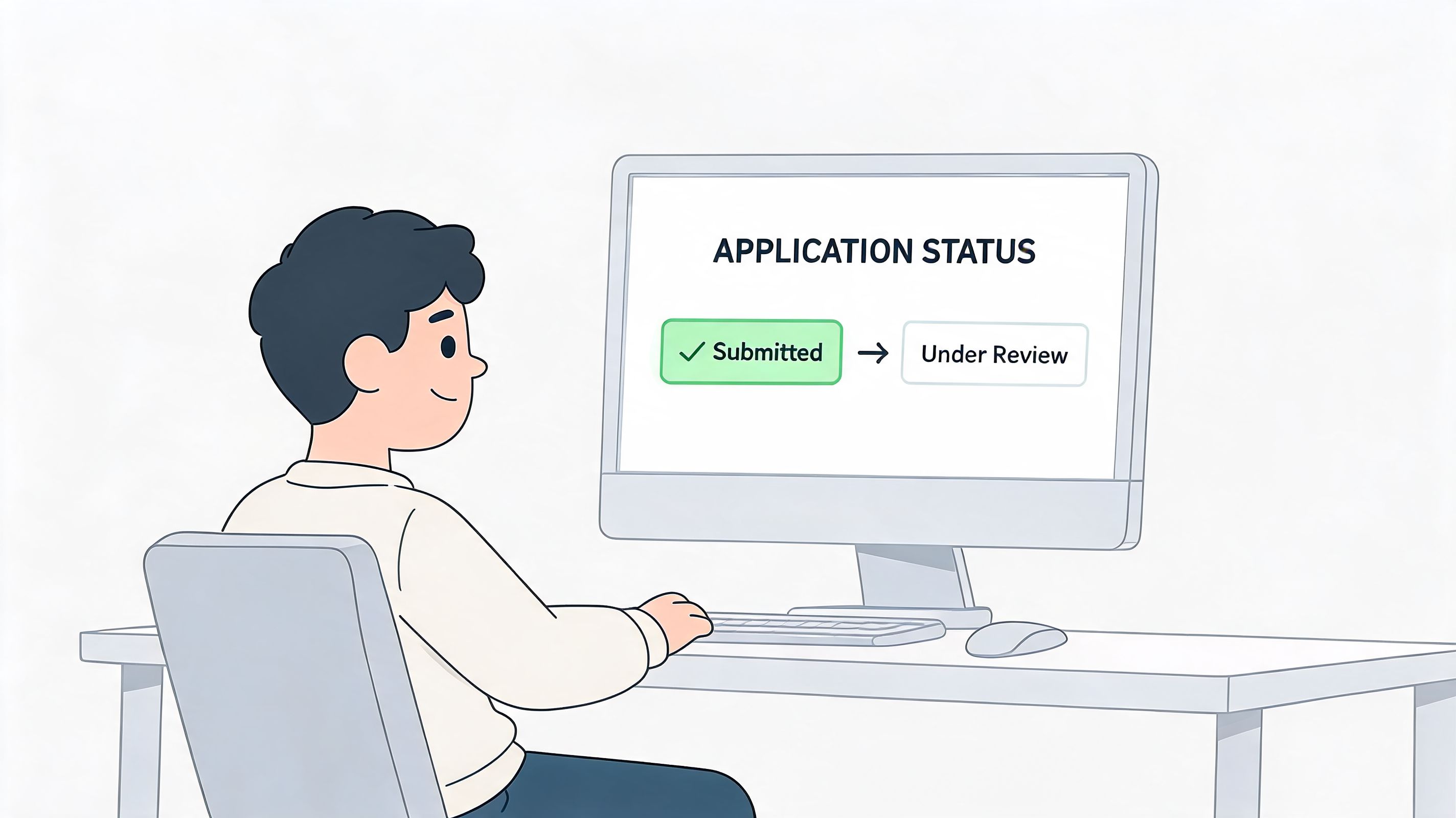
Teams typically remember whether they won or lost. Fewer remember what version of the program they pitched, which attachments they used, whether the funder asked follow-up questions, or how long the review took. Those details matter because they help you refine future applications instead of repeating the same mistakes.
Track outcomes like a portfolio
Instrumentl's analysis of 91,000 nonprofit grant applications found that success rates clustered between 43% and 46% for well-aligned submissions. That makes a mid-40% win rate a reasonable benchmark for a tightly screened pipeline, according to Instrumentl's grant success rate analysis.
That benchmark is useful only if your pipeline is already selective. If you apply indiscriminately, your win rate won't tell you much besides the fact that your screening was loose.
Keep a post-submission log with:
Follow up without becoming a nuisance
Some funders invite questions after submission. Others don't. Respect the funder's process.
A good follow-up is brief and specific. Confirm receipt if the system is unclear. Respond quickly if they request clarification. If a decision timeline passes and the funder allows contact, ask politely for a status update. Don't send repeated check-ins that create work for the reviewer.
Learn from both outcomes
A rejection is only wasted if you record nothing. If the funder allows feedback, ask a short, professional question such as whether there were any issues with fit, clarity, or competitiveness that would help strengthen a future application.
For awards, move fast on acceptance, grant agreement review, startup planning, and internal handoff. Make sure program, finance, and leadership all understand the restrictions, reporting schedule, and deliverables.
Treat win rate as a diagnostic tool, not a vanity metric. It tells you whether your screening and positioning are getting sharper over time.
The strongest grant programs improve because they study losses with the same discipline they bring to proposal writing.
Turning an Award into a Long-Term Partnership
A first-time award is a test. The funder is learning whether your organization communicates well, manages funds responsibly, and delivers the work it described. Renewal decisions often begin long before the formal report is due.
I've seen two nonprofits receive the same kind of youth grant and handle stewardship very differently.
The first sends a thank-you note, disappears for months, then rushes out a report near deadline. The report is technically complete, but the relationship stays transactional. The funder knows the organization complied. They don't know much else.
The second nonprofit treats the award like the start of a working relationship.
What strong stewardship looks like
A solid stewardship rhythm often includes:
That approach helps the funder trust your judgment.
Stay in touch before reporting season
For youth-serving nonprofits, this matters even more because programs often change in real time. School partnerships shift. Referral patterns change. Family engagement takes longer than expected. Transportation, staffing, and attendance can all affect delivery.
A thoughtful update might mention that recruitment took longer than planned but retention has been strong. Or that a subgroup of participants needed more intensive support than expected, and staff adjusted the schedule accordingly. Those updates show management, not weakness.
Move from transaction to partnership
The relationship deepens when you share the right kind of information at the right time.
Here's the difference:
| Transactional approach | Partnership approach |
|---|---|
| Thank you after award | Thank you plus a clear launch update |
| Formal report only | Periodic short updates between reports |
| Silence about problems | Early communication about changes and response plan |
| Generic impact summary | Specific stories, implementation lessons, and next-step thinking |
This doesn't mean overwhelming program officers with constant messages. It means communicating like a reliable partner.
When you do that well, the next grant conversation starts from a place of familiarity and trust instead of reintroduction.
Frequently Asked Questions About Youth Grants
Should a small nonprofit apply for youth grants if it doesn't have a full grant team
Yes, but only if it screens for capacity fit as seriously as mission fit.
Many youth grants are small, local, or highly specialized. Available examples in youth funding listings include grants ranging from $500 to $4,000 for LGBTQ+ youth projects in the Southeast, $500 to $2,000 in a national youth nonprofit small-grant program, and grants of up to $10,000 for underprivileged youth programs, as noted in this youth grants roundup. That's exactly why small organizations need discipline. A modest award can still consume a surprising amount of staff time if the application and reporting burden are heavy.
Don't ask only, “Can we win this?” Ask, “Can we manage this well?”
Is it better to sound broad so more funders can say yes
Usually no. Broad youth language often weakens the case.
Funders increasingly sort opportunities by specific populations and targeted outcomes. Existing youth grant listings already segment categories such as children with disabilities, critically ill children, children in the child welfare system, young people with Autism Spectrum Disorder, LGBTQ+ youth, and other underserved groups, as reflected in GrantWatch coverage of youth and underserved kids grants.
If your strongest work is with a defined subgroup, say so clearly. Specificity often improves fit.
What if we don't have sophisticated data yet
You still need evidence. It just needs to be credible and organized.
Start with what you can document consistently. Attendance. Participation. Referrals. Completion of program milestones. Staff observations captured in a standard format. Partner feedback. Short participant reflections. A simple evaluation system used consistently is more persuasive than a complicated one used inconsistently.
Should we apply to every youth grant that matches our mission
No. That's one of the fastest ways to lower efficiency.
Some major youth funders also run tightly scheduled rounds. In 2025, for example, the NBA Foundation accepted applications from July 1 to August 15, 2025 for organizations serving under-resourced youth ages 14 to 24, and the New York Life Foundation's 2025 Aim High competition awarded 30 grants totaling $1.8 million, or about $60,000 per grant, to afterschool and summer programs nationwide, according to this roundup of youth funding opportunities. That kind of structure rewards timing, fit, and preparation more than random volume.
The key advantage goes to the team that is ready when the right window opens.
How should we think about success if we're new
Think in terms of process quality first. Are you screening better? Writing more clearly? Tracking outcomes more consistently? Learning from decisions? Those improvements usually come before stronger results.
For nonprofit youth grants, the repeatable system matters more than any single application.
Fundsprout helps nonprofits build that system. If your team wants one place to research relevant grants, screen eligibility, organize deadlines, draft proposal sections, and track reporting through renewal, Fundsprout is built for that workflow.
Try 14 days free
Get started with Fundsprout so you can focus on what really matters.