Level of Effort in Grants: A Practical Guide
Master level of effort (LOE) for your grant proposals. Learn to calculate, budget, and justify team time to win funding and avoid burnout. For nonprofits.

Abdifatah Ali
Co-Founder
Your program manager just asked a reasonable question that can stall an entire proposal: “How much staff time should we put in the budget for this grant?”
If you run a small or mid-sized nonprofit, that question usually lands in the lap of someone already wearing three jobs. The executive director is helping with narrative. The program lead is guessing at implementation time. Finance wants numbers that can survive review. Nobody has a clean archive of past estimates. And the deadline keeps moving closer.
That’s where level of effort becomes useful. Not as jargon, but as a way to translate messy, real work into a plan you can budget, justify, deliver, and report on without burning out your team.
What Is Level of Effort and Why Does It Matter for Grants
A lot of nonprofit leaders first encounter level of effort when they’re trying to build a staff line in a grant budget and realize they have no simple way to answer, “How much of this person’s job belongs to this project?”

In grants, level of effort means the amount of staff time and supporting work required to carry out the project. It includes obvious work, like writing the proposal or running the program, and less visible work, like checking eligibility, coordinating with partners, tracking reporting requirements, revising drafts, and keeping documents straight.
For small nonprofits, that hidden work is usually the problem. Teams budget the deliverable and forget the support work around it. Then the project starts, and people end up doing compliance, follow-up, and coordination after hours because it never made it into the original estimate.
Why small nonprofits struggle with it
The challenge isn’t lack of commitment. It’s lack of a clean estimating system.
Existing guidance often defines LOE in broad terms but doesn’t tell a small nonprofit how to estimate it when there’s no dedicated grant writer and no extensive historical record. That gap matters because 70% of small nonprofits report underestimating grant writing LOE, and 62% of development teams exceed capacity on proposals due to poor LOE planning, according to the cited summary referencing the Fund Development Team resource and NFF worker well-being findings.
Practical rule: If your budget only reflects the time to produce the final application or deliver the final service, your LOE is probably too low.
I explain LOE to new program managers with a kitchen analogy. The grant deliverable is the meal that reaches the table. LOE includes prep, cleanup, timing, shopping, substitutions, and coordination with everyone else in the kitchen. Funders may focus on the meal, but your team experiences the full workload.
Why LOE matters beyond compliance
Good LOE work does three things.
- It protects staff capacity. You stop pretending people can absorb major proposal or reporting work “on top of everything else.”
- It strengthens the budget narrative. Reviewers can see that staffing aligns with scope.
- It builds credibility. A realistic effort estimate signals that your organization understands implementation, not just aspiration.
When LOE is weak, small nonprofits often make one of two mistakes. They under-budget and strain staff, or they overstate time in ways they can’t defend. Neither helps.
The point isn’t to find a perfect number. The point is to produce a number you can explain, support, and manage. That’s what turns a rushed budget into a workable grant plan.
Understanding LOE in Your Grant Budget
Most confusion about level of effort comes from mixing together two kinds of work: discrete project tasks and ongoing support work.
Discrete tasks create a visible output. Draft the logic model. Submit the application. Conduct the training. Deliver the report. You can point to a finished item.
LOE work is different. It keeps the project moving but doesn’t usually produce a standalone deliverable every time someone touches it. In project management for nonprofit grant writing, LOE covers supportive work such as daily RFP scanning, eligibility screening, and compliance tracking, and it is typically measured in staff-hours or person-days, with LOE tasks earning value equivalent to budgeted cost of work scheduled under earned value conventions, as described in this LOE glossary explanation.
What belongs in LOE
For a grant team, LOE often includes:
- Project coordination: Meetings, internal check-ins, timeline management, and follow-up with staff or partners.
- Compliance support: Document retention, reporting calendars, file review, and submission prep.
- Pipeline maintenance: Opportunity scanning, screening, and tracking deadlines across multiple prospects.
- Partner communication: Scheduling, reminder emails, collecting attachments, and clarifying roles.
- Administrative support: Budget review, approvals, and internal routing.
That doesn’t mean every support activity should become its own line item. It means you need to recognize the work and assign it somewhere instead of leaving it invisible.
The common budget terms
When funders ask for staffing, they usually want the same underlying concept presented in different formats.
Percentage of effort means the share of a person’s total professional time assigned to the project.
Person-months means the amount of effort expressed as months of work over the project period.
FTE means full-time equivalent. It translates part-time project effort into a standardized share of a full-time role.
These labels differ, but they’re all ways of expressing the same staffing reality. That’s why your internal estimate should start with actual work and then convert into the format the funder requires.
How this shows up in the budget
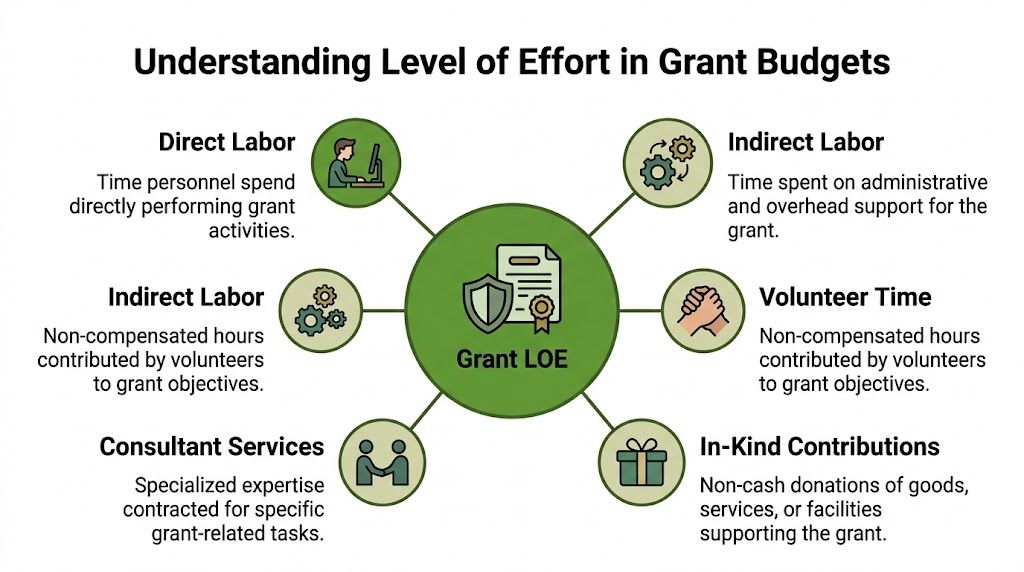
A practical budget usually blends multiple types of labor support:
| Budget element | How LOE helps |
|---|---|
| Personnel | Assigns staff time to direct project work |
| Fringe | Follows the personnel allocation |
| Consultants | Separates specialized outside work from staff time |
| Volunteer or in-kind support | Documents non-cash effort when allowed |
| Indirect support | Distinguishes overhead from program-specific labor |
For smaller organizations, things can get complicated. One employee may act as program lead, compliance monitor, community liaison, and proposal contributor in the same month. If that’s your reality, don’t force a fake clean line. Instead, define the role that person plays in the grant and estimate the share of time attached to those responsibilities.
If you need a starting format for organizing these categories before you write the justification, a set of grant budget templates can help you separate personnel, contractor, and support costs in a way reviewers can follow.
What doesn’t work
Three habits create weak LOE budgets fast:
- Using job titles as estimates. “Program Manager equals 25%” isn’t a method.
- Confusing salary with effort. A high salary doesn’t mean high project time, and a low salary doesn’t mean low effort.
- Skipping support work because it feels minor. Small recurring tasks are exactly what accumulate into overload.
A sound grant budget doesn’t just show who gets paid. It shows what labor the project requires.
From Hours to FTEs A Step-by-Step Calculation Guide
A small nonprofit often reaches this point late in the process. The program manager says, “I can help with reporting.” The executive director says, “Finance can cover the budget pieces.” Then the application asks for FTE, person-months, or percentage of effort, and nobody has translated that shared understanding into numbers.
Start with hours. Hours are usually the clearest way to estimate work, especially when one staff member is carrying program delivery, supervision, partner communication, and compliance at the same time.
Step one, list the actual activities
Break the role into grant-specific tasks.
For a program manager, that might include intake, partner coordination, case review, data entry, supervision, and report preparation. For a finance manager, it may be invoice review, reconciliation, documentation checks, and financial reporting. Small nonprofits get into trouble when they skip this step and assign effort based on title alone. Titles hide mixed responsibilities. Activities show the labor you are asking the grant to support.
A practical test helps here. If you can hand the activity list to a colleague and they can picture the work week, you are close.
Step two, estimate weekly or monthly hours
Estimate time at the task level, then total it for the role.
Use the method that fits the information you have:
Bottom-up estimating
Estimate each task separately, then add the hours. This takes longer, but it is often the most reliable option for organizations without strong historical records.Analogy estimating
Start with a similar program, grant period, or reporting cycle. Adjust for factors like a new partner, a more demanding funder, or a larger service area.Three-point estimating
Create optimistic, most likely, and high-end estimates for uncertain tasks. Keep the middle estimate for the proposal unless you have a clear reason to budget more conservatively.
If your team writes grants only a few times each year, building a simple internal benchmark helps. This grant writing time resource can give you a repeatable way to estimate proposal and planning labor without starting from scratch each cycle.
Step three, convert hours into annual effort
Use your organization’s standard full-time schedule. Many nonprofits use 2,080 hours per year.
The basic formula is straightforward:
- Weekly hours x 52 = annual hours
- Annual hours / 2,080 = FTE or percent of full-time effort
Example:
- 10 hours per week on the grant
- 10 x 52 = 520 annual hours
- 520 / 2,080 = 0.25 FTE
- 0.25 FTE = 25% effort
That percentage is what you apply to salary in the budget, assuming the role is charging time consistently across the year.
Here is a simple worksheet format.
| Staff Role | Weekly Hours on Project | Annual Hours (Weekly x 52) | % of Full Time (Annual Hours / 2080) | Annual Salary | Salary Request in Budget (% x Annual Salary) |
|---|---|---|---|---|---|
| Program Manager | |||||
| Executive Director | |||||
| Data and Compliance Lead | |||||
| Finance Manager |
If roles are still blurry, a simple staffing plan template can help assign ownership before you start calculating effort.
Step four, convert the number into the funder’s format
Funders do not all ask for LOE the same way. One application may ask for FTE. Another may ask for percent effort. Federal forms often ask for person-months.
The underlying math is the same. You are expressing the same share of time in a different format.
The University of Louisiana effort calculation guidance gives a clear example. A PI with a $100,000 institutional base salary at 25% LOE, or three person-months, would request $25,000 in salary support. That is the logic reviewers expect to see. The salary request follows the documented share of effort.
Step five, pressure-test the estimate against reality
This is the step many small teams skip.
A number can be mathematically correct and still be operationally wrong. If a program manager is already fully committed to existing services, adding 0.30 FTE to a new grant does not create time. It creates overload, missed deadlines, or work that shifts to evenings and weekends.
Check the estimate against four real-world questions:
- Can this person carry this grant work and their existing duties at the same time?
- Does the effort change by phase, such as startup, implementation, and closeout?
- Did you include support tasks like meetings, approvals, file maintenance, and reporting?
- Can a program lead and a finance lead both defend the number?
If the answer to any of those questions is no, revise the estimate before it reaches the proposal.
A simple example
A program manager expects to spend 8 hours each week on participant coordination, partner check-ins, and monthly reporting for a new grant.
That equals 416 hours per year. Divide 416 by 2,080, and the result is 0.20 FTE, or 20% effort. If the annual salary is $60,000, the salary request tied to that effort is $12,000.
The math is easy. The hard part is deciding whether 8 hours is honest.
The strongest estimates usually come from a short working session between program, finance, and whoever is drafting the proposal. In small nonprofits, that may be three different people or one person wearing three hats. Either way, a shared estimate is usually more accurate than a solo guess, and it gives you a staffing plan your team can sustain.
Justifying Your LOE in Grant Proposals
A reviewer reaches your personnel budget and sees 0.25 FTE for a program manager. The next question is immediate. Why 0.25, and what work does that time cover?
That is the job of the justification.
For small to mid-sized nonprofits, this part often gets rushed because the same few people are building the program plan, drafting the budget, and chasing attachments. Strong LOE justification does not require polished grant language. It requires a clear chain from staff time to project work, written in a way a reviewer can verify quickly.
What a strong justification shows
A defensible LOE narrative links four elements in one place:
- the position
- the specific duties
- the period of performance
- the project deliverables or compliance functions those duties support
As noted earlier, structured estimation methods help you arrive at the number. In the proposal, the reviewer needs the reasoning behind that number. A good justification shows that the time request came from planned activities, not from a rounded percentage added to make the budget work.
Language reviewers can follow
Use plain statements that connect time to tasks.
The Program Manager will dedicate 0.25 FTE during the 12-month grant period to coordinate participant enrollment, manage partner communication, monitor service delivery milestones, and prepare monthly performance updates.
The Finance Manager will dedicate 0.10 FTE to monthly expense review, grant draw documentation, reconciliation, and preparation of required financial reports.
Evaluation consultant time is limited to data analysis, outcome interpretation, and end-of-project reporting because those functions are outside current staff capacity.
Each example answers the reviewer’s practical question. What is this person doing, when are they doing it, and why does the project need that time?
Vague phrasing causes problems fast. Terms like “general oversight,” “administrative support,” or “as needed coordination” force the reviewer to guess. In a competitive review, guesswork rarely helps a score.
What weak LOE justifications usually get wrong
The common problems are predictable.
- The role is named, but the work is not.
- The level of effort does not match the scope described elsewhere in the proposal.
- The percentage looks arbitrary because no duties or time frame are attached to it.
- Compliance and reporting work are left out, especially on government-funded proposals.
That last issue matters more than many new program managers expect. Delivery staff do not just run services. Grants also require documentation, approvals, financial coordination, reporting, and record retention. If your proposal includes public funds or pass-through funding, your narrative should reflect the administrative workload that comes with compliance. For teams that need a clearer sense of that compliance environment, the OMB A-133 Compliance Supplement gives useful background.
A practical standard for small nonprofits
In larger organizations, a grants office may catch inconsistencies before submission. Small nonprofits often do not have that safety net. One spreadsheet sits with finance. Program assumptions live in notes from a staff meeting. The narrative gets updated late at night by whoever is available.
I have found that one simple rule improves this section immediately. Every LOE sentence should be traceable to a staffing worksheet or planning note your team can pull up during review, revision, or post-award setup. If nobody can point to where the number came from, the justification is not ready.
Modern budgeting and proposal tools can help here, especially for organizations without deep historical records. The benefit is not automation for its own sake. It is having one place where hours, salary allocations, timeline assumptions, and narrative language stay aligned.
A quick review test
Before submitting, read each personnel justification and ask:
- Would a reviewer understand what this person is doing without reading our minds?
- Does the effort reflect the actual demands of startup, delivery, reporting, and closeout?
- If this grant is awarded, can program and finance explain the same number the same way?
If the answer is no, revise the justification. Clear LOE language does more than support the budget. It gives your team a staffing plan they can defend, implement, and sustain without pushing hidden work onto nights and weekends.
Navigating Funder Expectations and Common LOE Mistakes
Funders don’t all read LOE the same way.
A family foundation may accept a simple staff allocation if the narrative is clear. A federal funder may expect person-months, detailed effort breakdowns, and stronger documentation linking labor to scope. If you use the same LOE explanation for both, you can create avoidable problems.
Different funders, different tolerance
The first mistake I see is assuming “reasonable” is enough. It isn’t always.
Some funders care most about whether the staffing feels proportional to the project. Others care whether the number is documented in the format they require. If the application instructions ask for person-months and you submit a loose FTE narrative, you’re asking the reviewer to translate your math for you. That never helps.
For federally funded work, your team also needs to think beyond application language and consider downstream compliance. If you’re trying to understand the audit environment that often surrounds federal awards, this overview of the OMB A-133 Compliance Supplement is a useful background read.
Renewal grants create a special problem
Renewals often get treated as simple repeats. They aren’t.
Recent data summarized by NFF indicates that nonprofits spend 25% less LOE on renewals when they use compliance tracking, yet funders may scrutinize that reduction. The same summary notes that post-2025 federal mandates require more detailed LOE breakdowns in renewals, and some reports indicate a 40% rejection rate for vague LOE justifications in 2025 in the NFF worker well-being discussion.
That creates a real tension. Your team may become more efficient over time, but the funder may read lower effort as weaker commitment unless you explain the reason for the change.
The right response is not to hide efficiency. It’s to document it. If a renewal takes less time because reporting systems, templates, or established partnerships reduce repetitive work, say so clearly.
Mistakes that cause trouble
Some LOE errors are small on paper and expensive in practice.
Leaving out support roles
Finance, compliance, and administrative review often disappear from nonprofit budgets because teams worry they will look “too indirect.” Then those staff still do the work with no protected time.Copying effort from the prior year without rechecking scope
Renewal staffing should reflect actual work, not inherited numbers.Using one staffing figure across all proposal documents
The budget narrative, personnel table, and program design have to agree.Treating volunteer or in-kind effort casually
If you include contributed labor, it still needs a method and a rationale.Ignoring capacity limits
A staff member can’t repeatedly absorb major grant work if their primary job hasn’t changed.
A better way to handle scrutiny
When a funder questions LOE, answer with operational logic.
Describe what changed. Name the tasks. Show which work remains labor-intensive and which work is lighter because the organization now has systems in place. That’s much stronger than insisting the number is “standard.”
Small nonprofits often fear that detailed LOE explanations will make them look fragile. In my experience, the opposite is true. Specificity signals that the organization understands delivery conditions and isn’t making promises on optimism alone.
Streamlining Your LOE Tracking and Reporting
Most LOE problems don’t start in the budget. They start in the workflow.
A team estimates effort once, submits the proposal, then never captures what happened. Six months later, nobody remembers how the original number was built. At renewal time, the organization is back to guessing.

Start with a simple tracking system
You do not need an elaborate project management stack to improve LOE.
For many small nonprofits, a workable starting point is:
- One master estimate sheet with roles, activities, assumptions, and proposed effort
- One live task tracker showing deadlines, owners, and pending documents
- One actuals log where staff record meaningful shifts in workload during drafting, implementation, or reporting
- One review checkpoint after submission or after a reporting cycle to note what the estimate missed
That last step is where the learning happens. If the team consistently underestimates partner coordination or reporting cleanup, that pattern should shape the next grant budget.
What to track during the grant cycle
Don’t try to track everything. Track the categories that usually distort labor.
Focus on items like:
- Proposal development time that expands because approvals take longer than expected
- Compliance and reporting work that recurs monthly or quarterly
- Partner follow-up that looks minor but consumes staff attention
- Data collection and cleanup that falls to program staff late in the cycle
- Revision rounds driven by internal or funder feedback
This gives you a practical historical record, even if your organization has never had one before.
The goal isn’t perfect timekeeping. The goal is to create enough evidence that next year’s LOE is smarter than this year’s.
Where tools help and where they don’t
Spreadsheets are still useful. Shared calendars are useful. Basic time-tracking tools can be useful. They all help if the team keeps them updated.
Where they tend to break down is in fragmented grant work. Opportunity review sits in one file. Narrative drafts live in another. Budget assumptions are buried in email. Reporting requirements are saved somewhere else. At that point, LOE stops being a staffing issue and becomes an information issue.
A platform such as Fundsprout fits here because it combines grant pipeline scanning, eligibility screening, RFP analysis, writing support, planning, and reporting workflow in one place. For teams trying to reduce duplicated effort, that kind of setup can make it easier to connect the work you estimated with the work you performed.
If your pain point is the handoff between program effort and financial reporting, it also helps to review practical guidance on accounting for grants, since LOE falls apart quickly when budget assumptions and reporting records drift apart.
A sustainable routine for small teams
The most reliable LOE process I’ve seen is also the least glamorous.
A nonprofit keeps a running file of past proposals. After each submission or reporting cycle, the team notes what took longer than expected, what was easier than expected, and which roles absorbed extra work. Those notes become the baseline for the next estimate.
That routine does two important things. It improves budgeting accuracy, and it gives staff language to push back when a new grant opportunity looks attractive but would overload the team.
For small and mid-sized nonprofits, that’s the key benefit of mastering level of effort. It helps you choose funding you can deliver. It gives funders a staffing plan they can trust. And it protects your people from becoming the invisible matching fund every time a proposal goes out the door.
If your team needs a cleaner way to estimate grant workload, organize proposal tasks, and keep reporting aligned with the original staffing plan, Fundsprout is built for that kind of end-to-end grant workflow. It helps nonprofits move from scattered effort estimates to a repeatable process that supports application, compliance, and renewal.
Try 14 days free
Get started with Fundsprout so you can focus on what really matters.