Mastering Budget Templates for Grants to Secure Your Next Win
Unlock funding with our guide to budget templates for grants. Learn to craft compelling, compliant, and funder-ready budgets with real-world examples.

Abdifatah Ali
Co-Founder
Think of your grant budget as less of a spreadsheet and more of a strategic story. It's the financial translation of your mission, showing funders you're not just passionate but also prepared, credible, and ready to make a real impact.
Your Budget Is Your Most Powerful Storytelling Tool
Let's face it, most of us don't get excited about building a budget. But I want you to reframe how you see that spreadsheet. Every single line item—from staff salaries to the cost of printing flyers—is a sentence in your project's story.
A well-built budget does more than just ask for money. It proves you're a responsible steward who can turn an investment into measurable change. It’s the concrete plan that backs up all the promises you made in your grant narrative, showing reviewers exactly how their dollars will get the job done.
This financial story is built on a few essential components. Once you get these down, you can confidently tackle any grant budget template.
Before we dive into templates, it’s crucial to understand the main building blocks that funders expect to see. Think of these as the non-negotiable chapters of your financial story. This quick table breaks down the essentials.
Core Components of a Winning Grant Budget
Mastering these categories is the first step. They form the foundation of any budget you'll ever submit, from a simple one-page foundation request to a complex federal application.
A well-crafted budget is the ultimate fact-checker for your narrative. If you claim you’re running a community workshop, the budget better show costs for a facilitator, materials, and maybe even coffee and donuts. That alignment is what builds trust and eliminates any doubt in a reviewer's mind.
Keep in mind that different funders have their own preferred formats, which often reveal their priorities. A massive federal form like the SF-424A signals a deep focus on compliance and granular detail. On the other hand, a simple two-column spreadsheet from a local foundation probably means they care more about the direct program costs than the administrative nitty-gritty.
Spotting these differences early on is key. It helps you choose from the many available budget templates for grants and pick one that lines up with what the funder actually wants to see. Making the right choice from the start saves a ton of headaches later and shows the funder you’ve done your homework.
Choosing and Customizing the Right Budget Template
Picking the right starting point for your proposal is more than just a time-saver; it's a strategic move that prevents major headaches down the road. Not all budget templates for grants are the same. A template that sails through a local community foundation’s review will almost certainly be rejected by a federal agency. The real trick is to align the template's structure with the funder's expectations and your project's own complexity.
Think of it like this: you wouldn't use a one-page business plan to apply for a multi-million dollar loan. The same logic applies here. Submitting a basic budget for a complex, multi-year federal grant immediately signals a lack of preparation and experience. Funders provide specific formats for a reason—they tell you exactly what data they care about most.
Decoding Funder Preferences
Your first move should always be to dig into the funder’s requirements. Some make it easy by providing a mandatory template. Federal agencies, for instance, often require the SF-424A form, a beast of a document that demands an incredibly granular breakdown of every single cost. On the other hand, many private foundations might offer a simple Excel sheet or even just ask for a budget in your own format.
When the choice is yours, weigh these factors carefully:
- Project Complexity: A multi-year project with subcontractors, major equipment purchases, and multiple staff roles needs a far more detailed template than a simple, one-off community event.
- Funder Type: Federal and state funders are all about precision, compliance, and following the rules to the letter. Private foundations often prefer a simpler, more narrative-focused budget that clearly tells a story.
- Your Internal Systems: Don't fight your own accounting system. Choose a template that mirrors how your organization already tracks expenses. Trying to retrofit your data into a completely alien format is a recipe for frustration and costly errors.
The competition for grant money is fierce. With an estimated $21 trillion USD in grant funding expected to be available globally over the next three years, you have to be strategic. Over half of that funding is concentrated in just 15 countries, which underscores the need for a precise, compelling budget that helps you stand out.
Matching Template Types to Funder Requirements
Choosing the right format from the get-go can make or break your proposal. The table below breaks down common template types and where they fit best, helping you align your budget with what reviewers expect to see.
Ultimately, the goal is to present your financial information in a way that feels familiar and easy for the reviewer to digest. The less work they have to do to understand your numbers, the better.
Adapting Templates for Your Unique Project
Once you've picked a base template, the real work begins. Customization is all about making that template tell your project's financial story, not cramming your story into a generic box.
For example, you might take a simple foundation template and beef it up for a more complex project. This could mean adding columns for "In-Kind Contributions" or breaking down the "Personnel" line item by individual roles, their salaries, and the percentage of time each person will dedicate to the project.
Conversely, you can simplify a complex federal-style template for a corporate funder. While a federal form might have dozens of categories, a corporate partner may only care about a few key areas like "Direct Program Costs" and "Community Impact Metrics." In that scenario, you can hide or delete irrelevant rows and rename categories to use the funder’s preferred language.
The best budget template is one that feels like a natural extension of your project narrative. Every line item should have a clear purpose, and the overall structure should guide the reviewer logically through your financial plan, leaving no room for questions or confusion.
As you look for the right fit, it’s a good idea to review various available templates to see what's out there. This initial research helps you understand the different formats funders use and lets you pick a starting point that requires the least amount of heavy lifting. For more specific guidance, our guide on building a nonprofit program budget template is a great resource.
This decision tree can help you visualize how to frame your budget's story based on your project's unique strengths and goals.
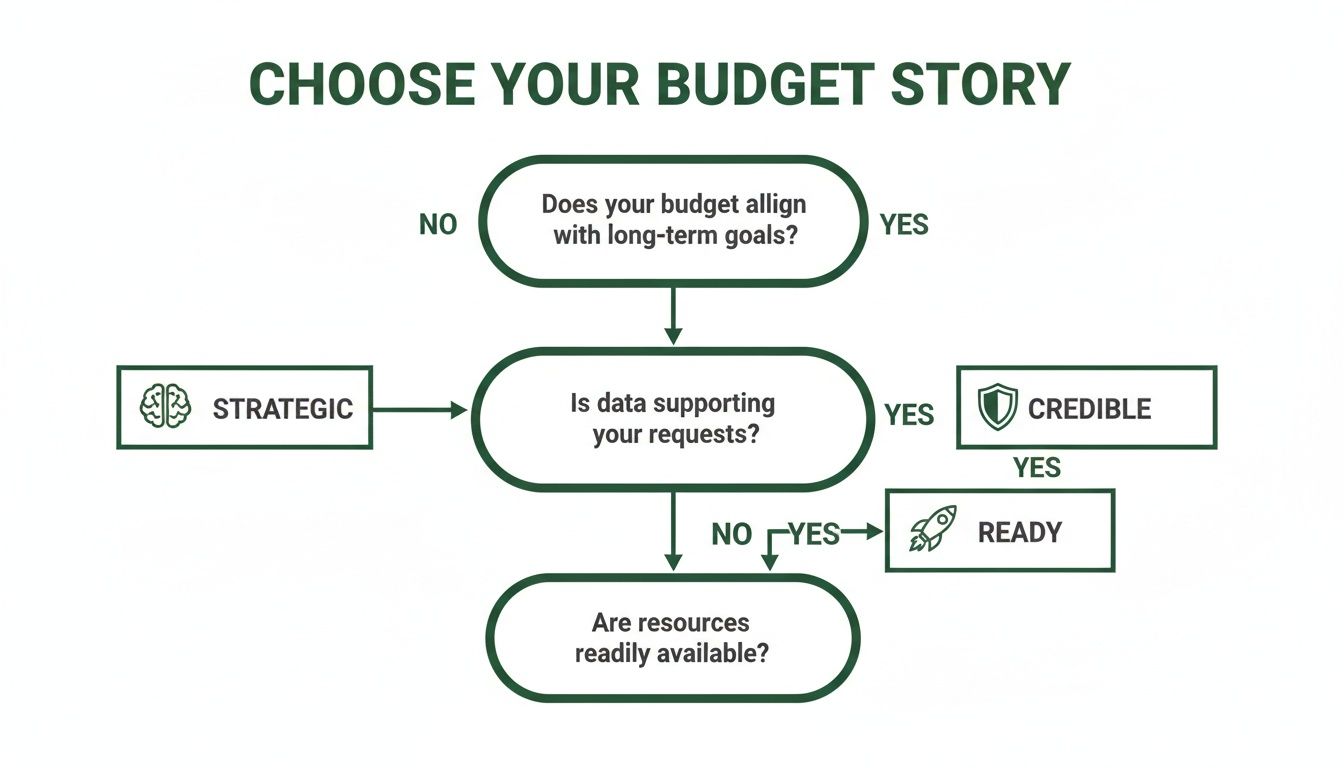
In the end, your budget should tell a story of credibility and readiness. It needs to show the funder you have a clear, realistic plan to use their money to achieve your stated outcomes.
Bringing Your Budget to Life, Line by Line
Alright, you've got your template ready to go. Now for the real work: turning those empty cells into a powerful financial story. This is where your big ideas get a price tag, translating your mission into a concrete, fundable plan. We’ll walk through this category by category, using a realistic example to show you how it's done.
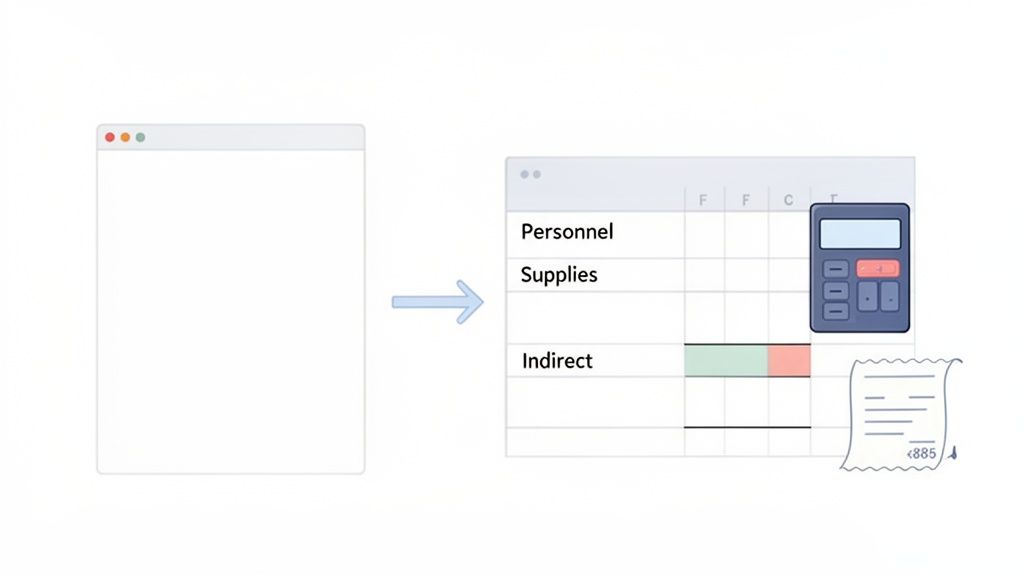
Think of your budget as a detailed instruction manual for the funder. Every single line item is a critical part they need to understand to see how you'll build your project and deliver on your promises.
Nailing Down Personnel Costs
Let's start with the big one. Personnel is almost always the largest slice of the pie and the section that gets the most scrutiny from reviewers. This is your human capital—the team that will make it all happen. Funders are looking for reasonable salaries and a crystal-clear justification for why each person is involved.
First, list every staff member who will touch this project. For each person, you need to determine their Percent of Effort, which is simply the portion of their total work time they’ll spend on grant activities.
Let’s imagine we're building a budget for a new after-school literacy program.
- Program Director: She’ll manage the whole project, from supervising staff to handling funder reports. We estimate she’ll dedicate 25% of her time to this.
- Literacy Tutor: This person works directly with the kids for 10 hours a week. Their role is 50% funded by this grant.
- Administrative Assistant: They'll spend about 5 hours a week on grant-related paperwork and logistics. That comes out to 12.5% of their time.
Once you have the Percent of Effort, the math is pretty straightforward. You just multiply each employee’s annual salary by their Percent of Effort to get the amount you'll request from the grant.
Never, ever just ask for a lump sum for "salaries." Show your work. A transparent calculation that breaks down salary by role and time commitment builds instant credibility. It tells the grant reviewer you’ve actually thought through your staffing needs, not just pulled a number out of thin air.
Next up: fringe benefits. This covers costs like health insurance, retirement contributions, and payroll taxes (FICA). The most common way to handle this is by using a standard fringe rate for your organization. For instance, if your organization's total fringe benefit costs equal 30% of your total salaries, you’d apply that 30% rate to the grant-funded salary portion for each employee.
Detailing Your Direct Program Costs
Direct costs are all the tangible things you need to buy to make the program happen. The key here is specificity. Vague line items like "Miscellaneous" or "Contingency" are major red flags for funders. Every dollar needs a name and a purpose.
Your goal is to provide realistic estimates backed by actual research. No guessing.
- Supplies: Don't just write "Office Supplies - $500." Break it down. For our literacy program, that might look like: "Workbooks (50 students x $15/book) = $750" and "Art Supplies for literacy activities (markers, paper, etc.) = $250." That level of detail shows you've planned everything out.
- Travel: If your team needs to travel, get precise. For local travel, you might calculate: "Local mileage for Program Director site visits (20 miles/week x 52 weeks x $0.67/mile) = $696.80." If you’re budgeting for a conference, include researched costs for the flight, hotel, and per diem.
- Equipment: Any single item with a hefty price tag (usually over $5,000, but check the funder’s definition) is considered equipment. Maybe our program needs a couple of new laptops for the tutors. Get a real quote: "2 Dell Laptops for Tutors (2 x $850/each) = $1,700." If you can, attach the quote to your proposal.
- Consultants/Contractors: Bringing in an external evaluator? Spell it out. For example: "Dr. Jane Smith, External Program Evaluator - $4,000 flat fee for pre/post-assessment analysis and final report."
Seeing how all these pieces fit together in a finished document can be a huge help. Looking over a complete sample grant budget is a great way to get a feel for the proper structure and level of detail.
Getting Indirect Costs Right
Finally, let’s talk about indirect costs—often called Facilities & Administrative (F&A) costs or just plain overhead. These are the very real, very necessary expenses that keep the lights on but aren't tied to one specific project. We’re talking about rent, utilities, insurance, and the salary of your Executive Director. Many nonprofits shy away from including these, but they're absolutely essential for long-term sustainability.
You generally have two ways to calculate and request these funds:
- Your Federally Negotiated Indirect Cost Rate (NICRA): If your organization gets a lot of federal funding, you might already have a NICRA. This is a formal, pre-determined percentage you can apply to your direct costs. You just state your approved rate and do the math according to your agreement.
- The 10% De Minimis Rate: This is the go-to for most organizations that don't have a NICRA. Federal guidelines allow you to claim a flat 10% de minimis rate of your Modified Total Direct Costs (MTDC). MTDC is basically all your direct costs except for big-ticket items like equipment, capital expenses, and the portion of any sub-award over $25,000. It's the simplest and most common method out there.
Choosing the correct approach is crucial, not just for compliance but for making sure your organization actually recovers the full cost of running its amazing programs. When you build a budget with this much care and detail, it stops being a simple list of expenses and becomes a compelling argument for your project's inevitable success.
Crafting a Budget Narrative That Wins Over Reviewers
Think of your budget spreadsheet as the "what" and your budget narrative as the "why." This is where you bring the numbers to life. You're not just listing costs; you're telling the story of how those resources will create real impact.
A strong narrative leaves no room for doubt. It walks the reviewer through your strategic thinking, justifying every dollar and showing them you’ve thought through every detail of your plan.
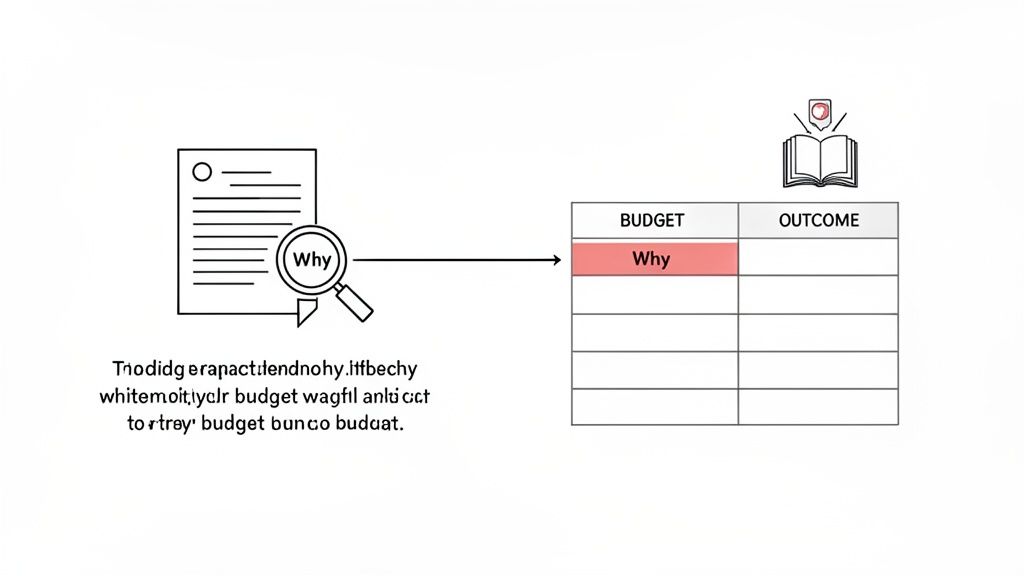
This document is your opportunity to prove you'll be a responsible steward of the funder's investment. By justifying your cost assumptions and explaining your calculations, you’re proactively answering the tough questions a reviewer is already asking in their head.
From Line Item to Story Point
Every single number in your budget needs a clear purpose that ties directly back to your project's goals. Your narrative is the bridge that makes that connection explicit and undeniable. Forget generic descriptions; your focus should be on the value each expense delivers.
Imagine the reviewer sitting with your narrative in one hand and your budget spreadsheet in the other. Your job is to make it incredibly easy for them to see how the numbers support the work.
Here’s how you can frame justifications for some common budget categories:
- Personnel: Don’t just put a title and a salary percentage. Explain why that specific person is essential. What critical tasks will they handle? How does their expertise directly contribute to the project's success?
- Supplies: "Office supplies" isn't enough. Tie the need directly to a program activity. For instance, explain that you need funding for printing because you’ll be creating 500 informational brochures for a key community outreach event.
- Travel: Clearly state the purpose of every trip. Is it for essential site visits, attending a mandatory grantee conference, or transporting program participants? Show the reviewer that the travel is mission-critical, not just a nice-to-have.
The best budget narratives are built on one simple principle: show your work. When you clearly explain how you arrived at a number—whether it's a salary calculation or a quote for new equipment—you build an incredible amount of trust and signal to the funder that you are meticulous and transparent.
Justification Showdown: Strong vs. Weak Examples
The difference between a winning narrative and one that raises red flags often boils down to the level of detail. Let's look at how a vague justification can be transformed into a powerful one.
Scenario 1: Personnel Justification
- Weak: "Program Coordinator (50% FTE) will manage the project."
- Strong: "The Program Coordinator will dedicate 50% of their time (20 hours/week) to this project. Responsibilities include recruiting 50 student participants, managing daily program logistics, and collecting pre- and post-program survey data for evaluation—all of which are critical for achieving Outcome #1."
Scenario 2: Travel Justification
- Weak: "Travel budget of $1,500 for staff."
- Strong: "We request $1,500 to cover travel for the Project Director to attend the funder's annual grantee convening in Washington, D.C. This cost is based on an estimated round-trip flight ($600), three nights of lodging ($250/night), and a daily per diem rate of $50."
Explaining Your Indirect Costs
Don't be shy about justifying your indirect costs. These are real, necessary expenses that keep your organization running and make your project possible. Funders expect to see them, and your narrative should explain both what they cover and how you calculated them.
If you have a Negotiated Indirect Cost Rate Agreement (NICRA), state your federally approved rate and the base it's applied to. If you’re using the 10% de minimis rate, say so explicitly, citing the federal guidelines of 2 CFR 200.414.
This level of detail, from direct expenses to overhead, showcases your organization's financial acumen. It proves you’ve considered every angle, leaving the reviewer confident that their investment will be managed effectively. A well-crafted narrative ensures your budget templates for grants are not just filled out, but fully and persuasively explained.
Navigating Funder Requirements and Staying Compliant
Winning the grant is a huge victory, but let’s be honest—that’s when the real work begins. The moment you accept that award, you’re not just getting a check; you’re starting a long-term relationship. How you manage that funding is what proves you’re a reliable partner and opens the door for future support.
Your focus has to shift from just proposing a budget to actually living by it in a way that’s compliant and ready for an audit at any time.
Every funder plays by a different set of rules, and it’s on you to know their playbook cover to cover. Those guidelines aren’t suggestions—they're the contractual terms you agree to. Think of your budget templates for grants as living documents that need to guide every dollar you spend throughout the grant period.
Understanding Allowable Costs and Restrictions
The absolute cornerstone of compliance is knowing what you can and can't spend grant money on. Funders are incredibly specific here, and for good reason. An "allowable cost" isn't just any expense; it has to be reasonable, essential for the project, and explicitly permitted by the grant agreement.
Some of the most common red flags—costs that are usually disallowed—include:
- Fundraising expenses: You almost never get to use grant money to raise more money. That means galas, appeal mailings, and donor events are typically out.
- Lobbying or political activities: Using grant funds to influence legislation is a major no-go, especially with federal grants and most private foundations.
- Alcoholic beverages: This is a classic restriction. If you’re hosting an event or a meeting with grant funds, the bar tab is on you.
- Capital expenditures: Need a new building or a van? Unless that big-ticket item was specifically approved in your proposal, you can't use grant funds for it after the fact.
Your first move after getting a grant should be to scour the agreement for a list of prohibited expenses. Misusing funds, even accidentally, can put your current funding at risk and seriously damage your reputation. It’s a costly mistake that a little bit of due diligence can completely prevent.
Tackling Matching Funds and In-Kind Contributions
Many grants come with a catch: a matching requirement. The funder wants to see you have some skin in the game, expecting your organization to contribute a certain amount to the project. This can be cold, hard cash or, more often, in-kind contributions—the value of donated goods or services.
This is where a lot of nonprofits get tripped up. If a local printer donates flyers for your program, you have to document the fair market value of that service. If a skilled professional volunteers their time, you need to track their hours and assign a reasonable hourly rate for their expertise. Coming up short on your promised match is one of the most common, and avoidable, negative audit findings.
Here’s a piece of advice I can't stress enough: start tracking your matching funds and in-kind gifts from day one. If you wait until the final report is due, you'll be scrambling to piece together documentation. That frantic rush almost always leads to mistakes and incomplete records, putting your grant in jeopardy.
Meticulous tracking isn't just about checking a box for the funder. It’s powerful proof of your organization’s broad community support and shows how you’re stretching the funder's investment for even greater impact.
Adapting to a Shifting Funding Landscape
Compliance isn't static. It’s about building a budget strong enough to handle whatever the world throws at it. The global funding environment is always changing, and those shifts have a direct impact on your strategy. For instance, the Institute for Health Metrics and Evaluation reported that global development assistance for health (DAH) recently dropped to $39.1 billion, its lowest level since 2009.
That dip, driven by a 21% overall decrease in DAH, means the competition for health-related funding is fiercer than ever.
In a tight funding climate like this, funders scrutinize your financial management even more closely. A budget that shows efficiency, multiple income streams, and a solid plan for long-term sustainability is no longer a "nice-to-have"—it's a must. Proving you can do more with less isn't just a talking point; it's a core survival skill. Digging into grant management best practices isn't just extra credit; it's essential for staying ahead.
At the end of the day, a compliant budget is your best risk management tool. It protects your nonprofit, honors your promise to the funder, and ensures your programs can keep making a difference without any unexpected financial hiccups.
Common Questions About Grant Budget Templates
Even with the best tools, grant budgeting can feel like a minefield. You're not alone. Here are the answers to the questions our team hears most often from nonprofit leaders and grant writers. Let's clear up some of the confusion so you can manage your budget templates for grants with more confidence.
What Is the Most Common Mistake Nonprofits Make?
Hands down, the biggest—and most damaging—mistake is a budget that doesn't match the story you're telling in your project narrative. Funders are detectives; they meticulously cross-reference these two documents. If you describe amazing community outreach events but your budget has zero dollars allocated for a venue, supplies, or the staff time to coordinate it all, a massive red flag goes up.
It screams a lack of planning. Another frequent stumble is drastically underestimating what things actually cost, especially staff time and administrative overhead. This makes a funder wonder if you truly grasp the full scope of running your program, which can make them very hesitant to invest.
The golden rule is simple: every single activity you propose must have a corresponding, well-justified cost in the budget. That alignment is what builds trust and proves your organization knows what it's doing.
How Do I Calculate Indirect Costs Without a Federal Rate?
This is a classic hurdle. If you don't have a formal Negotiated Indirect Cost Rate Agreement (NICRA) with the federal government, don't panic. For federal grants and many foundations, you can use the 10% de minimis rate of your modified total direct costs (MTDC).
So, what goes into your MTDC? It's most of your direct expenses, including things like:
- Salaries and benefits
- Materials and supplies
- Travel directly related to the program
- The first $25,000 of each subaward or subcontract
What's left out are big-ticket items like major equipment purchases, capital expenses, and the portion of any subaward over that initial $25,000. To get your number, just add up your MTDC and multiply by 10%.
Be sure to state this clearly in your budget narrative. A simple sentence like, "We are using the 10% de minimis rate as permitted under federal regulation 2 CFR 200.414(f)" is perfect. If you're dealing with a foundation that doesn't have a set policy, proposing a 10-15% rate for administrative costs is pretty standard, but always be ready to explain how you arrived at that figure.
Can I Include Salaries for Existing Staff?
Yes, absolutely! But there's a critical catch: you can only budget for the portion of their time that is directly spent on the grant-funded project. You can't just use grant money to cover an existing salary without a clear, documented link to the project's activities.
The key is to calculate the Percent of Effort each team member will dedicate to the project. For example, if your Program Director is going to spend about 25% of her time overseeing this grant's implementation, you can request 25% of her salary and related fringe benefits.
You’ll need to spell this out in your budget narrative. Explain each person's role and the specific grant-related responsibilities that justify that time allocation.
What Is the Best Way to Budget for In-Kind Contributions?
The cleanest way to handle this is to give in-kind contributions their own dedicated section or column in your budget. It's crucial not to mix these non-cash items with your actual cash expenses—that's a surefire way to confuse reviewers and create an accounting headache later.
For every in-kind item, you have to assign and document a fair market value.
- Volunteer Time: Don't just guess. Use a standard rate for that type of professional work. Organizations like Independent Sector publish updated state-by-state values for volunteer hours each year.
- Donated Space or Goods: Do a little research. What would it cost to rent a similar space or buy comparable goods in your area? That's your fair market value.
In the budget narrative, be transparent about the source of each contribution and how you calculated its value. This isn't just about checking a box; it's a powerful way to show a funder the depth of community support your project has, proving their investment will go even further.
For readers seeking to delve deeper into various grant-related topics or find additional resources, consider finding experts who can explore their blog for additional insights.
At Fundsprout, we're building an AI-powered platform to help you find the right funders, craft winning proposals, and manage your grants with confidence. See how you can streamline your entire grant lifecycle by visiting https://www.fundsprout.ai.
Try 14 days free
Get started with Fundsprout so you can focus on what really matters.