Master grant writing time: Estimate hours, plan your schedule, win proposals
Discover grant writing time tips to estimate project hours, manage your calendar, and craft winning proposals without last-minute stress.

Abdifatah Ali
Co-Founder
Ask any grant writer how long a proposal takes, and you'll likely get the same answer: "It depends." And it's true. The time you'll need can swing wildly from a breezy 10-20 hours for a straightforward local foundation request to a grueling 100+ hours for a complex federal beast. There's just no single magic number.
The real timeline hinges entirely on the funder's demands, how prepared your team is, and the sheer scope of the grant itself.
How Long Does Grant Writing Really Take?
Let's get right to it. Trying to apply a one-size-fits-all time estimate to grant writing is a surefire way to burn out your team. The real-world timelines for different grant types are worlds apart. A simple letter of inquiry to a local family foundation might take you an afternoon, while a multi-agency federal proposal could easily consume a small team for the better part of a month.
Setting realistic expectations from the get-go is half the battle. You need to know what you're getting into before you start.
To give you a better sense of what to expect, here’s a quick breakdown of typical time investments based on the type of funder you're approaching. This table can help you quickly gauge the potential workload for different opportunities.
Estimated Grant Writing Hours by Funder Type
This table is just a starting point, of course. Your actual time will depend on a host of other factors unique to your organization and the specific opportunity.
Factors That Shape Your Timeline
Your organization's internal situation is the biggest variable. I've seen two nonprofits apply for the exact same grant, with one finishing in a week and the other scrambling for a month. The difference always comes down to readiness.
Here's what really moves the needle:
- Organizational Experience: Is this your first time at the rodeo, or do you have a library of approved proposals, boilerplate language, and essential documents ready to pull from? If you're new to this, be sure to add a generous time buffer.
- Funder Complexity: Take a hard look at the application. Is it a simple narrative and a budget, or does it demand labyrinthine compliance documents, logic models, and formal agreements from multiple partners?
- Internal Readiness: Do you have up-to-date programmatic data, audited financial statements, and staff bios at your fingertips? Hunting down disorganized information is one of the biggest—and most frustrating—time sucks in grant writing.
If you're just starting out, getting these foundational pieces in place is your first priority. You can check out our guide on grant writing for beginners to get your core documents organized and ready to go.
A classic rookie mistake is underestimating all the non-writing tasks. I can't tell you how many times I've seen the actual writing take less time than gathering data, chasing down signatures for letters of support, and navigating internal review processes. You have to plan for these administrative hurdles just as carefully as you schedule your writing time.
Moving Beyond Guesswork
To stop the cycle of last-minute chaos, you need to get a real handle on where your time is actually going. This is where mastering the art of effort tracking becomes so valuable. This isn't about micromanaging your team; it's about building an honest, data-backed picture of the entire grant development lifecycle.
Once you know that crafting a detailed budget narrative consistently takes your team six hours, or that securing partner MOUs adds another ten, you can build that knowledge into every future timeline.
This data-driven approach is what separates amateurs from pros. It helps you pinpoint bottlenecks in your process and gives you the hard evidence you need to justify the resources required for a successful grant strategy. It’s how you turn grant writing from a frantic rush into a manageable, predictable project.
Breaking Down the Grant Writing Workflow
If there's one piece of advice I can give, it's this: stop thinking of a grant proposal as just a writing assignment. Start treating it like a full-blown project. This simple mindset shift is the secret to managing your time effectively and ditching that all-too-familiar sense of chaos as the deadline looms.
By approaching it as a project manager would, you’re forced to map out every critical stage, from the initial "should we even apply?" conversation to the final click of the ‘submit’ button. It’s no longer one giant, intimidating task. Instead, it becomes a series of smaller, more manageable milestones with clear ownership and mini-deadlines. This structure is what turns a daunting mountain into a series of conquerable hills.
This flowchart lays out the typical process for both simple and complex grants. Pay attention to how the timeline expands as the funder’s requirements get more complicated.
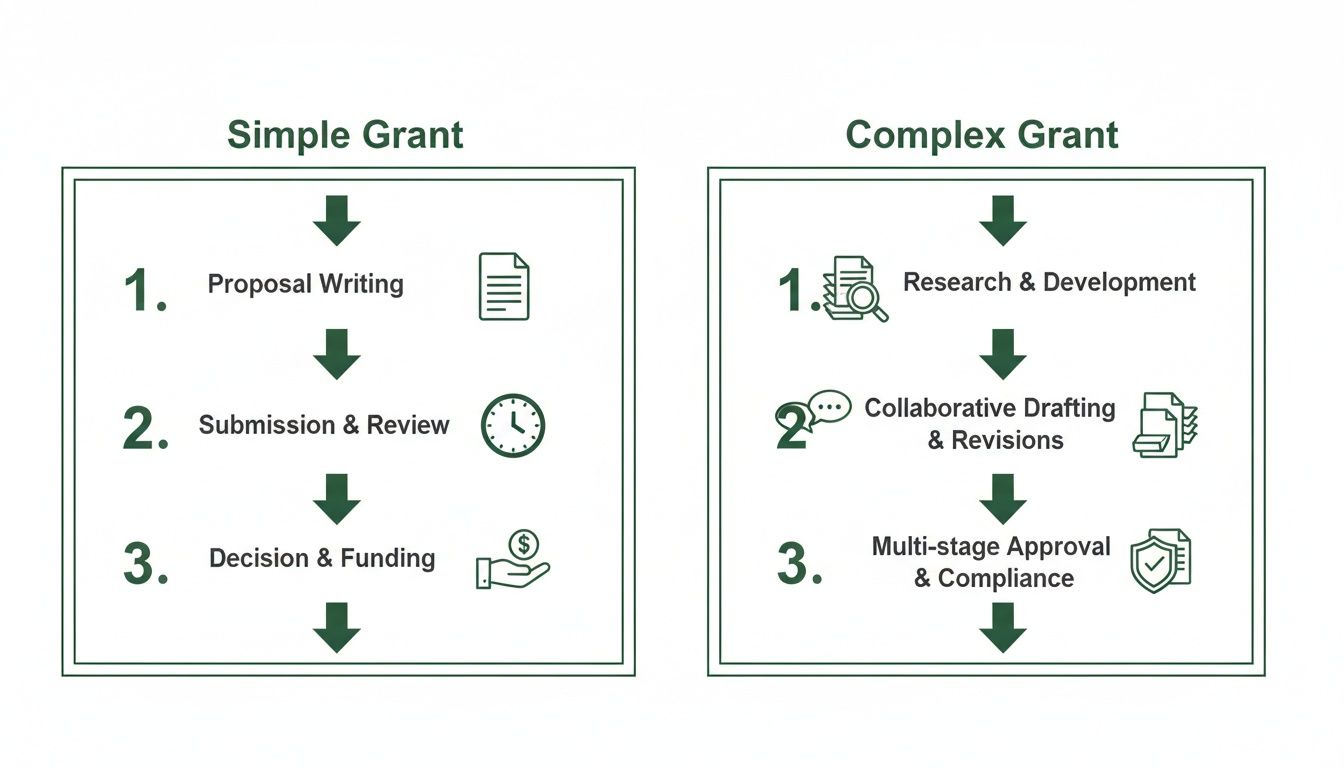
The big takeaway here is that complex grants don't just demand more writing. They introduce entirely new stages, like coordinating with multiple partners and navigating extensive compliance checks, which can dramatically stretch your timeline.
Phase 1: The Go/No-Go Decision and Deep Dive
Before you even think about writing, the most critical work begins. This is where you pull apart the Request for Proposal (RFP) and have a brutally honest conversation with your team. Are we truly a good fit for this funder? Can we realistically deliver on these promises if we get the money? A hasty "yes" at this stage will cost you dozens, if not hundreds, of wasted hours down the road.
Plan to spend about 15% of your total grant writing time right here. This isn't just a quick skim of the guidelines. It’s an intensive deep dive that involves:
- RFP Analysis: Methodically breaking down every requirement, from eligibility rules and scoring criteria to the long list of required attachments.
- Team Kick-Off: Getting your program, finance, and leadership staff in one room (or on one call) to talk through the opportunity.
- Resource Audit: An honest check to confirm you actually have the data, partnerships, and financial documents the funder is asking for.
This upfront diligence is your best time-saving tactic. It weeds out the grants you were never going to win anyway, freeing you up to focus on the ones where you have a real shot.
Phase 2: Data Gathering and Narrative Drafting
Once you’ve committed, the real hunt begins. This is the phase that almost everyone underestimates. You’ll be chasing down program stats, heartfelt client testimonials, audited financial reports, and those crucial letters of support. All while you’re trying to start drafting the heart of the proposal—the needs statement, your program design, and the evaluation plan.
Expect this phase to eat up a massive 50% of your total project time.
The biggest bottleneck I see isn't writer's block; it's waiting for information from other people. You can't write a compelling story about impact without the data, and you can't build a budget without the finance team. Start these requests on day one.
As you get into the thick of it, you might want to look into how to use AI for writing to help speed things up without sacrificing quality. Modern AI tools can be great assistants for analyzing dense RFPs, creating first drafts from your existing program documents, and organizing your research.
Phase 3: Budgeting, Review, and Submission
The final stretch is all about precision and polish. Now’s the time to build a detailed, justifiable budget that lines up perfectly with the story you’ve told in the narrative. Never treat the budget as an afterthought; reviewers will scrutinize it for realism and accuracy.
This last phase will take up the remaining 35% of your time and includes a few key steps:
- Budget Development: Working side-by-side with your finance team to create a line-item budget and a clear budget narrative that explains every cost.
- Internal Review Cycles: Sending the full draft to your key stakeholders for feedback. Always build in extra buffer time here—reviews always take longer than you think.
- Final Assembly and Submission: Gathering all the attachments, giving the entire package one last proofread, and wrestling with what is often a clunky online submission portal.
By clearly mapping out these phases, you transform grant writing from a frantic, reactive scramble into a proactive, well-managed project.
Planning for Federal Grant Proposals
Let's be clear: federal grants are in a league of their own. If a local foundation grant is like running a friendly 5K, a federal proposal is the Ironman triathlon of the fundraising world. The time commitment isn’t just longer; it’s an entirely different kind of effort, demanding immense precision and a ton of collaborative energy.
This leap in complexity is why the estimated grant writing time for these opportunities is so massive. Writing a single federal application can easily take between 80 and 200 hours of focused work—a figure that often shocks people who are new to government funding. This data comes from a comprehensive look at grant statistics for nonprofits by Submittable, and it reflects the incredibly stringent, multi-layered requirements that government funders demand.
Deconstructing the Time Commitment
So, where do all those hours actually go? It’s almost never the core narrative that eats up the clock. Instead, the hours get swallowed by a mountain of meticulous, non-negotiable tasks that require intense focus and coordination across your entire team.
The most time-consuming elements usually include:
- Dense Compliance Documents: Federal agencies require exhaustive paperwork to prove your organization's eligibility, financial health, and adherence to countless regulations. You're often wading through hundreds of pages of guidelines before you even start.
- Intricate Logic Models: You can't just describe your program. You have to create detailed visual maps—logic models or theories of change—that explicitly connect every single activity to a specific outcome, all backed by performance metrics.
- Multi-Partner Coordination: Many federal grants require formal partnerships. This means you’re on the hook for drafting, negotiating, and securing signed Memorandums of Understanding (MOUs) or letters of commitment from other organizations, each with its own slow-moving review process.
These pieces demand a project manager's mindset. You aren't just writing; you are orchestrating a complex, multi-stakeholder project under an unforgiving deadline.
Building a Federal Grant Project Plan
To even attempt a federal proposal without burning out your team, you need more than a simple to-do list. You need a rock-solid project plan that breaks the monstrous task into manageable phases and assigns clear ownership from day one.
The best way to start is by working backward from the submission deadline to set realistic internal milestones. A simple spreadsheet or a project management tool will be your best friend. Map out every required document, from the SF-424 form to the budget narrative, and assign a lead person and a due date for each one. This kind of visibility is the only way to keep everyone on track and spot potential roadblocks before they completely derail your progress.
My personal rule is to add a 25% time buffer specifically for partner coordination and internal reviews. I can almost guarantee a key partner will be slow to respond, or an executive will request last-minute changes. Planning for these delays keeps them from turning into full-blown crises.
Successfully managing the immense grant writing time for a federal proposal comes down to structure and proactive communication. For more guidance on finding and managing these opportunities, our detailed guide on securing federal grants for nonprofits offers deeper strategies. By treating the application like the major project it is, you can navigate the complexity with a lot more confidence.
Building Your Grant Writing Dream Team
Let's be honest: successful grant writing is a team sport, not a solo mission. All too often, the entire weight of a proposal lands on one person's shoulders. This creates a massive bottleneck that can stretch your grant writing time from manageable to completely maddening.
To get this right, you need to assemble and engage the right people from across your organization. This isn't about adding more meetings to everyone's calendar. It’s about strategically looping in the experts who already hold the essential pieces of the puzzle. Think of the grant writer as the conductor—their job is to bring the orchestra together, not play every single instrument.
Identifying Your Key Players
Before you even think about writing a single sentence, figure out who needs to be on your internal dream team. These are the non-negotiable stakeholders you’ll need to create a compelling and, more importantly, accurate application. Without their input, you’re just making educated guesses.
At a minimum, your core team will almost always include:
- The Program Manager: This person is your direct line to the heart of the story. They have the real-world impact data, the client success stories, and the operational details that make your narrative feel authentic and powerful.
- The Finance Lead: This is the keeper of the budget. They’re the ones who can give you the actual costs, pull the audited financials, and make sure your proposed budget is realistic enough to withstand scrutiny.
- An Executive Leader: This is typically the Executive Director or a department head. They provide the final sign-off, ensuring the entire proposal aligns with the organization's big-picture strategic vision.
Bringing these people in from day one is a game-changer. It transforms a frantic, last-minute hunt for critical information into a smooth, collaborative effort.
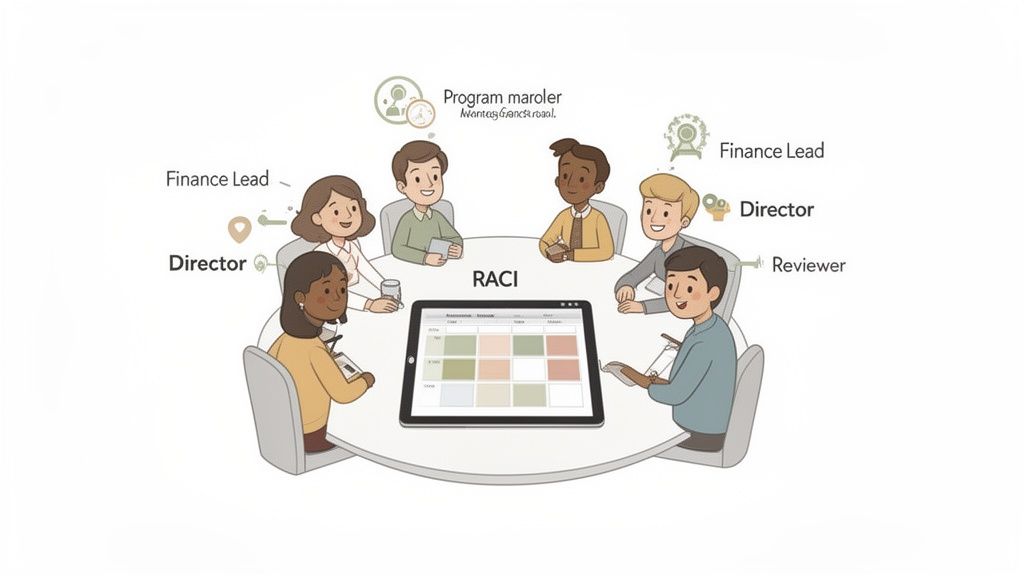
Creating Clarity with a RACI Chart
One of the biggest time-sucks in the grant writing process? Confusion over who is doing what. This is where a simple RACI chart becomes your secret weapon. RACI stands for Responsible, Accountable, Consulted, and Informed.
A RACI chart isn't just a piece of corporate jargon; it's a communication tool that kills ambiguity. When you define everyone's role up front, you stop tasks from falling through the cracks and end that dreaded "I thought you were handling that" conversation for good.
Here’s what this might look like for a typical grant proposal:
- R (Responsible): The person actually doing the work.
- A (Accountable): The person who ultimately owns the final result.
- C (Consulted): Stakeholders who need to provide input.
- I (Informed): People you need to keep in the loop on progress.
This simple matrix clarifies expectations almost instantly. Your program manager sees they are Responsible for getting you the data, while the finance lead knows they are Accountable for the final budget's accuracy. This kind of structure is absolutely key to managing your collaborative grant writing time effectively. It prevents so many headaches and keeps the project moving forward.
Smart Tactics to Reclaim Your Time
Let's be honest: winning more grants isn't about working harder; it's about working smarter. If you feel like you're constantly chasing deadlines, you can't just power through it. The real secret to reclaiming your schedule is to stop reinventing the wheel with every proposal.
It's all about building a solid foundation of reusable assets and leaning on modern tools to handle the monotonous, time-sucking parts of the job. You want to spend less time digging for documents and doing administrative busywork. That frees you up for the work that actually secures funding: telling a compelling story, building an airtight budget, and nurturing relationships with funders.
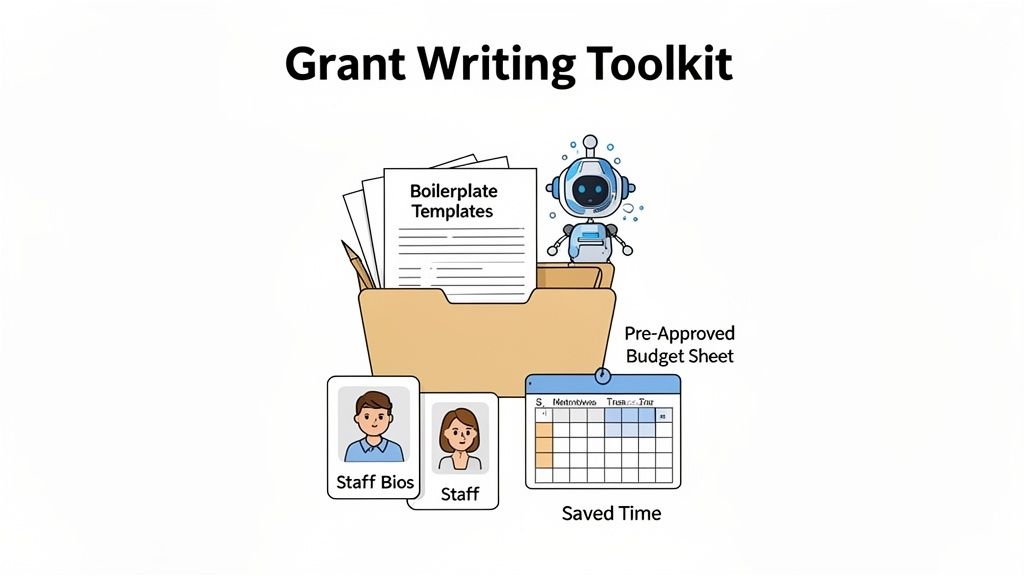
This idea of a "grant toolkit" is a game-changer. It’s simply a central, organized place for all the documents you use over and over. Getting this set up is probably the single biggest time-saver you can implement.
Build Your Grant Writing Toolkit
Can you imagine a world where you never have to search your inbox for a staff member's bio again? Or ask the finance department for the same budget numbers for the third time this month? That's what a grant writing toolkit does for you. It's your organization's one-stop shop for all the crucial, up-to-date info you need.
Think of it as your own internal library. The initial effort to organize it pays dividends almost immediately. I've seen teams cut their information-gathering phase in half by simply building and maintaining a toolkit.
Get started by creating a shared digital folder—on Google Drive, SharePoint, or wherever your team lives—and start collecting these essentials:
- Boilerplate Language: Pre-written, approved text for standard sections like your organization's history, mission, and core program descriptions.
- Key Personnel Documents: The latest résumés, professional bios, and a current list of board members with their affiliations.
- Financials and Budgets: Your most recent audited financials, proof of nonprofit status (like your 501(c)(3) letter), and pre-approved, line-item budgets for your main programs.
- Support Materials: A collection of powerful client testimonials, high-quality program photos, and recent letters of support.
Embrace Technology to Accelerate Your Workflow
Beyond just getting organized, technology can radically cut down your grant writing time. Modern platforms are now being built specifically to handle the most tedious grant-related tasks. For instance, AI-powered tools can take a dense, 50-page RFP and spit out a structured outline with all the key deadlines and requirements in minutes.
That means you can figure out if an opportunity is a good fit without losing hours just trying to understand the guidelines. The right software can also help you discover new funders that are a perfect match for your mission, saving you from the black hole of endless database searches.
Many grant professionals are quickly realizing that learning how to use AI for grant writing is becoming an essential skill. These tools can act as a writing assistant, generating a first pass on narrative sections or summarizing complex research. This lets you skip the blank page paralysis and jump right into strategy and refinement.
FAQs: Your Top Questions About Grant Writing Time, Answered
Even with the best plan laid out, you're bound to have questions. It's only natural. Getting clear answers helps you sidestep the common traps that can throw even the most seasoned grant writers off their game.
Let's dive into a few of the questions I hear most often.
I'm a First-Timer. How Much Extra Time Should I Really Block Out?
If this is your first rodeo, take your best time estimate and tack on an extra 30%. Seriously. The learning curve is steep, and you're not just writing. You’re also learning a new language filled with grant-specific jargon, creating foundational documents from the ground up, and wrestling with clunky online submission portals for the first time.
So, if you think a grant will take 20 hours, block out 26. That extra six hours isn't fluff; it’s a smart investment in building the knowledge and assets that will make every future application that much faster.
Can I Actually Write a Grant in Just One Week?
Look, you might be able to pull off a simple Letter of Inquiry (LOI) in a week, but attempting a full proposal on that timeline is a huge gamble. Rushing is a recipe for disaster. It leads to sloppy mistakes, a weak needs statement, and a budget that feels patched together. More than anything, it screams to the funder that their opportunity was an afterthought for you.
Even for a straightforward application to a local community foundation, I always recommend giving yourself a minimum of two weeks. This gives you breathing room for real planning, thoughtful drafting, and—this is critical—getting a fresh pair of eyes on it before you click submit.
Pro Tip: The best way to stay prepared is to build a "grant toolkit." This is your go-to digital folder with all the essential, up-to-date documents you'll ever need: organization history, mission and vision, board roster, key staff bios, program descriptions, budget templates, and your latest financials.
What's the Single Biggest Time-Saving Hack You Know?
Hands down, it's that "grant toolkit" I just mentioned. Nothing else comes close. Think of it as your command center for all the core documents you need, all pre-approved and ready to deploy.
Having this information at your fingertips can easily cut your information-gathering time in half. Instead of chasing down the finance team for budget numbers or trying to find the latest version of a program one-pager, you just grab it and go. This frees up an incredible amount of time and mental space, letting you focus on what really wins grants: crafting a powerful, persuasive story that aligns perfectly with the funder’s goals.
Ready to stop wasting hours on manual research and tedious proposal drafting? Fundsprout uses AI to help you find the perfect grant opportunities and write winning applications faster. Discover how our platform can reclaim your team's valuable time at https://www.fundsprout.ai.
Try 14 days free
Get started with Fundsprout so you can focus on what really matters.