How to Answer Grant Questions: Win Funding in 2026
Learn how to answer grant questions confidently. Decode funder intent, find answer frameworks, and craft winning proposals with data for 2026 success.

Abdifatah Ali
Co-Founder
You open the application portal, skim the first few questions, and then hit the one that stalls everything.
“Describe your organization's approach to solving this community problem.”
You know your work. You know the people you serve. You know the program is strong. But turning all of that into a concise, funder-friendly answer can feel harder than building the program itself. Many applicants don't get stuck because they lack passion. They get stuck because grant questions ask for several things at once. Strategy, evidence, clarity, confidence, and restraint.
That pressure is normal. It's also manageable once you stop treating each question like a writing test and start treating it like a decision-making exercise. Strong answers don't appear because someone felt inspired. They come from a repeatable process that helps you identify what the funder is asking, what proof belongs in the answer, and what details need to stay out.
A lot of nonprofit leaders discover this the hard way, especially when they first confront the difficulty of grant writing. The challenge usually isn't that the questions are unclear. It's that they're deceptively simple.
Beyond the Blank Page
A first-time applicant often assumes the hardest part is “writing well.” In practice, the hardest part is deciding what the answer needs to accomplish.
A weak response to “Describe your organization's approach” usually reads like a brochure. It talks about mission, values, and dedication. It sounds sincere. It also leaves the reviewer wondering what the organization will do, for whom, on what timeline, and how success will be judged.
A stronger response starts before the first sentence. The writer pauses and asks, “What proof would make this answer credible?”
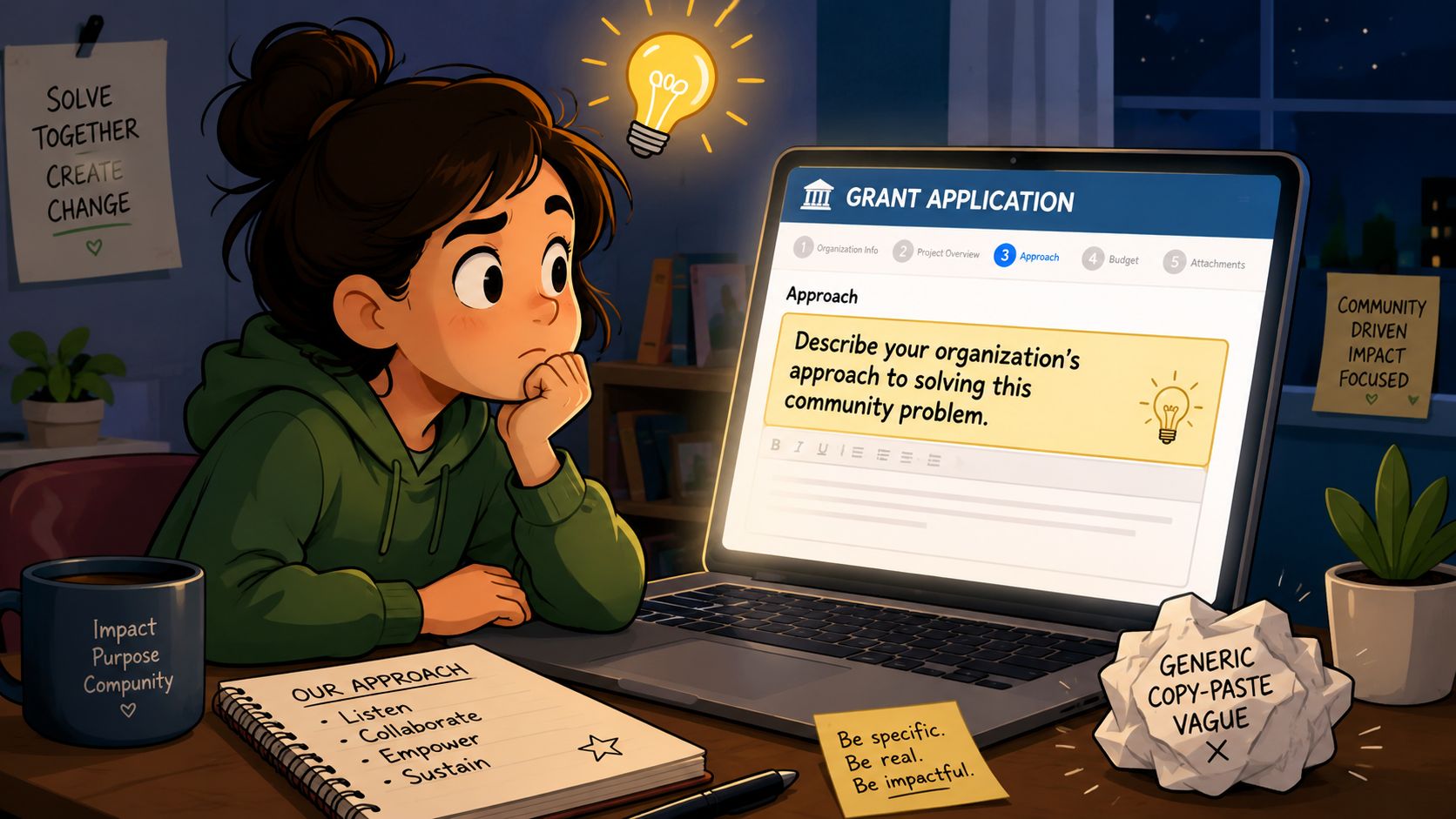
What the blank page is really signaling
The blank page usually means one of three things:
- The question is too broad: You haven't broken it into parts yet.
- The evidence is scattered: Program details live in one file, outcome data in another, and stories in someone's memory.
- The stakes feel high: You know a vague answer won't survive review.
None of that means you're bad at grant writing. It means you're trying to draft before you've built the answer.
Practical rule: If you can't outline the answer in plain language, you're not ready to write the polished version.
That shift matters. When people ask how to answer grant questions, they often want better wording. What they usually need is better structure.
What works and what doesn't
A few patterns show up again and again.
| Approach | What happens |
|---|---|
| Start writing immediately | The answer becomes repetitive, generic, or unfocused |
| Mirror the exact question and outline first | The response stays relevant and complete |
| Lead with mission language only | Reviewers get sentiment without a plan |
| Lead with a clear program model and evidence | Reviewers can track the logic quickly |
I've seen capable teams waste hours polishing paragraphs that were built on the wrong frame. Once they rebuilt the answer around the funder's actual concern, the writing got easier fast.
That's the primary goal here. Not to sound impressive. To make each answer easy to trust.
Decoding the Funder's Hidden Question
Every grant question has two layers. There's the literal question on the page, and there's the concern behind it.
“Describe your collaboration strategy” may really mean, “Show us you aren't duplicating work.”
“Explain your program design” may really mean, “Convince us you can deliver this without drifting off scope.”
“Describe community need” may really mean, “Prove this problem is real and bigger than your organization.”
If you miss that hidden question, your answer can be accurate and still score poorly.
Read the rubric before you draft
Applicants who succeed usually do something simple and unglamorous. They follow the instructions completely, study the scoring criteria, and answer each requirement thoroughly. The EPA's guidance is blunt on this point. Failure to follow the funding agency's instructions is a primary cause of rejection.
That means the rubric is not background material. It's the map.
When a question looks broad, check where the points are assigned. If the scoring language emphasizes feasibility, lead with implementation. If it emphasizes outcomes, lead with measurable change. If it stresses partnerships, don't just name partners. Explain roles, coordination, and why the collaboration matters.
How to read between the lines
Use this quick diagnostic before answering any prompt:
- Look for decision words: Terms like capacity, innovation, sustainability, equity, feasibility, and collaboration tell you what lens the reviewer is using.
- Check the funder's mission language: Their preferred language often signals what they reward.
- Review past funded work if available: You're looking for patterns in project type, scale, and tone.
- Match the question to the score: If a short prompt carries major weight, the hidden question matters more than the surface wording.
A question about “organizational capacity” doesn't always require your full history. It may only need the specific staffing, systems, and partnerships relevant to this grant.
Turn the RFP into a usable brief
Long applications become manageable when you convert them into a checklist of reviewer needs. Some teams do this manually in a spreadsheet. Others use tools built for requirement extraction, such as an RFP analyzer for grants, to pull out deliverables, deadlines, attachments, and scoring cues.
Reviewers don't reward you for saying everything. They reward you for answering what matters.
That distinction saves time. It also keeps your narrative from drifting into content that sounds polished but doesn't move the score.
Building Your Answer with a Strategic Framework
Once you've identified the hidden question, you need a structure that forces specificity. The most useful one I know is this:
Who. What. How many. By when. With what result.
It works because it stops vague writing before it starts. It also aligns with how reviewers think. They want to know who benefits, what you'll do, what scale you're proposing, when results should happen, and how you'll know whether the work mattered.
An Instagram post from Grantor Language 101 reported that proposals are rejected 45% more often when they fail to address the “Who? What? How many? By when? With what result?” framework. Even if you never mention the framework by name, your answer should satisfy each part.
Use the framework on a real question
Take a common prompt:
“Describe your organization's approach to improving youth mental health.”
A loose answer sounds like this:
“We provide trauma-informed, youth-centered services that support emotional well-being through outreach, counseling, and community partnerships.”
Nothing in that sentence is false. It also leaves major gaps.
A stronger outline looks like this:
- Who: Middle and high school students facing barriers to mental health support
- What: School-based counseling, family navigation, and referral coordination
- How many: The defined participant group or service volume for this proposal
- By when: During the grant period, with milestone checkpoints
- With what result: Specific changes the organization will track and report
Now the writer has something solid to build from.
Why this framework improves weak drafts
Most bad drafts fail in one of two ways. They either stay too abstract, or they crowd too many details into one paragraph without a clear sequence.
This framework fixes both.
| Framework element | What it prevents |
|---|---|
| Who | Overly broad claims about serving “the community” |
| What | Mission-heavy language without program detail |
| How many | Fuzzy scale and untestable ambition |
| By when | Plans with no timeline |
| With what result | Activity lists that never reach outcomes |
The same logic shows up in strategic planning. If your team needs help tightening goals before you write, Bulby's strategic planning guide is a useful companion because it helps translate broad priorities into clearer operational choices.
Where AI helps and where it doesn't
AI assistants are useful for speed. They can summarize long application materials, turn prompts into answer outlines, draft first versions, and identify missing pieces. They can also help map source material to the five-part framework so your team isn't starting from scratch every time.
But AI is not your strategist. It doesn't know which community nuance matters most, which partnership is politically important, or which promise your team can realistically keep. You still need a human to decide what belongs in the answer and what should be left out.
A short walkthrough can help if your team is experimenting with AI-assisted workflows:
Use AI for acceleration. Keep judgment with your staff.
Weaving Together Data and Compelling Stories
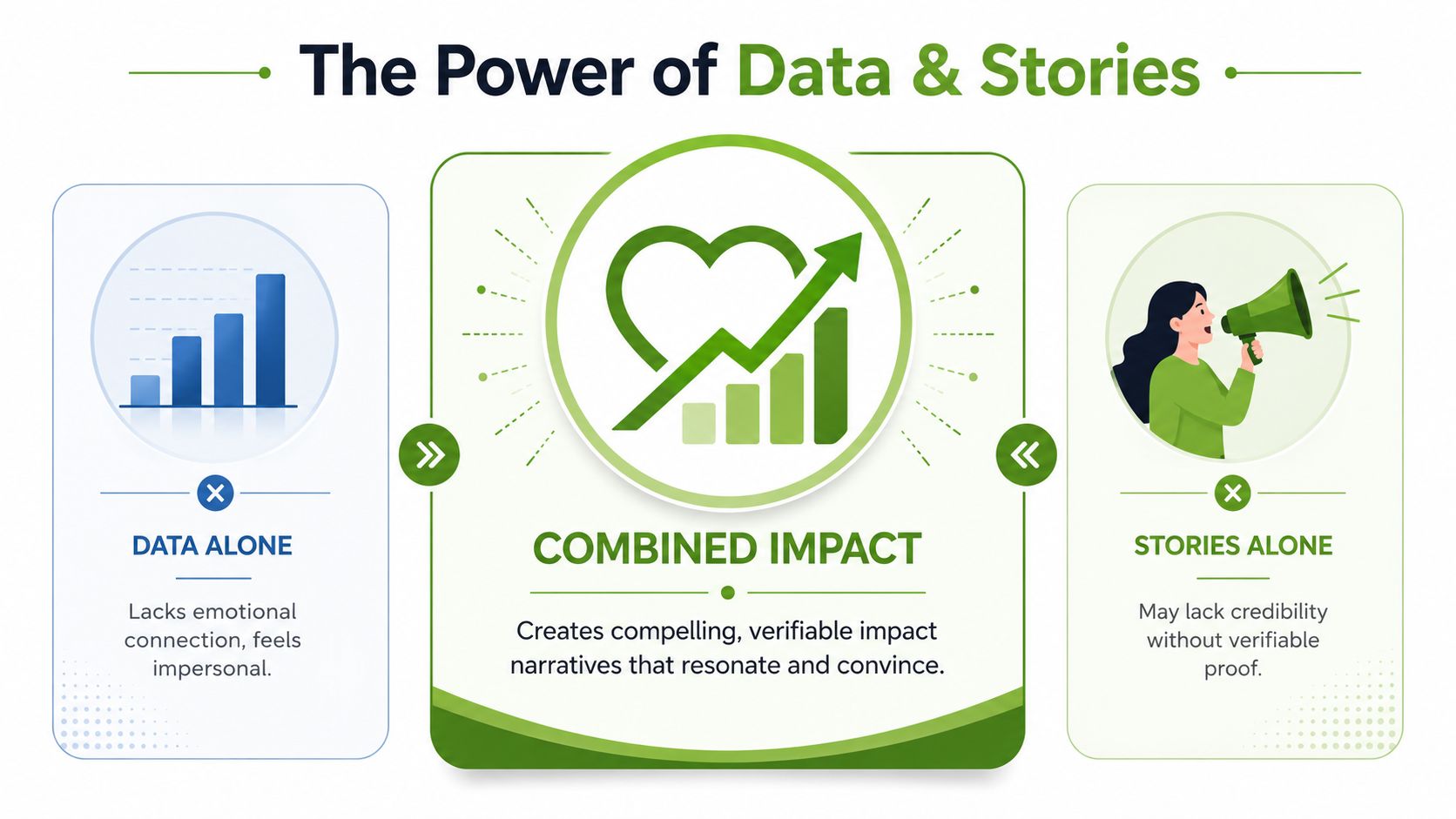
The strongest grant answers do two jobs at once. They prove a need, and they make that need matter.
Data handles the first job. Stories handle the second.
If you rely only on data, the answer can feel clinical. If you rely only on stories, the answer can feel ungrounded. The most persuasive responses combine both. Guidance from Grand Valley State University emphasizes that effective grant proposals use documented statistics and humanizing case studies, include more than one data point, and help reviewers interpret the numbers in concrete terms.
What this looks like in practice
Suppose you're answering a question about food insecurity.
A weak version says the problem is severe and your pantry is committed to helping. A stronger version uses multiple documented data points to define the need, then adds a short participant story that shows what those numbers mean in lived experience.
The story should not take over the paragraph. Its job is to interpret the evidence, not replace it.
A reviewer should finish the section understanding both the scale of the problem and the human consequences of ignoring it.
Keep the data readable
One common mistake is dropping statistics into the proposal without context. Another is adding so many figures that the narrative becomes cluttered.
Use this filter:
- Choose evidence that supports the exact claim: If you're discussing transportation barriers, don't pad the section with unrelated organization history.
- Use more than one data point when describing need: That creates depth instead of a single unsupported assertion.
- Translate numbers into practical meaning: Show what they imply for the people you serve.
- Prefer clarity over precision theater: Round numbers are often easier to absorb unless the grant is scientific.
If your team struggles to gather clean service data, operational systems matter more than people admit. Something as basic as consistent staff logging can improve the quality of your evidence later. For organizations trying to tighten documentation between implementation and reporting, it's worth reviewing how teams discover time tracking for grant reporting, because administrative discipline upstream often makes proposal writing easier downstream.
Pair need statements with outcome logic
Good storytelling doesn't just describe hardship. It creates a bridge between the problem and your response.
A useful internal test is this:
- State the need with evidence
- Show who is affected
- Explain how your program responds
- Illustrate what change looks like for one person
- Return to measurable outcomes
Teams that need help organizing this section often benefit from reviewing examples of a strong statement of need, because this is the point where many proposals either become too abstract or too emotionally overloaded.
The sweet spot is credibility with texture. Numbers make the case legible. Stories make it memorable.
Mastering Readability Wording and Tone
Grant reviewers are often reading fast, scoring fast, and comparing your answer against many others. Your job is to reduce friction.
That starts with sentence control. NIH guidance notes that for high-scoring responses, keeping sentence lengths under 20 words, using short paragraphs, and judiciously using bold text can reduce review time and improve scoring consistency by 15–20%.
That doesn't mean writing in a flat voice. It means writing so the reviewer never has to reread a sentence to understand your point.
Write for scan first, then style
Here's a simple before-and-after.
Before
Our organization has long been committed to meeting the evolving and interconnected needs of vulnerable families through a broad continuum of responsive and community-centered services designed to improve stability and long-term well-being.
After
We help families stabilize housing, access services, and reduce immediate crisis barriers. This proposal funds that work for families facing the highest risk.
The second version says less, but communicates more.
Small changes that improve clarity
- Use active voice: “We will train staff” is clearer than “Staff will be trained.”
- Front-load the main point: Don't hide your answer in the fourth sentence.
- Break dense ideas apart: One paragraph should carry one main job.
- Use bold sparingly: Highlight outcomes, deadlines, or major commitments. Don't turn the page into a patchwork.
- Cut throat-clearing: Phrases like “it is important to note” waste precious words.
Adjust tone without losing professionalism
Your proposal should sound like your organization, just tighter.
A grassroots nonprofit can sound community-rooted without becoming casual. A larger institution can sound capable without becoming stiff. The best tone is calm, direct, and specific. It signals that you know your work and can execute it.
For shorter answers, lead with the conclusion. Then support it.
For longer answers, build in layers:
| Answer length | Best structure |
|---|---|
| Short response | Main point first, then proof |
| Medium response | Problem, response, evidence |
| Long narrative | Need, approach, capacity, outcomes, fit |
If a reviewer skims only the first sentence of each paragraph, they should still grasp your case.
Edit like a reviewer, not a writer
Writers often edit for elegance. Reviewers reward clarity.
Print the draft or change the screen view and ask:
- Can I identify the answer immediately?
- Is any sentence doing two jobs badly instead of one job well?
- Did jargon replace explanation?
- Did I make the reviewer work to find the outcome?
Most proposals improve when the language becomes simpler, not smarter. Clean writing signals organized thinking.
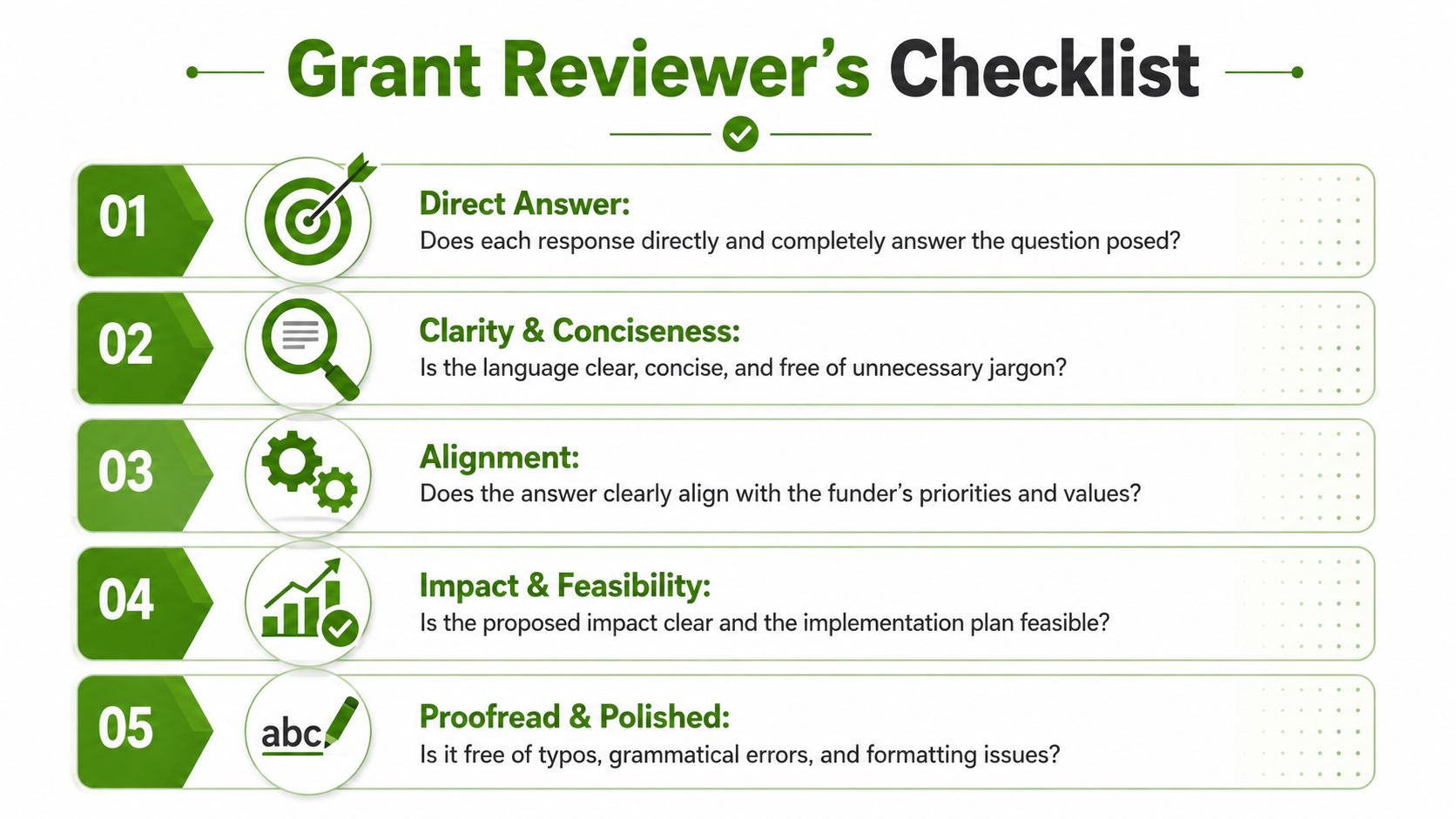
Final Review Through a Reviewer's Eyes
Before submission, stop acting like the author and start acting like the reviewer. Not the generous reviewer. The tired one.
That reviewer has limited time, a scoring rubric, and no obligation to infer what you meant. If your answer is incomplete, buried, overly optimistic, or off-format, they won't rescue it.
Many otherwise solid proposals break down at this stage. The draft may be emotionally compelling and technically accurate, but it still leaves questions unresolved. Reviewers prioritize applications where the thought process is easy to follow, every question is answered thoroughly, and formatting rules are followed closely. Guidance from Epiphany Community Services warns that even minor deviations from formatting instructions, scoring criteria, and font guidelines can lead to rejection.
The red flags reviewers notice fast
Some problems jump off the page:
- Indirect answers: The response sounds polished but never fully addresses the prompt.
- Unsupported claims: You state need, capacity, or impact without showing evidence.
- Formatting drift: Fonts, margins, page limits, and naming conventions don't match instructions.
- Scope inflation: The project promises more than the staff, timeline, or budget can support.
- Template residue: Language feels copied from another proposal and doesn't fit the current funder.
The last one is more common now that AI drafting is easy. AI can help with proofreading, consistency checks, and first-pass editing. But the final strategic review must stay human-led.
The sustainability question deserves special handling
Many applicants mishandle sustainability because they think they need to sound invincible. That usually backfires.
A sustainability answer should show that the grant matters, the work won't collapse without magical thinking, and the organization has a credible plan for continuation. GrantsEdge reported in a 2025 study that 68% of small nonprofits give vague or overly optimistic sustainability answers, which lowers funding success rates by up to 30%.
A better sustainability answer usually includes:
Current funding reality
Explain the role this grant plays without sounding dependent on a single source.Continuation strategy
Name the revenue mix, partnerships, or institutional commitments that support the work over time.Operational discipline
Show that you plan ahead rather than hoping renewal will solve everything.
The right tone is steady. Not desperate. Not overconfident.
A final pre-submission checklist
Read each answer with these questions in mind:
| Reviewer question | What to verify |
|---|---|
| Did they answer what we asked? | Match each response directly to the prompt |
| Can we follow the logic? | Make sure the narrative sequence is obvious |
| Is the plan believable? | Check scope, timeline, staffing, and outcomes |
| Did they respect instructions? | Confirm formatting, attachments, and limits |
| Is anything missing? | Look for unsupported claims and unanswered subparts |
Then do one more pass for consistency. Program names, dates, staffing references, and outcomes should align across the full application. Nothing undermines trust faster than internal contradictions.
Strong proposals usually don't win because they sound grand. They win because the reviewer can say yes with confidence.
If your team wants help moving from scattered notes to submission-ready answers, Fundsprout can support the heavy lifting. It helps nonprofits analyze RFPs, organize requirements, draft narratives in their own voice, and keep deadlines, source material, and reporting details in one place so each grant question is easier to answer well.
Try 14 days free
Get started with Fundsprout so you can focus on what really matters.