Overcoming the difficulty of grant writing: A Nonprofit's Guide to Success
Discover practical strategies to tackle the difficulty of grant writing and boost your nonprofit's funding success with clear, actionable steps.

Abdifatah Ali
Co-Founder
If you’ve ever felt like grant writing is an uphill battle, you’re not alone. It’s a field that demands a tricky combination of intense competition, rigid compliance rules, and a huge time commitment. For smaller nonprofits, it can feel like you’re trying to climb a mountain with just a fraction of the gear everyone else has. The whole process can be intimidating, if not downright exhausting.
Understanding Why Grant Writing Is So Difficult
That feeling of being overwhelmed when you stare at a blank grant application is a shared experience across the entire nonprofit sector. It’s so much more than just asking for money. A grant proposal is a strategic document that requires a very specific blend of skills.
Think of it as part legal brief, part business plan, and part compelling story—all rolled into one high-stakes package.
This guide is designed to tackle the real, nitty-gritty challenges of grant writing head-on. We're not here to give you generic advice. Instead, we’re going to unpack the core obstacles that make this work so demanding and reframe them as strategic hurdles you can learn to clear with the right mindset and tools.
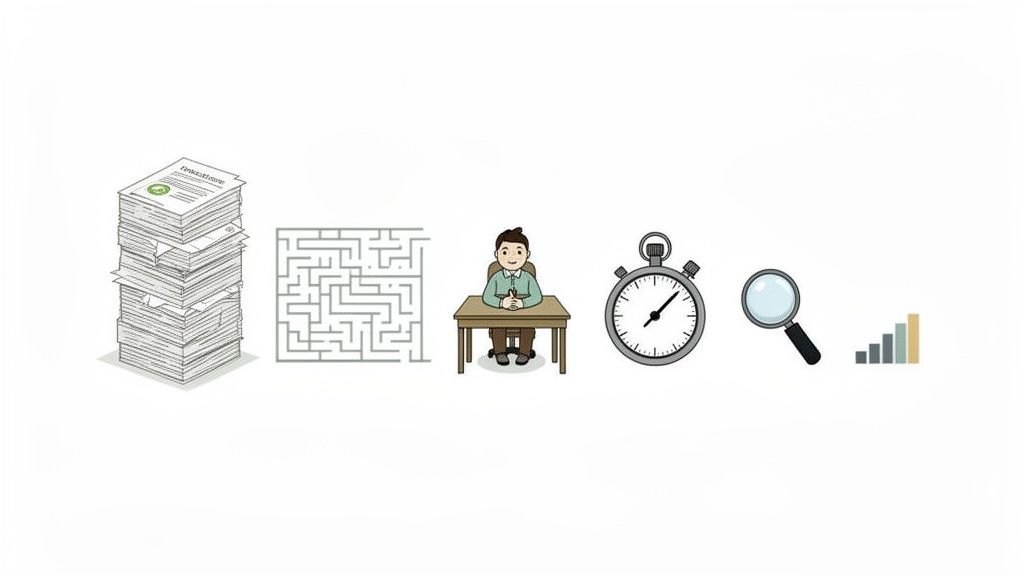
The Five Core Grant Writing Challenges
The difficulty you feel isn't just in your head; it’s the result of several concrete factors piling on top of each other. Pinpointing these specific pain points is the first step toward actually solving them.
Here's what we'll be diving into:
- Intense Competition: The funding world is crowded. There are always far more organizations applying for grants than there are awards to go around.
- Technical Compliance: You're navigating a maze of strict rules, specific formatting, and unforgiving character limits where one small mistake can get your application tossed out.
- Persuasive Writing Demands: It’s a unique writing style. You have to weave a story that is both emotionally compelling and rigorously backed by data. To get a handle on the basics, check out our guide on what is a grant proposal and what goes into one.
- Time and Capacity Drain: The sheer number of hours it takes to research funders, write proposals, and manage submissions can easily swamp a small team.
- The Pressure for Evidence: Funders want proof. Every single claim you make, from the community's need to your projected outcomes, has to be supported by hard data.
By breaking down each challenge, we can move from feeling overwhelmed to feeling empowered. The key is to stop seeing grant writing as a single, massive task and start viewing it as a series of manageable steps.
We won’t just explain why these things make grant writing so tough. We’ll also give you practical, modern strategies to conquer each one. From using new tools to building smarter workflows, you’ll walk away with a clear roadmap for turning this difficult process into one of your organization’s biggest strengths.
4. Facing the Reality of Stiff Competition
Getting that rejection email after you’ve poured weeks into a proposal is tough. It’s easy to take it personally and think, "I must have done something wrong." But more often than not, the real reason has less to do with the quality of your proposal and everything to do with the sheer volume of competition.
Think of it like this: a funder has a single life raft with room for five, but there are a hundred equally deserving people in the water. That’s what many grant cycles feel like. Funders are often swamped with hundreds, sometimes thousands, of fantastic applications for only a handful of awards. It’s a classic case of supply and demand.
The Numbers Tell the Story
This isn’t just a feeling—it’s a statistical reality. The average success rate for grant proposals often hovers between a sobering 10% and 30%. That single statistic paints a clear picture of the uphill battle nonprofits face. When there are more great proposals than available funds, even the most compelling applications can end up in the "no" pile.
For a deeper dive, you can explore more insights on grant success rates and what they mean for your strategy.
This reality hits smaller nonprofits the hardest. Larger, more established organizations usually have dedicated grant writing teams, years of impact data, and existing relationships with funders. That gives them a serious leg up. For a small team where everyone wears multiple hats, just getting noticed is a monumental task.
Grant Success Rates by Funder Type
Not all funding sources are created equal. Understanding where the competition is most intense can help you focus your energy where you have a better shot.
This table breaks down typical grant proposal success rates, showing nonprofits where competition is highest and where they may have better odds.
As you can see, your odds can improve dramatically when you focus on local and relationship-based funders. This data isn't meant to scare you away from federal grants but to help you build a balanced strategy that mixes long shots with more probable wins.
The goal isn't to get discouraged by these numbers, but to use them to build a smarter strategy. Knowing the odds helps you shift from a mindset of disappointment to one of strategic preparation, focusing your limited resources where you can truly make an impression.
How to Play It Smart When Competition is High
Once you accept how competitive the landscape is, you can start building a more resilient and effective fundraising plan. Instead of taking a scattergun approach and applying for everything that looks remotely relevant, a strategic, data-informed process becomes your best friend.
This means getting more selective and analytical.
- Do Your Homework: Don't just apply—investigate. Prioritize funders whose mission and past awards align perfectly with your work. A simple "Go/No-Go" checklist can save you from sinking dozens of hours into an application that was never a good fit.
- Build Relationships First: Try to connect with program officers before the application is even on your radar. A quick introductory call or email can make your proposal feel like it’s from a familiar face, not just another number in a stack.
- Find Your "Wow" Factor: What makes your organization's approach special? Your proposal needs a hook. Figure out what makes you different and present your impact data in a way that’s clear, compelling, and impossible to forget.
By acknowledging the competitive nature of grant seeking, you can stop wasting time and start investing it. This shift in mindset helps you channel your energy more effectively, turning a daunting challenge into a manageable one.
Balancing Heartfelt Stories with Hard-Nosed Rules
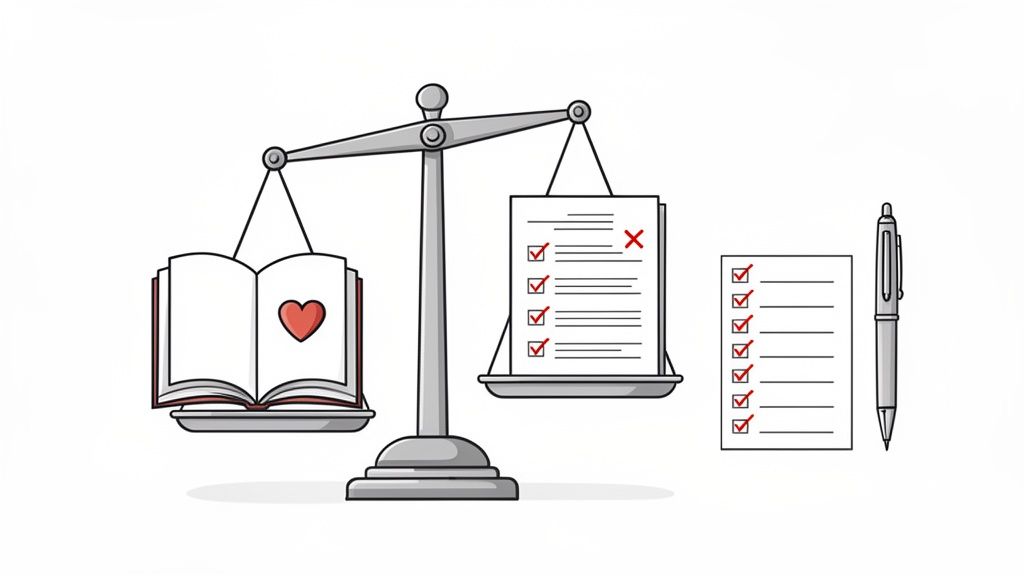
One of the toughest parts of grant writing is getting the hang of its split personality. On one hand, you need to tell a powerful story that connects with the reader on an emotional level. On the other, you have to produce a technical document that’s as precise as an engineering blueprint.
It’s this tightrope walk between creative storytelling and rigid compliance that trips up so many nonprofits.
Funders aren't just looking for a good story; they're screening for precision and your ability to follow directions. Even the most moving narrative about your work will get tossed aside if it doesn’t tick all their boxes. This is where the technical side of grant writing acts as the ultimate gatekeeper.
The Unforgiving World of Compliance
Think of the funder's guidelines as the non-negotiable price of admission. One tiny mistake—and I mean tiny—can get your proposal disqualified before a human even reads about your incredible mission. These aren't just suggestions; they're a test of your organization's professionalism and attention to detail.
Here are a few of the most common traps that send applications straight to the "no" pile:
- Formatting Fails: Using the wrong font, blowing a margin by a fraction of an inch, or using single instead of double spacing can be an instant dealbreaker.
- Character and Word Limits: Going over a character count, even by one letter, can stop you from submitting or trigger an automatic rejection from the system.
- Attachment Errors: Naming a file incorrectly or uploading a PDF when they asked for a Word doc is an easy, and frustrating, way to get disqualified.
See the funder's guidelines not as a list of annoying hoops to jump through, but as the exact recipe for what they want. They are literally telling you how to build a proposal they will accept.
Translating Your Mission into Measurable Metrics
Another big hurdle is learning to translate your passionate, big-picture mission into the cold, hard, data-driven language funders demand. Your team is fired up by the "why," but funders are investing in the "what" and "how." They don't just fund good intentions; they fund measurable results.
For instance, saying "We empower at-risk youth" is inspiring, but it's not fundable. Funders need the specifics.
A grant-worthy version sounds more like this: "Our program will serve 50 at-risk youth over a 12-month period. Our primary goal is to increase their high school graduation rate by 15%, which will be tracked using official school district data."
This requires a total shift in how you write. You have to be objective, ultra-specific, and focused entirely on outcomes you can count. This is especially true if you're going after government money. Taking some time to understand the unique world of federal grants for nonprofits is a smart move, as their compliance standards are notoriously high.
Getting this technical style right is how you show funders you’re not just passionate—you’re a professional, effective partner for creating real-world change.
Managing the Crushing Demands on Your Time
Beyond the tricky writing and stiff competition, maybe the biggest hurdle in grant writing is the sheer amount of time it devours. Time is your most precious, non-renewable resource, and for small nonprofits where everyone is already juggling multiple roles, grant writing can feel less like a task and more like a second full-time job.
This isn't just a feeling—the numbers back it up. Federal grant proposals can easily demand over 100 hours of intense work. Even a smaller foundation grant can soak up 15-20 hours. For a small team, that's weeks of time pulled away from running the very programs you’re trying to fund. You can see more grant writing statistics to understand the full picture.
This constant drain on your capacity brings up a painful reality: opportunity cost.
The Hidden Cost of Chasing Grants
Opportunity cost is simply the value of what you miss out on when you choose to do one thing over another. Every hour your Executive Director spends fighting with a dense federal grant application is an hour they aren't building relationships with major donors, mentoring their team, or connecting with community leaders.
Let's put it in real terms:
- Those 20 hours spent on a long-shot foundation grant? That could have been 10 strategic meetings with potential partners.
- That massive 100-hour federal proposal? That’s more than two full workweeks that could have gone into program development or volunteer management.
This constant, exhausting math forces organizations onto the "grant writing treadmill." It’s a frantic cycle of chasing deadlines, waiting anxiously for a decision, and then starting all over again, often with nothing to show for it. It's not just inefficient; it's a fast track to burnout for your most dedicated people.
The real challenge isn’t just finding the hours to write the grant. It's making sure those hours deliver the best possible return for your mission. Wasting time on a poorly matched grant is a luxury most nonprofits just can't afford.
Getting off this treadmill means thinking differently. Instead of reactively chasing every grant announcement, you need to build a smarter, more efficient process. This starts with getting really good at vetting opportunities before you write a single word and bringing in tools that can give you your time back.
Specialized nonprofit grant writing software can help teams reclaim dozens of hours. This lets you shift your focus from tedious paperwork back to the high-impact work that actually advances your mission. It’s all about working smarter, not just harder.
5. Building a Modern Workflow to Overcome Grant Hurdles
It's one thing to know grant writing is tough; it's another thing entirely to build a system that can handle it. The key is moving away from the frantic, last-minute scramble and creating a modern, proactive workflow. This turns the grant process from a constant source of stress into a manageable, strategic part of your nonprofit's funding plan.
At its core, this shift is about mindset. Stop chasing every dollar you see dangled in front of you. Instead, start building a pipeline of funders who are a genuinely good fit. When you stop reacting to every grant announcement and start proactively identifying funders whose missions truly align with yours, you save an incredible amount of time that would have been wasted on applications that were never going to succeed.
Create a Go/No-Go Checklist
To put this proactive approach into practice, the first thing you need is a simple "Go/No-Go" checklist. Think of this as your gatekeeper—a tool that protects your team’s most valuable resource: time. Before you even think about writing a single word, every potential grant opportunity should pass through this quick, objective filter.
Your checklist should ask the hard questions right up front:
- Does our mission directly align with the funder’s stated priorities? No stretching the truth.
- Do our programs serve the specific geographic area they fund?
- Do we meet 100% of their eligibility requirements? Not 90%, 100%.
- Can we realistically handle the reporting and compliance if we win?
- Is the award amount worth the hours we'll sink into this application?
If you get a firm "no" on any of these, you walk away. No guilt, no second-guessing. This simple tool is your best defense against pouring energy into proposals that are dead on arrival.
This is especially critical when you see the massive difference in the time commitment between various grant types.
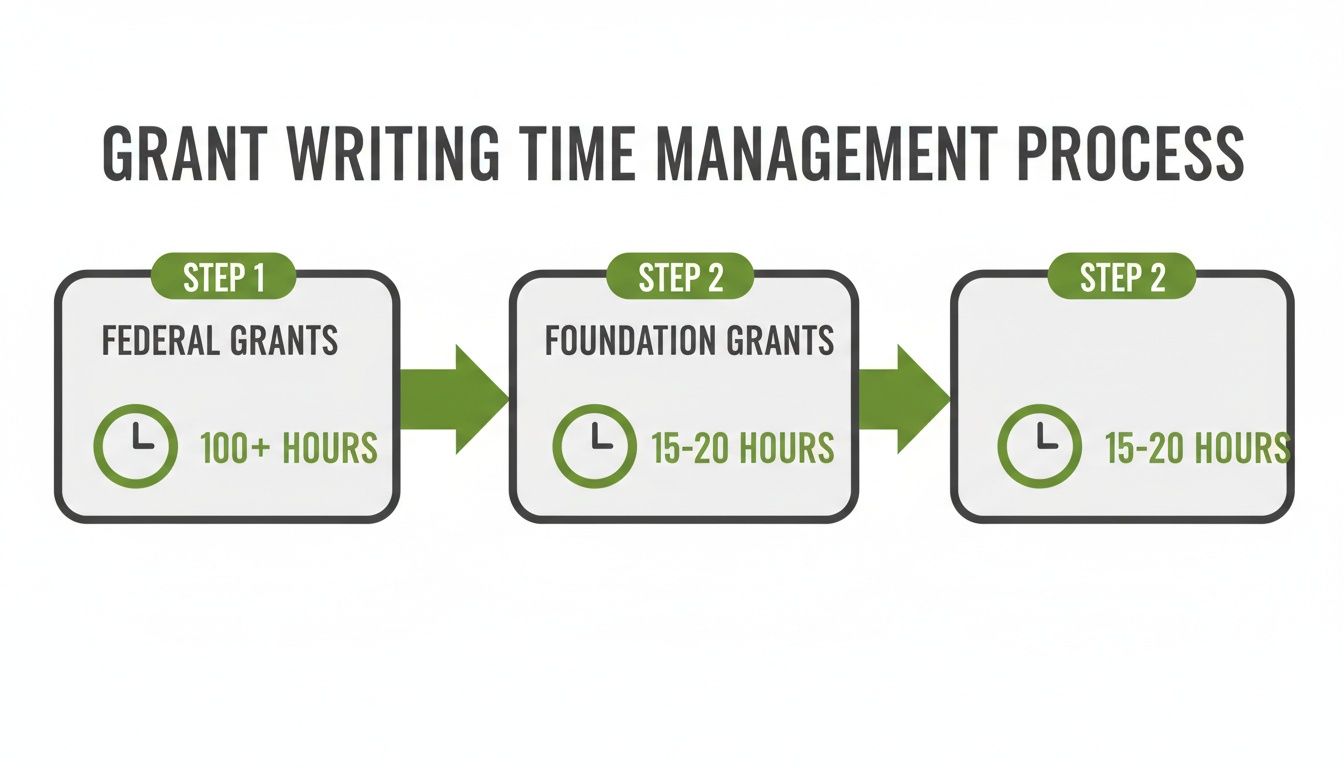
That huge time gap for federal grants shows just how high the stakes are. A solid workflow is what protects your team from burning out on a single, massive application.
Develop a Modular Content Library
Next up: stop reinventing the wheel for every proposal. Your secret weapon here is a modular content library—basically, a central hub for all your core narratives, essential data, and standard documents.
Think of it like building with LEGOs. Instead of starting from a pile of dust every time, you’re pulling pre-built, high-quality blocks and snapping them together.
A content library isn't just a time-saver. It's a quality-control machine. It ensures every proposal that goes out the door is built from your best, most compelling, and most up-to-date information.
This library is where you'll keep your organization's history, mission statement, detailed program descriptions, key stats on community need, and powerful stories of your past impact. When a new grant application lands on your desk, you can quickly pull and customize these core pieces instead of staring at a blinking cursor on a blank page. For a modern approach to managing the sheer volume of information this requires, a solid documentation workflow management system is absolutely essential.
Supercharge Your Workflow with AI
Finally, let's talk about the game-changer: AI tools. Weaving artificial intelligence into your process can give your small team a massive boost. AI assistants can help automate the tedious parts of prospect research, flagging highly-aligned funders you might have otherwise missed.
They can also help you get past the "blank page" problem by generating strong first drafts of narrative sections, using the approved content from your modular library as a starting point. This combination—a smart process backed by smart technology—is how you systematically take apart the challenges that make grant writing so difficult.
The table below shows just how much a well-integrated AI tool can change your day-to-day grant work.
Traditional vs. AI-Powered Grant Writing Workflow
By offloading the repetitive, time-consuming tasks to AI, your team can focus on what truly matters: building relationships with funders and telling your organization's most compelling story.
Turning Grant Writing Difficulty Into Your Strategic Advantage
The sheer difficulty of grant writing isn't just a hurdle to clear—it's a filter. It naturally separates the nonprofits that are truly prepared from those that are easily overwhelmed. The fierce competition, the rigid compliance rules, and the heavy time commitment are the very things that can give a smart, strategic nonprofit a powerful edge.
When you start to look at these challenges differently, they stop being roadblocks and become opportunities. Compliance isn't just a burden; it's a treasure map showing you exactly what a funder values. Competition isn't a reason to give up; it’s motivation to sharpen your impact story until it’s impossible to ignore.
By adopting a modern workflow, you can shift from reactively chasing deadlines to proactively building a reliable funding engine for your organization. This is where tools like a "Go/No-Go" checklist come in, helping you guard your team's most precious resource: time. It's about using the right systems to automate the tedious parts of the job so your people can focus on what really matters—building relationships and innovating your programs.
Your ability to navigate the grant writing process efficiently becomes your competitive advantage. It proves to funders that your organization is not only passionate about its mission but is also professional, organized, and capable of executing complex projects.
This strategic thinking extends beyond just the application itself. How you communicate with funders and partners is a huge piece of the puzzle. Knowing how to send the perfect email to get the response you want can make all the difference when you're making inquiries or following up after a submission.
Ultimately, mastering this process is about so much more than winning a single grant. It’s about building a truly sustainable organization that can confidently secure the resources it needs to thrive for years to come.
Frequently Asked Questions
When you're first dipping your toes into the world of grants, it's natural to have a ton of questions. Let's tackle some of the most common ones we hear from nonprofit leaders who are ready to get serious about their grant strategy.
Is Grant Writing a Good Career?
Absolutely. Grant writing can be an incredibly rewarding career if you love strategic thinking, persuasive writing, and seeing your work make a real-world impact. Nonprofits always need funding, so the demand for skilled grant writers stays consistently high. It also offers a lot of flexibility—you can find opportunities as a freelancer, a contractor, or a full-time member of a team.
But it’s not for the faint of heart. It's crucial to understand the inherent difficulty of grant writing before jumping in. You need resilience to bounce back from rejection, an almost obsessive attention to detail for compliance, and the ability to juggle multiple, complex projects and deadlines without breaking a sweat.
Can I Pay a Grant Writer on Commission?
This question comes up a lot, and the answer is a hard no. Paying a grant writer based on a percentage of the grant money they secure is considered unethical by professional organizations like the Grant Professionals Association (GPA).
A grant writer’s compensation is for their professional service—their time and expertise—not the funding outcome. This ethical line in the sand protects both the nonprofit and the writer from some serious conflicts of interest.
Think about it: funding is never a sure thing. A commission-only model shifts all the financial risk onto the writer, which just isn't fair. The standard, ethical ways to pay a professional are through an hourly rate, a flat project-based fee, or a monthly retainer.
Can AI Really Write a Full Grant Proposal?
Not entirely, and frankly, it shouldn't. While AI is a game-changing assistant, it can't write a complete, compelling grant proposal from scratch all by itself.
AI tools are fantastic for automating the grunt work. They can spit out a solid first draft, summarize dense data, or even help you check for compliance issues. They’ll save you dozens of hours and are a great cure for writer's block.
But a proposal that actually wins funding needs a human at the helm. It requires your strategic insight, your deep knowledge of the community you serve, and your organization's unique story. The best way to use AI is as a co-pilot. Let it handle the heavy lifting, which frees you up to focus on the high-level strategy, build relationships with funders, and weave in that authentic, human touch that makes a funder connect with your mission.
The difficulty of grant writing is definitely lessened by AI, but it's not completely eliminated.
Ready to turn grant writing from a headache into a strategic advantage? Fundsprout is an AI-powered grant success platform built for nonprofits on a mission. We help you find perfectly matched funders, draft powerful proposals in your own voice, and manage every deadline with ease.
Try 14 days free
Get started with Fundsprout so you can focus on what really matters.