Nonprofit Grant Writing Software: Boost Fundraising Today
Discover how nonprofit grant writing software streamlines fundraising, saves time, and boosts grants. Choose the right platform for your mission.

Abdifatah Ali
Co-Founder
Juggling grant deadlines, tracking countless applications, and managing complex reporting requirements can feel like an impossible task. If you're using a patchwork system of spreadsheets, calendars, and sticky notes, you know the chaos I'm talking about. This is where nonprofit grant writing software comes in—it’s the tool that brings much-needed order to the madness.
Think of it as your central command center, transforming a frantic, disorganized process into a well-oiled machine that actually wins funding.
From Chaos to Clarity With Grant Writing Software
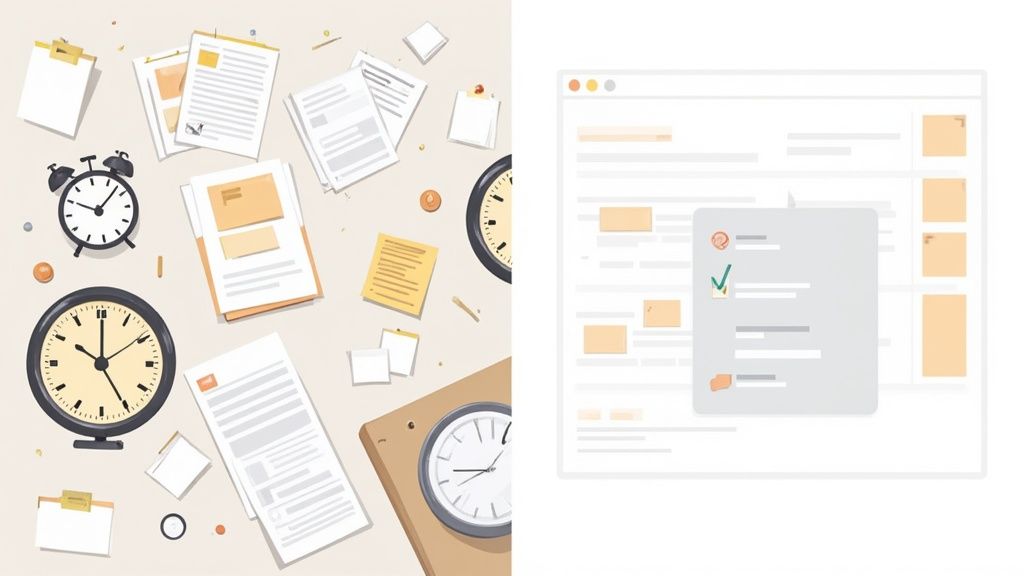
We're going to move beyond the daily scramble and show you how a dedicated platform can manage the entire grant lifecycle. Instead of digging through overflowing inboxes or trying to decipher cryptic spreadsheet notes, these tools give you a clear, strategic roadmap for everything from finding prospects to submitting the final report. This shift isn't just about getting organized; it's about boosting your efficiency and securing more funding.
And it’s not just a niche trend. The global market for nonprofit grant management software was valued at around USD 2.7 billion and is expected to grow by about 10% each year for the next decade. You can find more details on this growth at polarismarketresearch.com. This boom shows a clear move away from old-school, manual methods toward smarter, cloud-based software.
Why This Shift Matters for Your Mission
Bringing in a dedicated software solution is about so much more than just tidying up your workflow. It's about winning back precious time—time you can pour directly into the work that actually drives your mission forward. It’s like switching from a paper map to a GPS. Sure, both can get you where you’re going, but one is faster, more accurate, and gives you real-time information to avoid roadblocks.
With the right system in place, your team can finally:
- Stop Doing the Same Things Over and Over: Automate deadline reminders, data entry, and even parts of report generation.
- Actually Work Together: Create a single, reliable hub for all grant documents, communications, and to-do lists. No more "who has the latest version?" emails.
- Make Smarter Decisions: Get a clear picture of your application success rates, see which funders are a good fit, and stay ahead of upcoming opportunities.
This guide is designed to give you practical advice to help you understand what this software does, how to choose the right one, and how to get it up and running smoothly. Our goal is to make your grant-seeking process a powerful asset, not a constant source of stress.
We’ll break down how these tools work, what features are must-haves, and how to successfully integrate one into your team's daily routine. Before we dive in, getting a handle on the fundamentals is always a good idea, which is why we put together a separate guide covering grant management best practices for you to check out.
What Exactly Is Grant Writing Software?
Let's get straight to it. Nonprofit grant writing software isn't just a fancy word processor. Think of it as the central nervous system for your entire grant-seeking operation. It's the dedicated hub that brings strategy, organization, and sanity to what can often feel like a chaotic, high-stakes process.
It takes all the moving parts—the scattered spreadsheets, the endless email threads, the multiple versions of a proposal saved on different desktops—and pulls them into one structured, manageable workflow. This single source of truth is where your team finds funder details, tracks looming deadlines, works together on the narrative, and keeps an eye on reporting requirements.
The Difference Between Grant Writing and Grant Management
It’s helpful to understand a key distinction here, even though the lines are blurring fast. In the past, you'd often find two different types of tools for two different stages of the grant cycle.
- Grant Writing Tools: These focused purely on the "pre-award" phase. Their main job was to help you build and submit a winning application. Think AI assistants for drafting proposal sections, libraries of templates, and tools to help you build out a project budget.
- Grant Management Platforms: These kicked in after you won the money. They were all about "post-award" compliance—tracking how you spent the funds, managing reporting schedules, and monitoring program outcomes to keep the funder happy.
Today, the best platforms have merged these two functions into a single, cohesive system. This is a game-changer. A unified platform allows you to manage the entire journey, from identifying a potential funder to submitting your final impact report, all in one place.
The real magic happens when you connect every step of the grant lifecycle. The budget you build for an application can automatically set up your post-award financial tracking. The outcomes you log in a final report become powerful data points for your next proposal. It creates a continuous, powerful feedback loop.
How This Software Actually Changes Your Day-to-Day
Ever tried to build a house with a team of carpenters, electricians, and plumbers who refuse to speak to one another? That’s what grant seeking often feels like without a central system. The grant writer is crafting the story over here, the finance team is crunching numbers over there, and a program manager is digging up impact data somewhere else. It’s a recipe for version-control nightmares, missed deadlines, and inconsistent proposals.
Grant writing software acts as the general contractor for your fundraising. It creates that central hub where every document is stored, every task is assigned, and every deadline is visible to the whole team. This organized approach directly solves some of the most frustrating and common headaches in the grant world.
The table below breaks down the core functions you'll find in modern platforms and how they directly impact your work.
Core Functions of Modern Grant Management Platforms
By moving away from a frantic, document-shuffling routine to a proactive, system-driven strategy, nonprofits can do so much more than just get organized. They build the capacity to apply for and win more grants, period. The software handles the administrative grunt work, freeing up your team to focus on what they do best: building relationships with funders and telling your organization’s powerful story.
This system is a huge advantage, especially for organizations just getting their grant program off the ground. If your team is new to this, getting the foundation right is critical. For a deeper look at those fundamentals, our guide on grant writing for beginners provides essential insights that will make any software you choose even more powerful.
Must-Have Features for Your Nonprofit Software
Picking the right grant writing software is a lot like putting together the perfect toolkit for a big project. You wouldn't just grab a random handful of tools; you need specific, high-quality instruments designed for the job. Instead of just ticking boxes on a feature list, it's crucial to understand why each feature matters and what real-world problem it solves.
This is all about identifying the absolute non-negotiables—the features that turn a simple database into a strategic partner in your fundraising efforts. Let's dig into the core functions that will help you overcome the daily hurdles standing between your team and the funding you need.
This visual shows how a central software platform can bring together the distinct roles of researcher, project manager, and scheduler into one cohesive system.
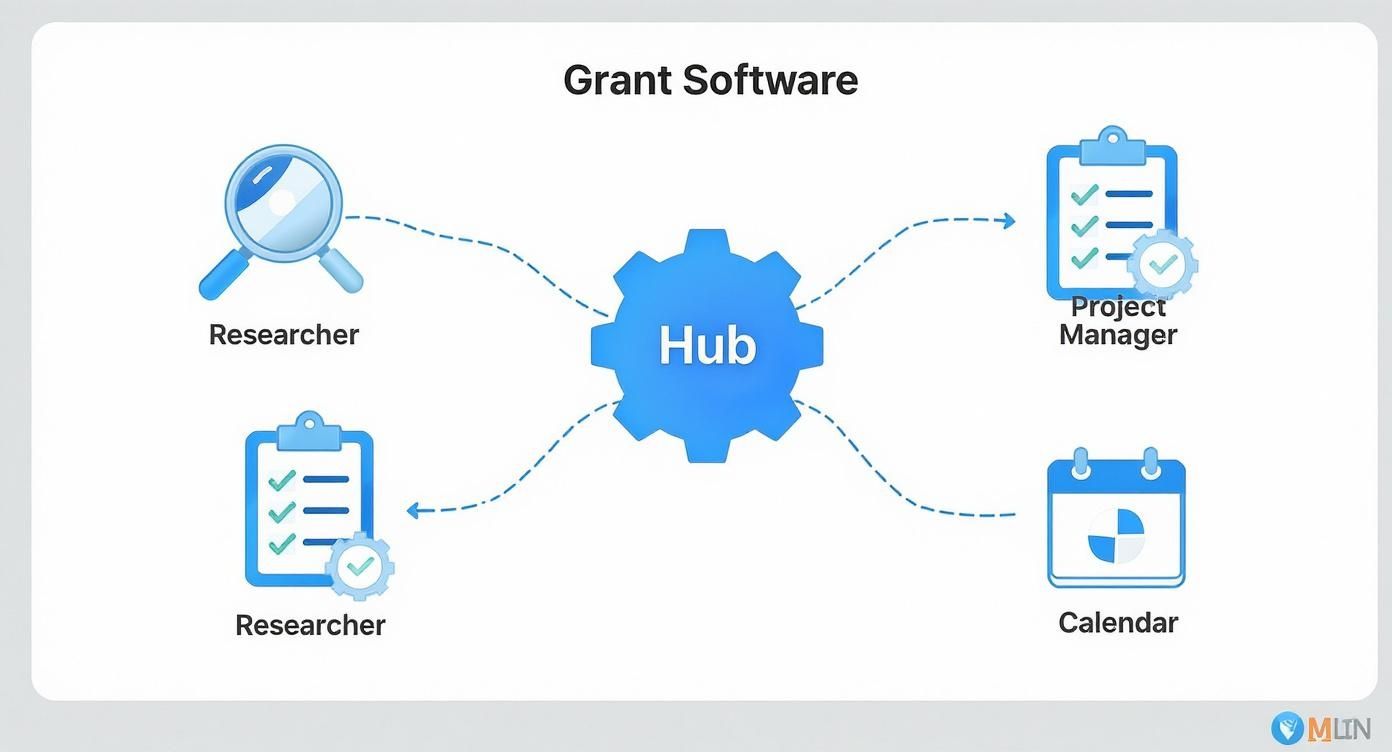
As the diagram illustrates, the best software acts as an integrated command center, making sure every part of the grant process is connected and informed by the others.
A Centralized Funder and Prospect Database
Think of an integrated funder database as your strategic headquarters, not just a digital address book. We’ve all been there—spending countless hours manually searching for grants, which often feels like looking for a needle in a haystack. A built-in, searchable database changes everything.
With this feature, your team can:
- Filter Opportunities Instantly: Zero in on funders by their location, area of focus, typical grant size, or specific keywords.
- Track Relationships: Maintain a detailed history of every touchpoint with a funder, from the first email to the final report.
- Store Critical Documents: Attach funder guidelines, past proposals, and email threads directly to a funder’s profile.
Having all this information in one spot can save you dozens of prospecting hours every month. Even better, it helps you identify funders who are truly aligned with your mission, which seriously boosts your chances of getting that "yes."
Robust Task Management and Collaboration
Let's face it, grant writing is a team sport. It pulls in writers, program managers, the finance department, and leadership, with everyone contributing essential pieces of the puzzle. Without a system to keep it all straight, deadlines get missed and important tasks fall through the cracks.
Imagine a platform that automatically nudges three different people when a report is due in a week. That’s the kind of power we're talking about with integrated task management.
The real goal here is to get rid of the endless "who's doing what?" emails and the chaos of managing deadlines on a spreadsheet. A great platform gives you a single source of truth for every deadline, task, and responsibility.
Key collaboration tools include shared calendars, task assignments with clear due dates, and the ability to comment internally on proposals. This structure keeps things moving smoothly and prevents those frustrating bottlenecks.
Proposal Templates and Document Libraries
Every grant writer knows the pain of starting from a blank page. You find yourself digging through old folders for that perfectly worded organizational history paragraph you wrote six months ago, or trying to track down the latest version of your boilerplate budget. A document library puts an end to that for good.
This feature is your go-to repository for all your reusable content. You can store and instantly access standard narrative sections, staff bios, financial documents, and letters of support. When you need that info for a new application, you can pull it in seconds.
Pair this with proposal templates, and you’ve got a real powerhouse. You can set up pre-built outlines for different kinds of grants—like federal, foundation, or corporate—that automatically pull in your standard content. This doesn't just speed up the writing process; it ensures your submissions are consistent and accurate every single time.
The Rise of Intelligent Automation
Beyond these core features, many platforms are getting smarter by incorporating new technology. We’re seeing more software embed artificial intelligence (AI) and machine learning (ML) to provide an extra layer of assistance. Leading vendors like Salesforce, Blackbaud, and Fluxx are at the forefront, creating AI-powered tools that help automate eligibility screening, improve grant matching, and even offer predictive insights. You can learn more about how vendors are innovating with AI at marketresearchfuture.com.
For your team, this means the software can do more than just hold information—it can help you make better strategic decisions. It might flag a new grant opportunity that’s a perfect fit for your latest program or analyze your past successes to suggest which funders you should focus on next.
Ultimately, the must-have features in your nonprofit grant writing software are the ones that save time, boost collaboration, and give you strategic insights. By focusing on these core capabilities, you’ll find a tool that doesn’t just organize your work—it amplifies your impact.
How to Choose the Right Grant Writing Platform
Picking the right grant writing software can feel like a huge decision, but it doesn't have to be overwhelming. If you break the process down into a few key steps, you can find a platform that actually helps your mission instead of just adding another line item to your budget.
This isn't just about buying a tool; it's about finding a strategic partner. The goal is to land on a system that fits your team’s real-world workflow, your budget, and your biggest fundraising goals.
Start With an Internal Needs Assessment
Before you even glance at a single software website, the most important first step is to look inward. A solid understanding of your own organization's reality will be your compass for this entire journey. Jumping into software demos without this foundation is like going car shopping without knowing if you need a two-seater or a minivan.
Get started by asking a few practical questions:
- Team Size and Structure: How many people will actually need to use this platform? Are you all in one office, or do you have remote team members?
- Grant Volume: How many grants are you currently juggling in a year? Just as important, are you trying to increase that number?
- Tech Comfort Level: Is your team pretty savvy with new technology, or do you need a system that's incredibly simple and intuitive right out of the box?
- Budgetary Constraints: What’s a realistic monthly or annual budget for this? Don't forget to ask about any one-time setup fees or hidden training costs.
Answering these honestly gives you a clear profile of your ideal solution. This profile will help you immediately weed out options that are too complicated, too pricey, or just not built for the way your team works.
Evaluate Vendors and Shortlist Your Options
Once you've mapped out your internal needs, you can start exploring the market. The objective here is to go from a sea of potential vendors to a tight shortlist of two or three strong contenders. This is where you put on your detective hat.
Don't just take the marketing copy on a vendor's website at face value. You need to dig a little deeper to get a true feel for each platform's real strengths and weaknesses.
A vendor's website will always show you the perfect, sunny-day scenario. Real-world user reviews, on the other hand, tell you how the software holds up on a rainy Tuesday when a critical deadline is just hours away.
Here are a few smart ways to vet your options:
- Read Third-Party Reviews: Check out sites like G2, Capterra, and TrustRadius for unfiltered feedback from other nonprofit folks. Pay special attention to what people say about customer support and day-to-day usability.
- Ask for Peer Recommendations: Tap into your network. Reach out to similar organizations and ask what grant writing platform they use and what they genuinely like—and dislike—about it.
- Confirm Key Integrations: Make a quick list of the tools your team relies on every day, especially your donor CRM. Make sure any software you're considering can talk to your existing systems to avoid creating frustrating data islands.
Doing this homework upfront ensures that the platforms you ultimately invite for a demo are already well-qualified to meet your most important needs.
Master the Live Software Demo
The live demo is your single best chance to see the software in action and figure out if it will truly work for your team. This is not the time to sit back and watch a slideshow. Come armed with a list of specific questions and real-life scenarios you want to see played out.
Think of it like a test drive. You want to see how the car handles your daily commute, not just how fast it can go on an empty track. A great way to take control is by framing your questions around your actual work.
For instance, instead of asking a vague question like, "Do you have reporting features?", try asking this instead:
- "Can you walk me through the exact steps to pull a report of all grant applications we submitted to community foundations in the last quarter?"
- "Show me how your platform would handle the complex, multi-stage reporting required for a federal grant."
- "What does your customer support and onboarding look like for the first 90 days? Who is our point of contact?"
- "How would three of our team members collaborate on a single proposal narrative at the same time without overwriting each other's work?"
These kinds of practical, "show-me-how" questions push the demo beyond a generic sales pitch and into a genuine test of the tool's capabilities. This is how you discover whether the nonprofit grant writing software will solve your problems or just create new ones.
To help you stay organized during this process, use a checklist to compare your top contenders side-by-side.
Software Evaluation Checklist for Nonprofits
By following a structured evaluation process and asking the tough questions, you give your organization the power to make a confident, well-informed choice. The right platform will pay for itself many times over in saved time, reduced stress, and ultimately, more funding for your mission.
Getting Your New Software Up and Running for Maximum Impact
You’ve done the hard work of choosing the right nonprofit grant writing software. That's a huge step, but the real journey starts now. A powerful platform is just a tool; its true value comes from how well your team actually uses it. A thoughtful rollout is what turns a new subscription into an asset you can't imagine living without.
This process should start well before anyone gets a login. Think about it: moving into a new house is much easier when you've decluttered first. The same goes for your data. A messy migration can cause months of headaches. Before you move a single file, take the time to clean up your existing grant data. Purge those duplicate funder records and archive old, irrelevant application files.
This initial cleanup gives you a clean slate, paving the way for accurate reporting and a more organized workflow right from the start. Trust me, it’s a foundational step that pays off big time down the road.
Building a Foundation for Success
Great adoption doesn't just happen—it’s driven by people and a clear process. One of the best things you can do is appoint one or two internal software champions. These are the folks on your team who are genuinely excited about the new tool. Let them learn it inside and out so they can become the go-to resource for their colleagues.
Your champions are the bridge between your team and the software vendor. They're the ones who can translate technical jargon into practical, "here's-how-this-helps-us" solutions.
Alongside your champions, you need clear, documented workflows. Don't leave it up to guesswork. You need to map out exactly how your team will use the software for the big three grant-seeking activities:
- Prospecting: What are the exact steps for finding, vetting, and assigning new funding opportunities within the platform?
- Application Development: How will you kick off a new proposal? Who gets assigned which tasks? What does the collaborative writing and review process look like?
- Reporting: How will program managers and the finance team track grant spending and outcomes to keep funders happy?
A Phased Rollout Plan That Actually Works
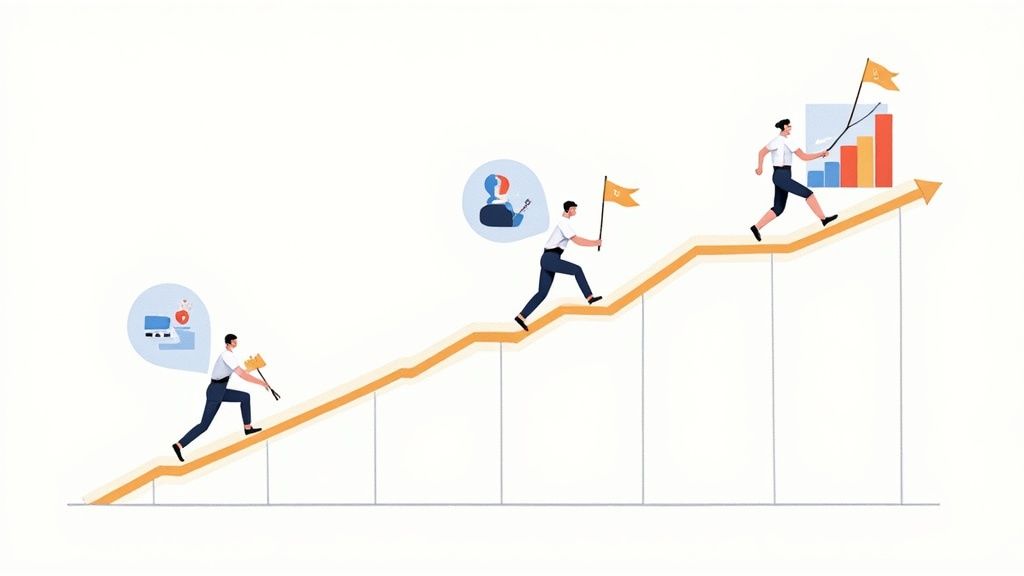
Trying to launch every single feature at once is a classic mistake. It's the fastest way to overwhelm your team. A much better approach is to think of the implementation in three distinct phases. I call it the "crawl, walk, run" method. You introduce new functions gradually, letting your staff build confidence and skill at a manageable pace.
The "crawl, walk, run" model ensures your team gets the fundamentals right before tackling the more complex features.
A phased implementation respects the human learning curve and builds momentum. When you score early wins with the core features, you generate real enthusiasm and buy-in. That makes the transition to more advanced functions a whole lot smoother.
It's no surprise that the North American market is leading the charge in adopting these tools, accounting for 35% of the global revenue for grant software. While on-premise solutions used to be common, flexible cloud-based platforms are now the standard, and they're perfectly suited for this kind of phased approach. You can read the full research on current grant software market trends for more context.
So, what does this phased plan look like in practice?
- Crawl Phase (First 30 Days): Stick to the absolute basics. Train everyone on logging in, finding their way around the dashboard, and using the core funder database. The only goal here is simple familiarization.
- Walk Phase (Days 30-90): Now, introduce the task and deadline management features. Start building out a few real grant applications in the system. Have your team collaborate on a couple of low-stakes proposals to get comfortable with the process.
- Run Phase (After 90 Days): It's time to unleash the power features. This is when you dive into custom reporting and analytics dashboards to get a bird's-eye view of your grant pipeline and success rates.
By taking this deliberate, step-by-step approach, you ensure your new software becomes a natural part of your team's daily routine, driving the efficiency and impact you were looking for from day one.
The Future of Grant Writing With AI Integration
The world of nonprofit grant writing software is heading for another big change, and this time, it's all about Artificial Intelligence. AI is quickly growing past its role as a simple grammar checker and is becoming a real partner in the grant writing process. This isn’t a far-off dream; it's the next logical step in making grant seeking smarter and more effective.
Think of an AI that helps you build your proposals from scratch, not just polish them. These new tools can draft initial narratives, boil down complex research into a powerful needs statement, and even tailor your emails to specific funders. This frees up grant professionals from the grind of routine drafting so they can focus on what really matters: strategy.
Predictive Analytics and Strategic Focus
One of the most exciting areas is predictive analytics. Soon, grant writing software will be able to crunch huge amounts of data on past funder behavior to predict your chances of winning a grant. It’s like a weather forecast for your fundraising efforts. The system could look at a foundation’s giving history, average award size, and preferred locations to give your application a probability score.
This would be a game-changer for nonprofits, allowing them to use their limited time and resources with incredible precision. Instead of casting a wide net and hoping for the best, you could focus your team’s energy on the grants you are statistically most likely to win, seriously boosting your return on investment.
The goal here is to augment human expertise, not replace it. Think of AI as your super-powered research assistant and data analyst. It handles the repetitive work, freeing you up to be a better strategist, storyteller, and relationship-builder—the things that truly require a human touch.
The Human Element Is Still King
Even with all these amazing advancements, the human element in grant writing is more important than ever. An AI can generate text, but it can’t fake the genuine passion that comes from being truly connected to a mission. It can analyze data, but it can't build the authentic relationships with program officers that so often tip the scales.
The most successful nonprofits will be the ones that learn how to work with AI as a partner. If you want to explore this partnership further, our guide on using AI for grant writing takes a much deeper look at this evolving relationship.
Ultimately, the future of grant writing software isn’t about replacing skilled professionals. It’s about giving them smarter, more powerful tools to amplify their impact and secure the funding their missions depend on.
Frequently Asked Questions
Thinking about bringing grant writing software into your nonprofit? It’s a big step, and you probably have a few questions. Let’s tackle some of the most common ones we hear from organizations just like yours.
How Much Should We Budget for Grant Writing Software?
There’s no one-size-fits-all price tag here, as costs can vary quite a bit.
For smaller teams or those just dipping their toes in, you can find solid entry-level tools in the $50 to $100 per month range. But if you’re looking for a more powerful platform with massive funder databases, sophisticated reporting, and AI assistance, you should expect to invest several hundred or even over a thousand dollars a month.
A quick tip: don't just look at the monthly subscription fee. Always ask about one-time setup costs, team training fees, and what kind of customer support is included. You want to understand the total cost of ownership, not just the sticker price.
Will This Software Talk to Our Current Donor CRM?
It absolutely should. This is one of the most important features to look for. The best grant writing platforms are designed to connect with the big-name nonprofit CRMs like Salesforce, Blackbaud, and Bloomerang. This creates a smooth, two-way street for your data.
Before you sign on the dotted line, get a firm "yes" that the software integrates with the specific tools your team already relies on. If a direct connection isn't available, ask about their API (Application Programming Interface) options for building a custom bridge.
Getting this right prevents you from creating frustrating data islands and ensures your grant activity is synced up with all your other fundraising efforts.
Is This Software Going to Be a Headache for My Less-Techy Staff?
Most modern platforms are built to be user-friendly, with clean dashboards and simple navigation that non-technical folks can pick up quickly. That said, any new system comes with a learning curve.
The real difference-maker is the quality of the vendor's support. Look for a company that offers a great onboarding process, live training webinars, and a deep library of how-to videos. A free trial or a live demo is the best way to see the software in action and gauge how intuitive it will actually feel for your team.
Can AI Just Write the Whole Grant Proposal for Me?
Not quite—and honestly, that's a good thing. Think of the AI in today's nonprofit grant writing software as a super-smart assistant, not a replacement for a human grant writer. It's fantastic at generating first drafts, summarizing your program data into tidy paragraphs, and helping you polish your language.
What it can't do is provide the heart and soul of the proposal. Your team's strategic vision, passionate storytelling, and genuine connection to your community are what truly win over funders. The human touch is still your most valuable asset.
Ready to streamline your grant process and win more funding? Fundsprout is the AI-powered platform designed to help you find perfect-fit funders, craft winning proposals, and manage your grants with ease. See how our tools can amplify your mission at https://www.fundsprout.ai.
Try 14 days free
Get started with Fundsprout so you can focus on what really matters.