RFP analyzer for grants: Boost Your Nonprofit Proposals and Win More Funding
Discover how the RFP analyzer for grants helps nonprofits save time, improve proposals, and win more funding with smarter grant writing.

Abdifatah Ali
Co-Founder
Think of an RFP analyzer for grants as your AI-powered research assistant, one that’s built to tackle the most tedious part of grant seeking. This smart tool takes dense, jargon-filled grant opportunity documents (RFPs) and instantly transforms them into clear, structured, and actionable outlines. For busy nonprofits, this technology is a game-changer, saving precious time, ensuring you don’t miss a single requirement, and letting you focus on writing a powerful proposal.
Conquering Grant Overload in a Competitive Landscape
If you’re in the nonprofit world, you know the frustrating paradox of grant funding. There are countless opportunities out there, but you have very limited time and resources to chase them. It often feels like you’re panning for gold in a raging river, sifting through mountains of complex RFPs just to find a handful of real possibilities.
This manual grind isn't just time-consuming; it's a major roadblock to your strategy. Every hour your team spends decoding eligibility rules and formatting guidelines is an hour they can't spend building relationships with funders, perfecting your program’s story, or gathering impact data. Trying to manage all those grant requirements by hand can feel just as overwhelming as navigating complex regulations without modern compliance risk management software.
From Reactive Paperwork to Proactive Strategy
This is where an RFP analyzer completely changes the game. Instead of your team getting bogged down in the details, the AI does the heavy lifting. It works like a tireless specialist, instantly pulling out the critical deadlines, flagging eligibility criteria, and organizing everything into a simple, easy-to-follow roadmap.
This shift moves grant seeking from a reactive chore to a proactive, strategic part of your fundraising. It empowers your organization to:
- Quickly Vet Opportunities: You can figure out if a grant is a good fit in minutes, not hours, because all the key requirements are laid out for you.
- Eliminate Human Error: It drastically lowers the risk of missing a critical detail—like a deadline, a budget limit, or a required attachment—that could get your application thrown out immediately.
- Focus on Impact: Most importantly, it frees up your team to focus on what they do best: telling your organization's powerful story and proving its impact.
An RFP analyzer doesn’t just help you write proposals faster. It helps you choose the right proposals to write in the first place, ensuring your team’s hard work leads to a higher win rate.
Navigating an Exploding Grant Landscape
The need for this kind of efficiency is only getting more critical. Consider this: the number of grant-making institutions worldwide has skyrocketed from 47,000 to over 84,000 in just the last 15 years. That’s a massive 79% increase, creating a vast ocean of potential funding. But for a small team, sifting through it all manually is a nightmare. This is exactly why platforms like Fundsprout incorporate an RFP analyzer. The tool scans countless sources, ranks them based on your nonprofit's specific profile, and then automatically generates structured outlines, turning a pile of RFPs into a clear, actionable pipeline. You can learn more about the growth of grant-making institutions from 360matchpro.com. It's all about helping you conquer the information overload and focus on winning the funding your mission truly deserves.
How an RFP Analyzer Actually Works
So, what’s really going on inside an RFP analyzer for grants? Think of it less like a simple search tool and more like an expert grant consultant powered by AI. It doesn't just skim for keywords; it actually reads and understands the entire grant document, figuring out the funder's real intent behind all that dense text.
The whole thing boils down to a straightforward, three-step process that takes the chaos of a new grant opportunity and turns it into a clear plan of attack.
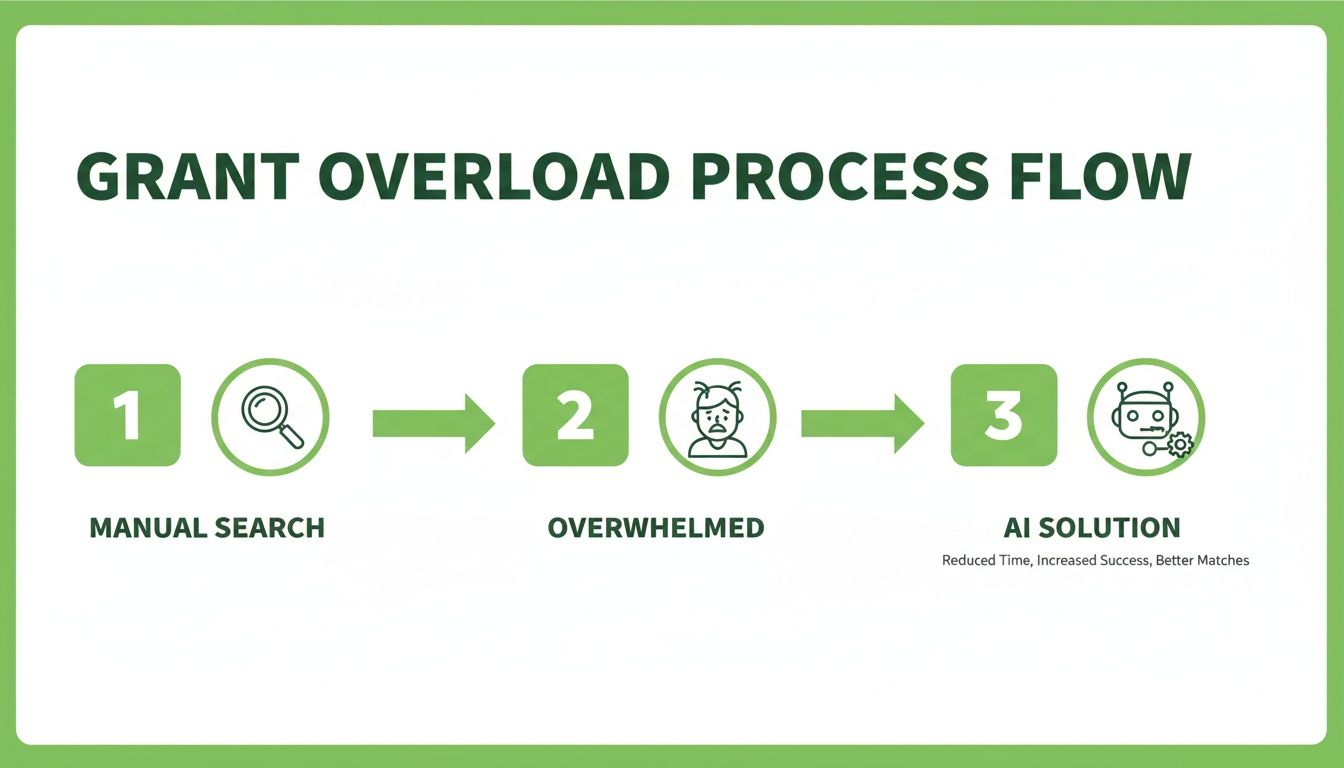
This visual really gets to the heart of it: moving from that all-too-familiar feeling of being buried in paperwork to having a clear, AI-driven path forward. That’s the core promise.
Step 1: Feeding the Machine (Ingestion)
It all starts with ingestion. You simply upload the RFP document into the system—whether it’s a tidy Word doc, a massive PDF, or even a scanned image. The AI's first task is to "read" every single word, from the cover page to the last appendix.
Using smart technology like Optical Character Recognition (OCR) and Natural Language Processing (NLP), the software essentially digitizes the document and preps it for analysis. It's the digital equivalent of getting a fresh pot of coffee ready before diving into a big project.
Step 2: Finding the Needles in the Haystack (Deconstruction)
This is where the real work happens. In the deconstruction phase, the AI acts like a seasoned grant writer with a box of highlighters, methodically pulling the document apart. But it’s much smarter than a simple keyword search.
Because the analyzer has been trained on thousands of real-world grant proposals, it recognizes the unique language and patterns found in RFPs. It knows how to spot the critical details and categorize them correctly.
It intelligently isolates and tags all the crucial elements, like:
- Key Deadlines: Submission dates, letters of intent, and reporting schedules.
- Eligibility Rules: Who can apply, where they must be located, and who they must serve.
- Budgetary Constraints: Funding ceilings, indirect cost policies, and unallowable expenses.
- Narrative Questions: The specific prompts you must answer to be considered.
- Formatting Demands: Page limits, font sizes, and all the required attachments.
This isn't just about finding dates and dollar amounts. It’s about understanding what each piece of information means for your proposal.
Step 3: Creating Your Roadmap (Structuring)
Finally, the tool performs the structuring step. It takes all that categorized information and assembles it into a logical, actionable format. This isn't just a jumbled list; it’s a strategic blueprint for writing a winning proposal.
The analyzer generates a comprehensive compliance checklist and a ready-made proposal outline. Each narrative question gets its own section, every required document is listed, and all the bureaucratic rules are laid out so you can’t miss them.
This structured outline becomes the backbone of your writing process. Tools like Fundsprout take it a step further by integrating this outline directly with AI writing assistants, giving you a seamless path from analysis to a solid first draft. To see how this works in practice, you can learn more about using AI for grant writing.
In the end, this three-step process turns a daunting 100-page RFP into a clear, manageable project plan in a matter of minutes. It demystifies what funders want and gives your team the confidence to respond quickly and accurately.
Manual RFP Review vs AI-Powered RFP Analyzer
To truly appreciate the difference, let's look at a side-by-side comparison. The table below highlights just how much changes when you switch from the old way of doing things to an AI-powered approach.
As you can see, the shift is dramatic. It’s not just about saving time; it's about fundamentally improving the quality and strategic focus of your entire grant application process.
Why Automating RFP Analysis is a Game-Changer
Knowing how an RFP analyzer works is one thing, but truly getting its strategic impact is another. Once you look past the technical process, you start to see how automating this first step can completely reshape your grant-seeking efforts. It isn't just about moving faster—it's about fundamentally boosting your team's capacity, accuracy, and strategic focus.
The most obvious win is the sheer amount of time you get back. Grant writing is a notoriously demanding slog. For many nonprofits, the reality is that 61% of grant seekers rely on just one or two people to manage the entire process. That’s an overwhelming burden, especially when a single foundation RFP can take 20 hours and a federal one can easily top 100. It’s no surprise that 35.1% of nonprofits point to limited staff capacity as a major roadblock to securing the funding they need. Check out more of these eye-opening grant funding trends on grantwritingandfunding.com.
An RFP analyzer for grants reclaims those lost hours, turning a manual, mind-numbing task into a quick, automated one.
From Administrative Burden to Strategic Advantage
By automating that initial deep-dive, you free your team from the low-value administrative grind. Instead of spending hours poring over dense documents and building checklists by hand, they can put their energy where it actually counts.
This newfound time can be funneled directly into high-impact activities:
- Deeper Program Design: Really spending time refining the project narrative so it perfectly aligns with what the funder cares about.
- Stronger Funder Relationships: Getting on the phone with program officers to build genuine connections before you even submit.
- Better Data Collection: Hunting down the compelling statistics and stories that truly prove your organization’s impact.
- Pursuing More Opportunities: Growing your pipeline and applying for more grants without pushing your team to the brink of burnout.
It's a profound shift. The analyzer takes care of the "what"—what are the requirements?—so your team can concentrate on the "why"—why is our work so essential and deserving of this grant?
Boosting Proposal Quality and Ensuring Compliance
Beyond just saving time, automation massively improves the quality and compliance of your proposals. Let's be honest, human error is a silent grant killer. A missed deadline, a forgotten attachment, or a misread budget limit can get your application tossed out before a single word of your powerful narrative is even read.
Think of an RFP analyzer for grants as your digital compliance officer. It meticulously flags every single rule and requirement, ensuring nothing falls through the cracks. The result is a cleaner, more professional submission every time.
What’s more, by instantly breaking down a funder’s requirements, the tool helps your team get inside their head. You can see which sections carry the most weight and tailor your story to speak directly to the funder's mission. That kind of alignment is what separates a winning proposal from the rest of the pile and can significantly boost your win rate. To really appreciate how this works, it helps to understand the core ideas behind workflow automation.
Enhancing Strategic Decision Making
Maybe the most powerful benefit of all is making smarter, faster "go/no-go" decisions. How many times has your team sunk days into a proposal, only to stumble upon a hidden eligibility rule that disqualifies you? It's a soul-crushing experience.
An analyzer gives you a clear, concise summary of all requirements in minutes. This lets you vet opportunities at lightning speed, quickly weeding out the poor fits. Your team’s limited, precious resources are only invested in grants you have a real shot at winning. This kind of strategic filtering is what builds a more sustainable and successful fundraising operation, where every bit of effort is pointed toward the most promising opportunities.
Putting Your RFP Analyzer into Action
It's one thing to talk about what an RFP analyzer for grants can do, but it’s another thing entirely to see it work its magic. This isn't about adding yet another piece of software to your already crowded toolkit. It’s about bringing a smart assistant into your grant writing process to make every step faster, clearer, and far more collaborative.
Let’s walk through what this looks like in the real world. Imagine your team finds a fantastic grant opportunity, but the RFP is a monstrous, 75-page document. The deadline is looming, and you have to make a quick "go/no-go" call. If it's a "go," you need to get moving immediately without letting a single detail slip through the cracks.
Step 1: From Document to Digital Blueprint
The first move is the easiest. You simply upload the RFP—whether it's a PDF, a Word file, or even just a link to the funder's website—into a platform like Fundsprout. In less time than it takes to brew a pot of coffee, the analyzer reads and breaks down the entire document.
What you get back isn’t a simple summary. It’s a complete, structured digital blueprint of the entire application. The AI instantly creates a clean, actionable outline that lays out everything you need:
- A Compliance Checklist: Every last requirement is pulled out and listed, from font size and page limits to mandatory attachments and specific submission portal instructions.
- A Deadline Schedule: All critical dates—the letter of intent, the final submission, Q&A session sign-ups—are extracted and can be pushed directly to your team’s shared calendar.
- Narrative Prompts: Every single question the funder wants you to answer is isolated and turned into its own distinct section, ready for your team to tackle.
Right off the bat, this step saves you hours of painstaking reading, highlighting, and manual checklist creation. Your team can see the full picture instantly and spot any potential red flags before you've invested too much time.
Step 2: Assembling the Team and Assigning Tasks
With that clean blueprint in hand, teamwork becomes incredibly straightforward. Instead of passing a messy, highlighted document back and forth via email, you can now use the structured outline as your project management command center.
This is where you bring everyone’s expertise into play. Inside a platform like Fundsprout, you can assign each section of the outline to the right person. The program manager gets the "Project Activities" section, while your finance lead is assigned the budget narrative. Everyone knows exactly what their piece of the puzzle is, and you get a bird's-eye view of the entire project's status at all times.
Here’s a snapshot of what that looks like, transforming a static RFP into a living, breathing project plan.
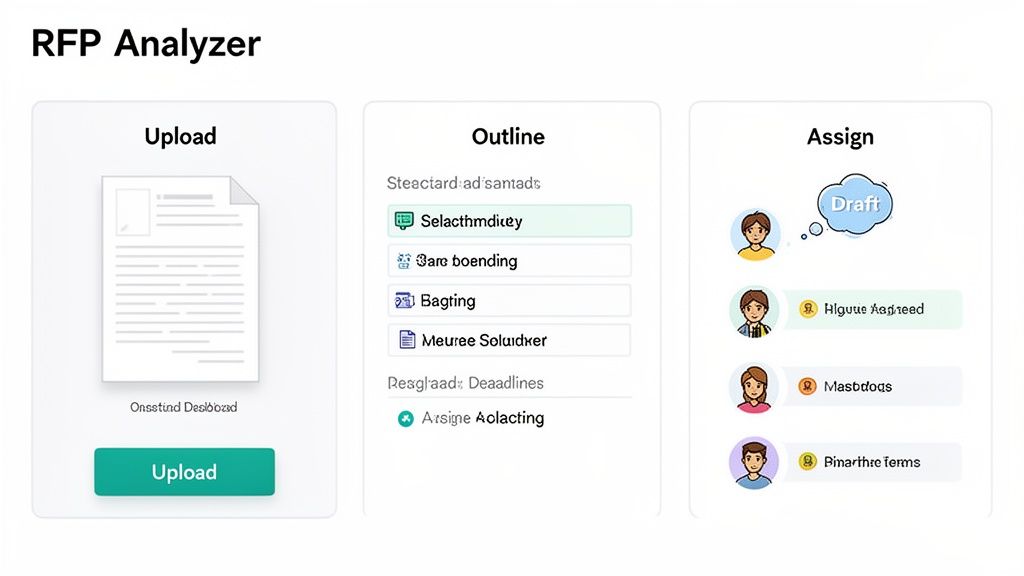
This visual shows the natural flow from a raw document to a collaborative workspace, where every single requirement is tracked and delegated.
Step 3: Kickstarting the Writing Process
This is where things get really interesting. That structured outline now doubles as a perfect set of instructions for an AI writing assistant. Since the RFP analyzer for grants has already neatly separated each question, you can prompt the AI to draft a response for every single one.
The key here is that the AI isn't just writing generic content from scratch. It taps into your organization's own library of information—your past proposals, impact reports, and program data—to generate drafts that sound like you.
For the "Organizational History" section, for instance, the AI can pull from your approved boilerplate language. When it's time to write the "Statement of Need," it can synthesize the latest community data you've uploaded. The result is a strong first draft that's already 80% of the way there, freeing up your grant writers to do what they do best: refine, edit, and add the human insight that truly makes a proposal stand out. This approach is a central part of a winning strategy, and you can find more tips for building compelling narratives in our guide on how to respond to an RFP.
By making an analyzer part of your workflow, you build a system that turns an overwhelming document into a collaborative plan, and then into a nearly complete draft with incredible speed. This means your team can finally spend less time on administrative grunt work and more time on the strategic storytelling that wins grants.
Choosing the Right RFP Analyzer for Your Nonprofit
Picking the right RFP analyzer for grants is a big decision, one that can seriously affect your fundraising efficiency and, ultimately, your success. Let's be honest, not all platforms are created equal. The best tool for your nonprofit really depends on your specific needs, the size of your team, and the kind of grants you typically go after. It's about looking past the shiny features and focusing on the core functions that will genuinely save you time and make your proposals stronger.
Think of it like hiring a specialized research assistant. You wouldn't bring on a generalist to parse complex scientific data; you'd find an expert in that specific field. It’s the same idea here. You need an analyzer that speaks the language of grant funding—one that understands the unique structures and terminology—not just a tool built for generic business proposals.
Key Evaluation Criteria for Your Analyzer
When you start comparing tools, it's easy to get lost in the details. To cut through the noise, concentrate on a few essential criteria that separate a helpful gadget from a true fundraising partner. A systematic approach ensures the platform you pick will actually fit into your workflow and give you a real return on your investment.
First and foremost, check its accuracy and intelligence. A top-tier analyzer should:
- Get the Nuances of Grant-Specific Language: The tool must be trained on actual grant documents. This is how it learns to correctly spot crucial details like eligibility rules, budget restrictions, and the specific narrative prompts from federal, state, and foundation funders.
- Handle Any Document Format You Throw at It: Your team needs a tool that can effortlessly process everything from a clean Word doc to a messy, multi-column PDF or even a scanned file without dropping critical information.
- Connect Seamlessly with Writing Tools: The analyzer’s output—that beautiful, structured outline—should be the perfect launchpad for an AI writing assistant, helping you draft proposals in your organization's unique voice.
That last point is a game-changer for creating a cohesive system. If you're aiming for an end-to-end solution, it's worth checking out our guide on the best nonprofit grant management software, as many of these platforms bundle these features together.
Ease of Use and Team Collaboration
An analyzer is only as good as its adoption rate. If it has a complicated interface or a steep learning curve, your team will avoid it, creating more friction than it solves. Look for a platform with an intuitive design. The goal is for anyone—from program managers to the executive director—to be able to upload an RFP and get a clear, actionable outline in minutes.
The goal is empowerment, not added complexity. The right tool makes everyone on your team feel more confident and capable of contributing to the grant-seeking process, turning it into a truly collaborative effort.
On top of that, think about how the platform supports teamwork. Can you assign different sections of the generated outline to specific people? Is there a central dashboard to track progress and keep everyone on the same page? These features are absolutely vital for keeping complex grant applications moving forward on schedule.
Making an Informed Decision in a Competitive Climate
The pressure on nonprofits to secure funding has never been more intense. We're in a landscape where 66% of nonprofits are worried about funding drops and 93% are actively looking for new funders. Meanwhile, the demand for services has spiked by 25%. There is simply no time to waste on grant opportunities that are a poor fit.
An effective RFP analyzer is your first line of defense, helping you quickly vet new grants so your team only invests effort where the chance of success is highest. This kind of precision is what elevates success rates from the typical 10% average to the 50-60% achieved by professionals who strategically target the right funders. You can read more about these charitable giving trends on candid.org. By choosing a tool that aligns with your mission, workflow, and strategic goals, you’re not just buying software—you’re equipping your nonprofit to thrive.
Common Questions About RFP Analyzers for Grants
Bringing a new piece of technology into your grant writing process can feel like a big leap, especially when your funding hangs in the balance. It’s only natural to have questions about how a tool like an RFP analyzer for grants actually works and where it fits into your day-to-day. Let's dig into some of the most common concerns we hear from nonprofits.
A lot of teams worry that an automated tool will just skim the surface, missing the subtle but critical details that a seasoned grant writer would catch. This is a totally fair point. Grant applications are full of nuanced language and unwritten rules that can make or break a proposal.
Can an RFP Analyzer Really Understand Funder Nuances?
Yes, and this is where modern AI really shines. A sophisticated RFP analyzer for grants, especially one trained on thousands of real grant documents like Fundsprout, goes way beyond simple keyword matching. The AI has learned to spot contextual clues, recognize funder-specific jargon, and even suss out the priorities that are implied but not explicitly stated in the text.
This means the tool can reliably break down complex documents from just about any source, including:
- Federal Agencies: Famous for their dense regulations and rigid formatting rules.
- Private Foundations: Each with its own unique mission, voice, and proposal structure.
- Corporate Funders: Who often want to see a blend of business metrics and philanthropic impact.
At the end of the day, the analyzer makes sure your proposal outline is built around what that specific funder is asking for, not just a one-size-fits-all template.
Will AI Make Our Grant Proposals Sound Robotic?
This is probably the biggest misconception out there. A good RFP analyzer isn’t there to write the final proposal for you. Its main job is to create a structured roadmap—a clear, compliant blueprint that organizes the funder's requirements for your team to follow.
Think of it this way: The analyzer is the architect who draws up the perfect blueprints for a house. Your team—the skilled builders—still brings the passion, expertise, and unique materials to actually build a compelling structure.
And when you do use this blueprint with an AI writing assistant, the system is designed to generate first drafts in your organization’s voice. It pulls from your past successful proposals, program data, and impact reports to make sure the content sounds like you. The tool gives you the structure; your team provides the soul.
Is This Technology Affordable for a Small Nonprofit?
Many platforms were built from the ground up with nonprofit budgets in mind, offering pricing that makes sense. When you’re looking at the cost, the key is to think about the return on investment (ROI). An RFP analyzer can easily save dozens of staff hours on a single grant application.
That time saved translates directly into more capacity, letting your team pursue more funding opportunities without getting burned out. The value of landing just one extra grant almost always outweighs the annual software cost, making it a very smart financial move.
How Difficult Is It to Implement This Tool?
The best platforms are designed to be simple and intuitive, knowing that most nonprofits don't have a dedicated IT department. Getting started is usually a straightforward process that doesn't require any deep technical skills.
Typically, it just involves a quick onboarding where you upload your key documents—like past grants and program one-pagers—to help the AI learn your history and voice. With a user-friendly dashboard, you can be analyzing RFPs and generating outlines almost immediately. The whole point is to take work off your plate, not to add another complicated system to your list.
Ready to transform your grant-seeking process and win more funding? See how the AI-powered tools from Fundsprout can help your nonprofit save time, improve proposal quality, and focus on what matters most—your mission. Explore Fundsprout's features today.
Try 14 days free
Get started with Fundsprout so you can focus on what really matters.