Hall Art Foundation: A Nonprofit's Guide to Engagement
Explore the Hall Art Foundation's mission, exhibition focus, and partnership potential. Our guide helps nonprofits assess fit and find engagement opportunities.


Abdifatah Ali
Co-Founder
You're probably looking at hall art foundation the same way many nonprofit leaders do. You see respected artists, serious exhibition spaces, and a polished public presence. The instinct is immediate: should we cultivate them as a funder, a lender, a collaborator, or leave them off the list entirely?
My advice is blunt. Treat Hall Art Foundation as a collection-driven art institution first, and only secondarily as a nonprofit entity you might approach. If you lead with a standard funding ask, you'll likely waste time. If you lead with curatorial alignment, institutional competence, and a proposal that helps them extend the reach of their collection, you have a real opening.
An Essential Guide for Arts Organizations
Most prospect research on hall art foundation stops at the visitor layer. That's not enough if you're deciding whether to invest staff time in outreach. What matters is the operating logic behind the public face.
This is not the kind of foundation that signals broad, open-call grantmaking. It presents art, stewards a major collection, and operates museum spaces. For an arts nonprofit, that changes everything. You are not evaluating a typical philanthropic prospect. You are evaluating a mission-controlled cultural operator with selective public access, a distinct aesthetic point of view, and founder influence built into the structure.
That means your central question isn't “How do we apply?” It's “Where does our institution intersect with their priorities?”
The right lens
Use these filters before you do any outreach:
- Curatorial fit: Does your program sit naturally in postwar or contemporary art discourse?
- Institutional readiness: Can your team handle museum-standard loans, interpretation, and installation?
- Reputational logic: Would a partnership with your organization strengthen their public-facing mission?
- Governance comfort: Are you comfortable engaging a founder-led nonprofit whose public identity and collection model are closely linked?
Practical rule: If your need is unrestricted operating support, move on. Hall Art Foundation is a poor prospect for that kind of ask.
What successful engagement usually looks like
The strongest path is usually one of these:
- A tightly framed exhibition concept.
- A scholarly loan request tied to a credible institutional program.
- A co-curated or host-venue conversation with clear public benefit.
Weak approaches are easy to spot. Generic sponsorship decks, cold donation requests, and “we admire your work” emails with no curatorial thesis usually go nowhere. Strong approaches show that your team understands what hall art foundation does, what it shows, and why your institution is a sensible partner.
Understanding the Foundation's Mission and Model
Hall Art Foundation's core identity is straightforward. It was founded in 2007 by Andrew Hall and Christine Hall, and it operates museum spaces in Reading, Vermont, and at Kunstmuseum Schloss Derneburg in Germany. Its Vermont campus repurposed a former dairy farm into about 6,000 square feet of gallery space, and the combined Hall and Hall Art Foundation collections comprise over 5,000 works according to this Hall Art Foundation overview.
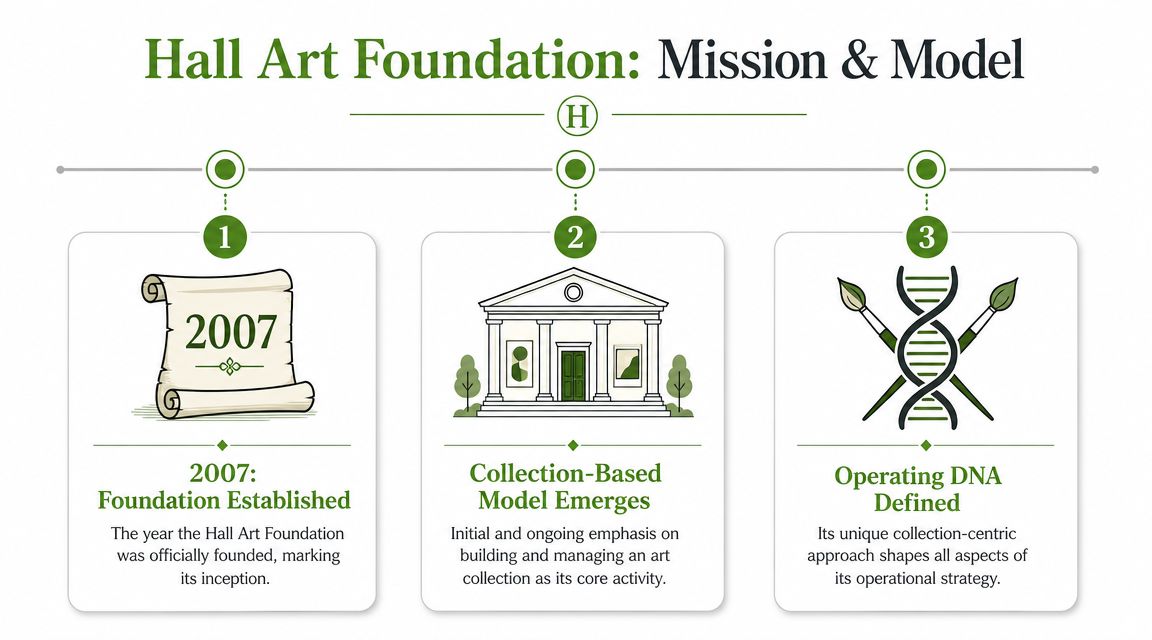
That's the first fact that should shape your strategy. This institution didn't emerge as a broad community foundation or a traditional private grantmaker. It emerged as a collection-based contemporary art organization. Its programmatic center of gravity is the collection itself.
What that means in practice
When a nonprofit is built around a collection, the priorities are different:
- Stewardship comes first. Conservation, storage, cataloging, lending discipline, and curatorial control matter more than volume of outside requests.
- Exhibition is mission delivery. Public benefit is expressed through access to the collection, not necessarily through a long list of grants.
- Founders matter. In founder-led cultural entities, taste, relationships, and long-term collecting interests often shape institutional decisions.
If your team normally researches opportunities through databases of open grant programs, you need a different playbook here. A useful reset is to review how foundation grants for nonprofit organizations typically work, then recognize that hall art foundation sits outside that standard pattern.
The hidden implication for partners
Many nonprofits misread institutions like this because they see “foundation” and assume “funder.” That's a category error.
Hall Art Foundation's primary program is not writing checks. It is managing, exhibiting, and selectively sharing a serious body of art.
That makes it closer to a museum partner, private collection steward, or exhibition collaborator than a conventional source of charitable support. If you approach them like a grant office, you signal that you haven't done the homework. If you approach them like a peer institution with a clearly articulated public-facing project, you're speaking their language.
Here's the confidential-briefing version: their mission is inseparable from their holdings. Your proposal has to help them do something with the collection that they already value. If it doesn't, your odds drop fast.
The Curatorial Focus What They Exhibit
If you only do one piece of research before deciding whether to engage hall art foundation, make it this one. Study the collection until you can describe its intellectual shape without looking at your notes.
The foundation states that the combined collection of the foundation and Andrew and Christine Hall exceeds 5,000 works and includes artists such as Georg Baselitz, Joseph Beuys, Anselm Kiefer, Barbara Kruger, Ed Ruscha, and Andy Warhol in this collection overview from Hall Art Foundation.

That artist list tells you more than most nonprofits realize.
The artistic DNA
This is a collection with strong signals:
| Signal | What it suggests for partners |
|---|---|
| Postwar and contemporary emphasis | Historical or community-art proposals with no contemporary framework may feel off-target |
| Established, critically recognized artists | They are operating in a serious curatorial lane, not a casual or purely local one |
| German and transatlantic depth | Projects involving postwar Europe, conceptual practices, or transnational dialogue may resonate |
| Institutional-caliber names | Your venue and scholarship must match the level of the material |
Baselitz, Beuys, and Kiefer point toward a sustained engagement with postwar German art and the broader intellectual traditions around memory, materiality, politics, and reconstruction. Kruger, Ruscha, and Warhol add a different register: language, image culture, media critique, and American postwar influence.
What this means for your proposal
Don't pitch broad arts education programming and assume the collection can be slotted in later. Start with the artistic logic.
A strong proposal might connect your institution's strengths to themes like:
- Postwar identity and memory
- Contemporary image culture
- Conceptual and politically charged art
- Cross-border art histories
- Sculpture and site-responsive presentation
A weak proposal leans on prestige alone. “You have famous artists and we have gallery walls” is not a compelling partnership rationale.
Your institution does not need to be large. It does need to be intellectually coherent.
That matters more than many development teams think. Hall art foundation's exhibition profile suggests a preference for work that can sustain curatorial argument, not just public enthusiasm. If your organization can frame a project with scholarly clarity, strong interpretation, and appropriate handling capacity, you become more credible very quickly.
Decoding Their Partnership and Exhibition Model
Many nonprofit teams often go astray here. They search for a grant portal, don't find one, and assume the prospect is inactive. Wrong conclusion.
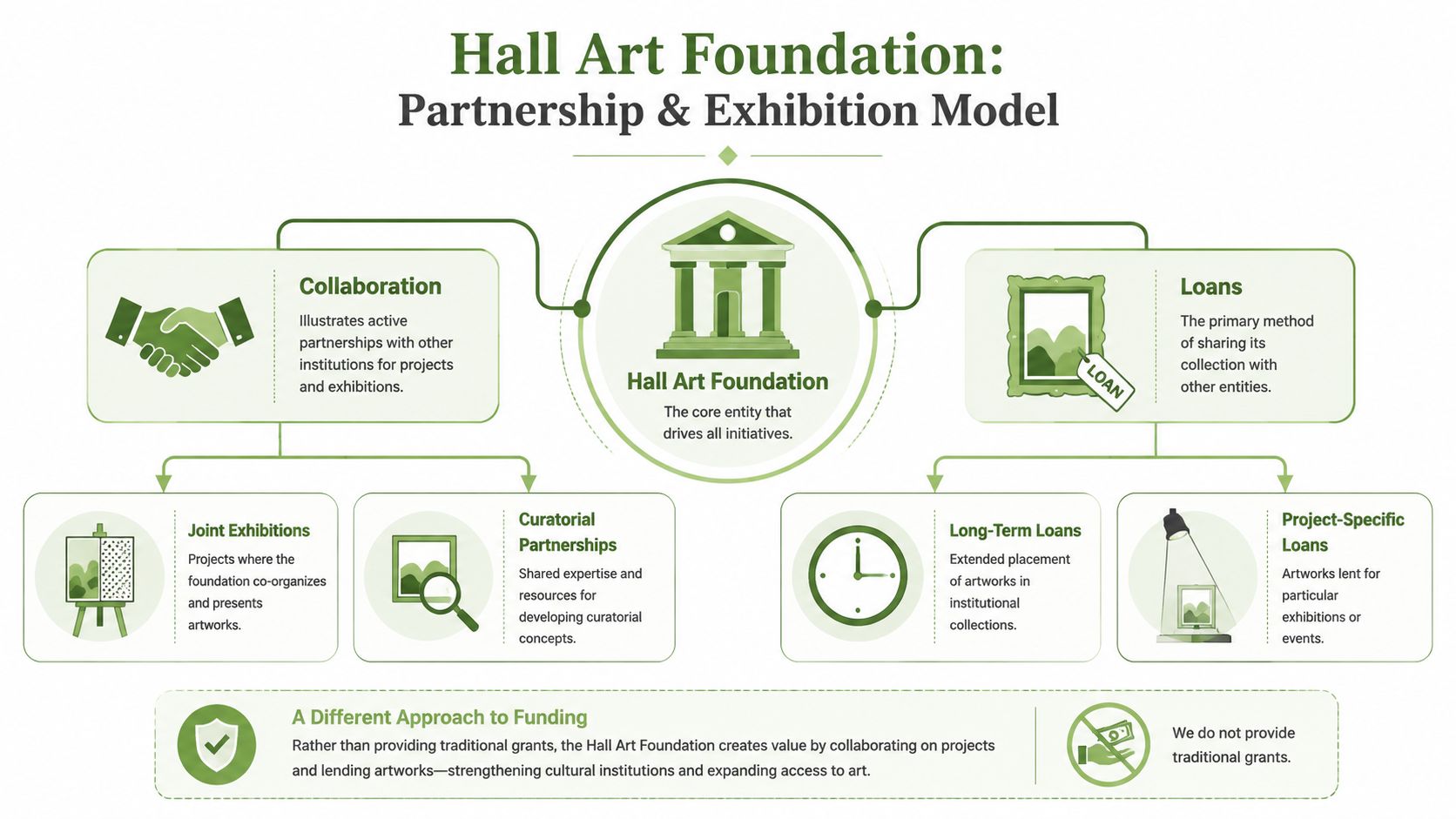
The better reading is this: hall art foundation appears to express partnership through exhibitions, collaborations, and loans rather than through a visible open-application grant program. So stop trying to fit them into your annual foundation appeal cycle.
What partnership probably means here
For most arts nonprofits, realistic opportunities are narrower and more specific than “fund us.” Think in terms of:
- Artwork loans for a tightly defined exhibition
- Co-curation where your institution contributes scholarship, audience, or context
- Host-venue opportunities for a project built from their collection
- Institutional collaboration that extends public access without diluting their curatorial standards
That's a different sales job. Your team isn't pitching need. You're pitching fit, execution, and relevance.
What they need to believe about you
Before a collection-based organization considers collaboration, it needs confidence in a few basics:
- You can care for the work responsibly.
- Your curators know what they're doing.
- Your audience and interpretive plan justify the effort.
- The project will reflect well on the collection and the institution behind it.
If you're building a related public program, your event framing matters too. Many nonprofits know how to ask for money, but not how to package a cultural partnership with enough clarity for outside stakeholders. If your project includes a public-facing component, this guide on how to create winning event sponsorship packages is useful because it sharpens how you present audience value, institutional alignment, and sponsor visibility without turning an exhibition into a generic marketing asset.
Don't send a development-first deck to a curatorial-first organization.
The wrong and right approach
Wrong: “We're seeking support for our annual season and would love to explore whether Hall Art Foundation might sponsor a show.”
Right: “We are developing an exhibition rooted in postwar and contemporary dialogue, with museum-standard handling capacity, a defined interpretive plan, and a venue profile that would extend meaningful public access to work aligned with your collection.”
The first message asks them to become a donor. The second asks them to become a partner. That distinction is the whole game.
How to Research and Approach the Foundation
Most nonprofits think research means reading the About page. That's surface work. For hall art foundation, the more useful question is whether the public nonprofit structure, the collection, and the access model all point to a partnership your institution should want.
Start with the Vermont campus because it reveals a lot about the organization's operating style. The site runs seasonally from May through November, with 2026 admission listed at $15 for adult self-guided visits, $18 for docent-led tours, and $5 for children 12 and under, plus private tours for groups of up to 15 people at $250, according to the Vermont visitor information. That's not a mass-access model. It's controlled access, structured scheduling, and managed visitor experience.
A practical research sequence
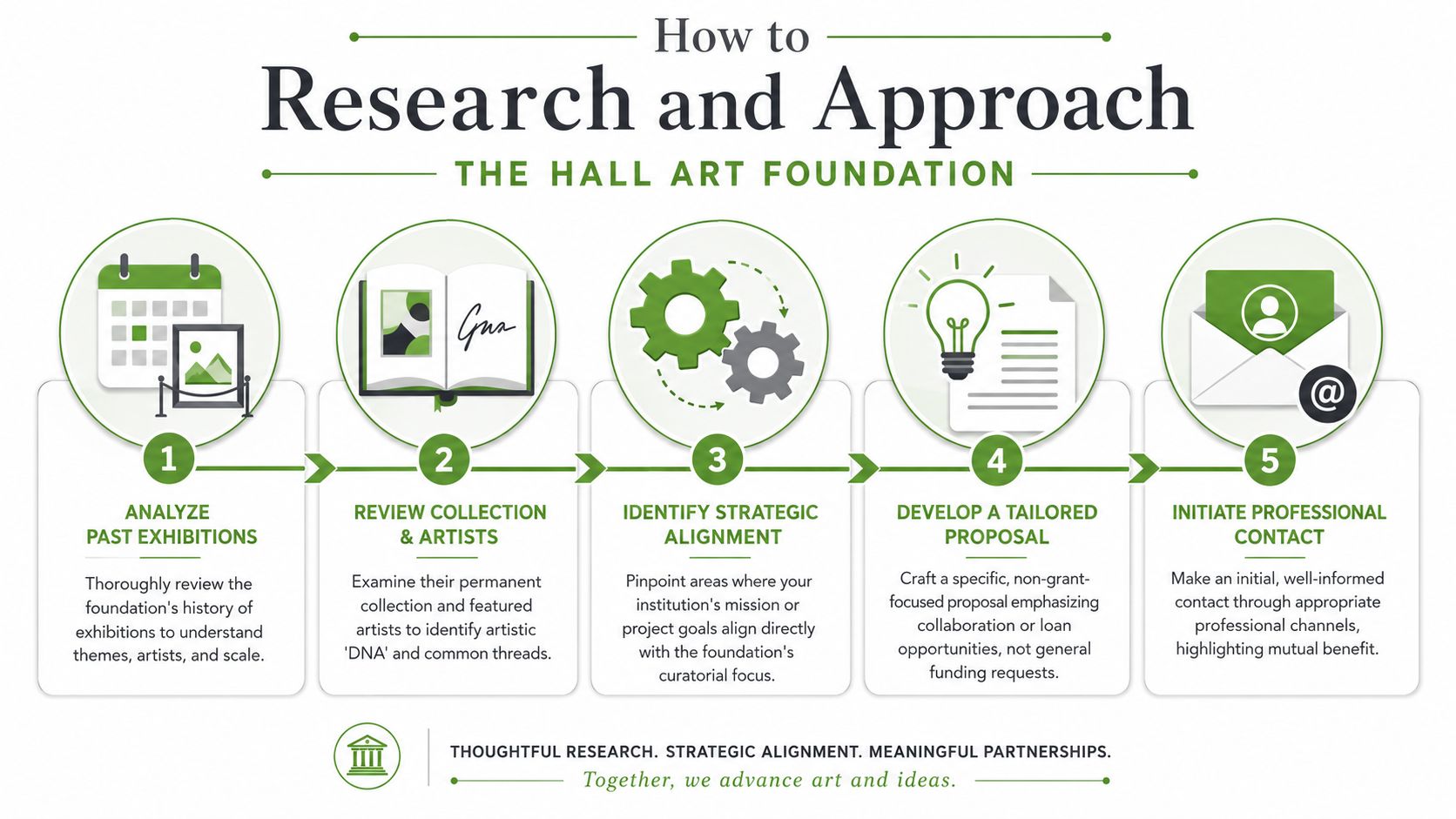
Use a five-part screen before anyone sends an email:
- Review exhibitions carefully. Track recurring artists, recurring themes, and whether they privilege depth over breadth.
- Map the institutional circle. Note which museums, curators, and scholars appear around their programs.
- Test your internal capacity. Confirm climate control, security, registrar support, installation expertise, and insurance readiness.
- Clarify your proposal type. Loan request, co-curation, venue hosting, or scholarly collaboration. Pick one.
- Draft contact language at peer level. No generic praise. No donation ask. Lead with concept, audience, and institutional competence.
A short, disciplined letter of inquiry is often more useful than a glossy packet. If your team needs a framework for tightening that first approach, this primer on a grant letter of intent is useful for structure even though your outreach here should be collaboration-focused rather than grant-focused.
The governance question you shouldn't ignore
Public records identify the organization as a 501(c)(3), and the available information also raises a legitimate strategic question: how do you evaluate public benefit when the institution is founded and led by the primary collectors, and when public transparency around acquisition strategy or long-term access commitments appears limited?
That is not a moral indictment. It is a due diligence issue.
Ask whether your partnership would expand public access in a meaningful way, or simply borrow the credibility of your institution to validate someone else's collection strategy.
That question matters if you're a museum, a university gallery, or a community-facing nonprofit with a strong accountability culture.
For teams that manage multiple prospecting tracks at once, platforms like Fundsprout can help organize eligibility screening, proposal materials, and research workflows across grants and institutional opportunities. That's useful when your development staff and curators are juggling very different outreach types.
A quick visual overview can help your team align before contact:
Visit if you can. Walk the space. Watch how the institution controls audience flow, interpretation, and atmosphere. You'll learn more from that than from a dozen generic prospect notes.
Assessing Your Fit with the Hall Art Foundation
Here's the blunt conclusion. Hall art foundation is worth pursuing only if your organization can meet it on curatorial terms. If you need a general funder, look elsewhere. If you run a serious visual arts program with credible scholarship, loan capacity, and a concept that aligns with the collection, the prospect is far more interesting.
Public records also make one final point impossible to ignore. As a 501(c)(3) founded and led by its primary collectors, the model raises recurring questions about public benefit versus private collection management, and there is limited public transparency on acquisition strategy or long-term public access commitments, as reflected in this public nonprofit profile. That doesn't make the organization unsuitable. It means your board and leadership team should evaluate the partnership with open eyes.
A simple go or no-go test
Pursue the relationship if most of these are true:
- Your exhibitions already operate in postwar or contemporary art discourse
- Your staff can handle institutional loans properly
- Your audience would gain real educational benefit from the collaboration
- Your proposal strengthens their mission of making the collection available
- Your leadership is comfortable with the governance profile
Pass if these sound more like your reality:
- You need unrestricted support
- Your arts programming sits far outside their collection focus
- Your team lacks registrar or collections capacity
- You're hoping prestige will compensate for a weak concept
If your pipeline needs more prospects with a clearer path to funding, your team may be better served by tools that help find winnable grants instead of chasing collection-based institutions that were never likely to behave like grantmakers.
The best approach to hall art foundation is disciplined, selective, and unsentimental. Treat it as a strategic curatorial prospect, not a default fundraising target.
Fundsprout helps nonprofits turn messy prospecting into a ranked funding pipeline. If your team needs a cleaner way to identify relevant grant opportunities, structure proposals, and keep submissions moving, take a look at Fundsprout.
Try 14 days free
Get started with Fundsprout so you can focus on what really matters.