Mastering the Grant Letter of Intent
Write a grant letter of intent that gets noticed. Our guide shares proven strategies, real-world examples, and expert tips to secure your funding.

Abdifatah Ali
Co-Founder
Think of a grant letter of intent (LOI) as your organization’s professional handshake. It's a short, powerful document you send to a funder that sketches out your project and asks for the green light to submit a full-blown grant application. It’s your first and best chance to grab their attention and make them lean in, eager to hear more.
This isn't just about saving yourself from writing a 20-page proposal that’s dead on arrival. It’s a strategic first move.
What Funders Really Look For in an LOI

Before you even type a single word, you have to get inside the funder's head. Why do they even ask for an LOI? It's simple: they're drowning in applications. For every grant they award, they might receive hundreds of requests.
The LOI is their most effective filter. It allows a small review committee to quickly sift through the noise and spot the projects that genuinely connect with their mission and current funding priorities. This preliminary step saves an incredible amount of time—for them and for you.
The Art of the First Impression
Your LOI is more than a dry summary; it's your story. It needs to paint a vivid picture of the problem you're tackling, the brilliant solution you’ve developed, and the real-world impact your work will have. A well-written letter instantly signals that your organization is competent, professional, and has a deep respect for the funder’s own goals.
"Your Letter of Intent is your 30-second elevator pitch in written form. It must be clear, concise, and compelling enough to make the funder say, 'Tell me more.' This is where the door to a full proposal opens or closes."
Many major foundations, like the Azrieli Foundation in Canada, make the LOI a mandatory first step. They do this to ensure only the most relevant, well-aligned projects even make it to the formal review stage. Taking the time to craft a thoughtful LOI dramatically increases your odds of getting invited to submit a full proposal. You can find more real-world examples of how foundations use this process on platforms like OpenGrants.io.
An LOI isn't just a hurdle to jump; it’s a strategic tool. The table below breaks down exactly what it accomplishes for both sides of the funding relationship.
Why Your LOI Matters: A Dual Perspective
Ultimately, a strong LOI shows a funder that a partnership with you isn't just a nice idea—it’s a strategic investment in achieving their own mission.
Reading Between the Lines: What Your LOI Communicates
While the content is king, the presentation sends subtle but powerful signals to the funder. A sharp, error-free letter that arrives on time tells them your organization is:
- Detail-Oriented: You follow instructions and respect deadlines. This implies you’ll be a responsible and accountable partner.
- Strategic: You've done your homework. You can draw a clear, logical line between your work and their mission.
- Professional: Your organization presents itself as a capable and well-managed entity ready to handle a grant award.
In a sea of grantseekers, the LOI is your chance to shine. It’s not about overwhelming the reader with data but about sparking their curiosity. Your goal is to make their decision to invite a full proposal feel like the easiest, most obvious choice they’ll make all day.
The Anatomy of a Winning LOI
Think of your Letter of Intent not as a form to fill out, but as the blueprint for a compelling story. Each section is a crucial chapter that, when woven together, convinces the funder that your project is a story worth investing in. Get one part wrong, and the whole narrative can fall flat.
Let's move past the simple checklists and really get into the guts of an LOI that makes a grant reviewer sit up and take notice. This isn't just about listing facts; it's about crafting a persuasive argument from the very first sentence.
The Opening: Your Hook and Summary
You get one shot to make a first impression, and your opening paragraph is it. This is prime real estate. It needs to grab the reviewer’s attention immediately and state your purpose with absolute clarity. Right here, you’ll introduce your organization, what you want to do, and exactly how much you need.
Don't bury the lede. Come out swinging with a sentence that ties your work directly to the funder’s own mission.
For example, if you know a foundation is passionate about youth literacy, you could start with something like: "To tackle the 25% literacy gap among our community's third-graders, the Reading Rockets Initiative is seeking $25,000 to launch an after-school tutoring program, a goal that aligns perfectly with your commitment to educational equity." That one sentence nails the problem, the project, and the ask.
The Foundation: Your Organization's Story
Okay, you've got their attention. Now you need to prove you’re the right team for the job. This section isn’t your life story; it's a curated highlight reel meant to build trust and establish credibility, fast.
Focus on what’s relevant to this specific project. Share a few key accomplishments that show you know what you’re doing.
- Your Track Record: Mention a similar program you’ve run and drop in a key metric. "Our summer reading camp last year improved reading levels for 92% of participants."
- Your Community Roots: Briefly touch on your deep connections to the community you serve. Show them you're a trusted local presence.
- Your In-House Expertise: Got a rockstar team or unique resources? Mention them. Let the funder know you have the capacity to pull this off.
The goal here is simple: leave the funder feeling confident that you can deliver. You're showing them, not just telling them, that you’re a safe and capable bet.
The Heart of It All: The Problem You're Solving
This is it. This is the most critical part of your entire LOI. Your problem statement (sometimes called a needs statement) has to create a real sense of urgency. You need to frame the issue in a way that makes your project feel absolutely necessary.
A powerful problem statement doesn’t just describe an issue; it makes the reader feel its weight. It uses specific, local data to turn a big, vague problem into a concrete challenge your organization is perfectly positioned to solve.
Instead of a generic line like "many children in our city are hungry," get specific. "According to the County Food Bank, one in four children in our district faces food insecurity—a rate 15% higher than the national average." See the difference? That targeted statistic gives the problem a face and a location.
If you want to master this section, check out our deep-dive guide on how to write a compelling needs statement. It’ll give you the framework to present the problem in a way that practically begs for a solution.
The Game Plan: Your Proposed Solution
Once you’ve clearly defined the problem, you need to present a logical, exciting solution. This is where you outline your project's goals and the key activities you'll undertake to get there. It’s your chance to show the funder how you’re going to make a difference.
Be clear and concise. Explain what your program actually does, who you'll be helping, and the general timeline. You don’t need every nitty-gritty operational detail, but you do need to show them you’ve thought this through.
Most importantly, connect what you do with the results you expect. What will change for the people you serve? For instance, "Through weekly job-readiness workshops and one-on-one mentorship, we project that 75% of participants will secure stable employment within six months of completing the program."
The Bottom Line: Your Budget Snapshot
Finally, you have to talk money. A strong LOI includes a brief summary of your budget and the total funding request. This isn’t the time for a detailed, line-item budget; it’s a high-level overview of the major cost categories.
Break down the total amount into a few key areas, like personnel, program supplies, and overhead. Presenting the numbers clearly shows you’ve done your homework. It tells the funder you’re a responsible steward of their money, making an investment in your project feel both strategic and secure.
From Blank Page to Persuasive Narrative
Knowing what to include in a grant letter of intent is one thing. Weaving those components into a story that actually connects with a reviewer—that's the real challenge. It's about translating your passion and data into a narrative that makes a real person nod their head and want to learn more. This process starts long before you type a single word.
Your very first move should be to deep-dive into the funder's world. Don't just skim their Request for Proposals (RFP). Pore over their annual reports and, most importantly, look at who they've funded in the past. You're not just ticking boxes here; you're learning their language, their values, and what genuinely gets them excited.
For instance, a funder like the California Ocean Protection Council often highlights projects that benefit environmental justice communities. If you know that, you can frame your coastal restoration project around its direct impact on those specific communities, not just its ecological benefits. That's how you align your story with their mission.
Setting the Right Tone
Your tone is everything. It’s the invisible thread that connects every sentence, and it can make or break your LOI. You need to sound confident and capable, but not arrogant. Passionate, but professional.
The sweet spot is a tone of respectful partnership. Imagine you're talking to a highly respected colleague. You'd speak with conviction about your work, but you'd also show you value their expertise and their time.
Avoid stiff, academic jargon that puts distance between you and the reader. At the same time, don't be overly casual. Remember, you're not just asking for money. You’re inviting them to join you in solving a problem. Your tone should reflect that collaborative spirit.
Drafting Your Narrative Section by Section
Once you've done your homework and have a clear tone in mind, you can start building your LOI. The best way to tackle it is piece by piece, making sure each section flows logically into the next and strengthens your overall case. Before you even start writing full paragraphs, just jot down one core message for each component.
Let’s walk through it with a quick example. Say your nonprofit, "Tech Forward," wants to start a digital literacy program for seniors. You're targeting a foundation dedicated to fighting social isolation among the elderly.
- Introduction: Get straight to the point and connect your work to their mission. "To combat the growing social isolation faced by seniors in our community, Tech Forward is seeking $35,000 to launch our 'Connected Seniors' digital literacy program."
- Organizational Background: Keep it brief and relevant. "For over five years, Tech Forward has provided essential tech skills to underserved groups, graduating more than 500 people from our workshops."
- Problem Statement: Use a compelling statistic to create a sense of urgency. "A recent city survey found that 68% of local residents over age 65 report feelings of loneliness, citing a lack of digital connection as a key reason."
This simple flow—from introduction to problem to solution—is the narrative heart of your LOI.
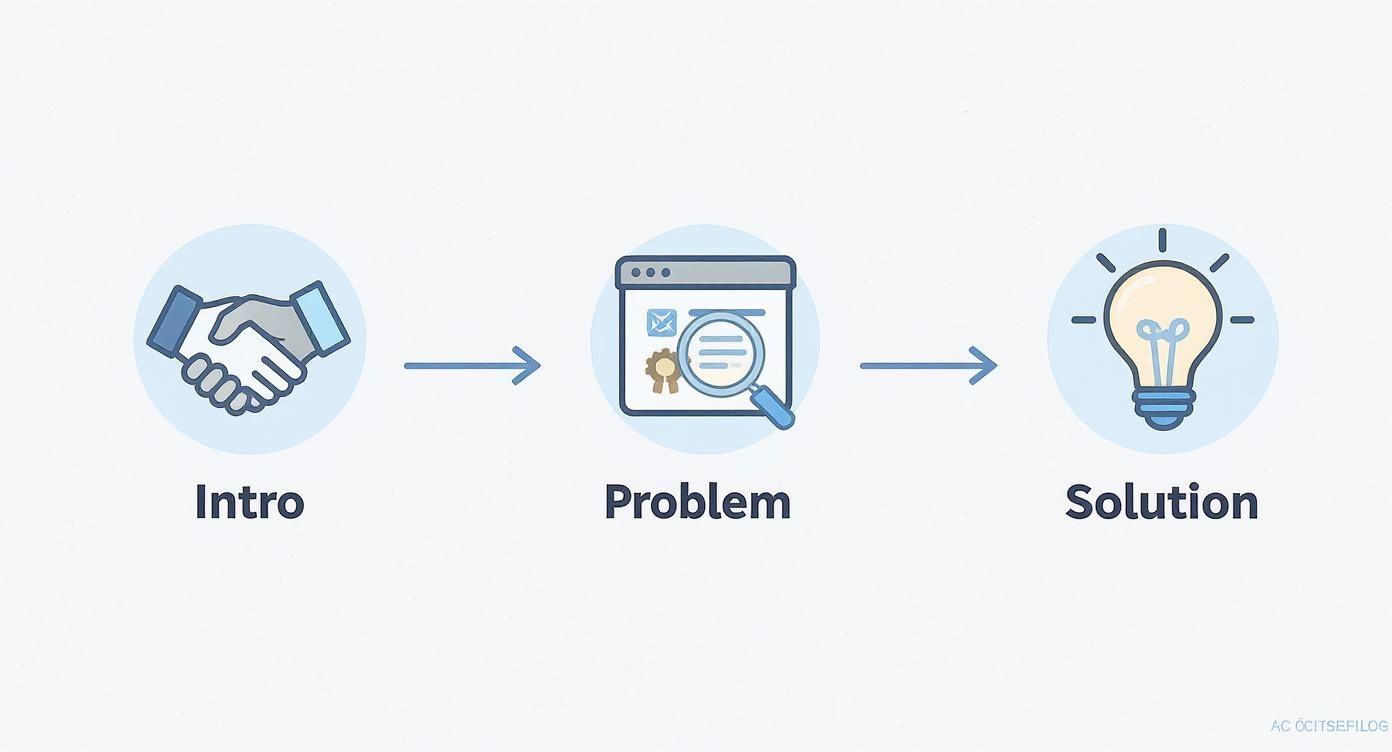
Think of it as guiding the reader from a friendly handshake to a shared understanding of a critical problem and, finally, the brilliant answer you've developed.
- Proposed Solution: Describe what you’ll do. "Our 'Connected Seniors' program will give 100 local seniors weekly, hands-on training on tablets and social media, each paired with a youth volunteer for one-on-one support."
- Budget Overview: Give them the top-line numbers. "The requested $35,000 covers the program coordinator's salary ($20,000), purchasing tablets ($10,000), and curriculum materials ($5,000)."
- Conclusion: End on a confident, forward-looking note. "We are confident this program will build lasting digital bridges for our seniors and welcome the opportunity to submit a full proposal."
The Final Polish: Review and Edit
You’ve drafted the letter. Now comes the most critical part: editing. One careless typo can completely undermine your credibility. It sends a message that you lack attention to detail, which is a huge red flag for a funder.
A polished, error-free document does more than just communicate clearly; it signals professionalism and respect for the funder's time. Don't let a preventable mistake be the reason your otherwise excellent LOI is set aside.
Don't try to edit right after you finish writing. Step away for at least a day. When you come back, you’ll have fresh eyes and will spot awkward sentences you missed before.
Get at least two other people to read it. One should be a colleague who knows the project inside and out, checking for accuracy. The other should be someone completely unfamiliar with your work. If they get it, you've succeeded. Finally, read the entire letter out loud. It’s a simple trick, but it’s the best way to catch clunky phrasing that your eyes might glide over.
While this process gets your LOI in shape, these principles of storytelling and careful editing are just as crucial for the full proposal. For those ready for that next step, our nonprofit grant proposal template offers a great framework to build on the foundation you've laid here.
Tailoring Your LOI to Resonate with Each Funder

If you take one thing away from this guide, let it be this: a generic, one-size-fits-all LOI is a one-way ticket to the rejection pile. Funders are experts at spotting a boilerplate letter, and it immediately signals that you haven't put in the effort to understand their work.
True success comes from customization. When you tailor your LOI, you're not just asking for money; you're starting a conversation. You're showing the funder that you've done your homework, you respect their mission, and you're serious about building a real partnership.
Conduct Deep Funder Research
Before you type a single word, you need to put on your detective hat. The goal isn't just to know what a foundation funds, but to understand why they fund it. You have to dig deeper than the mission statement on their homepage.
Start by poring over their website for annual reports, press releases, and, most importantly, lists of past grantees. These documents are absolute goldmines. Look for patterns. Do they favor certain types of projects? Are they focused on specific geographic areas? What's their typical award size?
For instance, the California Ocean Protection Council's Proposition 1 grant guidelines are very clear about prioritizing projects that benefit "environmental justice communities." If you know this, you can frame your coastal restoration project to highlight its direct, positive impact on those communities—a detail a generic LOI would completely miss.
A truly tailored LOI connects the dots for the funder. It doesn’t just explain what your project does; it shows how your outcomes directly advance their specific priorities, making your request feel like the logical next step in their mission.
Mirror the Funder's Language
Every foundation has its own internal language. They have specific terms and phrases they use to describe their impact and priorities. Pay close attention to this vocabulary.
Do they talk about "capacity building," "scalable solutions," or "community-led initiatives"? Weaving their language into your letter is a subtle but incredibly powerful way to build rapport. It shows you're not an outsider; you're aligned with their strategic thinking and you "get it."
If a funder like the ABIM Foundation consistently emphasizes projects that "promote trustworthiness and health equity," you should use those exact phrases when describing your own goals. This creates an instant sense of shared values and makes your proposal feel familiar and right.
Align Your Data with Their Interests
Data is persuasive, but only if it's the right data. Don't just throw in a national statistic and call it a day. A broad number about a widespread problem is far less compelling than a local data point that speaks directly to a funder's specific focus area.
If you're writing to a health-focused foundation, for example, targeted epidemiological stats are crucial. They lend credibility and frame your project's urgency with hard evidence. Highlighting a rise in HIV prevalence among a specific demographic in the suburbs they serve will underscore the critical need for your intervention in a way a national trend never could. The experts at GrantBoost.io have some great insights on using data effectively in your LOI.
Frame Your Project as a Partnership
Ultimately, all your research and tailoring should lead to one powerful conclusion for the funder: you are the perfect partner to help them achieve their goals. Your LOI shouldn't read like a simple request for a handout. It should feel like an invitation to collaborate on a shared vision.
It often comes down to a simple shift in framing.
- Weak Framing: "We are requesting $50,000 to fund our youth arts program."
- Strong Framing: "We are seeking a $50,000 partner to help us achieve our shared goal of empowering at-risk youth through the arts, a core focus of your foundation's community investment strategy."
See the difference? This reframing changes the entire dynamic. You’re no longer just a potential beneficiary; you're a capable ally. This positions your grant letter of intent as a compelling, and frankly, irresistible proposal for partnership.
Navigating Submission and Avoiding Common Pitfalls
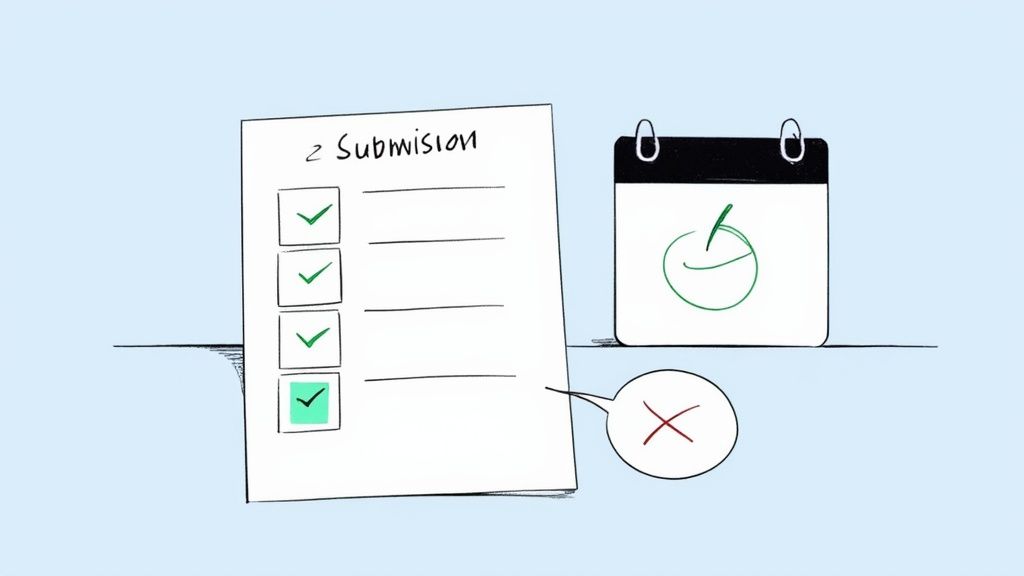
You’ve poured your best ideas and strategy into crafting a powerful LOI. Don't let a simple administrative slip-up derail all that hard work right at the finish line. Submitting your letter isn't just a final task; it's the first real test of your organization's professionalism.
Funders see the submission process as a window into how you operate. If you can’t follow basic instructions on a two-page letter, they'll wonder how you'll manage a complex grant. A missed deadline or a botched file format can knock you out of the running before your brilliant project even gets a read.
Mastering the Submission Checklist
Before you hit "send," slow down and double-check everything. Every foundation has its own set of rules, and assumptions are your enemy here. I recommend creating a quick checklist for every single LOI you submit.
Here's what should be on it, no exceptions:
- The Deadline: Is it 5 PM Eastern or 5 PM Pacific? Confirm the exact date and the time zone. This one detail sinks countless applications.
- The Format: Do they want a PDF, a Word document, or for you to paste the text into a web form? Sending the wrong format can lead to an automatic rejection.
- File Naming Conventions: Many funders have a specific naming structure, like
OrgName_LOI_ProjectName_2024.pdf. Following it shows you pay attention. - Contact Information: Triple-check the name and email address of your contact person. A single typo could mean you never receive that coveted invitation to submit a full proposal.
Treating deadlines as suggestions is a fatal error. These aren't just arbitrary rules; they are gatekeepers. Submitting correctly and on time also ensures you’re notified of important updates, like a deadline extension. On a platform like GrantWatch, missing the LOI deadline means you're out, even if the final application is weeks away.
Common But Costly Mistakes to Avoid
Beyond the technical side of submission, a few classic blunders in the writing itself can weaken an otherwise solid LOI. These are the subtle mistakes that even seasoned pros can make when they're too close to the project.
First is the curse of jargon. You're immersed in your work every day, but the grant reviewer isn't. Ditch the acronyms and insider terms. If you absolutely must use a technical term, define it. Your goal is to be clear and compelling, not to sound overly academic.
Another all-too-common misstep is a vague budget request. Simply saying you need $50,000 means nothing without context. You have to connect the money to the work.
A strong budget narrative doesn't just list costs; it frames the request as a strategic investment. It shows the funder exactly how their dollars will be transformed into the impact you've promised.
Finally, the most critical mistake is failing to explicitly link your project's outcomes to the funder's mission. You might think the connection is obvious, but it's your job to draw a bright, clear line for the reviewer.
- Weak: "Our project will improve local literacy rates."
- Strong: "By boosting third-grade reading proficiency by 15%, our program directly advances your foundation's stated goal of closing the educational achievement gap in our community."
By mastering these final details—both in your writing and your submission process—you give your LOI the best possible chance for a fair and thorough review. The LOI is just the first step in a longer journey, so if you want to see the full picture, take a look at our comprehensive guide on how to apply for grants.
Answering Your Top Grant Letter of Intent Questions
Even after you get the hang of writing a Letter of Intent, you're bound to run into a few tricky questions. It happens to everyone. Knowing how to handle these situations is what separates a good grant seeker from a great one.
Let's clear up some of the most common points of confusion I see in the field. Think of this as your personal FAQ for those moments when you're not quite sure what to do next.
How Long Should My Grant Letter of Intent Actually Be?
The golden rule is to keep it concise but comprehensive. Aim for one to three pages.
Your first priority is always to follow the funder's specific guidelines. If they ask for two pages, give them two pages—not three. If they don't give you a page limit, then two pages is usually the sweet spot.
This gives you just enough space to build a strong, compelling case without burying the reviewer in details. Remember, the grant letter of intent is a summary meant to get their attention, not the full-blown proposal.
A quick tip from experience: Program officers are often sifting through hundreds of these. A clear, brief LOI that gets straight to the point is far more memorable and effective than a long one.
Are Letter of Intent and Letter of Inquiry the Same Thing?
You'll hear these terms used interchangeably, but there can be a subtle difference. It's a small detail, but getting it right shows you're paying attention.
A Letter of Intent (LOI) is typically the formal first step for a specific grant you already know is open. It's your official notice that you plan to apply.
A Letter of Inquiry (LOQ) is often a bit less formal. You might send one to feel out a funder's interest in your project, even if they don't have a specific grant open at that moment.
When in doubt, just use the exact term the funder uses in their guidelines. It's a simple way to show you've done your homework.
Is It Okay to Send an Unsolicited LOI to a Foundation?
My advice? Tread very carefully here.
Most foundations are pretty clear on their websites: they don't accept unsolicited proposals or LOIs. Sending one anyway is a rookie mistake. It immediately signals that you haven't researched their process, and that can get you on their bad side fast.
That said, some smaller or family foundations might be more open. Before you even think about sending anything, scour their website for a submission policy. If you can't find one, don't just send the LOI blindly. A quick, professional phone call or email asking about their process is a much better first move.
What Should I Do Right After I Hit Submit on My LOI?
First things first: breathe! Then, make sure you got a confirmation. Nearly every online portal will send an automatic email or show a confirmation message on the screen. Save a PDF or take a screenshot of it for your records.
Now for the hard part: waiting. Find the funder's decision notification date, put it on your calendar, and then try your best to forget about it. Pestering them before that date won't help your case.
Use this time wisely. Start pulling together the documents and data you'll need for the full proposal. That way, if you get the green light, you'll be ready to hit the ground running.
Ready to move beyond questions and start crafting winning proposals with confidence? Fundsprout uses AI to analyze RFPs, find perfectly aligned funding opportunities, and generate compelling drafts in your organization's voice. Discover how Fundsprout can streamline your entire grant writing process today.
Try 14 days free
Get started with Fundsprout so you can focus on what really matters.