A Guide to Grants for the Homeless in 2026
Discover how to find, win, and manage grants for the homeless. This guide helps nonprofits secure the funding needed to fight housing insecurity.

Abdifatah Ali
Co-Founder
When we talk about “grants for the homeless,” we’re talking about the financial lifeline that keeps your mission running. These are funds from governments, foundations, and corporations that support everything you do—from keeping the lights on at an emergency shelter to funding a new permanent supportive housing project.
Winning these highly competitive grants is absolutely essential for any nonprofit in this space. It’s how you sustain your work and, just as importantly, how you grow to meet the ever-increasing need.
Confronting the Urgent Need for Homelessness Funding
The global homelessness crisis is staggering, but the funding to address it falls desperately short. If you’re a nonprofit leader, you don’t need me to tell you this. You live it every single day, trying to stretch limited resources to meet an overwhelming demand. As economic instability and the affordable housing crisis worsen, more people are pushed to the brink, and the gap between available services and available funding just keeps getting wider.
The numbers are stark. UN-Habitat estimates that 318 million people are homeless and another 2.8 billion lack adequate housing worldwide. Yet, international development aid for housing-related work has completely tanked. Since 2019, this funding has cratered to less than 0.09% of total aid. It’s a massive disconnect that shows a failure to prioritize one of the most basic human needs.
Navigating the Funding Landscape
For those of us on the ground, this environment makes securing grants more challenging—and more critical—than ever before. The usual funding sources are swamped with applications, and the competition is intense. Just finding the right opportunities requires a focused, systematic approach that goes way beyond a few simple keyword searches.
This is the journey we’re all on: recognizing the scale of the crisis and then building a strategic grant roadmap to do something about it.
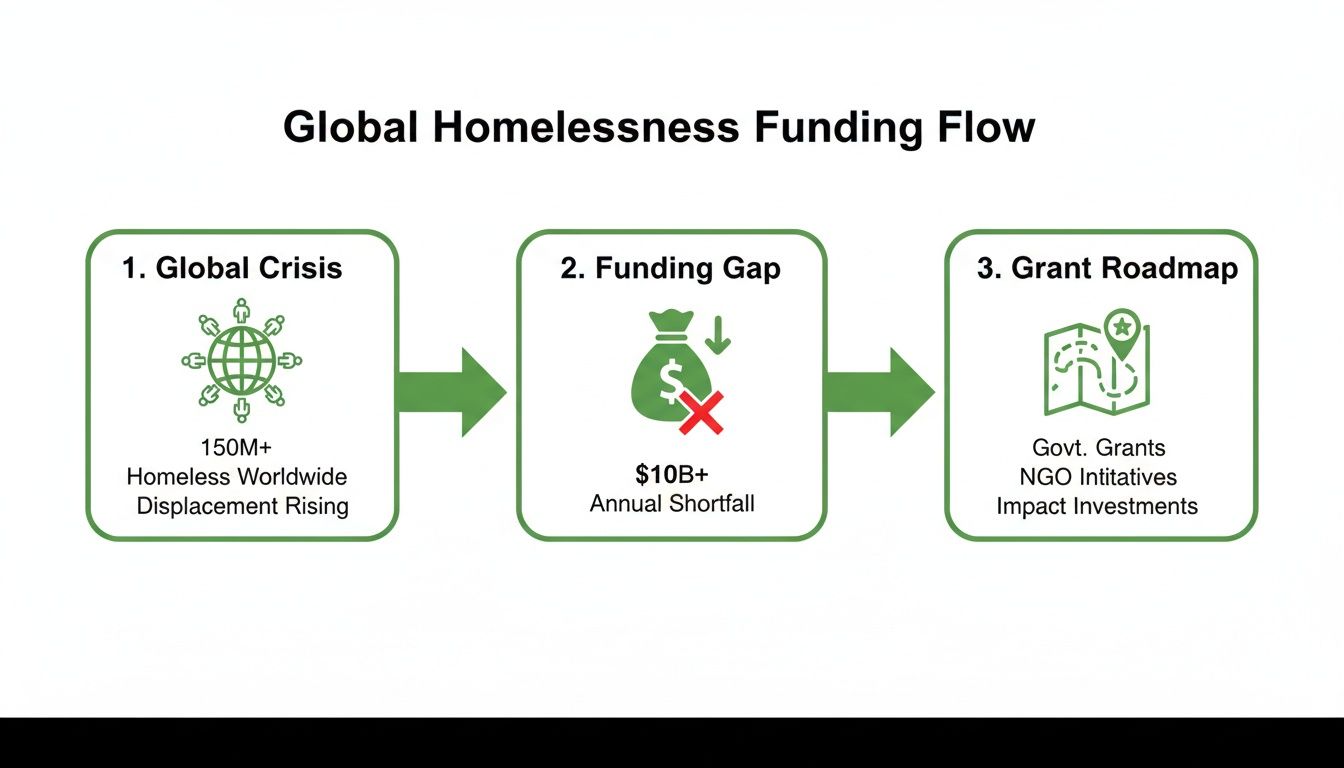
The flowchart really drives home the point: overcoming this funding gap isn’t about luck. It’s about having a deliberate, well-planned strategy to find and win the grants that are out there. A clear roadmap is what separates the organizations that struggle from the ones that succeed.
The real challenge isn't just a lack of money, but the difficulty in connecting your specific mission to the right funder. Success depends on a targeted strategy, not a scattered, throw-everything-at-the-wall approach.
This guide is that practical roadmap. We’re going to break down, step-by-step, how your nonprofit can effectively find, win, and manage the grants that fuel your work. Mastering these skills can level the playing field, helping your team build a sustainable funding pipeline for years to come.
A great place to start is by clearly demonstrating your community's unique challenges. You can get a head start by reviewing some community needs assessment tools.
How to Find Relevant Grant Opportunities for Your Mission

Finding the right grant often feels like looking for a needle in a haystack. If your strategy is just a series of random Google searches, you’re setting yourself up for frustration and a lot of wasted time. To succeed, your nonprofit needs a proactive system for uncovering grants for the homeless that actually align with your work.
This isn't about passively waiting for an opportunity to appear. It's about actively building a pipeline of prospects. The first step is knowing where to look—and it's a bigger pond than just federal funding. A truly solid strategy pulls in state, local, and private foundation grants, too. Each has its own rhythm, and understanding that landscape is your foundation for building a sustainable funding stream.
Diversify Your Grant Search Strategy
One of the biggest mistakes I see nonprofits make is fixating only on those huge, well-known federal grants. Yes, they’re important, but they are also fiercely competitive. You'll have much better luck if you cast a wider, more strategic net.
Let's say your small nonprofit wants to launch a transitional housing program for homeless youth. A diversified search would look something like this:
- Federal Databases: Of course, you’ll check portals like Grants.gov for funding from departments like HUD. You should set up alerts for keywords like "youth homelessness," "transitional housing," and "supportive services."
- State and Local Portals: Don't overlook what's happening in your own backyard. Many states have specific programs that are less competitive and laser-focused on local needs. For example, Minnesota’s Family Homeless Prevention and Assistance Program recently approved $28 million in funding—money that's specifically for local impact.
- Foundation Directories: Private foundations are a massive piece of the funding puzzle. The key is to find foundations whose mission explicitly mentions homelessness, housing stability, or at-risk youth in your specific city or county.
By searching across these different source types, you build multiple pathways to funding. It’s a simple way to reduce your reliance on a single grant application and significantly increase your odds of success. For a deeper dive into the tools available, check out our guide on the best grant discovery platforms.
A winning grant search strategy isn't about finding every single opportunity. It's about consistently finding the right opportunities—those that align with your programs, capacity, and the community you serve.
To make sense of these different funding sources, it helps to see how they stack up against each other.
Grant Opportunity Source Comparison
As you can see, a balanced approach gives you access to a mix of funding sizes and competitive landscapes, which is exactly what a healthy grant pipeline needs.
From Keywords to Actionable Alerts
The secret to a proactive grant system is putting it on autopilot. Don't just search for terms once and call it a day. You need to set up alerts that deliver new, relevant opportunities right to your inbox. The trick is to use a mix of broad and specific keywords to cast a net that is both wide and effective.
A search for "grants for the homeless" is a good starting point, but you'll get much better results by getting more specific.
Keyword Search Examples:
- Rapid Re-Housing grants + [Your City/State]
- Emergency shelter operations funding
- Supportive services for chronically homeless
- Street outreach program grants
Once you start identifying promising funders, the work isn't over. Add them to a master list or a tracking tool and make a note of their typical grant cycles and deadlines. This simple step turns your search from a frantic, one-time task into an ongoing, manageable process. You'll never be caught off guard by a looming deadline again.
Crafting a Winning Grant Application
So, you’ve found a grant that looks like a perfect match. That’s a huge step, but now the real work begins. The difference between a winning proposal and one that ends up in the "no" pile often comes down to how you tell your story.
Grant reviewers are wading through stacks of applications. What they're really looking for is a clear, compelling connection between the problem you're tackling and the solution you’ve designed. A great application doesn’t just state facts—it builds a case that's impossible to ignore. It proves you understand the community's needs, have a rock-solid plan, and can deliver results they can see.
Deconstructing the Funder’s Request
Think of the funder's Request for Proposal (RFP) as your playbook. Don't just skim it; dissect it. Every guideline, question, and formatting rule is a clue telling you exactly what the funder cares about most. Break it down, section by section, and turn it into an action plan for your team with firm deadlines.
For instance, if you're applying for a grant to support a youth homelessness program and the RFP keeps mentioning "long-term housing stability," that's your signal. They don't just want to hear about providing a bed for the night. This is your cue to build your narrative around the services that lead to lasting independence—your case management, job readiness training, and mental health support.
If you’re looking for ways to get all that information down on paper more efficiently, you might want to explore how you can write faster without typing faster.
Marrying Data with Human Stories
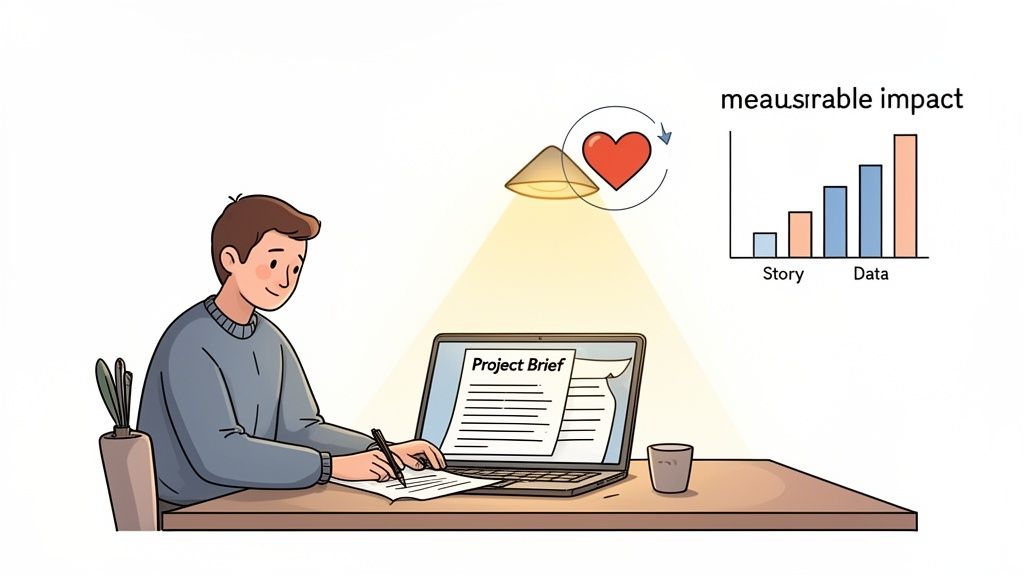
Hard data gives your proposal its backbone, but it’s the human stories that give it a heart. Grant reviewers are people, and a well-told story can make your application truly memorable. The trick is to weave the two together so they support each other.
Don't just state that 30% of the local homeless youth population aged out of the foster care system. Introduce them to "Maria," a real person who faced this exact reality. Then, use the data to zoom out and show that Maria’s struggle isn't an isolated incident. It’s part of a systemic crisis that your organization is uniquely equipped to address. This one-two punch makes the statistics feel both urgent and real.
A powerful statement of need doesn't just present the problem; it creates empathy and urgency. It convinces the funder that the need is critical and that your organization is the right partner to solve it.
This approach is more important than ever. While the U.S. government’s 'All In' Strategic Plan has a goal of cutting homelessness by 25%, the reality on the ground tells a different story. In 2024, homeless service organizations assisted over 1.1 million people, a staggering 12% increase from 2023. This spike in need, combined with a lag in new housing resources, creates a critical gap your proposal can and should address.
Defining Measurable and Meaningful Outcomes
Funders are making an investment, and they need to see a return on it. Vague goals like "improving lives" simply won't cut it. Your proposal has to clearly define what success looks like and exactly how you'll measure it using SMART objectives (Specific, Measurable, Achievable, Relevant, and Time-bound).
Let's look at how a youth shelter could sharpen its outcomes:
- Weak Outcome: "Help homeless youth find stability."
- Strong Outcome: "Within 12 months, 75% of youth exiting our transitional housing program will secure stable housing and maintain it for at least six months."
See the difference? The second one is an objective you can track, measure, and report on. It shows the funder you're focused on results and are accountable for their investment.
If you need more help getting this crucial section right, check out our guide on writing a powerful statement of need. By combining a carefully deconstructed RFP with a data-driven story and crystal-clear outcomes, you're not just asking for money—you're making a compelling case for partnership.
Building a Compliant and Realistic Grant Budget
I’ve seen it happen time and time again: a powerful, moving proposal gets tossed aside because of a shaky budget. This is where the rubber meets the road. Grant reviewers are trained to spot disconnects between your inspiring narrative and the financial reality of your plan.
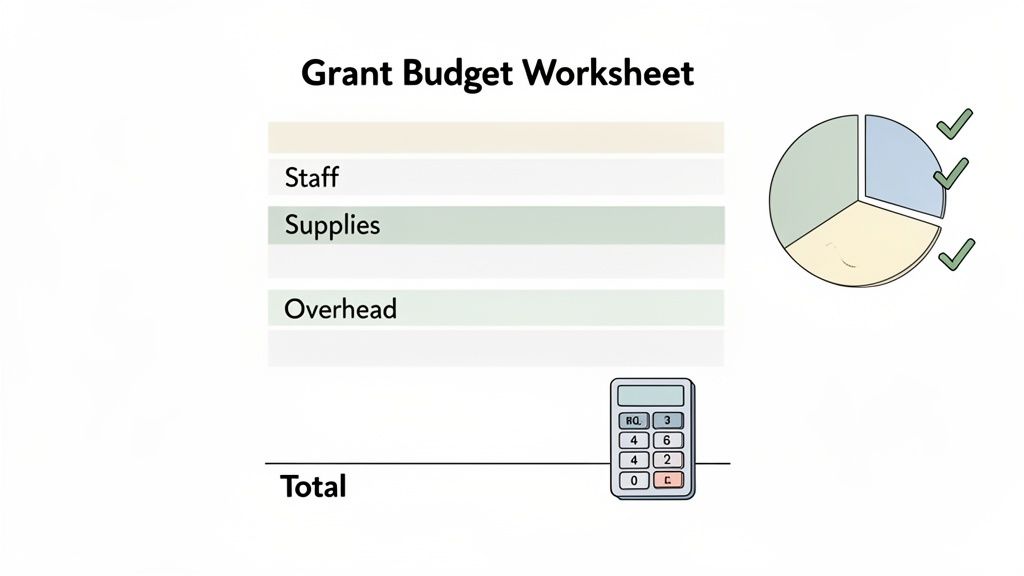
A budget isn’t just a spreadsheet of expenses; it's the financial blueprint of your project. Every single dollar must have a purpose that you can trace directly back to your proposed activities and outcomes. If you want to get funded, you have to master the art of crafting a comprehensive budget that screams feasibility and competence.
Accounting for Direct and Indirect Costs
Let’s break it down. Your budget has two main components: direct costs and indirect costs. Getting this right is fundamental to showing funders you understand what it truly takes to run your program.
Direct Costs are the expenses you can point to as being 100% for that specific project. Think of salaries for your outreach workers, the cost of hygiene kits, or bus tokens for clients to get to appointments. These are the tangible, front-line costs of doing the work.
Indirect Costs (Overhead) are just as critical, but they support the organization as a whole. This is your office rent, utilities, the bookkeeper’s salary, and other shared operational expenses. Many federal grants acknowledge this and allow for a de minimis indirect cost rate of 10% of your modified total direct costs if you don't have a federally negotiated rate.
For instance, if you get a $100,000 grant for a new shelter program, you might have $70,000 in direct costs for staff and supplies. You could then allocate $7,000 (10% of $70,000) for indirect costs to help keep the lights on. It shows you’ve considered the full cost of implementation.
Justifying Every Expense
Simply listing numbers on a page is a rookie mistake. The real magic happens in the budget narrative, which is your chance to explain the why behind every single line item. If you’ve budgeted $20,000 for a case manager, your narrative needs to detail their exact role, why their expertise is essential, and how their time contributes directly to your goals.
Your budget narrative should answer the funder's unspoken question for every line item: "Is this expense reasonable, necessary, and directly linked to achieving the proposed outcomes?"
This level of detail builds an incredible amount of trust. It proves you're a responsible steward who has thought through every contingency.
Look at targeted grants, like Australia's 'Homelessness and Health 2025' initiative, which often fund research to evaluate service models. A meticulous budget is essential to prove you have the capacity to conduct that research. These kinds of data-driven projects are exactly how we prove that smart housing assistance can slash public expenses by up to 80%.
A solid budget doesn't just win you grants for the homeless. It becomes a clear, actionable roadmap for your team once the funding comes through and the real work begins.
Managing Your Grant and Securing Future Funding
That "Congratulations!" email is an incredible feeling, but the truth is, winning the grant is just the beginning. The real work starts now—the work of delivering on every promise you made in your proposal.
Effective grant management is so much more than just spending the money correctly. It's your chance to prove you’re an effective, reliable partner, capable of turning an investment into real-world impact. Your application got your foot in the door; your performance during the grant period is what keeps you in the room for years to come.
Your Program Officer Is Your Best Ally
The single most important part of managing grants for the homeless is the relationship you build with your program officer. Don't ever think of them as a distant auditor. They are your advocate, your partner, and your direct line to the funder.
Keep them in the loop. Good news is easy to share, but they need to hear about the challenges, too. Did you hit a snag with client intake that slowed you down? Tell them, and also tell them how you're solving it. Did you get an amazing piece of local press or have a client story that perfectly captures your mission? Share that, too. This kind of open, honest communication builds a level of trust that is priceless when it’s time to ask for renewed funding.
Stay Compliant, Stay Funded
Grant compliance can feel like a mountain of paperwork, but it really comes down to a simple idea: do what you said you’d do, and keep the receipts. You need a rock-solid system for tracking every dollar and every activity from day one.
Key Compliance Habits:
- Dedicated Financial Tracking: The cleanest way to manage grant funds is to set up separate bank accounts or, at a minimum, specific accounting codes for each grant. This prevents co-mingling funds and makes reporting a breeze.
- Time and Effort Reporting: If the grant covers staff salaries, you need meticulous timesheets showing how their work directly supports the grant’s objectives.
- Document Everything: Keep every single receipt, invoice, client form, and piece of program data organized and accessible. You’ll be glad you did when the final report is due or an auditor calls.
This isn’t just about bureaucracy. Funders, especially federal ones like HUD, can shift their priorities and scoring criteria from one year to the next. Being able to pull accurate performance data quickly gives you a massive strategic advantage when you have to adapt.
A successful grant renewal starts on the first day of your current award. By treating your reporting not as a chore but as a storytelling opportunity, you build a compelling case for continued investment.
Turn Your Reports into a Renewal Proposal
Think of your grant reports as your most powerful marketing materials. They aren’t just a requirement to check off a list; they are the proof that a funder's investment paid off. This is your chance to connect the dots for them.
Don't just give them a dry spreadsheet. Frame your report as a story. Remind them of the problem you're solving, use data to show exactly what you accomplished, and then bring those numbers to life with powerful stories. If you promised to provide shelter for 50 individuals, show them the data that proves it. Then, tell them about one of those individuals and how having a safe place to sleep changed their life.
This is how you turn a one-time grant into a sustainable, long-term partnership. It proves you're not just a worthy cause, but an essential partner in the fight to end homelessness. This is where a tool like Fundsprout comes in handy, giving you a central place for all your compliance documents and reporting data so you can build that undeniable case for renewal, year after year.
Common Questions About Homelessness Grants
When you're deep in the grant-seeking trenches, a lot of tough questions come up. Let's tackle some of the most common ones I hear from nonprofit leaders and grant writers. My hope is that these direct, experience-based answers will help you sidestep common pitfalls and secure the funding you need.
What Are the Biggest Mistakes Nonprofits Make?
If there’s one mistake I see over and over, it’s chasing misaligned grants. It's the classic "spray and pray" method—you're so desperate for funding that you apply for anything and everything, wasting an incredible amount of time. Another huge red flag for funders is a budget that doesn't tell the same story as your program narrative. They can spot that disconnect from a mile away.
So many proposals also fall flat because they just list dry statistics without telling a story. Funders are looking for a logical and compelling thread that connects the dots: here's the problem in our community, here's our specific solution, here's why our team is the one to do it, and here's exactly what it will cost. If any link in that chain feels weak, your application is likely headed for the "no" pile.
How Can a Small Nonprofit Compete for Large Federal Grants?
It's definitely a challenge, but you can absolutely win if you're strategic. Don't go after a massive, multi-million dollar national grant right out of the gate. That's a recipe for burnout. Instead, start by targeting smaller, more specific federal opportunities that are a perfect match for your work, maybe from a particular program within HUD or HHS.
Partnering up is another fantastic strategy. Consider approaching a larger, more established nonprofit to apply as a sub-awardee on a joint application. This is a great way to build your organization's track record and credibility while sharing the immense workload of a federal proposal. Modern tools can also be a real game-changer, helping you find those niche opportunities and manage the complex writing process to put you on more equal footing.
Success for a smaller organization isn't about out-muscling the giants. It's about being more strategic, more focused, and proving you can deliver incredible impact with the resources you have.
What Kind of Data Is Most Important for a Proposal?
Funders need to see a thoughtful blend of both quantitative and qualitative data. One without the other just doesn’t paint the full picture.
- Quantitative Data: You need the hard numbers. This includes demographics of who you serve, the scale of homelessness in your area (using Point-in-Time data is standard), and your own performance metrics. For example, what percentage of your clients secured and maintained housing for over one year?
- Qualitative Data: This is where you bring the numbers to life. Share powerful, anonymized client testimonials or a short, compelling story that illustrates the real-world transformation your services make possible.
The best proposals masterfully weave these two together. You start with the data to establish the need, then use a story to create an emotional connection, making your solution feel both logical and urgent.
How Far in Advance Should We Start the Application Process?
I can't stress this enough: for any significant grant, you need to begin at least three to six months before the deadline. That might sound like a lot, but rushing a complex application in the last few weeks is a surefire way to make mistakes and get a rejection.
A longer timeline gives you the breathing room you need for everything that goes into a winning proposal: researching the funder, designing a thoughtful program, collecting all the necessary data, writing (and rewriting) the narrative, building a line-item budget, and getting feedback from your team. Do yourself a favor and map out a simple project plan with mini-deadlines for each component. It’s a simple step that will save you from that chaotic, last-minute scramble.
Ready to stop chasing misaligned grants and start winning the funding your mission deserves? Fundsprout uses AI to find your ideal grant opportunities, streamline proposal writing, and simplify compliance so you can focus on what matters most. Discover your perfect grant match.
Try 14 days free
Get started with Fundsprout so you can focus on what really matters.