The Grant Closeout Process: A Step-by-Step Playbook
Master the grant closeout process with our step-by-step playbook. Learn to manage reports, reconcile costs, and ensure compliance to protect future funding.

Abdifatah Ali
Co-Founder
Three weeks before a grant ends, the same pattern shows up in a lot of nonprofits. Program staff are still trying to finish deliverables. Finance is chasing invoices. Someone realizes the final report narrative lives in three different documents, and nobody is sure whether the equipment list is current. The work itself may have gone well, but the closeout feels shaky.
That's usually not a people problem. It's a system problem.
A strong grant closeout process starts long before the award end date. If you treat closeout as a final checklist, you'll scramble. If you build for closeout from day one by tracking expenses, deliverables, approvals, subrecipient reporting, and document storage in one digital workflow, the last stretch becomes controlled instead of chaotic. That shift matters more than many groups realize.
Why a Smooth Grant Closeout Matters More Than You Think
A grant can look healthy right up to the end, then get messy fast. The program team met its goals. The spending was mostly on track. But once the final package is due, small gaps become real problems: an unapproved budget shift, missing support for a cost, a property record nobody updated, or a narrative that does not match the final numbers.
I tell new program directors to treat closeout as the funder's last and clearest read on how your organization manages an award. It affects more than one report. It shapes audit readiness, internal trust between finance and programs, and the confidence a funder brings into your next application or continuation request.
Closeout also exposes whether your systems worked all year.
If records were stored in separate places, if subrecipient follow-up lived in someone's inbox, or if expenses were reviewed late instead of throughout the grant, the closeout burden lands all at once. Teams then waste time rebuilding the file instead of confirming it. A shared spreadsheet can help early on, especially if you start with a grant tracking spreadsheet template built for deadlines, owners, and reporting records, but spreadsheets usually break down once multiple departments, revisions, and final approvals are involved.
What usually creates risk
The pattern is familiar, and it rarely starts with the final report itself.
- The award file was never built for closeout: Key documents exist, but not in one controlled record with version history and clear ownership.
- Program and finance are closing two different stories: Outputs, participant counts, drawdowns, and final expenses have not been reviewed together.
- Subrecipient and vendor loose ends stay open too long: Final invoices, performance details, and required certifications come in late or incomplete.
- Nobody can see status in real time: Staff assume another team is handling a task because the process lives in email and calendar reminders.
Practical rule: If you need a meeting just to figure out what is missing, closeout started too late.
A strong digital grants management system changes that equation because it makes closeout part of daily grant administration. The benefit is not just storage. The primary value is having tasks, approvals, reporting dates, financial documentation, and final deliverables tied to the award record from the start. Platforms such as Fundsprout help teams keep one source of truth, assign owners, and catch missing pieces before they turn into deadline problems.
Why this affects more than compliance
Clean closeout work protects your reputation with funders, but it also protects staff time and decision-making inside the organization. Finance can close the books with fewer surprises. Program leaders can stand behind their final outcomes. Executive staff can answer board or auditor questions without pulling people back into a finished grant six months later.
That discipline looks a lot like year-end financial close in other fields. The controls are different, but the operating principle is similar: finish with clean records, documented reviews, and a file someone else can follow. For a useful comparison, see this guide for service business year-end close.
The organizations that close grants well usually do one thing differently. They set up the award in a system that assumes the end is coming. That means required reports, document retention, budget changes, match documentation, equipment tracking, and final approvals are organized from day one, not reconstructed at the end.
Your 90-Day Closeout Countdown and Timeline
Ninety days before a grant ends, the warning signs are usually already there. A subrecipient has not confirmed its final invoice timing. Program staff are still updating outcome data in separate files. Finance has one version of the remaining budget, and the grant file has another. That is when closeout starts to slip from a controlled process into a scramble.
The fix is not a heroic push in the final week. It is treating closeout as part of grant administration from the day the award is set up. By the time you hit the final 90 days, your system should already hold the reporting calendar, document list, approval path, subrecipient contacts, and final deliverables tied to the award record. If part of your team still tracks tasks outside the system, a grant tracking spreadsheet template can at least standardize owners, dates, and required support until everything is pulled into one workflow.
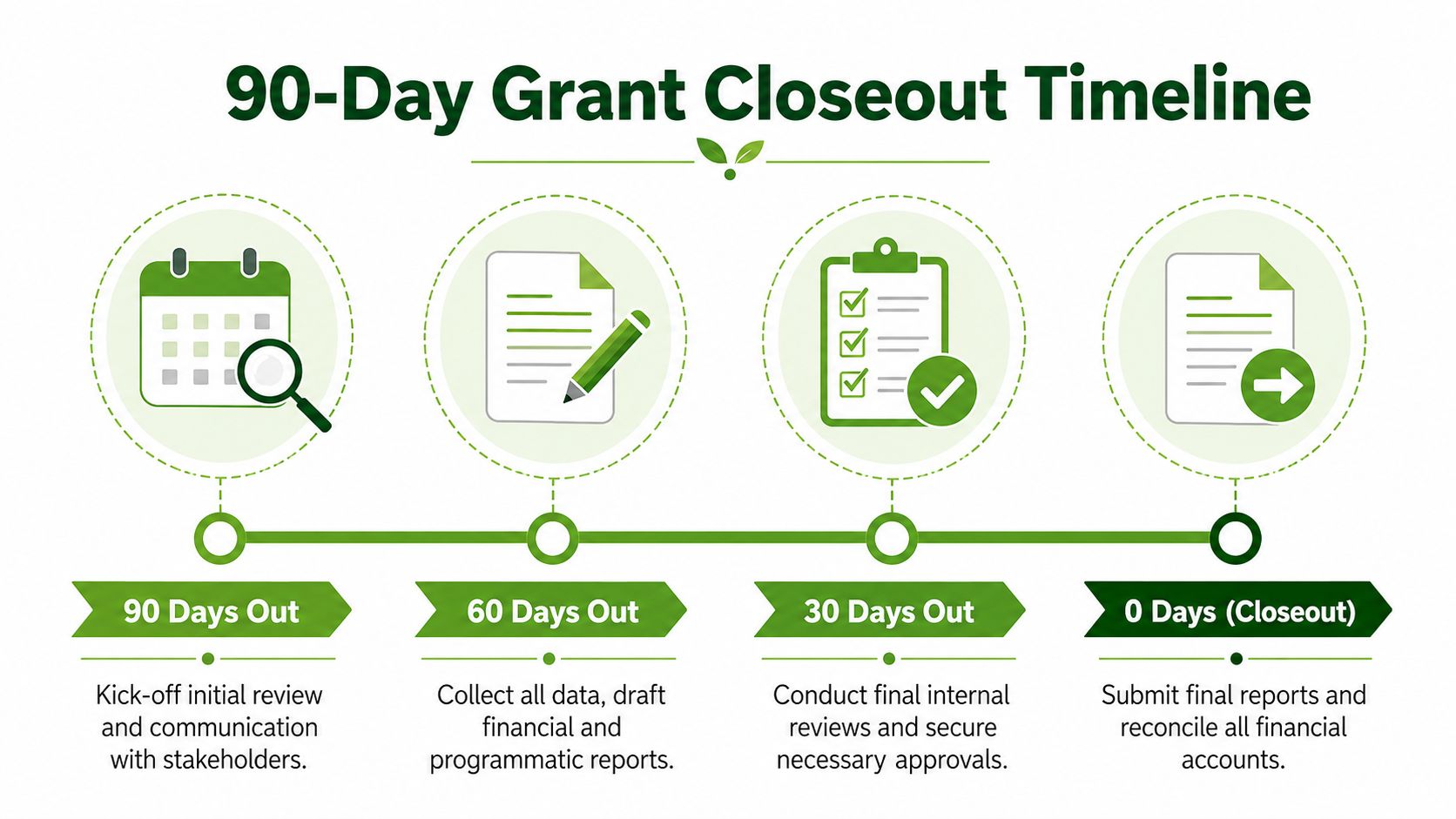
At 90 days out
Open a formal closeout workplan inside your grants management system. Do not wait for the end date to start assigning work.
Review the award terms, internal due dates, reporting requirements, and any property, match, or subrecipient obligations. If the grant includes pass-through funds, send closeout instructions to subrecipients now so their invoice deadlines and final report dates match your own timeline. This is also the point to confirm who owns each final deliverable. Program, finance, compliance, and executive sign-off should all be named, not assumed.
I like to check one thing early because it causes a surprising amount of delay. Confirm where the final package will be submitted and whether the right staff still have portal access. Good reports still miss deadlines when the only authorized submitter is on leave or no longer at the organization.
At 60 days out
By 60 days, the work shifts from planning to proof.
Finance should review remaining charges, expected obligations, payroll allocations, consultant payments, and any costs that may post late. Program staff should start assembling the final story of the grant using actual output and outcome records, not memory. If your system is set up well, this is mostly a retrieval exercise. If it is not, people start hunting through inboxes, shared drives, and old meeting notes.
Focus on four checks:
- Expense forecasting: Identify what still needs to hit the ledger and what should be removed before it becomes a reconciliation problem.
- Program support: Pull draft metrics, deliverables, participant data, and narrative examples while staff still remember the details.
- Subrecipient status: Get draft final invoices and reports moving now. Late partner submissions are one of the fastest ways to stall closeout.
- Property and asset review: Confirm whether equipment, inventory, or disposition reporting will be required.
A lot of teams benefit from borrowing discipline from the finance world here. This guide for service business year-end close is not grant-specific, but it is useful because it shows how much smoother closing work gets when tasks, owners, and review steps are defined in advance.
At 30 days out
The final month is for tightening the file and resolving exceptions.
Review draft narrative language against the award terms. Compare spending to the final approved budget, including any amendments. Confirm that match documentation, procurement support, consultant deliverables, and required approvals are already attached to the award record. If something is still unclear, raise it now. Unresolved questions rarely get easier after the period ends.
This is where a digital system earns its keep. Fundsprout, for example, helps teams see missing attachments, overdue tasks, and open approvals before those gaps turn into late reports or unsupported costs. That does not remove the judgment calls. It does make them visible while there is still time to act.
Closeout gets expensive when uncertainty sits unaddressed until the last week.
This is also the right time to confirm who will review, who will approve, and who will submit. I have seen strong closeout packages sit untouched because signature routing was never tested.
Here's a quick walkthrough that can help teams visualize the workflow:
After the end date
Once the project period closes, the work becomes controlled execution. Final reports, final cost review, liquidation of open obligations, and any return of unspent funds all have to move on schedule. As noted earlier, federal awards often give recipients a limited post-period window to finish these steps, but that window goes quickly once corrections, approvals, and subrecipient delays enter the picture.
Teams that close cleanly usually do one thing differently. They are not building the closeout process after the grant ends. They are finishing a process that has been tracked in the system all along.
Executing Your Financial and Programmatic Closeout
A closeout starts to slip when finance and program staff are each confident, but they are working from different records.
I usually see the same pattern. The program team believes the work is finished because deliverables went out on time. Finance still has payroll reallocations pending, one subrecipient invoice missing, and an equipment record no one has checked since purchase. By the time those issues surface, the final narrative is already drafted and the numbers are harder to correct cleanly.
That is why I run closeout as two coordinated tracks inside the grants system from the start of the award, not as a stack of tasks after the end date. The financial file, reporting documents, approvals, and deliverable records should already be tied to the award record. At closeout, the team is confirming and assembling, not hunting.
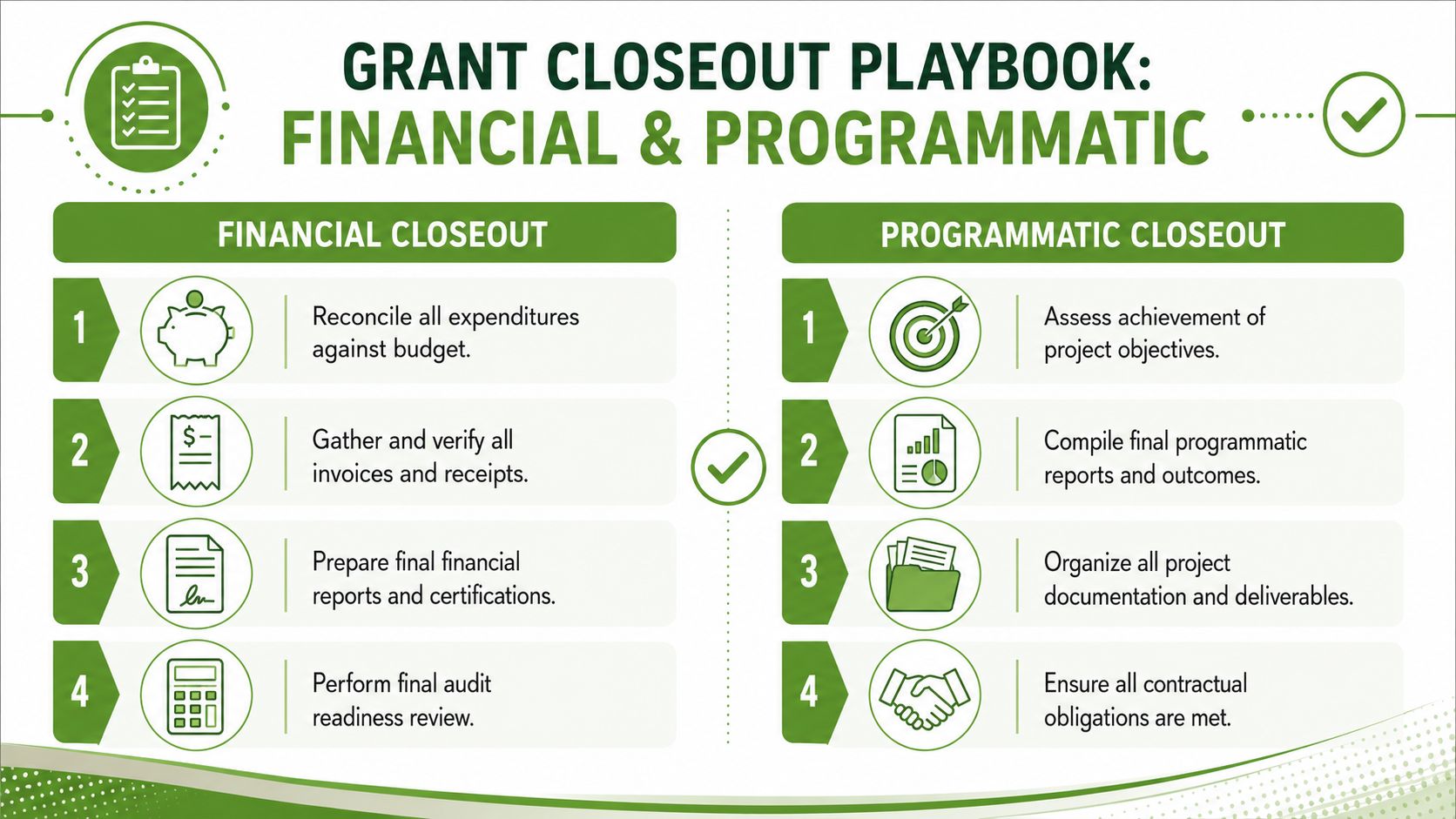
The financial track
Financial closeout works best in a fixed order. Review the final approved budget. Reconcile charges. Clear obligations. Confirm whether funds must be returned. Prepare the final financial report. Then close the account so no new costs post by mistake.
Here is what that looks like in practice:
Review the approved budget and all modifications
Use the final approved version, not the original proposal budget. Confirm that every rebudget, extension, and funder approval is stored with the award record. If your team keeps budget versions in email, closeout will slow down fast.Reconcile expenditures to the general ledger and support
Every posted charge should tie back to source documentation. Match transactions to invoices, payroll records, contracts, timesheets, and internal approvals. Teams that need a tighter month-end discipline can borrow methods used to streamline financial closing cycles. The same habits reduce grant closeout corrections.Clear final obligations
Open purchase orders, accrual questions, staff allocation updates, and subrecipient invoices need active follow-up. This is one of the main trade-offs in closeout. If you rush to submit before these items are resolved, you may need avoidable revisions. If you wait too long for perfect certainty, you create deadline risk.Identify unspent funds early
If there is a remaining balance, confirm the refund or drawdown adjustment process before the submission date. Do not leave that question for the last week. Cash activity, ledger balances, and final reported expenditures need to line up.Prepare the SF-425 carefully
The form itself is short. The review behind it is not. Variances usually come from timing, category mapping, or unsupported adjustments. A strong grant accounting workflow makes this step easier because the reporting structure already matches how the award was managed.Close the account in your financial system
After final reporting is complete, deactivate the grant account or apply the controls your accounting system uses to prevent new charges. Otherwise, a late AP entry or payroll correction can reopen a file you thought was finished.
The programmatic track
Programmatic closeout is usually less about writing and more about evidence control.
The final report should come from records maintained throughout the award, including status updates, deliverable logs, partner submissions, approval notes, and performance documentation. If those records live in one grants system, the final narrative becomes a synthesis exercise. If they live across inboxes, shared drives, and individual laptops, the team spends closeout week rebuilding the grant from memory.
Build the final report from records already attached to the award:
- Deliverables completed: trainings, services, publications, convenings, or milestones tied to the scope
- Outcome support: internal summaries, logs, and performance records that back up the narrative
- Context for variances: a plain explanation of what changed and how it relates to the approved scope
- Partner inputs: final statements, data, and deliverables from contractors, subrecipients, or other collaborators
Field note: The strongest final reports read like a well-kept file, not a last-minute defense.
Where the two tracks meet
Problems show up when finance and program records describe different versions of the award.
A program report may say all activities are complete while costs are still posting. Finance may show an underspend while the narrative describes work that appears to continue past the project period. Neither issue looks dramatic in isolation. Together, they invite funder questions and internal confusion.
Use a short internal review table before submission:
| Checkpoint | Finance asks | Program asks |
|---|---|---|
| Scope completion | Are any final costs still pending? | Are all funded activities complete? |
| Budget alignment | Do charges match approved categories? | Does the narrative reflect what was actually funded? |
| Supporting documentation | Can source records be produced quickly? | Can outcomes be supported with records already in the file? |
| Final submission package | Are all required forms included? | Are all required attachments included? |
This review works best if the grants system shows both sides in one place. The goal is not more meetings. The goal is a shared record before anything is submitted.
Property, equipment, and final documentation
Property reporting is one of the easiest closeout items to miss because many teams do not touch it until the end. If the award funded equipment or other tangible assets, verify early whether a final property report is required and who owns the inventory record internally. As noted earlier, some awards require the Final Tangible Personal Property Report (SF-428) when reportable property is involved.
Before you call the grant closed, confirm that the administrative file is complete:
- Award file integrity: Notice of Award, amendments, approved budget, correspondence, and submission confirmations
- Final report archive: narrative, SF-425, property forms if required, and any funder-specific attachments
- Internal close memo: a short summary of what was submitted, when, by whom, and where the final file is stored
Strong closeout files are boring in the best way. Another staff member should be able to open the record, follow the documentation, and understand exactly what was submitted without guessing.
Reconciling Final Costs and Communicating with Funders
A week before closeout, the program team says the project met its goals. Finance says two charges still need review. The funder is waiting on the final package. That is how closeout problems start. Not because the work was done badly, but because the financial record and the final message were built in different places.
Closeout goes better when reconciliation starts long before the award end date and lives inside the same grant record as the reports, approvals, and correspondence. If your grants system tracks budget categories, supporting documents, reporting deadlines, and funder communication in one place, the final review becomes a confirmation step instead of a scramble.
Reconcile final costs with the funder in mind
Final cost review is not just an accounting exercise. It is preparation for what you may need to explain.
Before anything is submitted, confirm four things:
- Every posted charge has support and belongs to the award
- Any reclasses or late adjustments are completed in the accounting system
- Unspent funds, match balances, and drawdowns agree with the final award position
- The financial record matches the program story you are about to tell
That last point causes more trouble than many new program directors expect. A final narrative may describe delayed hiring, revised activities, or underspending in one objective. If the ledger still reflects the original plan and no one has documented the variance clearly, the funder sees inconsistency. In closeout, inconsistency invites questions.
If your accounting team needs a stronger month-end discipline to support grant closeout, this resource on how to streamline financial closing cycles is useful because the same habits apply here. Clear cutoff rules, timely reconciliations, and documented review reduce last-minute corrections.
For teams that need a tighter connection between award restrictions, chart of accounts setup, and reporting categories, accounting for grants is a practical reference.
Budget closeout work from the start, not at the end
Recent Uniform Guidance changes allow certain closeout costs incurred after the period of performance for newer awards, as noted earlier in the article. The practical takeaway is straightforward. Closeout work is real work, and it should be planned like real work.
Experienced grants managers already know where the labor sits. Final financial review. Subrecipient follow-up. Property or equipment wrap-up. Portal submissions. File retention and documentation cleanup. A digital grants system helps because those tasks can be assigned, dated, and connected to the award record at kickoff, not created in a rush after the project ends.
That is one reason tools such as Fundsprout matter. They make closeout visible throughout the life of the grant. Staff can see unresolved budget questions, missing attachments, open approvals, and prior funder communication before those issues turn into deadline problems.
Keep funder communication short, specific, and documented
Funders do not need a long email. They need a clear one.
A useful final communication usually includes:
- A brief statement that the final package has been submitted or is attached
- A list of what is included
- A direct explanation of any material variance
- A short list of unresolved questions, if any remain
Write the message so a grants officer can understand it in one pass. If a return of funds is expected, say that directly. If a portal submission confirmation is pending, say that directly. If a subrecipient delay affects one attachment, identify it and state when the item will be provided.
The safest rule is simple. Raise issues while there is still time to fix them.
Know when to contact the funder before submission
Some issues should never sit in an internal email thread until the last day. Contact the funder early if:
- Subrecipient reporting is late and may affect your final package
- A cost allocation question is still being resolved
- A required attachment depends on another department or external party
- You may need instructions on return of funds, a portal error, or other agency-specific steps
Early communication does not make an organization look disorganized. Late surprises do.
Strong closeout communication comes from a clean record. Strong reconciliation comes from a process that starts on day one and stays visible in the grants system until the award is fully closed.
Automating Your Process with Grant Management Tools
Manual closeout works until it doesn't. One spreadsheet turns into five. A document folder becomes a maze of versions. Staff save “final” reports that are not final. Then someone leaves the organization, and the file loses its map.
That's why digital grant management tools matter most at the end of an award. They reduce the number of places where errors can hide.
What automation actually fixes
A good system doesn't just store documents. It structures the work.
The biggest closeout gains usually come from a few practical features:
- Deadline automation: The system triggers reminders before internal and funder deadlines, instead of relying on one staff member's calendar.
- Task ownership: Each report section, approval, and attachment has a visible owner.
- Version control: Teams stop emailing attachments back and forth and work from one current file set.
- Centralized evidence: Budget revisions, correspondence, invoices, and deliverables stay connected to the award record.
If your team also struggles with receipt collection and expense support, tools such as ReceiptsAI bookkeeping automation can help tighten the intake side so closeout documentation is easier to verify later.
Build closeout into the award setup
The mistake I see most often is configuring software only for pre-award work. Then when closeout arrives, the team drops back into email and spreadsheets.
A better setup includes:
- Reporting milestones created at award launch
- Required file categories built in from the start
- Subrecipient tracking attached to the same grant record
- Internal review and approval paths set before the final month
- A clear archive state once the grant is closed
Modern nonprofit grant management software earns its keep. The value isn't that it gives you another place to upload files. The value is that it keeps compliance work continuous across the life of the grant.
What works and what doesn't
What works is boring in the best sense. One system of record. Standard naming rules. Required fields for reporting items. Scheduled review points before the end date. Shared visibility between finance, development, and program staff.
What doesn't work is hoping a final checklist will compensate for months of fragmented tracking.
The cleanest closeouts come from systems that make the right next step obvious.
When closeout is built into the digital workflow from day one, the final period becomes verification rather than reconstruction. That's a major operational difference.
Turning a Successful Closeout into Your Next Opportunity
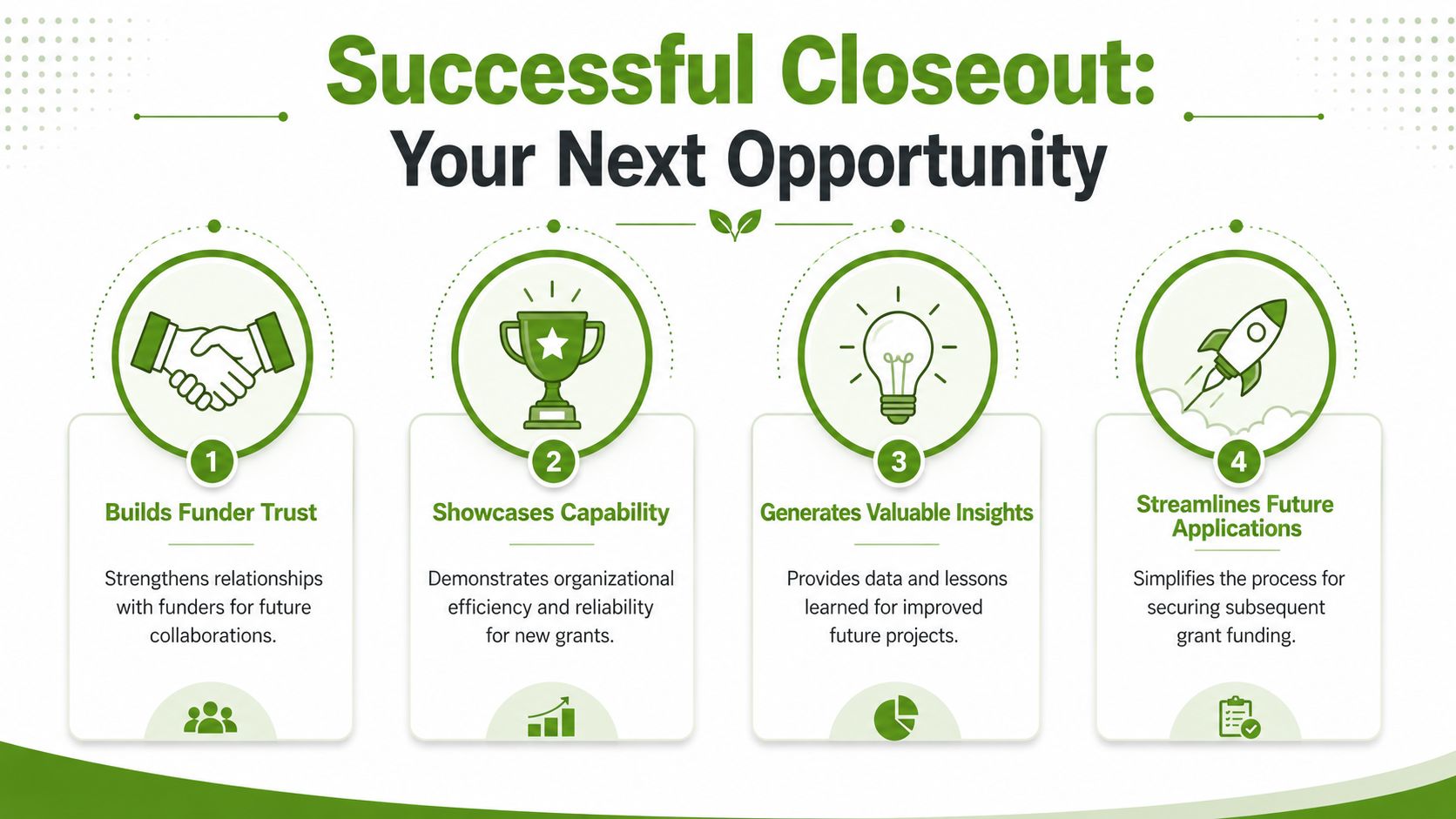
A successful closeout does more than end a grant. It creates the raw material for the next application, renewal, or funder conversation.
When your organization can point to a complete final record, a coherent narrative, and a clean financial package, you're not starting over next time. You already have proof of execution, language for outcomes, and a sharper understanding of where delivery matched plan and where it didn't.
The mistakes that keep repeating
Most recurring closeout problems are predictable.
- Scattered records: Teams save key approvals and supporting files in personal inboxes instead of the official award record.
- Late internal review: Draft reports reach finance or leadership too late for meaningful corrections.
- Weak subrecipient follow-up: Partner documentation becomes a last-minute chase.
- Unclear ownership: Everyone assumes someone else is preparing the final package.
- No post-close learning loop: The grant closes, but nobody captures what should change for the next award.
The habits worth keeping
A strong grant closeout process creates habits that improve the whole grant function.
| Common weakness | Better practice |
|---|---|
| Reporting starts near the end | Final report notes are collected throughout the award |
| Finance reconciles only at closeout | Expenses are reviewed against budget regularly |
| Program and finance compare work late | Both teams review the same grant record throughout |
| Files are archived reactively | Required documents are stored in a predefined structure |
| Closeout ends the conversation | The final package informs the next proposal |
Why funders notice
Funders may never see the internal scramble behind a rough closeout, but they always see the outcome. They see whether reports arrive on time, whether the numbers align, whether the narrative answers the obvious questions, and whether follow-up is professional.
That final impression carries weight. A clean closeout signals that your organization can manage restricted funds responsibly, learn from implementation, and finish what it starts.
The best teams treat closeout as a cycle:
- Document during implementation
- Review before the deadline pressure hits
- Submit a complete, consistent package
- Use the final file to strengthen the next proposal
That approach turns closeout from an exhausting endpoint into an asset.
If your team wants a better way to manage grants from opportunity tracking through reporting and renewal, Fundsprout helps centralize deadlines, documents, drafting, and compliance work so closeout doesn't become a last-minute scramble.
Try 14 days free
Get started with Fundsprout so you can focus on what really matters.