Foundation Funding Research: A Practical Guide for 2026
Master foundation funding research with our step-by-step guide. Learn to find, vet, and prioritize funders to secure grants for your nonprofit.

Abdifatah Ali
Co-Founder
You're probably staring at a messy spreadsheet, a bookmarked pile of foundation websites, and a program budget that still isn't final. Someone on your team said, “Let's start researching grants,” and now the work feels bigger than it sounded in the meeting.
That's normal. Most first-time foundation funding research goes off track for one simple reason: teams start with funders instead of strategy. They search by keyword, collect a long list, and only later realize half the prospects don't fund their geography, don't support their type of work, or aren't interested in the actual outcome the nonprofit delivers.
The fix is straightforward. Build your process in stages. First define what you need. Then find a broad universe of prospects. Then screen aggressively. Then study the few that survive. Then rank them and make a contact plan. That sequence saves time, protects staff energy, and gives you something much more useful than a giant list: a short list you can win.
Defining Your Funding Needs and Strategy
This is the step most small nonprofits skip, and it's the step that matters most.
If your team can't describe the funding need in a tight, concrete way, your research will stay fuzzy. You'll chase broad mission matches instead of qualified opportunities. That wastes weeks.
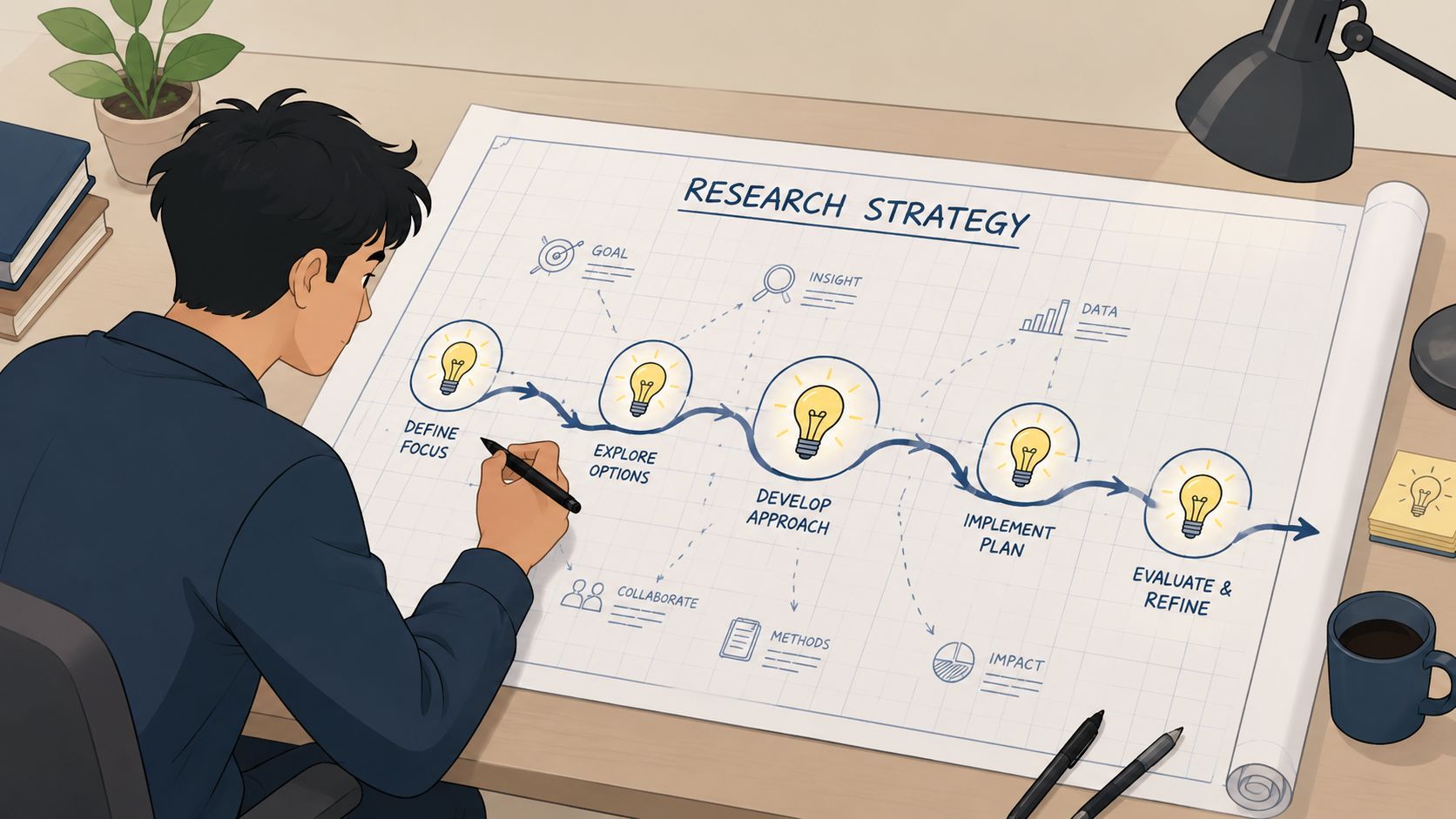
Start with a funder-ready need statement
Use a simple example. Say you run a local after-school arts nonprofit. Don't begin with “we need money for operations.” That's true, but it's not useful for research.
Write a one-page internal brief with five items:
Program need
“Expand after-school visual arts programming for middle school students.”Who benefits
“Students attending public schools in our county, especially those facing barriers tied to income, transportation, or limited access to arts enrichment.”Geographic scope
“Countywide, with initial delivery in three school partner sites.”Funding type needed
“Project support, plus a clearly stated share of overhead.”Request size and use of funds
Include staff time, supplies, evaluation, transportation, and administrative costs. If the budget isn't complete, pause and finish it before you research.
That brief becomes your search filter. It also helps your executive director, program lead, and development staff stay aligned when they review prospects.
Know where foundations fit
Foundations matter, but they are part of a larger funding environment. In 2022, the federal government funded an estimated 40% of basic research and businesses contributed 37%, according to the National Science Foundation's NCSES data. That matters because it reminds nonprofits not to treat foundations as the only serious source of support.
For small and community-based organizations, foundations often make the most strategic sense when you need support for work that is locally specific, early-stage, cross-disciplinary, or harder to package for government funding. They can also be a better fit when your program combines service delivery with experimentation, partnership building, or community trust.
Practical rule: If you can't explain why a foundation is the right funding vehicle for this project, you're not ready to research foundations yet.
Build search criteria before you open any database
Turn your one-page brief into a checklist your team can use.
- Program fit: Does the funder support this exact issue area, not just a vaguely related cause?
- Population fit: Does the language on the funder's site match the people you serve?
- Geography fit: Do they fund nationally, regionally, or only in a named city or state?
- Support type fit: Do they fund capital, project, general operating, research, or something else?
- Operational reality: Can your team manage the reporting, data collection, and grant period if you win?
A small nonprofit can also sharpen this profile by looking inward. For example, if your after-school program depends on unpaid tutors or event volunteers, reviewing your current systems for scheduling and retention can clarify whether you're asking for realistic staffing support. Practical resources like volunteer management tools can help you assess that capacity before you promise a foundation more delivery than your team can sustain.
The strongest foundation funding research starts with discipline, not discovery. Once your need is specific, your search gets faster and your shortlist gets better.
Finding Your Universe of Foundation Prospects
Once your criteria are clear, you can open the funnel.
This part should feel expansive. You're not trying to decide who gets an application yet. You're building a long list of possibilities, then preparing to cut it down hard.
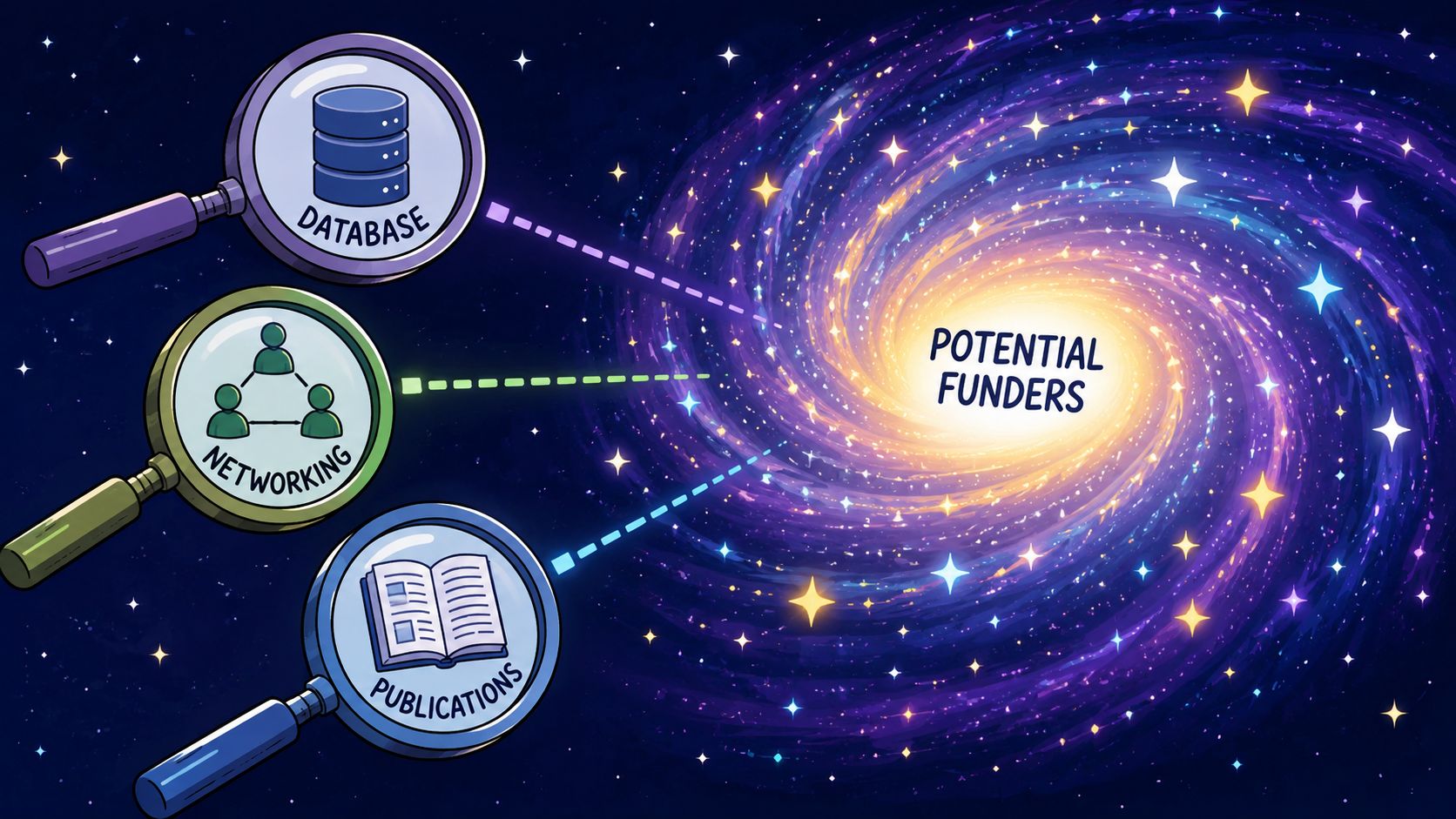
The universe is large. Foundation funding for scientific research includes over 926,000 grants totaling $208 billion awarded by nearly 70,000 nonprofits in a recent period, as described by the University of Virginia Data Science School. The practical takeaway isn't just scale. It's that there are more potential partners than most nonprofits realize, which is why random searching is such a poor method.
Option one is manual research
Manual research means reading publicly available materials one by one. That usually includes:
- Foundation websites: funding priorities, eligibility rules, deadlines, exclusions
- IRS Form 990-PF filings: grant history, recipient names, award patterns
- Annual reports and press releases: stated priorities and recent language shifts
- Board and staff pages: relationship clues and thematic interests
This approach is slow, but it teaches pattern recognition. A development director who reads enough 990s starts to spot useful signals: whether a funder makes repeat grants, whether grants cluster in one geography, and whether they prefer institutions that already look established.
Manual research is often the best place to begin if your budget is tight and your list is small. It's also useful when you're researching family foundations or local funders that aren't always well represented in broad search platforms.
Option two is a structured grant database
A dedicated database speeds up the same work by letting you filter for issue area, geography, support type, and eligibility. For many small nonprofits, that's a practical middle ground between doing everything by hand and paying for a full-service process.
What matters isn't the brand name alone. It's whether the filters match the way your organization works. If your team serves one county, a “national arts funder” result isn't nearly as helpful as a local or regional prospect with a history of funding similar programs.
When teams want a clearer side-by-side view of available grant search options, they can review guides to grant discovery platforms and compare the trade-offs in coverage, workflow, and screening depth.
Option three is AI-assisted discovery
AI-assisted prospecting can help when your staff time is more constrained than your ambition. Used well, it can sort through large volumes of opportunities and surface candidates that fit your stated program, location, and capacity.
That doesn't remove judgment. It changes where judgment gets used.
Instead of spending hours gathering names, your team spends its time checking alignment, reading context, and deciding whether a prospect is worth pursuing. That's a much better use of executive and development time.
A quick overview can help if your team wants to see a prospecting workflow in action.
Use one capture method
The tool matters less than the capture discipline. Every prospect should go into one working list with the same fields.
Use columns such as:
- Foundation name
- Website
- Primary issue area
- Geographic eligibility
- Typical support type
- Initial reason for inclusion
- Immediate concerns or disqualifiers
- Research status
A long list is only useful if every entry includes enough context for someone else on your team to understand why it's there.
For a first serious round of foundation funding research, your job is to build a broad universe without pretending every name is promising. Capture widely. Judge later.
Screening Prospects for True Alignment
In this context, strong teams separate themselves from busy teams.
A nonprofit can lose months pursuing a prestigious foundation that was never going to fund the work. Usually the warning signs were visible from the start: wrong geography, wrong grant type, too large or too small a request, or a mission statement that sounds close until you read the exclusions.
Why aggressive screening is worth it
Private foundations have a 30% grant success rate for nonprofits, while generic, unfocused approaches average 10%, according to Instrumentl's review of grant funder success rates. That's the clearest reason to screen ruthlessly. Every hour spent on a weak prospect reduces the time you can spend on a strong one.
For a small nonprofit, the hidden cost isn't just staff labor. It's opportunity cost. Your executive director delays relationship-building with better-fit funders because the team is still wrestling a bad lead through internal review.
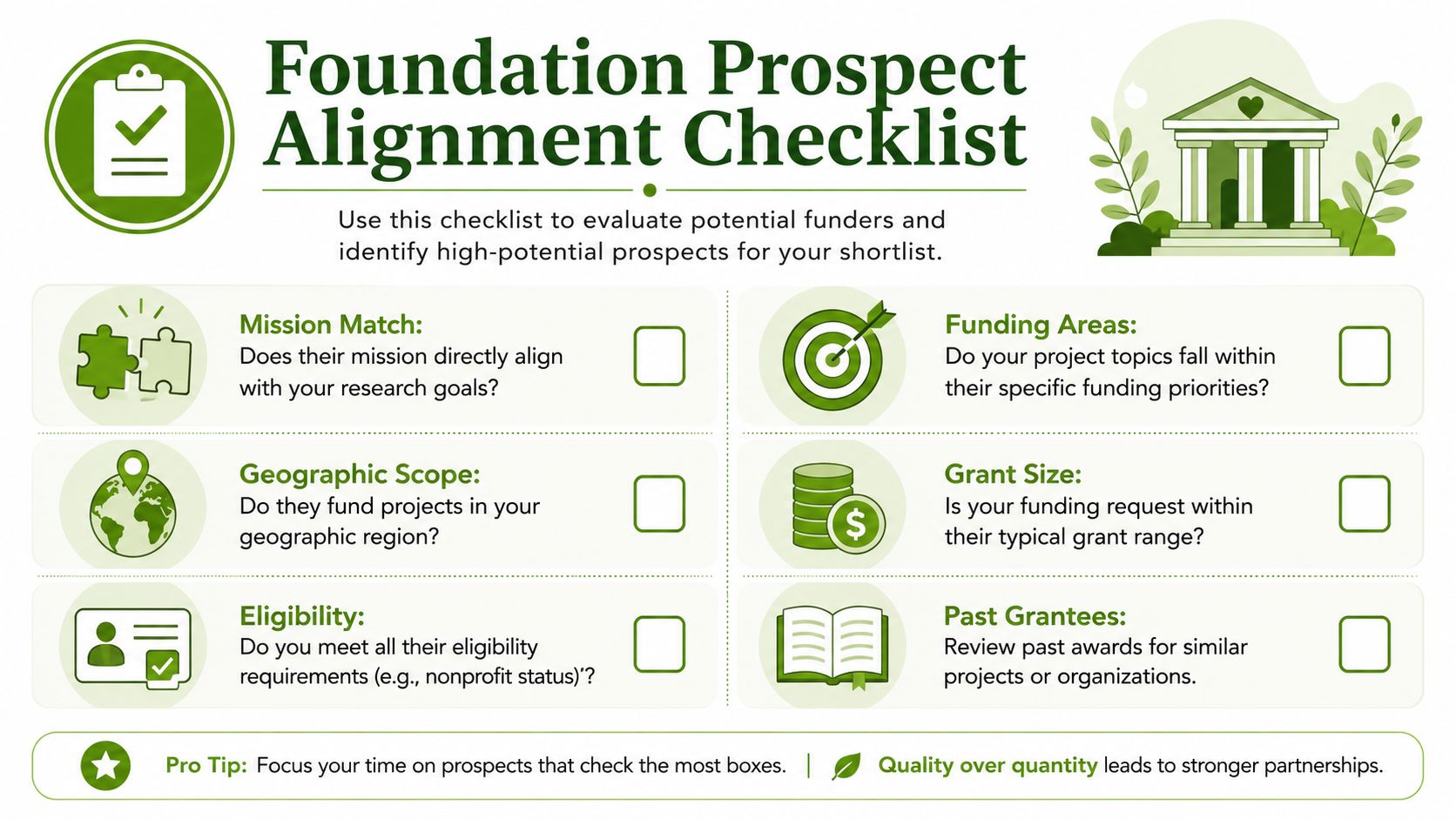
Use a go or no-go checklist
Don't rely on instinct alone. Review every prospect against essential criteria.
- Mission match: Does the funder clearly support your kind of work, using language that maps to your program rather than a broad social category?
- Funding priorities: Are your activities inside their stated program areas, or are you stretching a weak keyword overlap?
- Geographic scope: Do they fund your city, county, state, or region?
- Grant size: Is your likely request in line with what they usually award?
- Eligibility rules: Do you meet all stated requirements?
- Past grantees: Have they funded organizations or projects that resemble yours?
If the answer is “no” on geography or eligibility, stop there. Don't talk yourself into exceptions unless the funder explicitly invites them.
Screen for exclusions and hidden mismatch
The best disqualifiers are often buried in plain sight.
Some funders say they support education but only policy work. Others say they support youth but only through colleges, hospitals, or large civic institutions. Some fund only capital projects. Some don't fund religious organizations, public schools, advocacy, or regranting. Many list this in one sentence most applicants skim.
A practical first pass often looks like this:
| Screening item | Keep or cut |
|---|---|
| Geography fits exactly | Keep |
| Program area is adjacent but not explicit | Usually cut |
| Typical grants far below need | Usually cut |
| No nonprofit status match | Cut |
| Past grants show no comparable organizations | Caution |
| Funder excludes your model directly | Cut |
A strong team treats “maybe” as a warning, not a green light.
Narrow to winnable prospects
By this stage, you're not trying to be exhaustive. You're trying to be realistic.
If your initial list was broad, this is the moment to reduce it to the few prospects that deserve a deep dive. For teams that want a structured way to tighten that list around fit and competitiveness, resources on how to find winnable grants can help sharpen the filter.
A prospect isn't strong because the foundation is famous. It's strong because the fit is specific, documented, and actionable.
The quality of your shortlist usually predicts the quality of your grant calendar. When screening is weak, everything downstream gets harder.
Analyzing Funder Priorities and Past Giving
A qualified prospect still isn't the same thing as a high-probability prospect.
This is the stage where you stop asking, “Do they fund work like ours?” and start asking, “What problem do they believe they are solving, and how do they prefer that work to be framed?”
Read the funder across multiple documents
One page on a website rarely tells the full story. You need to combine several signals.
Start with the public-facing language. Look at how the foundation describes its priorities, who it names as beneficiaries, and what kind of change it seems to value. Then compare that with what its grant history suggests in practice. A funder may say it supports innovation, but its past awards may show a preference for established institutions, tightly scoped pilots, or long-standing local partners.
I usually look for three layers of meaning:
- Declared priorities from the website and guidelines
- Actual behavior from past grants and recurring grantees
- Decision style from how specific or vague the funder is about outcomes
When those three line up, you can build a credible strategy. When they don't, trust behavior more than branding.
Find the real answer to why fund us
Cornell Research Services notes that misalignment with funder priorities is the most common reason for rejection, and the same source highlights analysis showing 68% of rejected foundation grants lacked a clear “benefit-to-funder” narrative in 2024 to 2025. That's in the Cornell foundation funding guidance.
That phrase matters. Many nonprofits explain their own need well enough. Fewer explain how funding them helps the foundation accomplish its own agenda.
The difference is subtle but decisive.
Weak version: “Our students need more arts access.”
Stronger version: “Your foundation invests in youth development opportunities that reduce inequitable access to enrichment. Our program gives middle school students in your target geography sustained access to artist-led instruction, transportation support, and school-based participation structures that remove barriers to engagement.”
The second framing doesn't abandon the nonprofit's mission. It connects the mission to the funder's strategy.
Ask this in every prospect review: “If a program officer read our summary, would they immediately see how funding us advances their stated priorities?”
Look for proposal preferences hidden in past awards
A funder's portfolio can also tell you how they like projects designed.
The most frequent technical pitfall in research proposals is “domino aims,” where project goals depend on one another. This fatal flaw appears in 50% of failed research proposals, according to the Top Ten Grant Writing Mistakes guidance from PSF. That insight is useful even beyond formal research grants because it points to a broader lesson: funders often prefer projects with clear, independent components and visible fallback plans.
If their past grants consistently support discrete pilots, defined cohorts, or phased initiatives, don't bring them a sprawling plan where one delayed hire or one partner issue collapses the whole project.
Study the funded work and ask:
- Are grants supporting broad organizational growth or narrow projects?
- Do grantees present measurable, contained initiatives?
- Does the funder seem to reward partnerships, field-building, direct service, or research?
- Are repeat grants common, suggesting they value continuity and long-term learning?
Foundation funding research then becomes interpretation, not just collection. You're building a story about what the funder means by impact, risk, scale, and relevance. That story should shape every outreach choice you make next.
Prioritizing Prospects and Building an Outreach Plan
By now, your list should be short enough to manage and strong enough to act on. If it still feels bloated, the earlier screening wasn't strict enough.
The mistake I see here is teams treating every remaining prospect as equal. They're not equal. Some are obvious first priorities. Others belong in a later wave. A few should stay warm but inactive until your program or relationships change.
Score the shortlist
Use a simple matrix. Don't overengineer it. A small team needs a tool that supports decisions, not another spreadsheet monster.
| Foundation Name | Mission Alignment (1-5) | Relationship Potential (1-5) | Giving History Match (1-5) | Total Score |
|---|---|---|---|---|
| Foundation A | 5 | 3 | 4 | 12 |
| Foundation B | 4 | 5 | 3 | 12 |
| Foundation C | 5 | 2 | 5 | 12 |
Give each factor a quick justification in a notes field. “Mission alignment 5” is less useful than “Funds county-based youth arts access through schools.” The comment keeps your team honest.
Use the matrix to identify your top tier. In most first-round efforts, that means a very small number of prospects you would gladly put in front of your executive director and board.
Build a cultivation plan for the top prospect
Once one funder rises to the top, make the next steps concrete.
- Identify the right contact: Program officer, grants manager, or general inquiry route.
- Check for connection points: Board overlap, current funder introductions, community partners, or shared grantees.
- Prepare a short positioning summary: One paragraph on the problem, one on your solution, one on why this funder is a fit.
- Draft a clean LOI opening: Lead with the fit, not your history.
- Set an internal owner: One person should move the prospect forward.
A good outreach plan doesn't sound like a cold solicitation. It sounds like a disciplined attempt to start the right conversation.
The “why fund us” line should be visible early because 68% of rejected foundation grants lacked a clear benefit-to-funder narrative, as noted in the earlier Cornell guidance. That's why ranking should favor prospects where your team can explain mutual fit without strain.
Don't prioritize the prospect with the biggest name. Prioritize the prospect where your narrative lands cleanly and credibly.
If your executive director needs help shaping a concise, persuasive external narrative, resources on creating winning pitch decks can be surprisingly useful. The audience is different, but the discipline is the same: clarity, sequencing, and a strong reason to care now.
A strong shortlist plus a written outreach plan is where research starts turning into revenue work.
Tracking Your Work and Planning for Renewals
Most nonprofits treat tracking as administrative cleanup. It's not. It's a fundraising asset.
The first reason is simple. Without a reliable system, deadlines slip, follow-ups disappear, and no one remembers which version of the budget went to which foundation. The second reason is more important. Good tracking creates institutional memory that survives staff turnover.
Track more than deadlines
Your system can be a spreadsheet or a dedicated platform. Either way, capture the details that matter later:
- Contact names and roles
- Submission dates and decision timing
- Past conversations and next actions
- Proposal version used
- Reporting requirements
- Renewal eligibility and likely timing
- Lessons learned after each submission
If your team handles a lot of attachments, reporting files, and recurring documentation, it helps to borrow workflow habits from operations. Practical guides like this guide to automating document collection for SMBs can help small nonprofits think more systematically about file collection and repeatable document processes.
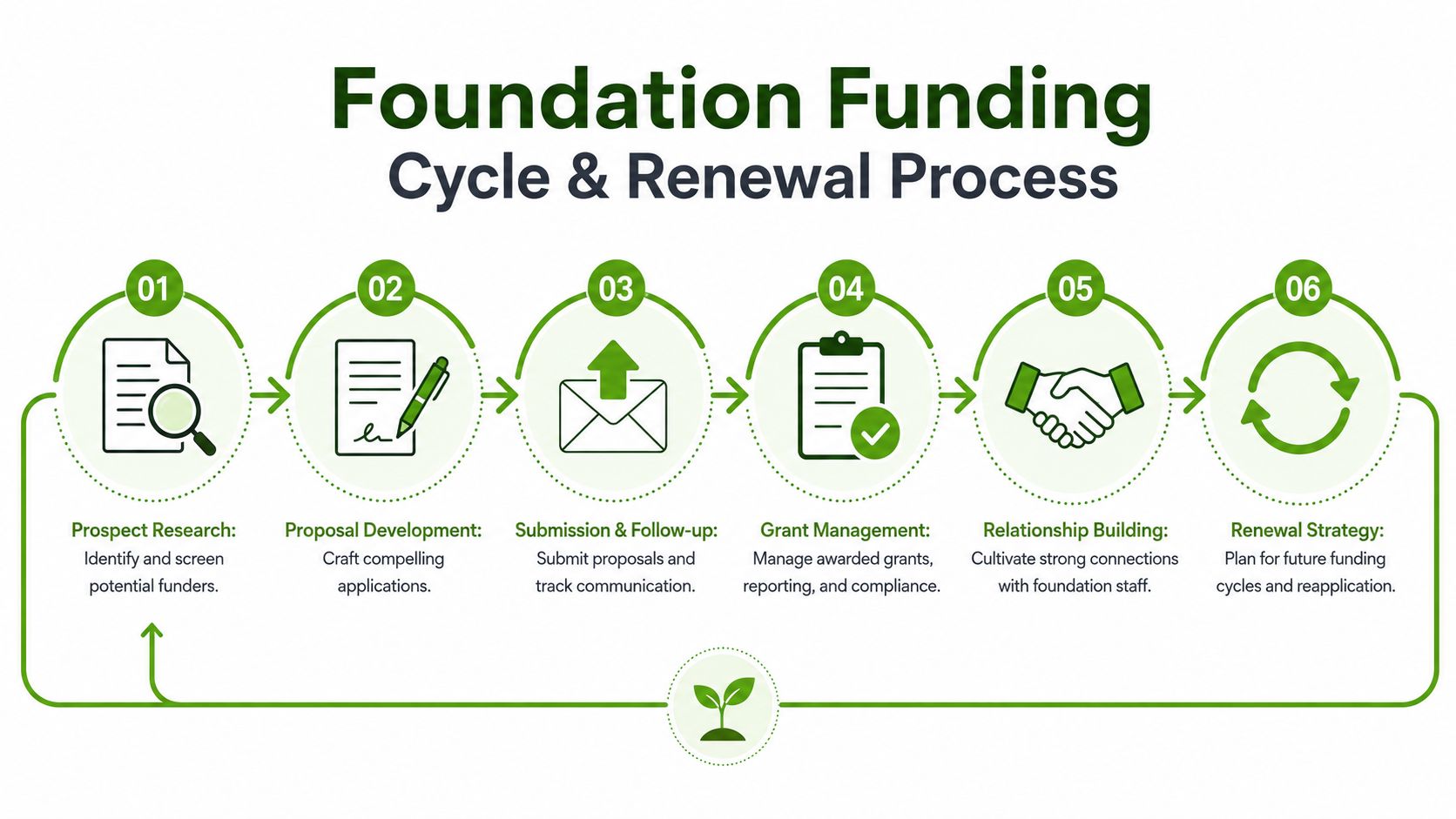
Renewals start earlier than most teams think
A grant isn't finished when the award arrives. The renewal case starts with grant management, reporting quality, and relationship consistency. Teams that document funder preferences, reporting formats, and communication history make future requests much easier to prepare.
If you're evaluating systems that can centralize those records and reduce manual chasing, it's worth reviewing nonprofit grant management software with an eye toward renewal workflows, not just first submissions.
The nonprofits that improve over time aren't necessarily the ones doing the most research. They're the ones turning each cycle into better judgment, cleaner records, and stronger next asks.
If your team wants help turning foundation funding research into a ranked pipeline, stronger proposals, and a cleaner path from application to renewal, Fundsprout is built for exactly that. It helps nonprofits find relevant opportunities, organize grant work, and keep compliance and renewals from slipping through the cracks.
Try 14 days free
Get started with Fundsprout so you can focus on what really matters.