Finding a Foundation for Islamic Education: Your 2026 Guide
Seeking a foundation for Islamic education? This guide covers funder types, eligibility, proposal tips, and how to find grants for your school or program.

Abdifatah Ali
Co-Founder
Your board just approved a program expansion. Parents are asking for more Arabic, stronger Quran instruction, better student supports, maybe even a middle-school track. Then the budget meeting starts. Tuition can't carry everything. Annual fundraising is inconsistent. Staff are already stretched. The school or nonprofit isn't failing, but it isn't financially secure either.
That tension is common in Islamic education. Leaders are trying to preserve mission, maintain trust, and build something durable for the next generation. The mistake I see most often is treating grants as occasional rescue money. In this field, the better approach is to treat foundations and other institutional funders as part of a long-term funding architecture, alongside tuition, major gifts, community giving, and when appropriate, waqf-based support.
A strong funding strategy for Islamic education doesn't copy generic nonprofit playbooks word for word. It has to account for religious identity, educational outcomes, community credibility, and the realities of faith-based philanthropy. If you're looking for a foundation for Islamic education, the work starts with understanding where your organization fits and how to present it clearly to the right funders.
The Growing Need for Sustainable School Funding
A familiar scene plays out in a lot of Islamic schools and education nonprofits. A director sits with two lists. One list has what the community needs: curriculum development, teacher training, student support services, technology, facility improvements, family engagement. The other list has what the current budget can absorb. Those lists rarely match.
The pressure isn't just internal. The field itself has grown. The Institute for Social Policy and Understanding reports that the number of full-time Islamic schools in the United States rose from approximately 50 to 235, a growth rate of roughly 370%, which points to a much larger educational infrastructure than earlier generations had to work with, as documented in ISPU's data-based profile of Islamic schools in the United States.
That growth is encouraging, but it creates a harder management problem. More schools, more programs, and more family expectations mean leaders need stronger financial systems, not just stronger fundraising appeals.
Why one-time fundraising doesn't solve the problem
A dinner banquet can fund a gap. It usually can't fund a multi-year staffing plan. A Ramadan campaign can help with operations. It usually won't underwrite curriculum design, governance strengthening, or program evaluation in a way that funders can track.
Foundation funding proves valuable. Not because it replaces community support, but because it can support defined projects, capacity-building work, and strategic investments that tuition and general donations often can't absorb cleanly.
Practical rule: If your expansion plan depends on one successful event, you don't have a growth strategy yet. You have a hope strategy.
Leaders who make progress usually stop asking, "Who might give us money?" and start asking, "What kind of funder supports this kind of educational work, and what evidence will they need?"
Stability starts with planning
Before you approach any foundation for Islamic education, get clear on what sustainability means for your program. That may involve mapping recurring costs, identifying what belongs in earned revenue versus philanthropy, and defining which investments are one-time versus ongoing. A practical starting point is this guide on what a sustainability plan is, especially if your team tends to chase opportunities before deciding how the program will last.
The strongest organizations don't present need alone. They present a path.
Understanding the Funder Landscape for Islamic Education
Most nonprofit leaders enter grant seeking with a blurry mental map. They know there are foundations out there, but not how those funders differ, or which ones are realistic. In Islamic education, that confusion gets sharper because the field sits at the intersection of faith, schooling, culture, and community development.
A better way to think about it is as a funding ecosystem. Different funders play different roles. If you ask each one for the same thing, your hit rate will stay low.
The four funder types that matter most
Private foundations are usually the first category people think of. These are independent grantmakers, often family or institutionally governed, with defined priorities. Some fund education broadly. Some support religious communities. A smaller set aligns directly with Islamic education.
They can be excellent prospects when your work matches their stated mission. They're less useful when you're stretching your story to fit a generic education category that doesn't really match your core identity.
Community foundations operate with a place-based lens. They often care about local youth development, education access, enrichment, family stability, and community wellbeing. If your Islamic school serves a clear regional population and can describe outcomes in community terms, these funders can be more accessible than national foundations.
The trade-off is that they may be less interested in explicitly devotional programming. You need to frame the request around educational and community benefit without diluting your mission.
International philanthropies can matter for some organizations, especially those with diaspora relationships or broader educational initiatives. These funders may understand Islamic educational language more intuitively, but they often come with added diligence, cross-border questions, and sometimes a different set of expectations about governance or reporting.
They aren't automatically better. Instead, they require a different level of organizational readiness.
Waqf is the category many leaders mention, but not always in a way that translates into modern fundraising practice. A waqf is a charitable endowment structure in the Islamic tradition. In practical terms, it is designed to preserve an asset or principal base while directing benefit over time toward a charitable purpose.
How waqf differs from a Western foundation model
A conventional foundation often distributes grants from invested assets according to board-approved priorities. Waqf, by contrast, is rooted in the idea of preserved charitable capital with enduring public or communal benefit. The language, legal structure, and administration can vary by jurisdiction and institution, but the governing spirit is long-term stewardship.
That distinction matters because many Muslim donors think in waqf terms even when they don't use the term formally. They may care less about a one-year program and more about permanence: scholarship funds, faculty support, library development, land, facilities, or endowment-building.
Islamic education funders often respond to two different value propositions. Immediate student impact, and durable community legacy. If you only present one, you may miss the donor's real motivation.
Comparison of Funder Types for Islamic Education
| Funder Type | Typical Focus | Average Grant Size | Best For |
|---|---|---|---|
| Private foundations | Mission-aligned education, capacity building, targeted programs | Varies | Defined projects with strong fit |
| Community foundations | Local education, youth, families, civic impact | Varies | Regionally rooted schools and community programs |
| International philanthropies | Education, religious learning, community development | Varies | Organizations with strong governance and cross-border credibility |
| Waqf or waqf-like giving | Long-term charitable benefit, legacy assets, enduring support | Varies | Endowment, scholarships, facilities, and permanent educational infrastructure |
If your team is still sorting through the mechanics of institutional fundraising, this overview of foundation grants for nonprofit organizations is a useful companion. It helps translate broad grant terminology into actual fundraising decisions.
What works and what doesn't
What works is matching the ask to the funder type. A curriculum pilot may fit a private foundation. A parent engagement initiative may fit a community foundation. A scholarship endowment conversation may fit waqf-minded donors.
What doesn't work is sending the same proposal everywhere and changing only the cover letter. Funders can tell.
How to Research and Prioritize Potential Funders
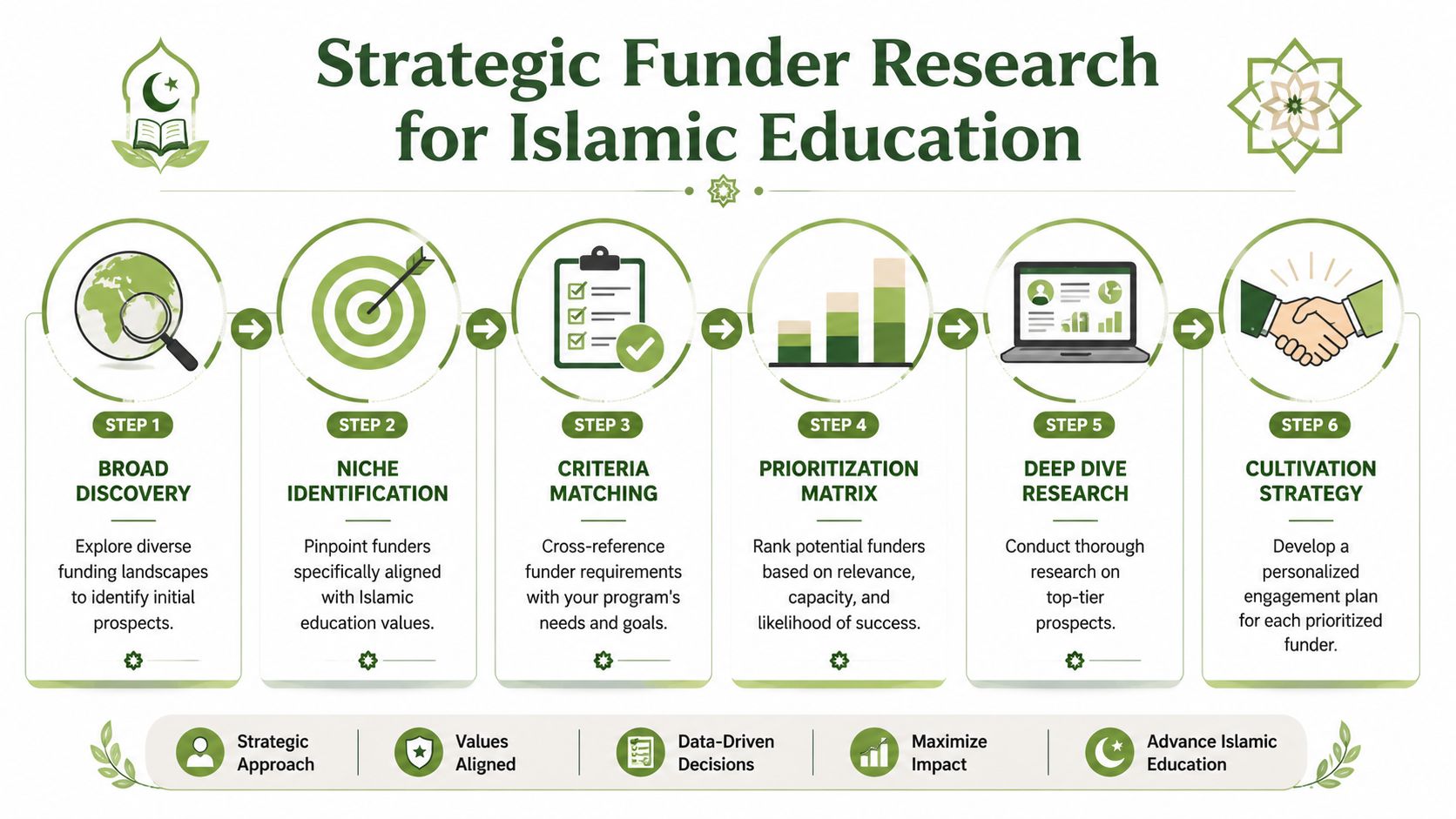
Most weak prospect lists are built too quickly. Someone searches for education grants, exports names into a spreadsheet, and starts applying. That creates activity, not strategy.
The goal isn't to build the longest list. It's to build the shortest credible list.
Start broad, then narrow fast
Use grant databases and prospecting tools to cast the first net. Search terms should include your direct mission and adjacent language. Try combinations such as Islamic education, faith-based youth programs, private school support, character education, youth development, family literacy, after-school enrichment, and civic leadership.
The point is to find overlap, not to force a perfect phrase match. A foundation may never use the term "Islamic education" publicly and still be a strong prospect for your tutoring, youth leadership, or teacher development program.
For teams comparing research tools, this roundup of grant discovery platforms is a practical place to start.
Build a prioritization matrix
Once you have an initial pool, score prospects against a few simple criteria:
- Mission alignment. Does the funder's giving language match what you do?
- Program fit. Would this funder support the specific request, not just your organization in theory?
- Geographic relevance. Do they fund in your state, city, or service area?
- Access path. Do you have a board connection, community introduction, or open application route?
- Institutional readiness. Can your team meet their reporting and documentation expectations?
Some organizations use a color-coded spreadsheet. Others use a CRM. The format matters less than the discipline. You want a ranked list, not a pile of names.
Field note: If a prospect only makes sense after three layers of reinterpretation, remove it. Good prospects don't need elaborate justification.
Read the evidence, not just the homepage
Foundation websites are polished. Their grant history is more revealing. Look for patterns in past grantees. Are they funding schools, direct services, capital projects, scholarship programs, or general operations? Do they support faith-based organizations openly, or only when the program is framed in secular educational terms?
Then review public tax filings where available, especially the 990-PF for private foundations. You're looking for practical clues: regularity of giving, kinds of recipients, repeat grants, and whether the foundation seems comfortable with smaller emerging organizations or prefers established institutions.
A strong shortlist usually ends with three tiers:
- Top tier with clear alignment and a realistic path to engagement
- Middle tier with partial fit that may work with reframing
- Watch list for future cultivation, not immediate application
That kind of discipline saves staff time and protects proposal quality.
Crafting a Proposal That Resonates
A generic education proposal rarely works for Islamic education organizations. If it strips out faith, it sounds hollow. If it leans only on identity and devotion, some funders won't know how to assess feasibility. The strongest proposals do both jobs at once. They speak to the head and the heart.
The head is structure, educational logic, staffing, implementation, budget, and outcomes. The heart is why the program matters to families and community life: identity formation, moral grounding, belonging, literacy in religious tradition, and intergenerational continuity.
Lead with a design funders can understand
Funders trust what they can picture. If your program description is vague, they assume implementation will be vague too.
One useful benchmark comes from an Islamic Foundations diploma described by Usul Academy as a 9-month program with 9 courses delivered both synchronously and asynchronously, an example of how structured cadence, modular sequencing, and hybrid access can make an educational model legible and assessable to funders, as shown on the Diploma in Islamic Foundations page.
That doesn't mean every proposal needs to copy that model. It means your proposal should answer basic operational questions clearly:
- Duration. How long does the program run?
- Sequence. What are the instructional components and in what order?
- Delivery. In person, online, hybrid, weekend, after school?
- Engagement. How will students stay connected and complete the program?
- Outcomes. What will participants know, do, or produce by the end?
Keep the faith identity, but translate the impact
A common mistake is overcorrecting for secular funders by sanding down the mission until the proposal could describe almost any youth program. Another mistake is assuming every reviewer already understands terms, context, and educational purpose inside a Muslim community.
Do the translation work for them. If you use terms like hifz, tarbiyah, fiqh, or adab, explain them in plain English. If the program preserves religious literacy and moral development, connect that to educational consistency, family engagement, student confidence, or other mission-relevant outcomes.
Don't hide the faith basis of the program. Clarify it. Ambiguity creates more risk than honesty.
Use the head and heart test
Before submitting, read the narrative and ask two questions.
Does the proposal prove this program can run well?
Does it also prove this program matters greatly?
If the answer to either question is no, revise.
A strong proposal often includes these ingredients:
- A concrete problem statement tied to your students and families, not abstract theory
- A credible implementation plan with named roles and defined activities
- Mission language with context so non-specialist reviewers can follow it
- A realistic budget narrative that matches the program design
- A stewardship mindset that signals you will report clearly and on time
The best proposals in this field don't apologize for being faith-based. They show that faith-based and professionally managed can, and should, sit in the same sentence.
Navigating Eligibility and Compliance Issues
Compliance anxiety stops a lot of good organizations from pursuing grants aggressively. That's understandable. Faith-based nonprofits often worry they'll be screened out, misunderstood, or asked to separate their religious identity from their educational mission in ways that feel artificial.
In practice, most compliance issues are less mysterious than they seem. They're about legal status, financial clarity, governance, and program description.
What funders usually need to see
If you're applying for institutional grants, have these documents current and easy to share:
- 501(c)(3) determination letter if you operate as a nonprofit eligible for charitable funding
- Board list with affiliations that show governance depth and oversight
- Current operating budget and project budget
- Recent financial statements prepared cleanly and consistently
- Organizational description that explains your faith-based mission in plain language
- Policies that address gifts, conflicts, and financial controls where relevant
Funders ask for these materials because they are trying to assess risk. They want to know whether your organization can receive restricted funds, manage them responsibly, and report on their use without confusion.
The issue beneath the paperwork
For Islamic education organizations, one recurring challenge is how to describe programming that includes both religious instruction and broader educational value. Secular funders may support components tied to literacy, youth development, teacher training, family engagement, student wellbeing, or academic enrichment, while avoiding direct support for devotional activity.
That doesn't mean you should disguise what you do. It means you should define which parts of the program are charitable, educational, and measurable in ways the funder can lawfully support.
A proposal gets into trouble when the budget, narrative, and outcomes don't line up. If you say you're requesting support for educational enrichment, but the activities and line items are described only in devotional terms, the reviewer has to guess. That's where denials happen.
Reviewers don't reject only because a program is faith-based. They reject when they can't tell what they are funding, how it will be governed, or whether the organization can document it.
Policies signal maturity
One document that gets overlooked is a gift acceptance policy. It helps boards decide what kinds of donations they can responsibly receive, under what conditions, and with what review process. For organizations balancing religious mission, restricted gifts, in-kind contributions, and long-term stewardship, Stobbe Design's guide to gift policies is a helpful reference point.
Organizations that prepare these materials before they need them always look more credible than those scrambling the week an LOI is due.
Funder Spotlights and Anonymized Case Studies
A real foundation for Islamic education is exemplified by Foundation for Islamic Education Inc. Public nonprofit information identifies it as a U.S. nonprofit based in Exton, Pennsylvania, established in 1990, focused on advancing Islamic education in North America, with 2023 revenue of $673,752, according to its Foundation Directory profile.
That profile tells you a few useful things without speculation. First, this is a specialized funder, not a broad religious-services entity. Second, it has operating history that signals longevity. Third, it sits in a defined niche, which matters when you're deciding how closely a prospect aligns with your mission.
Case study one
A weekend Islamic school had a decent donor base but weak institutional fundraising habits. The team kept approaching broad education funders with vague requests for "program support." The applications didn't move.
The turnaround came when leadership narrowed the ask. They presented a teacher training and curriculum improvement project with a clear implementation sequence, identified who would lead it, and explained why stronger instructional consistency mattered for student learning and family trust. The proposal became easier to evaluate because it described an educational system, not a general aspiration.
Case study two
A community nonprofit running youth Islamic learning programs wanted foundation support but assumed only Muslim funders would understand the mission. That assumption limited the prospect pool.
The organization eventually reframed one initiative around youth development, mentorship, and family engagement while keeping the faith-based context clear. They pursued local and mission-aligned institutional prospects instead of only waiting for explicitly Muslim funders to appear. The shift worked because the team matched the request to the funder's frame without erasing who they were.
The pattern worth noticing
In both situations, success didn't come from better adjectives. It came from tighter fit, clearer packaging, and more disciplined prospect selection.
Building Your Funding Pipeline for Long-Term Success
A single grant can help. A pipeline changes the organization.
Strong Islamic education nonprofits usually manage funding in stages. Some prospects are in research. Some are being cultivated. Some are ready for an LOI. Others need reporting and renewal planning. When leaders track those stages deliberately, grant work stops feeling chaotic.
What a healthy pipeline includes
Keep your list moving across a few lanes:
- Research lane for newly identified prospects that still need qualification
- Active lane for current applications and scheduled submissions
- Stewardship lane for grants already awarded, with reporting dates and relationship notes
- Renewal lane for funders that may support another cycle if you perform well
Stewardship drives future opportunity. If you send thoughtful updates, meet deadlines, and document outcomes cleanly, funders learn that your organization is dependable.
One more resource worth reviewing is this short walkthrough:
Small teams have a particular challenge here. The same person may be managing programs, parent communication, board requests, and grants. That's why systems matter. You need one place to track deadlines, proposal status, required attachments, reporting obligations, and the details that shape each funder relationship.
The organizations that build durable support for Islamic education don't treat grants as isolated wins. They build a repeatable process, protect institutional memory, and keep the mission legible to every funder they approach.
If you're ready to build a stronger grant pipeline, Fundsprout helps nonprofits find aligned funding opportunities, organize proposal work, track compliance materials, and manage reporting from application through renewal. For lean teams trying to fund Islamic education without losing momentum, it can bring much-needed structure to the process.
Try 14 days free
Get started with Fundsprout so you can focus on what really matters.