Build a Foundation for a Just Society: Nonprofit Guide
Guide nonprofits to build a foundation for a just society. Shift from charity to systemic change with practical steps on program design & funding. Start today!

Abdifatah Ali
Co-Founder
Your team is probably doing good work and still struggling to explain why it matters in grant language.
You may have a program that serves families every day, a board that wants clearer outcomes, and funders asking for “systems change” when your staff is already stretched just delivering services. That tension is common. Nonprofits often sit between urgent needs in front of them and larger injustices that created those needs in the first place.
The idea of a foundation for a just society becomes valuable. Not as a slogan, but as a method to sharpen program design, better align fundraising, and simplify impact explanation. When justice integrates into operations, it ceases to be abstract, instead shaping choices regarding leadership, funding allocation, success metrics, and the nature of change your organization seeks to produce.
Beyond Buzzwords An Introduction to Justice-Centered Work
At 8:30 on a Tuesday morning, a housing nonprofit is preparing for a full day. The intake team is returning calls from tenants with lockout notices. The development director is drafting a grant report. The executive director is reviewing board questions about outcomes. Everyone is working hard, yet the organization keeps running into the same problem. Its mission speaks about dignity and housing stability, while its reporting still centers on case volume, appointments completed, and emergency grants processed.
That mismatch is where many nonprofits get stuck. The work is real. The need is urgent. But the story the organization tells about its impact is often too narrow to explain how services connect to lasting change.
Justice-centered work gives that connection a structure. It helps a nonprofit explain how immediate help, community voice, and system repair fit together in one program strategy.
What justice-centered work looks like in practice
Consider a fictional tenant support group called Eastside Housing Partners. For years, the organization did solid direct service work. Staff helped residents respond to eviction notices, negotiated with landlords, and referred families to emergency cash assistance. Their reports showed activity clearly. Cases closed. Households served. Court filings answered.
Then the team noticed a pattern. The same buildings kept appearing in intake. The same maintenance failures led to the same legal threats. The same residents returned with new problems a few months later.
So the organization adjusted its program design.
Case managers started logging building-level patterns, not only individual crises. Staff invited tenants to help shape workshop topics and outreach priorities. The nonprofit partnered with a legal aid group and a neighborhood association to document recurring code violations. Over time, the organization could show a fuller chain of impact: fewer emergency filings in target buildings, stronger tenant participation, better enforcement conversations with the city, and residents taking visible leadership roles.
That is the heart of justice-centered work. Service remains part of the model, but the program also pays attention to who defines the problem, where the pattern comes from, and what would reduce repeat harm.
A strong nonprofit strategic plan example for mission, programs, and outcomes can help teams map that chain clearly enough for staff, boards, and funders to use.
Justice work becomes fundable when you can describe the path between immediate support and long-term structural change.
Why the term gets fuzzy
Many organizations use the word "justice" to signal values, but values alone do not guide operations. Program staff still need to decide what they will measure. Fundraisers still need to explain why community leadership belongs in the budget. Boards still need to see how today's activities connect to the mission in a way that is concrete.
A useful analogy is building maintenance. If a ceiling keeps leaking, you can place buckets on the floor every time it rains. Buckets matter because they protect the room today. A justice-centered approach also inspects the roof, tracks where the water enters, asks why repairs were delayed, and gives the people using the room a say in what gets fixed first. In nonprofit terms, that means the organization treats recurring harm as a design problem, not only a service volume problem.
That shift matters across many types of organizations, not only policy shops or advocacy groups. A youth program can examine discipline practices and student voice. A clinic can track which barriers keep patients returning in crisis. An arts group can change who curates, decides, and gets paid. Justice is less a sector label and more a management lens.
A practical test for your own organization
If your team is trying to tell whether justice shows up in daily operations, start with three checks:
- Problem definition: Who has the strongest voice in naming the issue and shaping the response?
- Success measures: Do your metrics stop at service counts, or do they also track changes in access, participation, leadership, policy, or institutional behavior?
- Resource flow: Does funding stay concentrated inside the organization, or does some of it support community members, partners, and affected groups to lead parts of the work?
These questions help translate a broad moral idea into program choices, staffing choices, and fundraising choices.
A foundation for a just society is built through repeated decisions about strategy, measurement, partnership, and power.
From Charity to Systemic Change A New Framework
The simplest way to understand justice-centered work is the old river story. People are standing on the bank pulling babies out of the water. Everyone rushes to help. That's necessary work. Then one person starts walking upstream to find out why babies keep falling in.
That upstream move is the difference between charity and systemic change.

What the charity model does well
Charity responds to immediate need. It feeds people tonight, shelters families this week, provides emergency cash, fills prescriptions, and pays for transport to appointments. None of that is small. When people are in crisis, speed matters.
The problem is not charity itself. The problem is stopping there.
If your organization only gets funded to pull people from the river, staff can become trapped in permanent emergency mode. You work hard, people still suffer, and the same crisis returns next month.
What a justice model changes
A justice model asks different operational questions:
- What systems produced this harm
- Who benefits from the status quo
- What would reduce the need for emergency response over time
- How are affected communities shaping the solution
That shift changes program design, staffing, partnerships, and grant language. It also affects planning. A strategic plan built around outputs alone will keep teams downstream. A plan built around root causes gives staff permission to work on prevention, policy, leadership, and institutional change. A useful reference for that planning work is this guide to a nonprofit strategic plan example.
Here's a side-by-side view.
| Aspect | Charity Model (Addressing Symptoms) | Justice Model (Addressing Root Causes) |
|---|---|---|
| Primary goal | Meet urgent needs | Change conditions that create repeated harm |
| Main activity | Deliver services quickly | Combine services with organizing, advocacy, leadership, or systems reform |
| Role of community | Receives help | Helps define problems and direct solutions |
| Time horizon | Immediate relief | Long-term change |
| Typical success marker | Number served | Shifts in access, power, policy, practice, or community leadership |
| Funding fit | Short-term project support | Multi-year support tied to structural change |
A short explainer can help make the contrast visual in team meetings:
How to evaluate your current programs
You don't need to abandon direct service to move upstream. Most nonprofits evolve by layering justice practices into existing work.
For example, a workforce program may begin with job placement. Moving upstream could mean identifying employer screening practices that exclude applicants, convening workers to shape training priorities, or pushing for better local hiring standards. A domestic violence program may continue crisis response while also investing in survivor leadership, court reform, and housing access.
Practical rule: Keep the life-saving work. Add the work that makes the life-saving work less necessary over time.
That is the framework behind a foundation for a just society. It treats urgent service as part of the response, not the whole strategy.
The Three Pillars of a Justice-Focused Approach
Once organizations shift upstream, they often ask the next hard question. What does justice look like in daily decisions?
I use three pillars: equity, participation, and accountability. They sound familiar, but each one has a practical meaning in program design and fundraising.
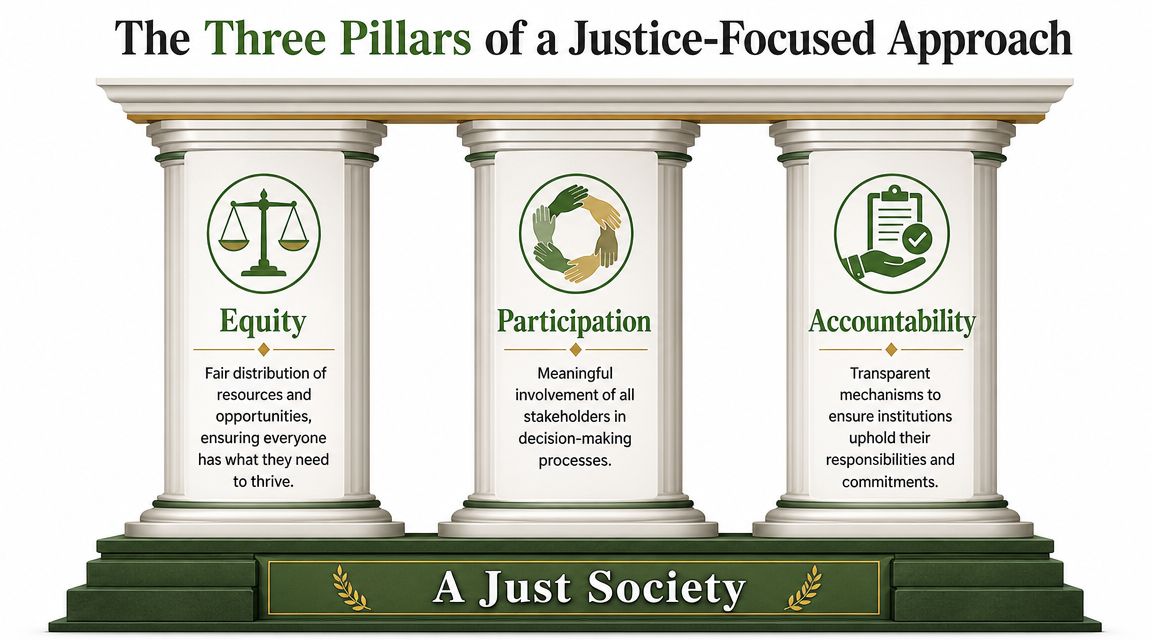
Equity means giving people what they need to succeed
Equality gives everyone the same box to stand on. Equity notices that people are starting from different ground.
In nonprofit terms, equality says every participant can attend the workshop. Equity asks who can't attend unless you provide translation, childcare, transport, flexible scheduling, disability access, or stipends.
A college access program offers a simple example. Equality is sending the same application checklist to every family. Equity is offering support in the languages families use, helping first-generation students interpret the process, and adapting hours for caregivers who work evenings.
Equity is not a bonus feature. It is the work of removing barriers that make opportunity uneven.
Participation means people affected by the issue help shape the solution
A lot of organizations gather feedback. Fewer share decision-making power.
Participation begins with “nothing about us without us,” but it doesn't end with a listening session. Real participation changes who sits on advisory groups, who approves priorities, who helps hire staff, and who influences budget choices.
A youth program can say it values youth voice. A participatory version would let young people help choose program topics, set meeting norms, review staff candidates, or direct a small project budget. That is different from asking for opinions after adults have already decided everything.
Signs participation is real
- Community members influence choices: They do more than comment. They shape priorities.
- Meetings are accessible: Interpretation, stipends, timing, and transport are considered.
- Power is visible: Staff can point to decisions changed by community input.
Accountability means answering to the community, not only the funder
Most nonprofits are very good at reporting upward. They submit outcomes, budgets, and narratives to foundations. Justice-centered organizations also report outward and downward. They make themselves answerable to the people they claim to serve.
That can look like public progress updates, community review panels, grievance processes people trust, or annual sessions where leaders explain what changed based on feedback.
A housing organization, for instance, might create a resident accountability forum that reviews whether the group's advocacy reflects tenant priorities. A health clinic might publish wait-time concerns and the operational fixes being tested.
If the community has no meaningful way to correct your course, accountability is incomplete.
These pillars help readers move from aspiration to design. They also help grantmakers assess seriousness. Many funders can tell when “justice” appears only in branding. They look for evidence in who leads, who decides, and who benefits.
Translating Principles into Nonprofit Programs
A program director approves a tutoring schedule, hires staff, and opens registration. Six weeks later, attendance looks uneven. Families are interested, but some students cannot stay after school, some caregivers need help with meals, and some young people do not see their own priorities reflected in the program. The problem is not the mission. The problem is the design.
That is the practical test of justice work. A value such as fairness has to show up in the choices a team makes about hours, staffing, budget, outreach, feedback, and outcomes. If those choices stay the same, the language changes but the program does not.
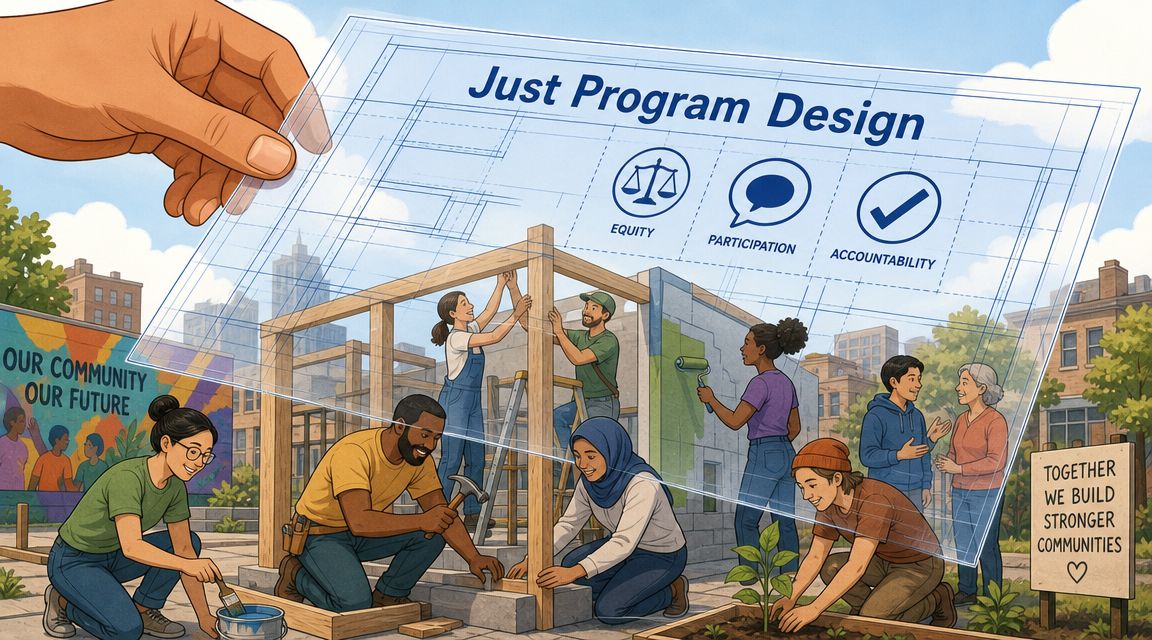
Before and after in program design
One useful way to understand this shift is to treat program design like renovating a building people already use. If the front door has stairs and no ramp, offering a warmer welcome does not solve the access problem. You have to change the structure.
An after-school tutoring program makes the point clearly.
Before: Students attend tutoring two afternoons a week. Success is measured by attendance and homework completion.
After: Staff learn that transportation is inconsistent, caregivers need dinner support, and students want a voice in what happens after the academic portion ends. The redesigned program adds meals, transportation help, family input sessions, and a youth advisory group that shapes enrichment topics. The team also tracks recurring barriers to participation and uses that pattern in advocacy with school partners.
The tutoring service still matters. The difference is that the program now fits the conditions families are managing.
A clinic can make a similar shift.
Before: The clinic provides health education workshops.
After: Patients help set workshop topics. Interpretation is included from the start. Appointment rules are reviewed for hidden barriers such as paperwork, scheduling, and communication practices. A patient council influences outreach priorities, and staff bring repeated patient concerns into discussions with partner institutions that control referral systems or service access.
A simple redesign process
Justice-centered design becomes manageable when a team breaks it into a few operating questions. Start with one program. Treat it like a pilot site for learning, not a full organizational overhaul.
Map the barriers
- List what prevents people from participating fully.
- Include practical barriers such as hours, transportation, documentation, language access, digital access, child care, and trust.
Check where decisions are made
- Review staff meetings, board committees, planning sessions, and advisory groups.
- Identify where lived experience is missing from choices about budget, strategy, and program rules.
Rewrite outcomes so they match the goal
- Keep service outputs if they are useful.
- Add outcomes tied to access, agency, leadership, retention, policy change, or reduced barriers.
Build a feedback loop that changes operations
- Feedback is only useful when it affects a policy, process, budget line, staffing pattern, or partnership choice.
- Mission fit: Does your work clearly advance rights, equity, or structural change for the communities the funder prioritizes?
- Geographic fit: Are you working in a place the funder has explicitly named?
- Strategy fit: Can you show leadership development, movement capacity, or root-cause logic rather than service delivery alone?
Many organizations begin with a community needs assessment because it gives staff a disciplined way to test assumptions before rewriting a program model. Teams that want a practical starting point can use community needs assessment tools to gather stronger input and document what they hear.
Cost design matters too. A justice lens is not only about who participates. It also asks whether the budget reflects real conditions. If a volunteer-heavy model depends on screenings, training, and supervision, a team may need to revisit line items and look for ways to lower volunteer screening expenses so funds can cover access supports such as interpretation, transportation, or stipends.
What funders look for in these designs
Justice-focused funders usually look for more than a list of activities. They want to see a clear chain from day-to-day service to longer-term change. In practice, that means your proposal should explain four things plainly. What problem people face right now. What barriers your program removes. How affected communities shape the work. What larger condition could improve over time because of the program.
As noted earlier, the Foundation for a Just Society supports long-term work tied to rights, leadership, and structural change. For a nonprofit, the lesson is straightforward. A strong proposal does not stop at describing workshops, case management, or events. It shows how those activities help people gain access, build influence, and change the systems that created the need in the first place.
A fundable justice program explains not only what staff will deliver, but how the design helps people move closer to voice, access, and lasting change.
Funding Justice How to Find Aligned Grantmakers
The most frustrating part of justice-centered strategy is often the search for funding. Teams redesign strong programs, then waste time applying to funders who want narrow outputs with no interest in root causes.
Examining a specific grantmaker can be beneficial. The Foundation for a Just Society is one of the clearest examples of what justice-oriented philanthropy looks like in practice.
According to Inside Philanthropy's profile of the Foundation for a Just Society, the foundation was founded in 2011 and has distributed more than $350 million globally to organizations advancing the leadership, vision, and missions of women, girls, and LGBTQ+ people, with an emphasis on people of color. That same verified profile notes its mission focus on advancing rights and promoting gender and racial justice. Separately, Instrumentl's 990-based report on the Foundation for a Just Society states that the foundation reported $63,123,280 in grants in 2024.
What those facts tell a grant seeker
The numbers matter, but the pattern matters more.
This is not a small pilot funder using justice language loosely. It is a major private foundation operating at significant scale. Independent grant profile data described by Inside Philanthropy's grantmaker overview says it has assets of about $1.29 billion, makes single- and multi-year grants ranging from $50,000 to about $500,000, focuses on specific geographies, and organizes grantmaking around recurring cycles.
For nonprofits, that suggests three practical screening questions:
If the answer to one of those is no, the issue may not be your proposal quality. It may be funder mismatch.
How to search more intelligently
Prospecting gets easier when your keywords reflect how justice funders think. Instead of only searching by issue area, add terms like community-led, systems change, movement building, racial justice, gender justice, leadership development, and multi-year support.
A grant database or prospecting workflow should help you screen for those signals early. If your team wants a practical starting point, this list of foundation grants for nonprofit organizations can help narrow the field by funder type and fit. Teams that want a software workflow can also use Fundsprout to scan grant opportunities, rank them by program and geography, and structure application requirements around eligibility and deadlines.
Cost discipline matters here too. If your justice program depends on volunteers, operational savings can protect more mission dollars for community leadership, stipends, and access supports. One example is reviewing ways to lower volunteer screening expenses without cutting safety.
Strong fundraising is often subtraction. Stop chasing funders who want a different theory of change than the one your mission requires.
Conclusion Building the Foundation One Step at a Time
A foundation for a just society is not built by rewriting your website and calling the work transformational. It is built when your organization starts making sharper choices about power, design, and accountability.
That shift doesn't require an overnight overhaul. Most nonprofits move in stages. They revise one program. They create one resident council. They add one new outcome tied to agency or access. They stop applying for grants that pull them away from their mission. Those small moves accumulate into a stronger operating model.
Three steps you can take this quarter
First, run a pillar audit on one core program. Ask where equity is weak, where participation is symbolic, and where accountability flows only to funders. Write down what would need to change in staffing, budget, outreach, and metrics.
Second, hold a board or leadership discussion focused only on the shift from charity to justice. Many boards support the language of justice but haven't been given practical examples of what that means for governance, risk, and resource allocation. If your board needs a primer before that conversation, these essential training resources for nonprofit boards can help ground the discussion.
Third, refine your prospecting language. In your next grant search, use terms tied to how justice-oriented funders describe their priorities. Search by root causes, leadership of affected communities, systems change, and long-term change. That language won't fix weak alignment, but it will help you find funders who recognize the kind of work you're trying to do.
What to remember
Don't wait until your organization feels perfectly ready. Justice-centered work becomes real through iteration. You test one change, learn from it, and adjust.
The important thing is that your programs, fundraising, and governance begin pointing in the same direction. When they do, “justice” stops being an abstract ideal. It becomes a practical standard for how your nonprofit operates every day.
If your team is trying to find grantmakers aligned with systems change, community-led programs, and long-term impact, Fundsprout can help you organize the search, screen for fit, and manage proposal work without losing sight of your mission.
Try 14 days free
Get started with Fundsprout so you can focus on what really matters.