Your Federal Business Opp Playbook for 2026
Your nonprofit's guide to any federal business opp. Learn to find, evaluate, and win grants and contracts with our step-by-step 2026 playbook and AI tools.

Abdifatah Ali
Co-Founder
Federal funding isn’t a side channel anymore. It’s a major revenue lane for organizations that are willing to treat the process like a discipline. In Fiscal Year 2023, the federal government awarded a record-breaking $178.6 billion in contracts to small businesses, surpassing the small business goal and supporting over one million jobs, according to the U.S. Small Business Administration.
That number changes the conversation. Most nonprofit leaders still think of federal funding as either grants for very large institutions or contracts for seasoned government vendors. In practice, the federal business opp spectrum is broader than that. It includes grants, cooperative agreements, service contracts, subawards, and partnership opportunities that many mission-driven organizations are better suited for than they realize.
The catch is that federal money rewards readiness. Organizations don’t usually lose because their mission is weak. They lose because they enter too late, chase poor-fit opportunities, or underestimate compliance work. The nonprofits that win tend to do ordinary things with unusual discipline.
Why Federal Funding is Your Nonprofit's Next Big Move
The strongest reason to pursue federal funding is simple. The market is large enough to matter. When small organizations can access even a fraction of federal opportunity, they can stabilize programs, hire staff with more confidence, and build delivery capacity that private fundraising alone often can’t support.

Most nonprofits are small organizations in operational terms, even when their mission is ambitious. That matters because the federal system already allocates substantial dollars to small entities. If you’ve been assuming federal business opp notices are designed for giant incumbents only, the procurement data says otherwise.
Grants and contracts both belong in the conversation
A lot of teams make an unnecessary mistake at the start. They decide they are either a “grant organization” or a “contract organization.” That split is too rigid.
Federal grants fund a public purpose. Federal contracts buy a defined product, service, or outcome for the government. Many nonprofits are capable of both, but they prepare for them differently. A workforce nonprofit might pursue a grant for program expansion while also competing for a service contract tied to training delivery. A health nonprofit might seek a cooperative agreement in one agency and a small services contract in another.
That’s why federal opportunity strategy should be integrated. You need one pipeline, one readiness system, and one internal process for deciding what deserves your staff time. A useful starting point is to review how federal funding opportunities for nonprofits are typically surfaced and categorized so your team can stop treating grants and contracts as separate universes.
Federal funding becomes realistic when you stop asking, “Can we win federal money?” and start asking, “Which federal funding mechanism fits the way we actually deliver results?”
The intimidation factor is real, but it’s manageable
Federal applications can feel dense because they are dense. The acronyms are heavy. The forms are exacting. Registration steps can stall good organizations before they even submit.
Still, complexity isn’t the same thing as impossibility.
A seasoned nonprofit team already knows how to document outcomes, manage restricted funds, coordinate partners, and report against milestones. Those are not small things. They are the bones of federal readiness. What usually needs work is the operating layer around them: registration, compliance controls, document management, and proposal discipline.
Here’s the practical reframing. Don’t think of federal funding as a leap. Think of it as a build. You build eligibility. You build a qualified pipeline. You build pre-proposal intelligence. You build a repeatable response process. Then you build post-award compliance.
That’s the difference between organizations that dabble and organizations that develop a durable federal lane.
Build Your Federal Readiness Foundation
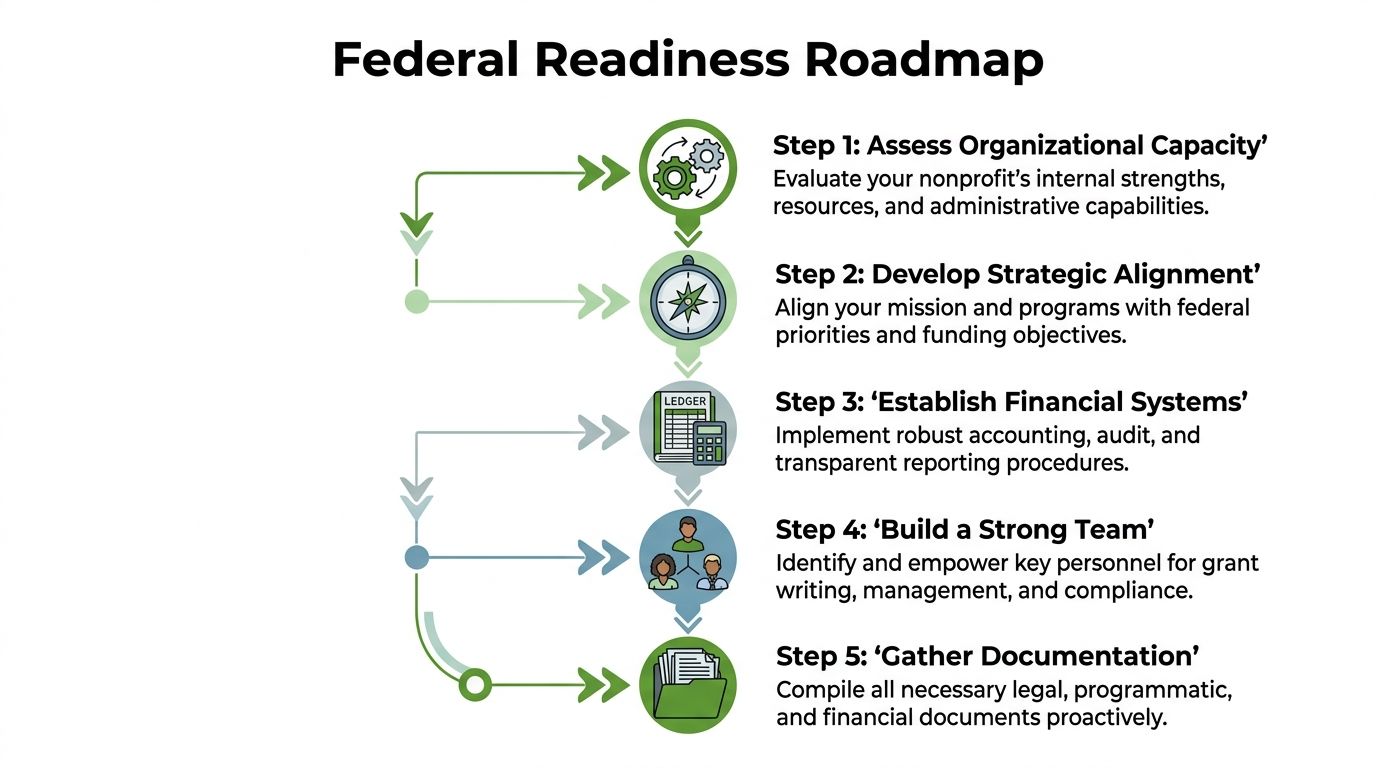
Federal readiness starts before opportunity search. If your registrations, internal controls, and core documents aren’t in order, the best notice in the world won’t help you.
Brookings noted that new small business entrants to federal procurements declined by 79% from 2005 to 2019, in part because of “intensified compliance requirements” and “administratively burdensome” processes that hit resource-constrained organizations hardest, according to the Brookings Institution’s analysis of contracting access barriers. Nonprofits run into the same wall. The barrier usually isn’t mission fit. It’s administrative fitness.
Start with the registrations that make you eligible
For most nonprofits, the first layer is procedural:
Get your Unique Entity ID
You need an entity identifier before you can fully participate in core federal systems. Don’t delegate this casually. The legal name, address, and tax records must match exactly across systems.Complete and maintain SAM.gov registration
Many teams encounter difficulties with this step. SAM is not a one-time task. It’s an active registration that needs monitoring and renewal discipline. If your status lapses, you can miss eligibility windows or payment processing steps.Set up Grants.gov access for the right staff
Don’t let one person become the single point of failure. Assign roles deliberately. Make sure your authorized organization representative and backup staff understand who can submit, who can edit, and who receives notices.Create an internal document library
Keep incorporation records, IRS determination documents, audit materials, indirect cost documentation, board list, leadership bios, key policies, and program summaries in one controlled folder structure.Confirm finance and reporting capacity
Federal awards demand cost tracking, segregation of duties, timely reporting, and documentation that holds up under scrutiny. If your accounting setup can’t isolate restricted activity cleanly, fix that before you pursue larger awards.
Treat readiness as risk management
A common mistake is to view these steps as “admin work” that can wait until an application looks promising. That almost always backfires. Federal timelines don’t pause while your team hunts for missing policies or tries to resolve registration issues.
Practical rule: If you need the opportunity deadline to force your readiness work, you’re already late.
Readiness also means being honest about capacity. Some nonprofits are ready to prime a federal award. Others should start with subawards, teaming roles, or smaller opportunities where the reporting burden is manageable. There’s no shame in sequencing your entry point. The mistake is pretending you’re ready for full federal complexity when your back office isn’t.
Build the internal operating checklist
Use a short readiness checklist that leadership reviews regularly:
- Legal identity is consistent: Your entity name, address, and tax information match across systems and records.
- Finance can support compliance: Your accounting team can separate costs, document allowability, and produce clean reports.
- Submission authority is clear: Staff know who owns registration, application assembly, and final submission.
- Core policies are current: Procurement, conflicts, records retention, and financial controls aren’t outdated or informal.
- Program evidence is organized: You can quickly pull outcomes, staffing plans, partner letters, and past performance examples.
Organizations that do this upfront move faster later. They also write better proposals because they aren’t scrambling to invent infrastructure during the deadline window.
Source and Qualify Opportunities Like a Pro
Most nonprofits don’t have an opportunity problem. They have a filtering problem.
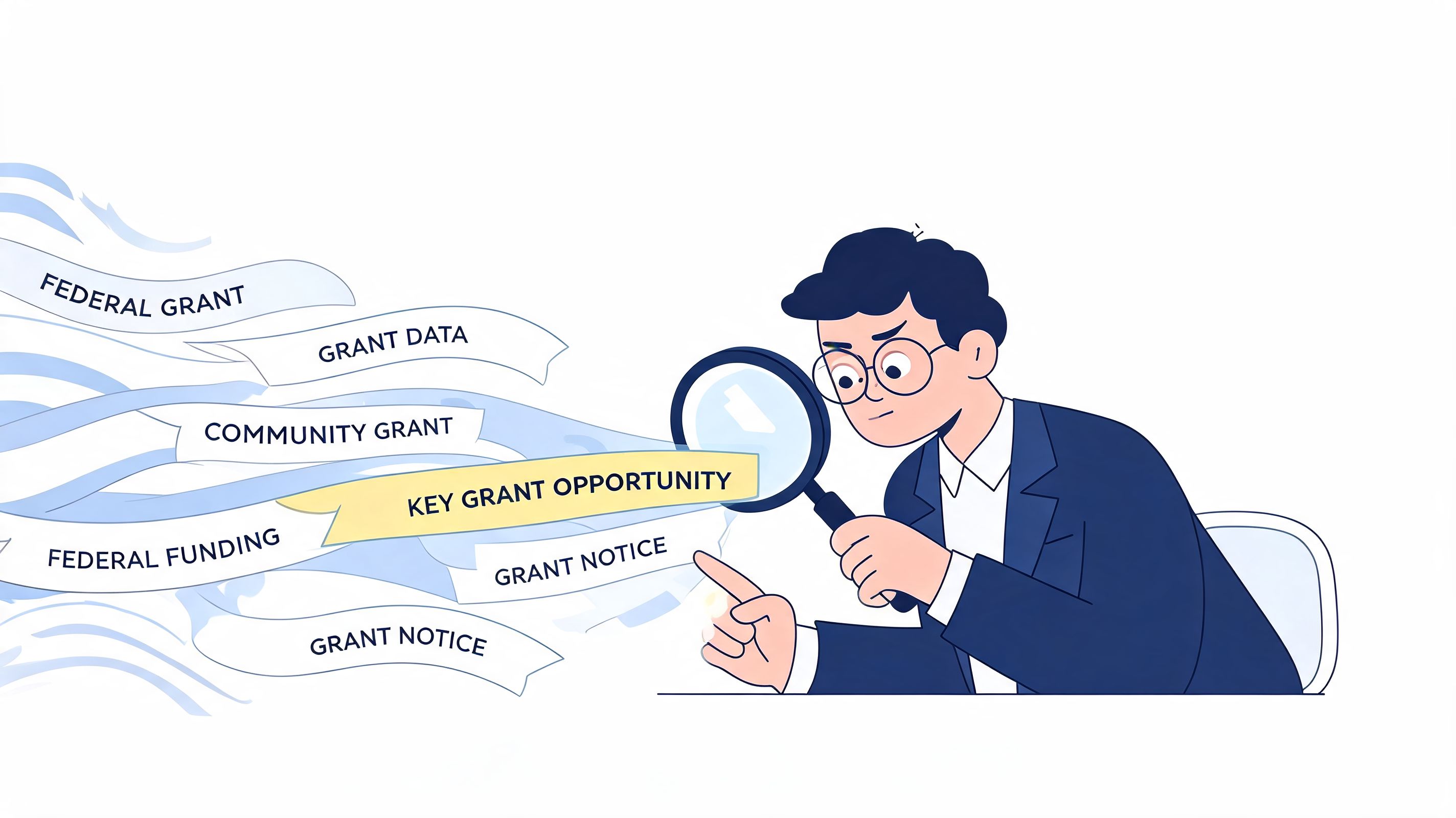
SAM.gov and Grants.gov can produce a flood of notices. If you react to every notice that sounds mission-adjacent, your team burns hours on work that never had a realistic path to award. Strong federal operators search broadly but qualify narrowly.
Build a search system, not a habit of random browsing
Set up saved searches and alerts in the major portals your team uses. Use terms tied to your actual services, populations, and geography, not just broad mission language. Search by agency, assistance listing when relevant, and procurement category when you’re reviewing contracts.
A workable search rhythm usually includes:
- Daily triage: Review new notices quickly and sort them into likely fit, maybe later, and no.
- Weekly pipeline review: Revisit likely fit opportunities with program, finance, and leadership in the room.
- Documented next step: Every opportunity gets a clear status. Pursue, monitor, partner, or decline.
If your team wants a tool layer on top of manual search, grant discovery platforms for nonprofits can help centralize scanning and initial fit assessment across federal and other public funding sources.
Use gate checks before anyone starts writing
Experienced contractors are far more disciplined than most nonprofits. Well-established federal contractors often achieve 25% to 40% win rates through rigorous qualification, while win rates below 15% often signal poor qualification and wasted effort, according to this federal opportunity qualification framework.
Nonprofits can borrow that discipline without copying every contractor practice.
Use three gates.
Gate one checks basic fit
Ask the obvious questions first.
- Mission fit: Does the opportunity support work you already do well?
- Eligibility fit: Are you clearly eligible, not arguably eligible?
- Geographic fit: Can you serve the target area credibly?
- Capacity fit: Do you have staffing, partners, systems, and delivery infrastructure?
If the answer is weak on any of those, decline early.
Gate two checks whether the agency problem matches your solution
At this juncture, many teams get fuzzy. They like the funding source but haven’t confirmed the actual need.
Review prior awards, program language, and any market signals you can gather. If the agency is trying to buy highly standardized service delivery and your organization’s strength is customization, that mismatch matters. If the notice emphasizes scale and you only have neighborhood-level operating proof, that matters too.
Here’s a useful explainer before you formalize your own process:
Gate three checks your path to a credible win
This is the hardest question. Why would this agency choose you?
Your answer can’t be “because we care a lot.” It has to be operational. Maybe you have trusted community access, a delivery model that fits the statement of work, a partner that fills a compliance gap, or documented past performance that maps closely to the requirement. If you can’t name a credible reason you stand out, don’t confuse hope with strategy.
Weak qualification feels productive because the team stays busy. Strong qualification looks selective because the team says no often.
A good pipeline isn’t the longest list. It’s the shortest list of opportunities your organization can pursue well.
Develop Your Competitive Edge Before the Proposal
Most federal losses happen before the proposal is drafted. The organization shows up after the requirement is set, after competitors have already built context with the agency, and after the internal team has fallen into reactive mode.
That’s why capture work matters. Contractors use that term constantly, but nonprofits should pay attention to it too. Capture is everything you do before release to improve your position.
Early engagement changes the game
Successful capture management requires early identification and stakeholder engagement 3+ months before a formal procurement release, and RFIs can function as “soft competitions” that influence final requirements, according to this capture strategy overview for federal pursuits.
That principle translates directly for nonprofits. If you wait for the final notice to appear, you’ve accepted whatever framing, evaluation logic, and assumptions the agency already settled on. If you engage earlier, you have a chance to understand the problem in agency terms and respond more intelligently.
What nonprofits should do before release
A practical pre-proposal effort usually includes a mix of research, outreach, and positioning.
Review prior awards and incumbents
Look at who won before, what kind of organization they are, and whether you might be more competitive as a partner than a prime. This tells you a lot about expected scale, delivery model, and likely evaluator preferences.
Respond to RFIs and Sources Sought thoughtfully
These notices are often ignored by smaller organizations. That’s a mistake. A concise, credible response can show the agency that nonprofits like yours can perform the work. It also forces your team to think through capability before the formal response clock starts.
Talk to program staff when the channel is open
For grants, that may be a program officer or technical contact. For contracts, that may be an industry day, outreach event, or pre-solicitation forum. The point isn’t to pitch hard. It’s to listen well and ask questions that reveal priorities, constraints, and blind spots.
Build a one-page capability statement
A capability statement is one of the most underused assets in nonprofit federal work. Keep it to one page. Make it scannable. Focus on relevance, not biography.
Include:
- Core services: What you deliver in concrete terms.
- Target populations or service areas: Who you serve and where.
- Differentiators: Specific strengths tied to the opportunity space.
- Past performance examples: Short, relevant examples of similar work.
- Key contacts and registrations: Enough information to make follow-up easy.
A capability statement should help a federal contact understand your fit in under a minute. If it reads like a donor brochure, it won’t do the job.
Relationship-building has trade-offs
Early outreach can encounter resistance from nonprofit leaders. They worry that it feels political or salesy. Done poorly, it does. Done well, it’s part of responsible market intelligence.
The trade-off is straightforward. Early engagement takes time before there’s a guaranteed opportunity. But late engagement almost guarantees that you’ll write into a vacuum. In federal work, context beats hustle. A team that understands the buyer’s problem usually writes a sharper response than a team that starts cold and tries to compensate with long narrative.
Craft a Winning Proposal and Stay Compliant
Once the notice drops, your job changes. This is no longer a relationship problem. It’s an execution problem.
Small firms, a category that includes most nonprofits, accounted for 52.8% of net U.S. job gains from Q1 2021 to Q2 2024, according to this small business statistics summary. That economic role is one reason federal systems continue trying to bring smaller organizations into the mix. But participation only matters if your proposal is compliant and your award management is clean.
Deconstruct the notice before writing a sentence
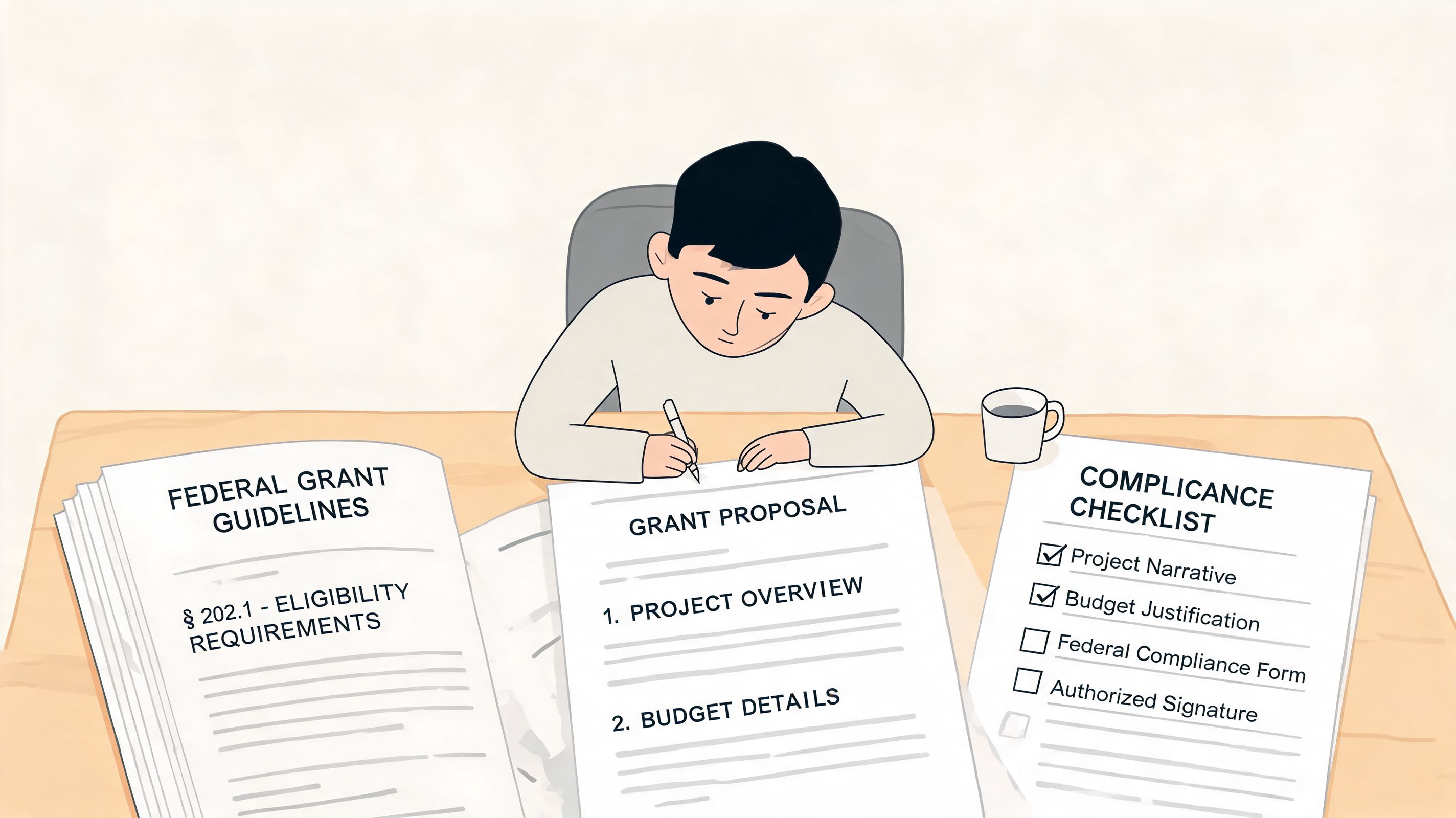
Don’t start by drafting the executive summary. Start by disassembling the solicitation.
Create a compliance matrix that captures every required attachment, every narrative prompt, every formatting rule, every representation, and every deadline. Then convert that matrix into a working outline for the proposal team.
A strong matrix should answer:
| Proposal element | What to capture |
|---|---|
| Requirement | Exact instruction or evaluation factor |
| Owner | Who drafts or supplies it |
| Evidence needed | Data, attachments, approvals, partner input |
| Deadline | Internal due date, not just agency due date |
| Risk note | Any issue that could make the response noncompliant |
Structured tools can help. Platforms such as Fundsprout can analyze an RFP, turn requirements into an outline, and support drafting with organization-specific source material so teams aren’t rebuilding from scratch every time.
Write for evaluators, not for your internal audience
Many nonprofit proposals sound sincere but unfocused. They explain why the issue matters, then wander. Federal evaluators are usually scoring against criteria. They need direct answers, supported by evidence, staffing clarity, implementation logic, and cost realism.
Use this order when drafting core sections:
- State your approach plainly
- Show why it matches the requirement
- Explain who will do the work
- Describe how you’ll monitor performance
- Connect budget to delivery
If you’re drafting budget narratives or planning cost recovery, this guide to calculating nonprofit indirect costs helps teams think through one of the easiest places to make avoidable mistakes.
Compliance doesn’t end at submission
Winning creates a second job. You now have to perform exactly enough structure to satisfy the award while still delivering real-world impact.
That includes document retention, reporting discipline, invoice support, procurement standards where applicable, partner monitoring, and accessibility obligations. If you’re delivering digital materials, forms, portals, or documents under a government-funded project, your team should also understand Section 508 compliance for government vendors. Accessibility isn’t a side issue in federal work. It can shape deliverables, review requirements, and project risk.
Good proposal teams think past submission day. They ask, “Can we prove performance and compliance six months from now?”
The nonprofits that build this habit become easier to trust. And in federal funding, trust compounds.
Frequently Asked Questions on Federal Opportunities
A few questions come up in almost every executive conversation about federal business opp work. The answers need to be practical, not philosophical.
| Question | Answer |
|---|---|
| What’s the real difference between a federal grant and a federal contract? | A grant supports a public-purpose program. A contract purchases a defined deliverable or service for the government. Grants usually give more programmatic flexibility within award terms. Contracts usually require tighter adherence to a statement of work, deliverables, and performance expectations. |
| How long does federal registration take? | Longer than most first-time applicants expect. Don’t tie your registration timeline to a live opportunity if you can avoid it. Start early, assign one accountable owner, and verify that your legal and financial records match across systems before submission season gets busy. |
| Can a small nonprofit actually compete? | Yes, but only when it competes selectively. Small organizations often lose when they chase everything, skip qualification, or underestimate compliance. They can compete well when they pursue opportunities that match their mission, geography, delivery model, and administrative capacity. |
| Should we start with grants or contracts? | Start with the mechanism that best matches how your organization already works. If your strength is program delivery with measurable community outcomes and you need room for implementation design, grants may be the cleaner first step. If you already deliver repeatable services with clear staffing and performance logic, a contract or subcontract can be a smart entry point. |
| Is partnering a sign that we aren’t ready? | No. Partnering is often the most disciplined way to enter federal work. You can gain experience, strengthen past performance, and learn federal reporting expectations without carrying every burden as the prime recipient or prime contractor. |
| What usually sinks first-time applicants? | Three things. Entering too late, pursuing poor-fit opportunities, and treating compliance as an afterthought. Most first-time failures aren’t caused by weak mission alignment. They’re caused by weak process. |
Federal funding gets more manageable when your team has a repeatable system for finding fit, qualifying rigorously, drafting with discipline, and staying compliant after award. Fundsprout supports that workflow by helping nonprofits discover relevant opportunities, organize proposal requirements, and maintain the documentation trail that federal work demands.
Try 14 days free
Get started with Fundsprout so you can focus on what really matters.