A Guide to Federal Funding Opportunities for Nonprofits
Discover how to find and win federal funding opportunities. Our guide helps nonprofits navigate federal grants, from application to award.

Abdifatah Ali
Co-Founder
Federal funding isn't just another grant to apply for; it's a completely different league. These are substantial financial awards from the U.S. government designed to fuel projects that serve a major public purpose. For a nonprofit, landing one of these awards can be the key to scaling your impact in ways you've only dreamed of. But getting there requires a real strategy, not just a casual search.
Starting Your Journey into Federal Funding
Let's be honest: stepping into the world of federal grants can feel like learning a new language. The sheer volume of forms, acronyms, and regulations is enough to make anyone's head spin. But underneath all that complexity is a system built to partner with organizations like yours to get critical work done in communities.
Pursuing federal funding opportunities is a major strategic decision. It’s about aligning your mission with national priorities to unlock resources that can fundamentally change your organization's reach and long-term sustainability. It’s a marathon, not a sprint, and it demands a serious commitment of time and effort. But for nonprofits with big ambitions, the payoff—often multi-year, high-impact funding—is more than worth it.
Getting the Lay of the Land
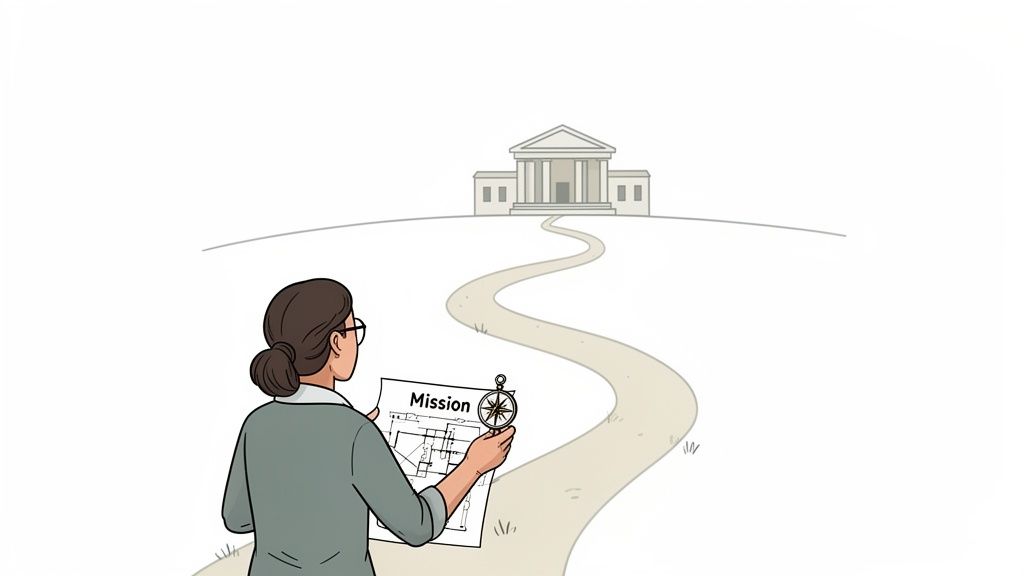
To get started, it helps to map out the landscape. The federal government is a massive collection of departments and agencies—think Health and Human Services or the Department of Education—each with its own specific mission. These agencies release funding opportunities to find partners on the ground (like you!) who can execute projects and deliver services.
The central hub for all this activity is Grants.gov, which is the official portal where agencies are required to post their funding announcements. Think of it as Grand Central Station for federal grants.
Of course, federal funding is just one piece of a healthy funding puzzle. It’s crucial to build a diversified strategy, and you can explore other sources of funding for nonprofits to create a more resilient financial future for your organization.
Before we dive deeper, here’s a quick overview of the main components you’ll be interacting with.
The Federal Funding Landscape at a Glance
This table breaks down the key players and platforms you'll encounter on your federal funding journey.
Understanding how these pieces fit together is the first step toward navigating the system effectively.
The Mindset You Need to Succeed
Winning federal grants is about more than just slick writing. It’s a game of strategy and persistence.
- Mission Alignment Is Everything. Don't chase the money. Instead, focus on finding agencies whose missions genuinely overlap with your own. The strongest applications always show a deep, authentic understanding of the funder's goals.
- Preparation Is Non-Negotiable. The application process is incredibly meticulous. You'll need to complete key registrations, like getting a Unique Entity ID (UEI) and registering in the System for Award Management (SAM.gov), months before you even think about applying.
- Think Long-Term. This isn't a one-and-done deal. It takes time to build relationships with program officers and get a feel for an agency's funding cycles. Your first application might not make it, but the feedback you get is gold for your next attempt.
Think of federal funding not as a simple transaction, but as a formal partnership. The government provides the resources, and your nonprofit provides the expertise, community trust, and on-the-ground execution needed to create meaningful change.
When you shift your perspective this way, you stop just asking for money and start proposing a collaborative solution to a shared problem. That mindset is the foundation of every single successful federal grant proposal.
Understanding the Different Flavors of Federal Funding
Not all federal funding is the same. The first step in building a smart funding strategy is figuring out what kind of money you’re actually going for. When you start digging into federal opportunities, you'll see a few key terms pop up again and again. These terms define your future relationship with the government—think of it as choosing the right kind of partnership for your mission.
The two big ones you’ll encounter most are grants and cooperative agreements. They might look similar on the surface, but the real difference comes down to one simple thing: how involved the federal agency plans to be. Getting this right from the start is crucial, as it sets expectations and helps you match your nonprofit’s style with the right opportunity.
Knowing the lingo helps you read between the lines of a funding announcement. It tells you whether the government is just handing you the keys and a gas card, or if they plan to be in the passenger seat with a map for the whole trip.
Grants: The Foundation of Federal Support
A federal grant is what most people picture when they think of government funding. It's a straightforward exchange where the government gives your nonprofit money to carry out a public purpose you've laid out in your proposal. Once the check clears, you have a ton of freedom to run the project your way, as long as you hit your goals and follow the rules.
Think of a grant like a scholarship. The university gives you the money based on your application and what you plan to study, but they don't follow you to class or tell you how to take notes. They trust you to do the work and just want to see your report card at the end of the semester. That’s a grant in a nutshell—it’s built on trust and your organization’s ability to get the job done.
A federal grant is a transaction of support. The agency transfers funds to a recipient to help them accomplish a public good with minimal federal involvement in the day-to-day activities. This model empowers organizations with the freedom to innovate and execute their vision.
This hands-off approach is perfect for nonprofits that have a crystal-clear project plan and the team to manage it all on their own.
Cooperative Agreements: A Hands-On Partnership
Cooperative agreements are a different beast entirely. They also provide funding for a public purpose, but they’re structured as an active partnership between your nonprofit and the federal agency. The magic words here are “substantial involvement.”
This means the agency isn’t just an observer; they're an active participant. Their staff might join your team meetings, offer technical advice, or even help shape the project's direction as it evolves. It’s less like a scholarship and more like a funded mentorship or a joint venture.
Here’s a simple way to think about it:
- A grant is like hiring a contractor to build a house. You sign off on the blueprints and check in every so often, but you trust them to handle the day-to-day construction.
- A cooperative agreement is like building the house with the contractor. You’re both there on-site, hammering nails, making decisions together, and pooling your expertise to get the job done right.
This collaborative model is common for complex projects, deep research, or new programs where the federal agency brings its own unique resources or know-how to the table. If you apply for one, get ready for a much closer working relationship with your government program officer.
Other Funding Mechanisms You Should Know
While grants and cooperative agreements are the bread and butter of nonprofit funding, you might run into a few other types. Knowing what they are will give you a complete map of the federal funding landscape.
Here’s a quick breakdown of the main types and a couple of others:
It's really important not to mix up grants and contracts. A contract is basically a procurement tool—the government is buying something from you, whether it’s a service or a product for its own use. It's not financial assistance. Always read the funding announcement carefully to make sure you’re chasing the right kind of money for your mission.
Navigating Key Federal Grant-Making Agencies
If you want to successfully land federal funding, you first need to know who holds the purse strings. The federal government isn’t some single, giant piggy bank. It’s a huge collection of specialized agencies, and each one has its own mission, its own budget, and its own priorities.
Think of it like a city with different neighborhoods, each one focused on a specific industry—one for healthcare, another for education, and a third for housing. Your job is to find the neighborhood where your nonprofit’s work is the talk of the town.
Instead of just casting a wide, hopeful net, taking a targeted approach saves an incredible amount of time and dramatically boosts your chances of success. Aligning your mission with an agency's core purpose is the first, and honestly, the most critical step.
For example, a nonprofit focused on public health would naturally gravitate toward the Department of Health and Human Services (HHS). An organization running after-school STEM programs? You should be keeping a close eye on the Department of Education. This kind of strategic thinking ensures your proposals land on the desks of people who are already deeply invested in your field.
The Major Players in Federal Funding
While plenty of agencies offer grants, a few big ones stand out as the primary sources of funding for most nonprofits. Getting to know their focus areas helps you build a shortlist of potential partners right away.
Department of Health and Human Services (HHS): As the largest grant-making agency, HHS is an essential source for anyone in health services, medical research, and social welfare. It’s home to heavy-hitters like the National Institutes of Health (NIH) and the Centers for Disease Control and Prevention (CDC).
Department of Housing and Urban Development (HUD): HUD is the go-to funder for projects focused on affordable housing, preventing homelessness, and community development. If your work involves revitalizing neighborhoods or providing shelter, HUD should be your first stop.
Department of Education (ED): This agency supports everything from early childhood literacy to adult education and special needs programs. Nonprofits working on educational equity, teacher training, or innovative learning models will find a ton of opportunities here.
The visual below shows the two main ways these agencies provide support: grants and cooperative agreements.

As you can see, both provide resources, but cooperative agreements involve a much more direct, hands-on partnership with the agency.
The Ever-Changing Funding Climate
The federal funding landscape is anything but static. It’s constantly being shaped by political shifts, new administration priorities, and intense congressional budget negotiations. An agency's focus can change from one year to the next, with new initiatives getting a flood of cash while others are quietly cut. This dynamic environment means grant-seekers have to be vigilant and adaptable.
The reality is that federal funding is a moving target. Success depends not just on writing a great proposal, but on understanding the political and economic currents that shape agency budgets and priorities. A resilient nonprofit stays informed and is ready to pivot its strategy.
For instance, a new administration might make workforce development a top priority, leading to a surge in grants from the Department of Labor. On the flip side, budget cuts could hit programs in other sectors hard. Staying on top of these trends allows you to anticipate where the money will flow and position your organization to be in the right place at the right time.
A Look at the Current Environment
The U.S. federal government operates 26 grant-making agencies, and the environment can get turbulent. After January 2025, for example, over 60 executive orders seriously disrupted the grants process, leading to the cancellation of more than $3 billion in funding and significant award delays. This climate of uncertainty makes strategic planning more important than ever, as nonprofits have faced funding freezes while agencies scramble to navigate new directives. You can get a deeper dive into the U.S. federal grants landscape to learn more.
Despite these challenges, federal grants are still the biggest source of funding by award size. In fact, HHS alone accounts for 29% of all funding. By understanding the missions of these key agencies and staying tuned in to the political climate, you can navigate this complex—but incredibly rewarding—landscape. This kind of strategic intelligence is your best tool for setting your nonprofit up for long-term success.
How to Find Federal Funding Opportunities

This is where the rubber meets the road. Knowing which agencies fund work like yours is the first step, but now you have to actually find the specific opportunities that fit your mission. It's a hunt, and it takes the right tools, some smart search tactics, and a good bit of patience.
The federal government gives you two main digital doorways to this world: Grants.gov, which is the central hub for applications, and the Assistance Listings on SAM.gov, the master catalog of every federal program out there. Getting comfortable with these two platforms is non-negotiable if you're serious about federal dollars.
But just knowing the websites won't get you far. You need a strategy to sift through the mountains of information, translate the government-speak, and zero in on the funding announcements that are a genuine match for your programs.
Using Grants.gov as Your Search Hub
Think of Grants.gov as the main search engine for currently open federal funding opportunities. It's the official, mandatory place where every federal agency posts its grant announcements. If you're looking for a competition you can apply for right now, this is your starting point.
But just typing a broad term like "after-school programs" into the search bar is a recipe for overwhelm. You'll get thousands of hits, and most of them will be useless to you. The trick is to get specific and use the platform's powerful filters to your advantage.
Here’s a better way to approach it:
- Start with Smart Keywords: Instead of vague terms, use the specific language of your field. Try "supportive housing services" or "homeless youth prevention" instead of just "homelessness."
- Filter by Agency: You've already done your homework on which agencies are a good fit. Now, filter your search to only show results from those departments. This instantly cuts out a huge amount of noise.
- Set Up Saved Searches: This is the best-kept secret of Grants.gov. You can save your carefully filtered searches, and the system will automatically email you daily or weekly updates when new opportunities that match your criteria pop up.
Seriously, setting up saved searches for the different pillars of your work is a game-changer. It puts your discovery process on autopilot, so you never miss a critical deadline because you forgot to check the site.
Leveraging Assistance Listings on SAM.gov
While Grants.gov shows you what’s active today, the Assistance Listings on SAM.gov (what used to be called the Catalog of Federal Domestic Assistance, or CFDA) gives you the 30,000-foot view. It’s a complete directory of all federal programs that offer assistance, whether they have an open call for applications right now or not.
Think of it this way: Grants.gov is like looking at the daily specials board at a restaurant. The Assistance Listings are like having the chef’s entire cookbook—you see every recipe they know, which helps you guess what might be on the menu next season.
This is an incredibly powerful tool for long-range planning. By exploring an Assistance Listing, you can learn an agency’s funding priorities, see who they've funded in the past, and get ready for recurring opportunities long before they’re ever announced. This is how the most successful nonprofits stay a step ahead.
The Reality of Manual Searching
Let’s be honest for a second: manually searching for federal funding opportunities is a massive time sink. The sheer volume is staggering. Federal grants to state and local governments hit an estimated $1.1 trillion recently, spread across a dizzying number of programs. For a small nonprofit team, sifting through that is a monumental task.
While a foundation grant might take 15-20 hours to write, a federal application often blows past 100 hours of effort—all for what is typically a 10% success rate. You can learn more about the scale of these programs from the latest congressional research on federal grants.
This is why so many nonprofits get stuck. It’s far too easy to miss the perfect opportunity when it’s buried under a mountain of irrelevant search results. The jargon-filled announcements and confusing filters can feel like a huge barrier, especially if you don't have a dedicated grant pro on staff.
This reality check is exactly why modern tools that help simplify the discovery process are so valuable. For a deeper dive into search strategies, check out our comprehensive guide on how to find federal grants.
A truly effective search strategy combines a disciplined approach to these official platforms with a clear-eyed understanding of their limits. By setting up automated alerts and using the Assistance Listings for strategic foresight, you can stop reacting and start building a proactive, mission-aligned funding pipeline.
Building a Competitive Grant Application
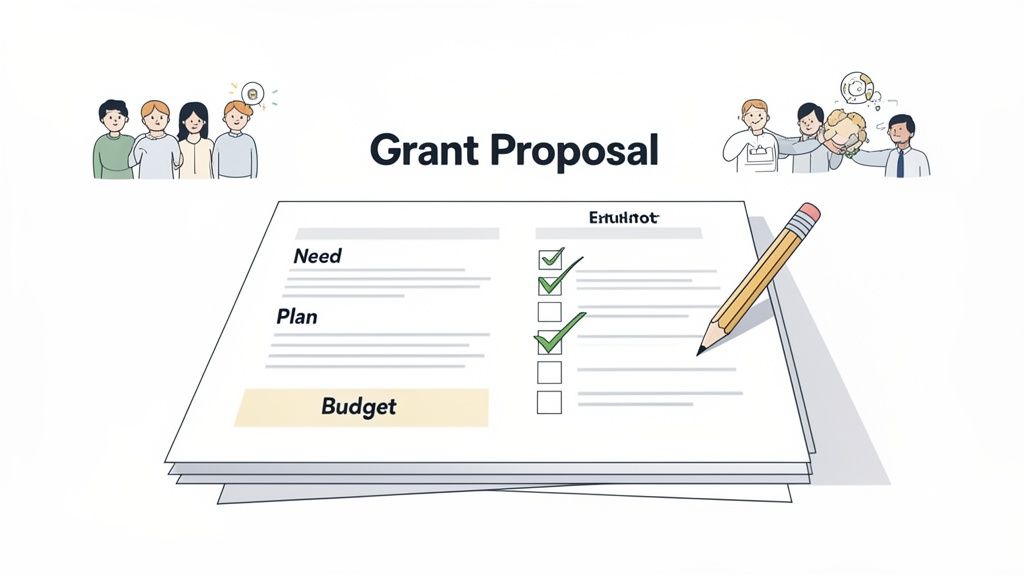
A winning federal grant application isn’t something you can throw together in a last-minute panic. It’s the result of a thoughtful, strategic process that kicks off long before you write a single word of the proposal itself. The key is to reframe this massive undertaking into a manageable project, one that clearly communicates your nonprofit’s vision and value.
Think of it like building a house. You wouldn't just start nailing boards together without a solid foundation and a detailed blueprint. The same logic applies here—the prep work you do upfront will ultimately determine the strength of your final submission.
Laying the Foundation Before You Write
Before you even start thinking about your compelling narrative, there's some critical administrative work to get out of the way. These aren't just suggestions; they are absolute must-dos for receiving any federal funds. Honestly, missing these steps is one of the most common—and totally avoidable—reasons good applications get disqualified right out of the gate.
The single most important task is getting registered in the System for Award Management (SAM.gov). This is where you’ll get your Unique Entity ID (UEI), which is the official government identifier for your organization.
This registration can take several weeks, sometimes even months, to process. Don't wait until you find the perfect grant to apply for. Start your SAM.gov registration now. That way, you’re ready to spring into action the moment a relevant opportunity pops up.
Getting this administrative groundwork done early removes a huge source of stress from the process. It means that when you do find the right federal funding opportunities, you can focus all your energy on building a top-notch proposal, not scrambling to get registered.
Crafting a Compelling Narrative
Once your administrative house is in order, you can shift your focus to the heart of the application: the story you're going to tell. A federal grant proposal is much more than a simple request for money. It's a persuasive argument that positions your organization as the best possible partner to solve a specific, important problem.
Every powerful proposal is built on a few core elements that have to work together to make a cohesive and convincing case.
- The Needs Statement: This is the "why" of your entire project. Your job here is to paint a vivid picture of the problem you’re addressing, using hard data, statistics, and real-world stories to show just how urgent and important it is.
- The Logic Model: Think of this as your project’s blueprint. A good logic model visually connects your planned activities to your expected outcomes, giving reviewers a clear, logical path from their investment to real-world impact.
- The Defensible Budget: Your budget isn't just a spreadsheet; it’s a financial story that has to align perfectly with your narrative. Every single line item needs a clear justification that ties it directly back to the activities you've described.
- Letters of Support: These endorsements from community partners, local officials, and other key players are gold. They provide powerful, third-party validation that your organization is credible and that your project is genuinely needed.
And a quick note: if you're working with international partners or have supporting documents in other languages, understanding certified translation services is essential for meeting submission rules and ensuring every part of your story is heard loud and clear.
Assembling the Pieces for a Winning Submission
A grant application is a big project with a ton of moving parts. The best way to manage it is to break it down into a step-by-step process so nothing slips through the cracks.
- Deconstruct the NOFO: The Notice of Funding Opportunity (NOFO) is your instruction manual. Read it, and then read it again. Highlight every requirement, deadline, and formatting rule. Create a master checklist to track every single document you need to submit.
- Develop Your Program Design: Get your team together to flesh out the project's goals, objectives, activities, and how you’ll measure success. This is where that logic model you built becomes an invaluable tool for getting everyone on the same page.
- Write the Narrative Sections: Now it's time to start drafting the core of your proposal. As you write, keep referencing the NOFO to make sure you're directly answering the agency's priorities and hitting all the review criteria they'll be using to score your application.
- Finalize the Budget and Gather Documents: While the narrative is being written, someone should be working in parallel to finalize the budget, lock in those letters of support, and gather all the other required attachments, like staff resumes and financial statements.
This structured approach helps you avoid the last-minute chaos that can sink an otherwise strong proposal. The good news is that grant writers don't have to go it alone anymore. It’s worth exploring how AI for grant writing can help with everything from writing initial drafts to running final compliance checks, giving your team a serious edge.
The Ever-Changing World of Federal Funding
Think of the federal funding landscape not as a fixed map, but as a constantly shifting coastline. Government priorities, budget changes, and new efficiency drives are the tides that reshape it every year. For nonprofits, just knowing where the opportunities are isn't enough; you have to understand which way the current is flowing.
This means that funding streams can dry up, agencies can suddenly pivot their focus, and new rules for compliance can appear seemingly overnight. We've seen a big shift, for instance, toward cooperative agreements instead of traditional grants in some areas. This tells us the government wants more hands-on involvement and stricter performance tracking, demanding greater accountability for taxpayer dollars.
A New Normal for Nonprofits
The last few years have really shaken things up, forcing nonprofits to become incredibly adaptable. Widespread government efforts to cut costs and streamline operations have had a direct impact on the grant world, creating a "new normal" for organizations like yours.
A prime example is the 2025 Department of Government Efficiency (DOGE) Initiative. It was a massive shake-up that eliminated nearly 12,000 grants to save $37 billion. While that only affected 6-9% of all active federal grants, it sent a powerful signal across the sector. Agencies like USAID and the Department of Education saw programs consolidated and funds frozen, hitting smaller nonprofits without full-time grant writers especially hard. You can get a much deeper look into these shifts by reading up on the current state of federal grant funding.
Key Trends to Watch
These changes aren't random; they're creating clear trends that should directly influence your funding strategy. Spotting them early is the key to getting ahead.
- Funding Consolidation and Redirection: Many programs got cut, particularly those focused on international work and DEI initiatives. A lot of that money was rerouted to domestic priorities, like boosting U.S. manufacturing and infrastructure. This closed some doors but opened entirely new ones.
- The Rise of Cooperative Agreements: As I mentioned, agencies are leaning more on cooperative agreements. It's a way for them to keep a closer eye on projects and demand more detailed progress reports, which is typical in a budget-conscious environment.
- Fresh Fiscal Pressures: Research institutions have felt this acutely. New rules, like a 15% cap on what they can claim for indirect costs from agencies like the NIH and NSF, are putting a serious strain on their operational budgets.
This isn't meant to scare you off. It's strategic intel. Knowing about these trends helps you read the tea leaves, pivot your proposals toward newly prioritized areas, and build a more resilient financial future for your organization.
Common Questions About Federal Funding
Stepping into the world of federal funding can feel a little intimidating. You’re not alone. Let’s walk through some of the most common questions and sticking points that nonprofits run into when they're just getting started.
Is My Nonprofit Eligible for Federal Grants?
This is the first and most important question to ask. The short answer is: it depends entirely on the specific grant.
Every single funding announcement, or Notice of Funding Opportunity (NOFO), has a section dedicated to eligibility. You absolutely must read this first. Generally speaking, you'll need to be a registered 501(c)(3) and have your Unique Entity ID (UEI) from SAM.gov squared away, but the specific requirements can vary widely.
Can Small Nonprofits Really Win Federal Funding?
Yes, they can and they do! The key is to be strategic, not just optimistic. Don't try to apply for a dozen grants at once; that's a recipe for burnout and weak proposals.
Instead, focus your energy on one or two applications per year that are a perfect fit for your mission. Another great starting point is to look for "pass-through" funding, which is federal money that your state government receives and then distributes through its own grant programs. These are often much more accessible for smaller, local organizations.
Rejection is part of the game. It happens to everyone. The most important thing you can do after getting a "no" is to politely ask the program officer for the reviewer's comments. This feedback is pure gold—it tells you exactly where you fell short so you can nail it the next time.
What Is the Biggest Mistake to Avoid?
If there’s one thing to take away, it's this: follow the instructions to the letter. Federal grant applications have zero tolerance for sloppiness.
Missing a deadline by one minute, using the wrong font size, or forgetting a single attachment can get your entire proposal thrown out without being read. A close second is submitting a project that isn't perfectly aligned with what the agency wants to fund. The NOFO is your bible—treat it that way.
How Much Time Does a Federal Application Take?
Plan for a marathon, not a sprint. If you're used to foundation grants that might take around 20 hours to pull together, you're in for a surprise. A competitive federal application often demands 100 hours or more of dedicated team effort.
That time gets eaten up by in-depth research, careful program design, writing the narrative, building a bulletproof budget, and getting all the necessary sign-offs. This is exactly why you can't start a month before it's due. A long runway and a clear plan are essential.
Finding the right opportunities and managing this whole process is a heavy lift. Fundsprout is designed to lighten that load. It's an AI-powered platform that helps you find perfectly matched grants, write stronger proposals, and keep track of compliance all in one place. See how you can build a more sustainable funding strategy at https://www.fundsprout.ai.
Try 14 days free
Get started with Fundsprout so you can focus on what really matters.