Disadvantaged Business Enterprise Requirements: 2026 Guide
Navigate Disadvantaged Business Enterprise requirements with our 2026 guide. Learn eligibility, certification, & compliance for your business.

Abdifatah Ali
Co-Founder
You open a transportation grant, skim the eligibility page, and then hit a phrase that changes the whole strategy discussion: DBE participation.
For many nonprofit executive directors, that moment is disorienting. You may not be a highway contractor. You may run workforce programs, community mobility services, environmental justice initiatives, or a social enterprise tied to public infrastructure. Yet suddenly you're expected to understand a certification system that sounds built for construction firms and engineering subs.
The good news is that disadvantaged business enterprise requirements are learnable. Better still, they matter to nonprofits in two practical ways. First, your organization may need to partner with certified DBEs to strengthen a proposal tied to transportation funding. Second, if your nonprofit operates an earned-income arm or social enterprise, that business may be able to pursue certification itself if it fits the rules.
This guide treats DBE rules the way a grant consultant would explain them in a planning meeting: plainly, strategically, and with an eye toward what you need to do next.
What Is a Disadvantaged Business Enterprise
A Disadvantaged Business Enterprise, usually shortened to DBE, is a certified small business that meets specific federal eligibility standards for participation on certain transportation-related projects that receive federal assistance.
The easiest way to think about the DBE program is this: it's a market access framework. It exists to help small businesses owned and run by disadvantaged individuals compete for work on publicly funded transportation projects. The program is not just a label. It affects how agencies structure participation goals and how prime contractors build teams.
For a nonprofit leader, the concept usually becomes real in one of two situations.
One scenario is partnership-driven. Your organization is preparing a proposal tied to transit access, airport-area services, complete streets outreach, or another transportation initiative. The application or procurement materials signal that DBE participation matters. Now your team needs to know whether a vendor, consultant, or local implementation partner is certified and usable for that purpose.
The other scenario is internal. Your nonprofit has a social enterprise that provides services such as planning support, maintenance, training, consulting, or field operations. Someone on your board asks whether that enterprise could become a DBE and compete for contract work.
Why nonprofits should pay attention
DBE status sits at the intersection of funding strategy, partnership strategy, and compliance.
A nonprofit that understands the basics can ask better questions:
- For grant partnerships: Is this vendor DBE-certified in the relevant state program?
- For proposal design: Does the partner's role make sense operationally, or are they included only on paper?
- For social enterprises: Does our business qualify, or are we assuming that mission status alone is enough?
A nonprofit's charitable mission does not automatically translate into DBE eligibility. Certification focuses on the business itself, who owns it, and who controls it.
That last point causes a lot of confusion. DBE is not a general designation for organizations serving disadvantaged communities. It is a certification tied to a business entity and its ownership, control, and economic status.
A plain-language example
Think of a grant team building a transportation project as assembling a cast for a play. The funder doesn't just care that everyone is in the room. The funder also cares who is playing which role. A certified DBE can't just be listed in the program. The business has to be legitimate, eligible, and positioned to do real work.
That's why understanding disadvantaged business enterprise requirements early can save you from weak partnerships, delayed applications, and compliance problems later.
The Legal and Programmatic Framework of DBEs
The DBE program is not an informal diversity preference created by a local agency. It sits inside a federal structure led by the U.S. Department of Transportation.
According to the U.S. Department of Transportation's DBE program overview, the program was enacted in 1983 and has been reauthorized in each subsequent surface and aviation authorization. That makes it one of the longest-running federal procurement equity programs in major transportation markets.
Federal rules and state administration
This federal-state split is where many nonprofit teams get lost.
The federal government sets the overarching rules. State-level certification systems typically handle the application review and certification process. In practical terms, that means your organization may be dealing with a state certifying body even though the standards come from DOT.
If you've managed government grants before, this structure will feel familiar. Federal law creates the framework. State agencies operationalize it. Local recipients and project sponsors then apply those rules inside actual procurements and funding agreements.
A useful analogy is Medicaid or workforce grants. The basic architecture is federal, but your day-to-day compliance experience happens through state implementation.
The core federal threshold
The same DOT overview states that, under the current federal framework, a firm must be a small, independent business that is at least 51% owned and controlled by socially and economically disadvantaged individuals, and those owners' personal net worth cannot exceed $2.047 million. The DOT page also explains that ownership-structure rules apply across corporations, partnerships, and LLCs, requiring at least 51% ownership in each relevant class of interest.
Here's the practical takeaway for nonprofit readers. DBE status is not just about identity or mission. It's built on a legal test applied to the business entity itself.
| Framework question | Why it matters to nonprofits |
|---|---|
| Is the business small and independent? | A partner may be mission-aligned but still fail size or independence rules. |
| Is ownership structured correctly? | Informal promises or handshake arrangements won't satisfy certification rules. |
| Does the disadvantaged owner actually control the firm? | A business can look eligible on paper but fail in review if control sits elsewhere. |
Why this framework matters in grant strategy
When a nonprofit forms a team for a transportation proposal, it's tempting to think of DBE participation as a matchmaking exercise. It isn't. It's more like eligibility engineering.
Your proposal may depend on whether a partner's certification is valid, whether their ownership and governance structure fits the rules, and whether their role on the project reflects real control and capability.
Practical rule: Treat DBE status like a compliance credential, not a branding descriptor.
That mindset changes how you vet partners. It also changes how you evaluate your own social enterprise. The right first question isn't “Do we serve disadvantaged communities?” It's “Does this business entity fit the legal framework that DOT and state certifiers apply?”
Decoding DBE Eligibility Who Qualifies
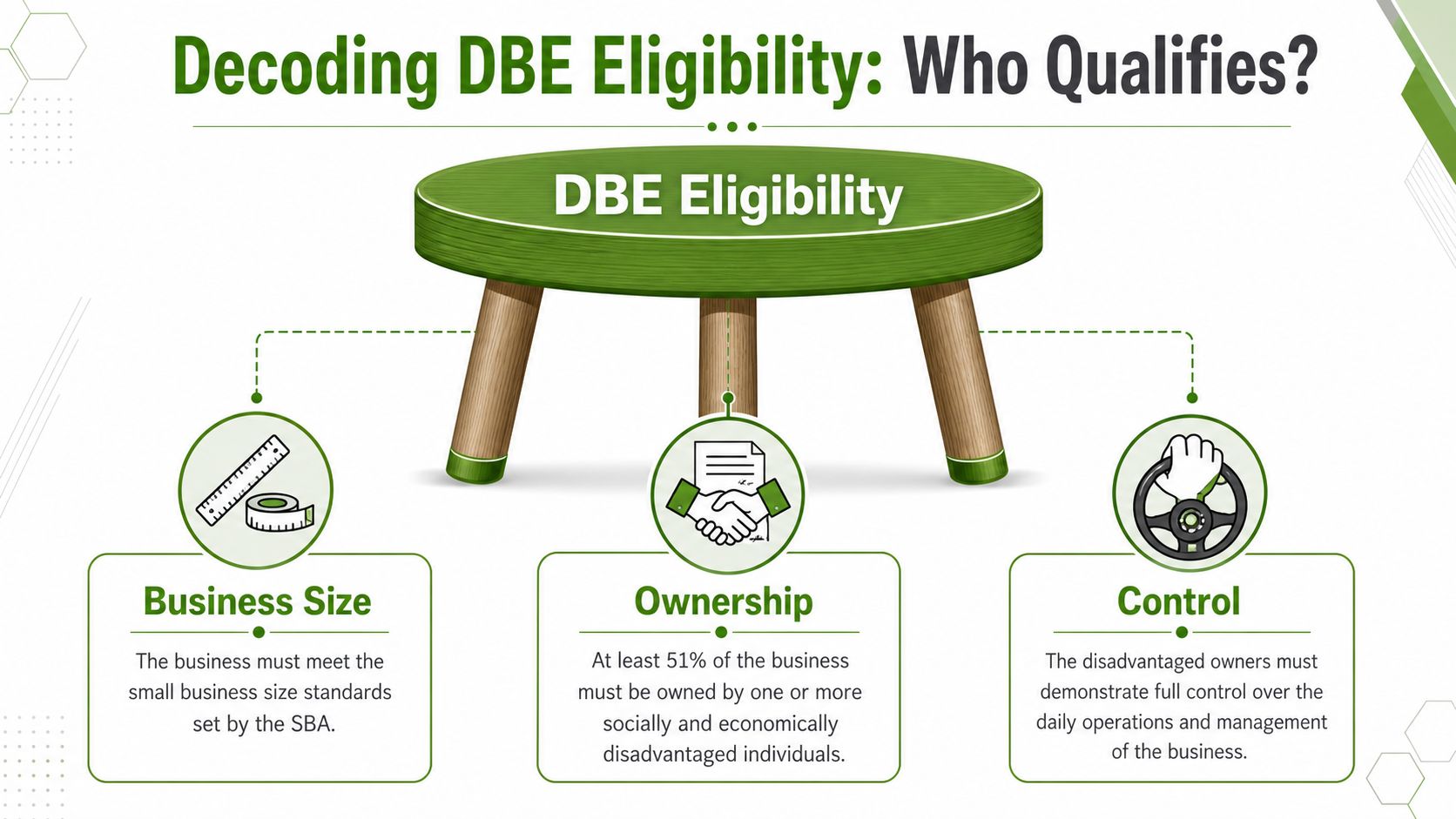
DBE eligibility is easiest to understand as a three-legged stool. If one leg is missing, the stool falls over.
A business generally needs all three elements working together: small business status, qualifying ownership, and real control.
The ownership leg
Ownership sounds straightforward, but applicants often oversimplify it. The rule is not merely that a disadvantaged individual appears somewhere in the cap table. The business must be at least 51% owned by socially and economically disadvantaged individuals.
That ownership also has to be real, documented, and properly structured. For corporations, partnerships, and LLCs, certifiers look closely at governing documents, classes of ownership interest, and whether the disadvantaged owner's stake has genuine substance.
A nonprofit executive director should hear a warning in that. If a social enterprise was formed with layered governance, side agreements, or informal founder arrangements, those documents can make or break eligibility.
The control leg
Control is where many otherwise promising applicants struggle.
A disadvantaged owner must do more than hold title. That person must direct management and daily operations. In plain language, the certifier wants to know who makes decisions when something important happens on a normal Tuesday, not just what the organizational chart says.
This can become tricky in family businesses, founder-led ventures, and nonprofit subsidiaries. If another person effectively runs operations, controls licenses, negotiates key deals, or approves major commitments, the control story weakens fast.
The certifier is asking a basic business question: who is really holding the steering wheel?
The economic disadvantage leg
Economic disadvantage includes a hard financial threshold. Current California certification guidance for DOT-based DBE eligibility uses a personal net worth cap of $2.047 million, and the firm must also remain below applicable small-business gross-receipts caps measured over prior fiscal years, as described in California DBE certification guidance.
That creates a dual test:
- Owner-level screening: The qualifying owner can't exceed the personal net worth cap.
- Firm-level screening: The business must still fit the applicable small business size standard.
This is one reason nonprofits with social enterprises need to separate mission language from legal analysis. A business can be socially valuable and still fail DBE certification because the owner's finances or the company's receipts push it outside the program.
A practical checklist for nonprofit teams
If you're screening a partner or evaluating your own social enterprise, use questions like these:
- Ownership reality: Does the qualifying owner hold a true majority interest, supported by formation documents and equity records?
- Decision authority: Can that owner show they direct policy, supervise work, and make day-to-day decisions without someone else pulling the strings?
- Financial eligibility: Has the owner reviewed personal net worth carefully, and has the business checked the relevant small-business size standards?
- Revenue monitoring: Is someone tracking trailing revenue before renewal periods or major bid submissions?
- Independence: Does the company operate as its own business, rather than functioning as a pass-through for a larger entity?
Where readers often get confused
The most common misunderstanding is believing that ownership alone is enough. It isn't.
The second confusion point is thinking that “economically disadvantaged” is a loose narrative standard in every respect. It isn't. The personal net worth review includes a hard cap in current guidance, and the business size test also matters.
The third mistake is assuming nonprofit affiliation helps or hurts by itself. Usually, it's not the decisive issue. The decisive issue is whether the specific business entity satisfies the program's requirements.
Navigating the Certification Application and Documentation
Eligibility is one question. Proof is another.
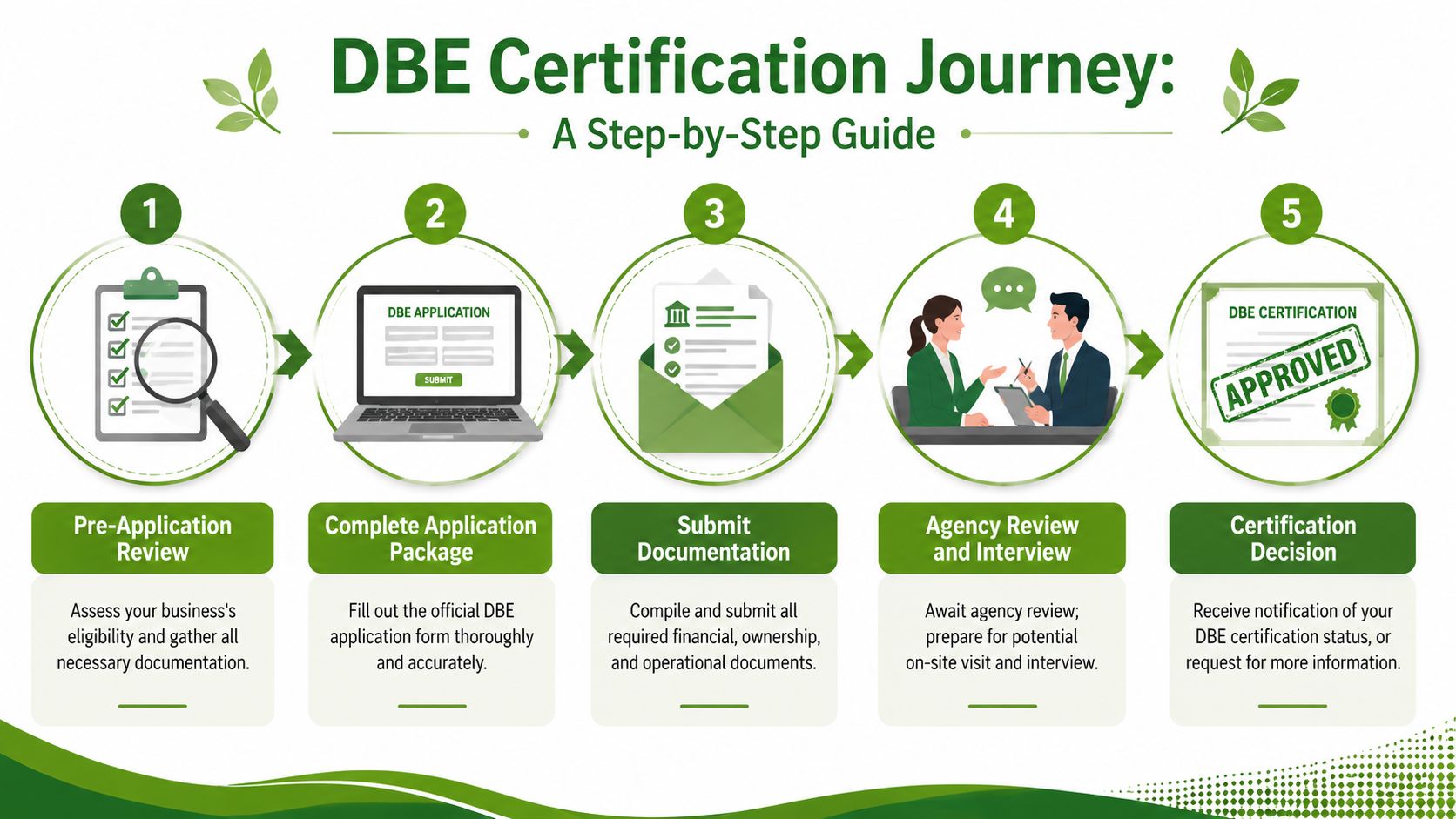
In DBE certification, the applicant has to prove the business qualifies. That means the process is document-heavy by design. If your nonprofit runs a social enterprise that may pursue certification, think of the application less like filling out a form and more like building an audit-ready case file.
Here's the process at a glance.
What the certifier is really evaluating
The DOT eligibility guidance explains that a DBE applicant must typically satisfy three technical gates at once: the firm must be 51% owned by socially and economically disadvantaged individuals, those owners must control management and daily operations, and the applicant must prove eligibility by a preponderance of evidence.
That phrase matters. Preponderance of evidence means the burden is on the applicant to provide a persuasive factual record. Ownership claims, control claims, and financial eligibility claims need backup.
For nonprofit-affiliated businesses, that usually means your records have to tell one coherent story. If your bylaws, operating agreement, board resolutions, resumes, contracts, and financial statements pull in different directions, the agency will notice. Clean governance documents matter, and many organizations benefit from reviewing basics such as a nonprofit bylaws template before they finalize the legal record around a social enterprise.
The application file you'll likely need
You can expect the certifier to ask for a substantial set of records. The exact package varies by certifying agency, but the themes are consistent.
- Formation documents: Articles of incorporation, LLC operating agreements, partnership agreements, stock records, membership certificates, and amendments.
- Governance materials: Board minutes, resolutions, signature authority records, and documents showing who can bind the company.
- Financial records: Business tax returns, personal financial materials for qualifying owners, and records supporting size and net worth eligibility.
- Operational proof: Resumes, licenses, client contracts, invoices, payroll records, lease documents, and evidence showing who runs the business.
- Relationship documents: Any management agreements, loans, subcontracting arrangements, or side agreements that could affect independence or control.
Strong DBE applications don't just answer the form. They align every supporting document behind the same ownership and control story.
The site visit and interview
Many applicants underestimate this step. The review does not end once the PDF is uploaded.
A site visit or interview gives the certifier a chance to test the paper record against real operations. They may ask who negotiates contracts, who supervises staff, who controls banking, who signs major documents, and how technical decisions are made. If the qualifying owner hesitates, defers repeatedly to someone else, or seems detached from the business's actual work, that can create problems.
This short video gives a useful overview of the process and what applicants should expect:
A workable way to prepare
Treat the application like a grant compliance project.
- Assign one owner internally. One person should manage the full submission, track requests, and control versions.
- Build a master checklist. Don't rely on email threads or memory.
- Reconcile documents before filing. Titles, dates, ownership percentages, and signatures should match across records.
- Practice the interview. The qualifying owner should be ready to explain the company's structure, services, and decision-making authority without coaching.
- Respond quickly to follow-up requests. Delays and partial responses often snowball.
Maintaining Your DBE Status Post-Certification
Many organizations treat certification like the finish line. It's closer to onboarding.
Once a business is certified, it enters an ongoing compliance relationship with the certifying agency. That matters for nonprofits because a partnership can look solid at proposal stage and then become risky if the DBE partner doesn't maintain status properly. It also matters for nonprofit-run enterprises that want certification to stay usable over time.
Certification can drift out of alignment
A business changes. Owners transfer interests. New managers come in. Revenue grows. Governance gets revised. A lender imposes new conditions. Any one of those shifts can affect whether the firm still satisfies disadvantaged business enterprise requirements.
That's why post-certification discipline matters. The smart approach is to build DBE oversight into regular compliance routines rather than treating it as a once-a-year scramble.
For teams that already manage grants, the logic is familiar. You don't wait until closeout to discover that reporting systems were weak all year. The same mindset applies here, and a structured compliance workflow or grant compliance tracking software can help organizations keep documents, deadlines, and responsibility lines visible.
What to watch continuously
Some requirements are annual. Others arise when something significant changes.
A practical monitoring list looks like this:
- Ownership changes: Any transfer, dilution, redemption, or restructuring can affect eligibility.
- Control shifts: New executives, consultants, or related-party managers may alter who really runs the firm.
- Financial eligibility: Owners should monitor personal net worth, and the business should keep an eye on size-related thresholds.
- Entity documents: Operating agreements, bylaws, and board actions should remain consistent with the certification record.
- Agency communications: Requests for updated information shouldn't sit unanswered.
Ongoing compliance is cheaper than corrective cleanup after an agency spots a mismatch.
Why this matters for nonprofit partnerships
If your nonprofit is relying on a DBE partner for proposal strength or contract performance, ask for proof of current status and discuss who on their side handles renewals and reporting.
That conversation is not intrusive. It's basic risk management. A strong partner will understand why you're asking. A weak partner may only discover a lapse when a funder or prime contractor checks certification status at the worst possible time.
For nonprofit social enterprises, the message is simple: protect the certification the way you'd protect a critical grant condition. Keep records current, report material changes promptly, and don't assume yesterday's eligibility guarantees tomorrow's.
Common DBE Application Pitfalls to Avoid
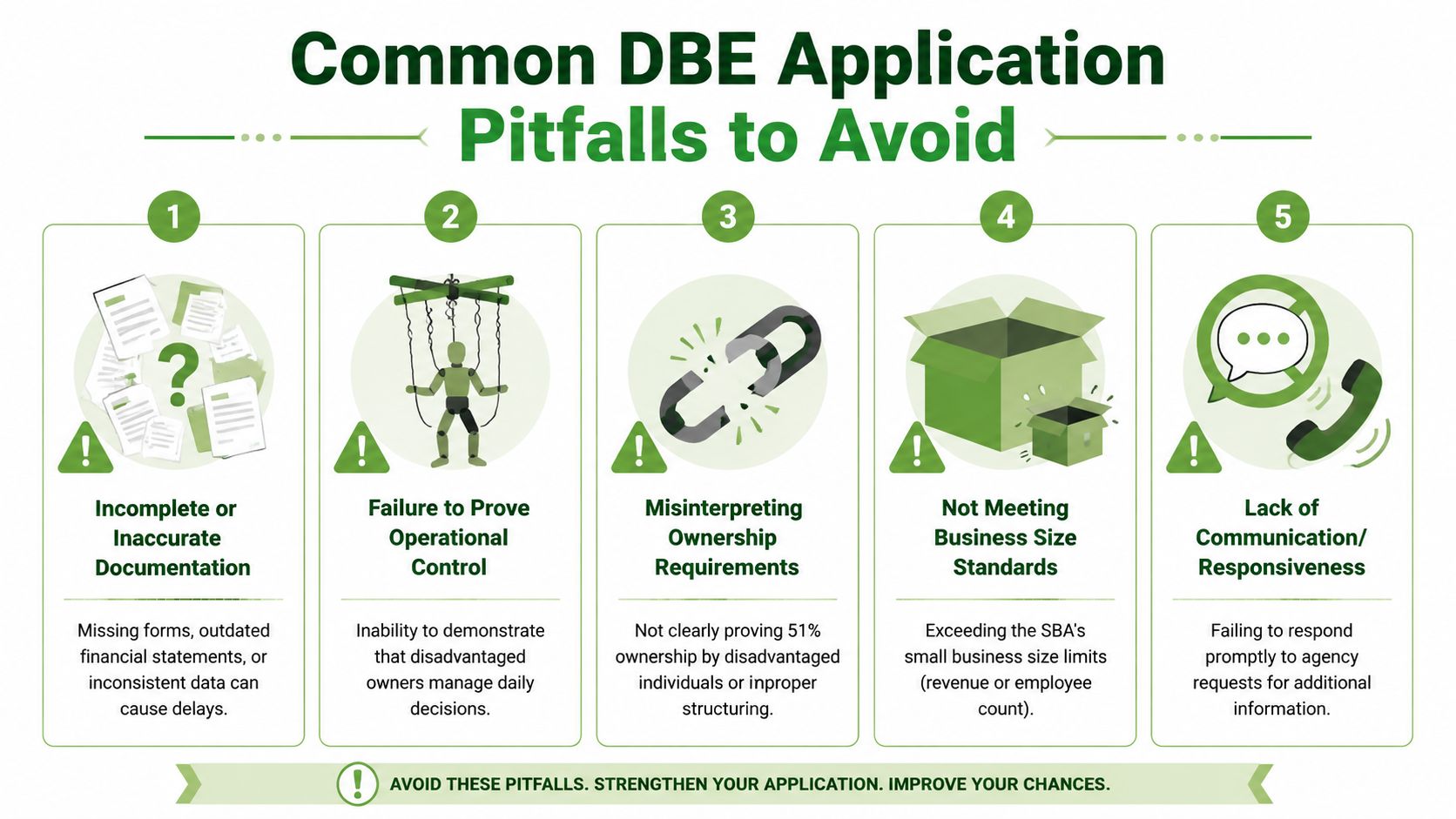
Most DBE application problems don't come from a single dramatic error. They come from a stack of smaller inconsistencies that tell the certifier the business is not fully buttoned up.
Mistaking formal titles for real control
A frequent assumption is that if the disadvantaged owner is listed as president, managing member, or CEO, the control test is satisfied. Certifiers look deeper.
If another person handles estimating, technical decisions, major contract negotiations, banking authority, or personnel supervision, the title may carry little weight. This shows up often in family-run firms and founder transitions.
Avoid it: Map key decisions to actual people before you apply. If the qualifying owner doesn't exercise authority in core business functions, fix operations first and apply later.
Submitting documents that tell different stories
DBE reviewers compare forms, tax records, governance documents, contracts, and interview statements. If one document says one person owns the business, another suggests a different structure, and a third shows someone else making decisions, the file starts to unravel.
Avoid it: Conduct an internal reconciliation review. Have one person check names, dates, percentages, titles, and signature authority across the full packet before submission.
Treating net worth review casually
Applicants sometimes assume personal financial review is a side issue. It isn't. As noted earlier, the program uses a hard personal net worth threshold in current guidance. Sloppy calculations or incomplete supporting records can trigger delay or denial.
Avoid it: Prepare the financial portion with the same care you'd bring to a lender file or audited grant submission. If a professional advisor is involved, make sure they understand DBE-specific context rather than treating it as a generic personal financial statement exercise.
Small inconsistencies are rarely interpreted as harmless. They often raise a bigger question about whether the business is being presented accurately.
Being unready for the interview
Some owners complete the paperwork and assume the hard part is over. Then the interview reveals they can't clearly explain operations, authority, or how the business earns money.
Avoid it: Rehearse. The qualifying owner should be able to walk through the company's services, decision structure, customer relationships, and daily management without relying on another person to fill in critical gaps.
Using a partner as a symbol instead of an operator
This pitfall matters especially for nonprofits assembling project teams. A certified DBE can't be attached to a grant or contract package for optics while another entity performs the substantive work.
Avoid it: Define a real scope, real deliverables, and a real management relationship. If the partner's role is vague, the arrangement may not hold up under scrutiny from the funder, prime, or certifier.
How Nonprofits Can Leverage the DBE Program
For nonprofits, the DBE program creates two strategic lanes.
The first lane is partnership. If you pursue transportation-related funding, certified DBEs can strengthen your implementation team, especially when the work includes outreach, technical services, field operations, planning support, or other contractable functions. Start with state certification directories and verify that the business is current, relevant to the scope, and positioned to do meaningful work.
The second lane is enterprise development. If your nonprofit has a revenue-generating business unit, the DBE framework may open doors to transportation-related contracting if the entity fits the eligibility rules and can support the documentation burden. This is most realistic when the social enterprise already operates like a true business, with clean governance, independent management, and clear ownership records.
A practical next step is to build DBE review into your opportunity screening process. When your team identifies transportation-related grants or procurement-linked funding, flag any DBE-related requirements early rather than discovering them halfway through narrative drafting. A curated pipeline of federal funding opportunities can help teams spot these requirements sooner and plan partnerships with enough lead time to matter.
Nonprofits that handle DBE issues well usually do three things consistently: they vet partners before proposal pressure sets in, they define scopes with precision, and they treat certification as a compliance matter rather than a symbolic designation.
Fundsprout helps nonprofits find relevant grant opportunities, analyze requirements, draft proposals, and stay compliant from application through renewal. If your team is juggling transportation funding, partner eligibility questions, and tight submission timelines, Fundsprout can help you organize the work and move faster with more confidence.
Try 14 days free
Get started with Fundsprout so you can focus on what really matters.