Guide to nonprofit bylaws template
Download our nonprofit bylaws template to simplify governance, stay compliant, and strengthen donor confidence.

Abdifatah Ali
Co-Founder
Your bylaws aren't just a legal document collecting dust on a shelf—they're the operational blueprint for your nonprofit's mission. A solid nonprofit bylaws template gives you the essential framework for good governance, which is absolutely critical for securing grants and staying compliant with the IRS. This guide provides an editable template and a quick-start framework to get your organization on the right track.
Your Nonprofit Bylaws Template And Quick-Start Framework
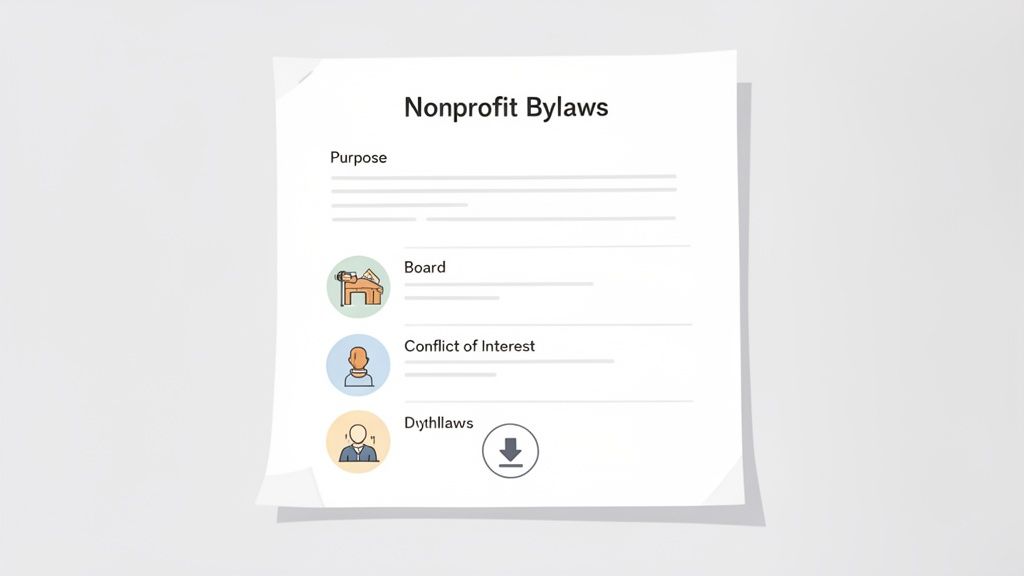
Think of your bylaws as the internal "rules of the road" for your organization. They spell out exactly how your board operates, how you make decisions, and how you ultimately protect your mission and assets. A thoughtfully crafted set of bylaws is a non-negotiable tool for any successful nonprofit, providing the kind of clarity and structure that both funders and regulators expect to see.
In recent years, nonprofit bylaws have become more important than ever. The IRS actually requires you to submit them as part of your 501(c)(3) tax-exemption application. When nonprofits file Form 1023 to get that coveted tax-exempt status, they must attach their bylaws to prove they have strong governance structures in place.
Core Components Of Your Bylaws
To make this whole process less intimidating, it really helps to break the document down into its essential parts. Each section serves a distinct purpose, from defining your mission to outlining how you'll handle conflicts of interest. Before you even start writing, you need a crystal-clear understanding of your nonprofit's https://www.fundsprout.ai/resources/nonprofit-organizational-structure.
Here’s a quick reference guide to the core sections every nonprofit needs to include. This table breaks down what each section does and, just as importantly, why funders care about it.
Core Components of Your Nonprofit Bylaws
Each of these articles builds on the last to create a comprehensive rulebook for your organization. Getting them right from the start saves you a world of headaches down the line.
When you're thinking about your nonprofit's internal framework, it can be helpful to see how other types of organizations handle governance. For instance, looking at an operating agreement template for an LLC can offer some perspective. While the legal structures are entirely different, the core idea of documenting roles and procedures is a universal principle of good management.
How to Customize Your Bylaws Template
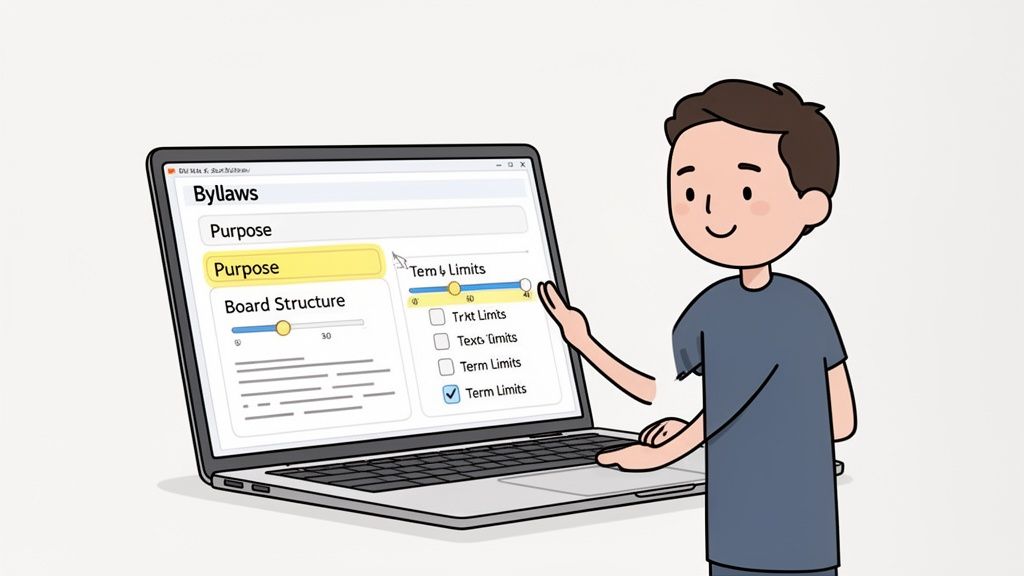
Think of a bylaws template as a good suit off the rack. It's a fantastic starting point, but it's not truly yours until it’s been tailored. The real work begins when you take that solid framework and shape it to fit your nonprofit's unique mission, culture, and day-to-day realities.
This customization process is where the document comes to life. You're moving beyond generic language to create a practical governance tool that will actually guide your board's decisions. This isn’t just about filling in blanks; it’s about strategic thinking that protects your leadership and impresses funders who know exactly what to look for in a well-run organization.
Crafting a Purpose Statement That Resonates
Your purpose statement is easily the most important part of your bylaws. A vague statement like "to support the community" is forgettable and does little to inspire action or funding. Grantmakers see dozens of these, and yours needs to cut through the noise.
Aim for a purpose statement that is both aspirational and incredibly specific. For instance, a small environmental group could evolve from "to protect local wildlife" to "to preserve and restore the native pollinator habitats of the Cedar River watershed through community education, invasive species removal, and native planting initiatives." That second version immediately tells a foundation everything they need to know about your scope, methods, and focus.
Structuring Your Board for Success
How you design your board of directors directly impacts your nonprofit’s ability to get things done. While a template provides the basic article, you need to define the details that make sense for your size and goals.
- Board Size: A nimble board of 5-7 members is often perfect for a small, local nonprofit that needs to make decisions quickly. A larger, national organization, however, might need a board of 15 or more to bring in diverse expertise and cover different regions.
- Term Limits: This is a critical best practice. Setting term limits—like two consecutive three-year terms—prevents board stagnation and ensures a steady flow of fresh perspectives. Without them, you risk burnout and entrenched thinking.
- Quorum Requirements: A quorum is the minimum number of directors needed for a vote to be official. If you set it too high (say, 90%), one person's absence can grind everything to a halt. A simple majority (51%) is a common, effective standard that keeps things moving.
A well-structured board clause does more than just outline rules; it builds a foundation for healthy leadership succession and prevents the kind of operational gridlock that can stifle a nonprofit’s growth.
Defining Essential Governance Clauses
Beyond the board, your bylaws need key clauses that protect your organization and its leaders. Two of the most important are the indemnification and conflict of interest policies. These aren't just legal formalities—they're hallmarks of a mature, well-managed nonprofit.
An indemnification clause is crucial for recruiting talented board members. It promises that the nonprofit will protect directors from personal liability for decisions made in good faith. Without this assurance, many qualified professionals would understandably think twice before joining your board.
The conflict of interest policy is just as vital for maintaining public trust and integrity. It lays out a clear process for directors to disclose any personal interests that could influence their judgment. A strong policy helps you avoid scandals that could tarnish your reputation and jeopardize funding. To see what a comprehensive policy looks like, you can check out this conflict of interest policy sample for non-profits.
Finally, think carefully about your membership structure. Does your arts organization have a fee-based membership with voting rights? Or does your advocacy group consider volunteers and donors to be non-voting members? Your bylaws must clearly define who your members are and what, if any, rights they hold. This is what transforms a generic template into your organization’s living, breathing operational guide.
Navigating IRS and State-Level Compliance
Think of your nonprofit's bylaws as more than just an internal rulebook. They’re a foundational document that both the IRS and your state charity officials will put under a microscope. Getting the details right from the start is non-negotiable for securing and keeping your 501(c)(3) status.
I often tell new founders to imagine building a bridge. The IRS sets the federal standards on one side, and your state sets the local rules on the other. Your bylaws are the structure that has to connect both sides perfectly. If there are any gaps, you risk serious delays or even having your application flat-out rejected.
Ultimately, both agencies are looking for the same thing: proof that your organization is built for the public good, not private gain, and that you have solid governance procedures locked in place.
What the IRS Mandates in Your Bylaws
When you file your Form 1023 application for tax-exempt status, the IRS examiner will beeline straight for your bylaws. They're looking for a few specific, non-negotiable clauses that prove you understand the legal obligations of a charity. Without them, your application is almost guaranteed to get kicked back.
Two of the most critical provisions the IRS will look for are:
- A Clear Purpose Clause: This needs to explicitly state that your purpose aligns with one of the exempt missions laid out in Section 501(c)(3) of the Internal Revenue Code—think charitable, educational, or scientific. Vague language like "making the world a better place" just won't cut it.
- The Dissolution Clause: This is an absolute must-have. It’s a formal statement explaining what happens to your nonprofit’s assets if you ever close down. The IRS requires a hard-and-fast rule: any leftover assets must go to another 501(c)(3) organization, not to board members, staff, or any for-profit company.
Here’s an example of the kind of language that gets an IRS agent to check the box and move on:
"Upon the dissolution of [Your Nonprofit's Name], any assets remaining after the payment of or provision for its debts and liabilities shall be distributed to one or more organizations that are organized and operated exclusively for charitable, educational, or scientific purposes as shall at the time qualify as an exempt organization under Section 501(c)(3) of the Internal Revenue Code."
This wording isn't just a friendly suggestion. It's the kind of ironclad language that signals to the IRS you’re serious about your perpetual commitment to public service, which is a core tenet of their approval process.
State-Level Rules and Requirements
While the IRS sets the federal baseline, your state's laws add another crucial layer of rules you have to follow. Every state has a nonprofit corporation act that governs the nuts and bolts of how you operate—things like board meetings, voting rules, and keeping records. And trust me, these rules can differ dramatically from one state to the next.
For example, California's Nonprofit Public Benefit Corporation Law has very strict rules about "self-dealing" transactions involving directors. Down in Georgia, the law requires that the president and secretary roles be held by two different people to ensure a proper separation of duties.
Here are a few common areas where state laws will dictate what goes into your bylaws:
- Board of Directors: States often set a minimum number of directors (e.g., three).
- Officer Roles: Some states mandate specific officer positions that must be filled.
- Meeting Notices: You'll find specific timelines for how far in advance you must notify directors of a meeting.
- Quorum: The minimum percentage of board members that must be present to hold a vote.
You absolutely have to dig into your state's specific nonprofit statutes. A quick search for "[Your State] nonprofit corporation act" is a great place to start. A nonprofit bylaws template is a lifesaver, but you must modify it to meet these local demands. What’s perfect for the IRS could easily be non-compliant at the state level.
And it's not just the government watching. Strong governance is a huge deal for funders. With 73% of grant programs evaluating governance quality, well-written bylaws can be a key to unlocking financial support. On the flip side, poorly written bylaws can lead to average legal costs of $15,000-$40,000 annually, while clear policies can boost donor retention by as much as 50%.
Creating a single, solid document that satisfies multiple authorities is the goal here. To see how this all connects to winning grants, you can check out our guide on federal grants for nonprofits.
How to Officially Adopt and Amend Your Bylaws
Getting your nonprofit bylaws template drafted is a huge milestone, but that document doesn't have any real authority until your board of directors makes it official. The formal adoption process is what turns a simple draft into the legally binding rulebook for your organization.
And it’s not a "set it and forget it" kind of document. You have to treat your bylaws as a living framework, ready to adapt as your nonprofit grows and your mission evolves.
If you don't have a clear, consistent way to adopt and later amend these rules, you're setting yourself up for confusion, internal squabbles, and maybe even compliance headaches. It's so important to get these procedures right from the start. Doing so formalizes your decision-making and shows funders and regulators that you're serious about good governance.
Making it Official: The Initial Adoption
Once your founding board has hammered out the details and agrees on the final draft, it's time to adopt them. This isn't a casual nod of agreement—it needs to be a formal vote that's recorded in your official board meeting minutes. The standard way to do this is by passing a board resolution.
A resolution is just the formal language used to document a decision made by the board. Usually, the board secretary will draft it, present it during a meeting, and then carefully record the vote's outcome. The wording needs to be completely clear.
Here’s a straightforward example of what that resolution could look like:
Resolution to Adopt Bylaws
WHEREAS, the Board of Directors of [Your Nonprofit's Name] has been established to govern the affairs of the organization; and
WHEREAS, the Board has reviewed a proposed set of bylaws to provide a framework for the governance and operation of the organization;
NOW, THEREFORE, BE IT RESOLVED, that the Board of Directors hereby adopts the proposed bylaws as the official bylaws of [Your Nonprofit's Name], effective immediately. The Secretary is instructed to file a signed copy of these bylaws in the official corporate records.
After the motion passes, the secretary's job is to make sure a final, clean version is signed, dated, and stored somewhere safe with your nonprofit's corporate records. As you grow, knowing how to use a board of directors resolutions template will become second nature for documenting all kinds of important board decisions.
This flowchart shows the compliance path your bylaws will take, from the first draft to getting the green light from state and federal agencies.
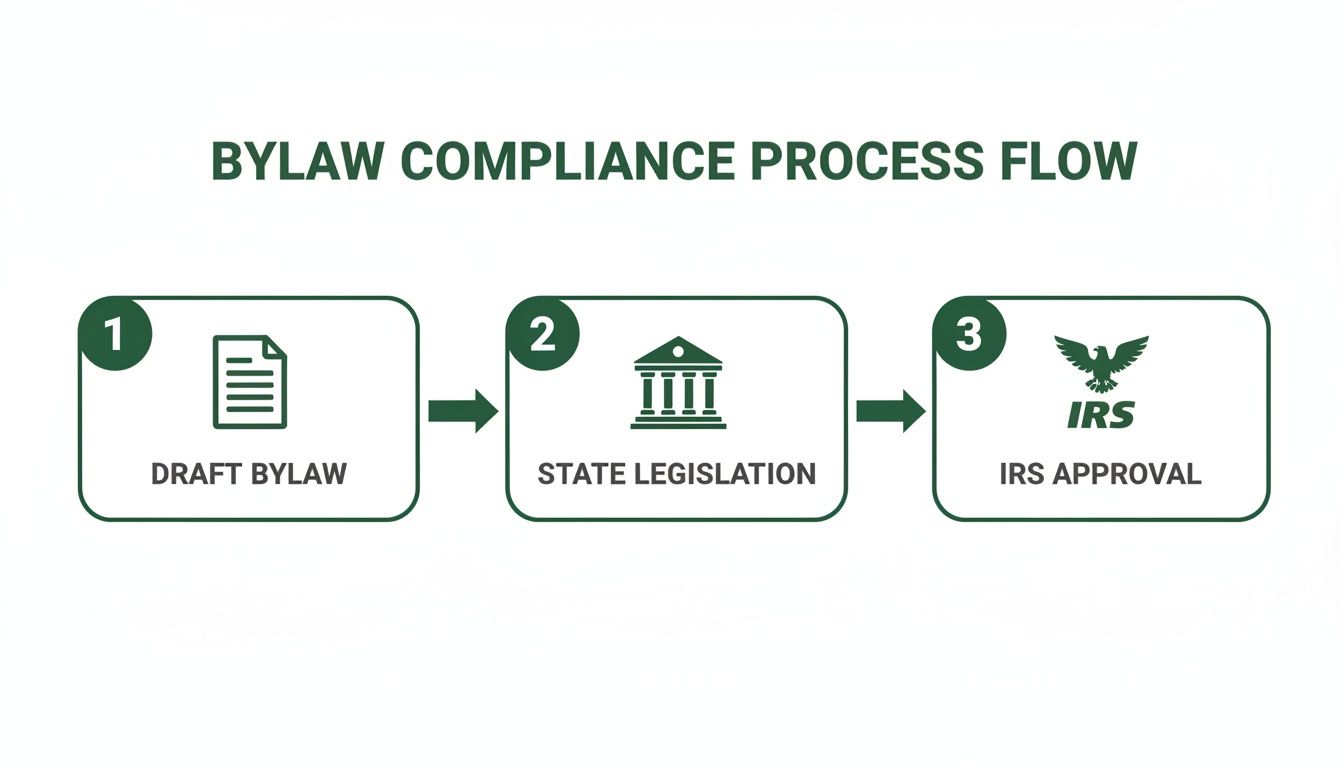
It’s a good reminder that while governance starts inside your organization, it ultimately has to satisfy outside regulators to be valid.
Changing Your Bylaws as Your Organization Evolves
Your nonprofit is going to change. That's a good thing! Your mission might broaden, your board could get bigger, or state laws might shift. When that happens, your bylaws need to keep up.
The process for making changes should be spelled out right there in the bylaws, usually in a section titled "Amendments." If you don't follow your own rules for making changes, you could accidentally invalidate them.
Generally, you'll follow a few key steps:
- Propose the Change: Typically, any board member can suggest an amendment. This should be submitted in writing to the board secretary with plenty of time before a meeting.
- Give Proper Notice: Your bylaws will state how much advance notice is required (for example, 30 days) to let all directors know about the proposed change. This avoids springing it on people and gives them time to think it over.
- Hold the Vote: The bylaws should also specify the voting majority needed. Because this is a core document, it's often a two-thirds majority, not a simple majority.
- Document Everything: Once an amendment passes, it has to be officially recorded. Update the master copy of your bylaws and clearly note the date the change was made. It's also smart to let key stakeholders know about any big changes to maintain transparency.
Good version control is a must. I’ve seen organizations get into trouble because nobody knew which version was the current one. Always keep a file with previous versions and clearly label the active document. It’s a simple habit that reinforces your commitment to organized, transparent governance.
Common Bylaws Mistakes to Avoid
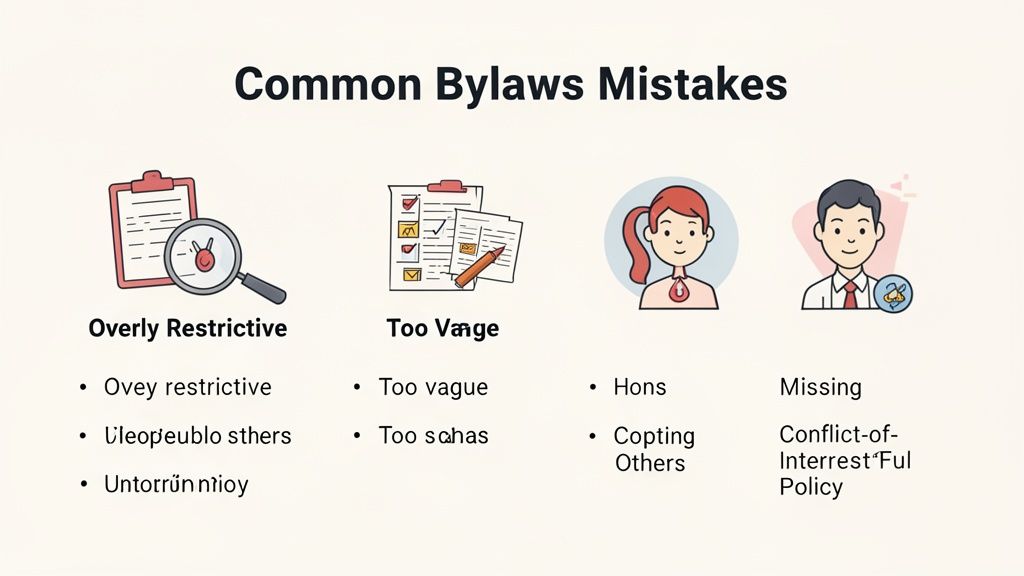
When you're drafting your bylaws, it's easy to get lost in the weeds and make small missteps that snowball into major headaches later on. I’ve seen it happen time and again. These aren't just minor typos; they can create governance loopholes, fuel internal conflicts, and even put your coveted 501(c)(3) status at risk.
Knowing what not to do is just as important as knowing what to do. The whole point is to build a strong framework that empowers your mission, not one that ties your hands with confusing language or unnecessary red tape.
Being Too Vague or Overly Restrictive
Finding the sweet spot between clarity and flexibility is one of the trickiest parts of writing bylaws. I often see organizations veer too far to one extreme—either they're painfully restrictive or hopelessly vague. Both paths lead to trouble.
Vague bylaws are a breeding ground for conflict. When terms for board duties, meeting rules, or member rights are fuzzy, you leave everything open to individual interpretation. Suddenly, when a disagreement pops up, you have no clear rulebook to fall back on, forcing the board into messy, on-the-fly decisions that can feel unfair and lead to total gridlock.
On the flip side, overly restrictive bylaws can strangle your nonprofit’s ability to grow and adapt. For example, if you set an absurdly high quorum requirement (say, 90% of the board), one director’s vacation could bring all official business to a screeching halt. Detailing every tiny operational procedure also means you can't pivot quickly without a formal, time-consuming amendment process.
The Critical Difference Between Shall and May
In a legal document, words have weight, and nowhere is this truer than with "shall" and "may." They seem interchangeable in conversation, but in your bylaws, they have completely different legal meanings that can dramatically alter how a rule is enforced.
- Shall is a command. It’s mandatory and creates an obligation. "The Treasurer shall present a financial report at every quarterly meeting" isn't a suggestion—it's a requirement.
- May is an option. It grants permission or authority but doesn't force action. "The Board may form an ad-hoc committee for the annual gala" gives the board the choice, not the duty.
Mixing these up is a classic mistake that can lead to serious disputes. If a bylaw says the board "may" remove a director for cause, it’s an option. If it says they "shall," it becomes a required action once certain conditions are met. In fact, nonprofit law specialists estimate that precisely worded provisions can cut governance disputes by 35-45%. It's no surprise that nearly 80% of nonprofits bogged down in such disputes admit their bylaws were unclear. You can find more insights about legal language in bylaws and why it's so vital for good governance.
Forgetting Key Policies
Another common pitfall is treating the bylaws as nothing more than a high-level guide to board meetings. Your nonprofit bylaws template must also include or reference essential governance policies. Skipping these creates huge risks and can be a red flag for savvy funders who want to see that you have mature oversight in place.
Two policies are absolutely non-negotiable:
- Conflict of Interest Policy: This is a must-have. You need a crystal-clear procedure for board members to disclose potential conflicts and, most importantly, recuse themselves from voting on those matters. Without it, you’re wide open to accusations of self-dealing.
- Indemnification Clause: This is what protects your directors from being held personally liable for decisions they make in good faith for the organization. This clause is critical for recruiting and keeping qualified board members—without it, few would be willing to take on the personal risk.
Adopting another organization’s bylaws without deep customization is one of the most dangerous shortcuts a new nonprofit can take. Every organization has a unique mission, culture, and structure; your bylaws must reflect that reality. What works for a national advocacy group will not work for a local animal shelter.
Got Questions About Nonprofit Bylaws? We’ve Got Answers.
When it comes to nonprofit governance, bylaws are a source of endless questions. It doesn't matter if you're a brand new founder working from a nonprofit bylaws template or a seasoned executive director of an established organization—questions always come up.
Let's clear up some of the most common points of confusion. Getting these fundamentals right is the key to building a strong, compliant organization that can focus on what really matters: your mission.
How Often Should We Actually Look at Our Bylaws?
Think of your bylaws as a living document, not something you write once and file away forever. Best practice in the sector is to give them a really thorough review every 2 to 3 years. This cadence ensures your governance rules still match how your organization actually works and, just as importantly, that they comply with current laws.
Of course, sometimes you can't wait for that scheduled review. Certain events should trigger an immediate look at your bylaws:
- You've made a major shift in your mission or strategic plan.
- State or federal nonprofit laws have changed (this happens more than you'd think!).
- Your budget has grown or shrunk dramatically.
- You're changing your board structure, like adding new officer roles or creating committees.
Even outside of these formal reviews, it’s a great habit to do a quick annual check-in during a board meeting. This keeps the bylaws from gathering dust and shows funders and partners that you take good governance seriously. It’s a simple move that prevents your rules from becoming outdated.
Articles of Incorporation vs. Bylaws: What's the Difference?
This is easily one of the most common mix-ups for new nonprofit leaders, but the distinction is pretty simple once you see it. Think of it like building a house: your Articles of Incorporation are the foundation and frame, while your bylaws are the detailed blueprints for how the house will actually function day-to-day.
Articles of Incorporation are the legal papers you file with the state to officially exist. This is your nonprofit's "birth certificate." It's a public document that contains just the high-level, essential facts:
- Your nonprofit’s official name.
- The address of your main office.
- Your registered agent's name and address.
- A broad statement about your charitable purpose.
Bylaws, on the other hand, are your internal rulebook. You don't usually file them with the state, but the IRS will absolutely want to see them. This document gets into the nitty-gritty of how you run the show:
- Board member roles, term limits, and responsibilities.
- How you'll hold meetings and what constitutes a vote.
- The specific duties of each officer (President, Treasurer, Secretary, etc.).
- Policies for handling conflicts of interest.
Both are critical. Your Articles legally create the organization, and your bylaws tell you how to run it. You'll need both when you apply to the IRS for 501(c)(3) tax-exempt status.
Can We Just Operate Without Bylaws?
Let me be direct: no. Operating a nonprofit without formally adopted bylaws isn't just a bad idea—it's a non-starter from both a legal and practical perspective.
On the legal front, the IRS requires you to submit a signed copy with your Form 1023 application to get your 501(c)(3) tax-exempt status. Beyond the IRS, most states have laws that require nonprofit corporations to adopt bylaws to manage their internal affairs.
From a practical standpoint, your bylaws are the bedrock of your organization's stability. Without them, how will you:
- Make a tough decision when the board is split?
- Resolve a dispute between two passionate board members?
- Ensure financial accountability and oversight?
- Hold leadership accountable for their duties?
An organization without bylaws screams instability. Donors, grantmakers, and community partners won't take you seriously without a clear governance structure. They are an essential tool for building trust and ensuring you're around for the long haul.
Where Should We Keep Our Official Bylaws?
Once your bylaws are approved, where you store them is just as important as what's in them. You need them to be secure but also accessible to the right people. I've always found a two-pronged approach—one physical, one digital—works best.
First, a printed and signed hard copy should go into the corporate record book. This is the official archive of all your key governance documents, usually held by the board secretary.
Second, and just as important, is a digital copy. Scan the signed version and save it in a secure cloud folder (think Google Drive or Dropbox) that all current board members and key staff can access. This prevents people from accidentally using an outdated version. Make it a standard part of your onboarding to give a copy to every new board member—it’s a cornerstone of good governance.
Ready to streamline your grant-seeking process and secure the funding your mission deserves? Fundsprout uses AI to match your nonprofit with the perfect grant opportunities, helps you craft compelling proposals, and simplifies compliance so you can focus on making an impact. Discover how Fundsprout can transform your fundraising efforts today.
Try 14 days free
Get started with Fundsprout so you can focus on what really matters.