Your Guide to AI Grant Writing Software in 2026
Discover how AI grant writing software helps nonprofits win funding and save time. Our guide covers features, selection tips, and implementation strategies.

Abdifatah Ali
Co-Founder
Picture this: you have a tireless assistant who hunts down the perfect grant opportunities and even helps draft compelling proposals, all while you stay focused on your nonprofit's mission. That's no longer a fantasy—it’s the reality with AI grant writing software, a new category of tools built to finally end the burnout so common in our field.
The End of Grant Writing Burnout Is Here
Let's be honest, grant writing has always been a high-stakes, high-effort game. Nonprofits, especially smaller ones, are often caught in a brutal cycle of endless research, tedious drafting, and the constant pressure of looming deadlines. This administrative weight steals precious time that should be spent serving communities or building genuine relationships with funders.
AI grant writing software completely flips that script. It’s a force multiplier, automating the most repetitive and draining parts of the job. Don't think of it as a replacement for human skill; think of it as a dedicated partner that handles the grunt work. This frees up your team to concentrate on what really matters: strategy, storytelling, and showcasing your impact. We’ve seen similar shifts in other fields, where AI in accounting automates tedious tasks, dramatically reducing administrative burdens and preventing burnout.
The table below paints a clear picture of just how different the process can be.
Traditional vs AI-Powered Grant Writing
This comparison highlights the shift from manual labor to strategic oversight, allowing grant professionals to work smarter, not just harder.
A New Era of Efficiency and Access
This technology does more than just save a few hours here and there. It's about leveling the playing field. For the first time, organizations with limited staff and shoestring budgets can get their hands on tools that help them compete for critical funding on much more equal footing.
The core promise of AI in grant writing is simple: it empowers your team to shift its energy from administrative drag to mission-focused drive. By automating the mechanics of proposal creation, you can dedicate more time to what truly matters—delivering on your promises.
The market for these tools is exploding. The AI writing market, valued at $2.74 billion in 2026, is projected to soar to $18.27 billion by 2035. This rapid growth is fueling powerful new features, with tools now able to slash proposal drafting time by an incredible 40%—saving the average user 2.2 hours every week. With 78% of organizations already adopting AI writing tools, nonprofits who embrace this shift are gaining a serious advantage.
To give you an idea of what this looks like in practice, platforms like Fundsprout provide a central command center for your entire grant strategy.
This dashboard organizes the entire grant pipeline, from identifying prospects to tracking submissions, all in one clean interface. By managing the full lifecycle this way, you can spot bottlenecks and fine-tune your process. This is a huge step in cutting down on how much time grant writing takes and maximizing your team's effectiveness.
How AI Grant Writing Software Actually Works
So, how does this software really do its job? It’s not about one single magic button. Instead, think of it as having a specialized digital team on your side—a research librarian, a compliance expert, and a skilled writer, all rolled into one and powered by smart technology. This "team" breaks down the daunting grant-seeking marathon into a series of manageable, automated sprints.
The process kicks off with the “librarian” part. Forget spending days manually digging through grant databases. The software scans thousands of federal, state, and foundation opportunities for you. You just tell it about your organization’s mission, programs, and location, and it generates a curated list of funders who are actually a good fit. This alone can save an incredible amount of research time.
This simple workflow is key to helping organizations move past burnout and toward meaningful action.
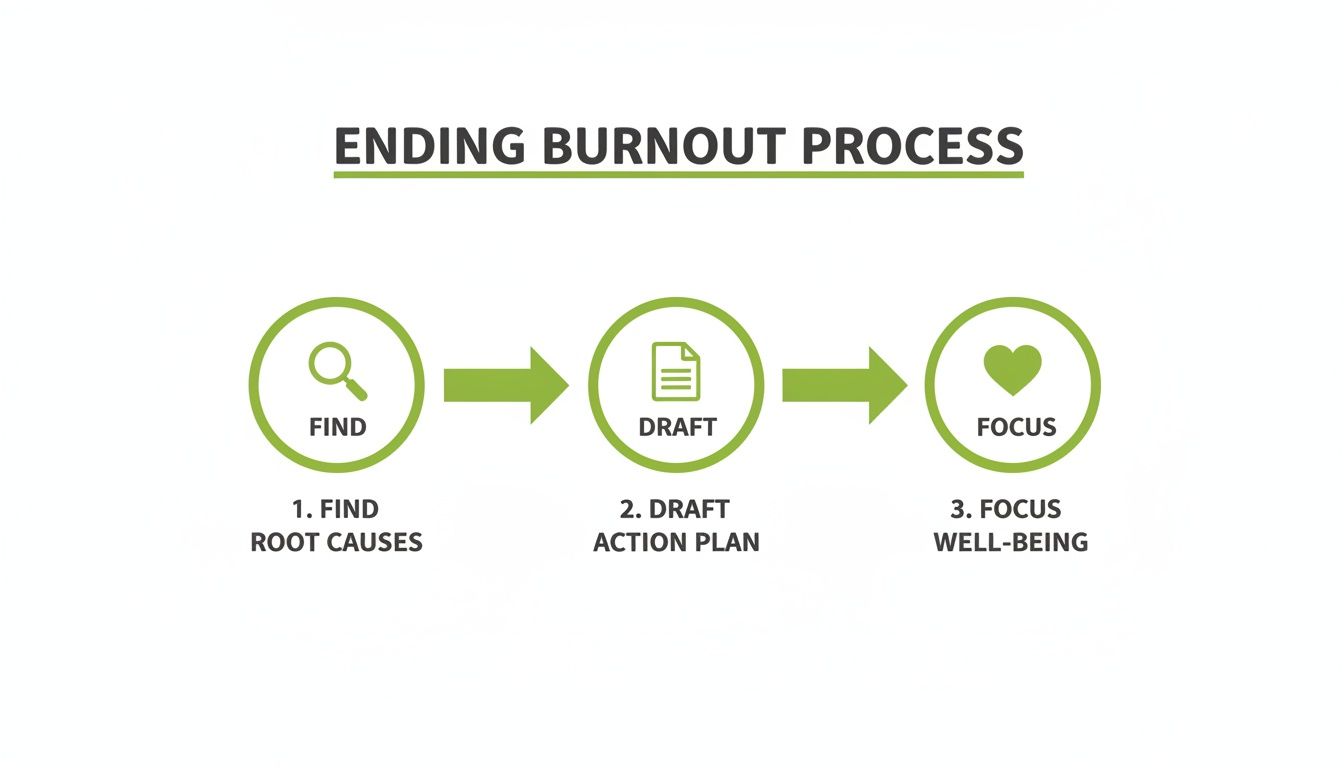
As you can see, it’s a straightforward path: find the right opportunities, draft proposals without the usual grind, and get back to focusing on your impact. This structured approach is what truly lifts the administrative burden.
From Complex RFPs to Clear Outlines
Once a promising grant is identified, the "compliance expert" in the software takes the lead. This is where a true ai grant writing software really shines and pulls away from more generic AI tools. It dives deep into the Request for Proposal (RFP), no matter how dense or complicated it is.
The platform’s RFP analyzer dissects the entire document. It pulls out all the critical requirements, eligibility rules, and submission guidelines, then organizes them into a clear checklist or a proposal outline.
It’s like this: Instead of you spending hours with a highlighter on a 50-page PDF, the AI hands you a clean, step-by-step project plan. It shows you exactly what the funder wants, section by section, before you even start writing.
This upfront analysis is a game-changer. It stops you from wasting precious time and resources on grants you were never going to get. More importantly, it gives you a solid roadmap for the entire application from the very beginning.
Generating Content with Your Voice
Now for the "master writer" component, which is where things get really interesting. You start by "training" the AI with your organization's own materials. You can feed it things like:
- Past successful grant proposals
- Annual impact reports
- Website content and case studies
- Program descriptions and strategic plans
The AI learns from this knowledge base to generate a first draft of your proposal narrative. The key here is that it picks up on your organization's unique tone, specific language, and overall style. The goal is to produce something that sounds authentically you—not like a robot. To see just how well it can adapt, it's worth learning about the functions of an automated grant proposal generator.
This is a world away from simply filling in a generic template. It’s a sophisticated process that sets specialized grant writing tools apart.
The Core Features That Win More Grants
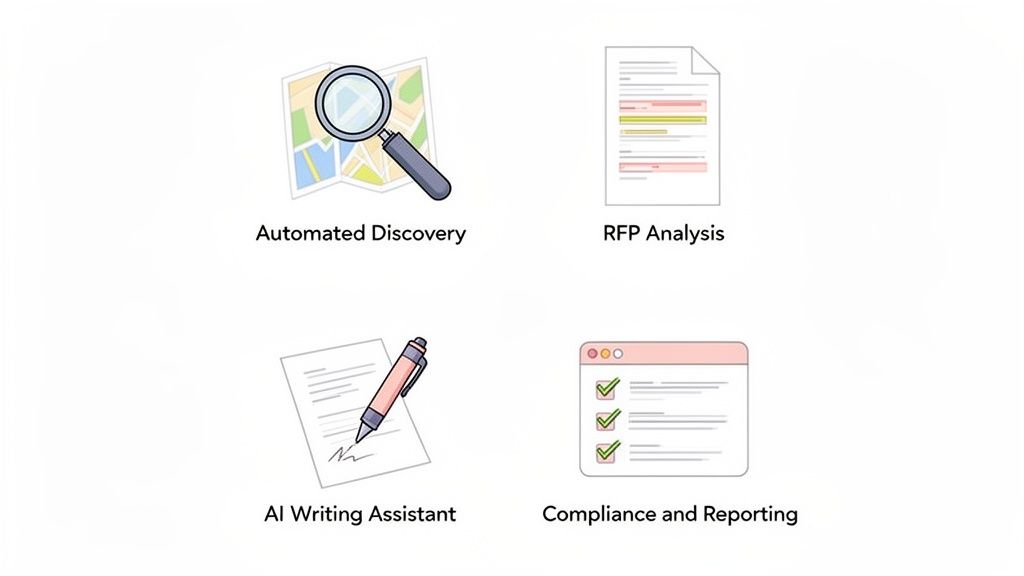
The real magic of AI grant writing software isn't some vague, futuristic promise. It's found in the specific, purpose-built tools that tackle the biggest headaches of the grant cycle. These features aren't just generic AI assistants with a "nonprofit" sticker slapped on; they were designed from the ground up by people who understand the grind of grant seeking.
Let's break down the core functions that help you secure more funding with far less friction. Think of it like a grant professional’s dream toolkit, where each tool has a precise job—from finding the right opportunities to crafting a perfect proposal and keeping your reporting on track.
Automated Grant Discovery and Matching
We've all been there. The first, and often most daunting, step is just finding funders that are a good fit. Manually digging through databases like Grants.gov or combing through foundation websites is a massive time sink, and you often end up with a list of long shots. Automated discovery flips this entire process on its head.
This feature acts like a dedicated scout working 24/7 for your nonprofit. You start by giving it your organization’s profile:
- Mission and Program Areas: What you do and who you serve.
- Geographic Focus: The communities you work in.
- Organizational Capacity: Your budget size, staff, and history.
From there, the AI constantly scans thousands of public and private funding sources. Instead of you hunting for grants, the software brings a curated list of opportunities right to you. It even provides a "match score" to show you exactly how well a funder aligns with your work, so you can stop wasting time on applications that were never going to fly.
Intelligent RFP and Eligibility Analysis
So you've found a promising grant. Now comes the next challenge: dissecting the Request for Proposal (RFP). These documents can be incredibly dense, sometimes running 50 pages or more, packed with legal jargon and hidden requirements. An intelligent RFP analyzer is your expert interpreter.
You simply upload the RFP, and the AI immediately goes to work. It reads and digests the entire document, pulling out the most important information and organizing it for you.
It’s like having an expert grant manager turn that convoluted document into a clear, actionable to-do list in a matter of minutes. The software flags key deadlines, formatting rules, required attachments, and the specific questions you need to answer, laying it all out in a simple checklist.
This saves countless hours of painstaking manual review. More importantly, it acts as a critical first line of defense, flagging eligibility issues from the get-go and preventing your team from pouring effort into a proposal that would be disqualified on a technicality.
The AI-Powered Writing Assistant
Here’s where it gets really interesting. The AI writing assistant is so much more than a grammar check or a generic text generator. It’s a true collaborative partner that helps you write your grant narrative, and it actually learns to sound like your organization.
You begin by feeding the system your own content—past successful grant proposals, annual reports, program statistics, and even your website copy. The AI analyzes all of this to learn your voice, your key messages, and your evidence of impact. When you start writing a new proposal, it can draft entire sections, like a Statement of Need or Organizational History, that already sound authentic to you.
This kind of power is why the global AI writing assistant market is expected to reach $8.3 billion by 2030. For nonprofits, this means access to sophisticated tools that can generate compelling narrative drafts, complete with citations, and even help visualize project timelines. These are a world away from generic chatbots that don't understand the strict compliance needs of grant funding. You can get a better sense of these trends by reviewing the full market research on the future of AI writing assistants.
The best tools don’t just write for you; they work with you. The system can produce a solid first draft and then give you options to refine the tone, making it more formal for a federal grant or more passionate for a community foundation.
Compliance and Reporting Dashboards
Winning the grant is a huge accomplishment, but the work doesn't stop there. Managing the award and handling the reporting is just as crucial. Good AI grant software builds in project management and reporting features that become a safety net for your team.
These dashboards bring all your grant activities into one clean, central hub:
- Deadline Tracking: Visual timelines for all upcoming proposals and reports so nothing slips through the cracks.
- Task Management: The ability to assign specific sections or tasks to different team members.
- Compliance Checklists: A final check to ensure every single funder requirement is met before you hit "submit."
- Reporting Automation: Pre-populating report templates with program data already stored in the system.
This functionality is absolutely essential for building and maintaining strong relationships with funders. It helps you avoid missed deadlines, simplifies the dreaded reporting process, and creates a clear audit trail that makes grant renewals and future applications much, much easier.
Choosing the Right AI Platform for Your Nonprofit
Picking an AI grant writing software isn't like buying a new printer. Think of it as hiring a new team member—one that you’re entrusting with your organization's future. The right platform can feel like a brilliant new grant coordinator, while the wrong one just adds another layer of frustration to your workload.
To find the right fit, you have to look past the flashy marketing and get down to what really matters for your nonprofit’s actual, day-to-day operations. It’s all about asking the right questions before you commit.
Security and Data Privacy First
Let's start with the most important thing: your data. You’ll be feeding this AI your most sensitive information—past grant proposals, impact metrics, financial statements, and strategic plans. This isn't just data; it's the very foundation of your nonprofit, and keeping it secure is non-negotiable.
Before you even look at a feature list, vet the platform’s security. Ask them directly about their protocols. You need concrete answers on a few key points:
- Data Encryption: Is your information encrypted both when you upload it (in transit) and while it's stored on their servers (at rest)?
- Privacy Policies: Do they have a crystal-clear policy stating they will never use your proprietary data to train their AI models for other customers? Your work should benefit you, not your competitors.
- Access Controls: Can you manage who on your team sees what? The ability to set user-level permissions is crucial for protecting sensitive financial or programmatic details.
Your data is your single most valuable asset in the grant-seeking world. A trustworthy AI partner will treat it with the same confidentiality you do, guaranteeing your intellectual property stays yours and yours alone.
Integrations with Your Existing Systems
No tool works in isolation. An amazing AI platform that can’t talk to your other software is like a brilliant colleague who refuses to attend team meetings. It creates data silos and forces you into more manual work—exactly what you’re trying to avoid.
The goal is a smooth, connected workflow. Check if the AI software plays nicely with the tools your team already relies on every single day. This could include:
- Your Customer Relationship Management (CRM) system like Salesforce or Bloomerang
- Donor management software
- Project management tools like Asana or Trello
- Cloud storage like Google Drive or Dropbox
This screenshot, for example, shows a platform's integration page, which is a great at-a-glance way to see what it connects with.
Seeing a clear list of integrations is a huge green flag. It tells you the developers built their tool to fit into a real-world tech stack. For more on how these tools fit together, check out our guide on the best grant discovery platforms.
AI Grant Writing Software Evaluation Checklist
To make this process easier, we've put together a checklist. Use these questions as a framework to compare platforms and ensure you're covering all your bases, from technical requirements to long-term support.
This checklist isn't just about ticking boxes. It’s about building confidence that the platform you choose will become a genuine asset, not a liability.
Training Support and Ongoing Costs
Finally, think about the people who will actually be using this software. The most powerful tool in the world is worthless if your team finds it confusing or intimidating, especially in smaller nonprofits without a dedicated IT person.
When exploring options like the Saucial AI platform, pay close attention to the post-purchase experience. What happens after you sign the contract? Do they offer one-on-one onboarding? Is there a library of help articles and training videos? And most importantly, can you get a real person on the line when you’re stuck?
Be sure to look closely at the pricing, too. Some platforms have a simple, all-in-one subscription, while others nickel-and-dime you for extra users, key features, or premium support. Do the math to understand the total cost of ownership and make sure it fits your budget and delivers a clear, measurable return.
Your First 90 Days With AI Grant Writing Software
So you've decided to bring an AI grant writing software into your process. That's a great move, but it's important to remember that this isn't a magic wand you just wave over your fundraising. Think of it more like hiring and training a new, incredibly fast assistant. The first 90 days are all about getting that assistant up to speed.
This roadmap isn't about frantically trying to win a grant in the first week. It’s about being deliberate and laying a solid foundation. The goal is to build a new, more efficient grant-seeking habit for your team, one that ultimately reduces stress and frees you up for more strategic work. Let's walk through what this looks like in practice.
The First 30 Days: Setting the Foundation
The first month is all about orientation. Your main job is to teach the AI about your nonprofit—your mission, your voice, and your history. This is how you turn a generic piece of software into a true partner that gets who you are.
Weeks 1-2: Onboarding and Brain-Dumping
The first couple of weeks are dedicated to getting your team comfortable and feeding the AI the right information. This is probably the most important step for getting quality results later on. Get this right, and everything else becomes easier.
- Team Onboarding: Get the training session from your software provider on the calendar. Make sure everyone involved in the grant process is there, not just the grant writer. Program managers and even your ED should be in the loop.
- Document Upload: Now for the "brain dump." Gather all your key documents—past winning proposals, your strategic plan, annual reports, program budgets, and any case statements.
- Voice Training: All that data you're uploading is what the AI uses to learn your organization's unique voice and nail down your key stats. The better the information you feed it now, the more authentic and accurate its first drafts will be down the line.
Weeks 3-4: Your First AI-Assisted Project
Alright, time to put the training wheels on and go for a ride. By the end of month one, you should be ready to tackle a real proposal with your new AI assistant. The key is to pick a low-stakes opportunity, like a grant renewal or a small proposal to a familiar foundation.
The goal here isn't necessarily to win—it's to learn the workflow. This is a practice run. Your team will co-create the proposal with the AI, letting it handle first drafts and analyze the RFP. This hands-on experience is where the confidence builds and you start to see how this new process actually works.
Days 31-90: Building Momentum and Seeing the Payoff
With a solid foundation in place, the next two months are about making the software a regular part of your workflow. This is when you'll really start to feel the impact, not just in time saved but in your team’s overall capacity.
Now you can start tracking your progress. Set up a simple dashboard to keep an eye on your key metrics. The goal is to see a clear picture of how your grant-seeking efforts are becoming more efficient.
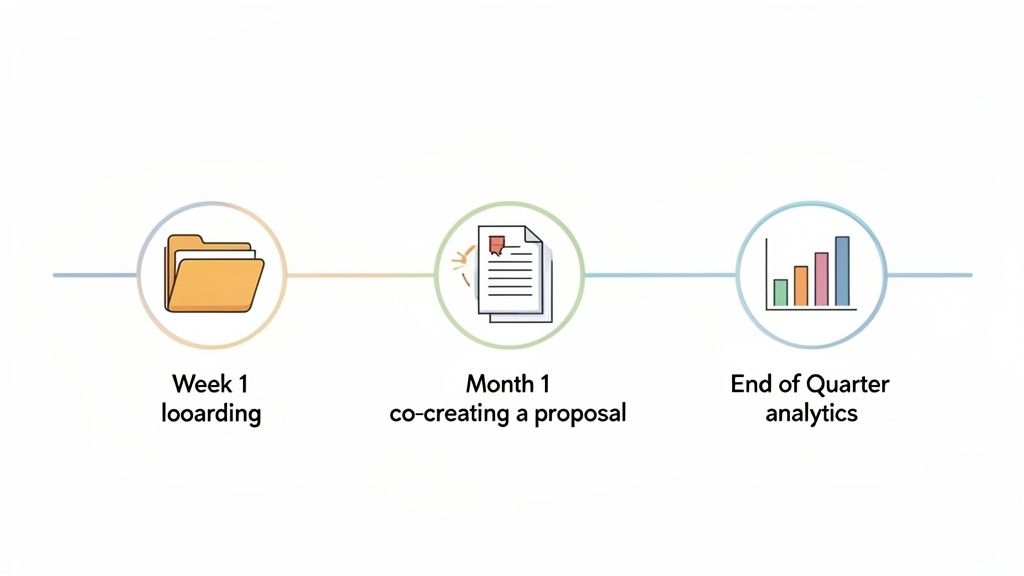
A visual timeline or dashboard helps you prove the value to your leadership and board. At the end of the quarter, you'll have concrete data, not just a gut feeling that things are better.
Focus on metrics that tell the whole story, not just the number of grants won:
- Increased Application Volume: Are you submitting more well-aligned proposals now that you're not bogged down in administrative tasks?
- Time Saved Per Proposal: How many hours is your team actually saving on each application compared to the old way of doing things? Even a few hours per proposal adds up fast.
- Reduced Team Burnout: This one is huge. Check in with your team. Do they feel less stressed? Are they finally getting to those important but not-urgent tasks, like building relationships with funders?
By the time you hit the 90-day mark, your team should feel capable and confident, not overwhelmed. You'll have a smoother process, a well-trained AI assistant, and the data to show exactly how much more effective your fundraising has become.
Frequently Asked Questions About AI in Grant Writing
Bringing any new technology into your nonprofit is a big decision, and it’s smart to have questions. When it comes to AI grant writing software, we hear a few common concerns pop up again and again—especially around ethics, data security, and whether it’s even practical for smaller teams.
Let's get straight to it and clear up the biggest questions on your mind.
"Is It Ethical to Use AI for Grant Writing?"
This is always the first, and most important, question. The conversation around ethics all comes down to a single, simple principle: AI is an assistive tool, not a replacement for human authenticity.
Think of it this way: you wouldn't think twice about using a powerful calculator to develop your budget narrative. The tool runs the numbers, but you—the human expert—are still the one checking the work, telling the story behind the figures, and making the strategic decisions. It’s the same with AI. It can help you draft sections or organize your thoughts, but your team must always review, edit, and ultimately own the final proposal. The AI assists; you ensure the final submission truly reflects your organization's unique voice and mission.
"How Secure Is Our Nonprofit's Data?"
This is another big one. You're thinking about uploading past grants, sensitive financial reports, and strategic plans into a new system. It's completely natural to worry about where that information is going. Any reputable AI provider understands this and has built their platform with security as a top priority.
When you're looking at different options, don't be shy about asking for specifics on security. You need to see clear commitments to:
- Data Encryption: Make sure your data is protected both "in transit" (while it's being uploaded) and "at rest" (when it's stored on their servers). This is the gold standard for data protection.
- Strict Privacy Policies: The vendor must explicitly guarantee that your confidential data will not be used to train their general AI models or be seen by other clients. Your information is your intellectual property, full stop.
- Access Controls: The platform should let you manage who on your team can see or edit what. Not everyone needs access to sensitive financials, and good software allows you to set those permissions easily.
These aren't nice-to-haves; they are non-negotiable features that ensure your confidential information stays that way.
"Can a Small Nonprofit Really Use This?"
Many leaders at smaller nonprofits assume these tools are only for large organizations with big tech budgets and dedicated IT staff. The reality is quite the opposite. Modern AI grant writing software is built for people who are experts in their mission, not experts in coding.
The whole point of this technology is to reduce your workload, not add a complicated new tool to your plate. The best platforms feel intuitive and straightforward—more like a simple project management app than complex enterprise software.
Good providers know that their success depends on yours. They offer dedicated support like one-on-one onboarding calls, video tutorials, and responsive customer service to make sure you get up and running smoothly. You don't need to be a tech guru or have a massive budget to see a huge return.
Ready to see how AI can transform your grant-seeking process without the complexity? Fundsprout is an all-in-one platform that finds perfect-fit funders, drafts compelling proposals in your voice, and keeps your team on track. Discover how Fundsprout can help your nonprofit win more grants at https://www.fundsprout.ai.
Try 14 days free
Get started with Fundsprout so you can focus on what really matters.