The Modern Automated Grant Proposal Generator Guide
Discover how an automated grant proposal generator saves time, boosts win rates, and scales your nonprofit's impact. Start fundraising smarter, not harder.

Abdifatah Ali
Co-Founder
Ever poured 50 hours into a grant proposal, only to get that dreaded rejection letter? It’s a gut-wrenching experience that puts your mission on hold and makes you question the entire process. An automated grant proposal generator is a tool designed to break this frustrating cycle. It’s not about replacing your team’s expertise but supercharging it, taking over the repetitive tasks so your people can focus on strategy and building relationships.
Ending the Grant Writing Grind
For many nonprofits, the grant writing process is a brutal numbers game. You put in a massive effort for a low return, with success rates for competitive grants often dipping below 20%. This grind doesn't just drain resources; it burns out your most dedicated staff and puts essential community programs in jeopardy. The sheer volume of tedious work—from finding the right opportunities to formatting citations—is overwhelming.
But what if you could change the odds? An automated grant proposal generator works like an expert assistant for your fundraising team. It’s a piece of tech built specifically to handle the most time-sucking parts of seeking grants.
Imagine a system that pinpoints the best funding matches for your work, drafts solid narratives using your existing data, and keeps track of all those complex deadlines. That’s what these tools do. They lift the administrative weight that consumes countless hours, freeing your team to think bigger.
A Strategic Partner, Not a Replacement
Let’s be clear: these tools aren’t here to get rid of the human element in grant writing. They’re here to amplify it. Your grant writer’s passion, their strategic mind, and their deep connection to the community’s needs are irreplaceable. The AI just handles the grunt work.
This allows your experts to focus on what truly matters:
- Building Funder Relationships: Nurturing the personal connections that lead to long-term support.
- Strategic Program Design: Thinking through the projects that will make the biggest difference.
- Narrative Polishing: Making sure every proposal tells a powerful, authentic story that resonates.
This shift is leveling the playing field, giving smaller nonprofits the ability to pursue funding with the same efficiency as organizations with large, dedicated teams. It's a prime example of the broader benefits of automation in business, where boosting efficiency becomes a game-changer. And the market is definitely taking notice.
The AI-Assisted Grant Writing market reached a global milestone of USD 1.15 billion and is projected to hit USD 8.41 billion by 2033. This explosive growth shows just how much nonprofits need a lifeline to secure funding in an incredibly competitive environment. Explore market growth insights on dataintelo.com.
This guide will walk you through how these tools are becoming essential, helping organizations finally escape the grant writing grind and focus on what they were founded to do.
How Grant Automation Actually Works
So, what’s really going on under the hood of an automated grant proposal generator? It’s not magic, but a sophisticated system built on artificial intelligence that breaks down the massive job of grant writing into a series of logical, manageable steps. This process frees up your team to focus on the high-level strategy and human-touch storytelling, while the technology handles the grunt work.
Think of it like having a junior grant writer, a research assistant, and a compliance officer all rolled into one. This AI partner doesn't just throw words on a page; it follows a clear workflow to build a compelling application from the ground up, making sure all the pieces fit together perfectly.
This diagram shows how an AI partner can shift your team's energy from the daily grind to genuine, strategic focus.
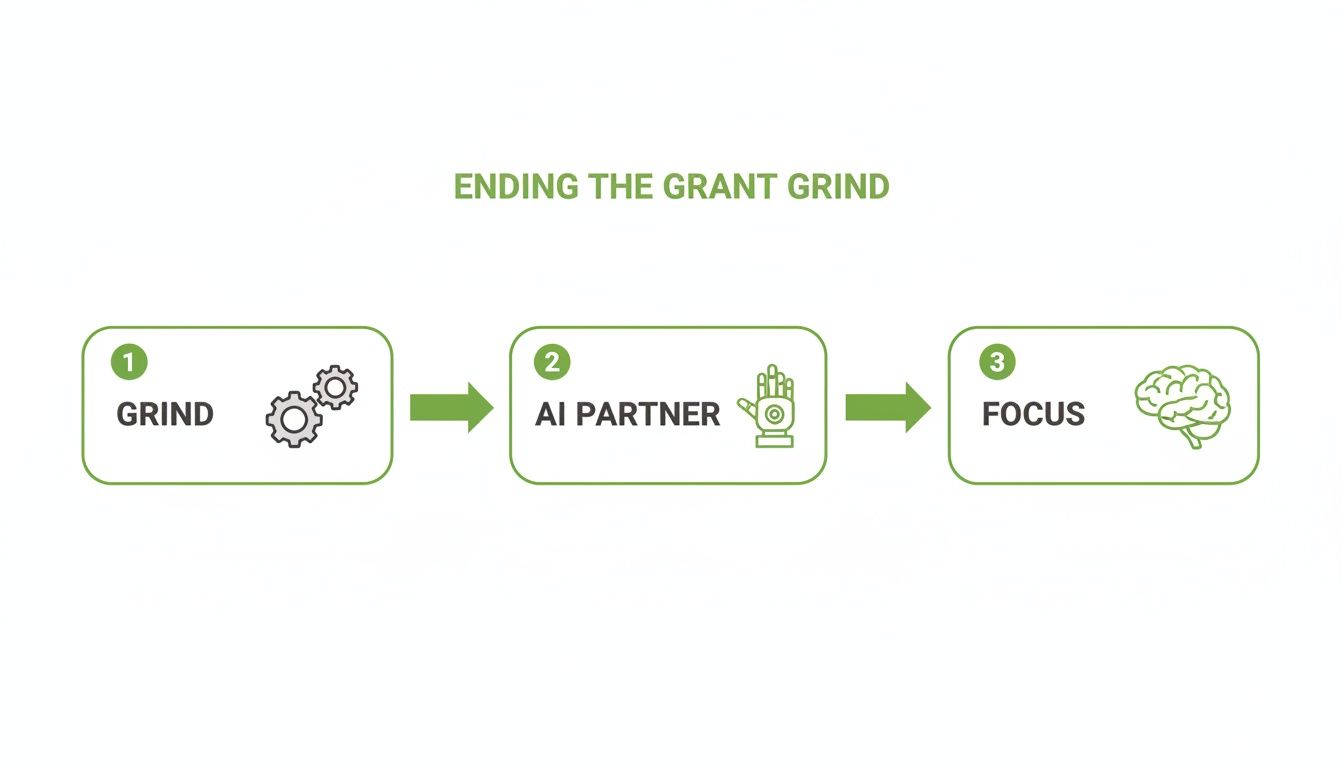
As you can see, automation acts as a bridge, turning chaotic, time-consuming tasks into a focused, high-impact effort.
Prospecting and Qualification
First things first: you have to find the right funders. Anyone who has spent days sifting through grant databases knows what a soul-crushing task it can be. An AI-powered system, however, does this research for you, scanning thousands of Requests for Proposals (RFPs) from every corner of the funding world.
But it goes deeper than just matching keywords. The system analyzes a funder’s priorities, looks at who they’ve funded in the past, and zeroes in on the specific eligibility requirements. It then holds that information up against your nonprofit’s profile—your mission, programs, and service area—to deliver a shortlist of funders who are actually a good fit. This alone can save your team from wasting dozens of hours chasing grants you were never going to get.
Narrative and Data Assembly
Once you’ve got a good prospect, it’s time to start writing. This is where natural language generation really shines. The AI essentially learns to speak your organization's language by studying your existing documents.
You can feed the system materials like:
- Past Successful Proposals: It learns what phrasing and structure resonated with funders.
- Annual Reports: It pulls out your best impact stats and success stories.
- Website Content: It soaks up your mission, program descriptions, and overall tone of voice.
Armed with this knowledge, the generator can draft compelling, data-driven narrative sections for the new application. It knows which statistics to pull and which stories to tell to answer the funder's questions directly. The result is a solid first draft that appears in minutes, not days. If you want to dig deeper into the mechanics, you can see how an AI Grant Writing Generator can reshape your entire funding strategy.
Automated Compliance Checks
One of the most painful ways to get rejected is over a simple technicality—a wrong file format, a missed attachment, or exceeding a character count. An automated grant proposal generator acts as your built-in proofreader and compliance expert, catching these little mistakes before they become big problems.
The system meticulously checks your draft against the funder's specific guidelines, flagging every single issue. This last line of defense prevents an automatic disqualification and ensures your proposal gets judged on its merits, not on a formatting error.
This built-in quality control gives you the confidence that you’ve checked all the boxes. To learn more about how these systems operate, our guide on https://www.fundsprout.ai/resources/ai-for-grant-writing provides some great additional context.
Version Control and Reporting
Finally, the platform helps manage the proposal's entire lifecycle. Instead of emailing different versions of a document back and forth and losing track of changes, the system creates a single source of truth. It tracks every edit and comment from your team, creating a clear audit trail.
The help doesn’t stop after you click "submit." When it's time for grant reporting, the system can auto-populate funder templates with project outcomes and data. This creates a neat, closed loop where the results from one successful grant cycle directly inform the proposals for the next one, making your whole fundraising operation smarter over time.
Unlocking Your Nonprofit’s True Potential
Let's be honest: the real value of an automated grant proposal generator isn't just about writing faster. It’s about completely changing the game for how your nonprofit operates. When you bring this kind of tool into your workflow, you start hitting strategic goals that once felt impossible, turning the grant chase from a chore into a real engine for growth.
Ultimately, it’s about shifting your team's focus—their time, their expertise, their passion—from tedious paperwork back to the mission that brought them to your door in the first place.
Give Your Team Their Time Back
Think about all the hours your team pours into just finding grants, let alone decoding dense guidelines and wrestling with document formatting. That administrative slog is a huge drag on your momentum. An automated system handles that heavy lifting, dramatically cutting down the time it takes to get a quality proposal out the door.
With that time back, your program managers can actually manage programs, refining how you deliver services. Your development staff can get out from behind the screen and build real relationships with funders. Instead of being buried in paperwork, your people are free to innovate, connect, and serve.
Actually Win More Grants
It's simple math: when you work more efficiently, you can submit more proposals. But this isn't just about quantity. Automation sharpens the quality of every single application. These platforms are smart; they use data to align each proposal with what a specific funder actually wants to see, making sure your story resonates.
By looking at what's worked before and what funders are focused on now, the AI helps you build a much stronger, more persuasive case for support. You’re not just sending more applications into the void; you're sending smarter ones with a much better shot at success.
The old way of doing things just can't keep up. To see the difference, let’s compare the workflows side-by-side.
Traditional vs. Automated Grant Writing Workflows
As the table shows, the time savings at every stage are significant, freeing up your team to focus on strategy instead of getting stuck in the weeds.
Nail Compliance and Cut Down on Risk
Grant compliance is a high-stakes game. One tiny mistake—a missed deadline, a wrong format—can get your proposal tossed out before it's even read. Worse, it can damage your reputation with a funder for years to come.
Automated platforms are built with compliance baked in. They create a clear, auditable trail for every proposal, from the first draft to the final submission. The system acts as your safety net, automatically flagging character limits, checking for required attachments, and ensuring everything is in order. It's built-in peace of mind.
This technology is more than just a niche tool; it’s a major market force. The grant management software that powers these generators is already a USD 2.78 billion industry. Why? Because automation can slash manual errors by up to 70% and guarantee compliance—a crucial advantage when teams without it waste 60% of their time on administrative tasks instead of driving impact. Discover more insights about this growing market on precedenceresearch.com.
Scale Your Impact, Not Your Payroll
Here’s where it gets really exciting. For so many smaller nonprofits, the big, complex grants from federal agencies or major foundations feel completely out of reach. They simply don't have a dedicated grant writer—or a whole team—to manage the overwhelming application process.
An automated grant proposal generator completely changes that dynamic.
It gives smaller organizations the firepower to go after the same funding opportunities as the big players. Suddenly, you can compete. This technology levels the playing field, empowering you to pursue the kind of ambitious funding that can truly scale your mission. It’s no longer about the size of your team; it’s about the strength of your vision.
Weaving Automation Into Your Grant Writing Workflow
Bringing a new tool into your grant writing process shouldn't feel like adding another chore to the list. Instead, it should feel like giving your team a superpower. An automated grant proposal generator doesn't replace your talented people; it amplifies their work by creating a clear, collaborative system where the AI does the grunt work, and your team provides the strategy and heart.
This isn't about letting a robot take the wheel. It's about building a smarter, faster process where everyone knows their part. The end result is a proposal that perfectly blends AI-powered speed with the genuine human passion that funders connect with.
Defining Roles in the New Process
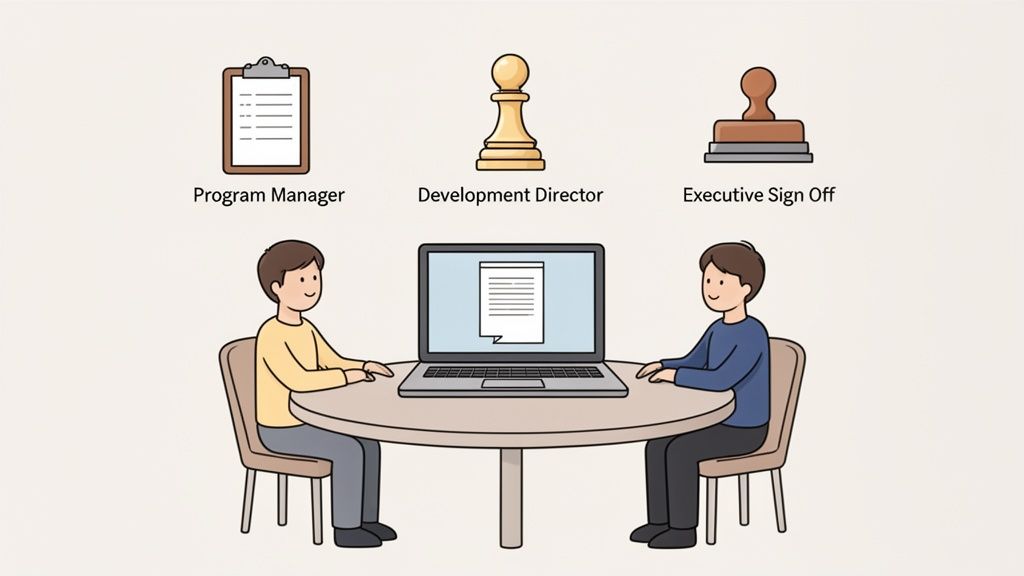
One of the biggest (and most welcome) surprises for teams I've worked with is how automation actually clarifies job roles, rather than confusing them. When you treat the AI as a new, highly efficient team member, everyone’s responsibilities snap into focus.
Here’s what that looks like in practice:
- The Program Manager: They’re the expert on the ground. Their job is to feed the AI the "raw ingredients"—the crucial project details, the latest impact metrics, and the powerful success stories that bring the work to life.
- The Development Director: This person holds the fundraising strategy. They take the AI's first draft and shape it, refining the tone, sharpening the narrative, and ensuring every word speaks directly to what that specific funder cares about.
- The Executive Director: As the final checkpoint, the ED gives the ultimate sign-off. Their review confirms the proposal is perfectly aligned with the organization's overarching mission and strategic goals.
This clear division of labor keeps everyone focused on their area of expertise, which makes the whole process smoother and faster.
Giving the AI What It Needs to Succeed
Any grant writer knows the final proposal is only as good as the information you start with. The same rule applies here. You have to feed the system the right information to get a compelling, accurate draft back.
Think of it this way: an automated grant proposal generator is a brilliant chef, but you still have to supply the fresh ingredients. It can't invent your mission from thin air or fabricate your impact data. The better the information you provide upfront, the better the final proposal will be.
At a minimum, you'll need to gather these core documents:
- Your official mission and vision statements.
- Previously submitted grant proposals, especially the ones that won.
- Recent financial documents, like your Form 990 or the current annual budget.
- Key programmatic data and the metrics you use to measure impact.
Getting this organized from the start is how you teach the AI your organization’s unique voice and prove your track record. Many modern platforms also come with fantastic nonprofit grant management software features that act as a central library for these documents, creating a single source of truth for every application you write.
The Review and Approval Cycle—Without the Headaches
Once the generator kicks out that first draft, the real human collaboration begins. This is where modern tools truly shine, finally helping us escape the nightmare of endless email chains and confusing file names like Final_Draft_v3_Final_USE_THIS_ONE.docx.
The workflow is beautifully simple and transparent:
- Initial Draft Generation: The system takes the RFP and your organizational data and produces a solid first draft in minutes.
- Internal Review: Your team logs into a shared workspace. They can leave comments, suggest edits, and tag each other for input right inside the document. No more passing Word docs back and forth.
- Version Control: The platform automatically tracks every change, so you always have a clear revision history. It’s impossible to lose track of which version is the most current.
- Final Approval: Once all the feedback is incorporated, the polished proposal goes to the Executive Director for a simple, one-click approval.
This kind of structured workflow helps your team get comfortable with an automated system almost immediately, letting them see the benefits without throwing their core responsibilities into chaos.
Choosing The Right Automation Platform
Not every automated grant proposal generator is created equal. With new platforms popping up constantly, picking the right one is a huge decision that can make or break your fundraising efforts.
The wrong tool can become a source of frustration and a drain on your budget. But the right one? It can feel like adding a seasoned grant writer to your team, one who works around the clock to fuel your mission. This isn't just about buying software; it's about finding a true partner for your organization.
Start With the AI's Core Capabilities
Before you get dazzled by sleek dashboards and long feature lists, put the AI itself under the microscope. This is the engine of the whole operation, and its performance will dictate the platform's real-world value.
You need to know how well it handles two critical tasks:
- Opportunity Matching and Vetting: How good is it at finding grants you can actually win? The best systems dig deeper than simple keyword searches. They analyze a funder's history, their stated priorities, and even who they've funded in the past to bring you a qualified shortlist.
- Narrative Generation Quality: When the AI drafts your proposal, does it sound like you? The only way to know is to test it. Feed it your past successful proposals, annual reports, and program data. The output should capture your unique voice and just need a polish, not a complete rewrite from scratch.
The market for this technology is booming, projected to hit USD 5.81 billion by 2030. Why? Because nonprofits are finding that the right tools can boost win rates by 2-3x and automate up to 90% of the tedious, repetitive work. This competition gives you leverage, so be picky. You can see a full proposal management software market analysis on fortunebusinessinsights.com to understand the trends.
Look Beyond the Tech: Evaluate the Vendor and Their Support
A brilliant product with terrible customer support is a headache waiting to happen. Once you've vetted the technology, turn your attention to the company behind it. Their approach to training, security, and customer service is just as important as the software itself.
Remember, you're not just buying a tool; you're entering into a partnership. The vendor should be just as invested in your success as you are, ready to help you get started and quick to respond when you hit a snag.
Don't be shy about asking tough questions. What does onboarding actually look like? Is live training included? What are your data encryption and privacy standards? A vendor who values your partnership will have clear, confident answers.
Use a Checklist to Compare Your Options
To keep your decision objective and avoid getting swayed by a slick sales demo, use a structured checklist. It forces you to compare each platform on the criteria that truly matter for your team's workflow.
Here is a simple table to help you organize your evaluation and compare different platforms side-by-side.
Feature Checklist for Automated Grant Platforms
By walking through this process systematically, you can confidently choose an automated grant proposal generator that’s a perfect fit. For a deeper dive, check out our comprehensive guide to nonprofit grant writing software, which covers even more of the essentials.
Common Pitfalls and How to Sidestep Them
Bringing a grant proposal generator into your workflow can be a game-changer, but it’s not just a plug-and-play solution. Like any powerful tool, you need a smart strategy to get the most out of it. Let’s walk through the most common stumbles organizations make so you can avoid them from day one.
The biggest mistake? Treating the AI like a "magic button." It’s easy to fall into the trap of thinking it will spit out a flawless, funder-ready proposal with a single click. That’s a recipe for disappointment.
Think of the AI as an incredibly efficient and knowledgeable junior grant writer, not the seasoned Grant Director. It’s there to do the heavy lifting—the research, the initial drafting, the compliance checks—but your team’s strategic oversight is what turns a good draft into a winning proposal. The human touch, the deep understanding of your community’s story, and the nuance of a funder relationship? That’s still your domain.
The "Garbage In, Garbage Out" Trap
Here's another classic misstep: feeding the AI messy, outdated, or incomplete information. These platforms are incredibly powerful, but they can't invent facts or polish a narrative that was weak to begin with. If you upload old grant proposals that weren't successful, vague program descriptions, or fuzzy impact data, the AI will simply give you a faster version of that same mediocre content.
It's like asking a world-class chef to make a gourmet meal with expired ingredients. The result will never be great, no matter how much skill is involved. High-quality output demands high-quality input.
To avoid this, you have to do the prep work. Spend time building a clean, organized, and up-to-date knowledge base. This is non-negotiable.
- Funded Proposals: Give the AI your greatest hits—the applications that actually won.
- Fresh Impact Data: Make sure your statistics are current and compelling.
- Crisp Narratives: Use clear, powerful language to describe your mission, programs, and the people you serve.
That initial investment in curating your best content is the single most critical factor for success.
Forgetting the Human Element
Finally, don't overlook your team. Bringing in new technology, especially AI, can stir up anxiety. If people think a machine is coming for their job, you’ll get resistance, not adoption.
It’s essential to frame the automated grant proposal generator for what it is: a tool to augment their skills, not replace them. Show your team how it will eliminate the tedious, soul-crushing parts of their job—like endless formatting and copy-pasting—so they can focus on what they do best.
Position the platform as an assistant that helps them be more strategic, build better funder relationships, and ultimately, win more grants for the mission they care about. When your team sees the AI as a partner in their success, you'll get the buy-in you need to make the technology truly work.
Got Questions? We’ve Got Answers.
Jumping into new technology always brings up a few questions. Let's tackle the big ones we hear from nonprofits when they're first exploring automated grant proposal generators.
"Will an AI Generator Make My Proposals Sound Like a Robot Wrote Them?"
That’s a fair question, and probably the most common one we get. The short answer? Not at all. It's a total myth that AI text has to be generic or soulless. The best platforms today are built to act like a member of your team—they learn your organization's unique voice.
Think of it this way: you feed the AI your best stuff—past winning proposals, your annual reports, even the content from your website. It studies your style, your specific terminology, and the passion that comes through in your writing. The result is a solid first draft that sounds like you, which your team can then refine. You're simply blending AI's speed with your team's authentic storytelling.
"How Do I Know My Nonprofit's Data is Secure?"
Data security is everything. Any vendor worth your time makes this their absolute top priority. When you're looking at different options, you need to see clear, upfront policies on how they protect your information.
Don't be shy about asking for the details. Specifically, you want to confirm:
- Rock-solid encryption: Your data should be encrypted both when it's being uploaded (in transit) and when it's stored on their servers (at rest).
- A secure foundation: They should be using established, trusted cloud providers—not some fly-by-night server setup.
- Official compliance: Look for certifications that show they meet recognized security and privacy standards.
Never upload a single sensitive document until you've seen a vendor's security documentation. Your data's safety is non-negotiable.
A good automated grant proposal generator should feel like a secure vault for your organization's most critical information. It's there to give you peace of mind, not create a new risk.
"Can a Small Nonprofit Like Mine Actually Afford This?"
Yes, absolutely. This isn't just a tool for the big guys anymore. The market has grown, and now there are tons of options with flexible pricing models designed specifically for the budgets of small and mid-sized nonprofits. Plus, most vendors offer significant discounts for registered charities.
But the real way to think about it is return on investment (ROI). Sit down and do the math: How many staff hours would you save? How many more high-quality proposals could you get out the door? What's the value if you win just one extra grant this year? When you look at it that way, the right tool often pays for itself surprisingly fast by turning administrative grunt work into real funding for your mission.
Ready to see how AI can completely change your grant writing? Fundsprout helps you find the right funders, draft compelling proposals, and manage compliance—all on one platform. Explore Fundsprout and book a demo today.
Try 14 days free
Get started with Fundsprout so you can focus on what really matters.