Writing Winning Proposals: Your 2026 Strategy Guide
Master the strategic framework for writing winning proposals. Our 2026 guide covers finding opportunities & crafting budget-first narratives for funding.

Abdifatah Ali
Co-Founder
Most organizations approach writing winning proposals as a writing problem. It usually isn't. It's a decision problem first, a planning problem second, and only then a writing problem.
That distinction matters because the baseline is brutal. The average grant success rate is about 10%, yet organizations that submit three to five well-researched applications annually can achieve a 94% cumulative success rate, according to Instrumentl's grant statistics and trends analysis. The gap between those outcomes isn't explained by better adjectives or prettier formatting. It's explained by better choices.
Teams that win consistently tend to do four things well. They qualify opportunities before committing time. They dissect the RFP instead of skimming it. They build the budget before drafting the story. And they write a narrative that proves the work is feasible, not just inspiring.
The biggest shift I'd urge any nonprofit team to make is this: stop treating the budget as the last spreadsheet someone fills in before submission. In strong proposals, the budget is the architecture. The narrative should follow it.
Why Most Grant Proposals Fail and How Yours Can Succeed
Roughly 9 out of 10 grant applications do not get funded. That reality pushes teams toward urgency, and urgency creates bad decisions long before the narrative draft exists.
I see the same failure pattern across nonprofits of every size. Staff pursue opportunities that look promising on the surface, shape programs to fit guidelines that were never designed for them, and leave budget logic until the end. By the time the writing starts, the proposal already has structural problems.
The problem isn't a lack of effort
Proposal losses usually come from weak fit, weak planning, or weak internal alignment.
A program director may describe one scope of work, finance may price another, and the writer is left trying to make both sound coherent. Or the team commits to an RFP before checking whether the organization can meet the reporting burden, match requirement, timeline, or beneficiary definition. Those are not writing mistakes. They are qualification mistakes.
Here is what that looks like in practice:
- Chasing pressure instead of fit: Revenue gaps make large awards look attractive, even when the funder has no history of backing your model.
- Forcing alignment that is not there: Teams rename an existing project instead of asking whether the project serves the funder's stated priorities.
- Writing before deciding: Staff begin drafting answers before confirming eligibility, staffing, deliverables, and cost assumptions.
That process produces more submissions. It rarely produces stronger submissions.
Practical rule: If your team cannot explain, in plain language, why this funder should support this project at this moment, stop before drafting.
Winning proposals come from disciplined systems
Strong grant teams use a repeatable process that reduces preventable errors early. They make fewer hopeful guesses. They ask harder questions sooner. They also treat the budget as the working blueprint, not a final attachment someone completes two days before the deadline.
That budget-first shift matters more than many teams realize. A credible budget forces clarity on staffing, timeline, units of service, indirect costs, and implementation capacity. Once those choices are on paper, the narrative has a job to do. It must explain and justify a plan that already works mathematically and operationally.
| What losing teams do | What winning teams do |
|---|---|
| Start with the narrative | Start with qualification and planning |
| Assume broad mission overlap is enough | Confirm fit through guidelines, exclusions, and prior awards |
| Treat the budget as an attachment | Use the budget as the operating blueprint |
| Catch problems during final review | Surface risks before drafting begins |
Even a strong application can lose in a competitive cycle. But disciplined teams lose for reasons they cannot control, not because they submitted a proposal built on shaky assumptions.
If you want a fast diagnostic, review these common reasons grant proposals get rejected. The useful part is not the list itself. It is how many of those problems can be prevented before the first paragraph is written.
How to Find and Qualify the Right Grant Opportunities
Good prospecting feels selective, not expansive.
The fastest way to waste grant-writing hours is to evaluate opportunities by award size or deadline alone. A funder can support your issue area and still be a poor match for your organization, geography, program model, or stage of growth. The job is to qualify fit before you commit the team.
Build a funder profile before you write
When proposals are thoroughly aligned with funder priorities, nonprofit success rates average 40 to 50%, while misaligned submissions fall to the 10 to 20% range, based on practitioner guidance summarized in this grantwriter success-rate discussion. Alignment isn't a soft concept. It's operational.

Before drafting anything, create a simple funder profile that answers five questions:
- What do they fund? Look past broad mission language. Read guidelines and exclusions carefully.
- Who have they funded before? Past grantees reveal preferred program types, organization size, and implementation style.
- What geography matters? A national funder may still favor specific regions or community types.
- What language do they use repeatedly? Words like equity, pilot, systems change, evidence, access, or capacity-building often signal how they think.
- Who can validate fit internally? Program staff usually know whether the project logic is real or forced.
Know the difference between a fit and a stretch
A good fit looks specific. A local after-school nonprofit applying to a funder with a history of supporting youth enrichment in the same region is plausible. The goals, audience, and delivery model match.
A bad fit usually requires translation gymnastics. If you have to keep saying, “we can position it as…” you're probably looking at a stretch.
Use a short screening method:
- Strong fit: Clear eligibility, obvious mission overlap, realistic project scope.
- Conditional fit: Some alignment, but one material concern needs verification.
- Pass: Weak historical fit, unclear geography, or a program that doesn't naturally map.
Reviewers can tell when an organization is describing the program it has versus the program the funder wanted.
That's why disciplined teams keep a qualified pipeline instead of a giant spreadsheet of possibilities. If you're comparing tools for that stage, this roundup of grant discovery platforms for nonprofits is a practical place to start.
Turn Any RFP into a Winning Proposal Outline
Most RFPs look harder than they are.
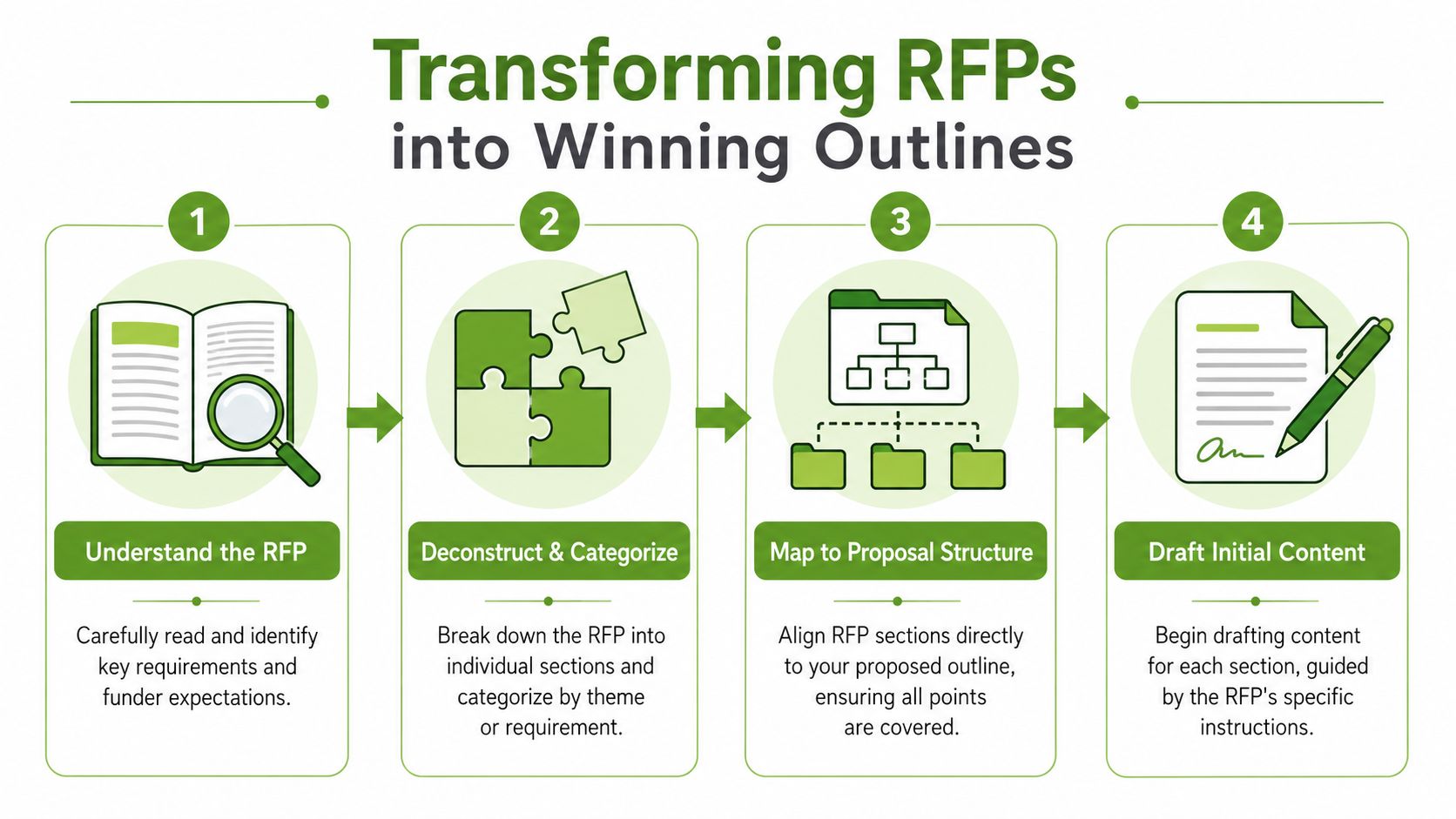
They feel overwhelming because requirements, scoring criteria, attachments, formatting instructions, and submission rules are often scattered across multiple pages. But the RFP is telling you exactly how the funder wants to evaluate the application. Your job is to convert that document into a working outline that mirrors the review process.
Read for structure, not inspiration
On the first pass, don't write anything. Extract the rules.
Create a working sheet with four columns:
| RFP element | What to capture | Why it matters |
|---|---|---|
| Required sections | Every narrative heading and attachment | Prevents omissions |
| Scoring criteria | Exact categories reviewers score | Shows where depth belongs |
| Compliance rules | Page limits, file types, formatting | Avoids technical rejection |
| Hidden signals | Repeated themes and reviewer language | Improves persuasion |
A lot of teams blend those layers together and then wonder why the final draft feels messy. It feels messy because the source document was never organized.
Translate funder language into a draftable outline
Suppose an RFP asks for “project design, implementation plan, staffing approach, measurable outcomes, and sustainability.” Many teams leave that as one big chunk in their draft folder. Don't.
Turn it into an outline like this:
- Problem definition
- Target population
- Core intervention
- Sequence of activities
- Timeline and milestones
- Operational dependencies
- Roles
- Qualifications
- Oversight
- Outputs
- Outcomes
- Evaluation approach
- Continuation plan
- Revenue or partnership support
Now the team can assign sections, gather source material, and spot gaps before drafting starts.
Use the scoring rubric as your writing map
If the funder scores “organizational capacity” separately from “project design,” don't bury capacity proof inside the methods section. Put evidence where reviewers are trained to look for it.
That mindset is similar to academic writing. A strong outline is less about elegance and more about making the evaluator's job easier. If your team needs a model for turning complex requirements into a logical structure, this step-by-step research paper guide is useful because it shows how disciplined structure reduces confusion before drafting begins.
For teams handling multiple opportunities at once, an RFP analyzer for grants can speed up this translation work. The point isn't automation for its own sake. The point is reducing missed requirements and giving writers a cleaner starting point.
Build Your Budget Before You Write a Single Word
At this stage, many proposals either become coherent or collapse.
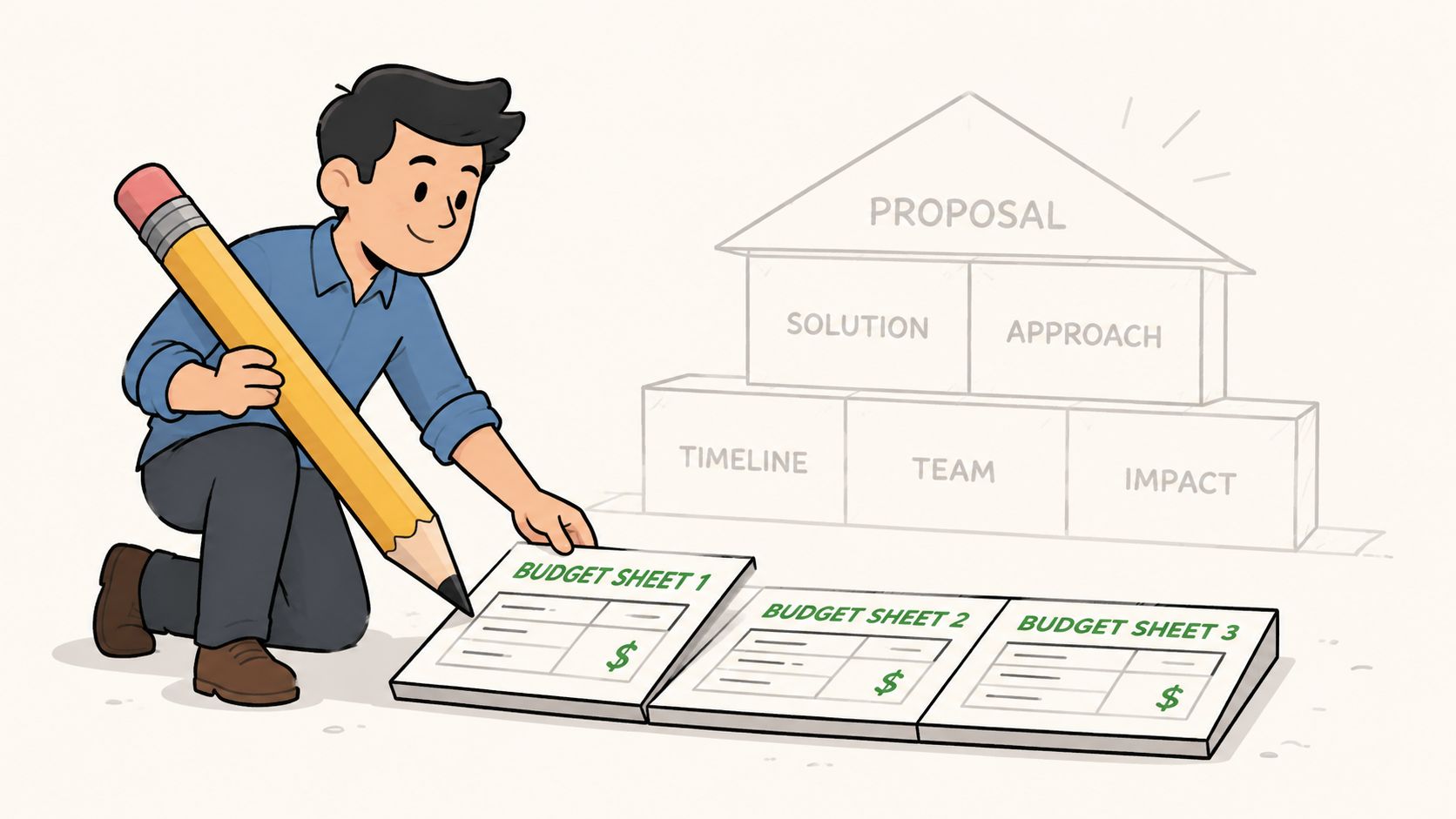
Many teams still start with the narrative because it feels more familiar. They write the need statement, sketch activities, promise outcomes, and hand the budget over at the end. That sequence creates friction because the budget then has to chase claims that are already on the page.
Research summarized by CharityHowTo reports that proposals built with a budget-first framework have a 32% higher success rate, and that 68% of rejected proposals contain budget inconsistencies or misaligned cost estimates, according to this budget-first grant writing analysis. That tracks with what practitioners see every day. Reviewers don't trust proposals whose math and story disagree.
Why the budget should lead
The budget is the most unforgiving part of the application. It forces decisions.
You can hide vagueness in prose. You can't hide it in line items. If you claim extensive outreach, the budget has to show who performs it, what tools support it, and how long it lasts. If you promise evaluation, the budget has to fund staff time, data collection, or outside support. If neither appears, the narrative reads aspirational rather than executable.
A budget-first workflow also exposes trade-offs early:
- Ambition versus feasibility: Can the team deliver the promised scope with the requested resources?
- Staffing versus direct program costs: Are key roles underfunded while activities are overdescribed?
- Funder priorities versus internal preferences: Are you allocating money where the funder scores heavily, or where your team is most comfortable writing?
A simple budget-first method
Start with the funder's scoring criteria and allowable costs. Use those categories as the top-line headers in your planning sheet. Then list the activities required to deliver the project, the people responsible, and the direct costs attached to each one.
That process turns the budget into a logic map.
For example, if the budget includes a Community Outreach Coordinator, that line item immediately anchors multiple narrative sections:
| Budget line | Narrative it supports |
|---|---|
| Community Outreach Coordinator | Methods, staffing, implementation |
| Participant materials | Activities, service delivery |
| Evaluation support | Outcomes, measurement, reporting |
The result is tighter writing because each paragraph is tied to an operational reality.
A reviewer doesn't need your proposal to sound expensive. They need it to sound believable.
Budgeting exposes weak program design fast
This is why I push teams to cost the project before they polish the need statement. Once you start assigning real labor, timelines, and allowable expenses, weak ideas show up early. Some projects are underspecified. Others are overbuilt for the funding ceiling. Some rely on staff capacity the organization lacks.
That kind of discipline isn't unique to grants. Founders and operators deal with the same issue in planning cycles. For a broader perspective on how financial planning sharpens strategic choices, this piece on budgeting and forecasting for UAE entrepreneurs is worth reading.
A short walkthrough helps if your team is trying to change old habits:
What doesn't work
A few patterns almost always create trouble:
- Writing outcomes first: The team promises results before checking whether the budget can support the activities.
- Using recycled budgets: Last year's staffing model rarely fits this year's RFP cleanly.
- Separating finance from program design: If finance only reviews at the end, inconsistencies survive too long.
- Treating narrative and budget as different stories: Reviewers catch that instantly.
Writing winning proposals gets easier when the numbers do the hard work upfront. Once the budget is credible, the narrative has something solid to stand on.
Write a Narrative That Proves Your Impact
A winning narrative doesn't just describe a worthy problem. It shows that your organization can solve it in a way the funder can trust.
The structure matters. Harvard guidance on proposal development recommends a narrative arc that starts with the broad context, narrows to the specific problem, and presents the methods as the solution. The same resource notes that including a Gantt chart is essential for demonstrating feasibility in a way reviewers can quickly understand, as outlined in this Harvard Medical School guide to writing a winning grant proposal.
Start broad, then get specific fast
Weak narratives stay abstract too long. They spend half a page on the general importance of education, health, housing, or workforce development, then rush the actual project.
Strong narratives tighten quickly:
- Context: What larger issue makes this project relevant?
- Specific problem: What exact gap exists for this population or community?
- Response: What will your organization do about it?
- Proof: Why is this plan feasible with this team?
That sequence helps the reviewer move from significance to confidence.
Use micro-evidence inside each section
The needs statement should not sound like a manifesto. It should sound like a diagnosis. Name the population, describe the barrier, and explain the consequence if the issue remains unresolved.
The methods section should read like a work plan, not a promise. Instead of saying your organization will “provide general support,” explain what participants receive, who delivers it, and when.
The evaluation section is where many narratives become vague again. Don't let it drift. Show how you'll know whether implementation happened as planned and whether the project produced the intended change.
If reviewers finish the methods section and still can't picture the work on a calendar, the proposal isn't ready.
Clarity beats cleverness
Complex writing creates doubt. Reviewers read under time pressure, and they're comparing multiple applications at once. If your hypothesis, approach, or staffing model takes too much effort to decode, the proposal loses force.
A few habits improve readability immediately:
- Use direct sentences: One idea per sentence is often enough.
- Name the actor: Say who will do the work.
- Keep section openings concrete: Start with the answer, then support it.
- Avoid decorative jargon: Specialized language should clarify, not impress.
A Gantt chart helps because it turns prose into sequence. It tells the reviewer that the timeline exists beyond the writer's imagination. Even a simple milestone chart can make a proposal feel more executable.
A short example of stronger narrative logic
Compare these two methods statements.
Weak version:
“Our organization will implement an integrated and community-centered strategy to improve participant outcomes through advanced service delivery.”
Stronger version:
“The program manager will enroll eligible participants, the outreach coordinator will run community recruitment, and case staff will deliver structured services according to the project timeline. Monthly milestones will track enrollment, service delivery, and reporting.”
The second version gives the reviewer something to evaluate. That's the standard. In writing winning proposals, credibility comes from precision.
Your Pre-Submission Checklist for a Flawless Proposal
Good proposals still get damaged in the final stretch.
The last review phase shouldn't feel like chaos. It should function like quality control. By the time the draft is complete, the team should stop asking, “What else can we add?” and start asking, “What could still disqualify or weaken this submission?”
Run a compliance audit first
Before anyone does line edits, confirm that the application package is complete and compliant.
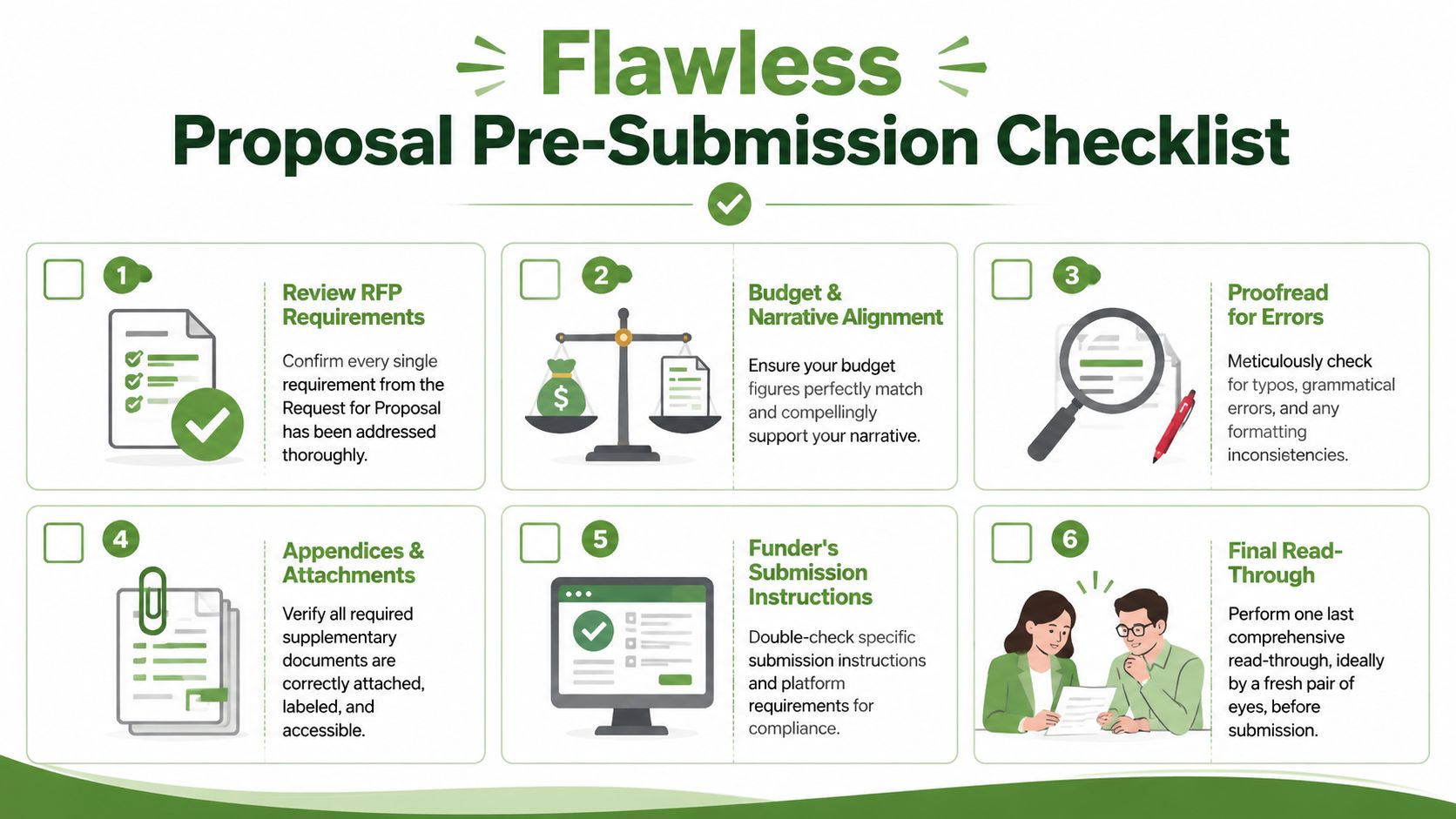
Use a pre-submission check like this:
- RFP match: Confirm every required question, attachment, and form has been addressed.
- Budget consistency: Check that figures, staffing references, and timelines match across the budget and narrative.
- Formatting review: Verify page count, font rules, file naming, and upload format.
- Attachment control: Make sure supporting documents are the correct versions and clearly labeled.
- Submission method: Review portal instructions, required fields, and signature requirements.
- Fresh-eyes review: Ask someone outside the drafting process to read for logic gaps and ambiguity.
Separate proofreading from decision review
Teams often mix technical proofreading with strategic review. That's a mistake.
One reviewer should focus on mechanics: spelling, grammar, repeated phrases, missing words, broken tables, inconsistent headings. Another should review like a scorer: Is the proposal easy to follow? Does every claim have support? Do the budget and work plan line up? Has the team answered the funder's question?
Those are different tasks, and they catch different failures.
Submit the version that is easiest to evaluate, not the version that contains the most words.
Protect your files and internal data
Proposal packages often contain budgets, staff details, financial attachments, and partnership documents. Those materials need a clean internal review process and secure handling, especially when multiple people are editing and sharing files near deadline. As a practical reminder, these data security best practices for handling sensitive information are useful for any team managing proposal documents across email, cloud storage, and shared drives.
The final read-through should happen in the same format the funder will see. Review the uploaded PDF, not just the source document. Check page breaks, table rendering, and whether appendices appear in the right order.
That last pass won't make a weak proposal strong. But it often keeps a strong proposal from losing on avoidable mistakes.
Fundsprout helps nonprofits do the parts of grant work that usually break under pressure: finding qualified opportunities, turning RFPs into structured outlines, drafting in your organization's voice, tracking deadlines, and keeping submission materials aligned from application to renewal. If your team wants a more disciplined system for writing winning proposals, explore Fundsprout.
Try 14 days free
Get started with Fundsprout so you can focus on what really matters.