What Is Program Evaluation and How Does It Win Grants
Unsure what is program evaluation? This guide explains how to measure your nonprofit's impact, satisfy funders, and win more grants in 2026.

Abdifatah Ali
Co-Founder
Think of program evaluation as your nonprofit's secret weapon. It’s the structured way you collect and analyze information to see if your programs are actually working. This isn't about getting a pass/fail grade; it’s about gaining the insight you need to prove your impact, make your services even better, and tell a story that funders can’t ignore.
What Is Program Evaluation and Why It Matters Now
If your nonprofit's mission is your destination, then program evaluation is your GPS. It shows you where you are, how fast you're moving, and whether you're even on the right road. Most importantly, it helps you adjust your course when you hit a detour and proves to everyone that you’ve arrived. It's simply the process of asking—and answering—the tough, important questions about your work.
Years ago, running a nonprofit on good intentions was often enough to get by. That world has changed. Today’s grantmakers, from the biggest foundations to your local community fund, think more like partners investing in change. They aren't just giving away money; they're investing in outcomes. They want to see a real return on that investment, measured in the positive, tangible change you create.
This is exactly why having a solid grasp of what is program evaluation is so critical. It’s no longer a box to check or an administrative headache. It’s the very engine that powers sustainable funding and genuine, mission-driven growth.
More Than Just Numbers—It's Your Narrative
At its core, evaluation is about telling your organization's story. The difference is, you’re not just relying on a few heartfelt anecdotes. You’re telling a powerful story backed by real, credible evidence. It’s the tool that helps you shift from saying, "We help people find jobs," to proving, "Our program helped 75% of participants secure stable employment within six months, a 30% increase compared to those not in our program."
This kind of data-backed narrative does a few crucial things for you:
- Earns Trust: It shows you're transparent and committed to being effective. Nothing builds trust with funders and your community faster than that.
- Sparks Improvement: Honest evaluation shines a light on what’s working beautifully and what’s falling flat. This allows you to fine-tune your programs and put your resources where they’ll make the biggest difference.
- Wins Funding: In a pile of competitive grant applications, a strong evaluation plan is often what sets the winner apart. It proves you’re a low-risk, high-impact partner.
A Practical Example of Evaluation in Action
Let’s say you run an after-school tutoring program. A basic evaluation might just track how many kids show up and whether they finish their homework. That’s a start, but it barely scratches the surface.
A truly effective evaluation goes deeper. It would measure changes in student grades, look at standardized test scores, and track school attendance rates over the semester. It might also use surveys to ask students how confident they feel or hold focus groups to hear directly from them about their experience.
This deeper dive gives you a rich, compelling picture of your program's real value. When it’s time to ask for that grant renewal, you can walk in with a powerful case: "Our program didn't just boost homework completion by 90%. It also contributed to a 15% average increase in participants' math scores and a clear jump in their self-reported confidence in school."
Now that is a story that gets funded.
Choosing Your Evaluation Approach
Now that you have a handle on what program evaluation is, it's time to pick the right approach for your specific program. The best way to think about this is to imagine your program is a new recipe you're developing. The type of evaluation you choose depends entirely on what you need to learn about that "recipe" and when.
This decision really boils down to one fundamental question: are you trying to improve your program as it’s running, or do you need to prove its impact after it’s finished? This simple flowchart can help you see which path makes the most sense for you.

As you can see, your core goal—whether it's refining your methods on the fly or demonstrating final results—is what guides your choice. Getting this right from the start saves a lot of headaches and ensures you’re gathering the most useful information.
There are three main types of evaluation, each built for a different purpose.
Formative Evaluation: The Mid-Process Taste Test
Formative evaluation is like tasting a sauce while it’s still simmering on the stove. You take a spoonful, notice it needs a bit more garlic or a pinch of salt, and you adjust the recipe right then and there.
This type of evaluation happens during your program. Its entire purpose is to provide real-time feedback so you can make immediate improvements. It’s not about a final grade; it’s about making the program better as you go.
- Example: A nonprofit rolls out a pilot digital literacy workshop for local seniors. After the first two classes, they use a quick formative evaluation—a simple participant survey and a chat with the instructor. They discover the pace is a little too quick for some attendees. Based on that feedback, they adjust the curriculum for the remaining sessions to ensure everyone can keep up.
Summative Evaluation: Judging The Final Dish
Summative evaluation, on the other hand, is the final verdict on the meal after everyone has finished eating. Did your guests enjoy it? Did it live up to their expectations? Would they come back for more?
This evaluation takes place after a program or a major program cycle has been completed. Its goal is to judge the program’s overall effectiveness and measure its impact. This is where you answer the big question that every funder asks: “Did it work?” Summative evaluation is crucial for proving the value of your work and building a strong case for continued funding.
- Example: At the end of a year-long food security initiative, an organization conducts a summative evaluation. They analyze data to see how many families now have consistent access to healthy food, comparing these results to the baseline information from their original guide to writing a needs assessment.
Developmental Evaluation: Inventing A New Recipe
Finally, we have developmental evaluation. This is what you use when you're not just following a recipe—you're inventing a brand-new one from scratch in a complex, ever-changing environment. Think of it as culinary R&D for social change.
This approach is designed for highly innovative programs tackling unpredictable problems where the path forward isn’t clear. It’s incredibly flexible, allowing you to learn and pivot as new challenges and opportunities arise.
Developmental evaluation is less about proving a fixed model works and more about co-creating a solution in real-time. It’s a perfect fit for social innovation labs, pilot projects addressing systemic issues like chronic homelessness, or responses to community-wide crises.
Which Evaluation Type Fits Your Program?
Choosing the right evaluation type is all about matching the method to your program's stage and learning goals. This table breaks down the three approaches to help you decide which one is the best fit for your needs right now.
Ultimately, the best evaluation is the one that gives you the insights you actually need. Whether you're fine-tuning, proving, or inventing, there's an approach designed to help you learn and grow.
Building Your Evaluation Framework
So, you’ve got a handle on the different ways to approach evaluation. Now comes the fun part: building the engine that will actually drive it. This is your evaluation framework, and it's less of a rigid set of rules and more of a practical blueprint for measuring your impact.
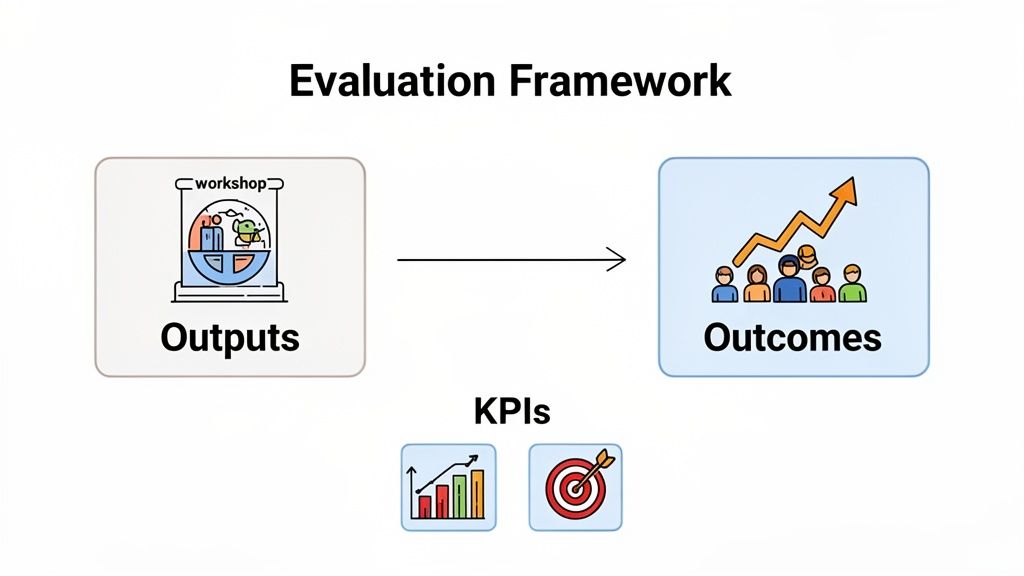
Think of it as the bridge connecting your day-to-day work to the real-world change you’re creating. It’s what lets you tell your story to funders with clarity and confidence, backed by solid proof. The whole thing really boils down to three key pieces: outputs, outcomes, and indicators. Let's get them straight.
Outputs vs. Outcomes: The Critical Difference
I see so many nonprofits get tangled up here, but the distinction is actually pretty simple—and it’s absolutely essential for winning grants. Outputs are the "stuff" you do, while outcomes are the change that happens because of that stuff.
- Outputs: This is about counting your activities. It's the answer to, "What did we do?" You held 10 workshops, served 500 meals, or provided 75 counseling sessions. They are the direct, tangible products of your hard work.
- Outcomes: This is about the results of your work. It answers, "What changed for the people we serve?" Their income increased, their mental health scores improved, or they successfully graduated.
Outputs are easy to track, and they’re important. But funders don't just invest in activities; they invest in impact. They want to see the return on their investment, which is measured in changed lives, not just services delivered. To see how to visually map all these connections, our guide on the logic model for program evaluation is a great place to start.
A focus on long-term outcomes dramatically increases funding success. Research from a 2025 NEYA Global study found that nonprofits measuring long-term impact—like a 35% income boost for microfinance participants over five years—achieved 52% higher grant renewal rates than peers who only reported short-term outputs. You can explore the full findings about the importance of measuring long-term impact on NEYA Global's journal.
Identifying Your Key Performance Indicators
Once you’ve defined your desired outcomes, you need a way to prove you’re achieving them. This is where Key Performance Indicators (KPIs) enter the picture. A KPI is just a specific, measurable data point you track to see if you’re hitting your goals. Think of them as the vital signs of your program's health.
Developing a strong evaluation plan means picking the right KPIs. For example, marketing teams use a metric framework for proving impact to show the value of a webinar. For a nonprofit, the concept is the same: you have to choose metrics that directly tell the story of your mission.
Let's look at a youth mentorship program:
- Output: 100 mentoring sessions conducted.
- KPI: A 15% decrease in truancy rates among participants after six months.
- KPI: 90% of program participants graduate high school, compared to the city average of 75%.
Selecting the right KPIs is how you turn your incredible work into a compelling, undeniable story of impact. They give you the hard evidence to show funders exactly what their support makes possible.
Designing a Practical Evaluation Plan
So you've built your framework—the "what" and "why" of your program's impact. Now it's time to get practical and figure out the "how." This is where you design an evaluation plan, which is really just a step-by-step roadmap for proving your program works.
Think of this plan as your guide for gathering the right clues, making sense of them, and then telling a compelling story about your impact. And no, this doesn't have to be some massive, expensive undertaking. The best plans are the ones that actually get used—meaning they fit your team’s capacity and budget while still being strategic.
A solid plan takes evaluation from a vague, intimidating idea and turns it into a manageable project. It gives you a clear beginning, middle, and end for measuring your success.
Start with Clear Evaluation Questions
Everything—and I mean everything—in your evaluation hinges on the questions you ask at the outset. Before you even think about creating a survey or scheduling an interview, you need to be crystal clear on what you want to learn. These questions should be a direct reflection of the outcomes you mapped out in your framework.
Resist the urge to ask broad, fuzzy questions like, "Is our program working?" You need to dig deeper.
- Weak Question: Do our participants like the job training program?
- Strong Question: To what extent did our job training program increase participants' confidence in their interview skills, as measured by a pre- and post-program survey?
See the difference? A strong question gives you a specific target to aim for. Spend real time getting your questions right, because they will dictate every other choice you make, from the methods you use to the data you collect.
Choose the Right Data Collection Methods
Once your questions are locked in, you can start picking the right tools to find the answers. For most nonprofits, especially those with small teams, the simplest and most affordable methods are often the most powerful. Your choice will come down to whether you’re looking for quantitative (the numbers) or qualitative (the stories) data.
Here are a few go-to methods that work for almost any organization:
- Surveys: Tools like Google Forms make it incredibly easy to create and send out surveys. They are perfect for gathering quantitative data on things like participant satisfaction or self-reported changes in knowledge.
- Interviews: There's nothing quite like a one-on-one conversation for getting deep qualitative insights. This is where you hear the personal stories and understand the "why" behind the data points.
- Focus Groups: Getting a small group of participants together for a guided discussion is a fantastic way to uncover shared experiences and even brainstorm ideas for improving your program.
Rigorous evaluation isn't just about internal learning; it's a proven driver of major growth. A decade-long study by Bridgespan revealed that nonprofits commissioning third-party evaluations after internal testing scaled their beneficiary reach by an average of 400%, attracting over $50 million in scaling funds. You can learn more about how evaluation fuels nonprofit growth on Bridgespan.org.
Plan Logistics and Uphold Ethics
Finally, a truly practical plan has to cover the nuts and bolts. You need to map out the logistics and commit to ethical practices. This means deciding who on your team is responsible for collecting data, setting a realistic timeline, and figuring out how you’ll store all the information securely.
And let’s be clear: ethical considerations are non-negotiable. Always get informed consent from your participants, making sure they understand exactly how their data will be used. You have a responsibility to protect their confidentiality by anonymizing responses whenever possible and keeping any personal information locked down. This isn't just a box to check—it’s how you build trust and ensure your evaluation is done with integrity.
Turning Evaluation Data Into Winning Grant Proposals
You’ve done the heavy lifting—you designed an evaluation, gathered the data, and made sense of the results. Now comes the most important part: turning all that work into a story that secures funding. This is where your numbers and findings get a voice, convincing funders that your work truly matters.
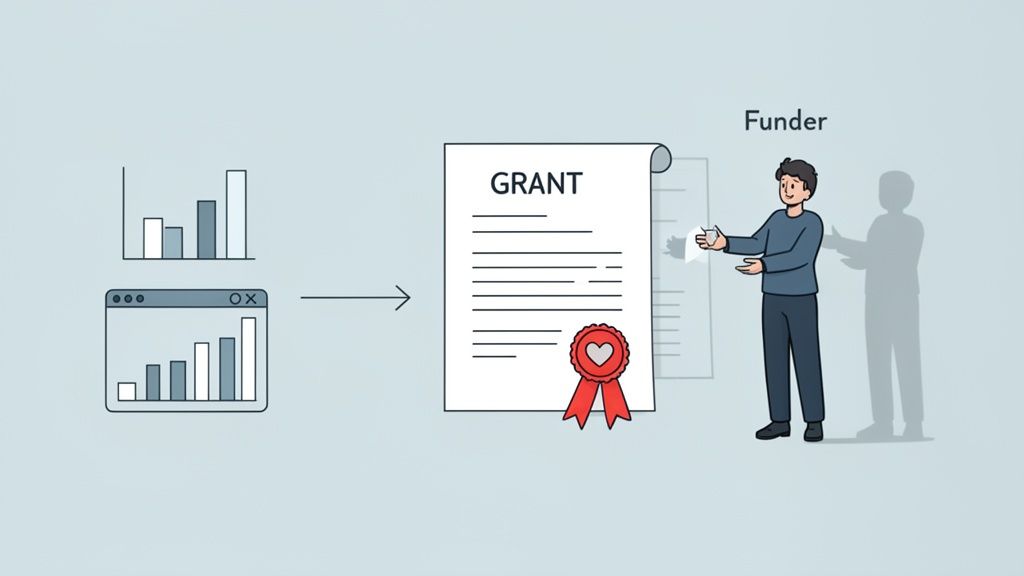
But here's the thing: raw data on its own is just noise. A spreadsheet doesn't tell a story. You have to be the storyteller, giving context and meaning to your metrics. A winning proposal uses evaluation findings to paint a clear picture of the change you’ve created, showing the tangible difference your program makes in people's lives.
From Data Points to Impact Narrative
Funders see countless applications that just list activities. To make your proposal stand out, you have to shift the focus from what you did (outputs) to the real-world change that happened because of it (outcomes).
It’s the difference between tracking activity and proving transformation. Let’s break it down:
- Before (Output-Focused): "We provided job readiness training to 50 unemployed adults."
- After (Outcome-Focused): "Our program led to a 30% increase in stable employment for 50 participants, a result we verified through our six-month follow-up survey."
See the difference? The second statement is powerful because it answers the funder's real question: "What happened as a result of your work?" It’s proof of a return on their investment. Honing your ability to how to write compelling impact statements is one of the most valuable skills you can develop. Of course, getting to that point requires a solid analysis of surveys and other data to find the insights that matter.
Weaving Your Story into the Proposal
Don't just dump your data into one section of your grant application. Sprinkle your evaluation findings throughout the entire proposal. Use them in your needs statement to back up the problem, in your objectives to set clear targets, and in your organizational history to prove you have a track record of success.
Tools like Fundsprout are built for this, helping you connect your impact data directly to your grant narratives and simplify how you report back to funders.
Program evaluation isn't just a best practice; it's a requirement. As far back as 2015, over 80% of U.S. federal grants demanded outcome-based reporting. The proof is in the pudding: one study of over 200 nonprofits found that programs with strong evaluations were able to secure 40% more in funding renewals.
When you ground your story in solid evidence, you do more than just check a box for a funder. You build their trust and position your organization as a reliable and effective partner. A proposal backed by a powerful, data-driven story of change isn't just another application—it’s an investment opportunity funders can’t afford to miss.
Common Questions About Program Evaluation
Diving into program evaluation often feels like opening a can of worms. Suddenly, you might have more questions than answers, and it’s easy to feel stuck before you even begin. That’s completely normal.
Let's walk through some of the most common questions we hear from nonprofit leaders. Getting these cleared up from the start can make all the difference.
How Can a Small Nonprofit Afford Program Evaluation?
This is easily the biggest hurdle for most organizations. The good news is, you don’t need a six-figure budget and a dedicated data scientist to get started. The secret is to start small and be resourceful.
You can build a powerful evaluation system right now using tools that are likely already at your fingertips:
- Free Survey Software: A tool like Google Forms is perfect for simple pre- and post-program surveys. Ask participants about their knowledge, satisfaction, or confidence levels before and after your services.
- Internal Data Tracking: Fire up a simple spreadsheet. Start tracking the numbers you already have—things like workshop attendance, number of clients served, or completion rates. This is valuable data.
- Informal Feedback: Don’t underestimate the power of a simple conversation. Hosting informal focus groups or one-on-one chats with participants can give you incredible stories and insights that numbers alone can't capture.
The real key is to weave these simple activities into your team's regular workflow. And here’s a pro tip: funders are increasingly viewing evaluation as a core program cost, not an optional luxury. Don’t hesitate to build a line item for evaluation—usually around 5-10% of the total program budget—directly into your next grant proposal. Showing you’re serious about impact is the best way to fund it.
What Is the Difference Between Monitoring and Evaluation?
These two terms get thrown around a lot, and it's easy to mix them up. But they play very different roles. The easiest way to think about it is to imagine you're on a long road trip.
Monitoring is glancing at your dashboard. You’re checking the speedometer, looking at the fuel gauge, and making sure the engine temperature is normal. It’s the constant, real-time check to make sure your day-to-day operations are running as planned. It answers the question, “Are we doing things right?”
Evaluation, on the other hand, is pulling over at a scenic viewpoint to look at the map. It’s a bigger-picture moment where you ask, “Are we still heading in the right direction? Is this the best route to get to our destination?” It’s a deeper, periodic assessment of your strategy and overall progress. You need both to reach your destination successfully.
Should We Share Mixed or Negative Results with Funders?
Absolutely. It might feel scary, but transparency is your greatest asset in building a long-term, trusting relationship with a funder. They’re partners in your work, and they know that real-world impact isn’t always a perfect, straight line.
No one expects every new idea to work flawlessly from day one. In fact, sharing a bump in the road shows you are a thoughtful, learning-focused organization. The trick is how you frame it. You’re not just reporting a failure; you’re sharing a lesson learned and a pivot made.
For instance, you could say: “Our early data showed that while participant recruitment was incredibly strong, our post-program follow-up wasn't having the lasting effect we hoped for. Based on this finding, we are shifting our strategy to implement a new mentorship component.” This shows you’re a responsible, adaptive partner—exactly the kind of organization funders want to invest in for the long haul.
Ready to use what you’ve learned to build stronger grant applications? Fundsprout is an AI-powered platform built to help your nonprofit find ideal funding opportunities, draft compelling proposals using your own impact data, and simplify your reporting. See how you can make a more powerful case for your mission at https://www.fundsprout.ai.
Try 14 days free
Get started with Fundsprout so you can focus on what really matters.