What Is Outcome Measurement: 2026 Nonprofit Guide
Discover what is outcome measurement and its crucial role for nonprofits in 2026. Learn to measure impact, report to funders, and enhance programs.

Abdifatah Ali
Co-Founder
You're probably here because someone asked a simple question that felt hard to answer.
A funder asked, “How do you measure your impact?”
A board member asked, “How do we know the program is working?”
Your team said, “We helped a lot of people,” and then got stuck on what to say next.
That moment is common in small nonprofits. You know the work matters because you see it every day. You hear the stories. You watch people come back stronger, safer, more confident, or more connected than when they arrived. But when it's time to put that into a grant report or renewal application, stories alone often don't feel like enough.
That's where outcome measurement comes in. Not as red tape. Not as a fancy research project. And not as something only big organizations with evaluation staff can do. It's just a disciplined way to show the change your program helps create.
Answering the Big Question What Is Your Impact
A new grant manager once told me, “I can describe everything we do. I just freeze when someone asks what changed because of it.”
That's the heart of the problem. Most small nonprofits are rich in activity and short on measurement language. You can list the workshops, meals, classes, referrals, check-ins, and volunteer hours. But funders usually want the next layer. They want to know what happened because those things were delivered.
That's the difference between being busy and being able to explain impact.
What people usually mean by impact
When a funder asks about impact, they're rarely asking for a perfect proof that your program alone changed the world. They're usually asking whether you can identify meaningful results and track them in a credible way.
For many small teams, that starts with a mental shift. You stop asking only, “What did we provide?” and start asking, “What changed for the people we serve?”
That shift also helps with writing. If you've ever struggled to move from heartfelt language into evidence-based language, a practical guide like how to write impact statements can help you translate mission into clear claims.
Practical rule: If you can finish the sentence “Because of this program, participants...” you're already moving toward outcome measurement.
Why this question feels bigger than it is
The term can sound technical because it lives in grantmaking, research, and public reporting. But the basic idea is familiar. Every program leader already does informal outcome measurement when they notice patterns such as:
- Participants stay engaged: People return, complete the program, or ask for the next level of support.
- Skills improve: Students read more confidently, parents manage routines better, or job seekers interview with more confidence.
- Conditions change: Families report less stress, clients gain stability, or a neighborhood becomes safer or more connected.
You don't need a research department to notice those changes. You need a way to define them before the program starts and capture them consistently as the work unfolds.
If you've ever looked at how scholars think about influence, Contesimal's impact score explainer offers a useful parallel. It shows how people try to turn a broad idea like “impact” into something observable and comparable. Nonprofits face the same challenge, just in human services, education, health, or community development instead of academic publishing.
From Activities to Impact Core Concepts Explained
Let's make this simple.
Outcome measurement is the practice of defining and tracking the results of an intervention, rather than just the activity delivered. In federal grant guidance, outputs count work done, while outcomes document the benefit or change in an individual's life or in a program, system, policy, or practice, as explained in the Office of Juvenile Justice and Delinquency Prevention guidance on performance measures.
The baking analogy
Think of your program like baking a cake.
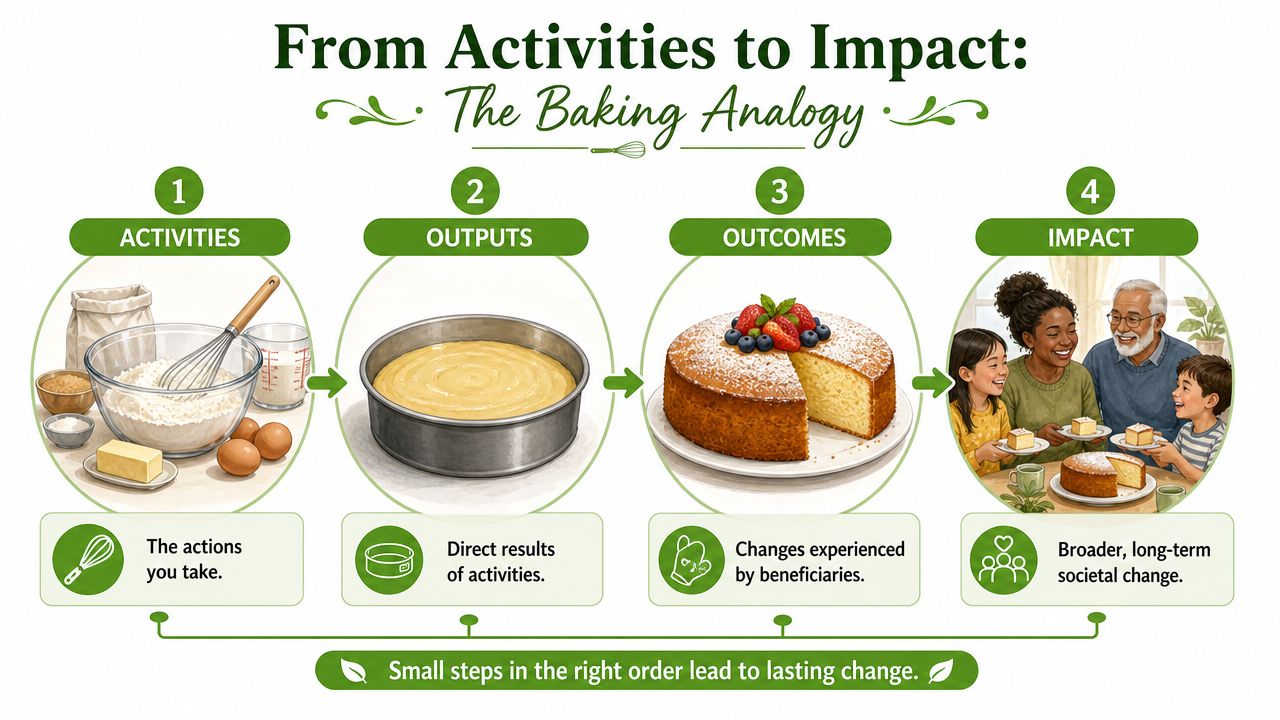
You gather ingredients, mix them, bake them, and then serve the cake. Nobody says the bowl itself is the result. The result is what people experience after the work is done.
Here's how that maps to nonprofit work:
| Stage | Plain meaning | Simple nonprofit example |
|---|---|---|
| Inputs | What you use | Staff time, volunteers, donated food, classroom space |
| Activities | What you do | Tutoring sessions, meal distribution, counseling, workshops |
| Outputs | What you delivered | Number of sessions held, meals served, people enrolled |
| Outcomes | What changed | Better attendance, stronger reading skills, improved food security |
| Impact | Broader long-term change | A healthier, more stable, better-educated community |
A lot of confusion happens because outputs are easier to count. They're not useless. In fact, they matter. If you didn't hold the class, distribute the food, or provide the service, nothing else could happen. But outputs are still not the same as outcomes.
Outputs answer what you did
Outputs are records of effort.
They help answer questions like:
- How much service did we deliver
- How many people did we reach
- How often did the program operate
Those are management questions. They matter for staffing, scheduling, and basic accountability.
Outcomes answer what changed
Outcomes go one step further. They ask whether people are different because they participated.
A tutoring program's output might be “students attended weekly sessions.”
Its outcome might be “students improved homework completion” or “students showed stronger reading confidence.”
A food pantry's output might be “families received groceries.”
Its outcome might be “families experienced more consistent access to food during the month.”
A good outcome doesn't describe your effort. It describes the participant's change.
Why logic models help
Small teams often hear “logic model” and assume they need a consultant.
You don't.
A logic model is just a program map. It shows how your resources and activities are supposed to lead to results. If you want a practical starting point, this logic model for program evaluation resource is a useful companion.
Here's the simplest possible version:
- We invest staff, time, money, and partnerships.
- We do a set of activities.
- We produce immediate outputs.
- We expect certain short-term and longer-term outcomes.
If that chain feels fuzzy, measurement will feel fuzzy too. If that chain is clear, your indicators become much easier to choose.
Why Outcome Measurement Matters for Your Mission
A small nonprofit can be busy every week, serve people with real care, and still struggle to answer one hard question at grant time. What changed because of our program?
That question is the reason outcome measurement matters.
For a small team, outcome measurement is less about building a formal evaluation system and more about replacing hunches with evidence you can use. It helps you see whether your program is creating the change you promised, where it is falling short, and what to adjust before another year passes.
It helps you improve the program you already have
Activity data tells you the engine is running. Outcome data tells you whether the car is headed in the right direction.
A workshop series can have full attendance and strong facilitator reviews, yet still leave participants stuck. If confidence does not rise, skills do not improve, or follow-through stays low, the issue may not be effort. The issue may be the design. Maybe the sessions are too long. Maybe families need transportation support. Maybe one-on-one follow-up matters more than the group lesson.
That is useful information.
Even a simple tracking system can help a small nonprofit spot patterns early. A shared spreadsheet, a short exit survey, or a quick check-in at 30 days can show whether participants are making progress or hitting the same barrier. If your team is still clarifying the problem behind the program, a practical guide to writing a needs assessment for nonprofits can help you connect measurement to the actual need you are trying to address.
It helps you answer funders in plain, credible terms
Funders rarely support activity for its own sake. They support activity because they expect it to lead to change.
That is why proposals and reports keep asking about outcomes, indicators, targets, and evidence. They are asking you to show the chain between what you did and what participants experienced. For a new grant manager, this can feel more technical than it really is. In practice, you are answering a familiar question. Did the program help in the way we intended?
Clear outcome measurement also makes your case easier to write. Instead of saying, “We held 24 workshops,” you can say, “Participants completed the workshops, and many reported stronger confidence managing their finances.” One sentence reports effort. The other explains value.
If your outcomes are still too broad to measure well, a short resource on setting effective smart goals can help you tighten them into something your team can track.
It builds trust without asking you to prove the impossible
Small nonprofits sometimes assume they need perfect proof before they can report outcomes. That standard keeps many teams from starting.
You do not need to claim that your program caused every change in a participant's life. You do need to define the change you expect to influence, measure it consistently, and be honest about the results. A youth mentoring program cannot control home life, school rules, health, and transportation. It can track attendance, sense of belonging, school engagement, or goal completion if those outcomes match the program model.
That kind of reporting shows maturity.
It tells funders, board members, and staff that your organization pays attention, learns from experience, and uses limited resources carefully. For a small nonprofit, that credibility can matter as much as the numbers themselves.
Strong reporting sounds like this: “Here's the change we aimed for, here's how we measured it, here's what we found, and here's what we're improving.”
Outcome measurement does not need to be expensive or complicated. It needs to be clear enough to guide decisions and modest enough that your team will keep doing it.
A Step-by-Step Guide to Your Outcome Framework
A small nonprofit team often reaches this point in planning and freezes. The mission is clear, the services are running, and someone asks, “How will we measure outcomes?” It can sound like a job for a researcher with a large budget.
It is not.
For a small team, an outcome framework is a working map. It helps you connect the problem, the service, the change you hope to see, and the few signs that will show whether that change is happening. A sheet of paper, a shared doc, or a basic spreadsheet is enough to start. If the problem statement still feels blurry, this guide on how to write a needs assessment can help you ground the framework in the need your program addresses.
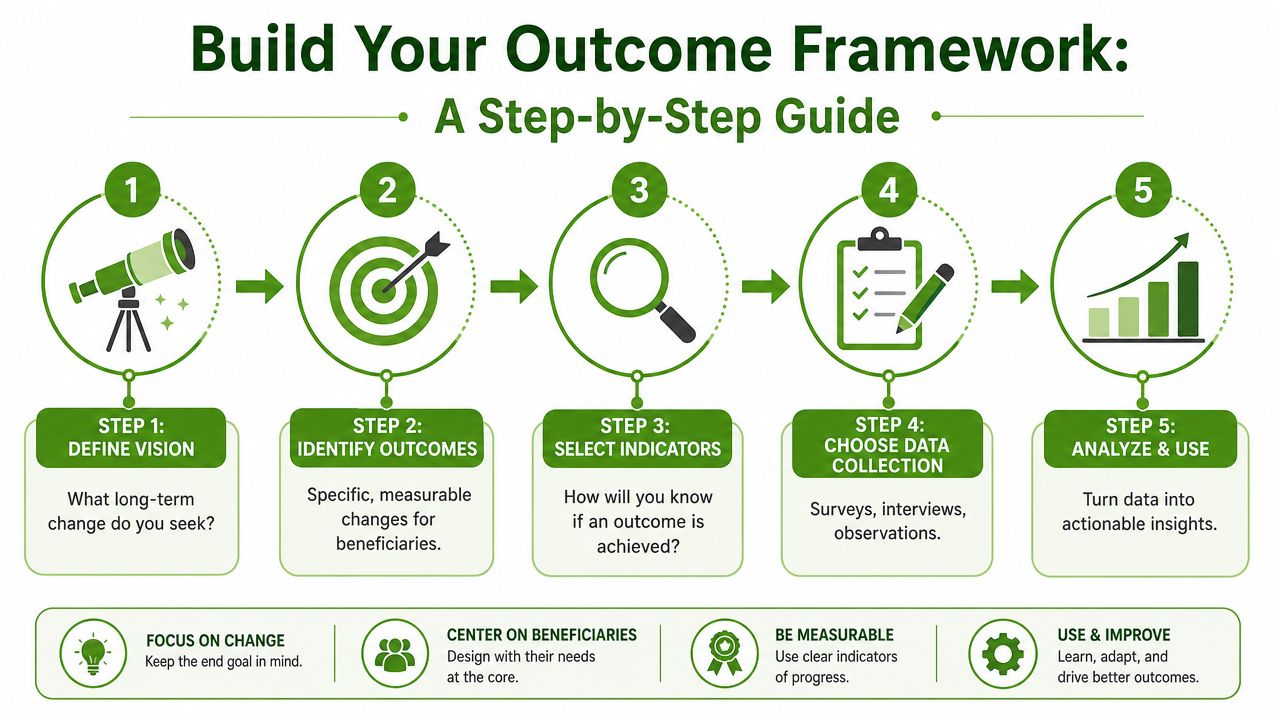
Step 1 define the change you're trying to create
Start with the destination.
Ask, “If this program works, what is different for participants six weeks from now, three months from now, or by the end of service?” That question keeps your team focused on change, not just activity.
A mission statement sits at the top of the ladder. An outcome sits on a lower rung where staff can observe progress. “Thriving communities” is too broad for measurement. “Parents feel more confident talking with teachers” gives your team something specific to look for.
If your staff keeps writing goals that are too vague or too big, a short guide on setting effective smart goals can help tighten the wording.
Step 2 choose a small number of outcomes
Small teams usually do better with a short list.
Three to five outcomes is often enough for one program. That keeps your framework usable during a busy month when staff are serving clients, answering funder questions, and trying to keep records current. If you list everything that might matter, the framework becomes a parking lot for good intentions instead of a tool.
A helpful way to narrow the list is to sort outcomes by time frame:
- Short-term outcomes: Participants gain knowledge, confidence, awareness, or motivation
- Intermediate outcomes: Participants change behavior, use services more consistently, or complete key milestones
- Long-term outcomes: Participants maintain stability, keep a job, stay housed, remain engaged in school, or sustain another meaningful change
This time-frame approach works like planning a road trip. You need to know the first turn, the major stop along the way, and the final destination. A small nonprofit does not need to measure every mile.
Long-term follow-up can matter too, but only if it is realistic for your team. If you can reach former participants with a text, a short call, or one simple follow-up question, that may be enough.
Step 3 pick indicators that are fit for purpose
An outcome is the change you hope to see. An indicator is the evidence you will collect to check whether that change happened.
That distinction trips up many new grant managers.
If your outcome is “participants improve job readiness,” possible indicators include completed resumes, stronger mock interview scores, or participant confidence applying for jobs. If your outcome is “caregivers feel more able to support reading at home,” your indicator might be a short caregiver survey, a reading log, or a staff checklist used during family sessions.
The key is fit. Choose an indicator that matches the outcome closely enough to be believable.
Use a few common-sense tests:
- Clear: Will two staff members understand it the same way?
- Relevant: Does it reflect the outcome, not just program activity?
- Repeatable: Can your team collect it the same way each month?
- Practical: Can you gather it without overloading staff or participants?
The What Works Clearinghouse training materials describe several useful types of measures, including participant-reported, observer-reported, and performance-based measures. For a small nonprofit, that matters because you have options. You are not limited to formal tests.
Here is a simple comparison table your team can borrow:
| If your outcome is about... | Consider measuring with... |
|---|---|
| Knowledge or confidence | Short pre/post survey |
| Behavior in practice | Observation checklist or follow-up call |
| Skill performance | Task demonstration, rubric, or assessment |
| Experience of service | Participant feedback form or interview |
Step 4 choose low-cost collection methods
Now match each indicator to a method your team can maintain.
Small nonprofits often overbuild. They create long surveys, add extra forms, and ask frontline staff to collect data they do not have time to record. A better approach is to use the lightest method that still gives a credible answer.
These methods are usually enough:
- Short surveys: Useful for confidence, knowledge, satisfaction, or self-reported behavior
- Staff checklists: Useful when staff already observe progress during service delivery
- Intake and exit forms: Good for simple pre/post comparison
- Follow-up calls or texts: Helpful for checking whether change lasted beyond the program
- Structured case notes: Better than open-ended notes when everyone uses the same prompts
A logic model can help here. It works like a one-page wiring diagram. It links need, activities, outputs, outcomes, and indicators so your collection methods do not drift away from the program itself.
Platforms such as Fundsprout can support teams that need to connect funding requirements, reporting tasks, and impact data in one place, especially when multiple grants ask for slightly different evidence.
A short video can also help if your team learns better by seeing the process mapped out:
Step 5 analyze simply and report clearly
You do not need advanced statistics to make the framework useful.
Start by looking for a few plain patterns. What changed from intake to exit? Which comments show the same theme again and again? Did one site, cohort, or service format produce better results than another? Those observations are often enough to guide a smart program decision.
A practical report for a board, funder, or staff meeting can stay very short:
- Outcome aimed for
- Indicator used
- How data was collected
- What you found
- What you will adjust next
That last line matters.
Outcome measurement is not a trophy case. It is a flashlight. Good reporting helps a small team see where the program is working, where participants are getting stuck, and what should change before the next grant report is due.
Outcome Measurement in Action Examples and Templates
The easiest way to understand outcome measurement is to see it in ordinary programs.

A food pantry example
A pantry team often starts by counting bags, boxes, and households served. Those are outputs.
A stronger outcome question is, “Did families experience more stable access to food after using the pantry?”
An affordable indicator might be a short check-in question at intake and again after repeated visits. Staff could ask whether the household had enough food for the week and record responses in a consistent way.
A simple template could look like this:
| Program goal | Outcome | Indicator | Collection method |
|---|---|---|---|
| Reduce food hardship | Families report more consistent access to groceries | Participant self-report on food sufficiency | Intake form plus follow-up question |
An after-school tutoring example
The tutoring team may proudly report attendance, volunteer hours, and sessions delivered. Again, useful, but incomplete.
A stronger outcome is “students show improved homework completion” or “students report greater confidence in reading.” The indicator could be a teacher update, a parent check-in, or a simple pre/post student survey using the same questions each time.
This works well for small teams because it doesn't require a formal test battery. It requires consistency.
A community arts workshop example
Arts organizations often struggle with measurement because the change feels personal and hard to quantify. But that doesn't mean it can't be measured.
Suppose the program goal is to increase belonging and confidence among teens. The outcome could be “participants feel more comfortable expressing themselves in a group setting.” The indicator might be a short reflection form at the start and end of the workshop series, plus a facilitator rubric for participation.
Small nonprofits don't need perfect instruments to begin. They need clear outcomes, sensible indicators, and repeatable habits.
A one-page template you can copy
For almost any program, this four-line template works:
Our program does:
Weekly mentoring sessions for middle school students.We expect this outcome:
Students feel more supported and more confident asking for help.We'll know because:
Students report confidence levels at entry and exit, and mentors complete a brief observation checklist.We'll use the findings to:
Adjust mentor training, scheduling, and family communication.
That's an outcome framework in miniature. It's enough to get started.
Common Pitfalls and Best Practices for Credible Reporting
Bad outcome measurement rarely comes from bad intentions. It usually starts on a busy afternoon, when a grant report is due, staff are stretched thin, and the easiest numbers to grab are attendance, referrals, and volunteer hours.
Those numbers matter. They just do a different job.
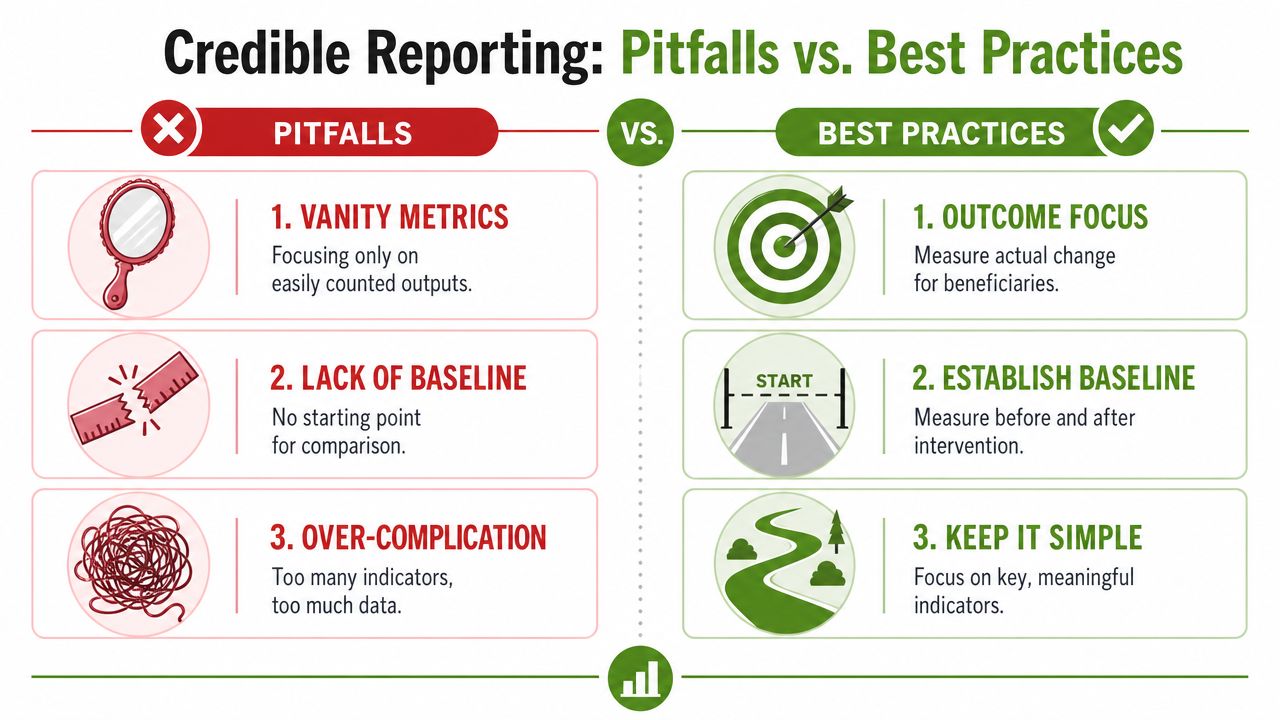
Pitfall one counting everything except change
A small nonprofit might run a strong program and still write a weak report if it only counts activity. You can list 12 workshops, 85 attendees, 40 follow-up calls, and 200 volunteer hours, then still leave a funder unsure whether anyone is better off.
Outputs show that work happened. Outcomes show whether the work helped.
That distinction is easy to blur because output data is usually close at hand. Sign-in sheets, case notes, and calendars already exist. Outcome data takes one more step. You have to decide what change matters, ask about it consistently, and record the answer the same way each time.
If your organization also depends on volunteers, operational tracking still matters. For example, a practical guide to managing church volunteer time shows how teams can document volunteer contributions in a structured way. That helps with administration, but it still doesn't replace outcome evidence.
Pitfall two using weak or inconsistent tools
A measurement tool works like a bathroom scale. If it gives a different reading every time you step on it, you stop trusting it. The same problem shows up in nonprofit surveys, observation forms, and intake questions.
The National Institutes of Health summary on outcome measures explains that reliability and validity affect whether a tool can detect real change, and that weak reliability adds noise that makes results harder to interpret, as explained in the NIH overview of outcome measure quality.
You do not need a research department to apply that lesson.
The practical takeaway is direct. If questions are vague, if staff explain them differently, or if the form changes from month to month, your results become hard to defend. For a small team, a short tool used consistently is often better than a longer tool no one completes the same way.
Ask these questions before adopting any measure:
- Is it clear: Would two staff members read the question the same way?
- Is it relevant: Does it match the outcome you care about?
- Is it repeatable: Can you use it the same way next month and next quarter?
- Is it realistic: Will staff and participants complete it?
Pitfall three only measuring positive results
Credible reporting includes uneven results. Some participants improve fast. Some improve slowly. Some drop out before the program has time to help.
That is normal.
Research on outcome measurement notes that a basic pre/post approach can miss short-term setbacks or deterioration between those two points, as discussed in the ScienceDirect overview of outcome measures. For small nonprofits, this does not mean you need constant testing. It means a few planned check-ins during the program can give a truer picture than one survey at the start and one at the end.
Honest reporting builds trust. A report that says, “Attendance stayed high, but confidence gains were uneven, so we adjusted facilitator training,” sounds more credible than a report where every number rises neatly.
Best practices that keep reporting credible
Small teams do better with a manageable system than an ambitious one that falls apart after two months.
- Start with one outcome per program: If you run three services, you do not need ten measures for each one.
- Set a baseline: A starting point gives later changes meaning.
- Write down collection rules: Note who asks the question, when they ask it, and where the answer is stored.
- Train for consistency: Even a 15-minute staff walkthrough can reduce variation.
- Keep tools close to the work: A short exit form or case manager checklist often fits better than a complex instrument.
- Report adjustments, not just wins: Funders usually respond well to clear learning and sensible course correction.
One helpful test is this. If a new staff member joined next week, could they collect the same data in the same way from your notes alone? If yes, your system is probably credible enough to use.
The most believable nonprofit report is the one that shows careful measurement, clear limits, and a willingness to learn.
Fundsprout helps nonprofits manage the full grant cycle, from finding aligned opportunities to organizing proposal inputs and post-award reporting requirements. If your team is trying to connect program outcomes with funding deadlines and compliance tasks, Fundsprout is one practical option to explore.
Try 14 days free
Get started with Fundsprout so you can focus on what really matters.