What Is G&A In Business? Your Ultimate Guide to G&A Costs
What is G&A in business? Discover how general and administrative costs drive nonprofit success and learn to budget for them with confidence.


Abdifatah Ali
Co-Founder
General and Administrative (G&A) expenses cover the essential, day-to-day costs of running your organization. Think of them as the central nervous system—the core operational costs that aren’t directly tied to a specific program or fundraising campaign, but make all of that work possible.
These are the costs for things like leadership salaries, rent for your main office, and accounting fees that keep the lights on and ensure you’re operating legally and responsibly.
The True Cost of Making an Impact

In the nonprofit world, G&A often gets a bad rap. It’s usually lumped under the dreaded "overhead" label, with pressure from all sides to keep it as low as possible. It's time we changed that perspective. G&A isn’t a necessary evil; it’s the strategic investment that makes your mission sustainable.
A great way to think about it is to imagine your organization as a car. Your programs—the tutoring sessions, the hot meals, the advocacy work—are the powerful engine. They’re what drive you forward and create change. But an engine can't get anywhere on its own.
G&A is the chassis that provides structure, the navigation system that guides your direction, the fuel that powers the journey, and the skilled driver at the wheel. Without this critical infrastructure, the engine cannot function effectively or sustainably.
Simply put, this operational backbone includes all the shared expenses that hold your organization together. Understanding the role of G&A is the first step toward building a more resilient and impactful nonprofit.
Debunking the Overhead Myth
The relentless push to shrink G&A costs can trap nonprofits in what’s known as the "nonprofit starvation cycle." This happens when an organization deliberately underinvests in its core infrastructure—its people, tools, and planning—just to show a low overhead ratio to donors.
While this often comes from a good place, it’s a deeply counterproductive mindset. Cutting corners on G&A almost always backfires, leading to serious problems down the road.
Underfunding your G&A can result in:
- Outdated Technology: Forcing your team to work with slow, inefficient systems that waste valuable time and energy.
- High Staff Turnover: Failing to offer competitive salaries, benefits, or professional development, causing you to lose talented and experienced staff.
- Compliance Risks: Lacking the budget for proper accounting, legal advice, or HR management, which can put your organization in jeopardy.
- Stunted Growth: Having no capacity for strategic planning, innovation, or scaling the programs that are already proven to work.
For a deeper dive into how these costs are defined and handled in the for-profit sector, this guide on What Is G&A in Business and How Does It Impact Profitability is a fantastic resource. Ultimately, investing smartly in G&A isn’t about wastefulness. It’s about building a strong foundation so you can deliver on your promises for years to come.
Decoding Your Nonprofit's Core Operational Costs

So, what actually is a G&A expense? The best way to understand what is G&A in business for a nonprofit is to forget the dry accounting definitions for a moment. Instead, think about these costs as the foundational pillars holding up your entire organization.
These expenses are the operational glue. They don’t belong to a single program but are essential for supporting every facet of your mission. When you break them down into a few logical categories, it’s much easier to see how they show up in your own day-to-day operations.
People and Leadership
First, you have the human infrastructure that gives your entire team direction, oversight, and support. These are the key people whose work benefits every single program and department, ensuring the organization runs smoothly and thinks strategically.
Common examples include:
- Executive Leadership: The salaries and benefits for your Executive Director, CEO, or other top leaders who are steering the entire ship.
- Administrative Staff: This covers your office manager, receptionist, or executive assistants who handle organization-wide tasks.
- Human Resources (HR): Any costs tied to your HR staff or services fall here, since they support every employee, regardless of their department.
These roles are considered G&A because their work serves the whole organization, not just one specific program. While a program manager’s salary is typically a program cost, the CEO’s salary is classic G&A because they oversee all programs. To see a clearer contrast, you can find more detail in our article covering https://www.fundsprout.ai/resources/example-of-direct-costs.
Place and Infrastructure
This category is all about the physical space and essential supplies that give your team a place to work and the tools they need to succeed. Think of it as the cost of creating a functional, safe, and professional home base for your mission.
These expenses are the operational bedrock. Without a central office, functioning utilities, or the necessary insurance, your programs would struggle to operate efficiently—or even legally.
Essential costs in this pillar include:
- Rent and Utilities: Payments for your main office space, plus electricity, water, internet, and phone services that keep the lights on.
- Insurance: This covers general liability, property insurance, and Directors & Officers (D&O) policies that protect the entire organization from risk.
- Office Supplies: General items like paper, ink, pens, and cleaning supplies that are used by everyone and aren't tied to a specific project.
Processes and Systems
Finally, this pillar covers the professional services and technology that keep your nonprofit compliant, financially sound, and operationally efficient. These systems are the backbone of good governance and accountability.
This includes things like your accounting software, the fees for your annual audit, or a retainer for legal advice. These services are fundamental to running a responsible organization and protecting it as a whole. A great way to see how these costs are formally reported is by reviewing various nonprofit financial statements examples, which can offer some valuable real-world context.
How Much G&A Is Too Much for a Nonprofit?
For decades, the nonprofit sector has been held captive by the "overhead myth"—a deeply flawed belief that low administrative spending is the best measure of an organization's worth. This obsession has pushed countless nonprofits into a dangerous corner, forcing them into what's known as the nonprofit starvation cycle.
This is where the real trouble starts. To satisfy donors and grantors who are fixated on low overhead, organizations begin to cut back on the very things that keep them running effectively. They skimp on leadership training, put off buying new technology, and underpay their essential administrative staff. The result? A brittle, weakened organization that struggles to actually deliver on its mission.
There's No Magic Number
So, what's the right amount to spend on G&A? The honest answer is that there’s no universal benchmark. The ideal ratio is completely dependent on a nonprofit’s size, its mission, and its stage of development.
The data backs this up. For instance, research from the Urban Institute that dug into IRS Form 990 data revealed that the median nonprofit actually spent about 27.3% of its budget on management and general expenses. Digging into these overhead cost findings shows just how widely these figures vary, especially for smaller organizations.
This proves that a one-size-fits-all approach isn’t just unrealistic—it’s damaging. What a massive, established health organization needs is worlds apart from the needs of a scrappy, growing arts collective.
The question we should be asking isn't, "How low can we get our G&A?" Instead, it should be, "Are we investing enough in our infrastructure to truly maximize our impact?" Focusing on a simple percentage completely misses the point.
The True Cost of Squeezing Your Budget
When you think about what is G&A in business through the lens of long-term impact, it becomes obvious that these investments are non-negotiable. Trying to "save" money by underfunding your core operations has real, painful consequences that can hamstring your ability to serve the community.
Think about what happens when you cut these costs too deeply:
- A Revolving Door of Talent: Without competitive pay or professional development opportunities, you can't attract or keep skilled leaders. High turnover means a constant loss of knowledge and momentum.
- Running on Fumes: Outdated software, failing computers, and clunky manual processes burn through staff time that should be spent on the mission itself. It's like trying to win a race with a sputtering engine.
- Stagnant Impact: If you don't invest in planning, evaluation, and better systems, you can't measure what’s working. You can't adapt to new challenges or grow the programs that are making a real difference.
Understanding these trade-offs arms you for more honest and productive conversations with your board and funders. The goal is to shift the dialogue from a punitive focus on penny-pinching to a strategic discussion about building a resilient, effective organization for the long haul.
So, you've moved past the "overhead myth." Excellent. The real question isn't "How low can we get our G&A?" but rather, "What's the right level of G&A spending to truly fuel our mission?"
This isn't about finding the lowest possible number. It’s about discovering the strategic sweet spot where your investment in solid infrastructure pays off with the biggest possible impact.
When you start thinking this way, your G&A budget transforms. It’s no longer a cost you have to constantly defend and minimize. It becomes a smart investment in your organization's capacity. Think about it: when you invest properly in good management, the right technology, and skilled administrative staff, you’re building the engine that delivers better programs and scales your impact.
Data That Challenges the 'Lower Is Better' Mindset
If you're still a bit skeptical, some fascinating research is starting to prove that the race to the bottom on overhead is a losing game. A landmark 11-year study looked at over 22,000 arts and cultural nonprofits and found something surprising: the organizations on the extreme ends of the spending spectrum really struggled.
Those who spent the least on overhead actually saw a 9% decline in attendance over time. On the flip side, those who spent the most saw a staggering 30% drop. So who came out on top? The most successful groups—the ones with the highest attendance—were those that invested just over a third, or about 35%, of their total budget in overhead. As you can learn from the full nonprofit overhead study, this investment in core functions like management and tech directly enabled them to execute their missions far more effectively.
Now, that 35% figure was specific to the arts sector, but the lesson is universal. Strategic G&A spending isn't a drain on your mission; it’s what drives your success. This kind of data is exactly what you need to advocate for the resources your organization requires to not just scrape by, but to actually grow and thrive.
Investing in your organization's core is not a detour from the mission—it's the fuel that gets you there. A strong G&A budget is the foundation upon which high-impact programs are built and sustained.
Armed with this evidence, you can have much more productive conversations with your board and funders. Instead of getting stuck defending G&A as a "necessary evil," you can frame it as a calculated investment in your organization's health and future. It's about building a resilient, effective nonprofit that can deliver on its promises for years to come.
Re-Evaluating Your Own Spending
With that in mind, it's a good time to take an honest look inward. Is your current G&A budget just keeping the lights on, or is it actively pushing your mission forward?
Ask yourself and your team a few tough questions:
- Technology: Is your current tech a time-saver, or is it a source of daily frustration and wasted hours?
- Talent: Can you attract and keep the skilled people you need to manage your finances, HR, and operations effectively?
- Strategy: Do you have the breathing room and resources to actually plan for the future, measure what’s working, and adapt when things change?
Answering these questions honestly is the first step. From there, you can start building a budget that reflects the true cost of making an impact and begin making the case for the G&A you really need.
How to Calculate and Allocate Your G&A Costs
Okay, we've established why G&A is the unsung hero of your organization. But how do you actually track it? Getting a firm grip on calculating and allocating these costs is more than just a bookkeeping chore—it’s essential for sound financial health, transparent reporting to your board, and building a rock-solid case for funding.
The quickest way to get a snapshot of your spending is with the G&A Ratio. It’s a simple but powerful formula that shows what percentage of your total spending goes toward keeping the lights on.
G&A Ratio Formula:
(Total G&A Expenses / Total Expenses) x 100 = G&A Ratio %
Let's put that into practice. Imagine your nonprofit had $150,000 in G&A expenses last year and your total expenses were $750,000. Your G&A ratio would be 20%. This number gives you an immediate benchmark to see how you’re tracking against your own goals and what others in the sector are spending.
As you look at that number, remember that it's all about finding a healthy balance.
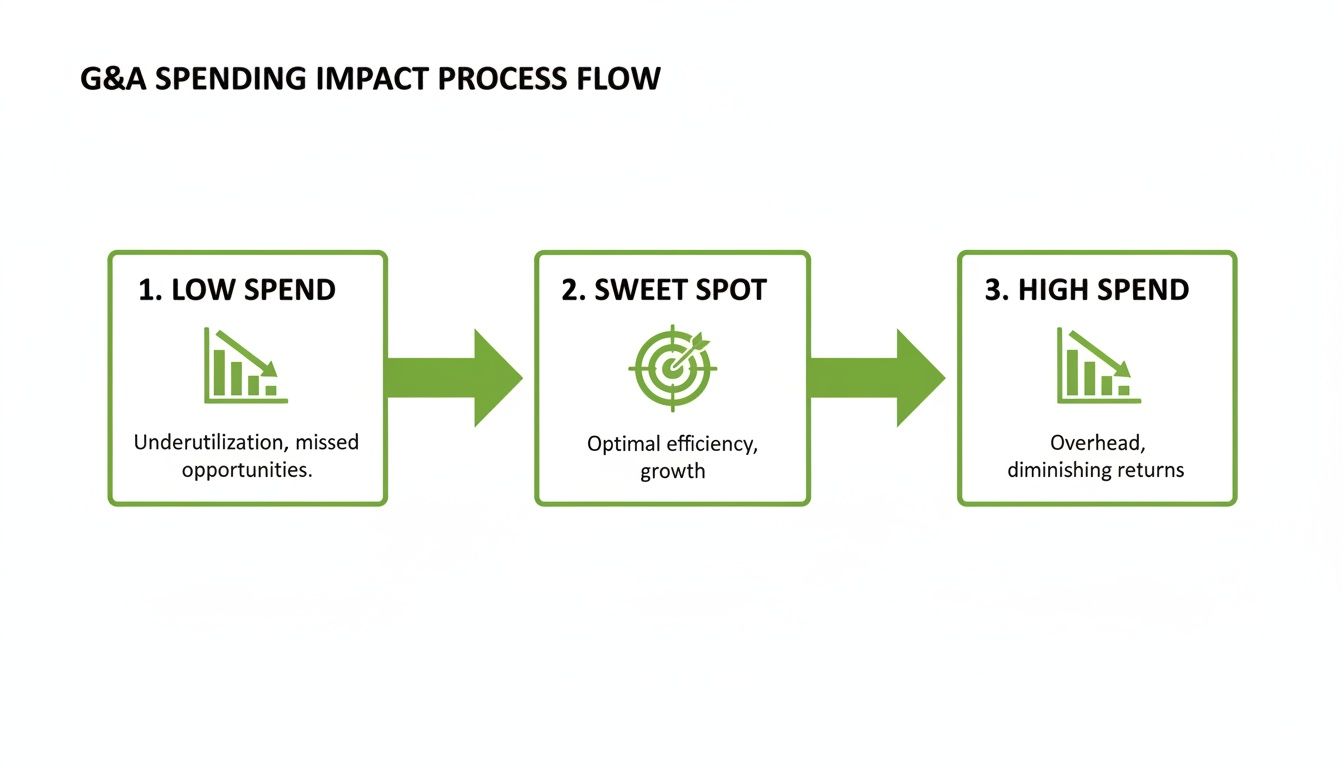
Spending too little on G&A can starve your organization of the support it needs to grow, leading to burnout and inefficiency. On the other hand, spending too much can raise red flags for funders and eat into the funds available for your programs. The goal is to find that sweet spot where your investment in infrastructure fuels your mission.
Using an Indirect Cost Rate
When you start pursuing federal grants, a simple G&A ratio won't cut it. You'll need to formalize your calculations by establishing an Indirect Cost Rate (ICR). Think of the ICR as the official, government-approved method for spreading your shared costs—including G&A—across all your different programs and funding streams.
Having an approved ICR is absolutely critical. It’s the mechanism that allows funders to reimburse you for a fair share of your overhead. Without one, you’re essentially leaving money on the table and forcing your unrestricted funds to carry the entire administrative load. For a step-by-step guide, check out our deep dive on how to calculate indirect costs.
Benchmarks for G&A Allocation
So, what’s a "good" G&A ratio? The honest answer is: it depends. While there's no single magic number, looking at industry benchmarks gives you a helpful frame of reference.
Different types of nonprofits have very different operational realities. For instance, a national health nonprofit might have a lean management structure, aiming for around 7% in G&A, while a local human services organization with complex case management needs might operate closer to 12%.
These aren't hard-and-fast rules but rather guideposts. Knowing where your organization fits in helps you set realistic budgets and confidently explain your financial structure to funders, especially if they’re comparing you to an organization with a completely different model.
Mastering Your G&A Budget and Funder Conversations
Okay, so you get what G&A is and why it matters. Now comes the hard part: putting that knowledge into practice. It’s time to build a budget that actually reflects the real cost of your work and learn how to talk about it without apology.
The mission is to change the narrative. In every conversation with your board, your donors, and especially your grant reviewers, we need to stop treating G&A as a dirty word. It's not a penalty; it's the fuel that keeps your engine running.
Adopt a True Cost Mindset
Your budget should be an honest accounting of what it truly takes to run your programs well. A "true cost" budget goes beyond just listing the direct expenses for a project. It thoughtfully and accurately includes a fair share of the G&A expenses that make everything else possible.
Here’s how to start thinking this way:
- Document Everything: Get serious about tracking every single administrative and operational expense. Think in terms of people (salaries for admin staff), place (rent, utilities), and processes (accounting software, insurance). Leave no stone unturned.
- Allocate Logically: Use a consistent and defensible method, like an Indirect Cost Rate (ICR), to spread these shared costs across all your programs. This ensures every project budget carries its fair weight.
- Build Your Case: For every G&A line item, you should be able to answer the question: "Why is this essential?" Connect that expense directly back to program quality, risk management, or organizational stability.
When you do this, your budget stops being just a list of numbers and becomes a powerful storytelling tool. If you need a solid starting point, a well-structured grant budget template can give you the framework to build out this complete financial picture.
Change the Conversation with Funders
When you sit down with funders, lead with the incredible impact you're making, but don't hide from the costs. The key is to connect your G&A needs directly to your ability to deliver on your promises. You have to reframe the discussion with confidence.
Instead of saying, "We need 15% for overhead," try this: "To effectively manage this program and ensure we meet all our promised outcomes, we require a 15% investment in our core operational support, which covers essential functions like financial oversight, compliance, and project management."
This isn't just a clever word trick; it's a fundamental shift in strategy. It presents G&A not as a tax on the grant, but as a vital component of the project itself.
By mastering this narrative, you position your organization to get the funding it actually needs to do its best work. This is how you build a sustainable organization that can deliver on its mission for years to come.
Frequently Asked Questions About G&A
Even for seasoned nonprofit leaders, the lines between different cost categories can get blurry. Let's clear up some of the most common questions we hear about General and Administrative costs.
How Is G&A Different from Overhead?
It's a classic mix-up, and for good reason—the two terms are very closely related. The easiest way to think about it is that overhead is the big umbrella for all your non-program costs.
Under that umbrella, you have two main buckets: G&A and Fundraising. G&A covers the core operational costs needed to run the organization itself (think leadership salaries, rent, audit fees), while fundraising costs are kept in their own separate category. So, while all G&A is a form of overhead, not all overhead is G&A.
Can Volunteer Time Offset G&A Expenses?
The short answer is no. On your official financial statements, you can't use volunteer time to reduce your reported G&A expenses. While the value volunteers bring is immense, formal accounting rules (GAAP) don't allow you to assign a monetary value to most volunteer services for financial reporting.
That said, you should absolutely be tracking volunteer hours internally. This data is pure gold for annual reports, grant proposals, and showing funders the depth of your community support. It just lives outside of your formal expense calculations.
What Is the Best Way to Explain G&A to a New Board Member?
When a new board member joins, analogies are your best friend. Try framing G&A as the organization's "central nervous system."
Explain that it’s the essential infrastructure—the leadership, finance, HR, and tech—that connects everything and allows your programs (the "limbs") to do their work effectively. It's not a burden; it's the core system that ensures the entire organization is coordinated, compliant, and healthy enough to make a sustainable impact.
Do G&A Costs Include Fundraising Salaries?
Generally, they don't. The salaries for staff whose job is primarily to raise money—like your Development Director or a dedicated Grant Writer—are almost always classified as fundraising expenses.
G&A salaries are reserved for roles that support the entire organization, not just one function. This includes positions like your Executive Director, finance manager, or office administrator.
Stop wasting hours sifting through irrelevant grants and struggling with proposal deadlines. Fundsprout uses AI to build a pipeline of perfect-fit funders and helps you write winning applications faster. Find the funding your mission deserves.
Try 14 days free
Get started with Fundsprout so you can focus on what really matters.