What Is an IFB and How Do You Win One?
Unsure what is an IFB? Our guide explains Invitation for Bid documents, how they differ from RFPs, and how your nonprofit can win these valuable contracts.


Abdifatah Ali
Co-Founder
At its core, an Invitation for Bid (IFB) is a formal request for vendors to submit a sealed bid for a project with incredibly specific requirements. The golden rule is simple: the contract goes to the qualified bidder who submits the lowest price.
Understanding the Core of an IFB

Think of an IFB as a highly structured "reverse auction." Unlike other procurement documents that might ask for creative ideas, an IFB is used when the buyer knows exactly what they want. There’s no room for negotiation on the scope, deliverables, or terms. The competition is all about the price tag.
For instance, if your nonprofit needs to buy 50 new laptops, the IFB won't just say "50 laptops." It will detail the exact processor model, the required RAM, the screen resolution, and maybe even the warranty terms. Vendors don't get to propose different models; they simply bid on providing those exact machines.
An IFB is designed to take subjectivity completely out of the equation. Because all the requirements are set in stone, the only variable left to compare is price. This creates a transparent and level playing field.
To help you get a quick handle on what makes an IFB unique, this table breaks down its essential characteristics.
Quick Guide to IFB Characteristics
| Attribute | Description |
|---|---|
| Primary Goal | To obtain the lowest possible price for clearly defined goods or services. |
| Vendor Role | To provide a price quote for meeting exact specifications. No creative input is needed. |
| Flexibility | Extremely low. The scope of work is rigid and non-negotiable. |
| Evaluation Criteria | Almost exclusively based on the lowest price from a responsive, responsible bidder. |
| Best Used For | Commodities, standard products, or simple services (e.g., office supplies, construction with fixed blueprints). |
In short, when you see an IFB, your winning strategy boils down to meeting every single requirement and offering the most competitive price.
When Is an IFB Used?
Organizations lean on IFBs for their clarity and fairness, which is why they are a favorite of government agencies and large institutions. In the world of government contracting, IFBs are a cornerstone. Just last year, in 2025, U.S. federal agencies issued over 120,000 IFBs, which accounted for roughly 45% of all competitive solicitations under the Federal Acquisition Regulation (FAR). You can dig deeper into how IFBs and RFPs differ to see their distinct roles in public procurement.
This method really shines when:
- The project specifications are crystal clear and can be detailed precisely.
- The most important decision-making factor is the lowest cost.
- There's no need for vendors to propose innovative or custom solutions.
- The goods or services are essentially commodities.
Grasping this is the key. When an IFB lands on your desk, you know the game isn't about creativity—it's about compliance and cost-effectiveness. Your job is to prove you can deliver exactly what's asked for, at a better price than anyone else.
What's Inside an IFB Document?
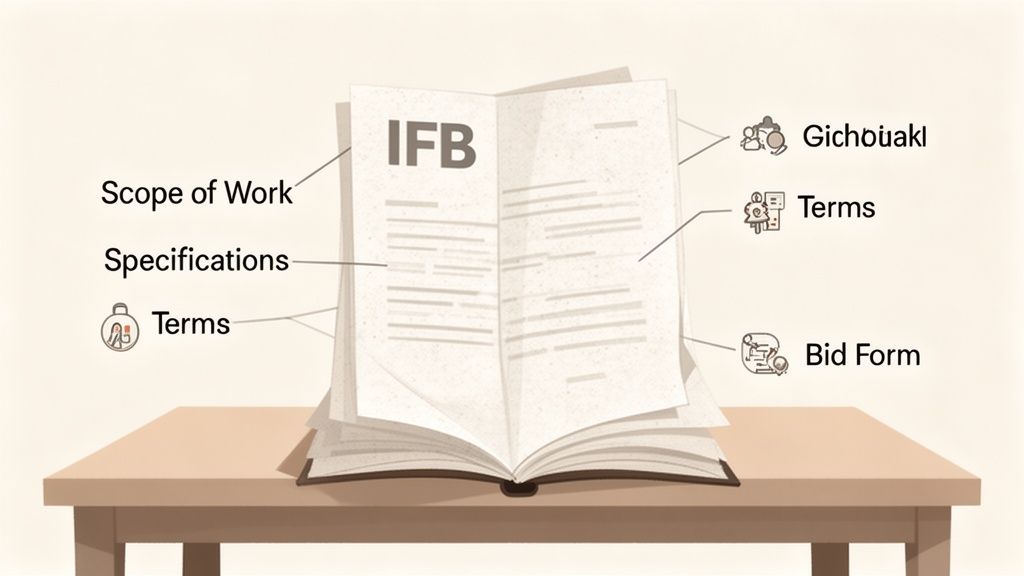
Cracking open a new Invitation for Bid can be intimidating. You’re often looking at a dense stack of pages filled with technical jargon and legal clauses. It feels rigid for a reason—the document is designed to be a precise, unbendable set of instructions.
Think of it less like a creative proposal and more like a detailed blueprint. To win the contract, you have to follow every single line and measurement exactly as written. Once you understand the layout, you can tackle it piece by piece. Overlooking even one small detail is often enough to get your bid disqualified before it’s even seriously considered.
The Core Components of an IFB
Every IFB package is built to give all potential bidders the exact same information, ensuring a level playing field. While the specific format might change from one organization to another, the core parts are almost always the same. Learning to spot and understand these sections is your first step toward building a bid that actually has a shot.
Here’s what you can expect to find:
- Cover Sheet and Instructions: This is your mission briefing. It tells you who issued the bid, the submission deadline, who to contact with questions, and gives a quick overview of the project.
- Technical Specifications: This section gets into the nitty-gritty of what is needed. It will list the exact, non-negotiable requirements, whether it's the type of materials for a construction project or specific performance standards for a piece of equipment.
- Scope of Work (SOW): Here’s where you’ll find the how and when. The SOW breaks down all the tasks you need to perform, key project milestones, and the full delivery schedule from start to finish.
- Terms and Conditions: This is the legal rulebook for the contract. It covers everything from insurance minimums and payment schedules to liability clauses and government compliance standards.
Before you ever put a number on a bid form, you have to be comfortable with the legal side of the agreement. This guide on how to review a contract is a great resource for learning how to break down these complex legal documents.
Remember, with an IFB, there's no such thing as a "minor" detail. Every requirement listed, from insurance liability limits to packaging specifications, is a pass/fail test.
Finally, you’ll come to the most critical part of your submission: the Bid Submission Form. This is the official document where you’ll present your price. Pay close attention here—it often requires specific signatures, notarization, or formatting. Filling it out incorrectly is one of the most common and easily avoidable reasons for a bid to be rejected on the spot.
Understanding IFB vs. RFP vs. RFQ
If you’ve ever felt like you're drowning in a sea of procurement acronyms, you're not alone. It's a common hurdle for nonprofits, but figuring out the difference between an Invitation for Bid (IFB), a Request for Proposal (RFP), and a Request for Quotation (RFQ) is absolutely essential. Chasing the wrong one won't just waste time; it can drain your organization's most precious resources.
Let’s put it in practical terms. Say your nonprofit needs vehicles.
If you need a fleet of 10 specific, identical vans and you've already defined every feature, you're in IFB territory. The only thing that matters is the bottom-line price.
But if you need a comprehensive transportation solution for a new community outreach program—and you're open to creative ideas, different vehicle types, or even innovative scheduling software—you’re looking at an RFP. You have a problem, and you need an expert to propose the best solution.
And if you just need quick price quotes on standard office supplies like printer paper and pens from a few of your usual vendors, an RFQ is all you need. It’s fast, simple, and straightforward.
Knowing these distinctions on sight helps your team immediately spot the opportunities worth pursuing and focus your energy where it can actually lead to a win.
The IFB: A Purely Price-Driven Game
The Invitation for Bid is the most black-and-white of the three. Its goal is singular and non-negotiable: to secure the lowest possible price for a product or service with a scope that is already set in stone. Government agencies and other funders use IFBs when they know exactly what they need, which removes all subjectivity from the evaluation process. It's all about the numbers.
This is a world away from the RFP. While RFPs often require vendors to submit detailed, custom-built proposals—a method used in 55% of cases for services where qualifications are paramount—the IFB is built on price transparency. The process is designed to create a level playing field, with public postings and firm deadlines. All bids are opened at the same time after the closing date to ensure fairness and prevent any behind-the-scenes influence.
RFP and RFQ: Finding a Solution vs. Getting a Price
On the flip side, you have the Request for Proposal (RFP). An organization issues an RFP when they have a problem or a goal but aren’t sure of the best way to get there. It’s an open invitation for vendors to pitch their best ideas. The evaluation is a blend of factors, weighing the vendor's experience, the creativity of their proposed solution, and, of course, the price. For a closer look at these, you might find our guide on the nuances of RFPs and RFQs helpful.
Then there’s the Request for Quotation (RFQ), the simplest of the bunch. An RFQ is used for common, off-the-shelf items or basic services. The main goal is just a quick price comparison from a handful of suppliers. It’s far less formal than an IFB and is typically used for smaller, more routine purchases.
The real difference comes down to the question being asked. An IFB asks, "What is your lowest price?" An RFP asks, "What is your best solution?" And an RFQ simply asks, "How much does this cost?"
To make these differences even clearer, the table below breaks down how each document compares across the most important characteristics.
IFB vs. RFP vs. RFQ: A Comparative Overview
This table outlines the key differences between the three most common procurement documents to help nonprofits quickly identify the opportunity type.
| Characteristic | Invitation for Bid (IFB) | Request for Proposal (RFP) | Request for Quotation (RFQ) |
|---|---|---|---|
| Main Goal | Obtain the lowest price | Find the best overall solution | Get a quick price quote |
| Flexibility | Rigid and non-negotiable | Flexible and encourages creativity | Low flexibility, focuses on price |
| Evaluation | Lowest price from a qualified bidder | Multi-factor (solution, expertise, price) | Primarily lowest price |
| Best For | Commodities, construction, standard goods | Complex services, technology, consulting | Standard, off-the-shelf items |
In a nutshell, understanding which document you're looking at is the first step toward building a successful response. Recognizing an IFB's focus on price versus an RFP's call for a creative solution will fundamentally change your approach and dramatically increase your chances of success.
Your Step-By-Step IFB Response Playbook
Successfully responding to an Invitation for Bid isn’t about being creative or innovative—it’s about discipline and precision. Think of it as a game where the rules are everything. Unlike other funding requests, an IFB is all about compliance and price. One tiny slip-up, like a missing signature or a misread spec, can get your bid tossed out before it’s even reviewed. Having a solid playbook isn't just a good idea; it's absolutely essential.
If you treat each IFB response like a mini-project with its own clear phases, you can sidestep the last-minute scramble and put forward a competitive, compliant bid every single time. This structured approach breaks an intimidating task into manageable pieces, making sure nothing gets missed. It all starts with finding the right opportunities in the first place.
Finding and Vetting Opportunities
Your first job is to hunt down IFBs that actually make sense for your nonprofit’s mission and what you can deliver. Keep a close eye on government procurement portals like SAM.gov, as well as state-level bidding sites and your local city or county websites.
Once you spot a potential fit, the real work begins. You have to vet every opportunity with a critical eye. Ask the tough questions: Can we genuinely meet every single technical requirement listed? Do we have the staff and resources to deliver on schedule? This initial screening is your most important filter, saving you from pouring precious time and energy into bids you simply can't win.
The Go/No-Go Decision
After that initial look, it's time for a formal go/no-go decision. This isn’t a gut feeling; it’s a strategic choice your team makes based on the facts you’ve gathered. A "go" means you’re committing the people and hours needed to build a complete response. A "no-go" frees up those resources for a better opportunity down the road.
This is where it’s crucial to understand what you’re getting into. Different procurement types demand entirely different game plans right from the start.
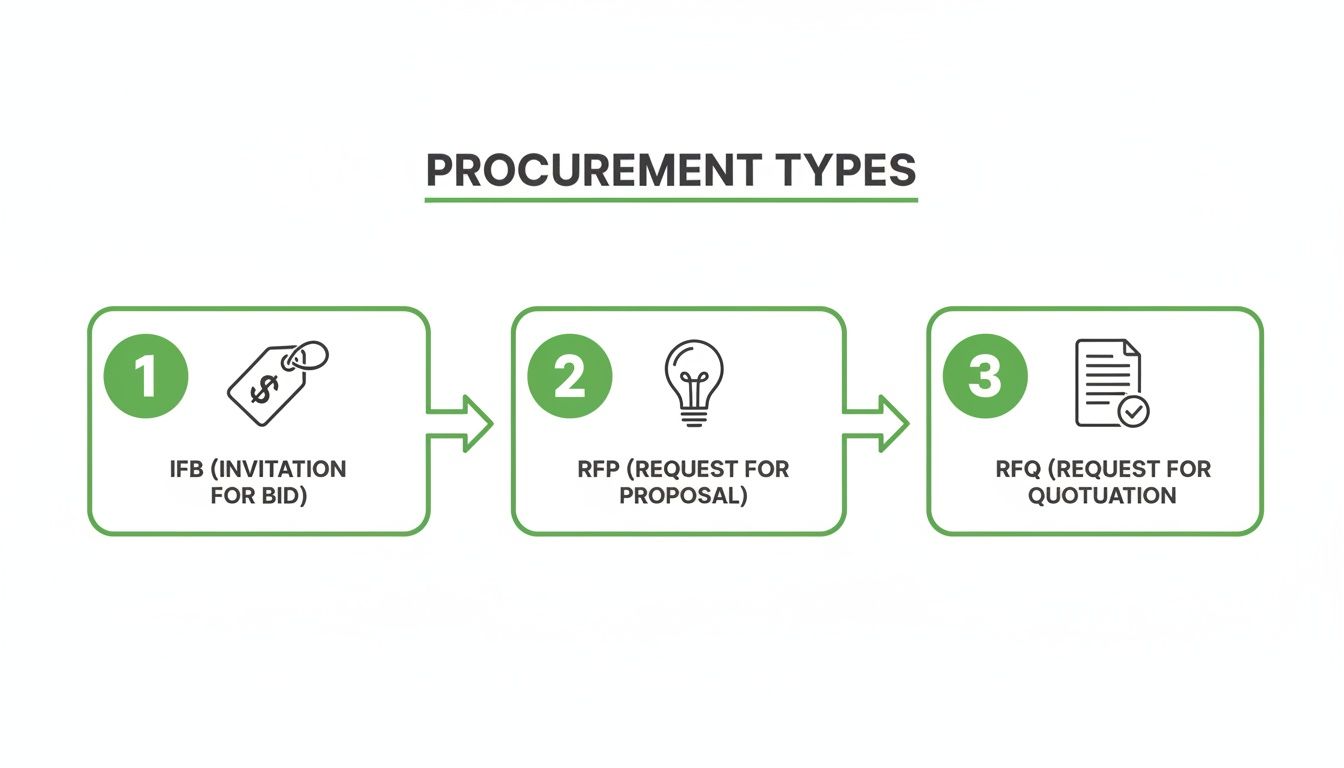
Seeing this laid out visually helps clarify the path ahead. An IFB is a straight line focused on compliance, an RFP is a winding road that requires a custom solution, and an RFQ is a quick trip for a simple price quote.
Assembling a Flawless Bid Package
Decided to go for it? Great. Now the focus shifts to meticulous execution. Follow this checklist to build a bid that stands up to scrutiny:
- Read Every Word: Go through the entire IFB document with a fine-tooth comb. Highlight every single mandatory requirement, deadline, and submission rule. Don't skim.
- Sharpen Your Pencil: This is the heart of the IFB. Calculate your costs with precision to arrive at a price that’s both competitive enough to win and sustainable enough for your organization to deliver without cutting corners.
- Gather Your Documents: Systematically collect every required form, attachment, and signature. Even something as standard as a request for proposal cover letter must be perfectly tailored to the IFB’s rigid format, not a generic template.
- Submit and Confirm: Get your bid submitted well before the deadline—never at the last minute. Then, follow up to get a confirmation of receipt so you have proof it arrived safely.
The government's growing reliance on IFBs is no accident. They are incredibly efficient for projects where the lowest responsive bid wins without a lengthy negotiation, saving agencies an average of 15-20% on costs compared to RFPs. In fiscal year 2025 alone, contracts awarded through IFBs totaled a staggering $150 billion. What's more, 68% of those contracts went to small businesses that had their registrations and paperwork in order, proving that being prepared gives you a serious advantage.
How Your IFB Response Is Actually Evaluated
If you want to win an Invitation for Bid, you need to know how the game is scored. Unlike other funding requests where your innovative approach or deep experience might tip the scales, the IFB evaluation is a brutally simple, black-and-white process.
Think of it as trying to get through two high-security checkpoints. If you get turned away at the first one, you're out. No second chances. Only those who clear the first gate even get a shot at the second. The entire system is built for fairness, which means it’s rigid and focused on just two things: compliance and price.
Gate 1: The Responsiveness Check
The first checkpoint is all about following the rules. A contracting officer will perform a responsiveness check, asking one simple question: did you follow every single instruction to the letter? This isn't about the quality of your work; it's a purely administrative pass/fail test.
They’re looking for common mistakes that will get you disqualified instantly:
- Did you submit everything before the exact deadline?
- Are all the required forms filled out completely and correctly?
- Is every signature exactly where it needs to be?
- Did you agree to all the terms and conditions without trying to change them?
If your bid is missing a single document or arrives one minute late, it’s deemed non-responsive. That’s it. Your proposal is disqualified on the spot, and the evaluators will never even see your price.
Gate 2: The Responsibility and Price Check
If you make it past the first gate, congratulations. Now you've reached the second and final checkpoint, where the focus shifts to two new factors: your organization's capability and your price.
First, the agency needs to determine if you are a responsible bidder. This is their way of asking, "Can you actually do this job?" They’ll look into your financial stability, your track record on similar projects, and whether you hold all the necessary licenses or certifications.
Assuming you pass the responsibility check, it all comes down to one thing: the bottom line. The contract is awarded to the lowest responsive, responsible bidder.
This straightforward, no-frills evaluation is exactly why IFBs are so popular in government procurement. In fact, for projects under Simplified Acquisition Procedures (up to $250,000), IFBs account for a staggering 70% of all local government contracts. For nonprofits that master this process, win rates can climb as high as 25%.
To dig deeper into the nuances, you can check out this great analysis of the differences between IFBs and RFPs. Once you truly understand how you're being judged, you can stop wasting time on flashy narratives and focus your energy where it actually counts: on flawless compliance and a rock-solid price.
Streamline Your Search and Win More IFBs
Let's be honest: hunting for IFBs can feel like a full-time job you never signed up for. Manually digging through dozens of federal, state, and local government websites is a grind. It’s a frustrating cycle of missed deadlines and finding opportunities that just aren't the right fit. This is where so many nonprofits get bogged down, spending far more time looking for work than actually bidding on it.
Fortunately, you don't have to stay stuck in that chaotic daily search. AI-powered platforms now do the heavy lifting, scanning thousands of sources for you. The result? A clean, curated list of IFBs that perfectly match your nonprofit’s specific services, location, and capacity.
Cut Through the Noise with Automation
The real game-changer here is automation. Imagine having a system that instantly filters out the bids you have no chance of winning, saving your team countless hours of tedious review. For any mission-driven organization, getting a handle on the IFB process means using these kinds of automated checks to build a ranked pipeline of real opportunities. You can find more detail on how automated processes transform bid management on diener.org.
This shift allows your team to stop wading through noise and start focusing only on bids with the highest potential.
By transforming the search from a manual chore into an automated workflow, you change your team's entire focus from finding opportunities to winning them. All that energy can finally be directed toward crafting competitive, compliant bids.
These tools also bring much-needed clarity by giving you a visual pipeline of every opportunity you’re tracking.
A dashboard like the one above turns a confusing spreadsheet or a messy inbox into a structured, actionable workflow. It's all right there—what's coming up, who's responsible, and where each bid stands. This clarity is crucial for managing deadlines and keeping your team on the same page. You can also get a deeper look into how to find the best funding opportunities with database matching tools.
Ultimately, bringing a platform like Fundsprout into your process helps you move past simply knowing what an IFB is. It empowers you to build a reliable, sustainable system for winning them, turning a reactive search into a proactive strategy and giving your nonprofit a serious competitive edge.
Frequently Asked Questions About IFBs
Even for seasoned pros, the rigid world of IFBs can raise some tricky questions. Let's clear up a few of the most common ones that we see nonprofits grapple with all the time.
Can I Negotiate the Terms in an IFB?
This is a big one, and the answer is a firm no. The entire point of an IFB is to create a perfectly level playing field where price is the primary decider. Negotiation is what you do with a Request for Proposal (RFP), not an IFB.
Trying to suggest your own terms, even if you think they’d be an improvement for the agency, is a fast track to disqualification. The moment you propose a change, your bid is no longer a direct response to the IFB, making it "non-responsive." Stick to the script, exactly as it's written.
What Happens If I Make a Small Mistake in My Bid?
This is where things get scary, because it really depends on the mistake. Any "material" error—like a missed deadline, a forgotten signature on a key form, or failing to include a required insurance certificate—is an automatic dealbreaker. Your bid will be tossed out.
What about a tiny typo on a non-critical page? The issuing agency might have the discretion to overlook it, but you should never, ever bank on that. There’s no guarantee of leniency. The only winning approach is to triple-check every single detail for 100% compliance before you hit "submit."
The core principle of an IFB is that the award goes to the lowest price from a responsive and responsible bidder. If your bid fails the responsiveness test due to an error, your price becomes irrelevant.
Is the Lowest Price Always Guaranteed to Win?
Not quite. It’s more accurate to say the award goes to the lowest qualified bidder. To win, you must have the lowest price and be deemed both "responsive" and "responsible."
- Responsive: This means you followed every rule. Your bid meets every single technical spec and administrative requirement laid out in the IFB document, without exception.
- Responsible: This means your organization can actually do the job. You have the financial stability, the right equipment, and the proven track record to perform the contract successfully.
If the bidder with the lowest price gets disqualified—maybe their financials are shaky or they have a history of failed projects—the agency simply moves on to the next-lowest bidder. They'll then run the same responsibility check on them, and so on, until they find a winner who checks all the boxes.
Ready to stop searching and start winning? Fundsprout uses AI to find the perfect IFBs for your mission, turning a chaotic process into a clear pipeline of opportunities. Discover your next contract at https://www.fundsprout.ai.
Try 14 days free
Get started with Fundsprout so you can focus on what really matters.