Request for Proposal Cover Letter: Stand Out and Win More Bids
Discover a proven approach to the request for proposal cover letter that persuades buyers and boosts your bid-winning chances.

Abdifatah Ali
Co-Founder
A request for proposal cover letter is a one-page introduction to your full proposal. Think of it as the handshake before the big meeting. It's your very first opportunity to make a real connection with the funder, set the stage for your solution, and convince them to read the rest of your proposal with genuine interest.
Why Your RFP Cover Letter Matters More Than You Think

It's tempting to treat the cover letter as an afterthought, a quick formality to check off the list before you submit the real work. That's a huge mistake. In the world of competitive funding, that single page is one of your most powerful tools.
A generic, copy-and-paste letter sends a clear message: a lack of effort and genuine interest. On the other hand, a carefully crafted cover letter shows you're professional, thorough, and you actually understand the funder’s mission before they even get to page one of your proposal.
Your First and Best Chance to Connect
Imagine being on a review committee, staring at a mountain of proposals. They all start to blend together. Your cover letter is the first thing they see, making it your prime chance to stand out. It’s where you stop being just another application and start building a real case for a partnership.
A great cover letter can do a few critical things right away:
- Humanize Your Organization: It gives a confident, personal voice to your work, turning a technical document into a compelling story.
- Show You’ve Done Your Homework: Mentioning a specific goal from the funder’s strategic plan or a recent initiative proves you're not just sending out mass applications.
- Frame Your Entire Proposal: It lets you immediately highlight the most important ways your project aligns with what the funder cares about.
The Power of a Strong First Impression
The nonprofit sector might feel different from the corporate world, but the psychology of first impressions is universal. The expectation for a personalized introduction is just as high. In the hiring world, for instance, 89% of professionals expect a cover letter, and 45% read it before the resume.
That same mindset applies to grant reviews. A strong opening can color how the committee reads your entire proposal.
Your cover letter isn’t just an introduction; it’s your first piece of evidence that you are the right partner. It has to answer the question on every reviewer's mind: "Why should I care about this proposal over all the others?"
Ultimately, a fantastic RFP cover letter makes sure your full proposal gets the serious, thoughtful consideration it deserves. If you want a deeper dive into the whole submission process, our complete guide on how to respond to an RFP can walk you through it from start to finish.
The Anatomy of a Winning RFP Cover Letter
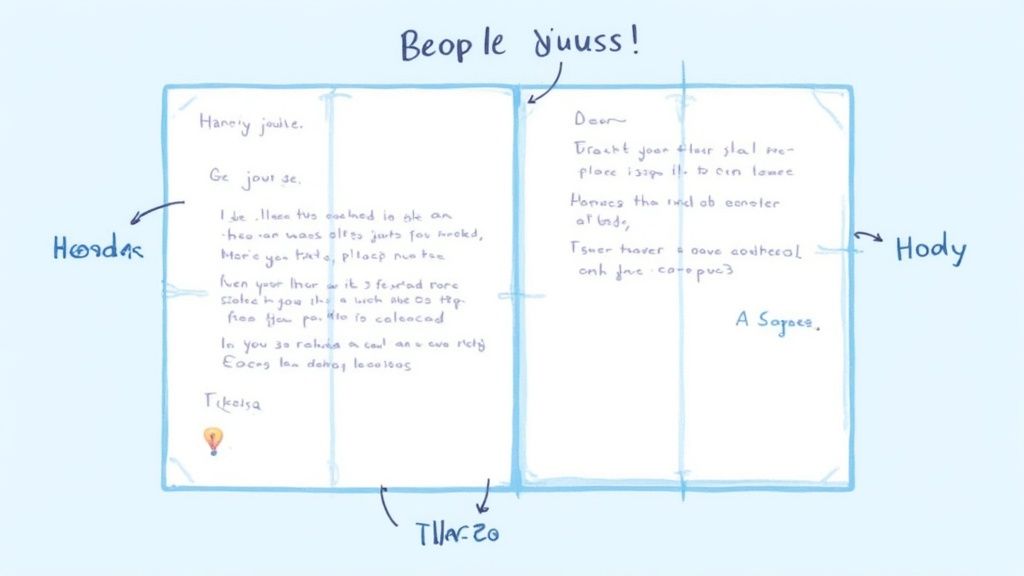
Think of your RFP cover letter like an architectural blueprint. Every section has a critical function, and when they all fit together perfectly, they create an introduction that’s both powerful and memorable. If the structure is weak or generic, the whole message can fall flat. Let's break down the essential parts, piece by piece.
The Header and Salutation
This might seem like the most basic part, but getting the small details right makes a world of difference. Your header needs the essentials: your nonprofit’s name, address, and contact info. Below that, add the date and the recipient's details.
Here's a tip from experience: always try to find a specific name. While "Dear Grants Committee" is okay in a pinch, addressing your letter to "Dear Ms. Anya Sharma, Program Officer" shows you’ve done your homework. That simple touch of personalization signals genuine interest and respect right from the start.
The Opening Hook
Your first paragraph is your one shot to grab their attention. Don't waste it with a bland, "Thank you for the opportunity." Instead, lead with a powerful statement that immediately connects your mission to the specific goals laid out in the RFP.
For instance: "The [Funder's Name]’s commitment to improving early childhood literacy in our county perfectly mirrors the mission of our 'Readers for Life' program, which has boosted reading proficiency for over 500 local children in the last two years." See the difference? You've instantly positioned your proposal as the solution they're already looking for.
The Compelling Body Paragraphs
This is your moment to make a persuasive case without just rehashing your executive summary. The body of your letter should be two or three concise paragraphs that connect the dots between the funder’s stated problem and your organization’s unique capacity to solve it.
Here’s what to focus on:
- Summarize Your Solution: Briefly outline how your project will tackle the need described in the RFP. This isn't the place for a deep technical dive; think high-level overview of your approach.
- Highlight Your Unique Value: What makes your nonprofit the absolute best choice? Mention a key achievement, a unique methodology, or a vital community partnership that makes you stand out.
- Build a Case for Partnership: Shift your language from transactional to collaborative. Frame the relationship as a true partnership working toward a shared goal.
A winning cover letter doesn't just list qualifications; it tells a concise story of shared purpose. It should leave the reviewer thinking, "This organization understands us and what we’re trying to accomplish."
To make sure your letter hits all the right notes, it helps to understand the fundamentals of what to include in a cover letter. While the context is different from a job application, the core principles of making a strong first impression are the same. For more grant-specific examples, our guide on the cover letter for a grant proposal is a great resource.
The table below offers a quick reference for putting these pieces together.
Key Components of an RFP Cover Letter
By ensuring each section fulfills its purpose, you create a cohesive and compelling narrative from start to finish.
The Confident Closing
Your final paragraph needs to be clear, confident, and action-oriented. Reiterate your enthusiasm for the potential partnership and clearly state the next steps.
Always end with a professional sign-off like "Sincerely," followed by the handwritten or digital signature of your Executive Director or another key leader. Having leadership sign the letter adds a layer of authority and demonstrates that your proposal has high-level buy-in. It's a small detail that reinforces your organization's commitment and professionalism.
Finding the Right Tone to Connect with Funders
The words you choose in your RFP cover letter are important, of course. But how you say it can be the difference between getting noticed and getting tossed in the "no" pile. Nailing the right tone turns a standard letter of transmittal into a real opportunity to connect.
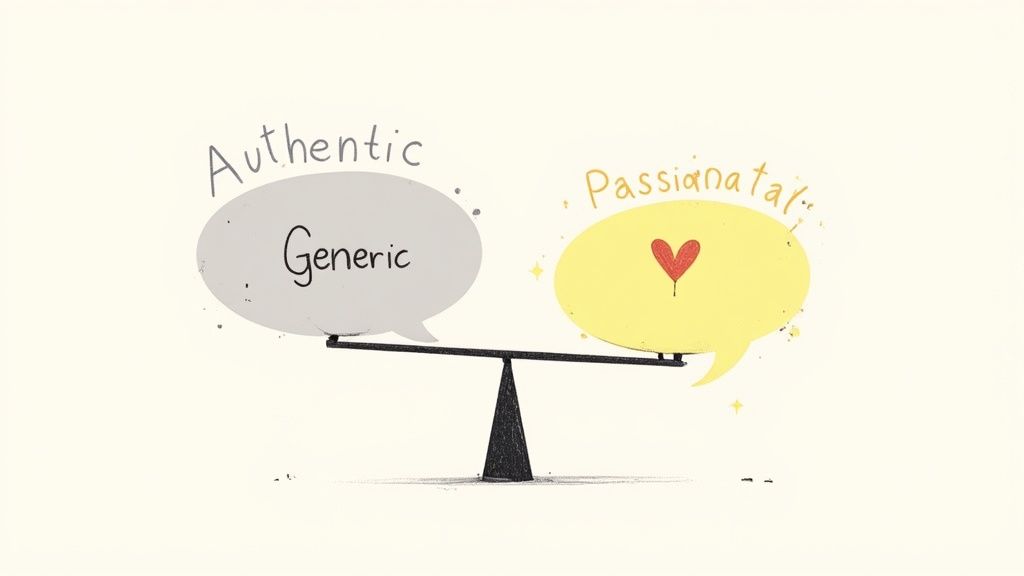
The goal here is a tricky balancing act: you want to be professional but not cold, and passionate without sounding unprofessional or desperate. Think of it like a great TED Talk versus a dry academic journal. Both are filled with facts, but only one leaves you feeling inspired and ready to act. Your letter needs that same energy and confidence.
Ditching Jargon for Authenticity
Nothing makes a reviewer's eyes glaze over faster than a letter stuffed with nonprofit jargon. We all use it internally, but terms like "capacity building," "stakeholder engagement," or "leveraging synergies" often land with a thud. To a funder reading their tenth proposal of the day, these phrases just sound like fluff.
The fix is simple: describe what you actually do. Use clear, direct language.
- Instead of: "We will leverage our core competencies to facilitate stakeholder engagement."
- Try: "We will bring together community leaders and local families for monthly planning sessions."
See the difference? The second one is tangible. It paints a picture. It shows you’re focused on real-world action, not just abstract theory.
A cover letter should read like it was written by a human, for a human. Authenticity builds trust far more effectively than corporate-speak ever could.
Conveying Passion and Personality
This letter is your chance to let your organization's personality shine through. The full proposal gets into the nuts and bolts—the "what" and the "how"—but the cover letter is all about the "why." Funders aren't just buying a project; they're investing in your team and your mission.
This is where showing your enthusiasm becomes a huge asset. Think about it from a hiring perspective: research shows that 47% of recruiters read cover letters to gauge a candidate's actual motivation. Funders are no different. You can dive deeper into these cover letter insights and what recruiters look for to see just how crucial this is.
So, how do you inject that passion without sacrificing professionalism? It's all about using active verbs and mission-focused language. Instead of a flat statement like, "We are qualified to run this program," try framing it with purpose: "Our team is driven by a deep commitment to ensuring every child has access to healthy meals."
That small shift changes everything. It’s no longer just a statement of qualification; it’s a testament to your purpose, and that’s what creates a real connection.
How to Personalize Your Cover Letter for Real Impact
If there's one surefire way to get your proposal tossed aside, it's submitting a generic, copy-paste cover letter. Reviewers can spot boilerplate language a mile away, and it instantly signals that you haven't put much thought into your application.
Real personalization is so much more than just swapping out the funder's name. It's about showing them you’ve picked them for a very specific, well-researched reason.
This all starts with good old-fashioned homework. Before you even think about writing, you need to immerse yourself in the funder's world. Dig through their website, pour over their annual reports, and check out recent press releases. You're hunting for clues: their strategic priorities, the exact language they use, and the kinds of projects they've been excited about lately. This isn't just busywork; it's the foundation of a letter that connects.
Mirror the Funder’s Language
One of the smartest things you can do is to echo the keywords and phrases you find in the RFP and the funder's own materials. If their strategic plan mentions "community-led initiatives" or "sustainable food systems" over and over, you should absolutely weave those terms into your letter.
This does two things. First, it proves you've done your homework. Second, it creates an instant sense of familiarity and alignment, making the reviewer feel like you're already on the same page. It’s a subtle tactic, but it works wonders for building a quick rapport.
Connect Your Project Directly to Their Mission
Your research will give you a clear picture of what drives the funder—their core mission. Your next job is to draw a bright, unmissable line connecting that mission to what your project will achieve. Don't just talk about what you do; frame it in the context of helping them meet their goals.
The best cover letters make a critical shift in perspective. They move from "Here is what our nonprofit needs" to "Here is how we can help you achieve your mission." This changes the entire conversation from a simple ask to a powerful pitch for a genuine partnership.
For instance, instead of a flat statement like, "Our program provides after-school tutoring," try something with more punch: "Our after-school tutoring program directly advances your stated goal of closing the academic achievement gap for at-risk youth in our community." See the difference? That simple change shows you understand their world and where you fit within it.
Beyond tailoring your message for a specific proposal, thinking about broader strategies to make your business stand out can give you a bigger-picture advantage in a crowded field.
At the end of the day, a personalized request for proposal cover letter isn't about empty compliments. It’s about showing genuine interest and proving a strategic fit. It tells the funder you aren't just sending out mass mailings for money—you’re looking for the right partner. That kind of thoughtful effort is what makes a proposal truly memorable.
Common Cover Letter Mistakes That Guarantee Rejection
I’ve seen it happen time and time again: a fantastic, well-researched proposal gets torpedoed by a few simple, avoidable mistakes in the cover letter. These may seem like small slip-ups, but to a grant reviewer looking for any reason to shrink their stack of applications, they're giant red flags.
You’d be surprised how many nonprofits accidentally sabotage their chances from the very first sentence. Glaring typos, using the wrong funder's name, or addressing the letter to "To Whom It May Concern" screams carelessness. It immediately raises a question in the reviewer's mind: if they're this sloppy here, will they be sloppy with our grant money?
Going on Too Long
One of the most frequent blunders I see is the rambling cover letter. Funders are incredibly busy people. A two-page narrative that meanders through your organization's entire history isn't just boring; it shows a fundamental lack of respect for their time and an inability to get to the point.
The aim is to be impactful, not exhaustive. One survey found that a staggering 66% of professionals prefer cover letters to be half a page or less. This desire for brevity is even stronger in the competitive world of grants. You can see how this trend plays out in our guide to professional communication trends.
Focusing on Need Instead of Partnership
Another critical misstep is framing your letter as a desperate plea. I often read phrases like, "We desperately need this funding to keep our doors open." This approach immediately positions you as a charity case, not a strategic partner.
Shift your thinking. The funder has a mission they're trying to achieve. Your job is to show them how your project is the perfect vehicle to help them reach their goals. It’s a subtle but powerful change in perspective.
- Don't say: "Without this grant, our program can't continue serving the community."
- Do say: "This partnership will advance your mission of improving community health by enabling us to reach an additional 500 residents."
Your cover letter is a strategic document, not a plea for help. Its purpose is to demonstrate your value as a partner who can deliver measurable results that align with the funder’s strategic objectives.
Ignoring the Instructions
This might be the most lethal mistake of all: failing to follow the RFP's instructions to the letter. If the funder asks for specific details in the cover letter, or a certain format, you must follow it precisely.
Ignoring their directions is the quickest way to land your proposal in the rejection pile. It tells them, loud and clear, that you can't be trusted to manage the more complex requirements of a grant agreement.
These mistakes are common, but they're also completely avoidable. Building a careful review process is the best way to ensure your proposal gets the serious consideration it deserves. To get a better handle on the entire bidding process, check out our comprehensive guide to RFPs and RFQs.
Answering Your Top RFP Cover Letter Questions
Even with a solid plan, you're bound to hit a few tricky spots when you sit down to write your cover letter. Getting these details right can be the difference between a proposal that gets noticed and one that gets lost in the stack.
Let’s tackle some of the most common questions we hear from nonprofit leaders every day.
How Long Should a Request for Proposal Cover Letter Be?
This one’s easy: keep it to one page, always. Funders and their review committees are drowning in documents. A letter that’s concise and gets right to the point isn’t just easier to read—it shows you respect their time.
You should be aiming for a word count between 250 and 400 words. This usually works out to three or four punchy paragraphs.
- The Opener: Get straight to it. State why you're writing and make an immediate connection to the funder's mission.
- The Body: This is your "why us." Briefly highlight your proposed solution and how it directly aligns with their strategic goals.
- The Closer: End strong with a clear, confident call to action and a professional sign-off.
A letter that is tight and focused sends a powerful message. It tells the reader you're organized, strategic, and ready to get to work.
Who Do I Address If No Contact Person Is Listed?
This is a classic grant-writing puzzle. The one thing you absolutely shouldn't do is fall back on "To Whom It May Concern." It’s impersonal and immediately suggests you didn't put in the effort.
First, do a little digging. Scour the funder's website for staff titles like "Program Officer" or "Grants Manager." Look for the head of the department that aligns with your project. Don't be shy about making a quick, polite phone call to the foundation's main line to ask for the best contact. It often works.
If you’ve tried everything and still come up empty, your next best move is to use a specific, respectful title.
Pro Tip: Go with something like "Dear Grants Review Committee" or "Dear [Foundation Name] Program Team." It's worlds better than a generic greeting and shows you’re still thinking about your audience.
Is It Okay to Use a Template for My Cover Letter?
Yes, but think of a template as a skeleton, not the whole body. It’s fantastic for structure, ensuring you have all the essential components in the right order—the header, date, salutation, body, and closing.
Where you can’t cut corners is the content. The actual words you write must be entirely original and tailored to that specific funder.
Experienced reviewers can spot boilerplate language from a mile away. A letter stuffed with generic phrases screams that you're just going through the motions. Every sentence should prove you’ve done your homework and are genuinely invested in building a partnership.
What Is the Biggest Mistake to Avoid?
Without a doubt, the most common and damaging mistake is making the cover letter all about your organization’s needs. It's a natural trap to fall into, but it instantly turns a potential partnership into a simple plea for help.
Resist the urge to write things like, "We desperately need this grant to continue our vital work." This language frames the proposal around your problems, not their goals.
The entire focus has to be on how your project advances their mission. Frame your work as the solution to a problem they are committed to solving. It’s a subtle but powerful shift in perspective that transforms your letter from a request into a compelling pitch for a shared victory.
Ready to stop guessing and start winning? The AI-powered tools from Fundsprout can analyze any RFP, generate a structured outline, and help you draft compelling narrative sections in your nonprofit’s unique voice. Discover how Fundsprout can strengthen your proposals today.
Try 14 days free
Get started with Fundsprout so you can focus on what really matters.