A Guide to Nonprofit Grant Database Matching
Discover how nonprofit grant database matching works. Our guide explains how AI-powered platforms can help you find the right funders to fuel your mission.

Abdifatah Ali
Co-Founder
Grant seeking can feel like an endless, frustrating treasure hunt. You know the perfect funders are out there, but finding them? That's the hard part. This is where grant database matching changes the game entirely.
Think of it as a strategic matchmaker for your nonprofit. It uses powerful data to connect your organization with funders who are actively looking for a mission just like yours. Suddenly, the search isn't a game of chance anymore—it's a predictable, focused system.
Your Guide to Finding the Perfect Funder
The single biggest challenge for most nonprofits is cutting through the noise. There are thousands of potential funders, but only a handful are a perfect fit for your cause. Manually sifting through foundation websites, 990 tax forms, and old, outdated lists can eat up hundreds of hours with no guarantee of a payoff. This is where strategic matchmaking becomes so critical.
It’s less like a generic search engine and more like a highly specialized dating app for your organization. Instead of you doing all the hunting, a smart system connects you with funders whose giving history and stated interests already signal a strong compatibility with your work. This data-driven approach means you can finally focus your energy on what actually matters: building relationships and securing the funding you need.
This guide will walk you through exactly how this technology works, helping you:
- Understand the mechanics behind the different matching technologies.
- Identify high-quality data sources that fuel accurate results.
- Optimize your nonprofit's profile to attract the best possible opportunities.
- Evaluate and compare platforms so you can make a smart investment.
By moving beyond simple keyword searches, you gain a massive advantage. While many resources are available, including a free grant database for nonprofits, dedicated matching platforms provide a much deeper level of analysis. They spot patterns and contextual clues to bring you opportunities you’d probably never find on your own.
This shift lets you spend more time building connections and less time chasing dead ends, which is how you truly accelerate your mission's impact.
How Grant Matching Technology Actually Works
So, what’s the secret sauce behind a perfect grant match? It’s not magic, but a fascinating evolution of technology built to comb through mountains of data. Once you understand what's happening under the hood, you'll see why some platforms deliver gold while others just give you a long list of dead ends.
From Simple Keywords to Smart Rules
At its most basic, nonprofit grant database matching began with simple keyword searches. Think of it like using a standard search engine. You type in "after-school arts program" or "homelessness prevention," and the system scans funder profiles for those exact terms.
While this was a huge leap from manually flipping through foundation directories, it’s a pretty blunt instrument. A funder might mention a keyword once in an old press release, creating a false positive that sends you down a rabbit hole. This approach just doesn't get the context, so you end up with a lot of noise.
The next step up the ladder is rules-based matching. This is like creating a highly detailed checklist for your ideal funder. You set specific, non-negotiable criteria, and the system only returns funders who tick every single box.
For instance, your rules might look like this:
- Geographic Focus: Only foundations that fund in my specific county.
- Funding Area: Must explicitly list "environmental conservation" as a primary interest.
- Grant Size: Opportunities have to be between $25,000 and $50,000.
- Type of Support: Must offer general operating support, not just project funding.
This method is a game-changer for cutting out obviously poor fits. The downside? It can be too rigid. You could miss a perfect-fit funder just because they use slightly different phrasing or their profile isn't tagged with the exact category you chose.
The Real Breakthrough: AI and Machine Learning
This brings us to today's most powerful systems, which are driven by Artificial Intelligence (AI) and Machine Learning (ML). This technology doesn't just match words; it understands meaning, intent, and context. An AI-powered platform behaves less like a rigid filter and more like a seasoned grant professional with a photographic memory.
AI doesn't just look at what a funder says; it analyzes what they do. By digging into years of 990 tax data and past awards, it spots the real patterns in their giving history, showing you their true priorities.
This is a massive leap from the old way of doing things. The whole process has evolved from a manual, time-sucking hunt to an intelligent, data-backed matchmaking service.
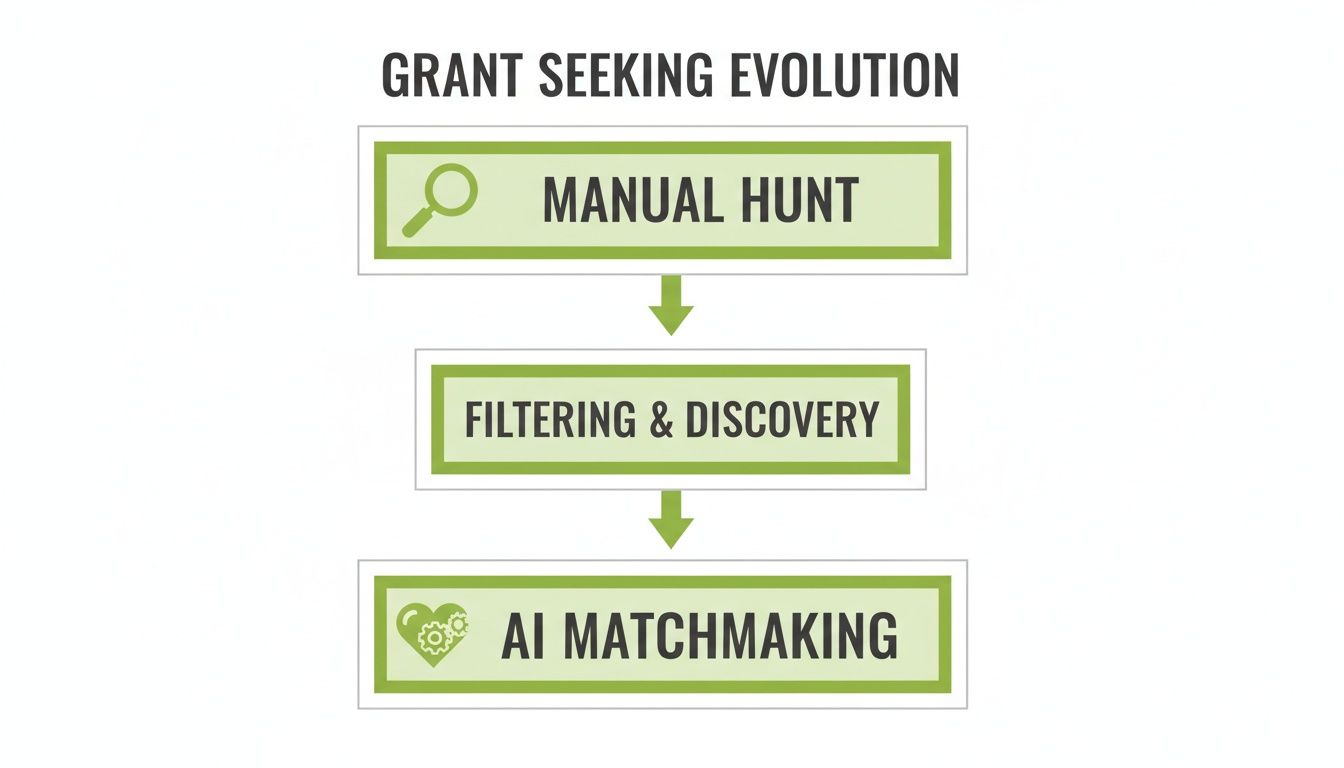
As you can see, the shift is from brute-force searching to strategic, data-driven connections that save incredible amounts of time and dramatically improve your odds.
To help you visualize the differences between these approaches, here’s a quick breakdown of how they stack up.
Comparing Grant Matching Technologies
Ultimately, AI-powered systems provide a deeper, more intuitive search that mirrors human expertise.
Let's say your nonprofit focuses on "youth workforce development," but a fantastic potential funder describes their work as "career readiness for adolescents." A keyword or rules-based system would almost certainly miss that connection. AI, however, understands that these are conceptually the same and makes the match. Seeing how SaaS companies use AI to enhance products can offer more insight into this kind of innovation.
This ability to find the signal in the noise is what sets modern nonprofit grant database matching apart. It helps you build a curated pipeline of funders who are genuinely likely to support your mission. If you're curious about how this technology extends to the application itself, check out our guide on using AI for grant writing.
The Critical Data Powering Your Grant Search
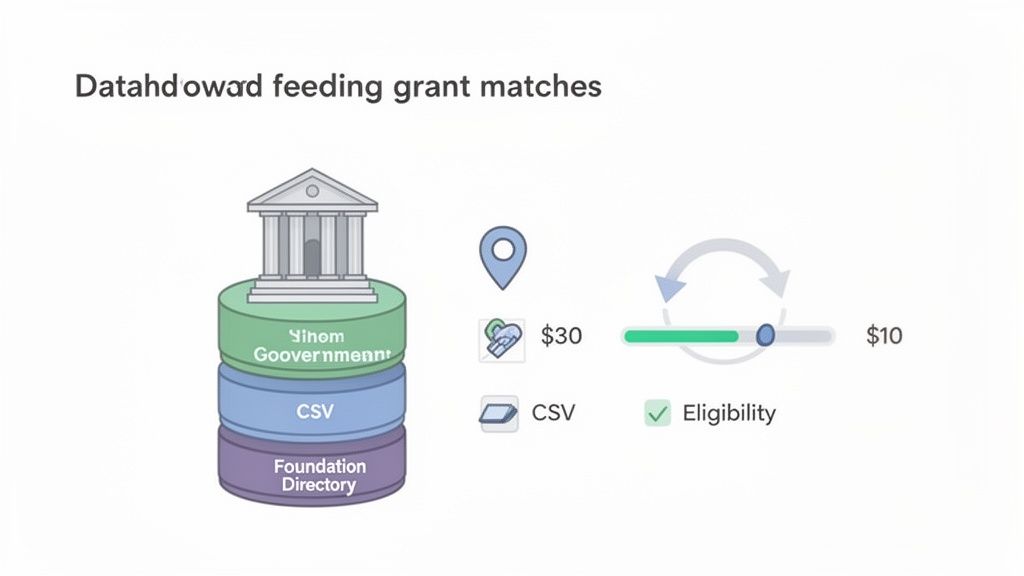
A grant matching platform is only as good as the data it’s working with. Think of it this way: even the most brilliant matchmaker can't find your perfect partner with a blurry photo and a vague bio. The accuracy of your grant matches hinges entirely on the quality, depth, and freshness of the information fueling the system.
These platforms work by pulling information from a huge variety of sources to create a complete, bird's-eye view of the funding world. This saves you from the endless, soul-crushing task of bouncing between dozens of websites, each with its own clunky search function and out-of-date listings.
Key Data Sources
So, where does all this information come from? The best platforms don't just scrape the web; they tap into reliable, verified data streams.
- Federal Databases: This includes massive government portals like Grants.gov, the official source for thousands of opportunities from federal agencies.
- Foundation Directories: Reputable platforms pull comprehensive data from trusted nonprofit sources like Candid, which curates detailed profiles and giving histories on foundations of all sizes.
- IRS Form 990-PF: This is the secret sauce. These are the public tax filings from private foundations, and they reveal the unvarnished truth: who they actually funded, how much they gave, and what their priorities look like in practice, not just on their website.
That last one is a game-changer. Private foundations are a true powerhouse, representing the single largest source of grant awards for 95% of nonprofits. With over 86,000 grantmaking entities globally sitting on assets of more than $1.61 trillion, effective nonprofit grant database matching is non-negotiable for survival and growth. You can dig into more grant statistics over at Instrumentl to get the full scope.
Filtering Your Way to the Perfect Match
Having all that data is one thing, but making sense of it is another. This is where powerful filtering comes in. It’s how you slice and dice that mountain of information to find the funders who are a true fit for your mission. Think of filters as your non-negotiables on a dating app—they weed out the bad fits immediately.
A few smart filters can take a list of thousands of potential funders and instantly shrink it down to a highly relevant, manageable list of your top 20 prospects.
Common and incredibly useful filters include:
- Geographic Scope: You can narrow your search to funders who only support projects in your specific city, state, or even neighborhood.
- Funding Amount: Need between $50,000 and $75,000? Set a minimum and maximum grant size to stop wasting time on opportunities that are too small or too large.
- Type of Support: Are you looking for general operating support, program-specific funds, or a capital campaign grant? A good platform lets you filter for exactly that.
- Area of Focus: Zero in on funders whose mission aligns directly with yours, whether it's animal welfare, youth arts programs, or environmental conservation.
Of course, these filters are only as smart as the information you give them. The more detailed and accurate your nonprofit’s profile is, the better the system can work for you. Strong data from a community needs assessment can provide the hard evidence to back up your profile, giving the platform the context it needs to deliver hyper-relevant matches. The better your input, the better your output. Simple as that.
How to Optimize Your Profile for Better Grant Matches
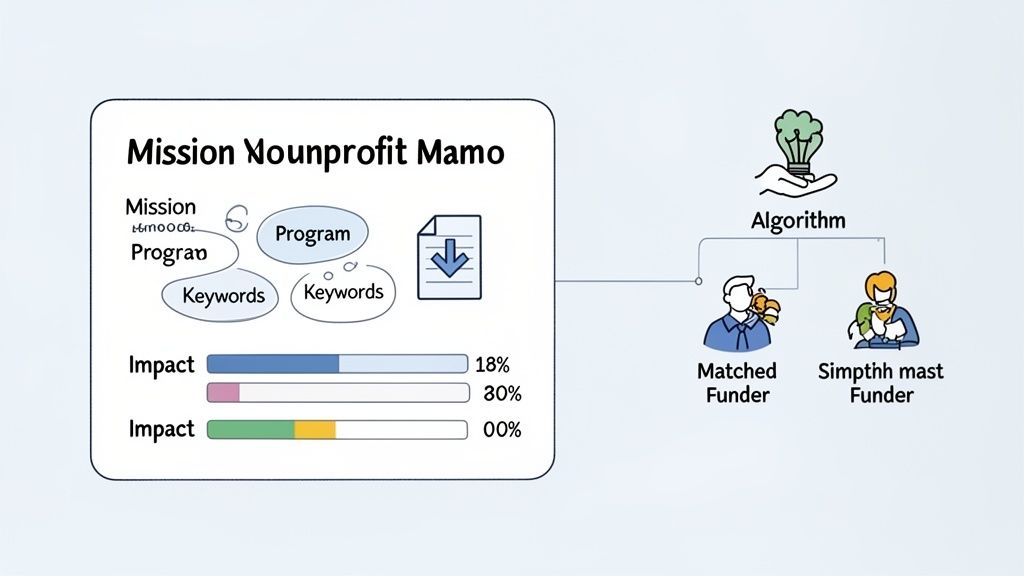
Think of a grant matching platform as a brilliant but very literal research assistant. It's incredibly powerful, but it can only work with the information you give it. Getting the best results starts with building a detailed, compelling, and honest profile for your organization. It's less about filling out a form and more about strategically positioning your nonprofit to attract the right kind of attention.
Your profile is the raw material the platform's algorithm uses to understand who you are, what you do, and who you serve. If your information is vague or incomplete, you'll get generic, low-quality matches in return. A rich, detailed profile, on the other hand, gives the system everything it needs to build a highly relevant pipeline of funding opportunities just for you.
Crafting a Compelling Narrative
First things first: nail your core identity. Those mission and vision statements aren't just for your website's "About Us" page—they are critical data points for any matching algorithm. Clearly articulate your purpose, the specific problem you exist to solve, and the future you're working to create.
Next, get granular about your programs. Don't just list their names; describe what they actually do with precision.
- Who do you serve? Be specific. Instead of "at-risk youth," try "low-income high school students ages 14-18 in the downtown core."
- Where do you work? Define your geographic footprint, from the state or province down to the specific neighborhoods you operate in.
- What are your activities? Detail the services you provide. Think "after-school STEM tutoring" or "job readiness workshops for new immigrants."
This level of detail is what allows a nonprofit grant database matching system to connect you with funders who have a proven track record of supporting initiatives just like yours. A big part of this is making your case effectively. Understanding how to write a persuasive essay can provide a great framework for crafting compelling arguments that resonate with funders.
Speaking the Algorithm's Language
Keywords are the essential bridge connecting your work to a funder’s stated interests. The trick is to use a strategic blend of both broad and highly specific terms throughout your profile.
For example, if you run a food bank, you’d want to use broad terms like "food insecurity" and "hunger relief." But don’t stop there. Get specific with keywords like "mobile food pantry," "nutritional education for seniors," and "urban community gardens."
Your goal is to "speak the language" of potential funders. Brainstorm the various terms a foundation might use to describe the work you do and integrate them naturally into your program descriptions.
Finally, back it all up with concrete proof of your impact. Uploading documents like your annual report, strategic plan, and recent financial statements gives the matching AI more context to work with. Whenever you can, sprinkle in specific data points: "served 800 individuals last year" or "achieved a 92% program graduation rate." This data doesn’t just strengthen your case to a human reviewer; it also helps refine the algorithm, pointing you toward funders who value measurable outcomes.
How to Choose the Right Grant Matching Platform
With so many grant databases out there, picking the right one can feel like a shot in the dark. But let’s be clear: not all platforms are built the same. The best choice for your nonprofit boils down to your specific needs, budget, and the time your team can actually commit. Investing wisely here means looking past the flashy sales pitch to find the features that will genuinely save you time and help you win more grants.
Think of it like choosing a vehicle. A simple, reliable sedan is perfect for a daily commute. But if you’re navigating rough backroads, you’ll need a rugged, off-road truck. It's the same with grant platforms. A small, local nonprofit might do great with a straightforward, curated database. A larger organization with a complex funding strategy, on the other hand, will likely need a powerful, AI-driven system to cut through the noise. It’s all about matching the tool to the job.
Evaluating Core Platform Features
Before you even think about signing a contract, you need to kick the tires on a few essential features. These are the fundamentals that will make or break your experience, turning a platform into either a powerful asset or just another frustrating login.
First and foremost, look hard at the accuracy and relevance of its grant matches. When you’re in a free trial, really pay attention to the quality of the opportunities it serves up. Are they truly a good fit for your mission? Or is it just a long list of vague suggestions based on a few keywords, leaving you to do all the heavy lifting? A good system should deliver high-probability prospects, not just a mountain of maybes.
Another huge factor is the data refresh rate. The grant world moves fast. New opportunities pop up and guidelines change all the time. A platform that only updates its database once a month is basically serving you old news. You need to ask vendors how often they refresh their data. The best ones are doing it daily, so you never miss a deadline or a newly announced grant.
Your evaluation shouldn't just focus on finding grants. The best platforms also provide competitive intelligence, showing you which funders are supporting organizations similar to yours. This insight is invaluable for strategy.
The grant database matching space has some major players, like Instrumentl, GrantStation, and Candid, all designed to help nonprofits navigate the funding maze. Candid's Foundation Directory Online (FDO) is a powerhouse, with millions of profiles on grantmaker histories—perfect for deep-dive research. GrantStation, meanwhile, offers a more curated, affordable option that's often a great fit for smaller nonprofits.
The numbers show just how high the stakes are. U.S. foundations gave away a staggering $103.53 billion in a single recent year, which accounted for 18.6% of all charitable giving. Having the right tool is essential if you want to secure a piece of that pie. You can explore more about these powerful grant tools for nonprofits to see how they stack up.
Key Questions for Your Demo or Trial
To feel confident in your choice, go into any product demo or trial period armed with specific questions. Your goal is to figure out how this platform will actually work for your team, day in and day out.
Here’s a simple checklist to guide you:
- User Interface (UI): Is this thing actually easy to use? Can you and your team find what you need without a week of training?
- Collaboration Tools: Can your whole team work together in the system? Look for features that let you track grants, assign tasks, and keep an eye on deadlines all in one place.
- Customer Support: What happens when you get stuck? Is support just a generic email address, or can you get a real person on the phone or chat quickly?
- Integration Capabilities: Does it play nicely with the other software you already use, like your donor management system?
Picking the right platform is a strategic move that will have a direct impact on your fundraising results. If you focus on match accuracy, data freshness, and simple usability, you’ll find a tool that becomes a true partner in your mission.
Common Questions About Grant Matching
Bringing new technology into the fold can feel like a huge leap, especially when budgets are tight and every hour of your team's time is precious. It's completely normal to have questions about whether a nonprofit grant database matching platform is the right call for your organization.
Let's walk through some of the most common concerns we hear from nonprofit pros. The goal here is to give you straight answers so you can see what these platforms really bring to the table for your fundraising.
Is a Grant Database Subscription Really Worth It for a Small Nonprofit?
For a small nonprofit, the answer is a resounding yes. Think about it: your team's time is your most limited and valuable asset. The old-school approach of digging through countless foundation websites for grants can eat up hundreds of hours with very little to show for it.
A good grant database is an investment in efficiency, pure and simple. The annual subscription fee is often a fraction of the staff salary you'd spend to manually uncover just one or two solid opportunities. Even more importantly, these platforms give you a much better shot at actually winning grants by pinpointing best-fit funders you might have never found on your own.
Don't think of it as just another line item on your budget. See it as a force multiplier for your entire fundraising strategy. The payoff comes from both saving a massive amount of time and bringing in more grant money.
How Is AI-Powered Matching Different from Using Google?
Searching for grants on Google is like trying to find a very specific needle in a global haystack. You'll get millions of hits, but most of them will be useless—outdated, irrelevant, or for funders who are a terrible match for what you do. It’s a classic case of information overload.
AI-powered grant matching is a whole different ballgame. It starts with a clean, curated, and verified set of data from thousands of vetted sources, not the entire wild west of the internet. The AI is built to understand the specific nuances of your nonprofit’s work and the distinct priorities of each funder.
Instead of just matching keywords, it's analyzing context, looking at past funding patterns, and digging into detailed eligibility rules. What you get is a ranked, prioritized list of your most promising opportunities. It’s the difference between a random, frustrating search and a strategic sit-down with a grant research expert who has already done all the legwork for you.
How Much Time Should We Expect to Spend Using a Grant Database?
Your biggest time commitment is right at the beginning. You’ll need to set up a detailed and accurate profile for your organization. Plan on dedicating a few solid hours to this—it’s the single most important step you can take and will pay you back tenfold down the road.
Once your profile is dialed in, the ongoing time you'll spend drops off a cliff. The platform does the heavy lifting, constantly scanning for new opportunities and often sending you daily or weekly digests of fresh, highly relevant matches.
This completely flips the script. Your team's time shifts from tedious searching to the high-value work of strategically vetting excellent matches. Many platforms also come with workflow tools to help you manage deadlines and track tasks, which cuts down the administrative headache even more. The whole point is to free up your team to focus on what matters: building relationships with funders and writing fantastic proposals.
Can These Platforms Help Us Find Grants for General Operating Support?
Yes, and this is easily one of the biggest game-changers of using a sophisticated nonprofit grant database matching system. Grants for general operating support—that wonderfully flexible, unrestricted money that keeps the lights on—are the holy grail for most nonprofits, but they are notoriously hard to find with manual searches.
Advanced platforms make this much easier by letting you filter specifically for "type of support," including "general operating."
But here’s where AI-powered systems really shine. They can identify foundations that have a long history of giving this type of funding, even if they don't explicitly advertise it in their current guidelines. By analyzing years of past awards and funder behavior, the platform can uncover opportunities for core support that would have otherwise been completely invisible.
Ready to stop searching and start matching? Fundsprout’s AI-powered platform delivers a ranked pipeline of your best-fit funders directly to you. Find your perfect funder today.
Try 14 days free
Get started with Fundsprout so you can focus on what really matters.