A Guide to the Different Types of Grants for Nonprofits
Explore the essential types of grants available for nonprofits. Learn to identify and secure the right funding to amplify your organization's impact.


Abdifatah Ali
Co-Founder
If you're new to the world of grants, the sheer variety can feel overwhelming. But here’s the secret: that variety is your biggest asset. A grant is simply a sum of money given by an organization for a specific purpose, and the real work is finding the right type of grant for what you need to accomplish.
Navigating the World of Nonprofit Grant Funding
Think of grants not as a single stream of money, but as different tools designed for different jobs. You wouldn't use a screwdriver to hammer a nail, and you shouldn't use a capital grant application when what you really need is funding for your day-to-day expenses.
Getting this right is what separates struggling organizations from thriving ones. When you match your nonprofit’s needs to a funder’s goals, you stop being just another applicant asking for a handout. You become a potential partner with a shared vision.
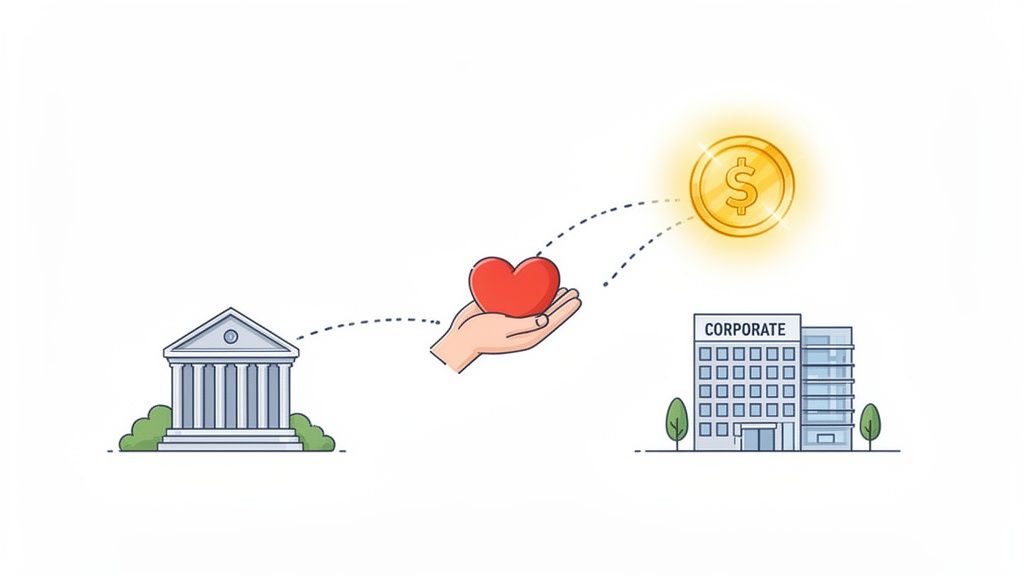
To really get a handle on this, it helps to look at grants through two different lenses: where the money is coming from (funding sources) and what the money is intended for (functional categories).
To give you a quick overview, here’s a simple table that breaks down the main grant categories, who typically provides them, and what they're best used for.
A Quick Guide to Grant Categories
This table is just a starting point. The most successful fundraising strategies often involve combining different types of funding to support a single, cohesive mission.
For instance, a savvy nonprofit might "stack" different grants together. You could secure a capital grant to construct a new community center, a project grant to launch an after-school program inside it, and an operating grant to help pay the salaries of the staff who make it all happen.
This guide will walk you through each of these grant types in more detail. We'll explore the key funding sources and functional categories, helping you spot the right opportunities for your work. We'll also show you how tools like Fundsprout can simplify the search, so you can spend less time hunting and more time making an impact.
Understanding the Three Main Sources of Grants
When you're looking for grant money, it's helpful to know it generally flows from three main places: government agencies, private foundations, and corporations. Think of them as different types of partners for your mission. Each one has its own personality, its own reasons for giving, and its own set of rules.
Getting to know what makes each of them tick is the first real step toward writing a proposal that doesn't just ask for money, but clicks with the funder. When you can frame your work in a way that aligns with their goals, you’re not just another application in the pile—you’re a potential partner. That’s how you unlock the funding that helps you make a real difference.
Government Grants: The Public Investment
Government grants are exactly what they sound like—an investment of public money from federal, state, and local agencies to tackle public needs. These are often the big, hefty grants designed to support programs that line up with specific policy goals, whether it’s in public health, education, or community development.
For instance, a state’s department of health might offer a grant to a nonprofit providing substance abuse counseling, which directly helps the state meet its public health targets. Or, a city government could fund an after-school program run by a community group to boost educational outcomes for local kids.
But with great funding comes great responsibility. Government grants are famous for their tough application processes, strict compliance rules, and incredibly detailed reporting. It’s a ton of administrative work. Because of this, they’re usually a better fit for established organizations that already have the staff and systems in place to handle the paperwork. The American Rescue Plan Act, for example, pushed $350 billion to governments, which then trickled down to communities through programs that required meticulous tracking.
Key Takeaway: Government grants offer powerful funding for proven, large-scale programs, but they demand a rock-solid system for compliance and reporting.
Foundation Grants: The Mission-Driven Partner
Private foundations are nonprofits with a simple, powerful purpose: to give money away in service of a mission. This world is incredibly diverse, ranging from huge national players and community foundations to small, family-run operations. Their driving force is pure philanthropy, which makes them a natural fit for other mission-driven nonprofits.
Here’s the deal with foundations: they often offer a lot more flexibility than the government. They tend to see themselves as partners in your work, not just funders. Many are interested in building genuine, long-term relationships and are often more open to funding innovative new ideas or even providing that coveted general operating support.
- Community Foundations: These are your local experts. They focus on a specific city or region, making them an amazing starting point for local nonprofits.
- Family Foundations: These are guided by the personal passions and values of the family that started them.
- Corporate Foundations: While linked to a parent company, these are their own separate legal entities. Their giving usually aligns with the company's industry or core values.
A fantastic real-world example is the $1.5 million grant iNaturalist recently received from Google.org to improve its species identification AI. It's a perfect partnership where the funder’s tech interests directly fuel the nonprofit’s mission to connect people with nature. This kind of collaboration is what great foundation fundraising is all about.
Corporate Grants: The Strategic Alliance
Corporate grants come straight from a for-profit company’s checkbook, usually as part of their corporate social responsibility (CSR) or marketing plans. This is less about pure philanthropy and more about a strategic alliance. The company supports a cause that reflects well on its brand, resonates with its customers, or aligns with its business interests.
This funding can show up in a few different ways—cash grants are common, but so are event sponsorships or in-kind donations of products and services. Picture a tech company giving free software licenses to a nonprofit, or a local bank sponsoring a community arts festival. The motivation is a blend of doing good and smart business; it builds brand loyalty and keeps employees engaged.
What this means for your proposal is that you need to speak their language. You have to show how a partnership creates value for both of you—advancing your mission while also hitting their strategic goals.
Trying to make sense of all these sources, especially the notoriously complex world of government funding, can feel like a full-time job. Federal grants alone make up a massive slice of the pie, accounting for 40% of government funding sources for applicants. With agencies like the Department of Health & Human Services distributing 29% of all federal grant funding, the opportunities are huge, but they can be incredibly hard to find and win.
For nonprofits ready to dive deeper, our guide on securing federal grants for nonprofits is a great next step and provides a more detailed roadmap.
12 Types of Grants to Fuel Your Nonprofit's Mission
Knowing who gives out grant money is a great start, but the real magic happens when you understand how you're allowed to use it. Think of the different grant types as specialized fuel for your nonprofit's engine—each is formulated to power a specific part of your mission.
Matching your organization's immediate needs to the right kind of grant is the secret to building a truly sustainable funding strategy. It's about getting the right tool for the right job.
The funding landscape is generally broken down into three main sources, as this chart shows. These are the entities that provide all the functional grant types we’re about to dive into.
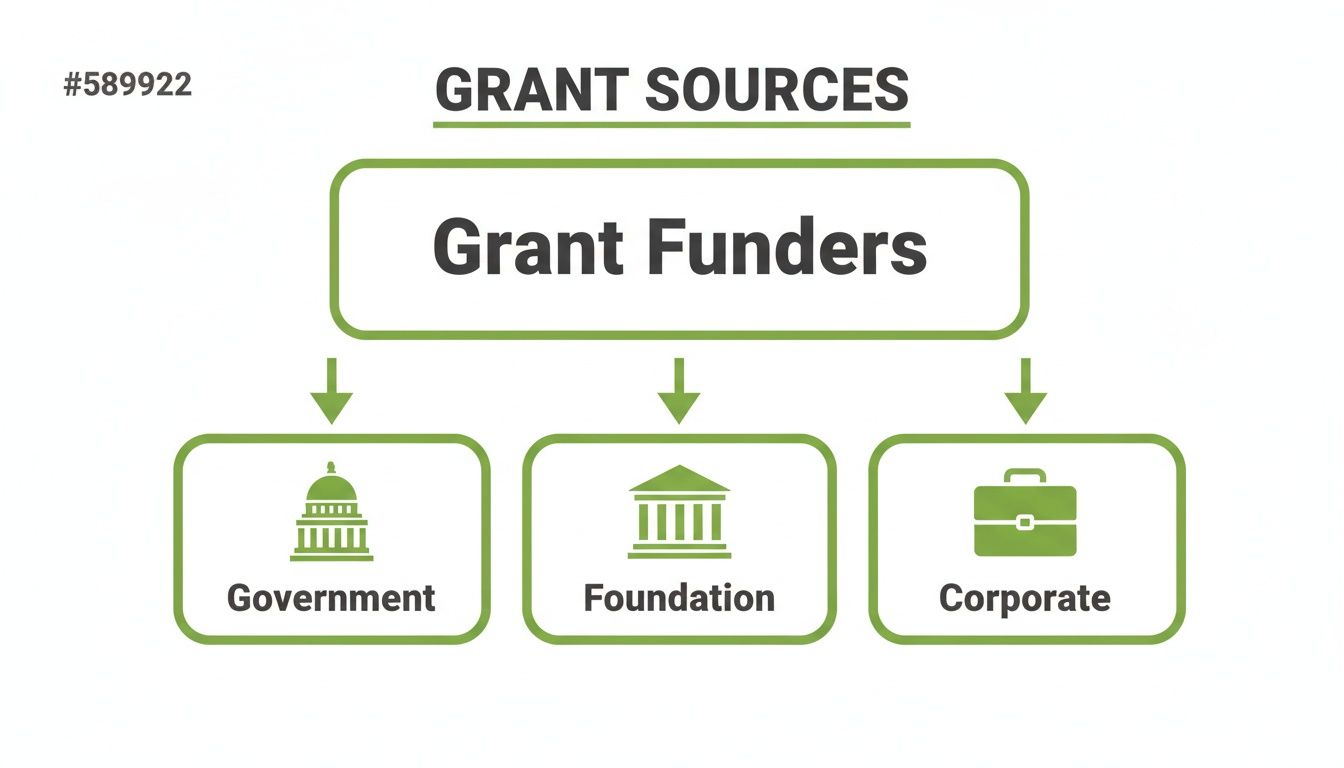
With those sources in mind, let's get into the nitty-gritty of what that money can actually be used for.
1. Operating Support Grants: The Flexible Fuel
Ask any seasoned nonprofit leader what they wish they had more of, and you'll likely hear "general operating support." These grants are often called the "holy grail" of fundraising, and for good reason.
This is flexible, unrestricted funding meant to cover the essential, day-to-day costs of simply existing—things like salaries, rent, utilities, and administrative expenses. It’s the money that keeps the lights on and the core mission running.
Because they are so flexible, these grants are incredibly competitive. A funder providing operating support isn't just backing a single program; they are placing immense trust in your leadership, vision, and financial management. They're investing in your organization as a whole.
2. Project Grants: Funding for Specific Initiatives
By far the most common type of funding you'll encounter are project or program grants. This money is restricted, meaning it can only be used for a specific initiative with a clearly defined scope, timeline, and budget.
For instance, an animal shelter might get a project grant to run a "Seniors for Seniors" adoption event, covering the costs of reduced adoption fees for older pets, marketing, and staff time for that specific weekend. Success isn't measured by the shelter's overall budget, but by the direct outcomes of that single project—how many senior pets found homes.
3. Capital Grants: Building for the Future
When your organization needs to make a major, one-time investment in its physical assets, you'll be looking for a capital grant. This is funding for big-ticket, "brick-and-mortar" expenses that build your nonprofit's long-term infrastructure.
Common uses for capital grants include:
- Construction: Building a brand-new facility or adding an expansion.
- Renovation: Making significant upgrades or repairs to an existing building.
- Equipment: Purchasing major items, like a new refrigerated truck for a food bank or new computers for a community tech lab.
Capital campaigns are massive undertakings, but they provide the physical foundation your nonprofit needs to expand its services and serve the community for years to come.
4. Capacity-Building Grants: Strengthening From Within
Capacity-building grants are a strategic investment in your organization's internal health and effectiveness. Instead of funding your external programs, this money strengthens your operational core—your management, systems, and governance.
Think of it as an investment in making your organization smarter, stronger, and more efficient.
These grants recognize that a strong infrastructure is essential for long-term impact. The funder is helping you build a more durable and resilient organization that can better achieve its mission over time.
A capacity-building grant might pay for a new donor management system, leadership training for your executive team, or hiring a consultant to develop a three-year strategic plan. You can learn more about how funders approach this kind of support in our deep dive into foundation grants for nonprofit organizations.
5. Seed Grants: The Venture Capital of Nonprofits
Also known as innovation grants, seed grants are the venture capital of the social sector. They provide the start-up cash needed to test a brand-new idea or launch a pilot program.
These grants are for bold experiments that have the potential for high impact but also carry a higher risk of not panning out. Funders who offer seed money are looking for groundbreaking solutions and are comfortable with the uncertainty. Securing a seed grant can provide the crucial proof-of-concept you need to attract larger, more sustained funding down the road.
Understanding How Grants Are Awarded
It’s not enough to know the different flavors of grants. You also have to get a feel for how they’re actually handed out. The way a funder awards money can completely change your application strategy and what you should expect from the relationship.
After all, not every grant is won with a beautifully written story. Some are simply doled out based on data. Understanding these distribution models is key to deciding where to invest your nonprofit’s precious time and resources—it’s about playing the right game with the right set of rules.
Competitive Grants Versus Formula Grants
When most people think of grant writing, they’re picturing competitive grants. This is the classic scenario: a group of organizations all vying for the same pot of money. You submit your best proposal, and the funder picks the strongest applicants based on merit, mission alignment, and potential impact. It’s a true competition where the best application wins.
Then you have formula grants, which take that direct competition out of the equation. These are funds allocated by a government agency—usually to states or local governments—based on a predetermined statistical formula. Things like population, per capita income, or local unemployment rates dictate how much money a region gets.
A great example is the federal Community Development Block Grant program. Funding is often sent to cities based on a formula. That city might then run its own competitive process for local nonprofits to apply for a piece of that funding, but the initial pot of money wasn't won—it was allocated by a set rule.
Continuation and Renewal Grants
A continuation grant, sometimes called a renewal grant, is funding for the next phase of a multi-year project. Think of it as a reward for a job well done. If you’ve managed your grant well, hit your targets, and submitted clear and timely reports, the funder might invite you to apply for more funding without making you go through the full competitive gauntlet again.
Securing continuation funding is a massive vote of confidence. It signals that the funder trusts your organization and sees real value in its investment. This is precisely why great grant management isn't just about paperwork; it's the key to building stable, long-term funding relationships.
Matching Grants and In-Kind Support
Two other important award types are designed to amplify your efforts, though they don't always come as a straightforward check.
Matching Grants: With a matching grant, a funder promises to donate a certain amount, but only if you can raise a corresponding sum from other people. A foundation might offer to match every dollar you raise from individual donors up to $25,000, which instantly doubles your fundraising power and creates a sense of urgency for your supporters.
In-Kind Grants: These grants provide valuable goods or services instead of cash. An in-kind grant could be a tech company giving you free software licenses, a law firm offering pro bono legal help, or an office supply company donating new furniture. These contributions free up cash you would have otherwise spent, letting you channel your financial resources where they’re needed most.
Understanding these different award mechanisms is crucial for building a diverse and resilient funding plan. You might be chasing a competitive project grant for a new program while also benefiting from a formula grant that supports your entire region. Learning how to strategically combine these opportunities is the hallmark of a savvy nonprofit.
If you're ready to start sorting through the possibilities, our guide on how to find winnable grants can help you zero in on the opportunities that are the best fit for your organization.
Winning Grant Strategies in the Real World
Knowing the different types of grants is just the start. The real magic happens when you learn how to make them work together. Let's look at how successful nonprofits move beyond one-off applications and strategically stack grants to build a strong, diverse financial base for their work.
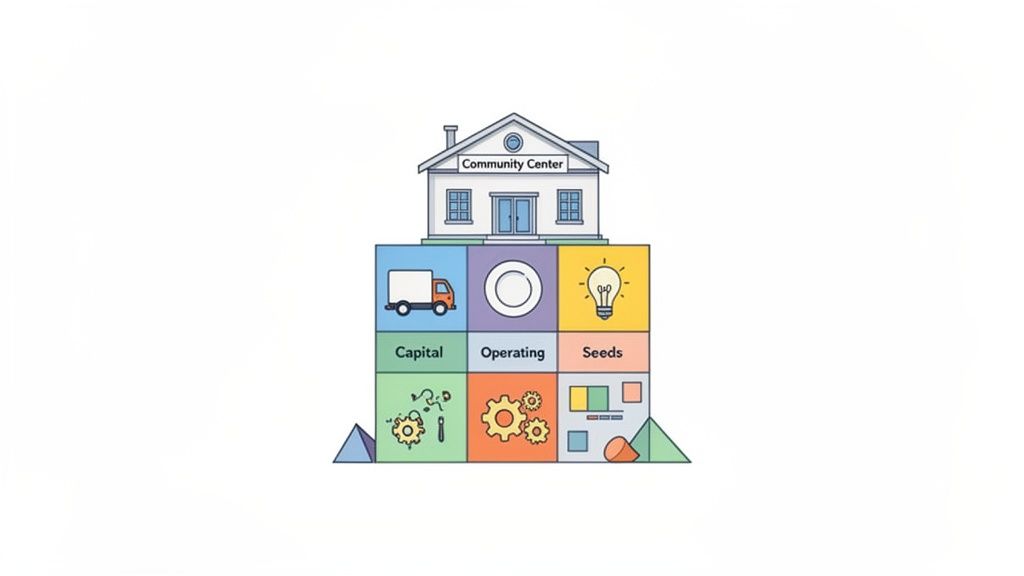
Think of it as building a house. You don't just use one type of material. You have a foundation, a frame, and a roof. In the nonprofit world, this "grant stacking" allows you to fund your long-term vision, specific programs, and day-to-day survival all at the same time.
The Food Bank: Stacking Grants for Growth
Imagine a local food bank that's outgrowing its current capacity. Instead of hunting for a single, massive grant to cover everything, they get strategic with a multi-pronged approach:
- The Capital Grant: First, they go after a large, one-time capital grant from a regional foundation to buy a new, bigger refrigerated truck. This is a game-changer, letting them rescue and deliver far more fresh food than before.
- The Project Grant: At the same time, they land a project grant from a corporate partner to launch their "Weekend Backpack" program. This restricted funding is specifically for the food, bags, and volunteer supplies needed to get meals to kids.
- The Operating Grant: Finally, a local community foundation provides an unrestricted operating grant. This is the flexible money that keeps the lights on—literally. It pays the warehouse rent, utility bills, and the salary of their volunteer coordinator, the essential costs that make all their programs possible.
The Youth Arts Group: Seeding and Scaling an Idea
Here's another common scenario. A small youth arts organization has a brilliant new idea for a digital media workshop for local teens. They're too new to qualify for a big federal grant, so they start smaller and build momentum.
Their first win is a seed grant from a local innovation fund. This initial funding is just enough to run a pilot workshop, gather powerful testimonials, and collect data showing how the program helps students build new skills.
With a successful pilot under their belt, they suddenly have proof that their idea works. This evidence makes them a much stronger, more compelling applicant for bigger grants down the road.
Armed with this success story, they apply for and win a larger continuation grant from a foundation that focuses on youth arts. This multi-year funding allows them to formalize the curriculum, hire a dedicated instructor, and double the number of teens they can serve.
Finding the Right Mix with Corporate Grants
While corporate giving makes up a smaller slice of the philanthropic pie (around 3% of total giving), it accounts for a significant 17% of all non-governmental grants. This funding can be unpredictable and often tied to the economy, but it also offers huge opportunities, especially if your work is in an emerging field like sustainable agriculture or social innovation. In fact, corporate funding has poured into climate-focused sectors like the circular economy.
Of course, your success with any funder often comes down to how well you tell your story. Investing time in learning the art of writing effective business proposals can make a huge difference in crafting grant requests that get noticed.
This is where platforms like Fundsprout come in, helping you find that ideal mix of opportunities—from federal block grants to local foundation support—all in one place. By filtering for the specific grant types you need, whether it's for capital, operations, or a specific project, you can build a layered funding strategy that helps your mission not just survive, but truly thrive.
Build Your Sustainable Funding Strategy
Knowing the difference between an operating grant and a capital grant is one thing. Turning that knowledge into a durable financial future for your nonprofit is another challenge entirely. A strong funding strategy isn’t built on luck or even just good writing—it’s about methodically finding the right blend of opportunities that truly fit your mission.
Think of it like building a balanced portfolio. Relying on a single grant type is risky. A truly resilient nonprofit strategically layers its funding. You might secure a capital grant for a new facility, then win a project grant for a specific program inside it, all while attracting operating support to keep the lights on and pay the incredible staff who make it all happen. This kind of diversification is what helps you weather any storm.
Of course, juggling all those moving parts by hand is a monumental task. The time spent digging for opportunities, tweaking proposals, and tracking deadlines across federal, foundation, and corporate funders can burn out even the most dedicated team. This is exactly the problem that modern grant-seeking platforms like Fundsprout were built to solve.
Turning Knowledge into Action
Imagine shifting your grant process from a constant, reactive scramble to a proactive, strategic operation. An AI-powered platform can become your central command center, automating the most grueling parts of the grant-seeking cycle. It starts by giving you back hundreds of hours, automatically scanning thousands of new grant opportunities every single day.
Fundsprout delivers a ranked pipeline of federal, state, and foundation grants that are a great fit for your nonprofit's specific work, location, and budget. That means you spend less time hunting and more time connecting with funders and telling your story. From there, the platform's tools can help you quickly break down RFP requirements, generate solid first drafts of your proposal, and manage every deadline with total clarity.
By automating discovery and simplifying proposal creation, you give your nonprofit the power to compete for a much wider range of grants. This system allows even small organizations to punch well above their weight, turning what you know about grant types into a steady, reliable funding pipeline.
Foundation grants, in particular, remain a critical piece of this puzzle. They often offer more flexibility than government agencies and can be much quicker to respond. And while overall charitable giving has had a hard time keeping up with inflation, collective giving movements have seen incredible growth, mobilizing over $3.1 billion from 2017 to 2023 in the U.S. alone. This trend shows a real shift in philanthropy, with huge funding flowing into areas like health research, climate change, and urban development. You can explore more about these philanthropic shifts and what they mean for nonprofits.
A Partnership for Long-Term Success
At the end of the day, a winning grant strategy is about more than just cashing the next check. It's about building a system that fuels your mission for years to come. That means not only finding the right types of grants but also managing them effectively from the moment you apply through your final report and renewal.
With the right tools, you can move past just knowing the definitions of operating, project, and capital grants. You can start actively pursuing the perfect mix of them for your organization. Fundsprout can be an essential partner in that journey, giving your team the intel and efficiency needed to transform grant-seeking from a constant headache into a core strength. That’s how you build a truly sustainable future.
Frequently Asked Questions About Grant Types
As you get deeper into the world of grants, you’re bound to have questions. It's a complex field, but with a little guidance, you can build a funding strategy that truly works. Here are our answers to some of the questions we hear most often from nonprofit leaders.
What Is the Easiest Grant for a New Nonprofit to Get?
This is a great question, and one we hear all the time. From what we've seen, the best place for new nonprofits to start is right in their own community. Focus on local community foundations and the giving programs of small, local businesses.
Why? Because these funders are already invested in the area you serve. They're often far more willing to take a chance on a new organization than a huge federal agency that demands years of financial history and a mountain of paperwork.
Think of it this way: starting local helps you build relationships and get a few wins under your belt. These early successes become powerful proof points when you decide to go after those bigger, more competitive grants down the road.
Key Insight: Local funders want to see a tangible impact on the community they call home. When you focus your efforts on your own backyard, your mission lines up perfectly with theirs, making you a much more compelling partner.
Can I Apply for Multiple Types of Grants at the Same Time?
Not only can you, but you absolutely should! A healthy fundraising strategy is a diverse one. Putting all your hopes on a single grant type is a risky game. Pursuing a smart mix of project funding, operating support, and maybe even a capital grant is the sign of a resilient organization.
But there’s a big catch: you must tailor every single application. Sending out a generic, copy-pasted proposal is the quickest path to the rejection pile. Each application has to feel like it was written specifically for that funder, speaking directly to their mission and following their unique rules for that grant category.
What Is the Difference Between a Grant and a Donation?
The key difference really comes down to accountability and the strings attached.
- A grant is a formal award of money to achieve a specific, pre-approved purpose. It comes with a formal application, a legal agreement, and strict reporting requirements to show how you spent the funds and what you accomplished.
- A donation is a more straightforward charitable gift, usually with few or no restrictions. While a major donor might express a wish for how their gift is used, it rarely involves the formal, legally-binding process of a grant.
A simple way to think about it is that a grant is like a formal contract to do specific work, while a donation is a gift to help you carry out your mission as a whole.
Ready to stop spending hundreds of hours searching for the right grants? Fundsprout uses AI to automatically find relevant federal, state, and foundation opportunities and helps you write compelling proposals faster. Discover your perfect funding mix at https://www.fundsprout.ai.
Try 14 days free
Get started with Fundsprout so you can focus on what really matters.