Master Training Grant Writing for Nonprofits
Build a powerful internal grant writing team for nonprofits. Get step-by-step guidance on training grant writing, from curriculum design to AI integration.

Abdifatah Ali
Co-Founder
The most popular advice on training grant writing is also the least useful for small nonprofits. It usually boils down to two options. Send someone to a formal course and hope they come back ready, or hire a specialist you can barely afford and let the rest of the staff stay disengaged from fundraising.
That binary breaks down in real organizations.
Most community nonprofits don't have the luxury of a dedicated grants department. Program managers hold the impact data. Finance owns the budget logic. Executive directors know the strategy and relationships. Development staff, if they exist, are already overloaded. Treating grant writing as a specialized craft that lives with one person is exactly how teams stay fragile.
A stronger model is to train the people already closest to the work, then give them systems that reduce the technical burden. That is where training grant writing needs to go. Not toward longer theory-heavy instruction, but toward practical internal capacity, shared process, and AI-supported execution.
Rethinking Your Approach to Grant Writing Training
Traditional grant training often assumes the trainee is already a writer. That's a bad assumption for small nonprofits. In many organizations, the people touching grants are executive directors, program leads, operations staff, or a development generalist who learned by necessity.
That gap matters. Existing training content largely focuses on grant basics but misses how non-writers in small nonprofits can self-train with AI tools. A 2025 Nonprofit Tech for Good survey found 62% of small nonprofits said untrained staff were their top barrier to funding success, while AI adoption for grant tasks surged by 45% according to UTA's overview of professional grant writing training.
The old model says training happens first and tools come later. In practice, that slows people down. Staff sit through broad instruction, then return to a desk full of deadlines and blank pages. Skills don't stick because the training wasn't attached to live work.
A better approach starts with the work itself. Staff learn prospecting while reviewing real opportunities. They learn narrative structure while building a real outline. They learn compliance by using actual submission checklists and reporting calendars. AI doesn't replace judgment in that process. It removes friction so judgment can improve faster.
Practical rule: If your training requires staff to leave their real grant workload behind, it probably won't change performance for long.
That doesn't mean fundamentals no longer matter. They do. Teams still need to understand funder fit, outcomes, budgets, and evidence. But they don't need to master everything in a classroom before they can contribute. They need a supervised workflow, clear quality standards, and tools that shorten the distance between "I don't know how to write this" and "I can produce a usable draft."
For nonprofits trying to build a grant function without hiring a full-time specialist, the challenge isn't just writing. It's the overall difficulty of grant writing, including research, coordination, compliance, and revision. Training has to reflect that reality.
The nonprofits that get traction usually stop asking, "Who is our grant writer?" and start asking, "How do we build a grant writing system that several people can run?"
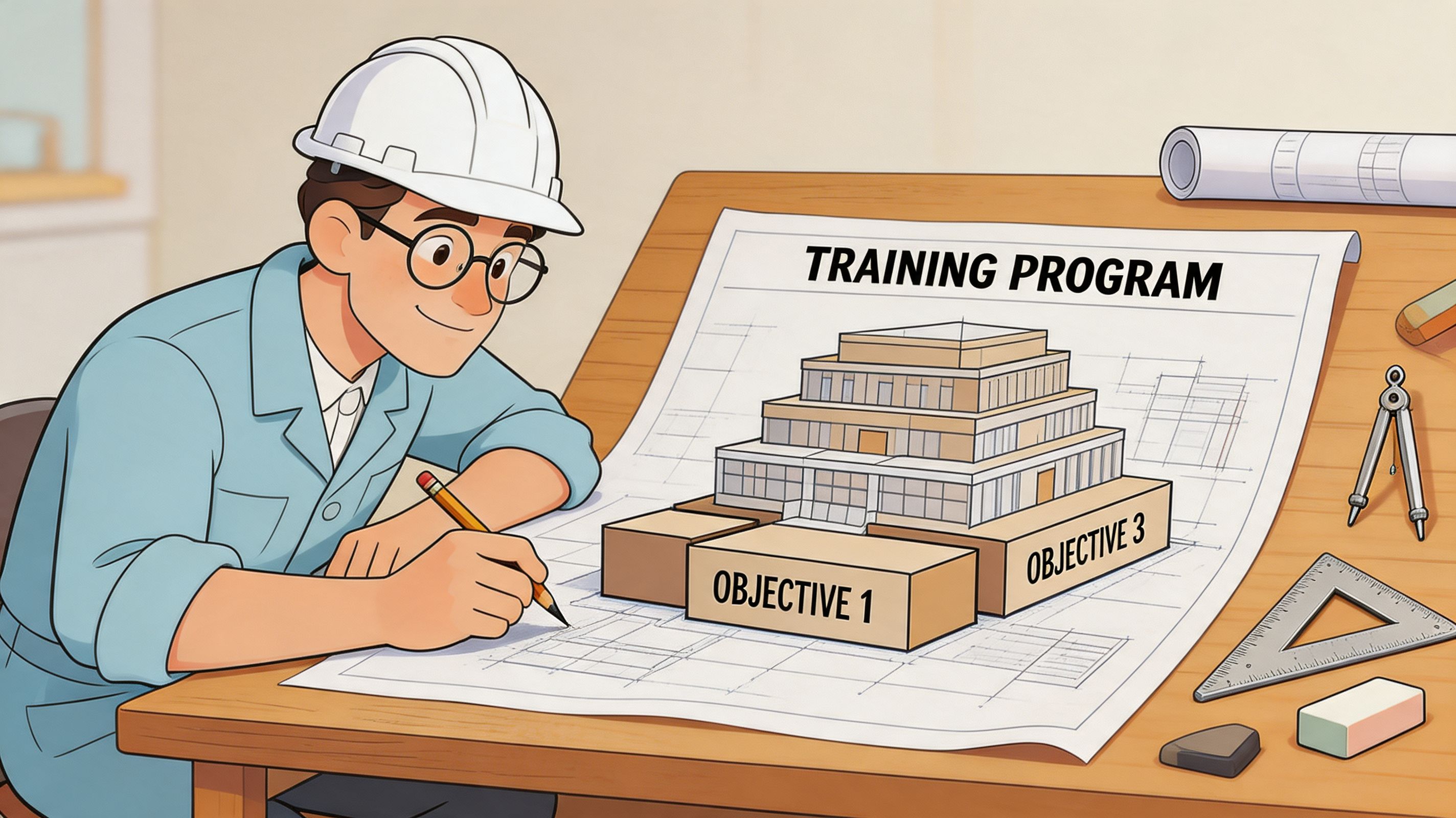
Designing Your Program Foundation and Objectives
Most failed grant training programs don't fail because the curriculum is weak. They fail because nobody defined what the team is being trained to do.
If the goal is "win more grants," staff will hear pressure, not direction. A useful training plan names the work, the constraints, and the expected behaviors before anyone starts drafting.
Grant writing takes real labor. Foundation grants typically require 15 to 20 hours, federal grants exceed 100 hours, and the average success rate is just 10% according to Instrumentl's grant statistics and trends roundup. The same source notes that 61% of nonprofits rely on only one or two people for grant work. Those conditions shape your training program whether you acknowledge them or not.
Start with operational objectives
Good training grant writing programs set objectives in operational language, not inspirational language.
Use targets like these:
- Opportunity screening: Staff can determine whether a grant is worth pursuing before the team spends hours drafting.
- Narrative contribution: Program staff can provide usable inputs for needs statements, activities, outcomes, and implementation plans.
- Budget coordination: Finance and program leads can build a grant budget that aligns with the narrative and funder rules.
- Submission discipline: A designated owner can manage deadlines, attachments, approvals, and final packaging without scrambling.
- Post-submission follow-through: The team can document what was submitted and what needs to happen next.
Those aren't abstract competencies. They're daily work.
Define roles before content
I've seen organizations send three staff members to grant training and still get nowhere because each person came back assuming someone else owned the process. Training only sticks when roles are visible.
A simple role map helps:
| Role | Primary training focus | Common risk |
|---|---|---|
| Executive director | Fit, strategy, funder relationship, final approvals | Becoming a bottleneck |
| Program manager | Need, activities, outputs, outcomes, evidence | Writing in service language instead of funder language |
| Finance lead | Budget, cost logic, reporting feasibility | Joining too late |
| Development staff or coordinator | Research, assembly, calendar, submission management | Carrying the entire proposal alone |
Many small nonprofits require stricter internal processes for grant writing. The executive director should not be writing every draft. The program manager should not be pulled in only after the narrative is complete. Finance should not review the budget the day before submission.
Teams don't burn out only because grants are hard. They burn out because the work arrives late, scattered, and ownerless.
Choose learning benchmarks you can observe
You don't need elaborate theory to set learning benchmarks. You need signs that the team is becoming more capable and less chaotic.
Use a short list:
- Can staff explain why a funder is a fit?
- Can they pull the right organizational data without hunting through old files?
- Can they convert program knowledge into funder-ready language?
- Can they follow a checklist and catch missing attachments early?
- Can they hand off work cleanly between departments?
Those questions reveal training progress faster than waiting for a funding decision.
A short training video can help align the team before the first work session:
Build for sustainability, not intensity
Many nonprofits overdesign the kickoff and underdesign the routine. A sustainable program has a repeatable meeting cadence, shared files, standard prompts for program input, and one place where deadlines live.
That foundation matters more than squeezing in more content. Staff can learn grant writing over time. They can't learn inside chaos.
Crafting a High-Impact Training Curriculum
A strong curriculum doesn't try to turn everyone into a career grant writer. It teaches staff how to contribute high-quality work at the right points in the grant lifecycle.
The best model for internal training remains surprisingly traditional. The Grantsmanship Training Program has trained over 150,000 graduates who collectively secured billions in funding, and its framework emphasizes research, funder perspective, measurable outcomes, and organizational capacity according to the Grantsmanship Training Program overview. That structure still works. What changes today is how teams practice it and how fast they can apply it with AI support.
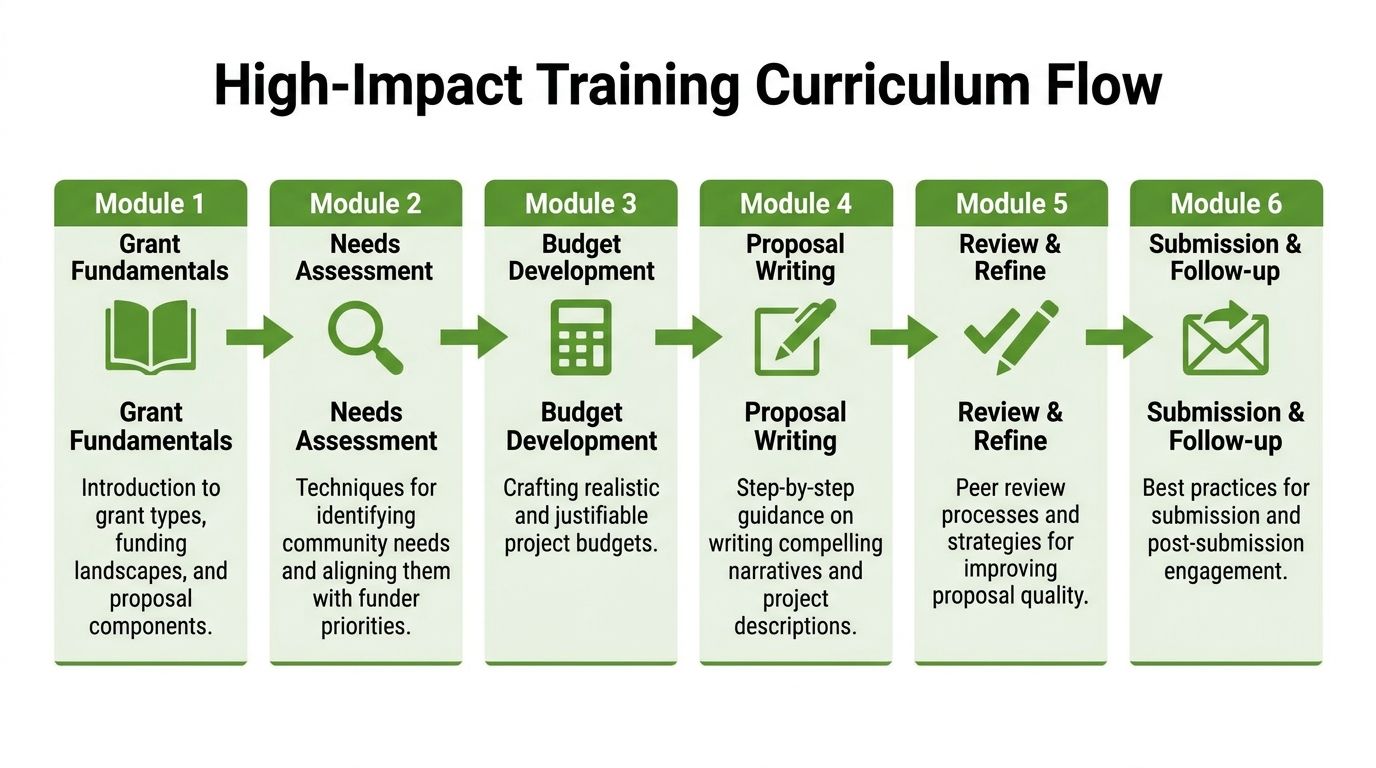
Module one and two build the base
Start with grant fundamentals and needs assessment, but keep both grounded in your own organization.
In the first module, staff should learn the difference between foundation, government, and local opportunities; what a proposal package usually includes; and how funders read for alignment. Don't overteach vocabulary. Teach recognition. Staff need to spot required attachments, page limits, allowable costs, eligibility flags, and evaluation criteria.
The second module should focus on turning internal knowledge into case-making material. Program staff often know the problem well but describe it in ways funders can't easily score. Train them to answer a few questions cleanly:
- Who is served?
- What problem is being addressed?
- Why now?
- What evidence does the organization already have?
- What result is realistic to promise?
This is also where curated outside references can help sharpen judgment. I often recommend reading Documind's expert funding strategies alongside internal discussions, because practical strategy examples help newer staff distinguish between generic writing and persuasive positioning.
The best early training exercise isn't writing a full proposal. It's rewriting a vague program description until a funder could understand it in one read.
Module three and four turn knowledge into draftable material
The next phase is budget development and proposal writing. Most training programs underplay how connected these two are.
A budget isn't a spreadsheet you fill out after the narrative is finished. It's the financial expression of the project plan. If your training separates the two, staff will produce proposals that sound ambitious and budgets that don't support the work.
Use budget training to teach:
- Activity-to-cost alignment: Every major activity should have a visible cost logic.
- Reasonable staffing assumptions: Staff time should reflect who will perform the work.
- Match awareness: Teams must flag when a funder expects cost share or complementary support.
- Narrative consistency: The numbers, timeline, and staffing model need to agree with the story.
Then move into writing. In the writing process, AI becomes useful if it's handled correctly. Teams can learn faster when they use tools to analyze requirements, generate structured outlines, and draft early language that staff then revise for accuracy and voice. A practical primer on AI for grant writing can help teams understand where automation supports thinking and where human review remains essential.
Module five and six create discipline
Most internal teams stop training after the first draft. That's a mistake. The difference between amateur and dependable grant work often shows up in review and refinement, then in submission and follow-up.
Use the review module to assign different readers different jobs:
| Reviewer | What to check |
|---|---|
| Program lead | Accuracy of services, timeline, and outcomes |
| Finance lead | Budget math, cost categories, and feasibility |
| Executive director | Strategic fit and institutional credibility |
| Submission owner | Instructions, attachments, formatting, and deadlines |
That division prevents one person from trying to catch everything.
In the final module, train people on packaging. They should know how to assemble attachments, track approvals, label versions, confirm final uploads, and record what was submitted. This sounds administrative because it is. And weak administration kills strong proposals all the time.
A high-impact curriculum doesn't just teach persuasive writing. It teaches staff how to produce a complete, credible, and compliant application as a team.
Using Real Proposals as Training Exercises
The fastest way to improve training grant writing is to stop treating practice as hypothetical. Use a real proposal.
Not your biggest federal application. Not the deadline that's due tomorrow. Pick a real opportunity with manageable complexity, clear guidelines, and a timeline that allows teaching and revision. That becomes the team's training lab.
I usually recommend choosing a grant that matters, but won't destabilize the organization if the first attempt falls short. That creates urgency without panic.
Run the first exercise like a project kickoff
Bring the team together with the actual notice, guidelines, and required attachments. The first session shouldn't start with writing. It should start with dissection.
Ask the group to identify:
- What the funder is funding
- Who is eligible
- What outcomes the funder appears to care about
- What documents or data your organization already has
- What is still missing
A requirement analysis tool can save hours and teach pattern recognition at the same time. Instead of asking junior staff to read a long application packet and somehow infer priorities, use structured analysis to pull out deadlines, scoring criteria, required sections, and missing inputs.
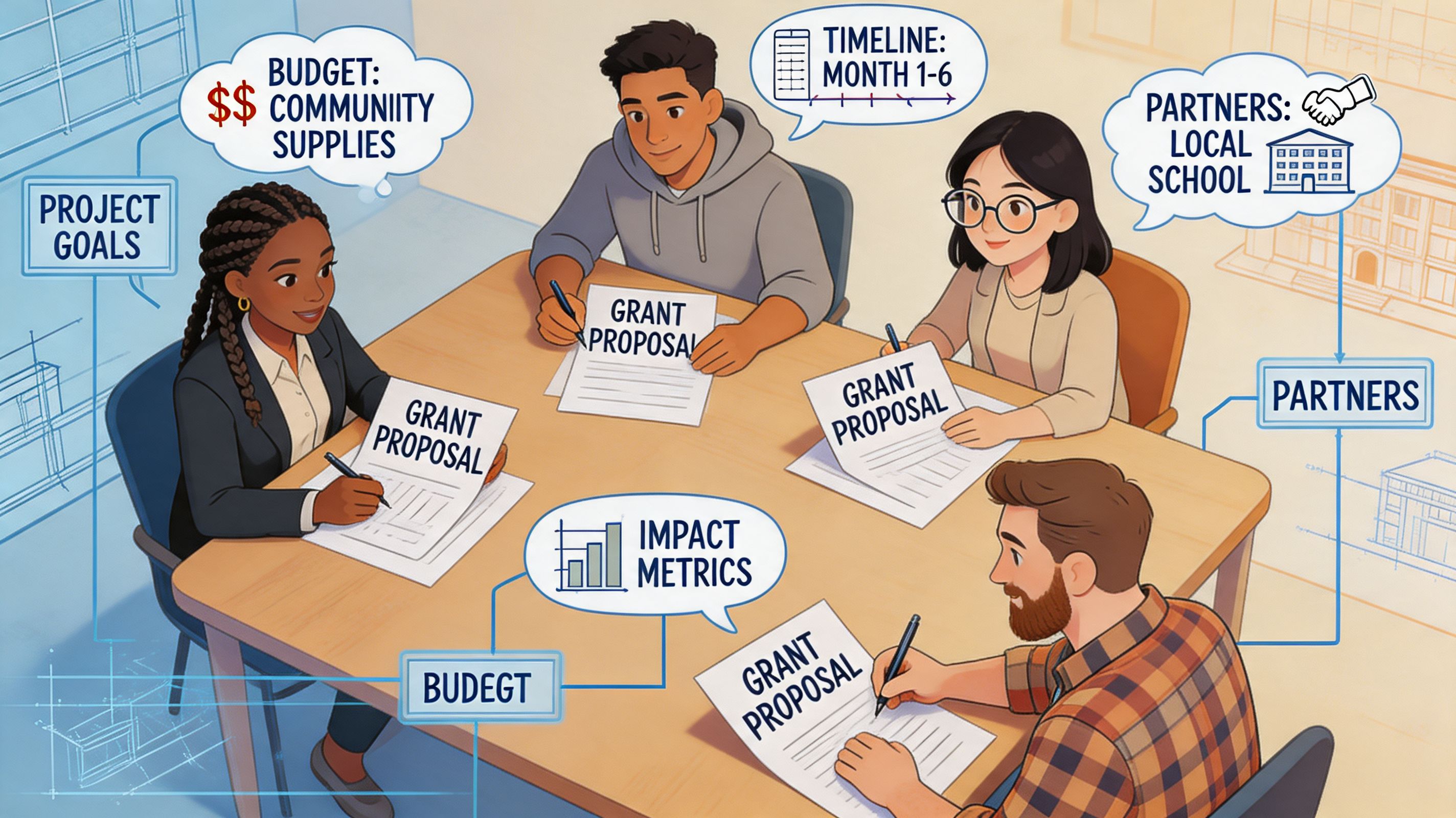
A useful companion for this exercise is a strong grant proposal example, especially when newer staff need to see how raw requirements turn into a coherent narrative.
Split the work by section, not by seniority
Teams often make a bad call. They hand the hardest sections to the most experienced person and assign lighter admin tasks to everyone else. That protects the deadline, but it doesn't build capacity.
A better training exercise assigns sections based on what each role knows best.
For example:
| Proposal section | Best first drafter |
|---|---|
| Need statement | Program lead with data support |
| Organization background | Executive director or senior staff |
| Methods or activities | Program manager |
| Budget narrative | Finance with program review |
| Evaluation approach | Program plus whoever tracks outcomes |
| Attachments checklist | Operations or development coordinator |
Then use peer review deliberately. Have each trainee read a section they didn't write and answer three questions: Is it clear? Is it supported? Does it answer the prompt?
If someone outside the program team can't follow the section, a reviewer probably won't either.
Turn revision into the real lesson
Most learning happens in revision. That's where staff discover the gap between what they meant and what they wrote.
A practical training sequence looks like this:
Draft from source material
Staff pull from program notes, prior reports, budgets, and guidelines.Compare the draft against the prompt
Every paragraph should earn its place by answering a requirement.Tighten unsupported claims
Remove vague promises and replace them with what the organization can credibly deliver.Check cross-document consistency
Timeline, staffing, outputs, and budget need to match.Document reusable language
Save improved descriptions, capacity statements, and program summaries for future proposals.
That last step matters. A live proposal should leave behind assets. Training isn't just about one submission. It's about creating reusable institutional language, better internal prompts, and stronger habits.
Debrief after submission, not just after award
When the proposal goes out, hold one more meeting. Not a celebration meeting. A process review.
Discuss what took too long, what information was hard to get, what sections required the most rewriting, and what should be prepared before the next application. That's how a team stops relearning the same lessons.
Real proposals expose weakness quickly. That's why they're such good teachers.
Assessing Progress Beyond the Win Rate
A lot of nonprofit leaders judge grant training too early and too crudely. They ask one question: did we win?
That's understandable, but it's not how serious teams evaluate improvement. Grant outcomes depend on funder priorities, applicant pool strength, relationship history, geography, and grant type. A funded proposal is a useful result. It is not the only sign that training worked.
According to analysis on evaluating grant writer performance, performance has to be assessed with more nuance than raw win rate. That includes segmenting submissions by funder type and using context-sensitive benchmarks. The same source notes that training grants reached a 46% success rate in one large application set, which is a reminder that some opportunities are less competitive than others.
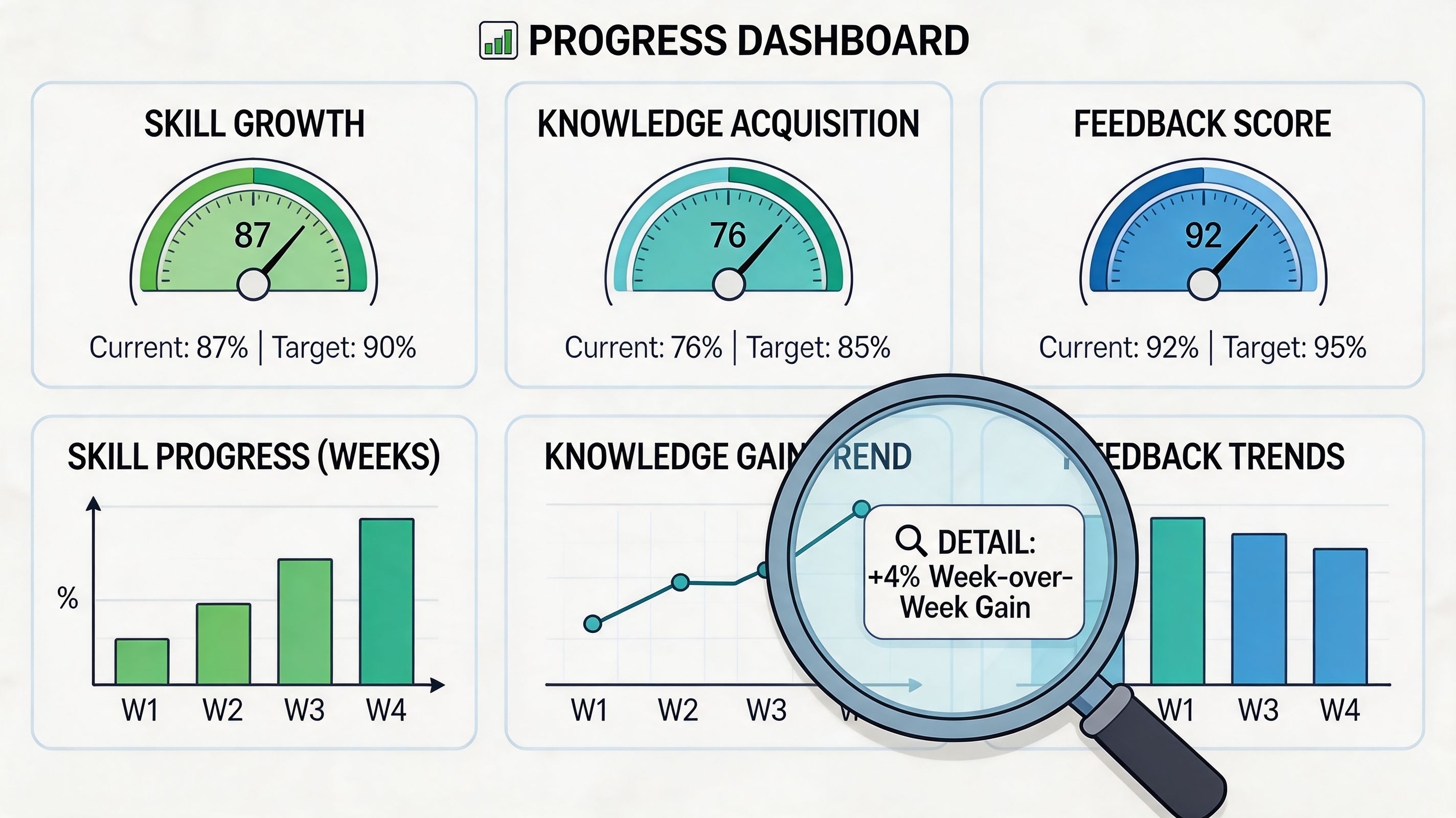
Track competencies you can coach
If you're building internal capacity, you need to know whether staff are getting better at the actual work. Use a simple rubric and score people on observable behaviors.
A practical rubric might include:
Funder fit judgment
Can the trainee explain why an opportunity aligns with the program and why it may not?Requirement interpretation
Can they identify what the application is asking for without skipping key details?Narrative clarity
Do they write plainly, answer the prompt, and avoid filler?Evidence use
Do they support claims with organizational data and program knowledge appropriately?Cross-functional coordination
Can they get what they need from programs, finance, and leadership without losing momentum?
This kind of assessment makes weak spots visible. It also gives supervisors something more useful than "write better."
Measure process improvement separately
A team can improve dramatically before seeing a funding win. If your internal process is cleaner, your grant function is stronger even before awards show up.
Track process signals like these:
| Process area | What improvement looks like |
|---|---|
| Prospect review | Fewer poor-fit opportunities move into drafting |
| First drafts | Sections arrive earlier and need fewer structural rewrites |
| Data gathering | Staff know where to find outcomes, budgets, and attachments |
| Reviews | Comments focus on strategy, not missing basics |
| Submission prep | Fewer last-minute scrambles |
Those are meaningful gains because they compound. Better process gives the team more shots at well-matched opportunities.
A rejection after a disciplined, well-matched submission teaches more than a win on a soft opportunity your team didn't really understand.
Compare like with like
One more rule matters. Don't compare all grants together.
A renewal is different from a new relationship. A local foundation is different from a federal competition. A capacity-building request is different from a large implementation proposal. If you collapse them into one number, you hide what your team is learning.
Training grant writing becomes measurable when you look at proposal quality, readiness, and operational discipline. Funding wins still matter. They just aren't the only scoreboard.
Facilitating Training and Sustaining Momentum
Training falls apart when the facilitator treats it like a workshop instead of a management system. A team might finish a few sessions energized, then drift right back into reactive grant chasing because nobody changed how the work gets owned.
The facilitator's real job is to build rhythm. That means regular review meetings, standard templates, deadlines that begin before the funder's deadline, and explicit expectations for who supplies what. Good facilitation isn't motivational. It's operational.
Keep sessions active and role-based
Adults learn grant work best when they can apply it immediately. So don't lecture for an hour about need statements if the program manager still hasn't produced the basic service description you need. Use live materials and make each person work from their own role.
A few facilitation habits work well:
- Use short working sessions: Keep training connected to active proposals or prospect review.
- Assign deliverables between meetings: Each session should end with a concrete output due from each role.
- Review drafts in layers: Discuss fit first, then structure, then language. Don't start by line-editing.
- Rotate ownership where possible: Let different staff lead screening, outlining, and checklist review so the process doesn't stay trapped with one person.
This is especially important in small nonprofits, where one strong grants person often becomes the unofficial translator for everyone else. That may keep things moving for a while, but it doesn't create resilience.
Build post-award management into the training
Many teams treat award management as separate from grant training. That's a serious mistake.
Post-award grant management is a critical training gap, and 35% of grants are lost at renewal because of poor tracking, according to Parris Foundation's discussion of grant writing training. Small organizations are hit harder because the same people writing grants are often also delivering programs and handling reporting.
That means training has to cover what happens after the award notice arrives:
- Store the final submitted package so reporting staff know what was promised.
- Create a milestone calendar for reports, spending checkpoints, and renewal preparation.
- Assign compliance ownership across program, finance, and leadership.
- Track deliverables and changes so no one is reconstructing history at renewal time.
- Capture reusable reporting language for future proposals and continuation requests.
Renewal success often depends less on persuasive writing than on whether the organization can prove it did what it said it would do.
Sustain the system after the formal training ends
Momentum doesn't come from enthusiasm. It comes from repetition with feedback.
A sustainable internal grant function usually includes:
| System element | Why it matters |
|---|---|
| Grants calendar | Prevents deadline surprises and late-stage panic |
| Standard intake form | Pulls consistent program information from staff |
| Shared language bank | Speeds up future proposals and improves consistency |
| Review checklist | Reduces avoidable compliance mistakes |
| Post-award file structure | Makes reports and renewals easier to manage |
The facilitator should also run periodic reviews of both submitted and declined proposals. Not to assign blame. To identify where the process slipped, where fit was weak, and what the team can tighten next time.
If you want training to last, tie it to the full funding lifecycle. Writing is only one phase. The organizations that build durable grant capacity train for follow-through too.
Building Your Nonprofit's Funding Future
Small nonprofits don't need more abstract advice about grants. They need a workable way to build internal capacity without waiting until they can afford a dedicated specialist.
That's why training grant writing has to be rethought as a team function. The strongest approach combines a clear operating foundation, role-based curriculum, live proposal practice, realistic assessment, and post-award discipline. When those pieces are in place, staff stop treating grants like mysterious one-off events and start handling them as a repeatable organizational process.
The shift matters beyond fundraising.
When program staff can explain outcomes clearly, finance can budget in sync with delivery, and leadership can judge fit before the team chases an opportunity, the whole organization gets sharper. Grant readiness becomes operational readiness. Training improves not just proposals, but coordination, documentation, and strategic clarity.
AI changes the pace of that learning. It doesn't remove the need for judgment, ethics, or review. It does remove a lot of the wasted effort that has traditionally kept smaller teams from building confidence. That makes internal capacity more realistic than it used to be.
If you're leading a nonprofit with limited staff, don't wait for the perfect hire or the perfect course. Start by choosing one real opportunity, assigning clear roles, and building one repeatable workflow your team can improve over time.
That is how a grant function gets built. Not all at once, and not by one heroic writer. By training the people already carrying the mission, then giving them a system strong enough to support the work.
If you're ready to turn this approach into a repeatable grants system, Fundsprout can help your team find aligned opportunities, organize application requirements, draft stronger proposals, and stay on top of reporting and renewals. It's built for mission-driven nonprofits that need more capacity without adding more chaos.
Try 14 days free
Get started with Fundsprout so you can focus on what really matters.