7 Grant proposal example You Should Know
Discover the top 7 grant proposal example strategies and tips. Complete guide with actionable insights.

Abdifatah Ali
Co-Founder
Crafting a compelling grant proposal can feel like navigating a maze without a map. You know your organization's mission is vital, but translating that passion into a funder-ready document presents a significant challenge. The right structure, tone, and data can make the difference between a rejection letter and a secured grant, yet starting with a blank page is often the most difficult part. This is where a strong grant proposal example becomes an indispensable tool.
This curated list moves beyond generic advice to provide a strategic breakdown of what works and why. We have compiled a collection of high-quality grant proposal examples and templates from trusted sources across the web. Each entry is designed to give you a clear, actionable blueprint for building your own successful application.
You will find a diverse range of resources, from federally funded research applications to foundation-focused narrative templates. For each resource, we provide:
- A direct link to the grant proposal example or template.
- A strategic analysis of its strengths and key components.
- Actionable takeaways you can apply immediately to your writing process.
- Screenshots to guide you through the document's structure.
Our goal is to equip you with the insights and tools needed to move from concept to submission with confidence. By studying these successful examples, you can learn to articulate your project's value, present a clear budget, and meet the specific expectations of funders. Let’s dive into the examples that can help you secure the funding your mission deserves.
1. Fundsprout
Fundsprout positions itself not merely as a database of examples but as an end-to-end grant success platform. It stands out by integrating the entire grant lifecycle, from discovering opportunities to drafting proposals and managing compliance, all powered by AI. This comprehensive approach makes it an invaluable resource for organizations seeking not just a static grant proposal example, but an active, intelligent system for creating their own winning applications.
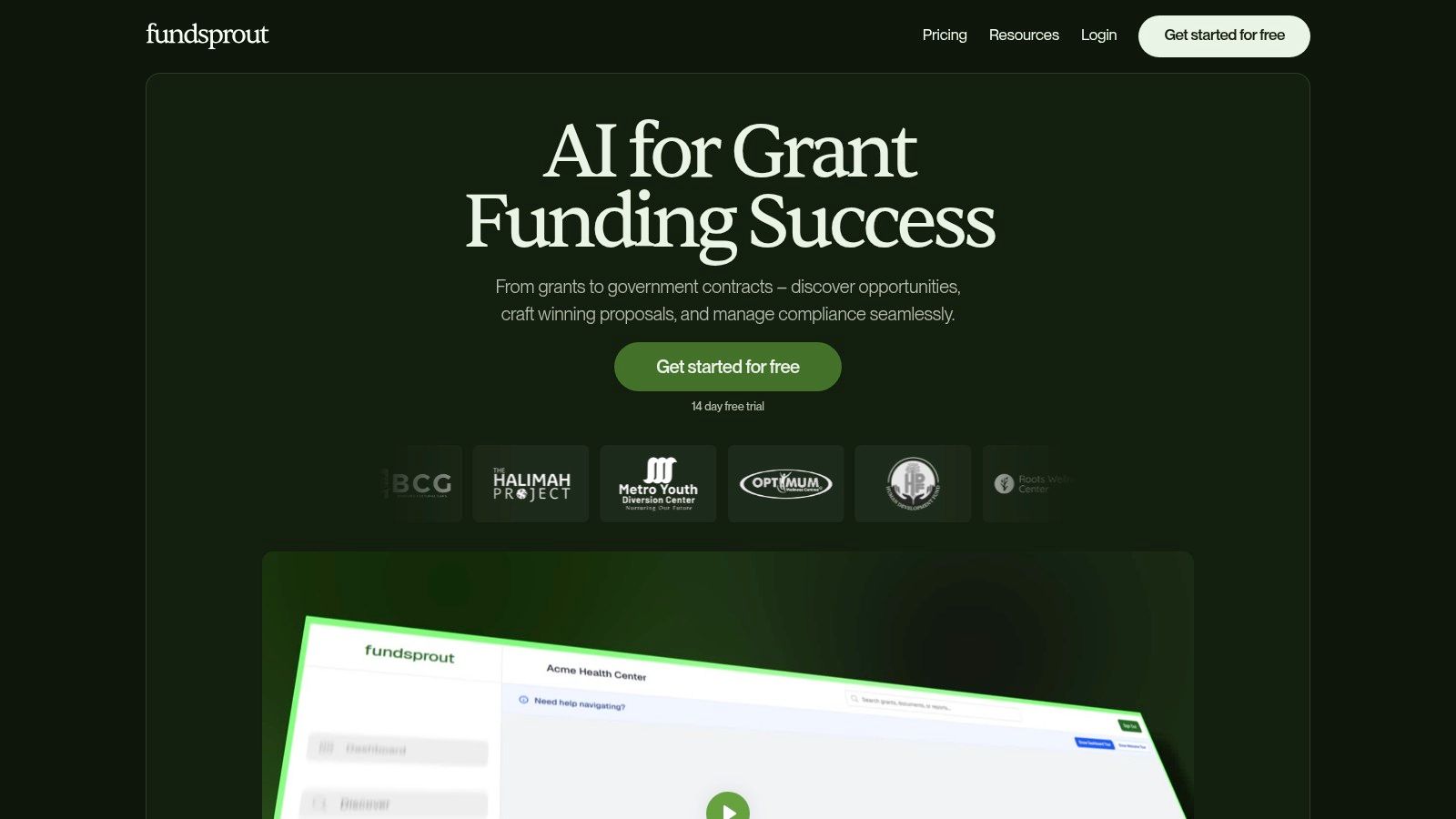
The platform is designed to alleviate the most significant pain points for small to medium-sized nonprofits, particularly those without a dedicated grant writer. By automating the tedious aspects of grant seeking, Fundsprout allows teams to focus their energy on program delivery and strategic planning rather than administrative legwork. Its ability to scan over 275,000 funding sources daily and deliver a curated, high-fit pipeline is a game-changer for resource-strapped organizations.
Key Strengths & Strategic Advantages
Fundsprout’s core value lies in its AI-driven drafting and workflow automation, which transforms how organizations approach grant writing. Its features are engineered to maximize efficiency and success rates.
- AI-Powered Drafting in Your Voice: The DraftAI assistant is a standout feature. It moves beyond generic templates by analyzing your organization's uploaded documents, past proposals, and impact data to generate narrative sections that reflect your unique voice and mission. This ensures authenticity and consistency, critical elements for building funder trust.
- Intelligent RFP Analysis: The platform's RFP analyzer deconstructs complex funder requirements and converts them into a structured outline. This tool eliminates the risk of missing critical information and provides a clear, compliant roadmap before the writing even begins, saving hours of manual review.
- End-to-End Workflow Management: From discovery to renewal, Fundsprout creates a unified system. It tracks deadlines, auto-populates funder templates, and maintains a complete audit trail for reporting. This streamlined process not only improves efficiency but also strengthens an organization's capacity for successful grant renewals.
Strategic Takeaway: The platform’s greatest advantage is its ability to make small teams operate with the capacity of a full grants department. By automating prospecting, drafting, and compliance, it empowers organizations to pursue more funding opportunities with a higher likelihood of success.
Who is Fundsprout For?
This platform is ideally suited for executive directors, development teams, and program managers at community organizations and small nonprofits. It is particularly beneficial for teams that lack a dedicated grant writer, as it provides the structure and automation needed to manage a competitive grant-seeking program. Testimonials highlight its ability to cut drafting time from days to hours, a significant efficiency gain that resonates with this audience.
Platform Breakdown
Access and Pricing
Fundsprout offers a free get-started option and a 14-day free trial, allowing users to explore its core functionalities without an immediate financial commitment. However, detailed pricing for its tiered plans is not publicly available on the website, requiring potential customers to contact the sales team for a quote. This lack of transparency may be a hurdle for some organizations.
Visit the website: https://www.fundsprout.ai
2. Candid Learning — Sample Documents Library
Candid Learning (formerly Foundation Center) offers one of the most respected free resources available for grant seekers: its Sample Documents Library. This isn't just a collection of templates; it's a curated database of real, funded proposals, letters of inquiry (LOIs), and budgets submitted by actual U.S. nonprofits. For anyone looking for an authentic grant proposal example, this is a top-tier destination.
What makes this library exceptionally valuable is the inclusion of funder critiques and annotations on many of the samples. This feature provides a rare "behind-the-curtain" view, showing you exactly which sections resonated with reviewers and why. It moves beyond theory and into the practical reality of what gets a proposal moved to the "yes" pile.
Why It Stands Out
Candid’s library excels by providing complete, contextualized examples. Instead of isolated sections, you can download full proposal packets that were successfully funded. This allows you to see the entire narrative arc, from the cover letter and executive summary to the detailed budget and appendices. It’s an invaluable tool for benchmarking your own proposal's tone, scope, and structure against proven successes.
The platform is entirely free to access, requiring no subscription or paywall. The user interface is straightforward, allowing you to filter documents by type (e.g., proposal, budget, letter of inquiry) to quickly find relevant examples.
Deep Dive: Analysis & Actionable Takeaways
Pros & Cons Snapshot:
- Authentic, funded examples from U.S. nonprofits.
- Includes rare funder critiques and decision-maker notes.
- Offers complete document sets (proposals, budgets, LOIs).
- Completely free to access.
- The collection is extensive but not exhaustive; some niche sectors may be underrepresented.
- It is not a fill-in-the-blank tool and requires you to adapt the strategies to your own organization's needs.
Website: Candid Learning Sample Documents Library
3. Smartsheet — Free Grant Proposal & Budget Templates
While real-life examples provide context, sometimes you need a solid structural foundation to start building your own narrative. Smartsheet’s collection of Free Grant Proposal & Budget Templates offers a practical toolkit designed to streamline the entire grant lifecycle, from initial drafting to post-award management. This resource provides a comprehensive library of downloadable, fully editable templates for proposals, budgets, and tracking.
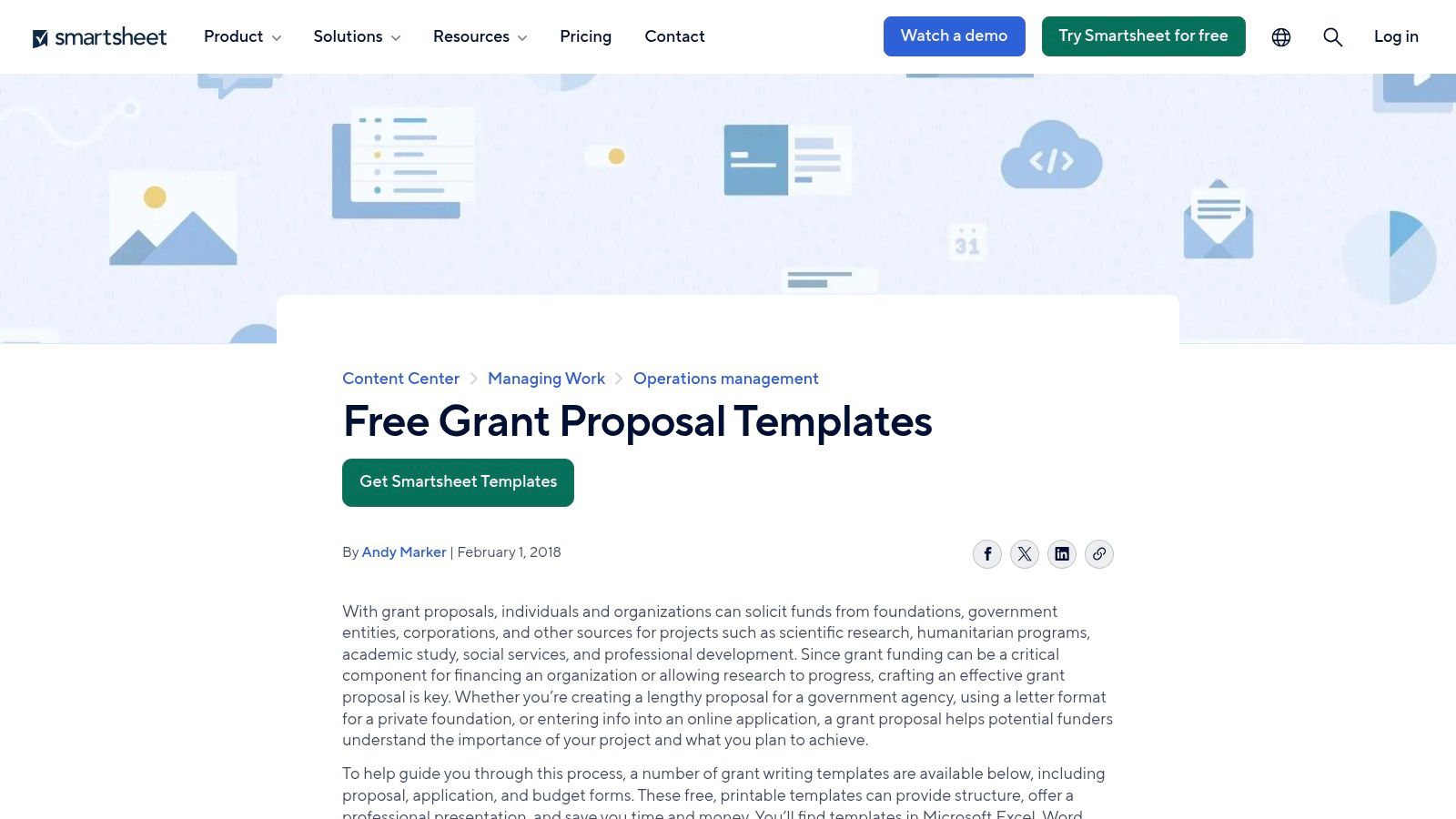
What sets Smartsheet apart is its focus on the operational side of grant management. Beyond just a narrative template, it provides the complementary tools needed to execute a grant successfully. You can find templates for grant tracking pipelines, budget revisions, and progress reporting, making it a valuable hub for organizations looking to standardize their processes.
Why It Stands Out
Smartsheet excels by providing an integrated set of tools that address the entire grant-seeking process. The templates are available in common formats like Microsoft Word, Excel, and Google Sheets, ensuring maximum accessibility and ease of use for any team. This practical approach saves significant time, especially when constructing complex budgets or managing multiple grant application deadlines.
Most of the core proposal and budget templates are completely free to download and use without a Smartsheet account. While some of the more advanced project management and pipeline templates are designed for the Smartsheet platform (requiring a trial), the essential documents are readily available. This makes it an excellent resource for any nonprofit seeking a strong grant proposal example or a reliable budget framework.
Deep Dive: Analysis & Actionable Takeaways
Pros & Cons Snapshot:
- Broad library covers narrative, budgets, and post-award tracking.
- Ready-made budget templates with formulas reduce errors and save time.
- Templates are available in common, easily editable formats.
- Many essential templates are free and require no account.
- Templates are generic and must be heavily tailored to each specific funder's guidelines.
- Some advanced management template sets are gated behind a 30-day Smartsheet software trial.
Website: Smartsheet Free Grant Proposal Templates
4. PandaDoc - Online Grant Proposal Template
PandaDoc’s online grant proposal template provides nonprofits with a pre structured web based editor that guides users through every critical section - need statement, goals and objectives, methodology, evaluation, and budget justification. You begin with sample language prompts, then customize the content to match your mission voice. A free PandaDoc account unlocks basic templates; advanced collaboration and analytics require a paid subscription.
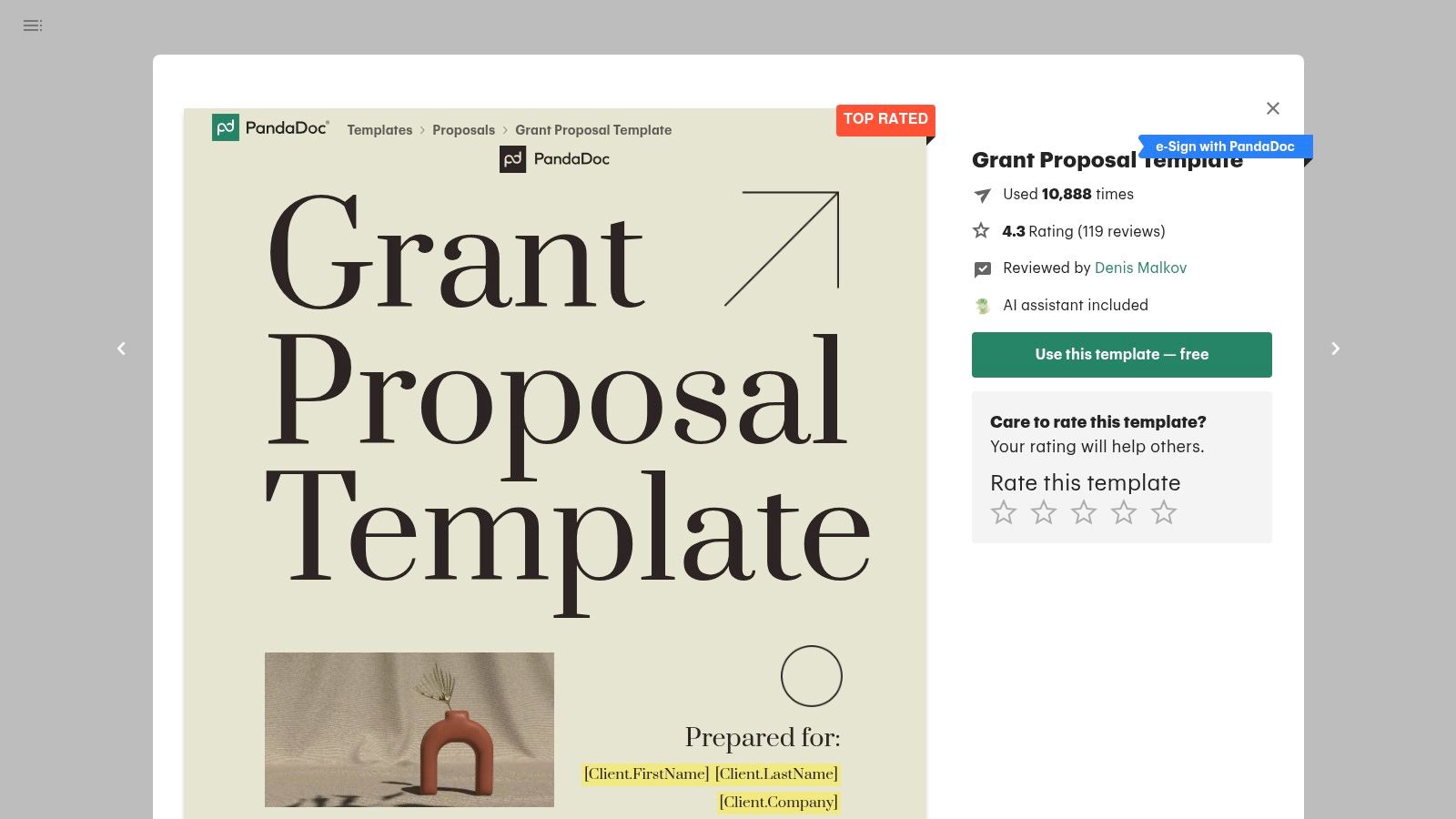
Once inside the editor, teams appreciate the intuitive interface and drag and drop elements that simplify formatting. Real time commenting, change tracking, and version history keep your team aligned. Customer support via chat and a comprehensive knowledge base ensure any questions are answered. When ready, you can send the finalized proposal for e signature directly from PandaDoc, removing the need for external tools.
Why It Stands Out
PandaDoc stands out by uniting narrative development, workflow automation, and e signature in one cohesive environment. Instead of assembling disparate docs and tools, you work within a single platform that handles drafting, collaboration, approvals, and delivery. The addition of usage and rating indicators helps you pick the most successful template structures, backed by community feedback and performance data.
Deep Dive: Analysis & Actionable Takeaways
Pros & Cons Snapshot:
- Speeds first draft with guided section prompts.
- Consolidates editing, approvals, and e signature.
- Free account available, with paid upgrades for advanced features.
- Generic structure means heavy customization needed.
- Core features require a PandaDoc account; some functions are paid.
- Limited sector-specific examples compared to dedicated document libraries.
Website: https://www.pandadoc.com/grant-proposal-template/
5. Etsy — Grant Proposal Templates Marketplace
For organizations needing a structured starting point without a significant budget, the e-commerce marketplace Etsy offers a surprisingly large collection of grant proposal templates and toolkits. While not a traditional resource like a foundation library, Etsy provides hundreds of low-cost, instant-download materials created by independent designers, consultants, and nonprofit professionals. This makes it an accessible first step for finding a grant proposal example.
What makes Etsy a unique option is the sheer variety and modern design of its offerings. Sellers provide templates in editable formats like Word, Google Docs, and even Canva, allowing for easy customization. These are not funded proposals but frameworks designed to guide you through the writing process with section prompts, sample copy, and organizational tools like grant trackers and calendars.
Why It Stands Out
Etsy excels by offering affordable and visually organized templates for those who are new to grant writing or feel overwhelmed by a blank page. Instead of a single, formal style, you can find dozens of different layouts and approaches, allowing you to choose one that best fits your organization's voice and the specific project you're funding.
The products are delivered digitally and are typically very inexpensive, often under $10. The platform's built-in seller ratings and customer reviews provide a layer of quality control, helping you select a well-regarded template before purchasing. When exploring the variety of templates available on marketplaces like Etsy, an Etsy product listings scraper can assist in efficiently analyzing current offerings and trends for grant proposals.
Deep Dive: Analysis & Actionable Takeaways
Pros & Cons Snapshot:
- Extremely affordable, making it accessible for any budget.
- Instant digital delivery in multiple editable formats (Word, Canva, etc.).
- Wide variety of styles and bundled toolkits available.
- Seller ratings and reviews help in choosing a quality product.
- Quality and accuracy can vary significantly between sellers.
- These are generic templates, not real funded proposals, and won't match the strict forms of federal or large foundation grants.
- Requires significant customization to be effective.
Website: Etsy Grant Proposal Template Marketplace
6. NIH/NIAID — Sample Funded Grant Applications and Summary Statements
For organizations in the scientific and medical research fields, the National Institutes of Health (NIH) and its National Institute of Allergy and Infectious Diseases (NIAID) provide the gold standard of grant proposal examples. Their repository features dozens of real, funded grant applications alongside the corresponding summary statements from the peer-review process. This resource is an absolute necessity for anyone navigating the complex world of federal research funding.
What elevates this collection is the direct pairing of the application with its official summary statement. This gives applicants an unparalleled look into the peer review process, showing not only what a successful proposal looks like but also how reviewers evaluated its strengths and weaknesses. It demystifies the scoring criteria and highlights the specific elements that lead to a fundable score.
Why It Stands Out
The NIAID library stands out for its specificity and authority in the biomedical research sector. While other resources offer general nonprofit examples, this one provides high-fidelity models for a range of NIH funding mechanisms, including R01, R21, K-series awards, and SBIR/STTR grants. It’s an inside look at what succeeds at one of the world's largest public funders of biomedical research.
Access to this invaluable resource is completely free and requires no login. The website is structured to help users find applications relevant to their specific grant mechanism. This targeted approach saves immense time for researchers and grant writers who need a precise grant proposal example that matches their highly technical and structured application requirements.
Deep Dive: Analysis & Actionable Takeaways
Pros & Cons Snapshot:
- Provides gold-standard models of funded NIH applications.
- Includes invaluable peer-reviewer summary statements.
- Covers a wide range of complex grant mechanisms.
- Extremely instructive for health/research nonprofits, universities, and hospitals.
- Highly specialized and less relevant for general nonprofit program grants.
- NIH formats and requirements evolve; some older samples may not reflect the latest rules.
Website: NIH/NIAID Sample Applications
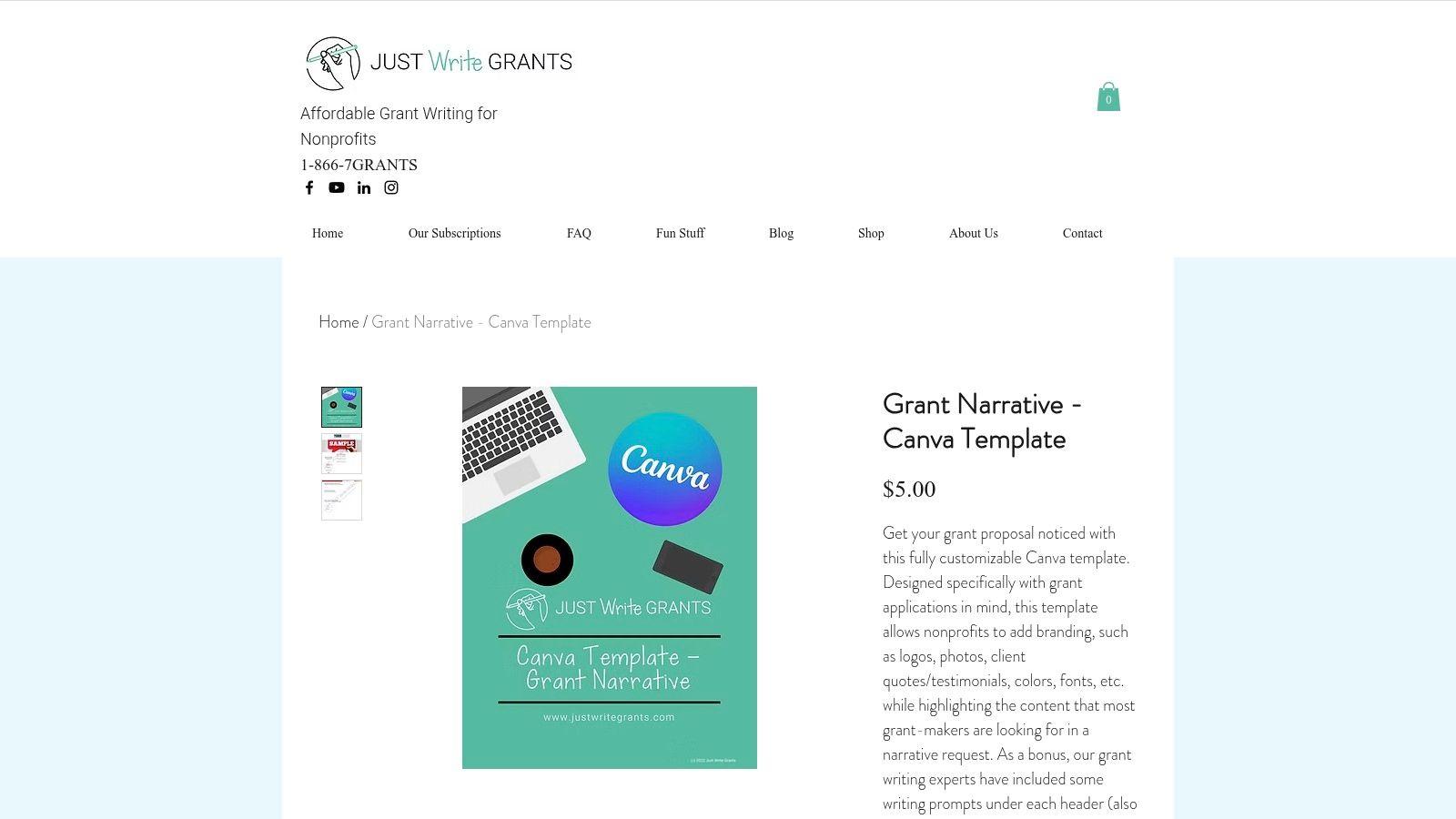
7. Just Write Grants – Grant Narrative Canva Template
Just Write Grants offers a nonprofit-specific grant narrative template built in Canva for storytelling with impact. Priced at just $5.00, this purpose-built template includes guided prompts to help small teams craft a polished narrative without breaking the bank. It works seamlessly on free or paid Canva accounts and includes step-by-step instructions to download and customize within minutes.
Why It Stands Out
Unlike generic layouts, this Canva template is written to match funder expectations for narrative uploads. The included prompts under each header guide writers to focus on problem statements, objectives, and evaluation methods without starting from a blank page. Custom branding options let you upload logos, adjust colors, and set fonts so your narrative mirrors your nonprofit’s existing style guide. The intuitive interface and responsive customer support ensure that teams with limited design skills can deploy the template without frustration. For design hacks and advanced layout techniques, you can also utilize Canva more effectively.
Deep Dive: Analysis & Actionable Takeaways
Pros & Cons Snapshot:
- Practical, branded narrative template ready in minutes
- One-time inexpensive purchase at $5.00
- Fully customizable in Canva, works on free or paid accounts
- Not suitable for strict portal-based submissions like Grants.gov
- Digital sale is final; confirm it fits your needs before purchase
- Requires a basic understanding of the Canva interface
Website: https://www.justwritegrants.com/product-page/grant-narrative-canva-template
7-Point Comparison of Grant Proposal Examples
Final Thoughts
Navigating the world of grant proposals can often feel like piecing together a complex puzzle. You have a powerful mission, a clear need, and a dedicated team, but translating that into a compelling, funder-ready document is the ultimate challenge. Throughout this guide, we've deconstructed several diverse grant proposal example resources, moving beyond mere templates to uncover the strategic architecture that makes a proposal successful.
From the comprehensive, data-backed federal applications found in the NIH/NIAID library to the visually engaging narratives crafted with Just Write Grants' Canva templates, a clear pattern emerges: the most effective proposals are not just well-written, they are meticulously structured, deeply researched, and authentically aligned with both the funder’s priorities and the organization's unique voice.
Key Takeaways from Our Grant Proposal Example Analysis
As you move from studying examples to crafting your own application, keep these core principles at the forefront:
- Clarity is King: Every section, from the executive summary to the budget narrative, must be clear, concise, and easy for reviewers to digest. The Candid Learning examples repeatedly show how straightforward language outperforms jargon.
- Data-Driven Storytelling: A compelling narrative backed by solid data is unstoppable. Your proposal must weave a story of impact while providing the quantitative evidence (statistics, program metrics, community data) to prove its credibility. The best grant proposal example files demonstrate this balance perfectly.
- Customization is Non-Negotiable: A generic, one-size-fits-all approach is a recipe for rejection. As seen with tools like PandaDoc and the variety on Etsy, the foundation can be a template, but the final product must be tailored to the specific funder’s guidelines, mission, and even their preferred terminology.
- The Budget Tells a Story: Your budget isn't just a list of expenses; it's a financial narrative of your project plan. Each line item should directly correspond to a proposed activity, reinforcing your project's feasibility and your organization's fiscal responsibility. Smartsheet's templates provide a great starting point for building this financial story.
Your Actionable Next Steps
Feeling inspired and ready to start writing? Excellent. Here’s how to channel that energy into action and transform these insights into a winning proposal.
- Select Your Foundation: Begin by choosing one grant proposal example from our list that most closely mirrors your sector (e.g., federal, foundation) and project type. Use it not as a template to copy, but as a model to understand structure, tone, and flow.
- Outline with Precision: Before writing a single sentence, create a detailed outline based on the funder’s specific requirements. Map out each required section, noting the key points, data, and stories you will include. This step prevents rambling and ensures you address every prompt.
- Gather Your Assets: Collect all necessary documentation now. This includes letters of support, financial statements, staff bios, program data, and your 501(c)(3) determination letter. Having these on hand will streamline the writing and submission process.
- Draft, Revise, and Edit: Write your first draft with passion, focusing on getting your ideas onto the page. Then, switch to a critical mindset. Revise for clarity, strengthen your arguments with data, and ruthlessly edit for grammar, spelling, and adherence to character or word limits. Ask a colleague or board member who is unfamiliar with the project to read it; their feedback will be invaluable for identifying areas of confusion.
Ultimately, every grant proposal example serves as a testament to the power of preparation and strategic communication. By studying what works, understanding the underlying strategy, and applying those lessons with diligence, you equip your organization to turn its vital mission into a funded reality.
Ready to move beyond static examples and build your next proposal with AI-powered precision? Fundsprout uses your organization's unique data to help you draft tailored, funder-ready grant applications in a fraction of the time. Explore how our platform can become your strategic grant writing partner at Fundsprout and start securing the funding your mission deserves.
Try 14 days free
Get started with Fundsprout so you can focus on what really matters.