TLL Temple Foundation: A Guide to Grant Success
Get an inside look at the TLL Temple Foundation. This guide covers funding priorities, the application process, and tips to write a winning proposal.

Abdifatah Ali
Co-Founder
If you are looking at the tll temple foundation right now, you are probably in one of two situations. Your organization serves a rural East Texas community and needs a serious funding partner, or you have found the foundation on a prospect list and are trying to figure out what makes an application competitive.
That second problem is the important one.
Most nonprofit teams can find the foundation’s website, identify the broad program areas, and submit something technically eligible. Fewer teams do the harder work of reading the foundation as an institution. That means understanding where its money came from, what kind of change it seems willing to back, and how to translate your local project into the kind of partner-ready proposal a regional funder wants to see.
Understanding the TLL Temple Foundation's Deep Roots
A nonprofit can be fully eligible for TLL Temple funding and still miss the point of the institution behind the grant. The organizations that read this foundation well do more than match a project to a category. They show they understand the region, the history, and the kind of long-horizon work this funder has backed over time.
The tll temple foundation grew out of a specific East Texas business and land legacy. Thomas Lewis Latané Temple built wealth in timber through the Southern Pine Lumber Company and acquired property that later became tied to the Boggy Slough Conservation Area, as described by the Texas State Historical Association’s entry on the T.L.L. Temple Foundation. The foundation itself was established in 1962 by Georgia Temple Munz in honor of her father, and its grantmaking capacity expanded after her later bequest.
That background gives grantwriters a practical clue. This is a place-based foundation with memory. It has roots in land, industry, and rural communities, so proposals that treat the service area as interchangeable feel shallow.
A family legacy with regional obligations
For small nonprofits, size alone is not the main story here. The better read is scale plus regional accountability.
TLL Temple has grown into a major philanthropic institution serving rural communities across East Texas and Arkansas. That matters because applicants are not approaching a family checkbook or a casual local donor. They are approaching a disciplined regional funder that has had decades to develop a view of what community progress looks like, which local institutions can carry weight, and where short-term charity falls short.
That is the trade-off many applicants miss. The foundation is local enough to care about community context, but established enough to expect clear thinking, execution capacity, and evidence that a project strengthens the region beyond one grant cycle.
Why history should shape your proposal
Strong proposals frame the organization as part of the region’s long-term civic infrastructure.
That does not mean repeating the foundation’s public language back to staff. It means showing that your board, leadership team, and program design are grounded in the community you claim to serve. If you work in a small town, name the local constraints. If transportation, staffing, broadband, provider shortages, or geographic isolation affect outcomes, say so plainly. Then show how your project responds to those facts in a way that can last.
Historical reading, in this context, gives you an edge over a basic eligibility check. The foundation’s record suggests sustained interest in institutions, stewardship, and region-specific assets. A stronger application explains how the grant will build local capacity, preserve something of lasting value, or improve conditions in a way the community can hold onto after the funding period ends.
What smaller nonprofits often miss
Smaller organizations are not automatically at a disadvantage. In my experience, they become competitive when they answer four questions with precision:
- Why here? Define the local problem in terms of this county, town, or service area.
- Why you? Show the trust, access, partnerships, or operating role your organization already holds.
- What gets stronger? Explain what the grant will leave behind, such as staff capacity, service continuity, infrastructure, or institutional coordination.
- Why this foundation? Connect the request to the foundation’s regional purpose, not just a broad program label.
If your team needs a clearer baseline on how private philanthropy works compared with public funding, this guide to foundation grants for nonprofit organizations is a useful companion.
The conservation thread reveals an unspoken preference
One of the clearest examples of the foundation’s identity is Boggy Slough. The foundation later reacquired the property and protected it through a conservation easement that was transferred to the Texas Land Conservancy, according to the foundation’s Boggy Slough and Buddy Temple program announcement.
Even for applicants outside conservation, the signal is useful. This is a funder that appears to value stewardship, permanence, and assets with long regional relevance.
Write to that preference carefully. A proposal does not need to promise forever, but it should show what will endure. That could be a stronger partner network, a more stable rural service model, trained staff who remain in the community, or a facility or program that keeps producing value after the grant ends.
Decoding the Foundation's Funding Priorities
The tll temple foundation officially funds six areas. Most applicants stop there. They should not.
The public categories tell you where a proposal can fit. The strategic plan tells you what the foundation is trying to make happen.
The official funding areas
Here is the cleanest way to think about the foundation’s portfolio.
| Funding Area | Objective | Example Initiatives |
|---|---|---|
| Economic opportunity | Expand pathways to jobs, entrepreneurship, and community wealth | Small business support, capital access, workforce-connected projects |
| Education | Improve learning access and long-term student success | Teacher pipeline work, literacy efforts, school-linked partnerships |
| Health | Strengthen care access and rural health systems | Clinic partnerships, provider support, health service expansion |
| Human services | Address immediate and structural barriers facing vulnerable residents | Family support, crisis response, community-based service coordination |
| Arts and culture | Preserve and activate regional identity and community life | Cultural institutions, place-based arts programming, heritage efforts |
| Environment | Protect natural assets while supporting rural stewardship | Conservation, land management, forestry-linked education or outreach |
The table helps with classification. It does not tell you which proposals will rise.
What the strategic plan reveals
The foundation’s 2021-2025 Strategic Plan puts unusual weight on broadband infrastructure. It notes that rural East Texas has less than 70% broadband penetration compared with 95% in urban areas, and it points to a partnership with the Center on Rural Innovation in Nacogdoches County as part of a strategy to build a digital economy and attract larger public funding, according to the public strategic plan document.
That is more than a technology priority. It is a clue about how the foundation thinks.
Broadband is a systems issue. It touches education, healthcare, entrepreneurship, workforce access, and regional competitiveness. A foundation that prioritizes broadband is signaling interest in infrastructure-like interventions that unlock other outcomes.
Read the categories through a systems lens
A generic applicant reads “education” and submits an after-school program. A sharper applicant asks a harder question: what educational bottleneck is the foundation likely to see as strategic?
That is the difference between an eligible proposal and a compelling one.
Here is how that lens changes your planning:
- Education is not just direct service. The teacher pipeline example tied to Texas A&M University-Texarkana shows the foundation will back talent infrastructure when it addresses a structural shortage.
- Economic opportunity is not just job readiness. The foundation appears interested in capital flows, entrepreneurship, and market access.
- Health is not just patient volume. Rural provider capacity, partnerships, and service continuity are often stronger frames.
- Environment is not separate from economic life. In East Texas, conservation and working-land stewardship can also connect to local identity and economic activity.
What this means for proposal design
When I review drafts for small nonprofits, I look for one common mistake. The organization describes its program correctly but too narrowly.
A food access project may involve rural transportation and health coordination. A youth initiative may also be a workforce retention strategy. A library technology request may be a broadband adoption and digital access project. The foundation’s strategy rewards applicants who can make those linkages clearly and credibly.
A better framing question: What larger rural constraint does this project remove?
That question can improve your narrative fast.
What not to do
Some proposals fail because they chase keywords. They mention broadband, workforce, innovation, or collaboration without changing the underlying project design.
Reviewers can see that immediately.
Avoid these weak approaches:
- Category stuffing: Listing multiple program areas without a coherent theory of change
- Trend mimicry: Using strategic-plan language that your project does not reflect
- Program isolation: Describing a stand-alone activity with no partnerships, no ecosystem role, and no downstream value
- Local vagueness: Saying “our community needs this” without explaining the specific rural barrier
If your team is still narrowing where your project fits, this guide on how to find winnable grants can help you sort broad fit from true strategic fit.
The foundation appears to value initiatives that create broader impact
Another pattern worth noticing is that the strategic plan language around attracting public funds and building regional capacity suggests the foundation values projects that do more than consume grant dollars.
This broader impact can take different forms:
- a partnership that unlocks public investment
- a model that other counties can adapt
- capacity that lasts past the grant
- a local institution that becomes stronger and more useful to the region
That does not mean every proposal needs a complex finance stack. It does mean your application should answer one practical question: what changes in the community because this grant exists that would not happen otherwise?
Navigating the Grant Application Process
The mechanics matter. A strong strategy can still fail if the submission is messy, mistimed, or aimed at the wrong entry point.
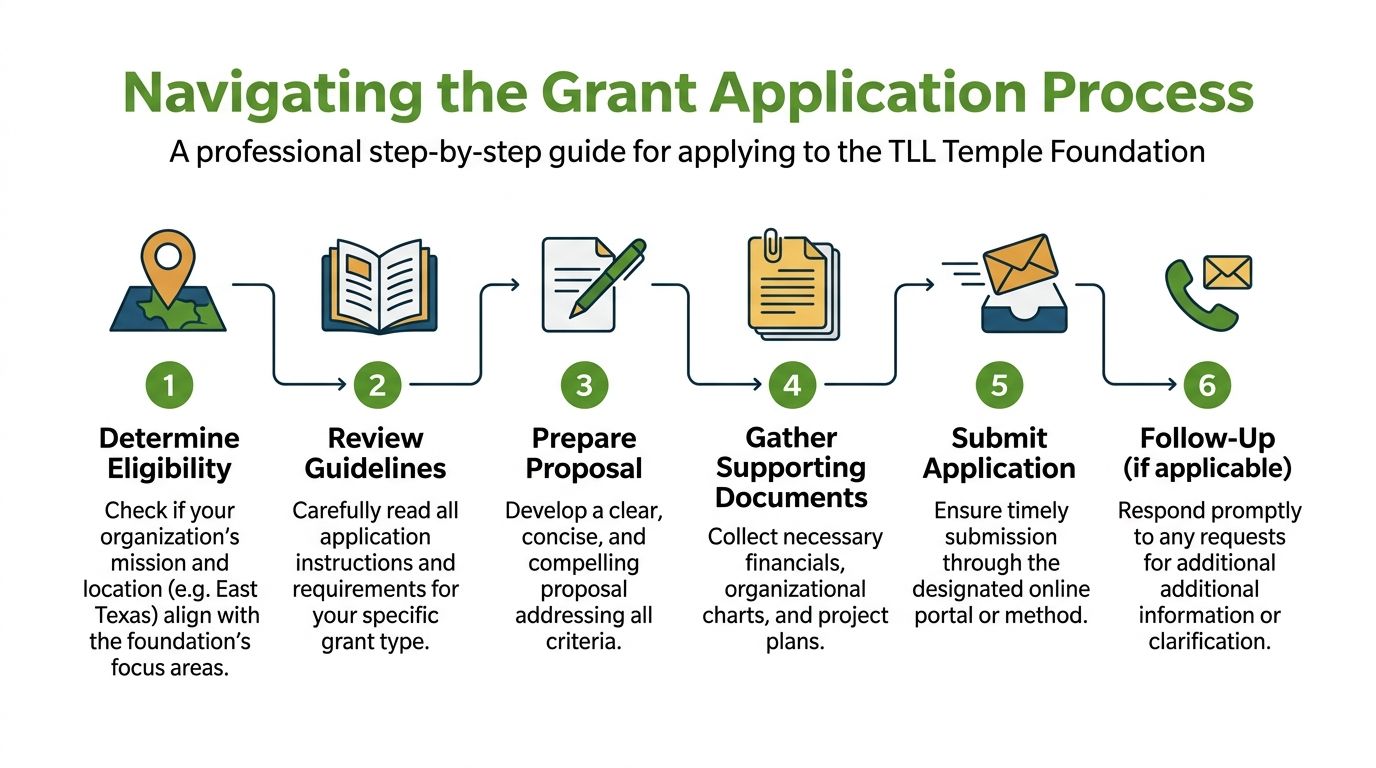
For the tll temple foundation, the application process is best handled as a sequence, not a single writing task.
Start with fit before you open the portal
The foundation serves a defined regional footprint. Before drafting anything, confirm that your organization, beneficiaries, and proposed work clearly connect to the foundation’s service area and one of its funding interests.
Do not use the Letter of Inquiry to test a vague idea. Use it to present a screened idea.
A practical internal checklist looks like this:
- Geographic fit: Can you show a direct benefit to the foundation’s service area?
- Program fit: Does the request clearly align with one primary funding area?
- Strategic fit: Can you show how the work addresses a deeper rural barrier?
- Organizational readiness: Do you have the documents, leadership alignment, and project plan to follow through if invited?
Understand the two-stage structure
The foundation uses a two-stage process through its online portal. For most organizations, the first real hurdle is the Letter of Inquiry, not the full proposal.
That changes how you should write.
The LOI is not the place for every detail. It is the place to prove judgment. A strong LOI does four things well:
- identifies a real and local problem
- explains why your organization is positioned to act
- states the request clearly
- shows why the project belongs with this foundation specifically
If invited forward, the full proposal needs sharper operational detail. That includes implementation, budget logic, partnerships, outcomes, and organizational capacity.
Work the timeline backward
The foundation’s materials indicate ongoing applications, review tied to board cycles, and decision periods that can take time. Treat that as a planning requirement, not a minor detail.
For a small team, that means:
- building internal approval time before submission
- gathering attachments early
- confirming who owns budget, narrative, and portal entry
- preparing for follow-up questions after submission
Tip: The most common avoidable problem is not weak writing. It is late assembly of attachments, approvals, and supporting documents.
Use the portal like an operational tool
Many organizations treat grant portals as final submission boxes. That is backwards.
The GivingData portal should function as a project management checkpoint. Draft offline, assign owners, keep a clean file naming system, and enter only polished material. Portal fatigue creates mistakes, especially when teams paste in outdated language from other applications.
The how to apply for grants resource is useful if your staff needs a process for organizing drafts, attachments, and internal review before portal submission.
What a solid application package usually includes
Your exact requirements will depend on the request, but strong applicants prepare these elements before hitting submit:
- Core narrative: Problem, response, beneficiaries, and expected change
- Budget support: A budget that matches the story and avoids unexplained line items
- Organizational context: Mission, track record, leadership, and local credibility
- Partnership evidence: Clear roles for collaborators where relevant
- Outcome plan: A small set of practical measures tied to the project’s purpose
What works better than overexplaining
Applicants often overestimate how much background a reviewer needs and underestimate how much judgment the reviewer is looking for.
A concise, well-prioritized application signals readiness. A bloated one signals uncertainty.
If your first page cannot answer these questions, revise:
- What problem are you solving?
- Why here?
- Why now?
- Why your organization?
- Why this foundation?
Examples of High-Impact Temple Foundation Grants
The best clues about funder preference come from actual grants. Not because they give you a template to copy, but because they show the level of ambition and the type of broader impact the foundation values.
The ROC-ET example is about more than lending
One of the clearest examples is the Rural Opportunity Catalyst for East Texas (ROC-ET) Initiative. The foundation awarded $1.15 million to Communities Unlimited and PeopleFund, two nonprofit CDFIs. That investment helped PeopleFund create an initial $1.5 million lending pool, according to the ROC-ET summary.
This is a strong example because it shows the foundation funding an intermediary, not just an end service.
The grant did not just support a single business or one training cohort. It helped build permanent lending capacity in a region where access to capital has been thin. That is a force-multiplier approach. The foundation backed infrastructure that other entrepreneurs could use over time.
The teacher pipeline example shows workforce logic
Another revealing grant is the foundation’s 2023 five-year grant of $1,137,835 with the Texas Pioneer Foundation to Texas A&M University-Texarkana to build a teacher pipeline, as noted in the earlier historical source.
That grant sits inside education, but it is about labor supply, institutional partnership, and long-range rural capacity. A weak applicant might pitch classroom enrichment. A stronger one asks what system constraint is preventing student success and whether the project addresses that root issue.
Boggy Slough shows stewardship as strategy
The Boggy Slough Conservation Area also belongs in this conversation. It is easy to read that work as land preservation alone. It is more useful to read it as a statement about stewardship, continuity, and region-linked assets.
For applicants, that matters because the foundation seems willing to support projects that preserve value while also making it usable for the future. In some cases that may be conservation. In others it may be a clinic network, a teacher pipeline, a local arts anchor, or a financing partner.
What these examples have in common
They are not identical in sector, but they share a pattern:
- They address structural barriers, not just symptoms
- They strengthen regional capacity
- They involve credible institutions or partnerships
- They create benefits that extend beyond one grant cycle
That pattern should influence your own concept design.
If your proposal is for direct service, that is fine. But you should still show how the work improves a local system, expands access, or leaves behind stronger community capacity. That is often the bridge between “worth funding” and “important to fund.”
Insider Tips for a Winning Grant Proposal
Most rejected proposals are not bad. They are just too generic for a foundation with a clear regional identity and a strategic agenda.
The tll temple foundation’s own website gives applicants a starting point, but it does not offer much detailed guidance on what a strong proposal sounds like. That gap matters. The available guidance notes that proposals crafted with specific narrative and impact data show a 40% higher success rate than generic applications, according to the foundation application guidance context.
Start with the significant rural problem
A winning proposal does not open with your organization. It opens with the barrier your community faces.
That may be teacher shortages, healthcare access, transportation gaps, weak small-business financing, digital access, or another local constraint. The point is to define the problem in a way that fits the foundation’s regional logic.
Weak version: “We provide important services to underserved residents.”
Stronger version: “Residents in our county cannot consistently access this service because the local system lacks this capacity, and our project removes that barrier through these partners and this delivery model.”
The second version is more fundable because it names the bottleneck.
Match your narrative to the foundation’s style of thinking
The foundation appears interested in durable change. Write like someone who understands that.
Good proposal narratives include these moves:
- Name the local challenge precisely
- Describe the system around it
- Show where your organization sits in that system
- Explain what becomes possible if the project succeeds
Do not rely on moral urgency alone. Pair need with a credible response.
Key takeaway: A compelling proposal shows both empathy for the community and discipline in the intervention.
Use evidence carefully
For small nonprofits, many drafts go sideways at this stage. Teams either overload the proposal with disconnected statistics or avoid evidence entirely.
The better approach is tighter:
- use a small number of relevant facts
- connect each fact directly to your proposed response
- include local operating knowledge, not just broad problem statements
- avoid unsupported claims about impact you cannot document
You do not need a giant evaluation apparatus to sound credible. You need clear logic, realistic outcomes, and evidence that your team knows the terrain.
Show collaboration without hiding behind it
Partnership language helps only when the roles are real.
If you mention schools, clinics, colleges, lenders, libraries, or municipal partners, explain who is doing what. A reviewer should be able to see whether your organization is convening, delivering, referring, training, financing, or coordinating.
A vague “we collaborate with many stakeholders” line weakens a proposal. It sounds borrowed.
This short video is a useful reminder that grant writing quality comes down to clarity, relevance, and alignment.
Write measurable outcomes without sounding mechanical
Applicants swing between two extremes. They either make the outcomes so broad that nothing can be measured, or they create a rigid dashboard that does not match the project.
A better method is to choose a few outcomes that track whether the grant changed access, capacity, participation, or readiness.
Useful outcome questions include:
- Did more people gain access to the service?
- Did a partner institution become more capable?
- Did the project remove a known bottleneck?
- Did the grant position the community for a larger next step?
What tends to lose reviewers
Three patterns show up in weak drafts:
- The copy-and-paste proposal. It sounds like it could go to any funder in any state.
- The activity list. It explains what staff will do but never clarifies why those actions matter.
- The oversized promise. It claims transformational change without enough organizational basis.
A small nonprofit can compete here. But it has to sound local, grounded, and strategically aware.
How to Systematically Pursue Foundation Funding
A one-off application can work. A system works better.
That is especially true with a foundation like the tll temple foundation, where competitiveness comes from fit, timing, local knowledge, and disciplined proposal development. If your team treats each application as a brand-new scramble, you will keep recreating the same stress.
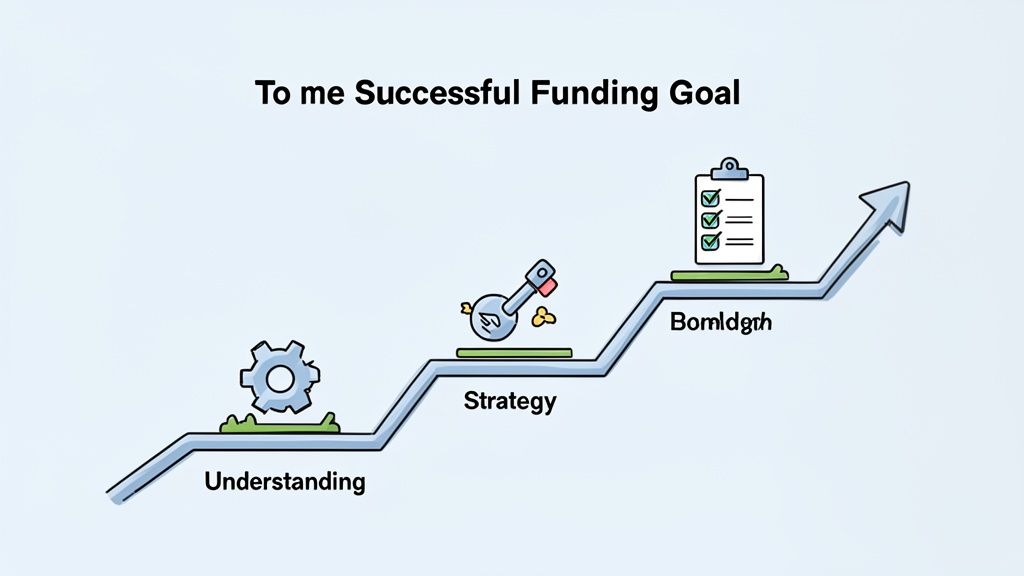
Build a repeatable internal process
Most small nonprofits do not need more inspiration. They need a cleaner operating rhythm.
A workable foundation-funding system includes:
- Prospect qualification: Decide early whether a funder is merely eligible or aligned.
- Program translation: Convert field knowledge into funder-ready language without losing local specificity.
- Shared files: Keep budgets, organizational documents, leadership bios, and project descriptions updated in one place.
- Calendar discipline: Track board cycles, internal review dates, and follow-up windows.
- Post-submission review: Capture what worked, what was hard, and what should change next time.
That process matters beyond one foundation. It reduces staff strain and improves application quality across your whole pipeline.
Treat funder research as interpretation, not collection
Many development teams collect information without turning it into strategy. They save URLs, skim guidelines, and circulate notes, but no one makes a firm call on positioning.
For this foundation, interpretation means asking:
- Is our project solving a structural rural problem or just describing a service?
- Are we presenting a durable community asset?
- Can we show local credibility and partner readiness?
- Does this request fit the foundation’s approach to maximizing impact and capacity-building?
Those questions are more useful than a long internal memo.
Create reusable proposal building blocks
You can save major time by developing modular assets that can be adapted for different funders without becoming generic.
Useful building blocks include:
- a one-page regional needs summary
- short descriptions of each program area
- partner role summaries
- outcome menus for different project types
- budget narratives that explain common cost categories
- a standard institutional capacity paragraph that can be customized
The warning is obvious. Reuse structure, not language. A proposal to this foundation still needs to sound specific to this funder.
Use tools only where they reduce friction
Some teams manage this work with shared drives, spreadsheets, and checklists. That can be enough if someone owns the process.
Others use grant management tools to keep opportunities, deadlines, outlines, and reporting in one workflow. Fundsprout is one example. It scans grant opportunities, screens for fit, helps turn requirements into structured outlines, supports drafting with organizational documents and impact data, and tracks deadlines and reporting tasks. In practice, tools like that are most useful when a small team needs consistency more than complexity.
Best use of a tool: Reduce administrative drag so staff can spend more time improving fit, partnerships, and narrative quality.
What a mature approach looks like
A mature grant process does not mean a big development department. It means your organization can do the following without chaos:
- identify high-fit funders
- decide quickly whether to pursue
- draft from current materials
- involve program and finance staff early
- submit on time
- learn from each cycle
That is how small nonprofits become more competitive with regional foundations. They stop treating grants as isolated writing assignments and start managing them as part of organizational strategy.
The tll temple foundation is a strong prospect for many East Texas organizations. But the key advantage is not knowing that it funds education, health, economic opportunity, human services, arts and culture, and the environment. The edge comes from reading its history, spotting its strategic logic, and presenting your work as a credible answer to a rural barrier.
If your team wants a more organized way to find relevant funders, build customized proposals, and manage deadlines and reporting in one place, take a look at Fundsprout. It is built for nonprofits that need a practical system for grant work, not just another list of opportunities.
Try 14 days free
Get started with Fundsprout so you can focus on what really matters.