Unlock Technology Grants For Schools 2026
Access technology grants for schools. Our playbook guides you to find opportunities, write winning proposals, & manage K-12 tech funding.


Abdifatah Ali
Co-Founder
A teacher opens the laptop cart before first period and finds the same problems as yesterday. Half the devices need updates. A few won't hold a charge. The wireless signal drops in the far classroom. Students wait while the lesson stalls. Nobody in that building doubts the value of technology. The problem is paying for it, replacing it, maintaining it, and proving that the next purchase won't become next year's headache.
That's where many small schools get stuck. They chase every grant they can find, recycle the same narrative, ask for equipment before they've defined the instructional use, and treat the award like the finish line. Then they wonder why strong needs don't turn into funding.
Technology grants for schools work better when you stop treating them like isolated applications and start treating them like a system. The schools that make progress usually do a few simple things well. They match the request to the right funder. They write around student outcomes, not gadgets. They budget for training and upkeep. And after the award, they manage reporting tightly enough that one grant leads to the next.
Beyond Bake Sales The Modern Approach to School Tech Funding
A principal approves a set of new devices in June. By October, teachers are sharing hotspots because coverage drops at the edge of the building, the charging setup is inadequate, and nobody budgeted for training. The purchase was real. Student access still did not improve the way the school expected.
That is the shift small schools need to understand. Technology grants for schools are no longer just small one-off gifts for hardware. Public funding, research funding, and private grantmaking now support different parts of the technology stack, from broadband and internal connections to classroom implementation and evidence-building. The Emergency Assistance to Non-Public Schools program under the CARES Act directed substantial federal support to education during the pandemic response, and the Institute of Education Sciences has also funded long-term education technology research through its ED/IES SBIR portfolio.
For a small team, that changes the job. The goal is not to find any grant that mentions devices. The goal is to build a funding plan that matches the actual constraint, the right funder type, and the school's capacity to carry the work after the money arrives.
Start with the constraint that is causing the instructional problem. A device gap calls for one kind of request. Weak Wi-Fi, poor switching, or outdated wiring calls for another. Schools lose strong opportunities when they write a compelling student story but skip the technical conditions required to deliver it. If your building issues start below the ceiling tiles and inside the walls, this guide to network cabling gives a plain-language explanation of what reliable connectivity depends on.
Practical rule: Do not ask a funder to buy classroom technology your building cannot support.
Small schools also need a repeatable way to spot fit before staff time disappears into low-probability applications. A simple screening process, supported by a grant discovery platform for school funding research, helps teams separate real opportunities from attractive distractions.
The schools that stay funded treat grants as a full lifecycle. They define the instructional result first, confirm infrastructure and staffing, choose opportunities that fit the project stage, and plan for replacement, training, reporting, and renewal before submission. That is how a grant stops being a short-term rescue and starts becoming part of a durable technology plan.
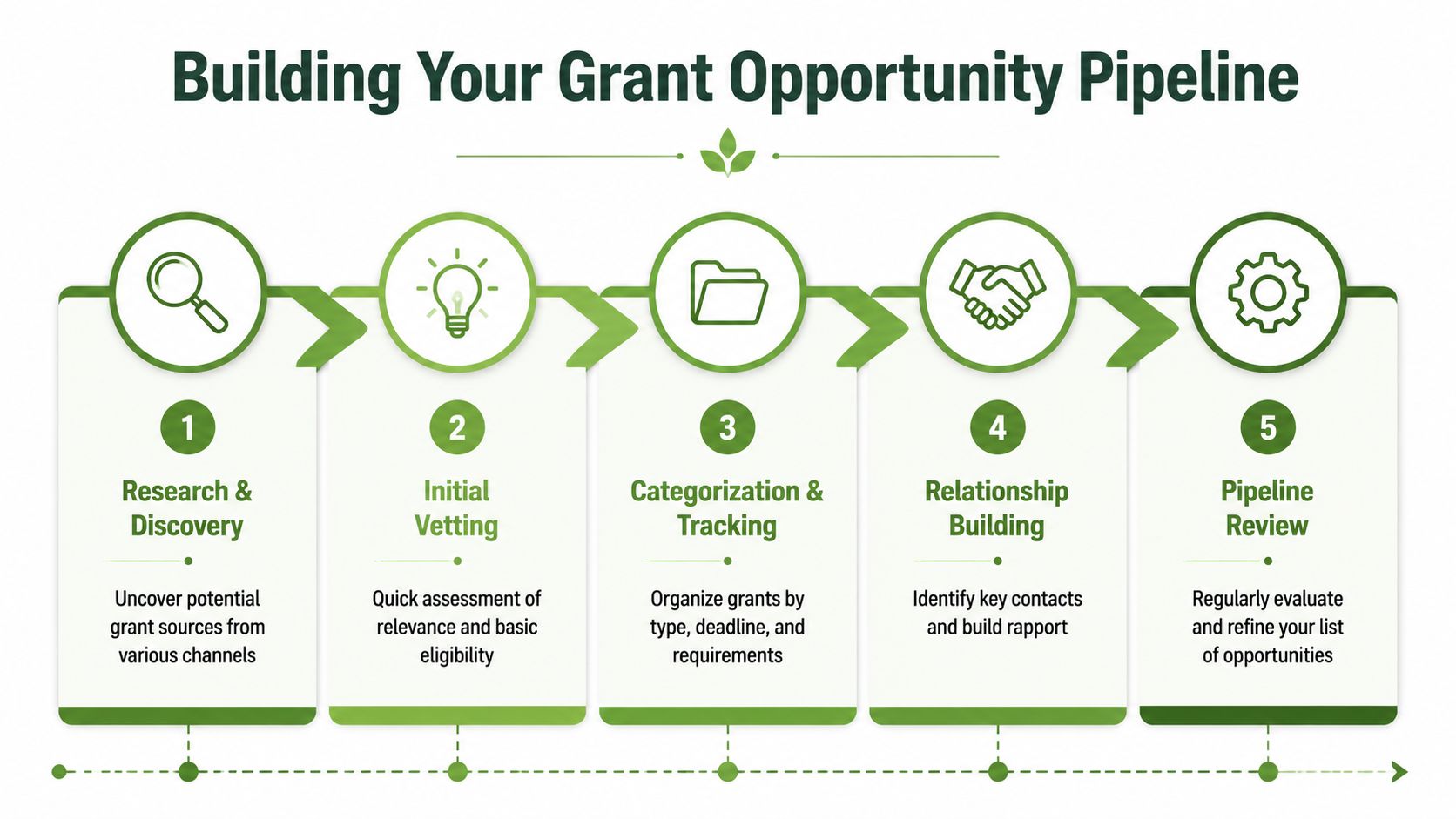
Building Your Grant Opportunity Pipeline
On Monday morning, the principal forwards a grant email. By Wednesday, a teacher shares a corporate program on social media. Two weeks later, someone remembers a state deadline that passed last spring. That is not a pipeline. It is a collection of good intentions with no system behind it.
A workable pipeline does three jobs. It brings in opportunities on a set schedule. It helps a small team decide quickly what deserves attention. It keeps the school from losing hard-won knowledge when priorities shift or one staff member carries too much of the process.
Start with four grant lanes
Small school teams usually get better results when they organize by funder type. One long spreadsheet without categories turns every search into rework and makes it harder to see patterns in what each funder supports.
Federal programs
Use this lane for projects that need formal planning, purchasing coordination, and careful records. These opportunities often involve more paperwork and longer timelines, but they can fit larger technology efforts, especially when the project affects multiple classrooms, buildings, or student groups.State education funding and state-level initiatives
This lane is often more practical than teams expect. State programs tend to reflect current priorities such as digital access, career pathways, attendance, literacy, or teacher support. They may also be easier to justify internally because the goals already connect to state accountability and instruction.Corporate giving and business partnerships
This lane works well for visible, contained projects. Examples include classroom pilots, STEM tools, maker equipment, and teacher-designed innovation efforts. Corporate funders usually want a request they can grasp quickly, with a clear student benefit and a plan that looks realistic for a small staff.Private and community foundations
These opportunities are often strongest when the technology request serves a broader mission. Equity, disability inclusion, family engagement, college and career readiness, and community access are common examples. Read past grantee lists before you invest writing time. They often reveal more than the guidelines do.
Build a repeatable search routine
The strongest pipelines are boring in the best way. They run because someone owns the process and the cadence is clear.
Use a rhythm like this:
- Weekly search block: Set one recurring block to review funder alerts, foundation newsletters, association emails, and saved searches.
- Single intake point: Put every opportunity in one shared place with the same fields every time.
- Monthly decision review: Meet briefly to decide which opportunities move forward, which stay warm, and which should be dropped.
- Internal deadline planning: Put draft dates, approval dates, and attachment deadlines on the calendar before the actual due date.
If your team needs a more organized way to centralize searches, tags, and recurring reviews, a grant discovery platform for school funding research can reduce duplicate effort and make handoffs easier.
Track the details that affect real decisions
Many schools build tracking sheets that collect information but do not support decisions. The goal is not to archive links. The goal is to help the team judge fit, readiness, and workload before staff time disappears into a weak application.
| Field | Why it matters |
|---|---|
| Opportunity name | Keeps everyone using the same reference |
| Funder type | Helps you compare similar grants together |
| Project fit | Shows whether the request matches an active school priority |
| Deadline cadence | Annual, rolling, or invitation-based changes how you plan |
| Eligible applicant | Confirms whether the school, district, nonprofit partner, or teacher applies |
| Allowed expenses | Separates grants for devices, infrastructure, software, training, or program support |
| Required attachments | Signals the real workload early |
| Readiness notes | Flags what is missing before the team commits |
| Owner | Prevents opportunities from sitting in limbo |
| Go or no-go status | Keeps stale prospects from clogging the list |
One field matters more than teams expect: owner. If no one owns the next step, the opportunity is already drifting.
Keep a warm list on purpose
Some grants should wait. That is good judgment, not hesitation.
A small school may need stronger usage data, district approval, a vendor quote, a partner letter, or a cleaner implementation plan before applying. Track those opportunities in a separate warm list with a clear note about what has to change before they move into active pursuit. That habit protects your team from writing premature proposals and helps you build a stronger pipeline over time, not just a busier one.
A healthy pipeline is a managed set of opportunities your school can pursue, fund, carry out, and sustain. That is the difference between chasing grants and building a grant strategy.
From Long List to Shortlist How to Prioritize Opportunities
It is 4:15 on a Thursday. The principal wants a grant list by tomorrow, a teacher has forwarded three opportunities that "look promising," and the district office just asked whether any of them can cover devices, training, and ongoing software. This is the point where small school teams lose time. The problem is rarely finding grants. The problem is choosing the few your school can win, run well, and sustain after the first year.
That is why prioritization matters. A long list creates activity. A shortlist creates results.
The school tech grant field includes very different kinds of opportunities. Some are classroom-scale awards with simple applications. Others are built for schools or organizations that already have implementation evidence, partner capacity, and a plan for multi-site execution. If a team treats those as interchangeable, it can spend two weeks drafting for a grant it was never ready to pursue.
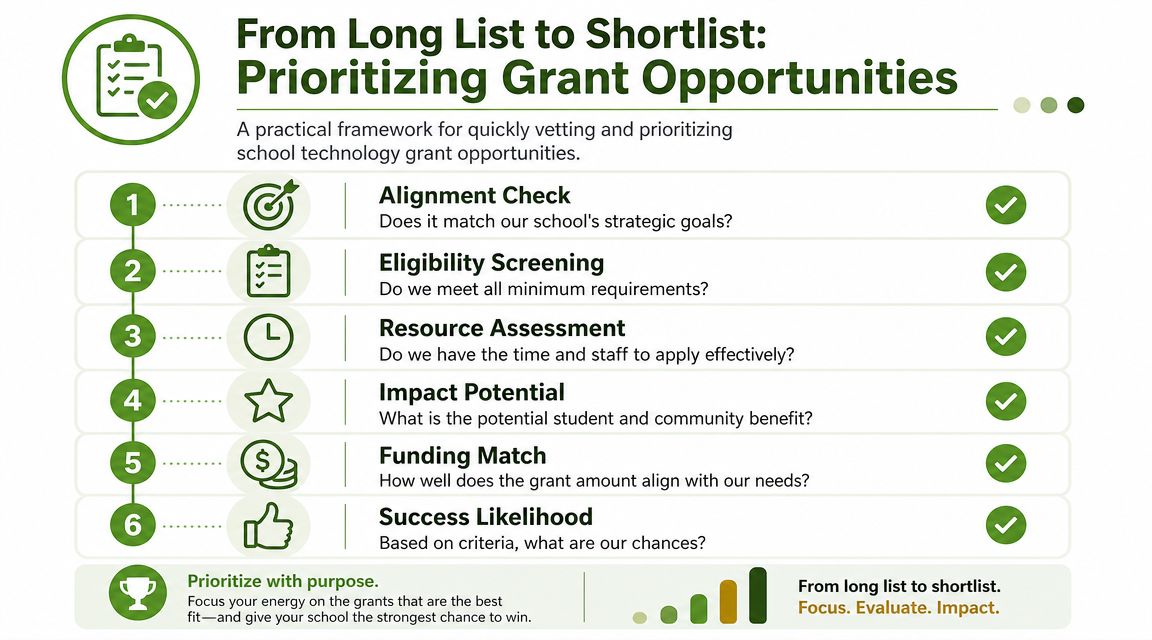
Use a three-part filter
I advise small teams to screen opportunities in this order because it prevents the most expensive mistake. Writing before qualifying.
Eligibility first
Start with the hard rules. Applicant type, grade bands, geography, fiscal sponsor requirements, existing program use, and district approvals can rule a grant in or out quickly. Funders are usually plain about this, but teams skip the details because the project idea feels strong.
Do not do that.
If a program is designed for applicants with documented implementation history or broader deployment capacity, a promising idea is still a weak fit. Enthusiasm does not fix an eligibility gap.
Mission alignment second
A technology grant is rarely about technology alone. The funder may care about literacy growth, STEM participation, career pathways, accessibility, teacher practice, or equitable access across student groups. Devices and software are just the delivery mechanism.
Use one test before you move a grant to active pursuit: if you removed every product name from the draft, would the proposal still address the funder's stated outcome in a clear, specific way?
If the answer is no, the school is forcing the fit.
Effort versus reward third
Award size matters less than teams think. A modest grant with a short application, clean fit, and few reporting demands can produce a better return than a larger opportunity that requires extensive partner coordination, board approvals, detailed evidence, and post-award data collection your staff cannot maintain.
Here, experienced teams protect capacity. They do not ask only, "How much could we win?" They ask, "What will this cost us in staff time, documentation, implementation pressure, and follow-through?"
Use a scorecard before anyone starts drafting
A simple internal scorecard is enough.
| Criterion | Low score means | High score means |
|---|---|---|
| Eligibility | We may be stretching the rules | We clearly qualify |
| Alignment | We are reshaping our idea to fit | The funder's goals and our project match directly |
| Capacity | The team lacks time or key documents | The school can prepare a solid application on schedule |
| Readiness | We still need approvals, quotes, or baseline data | We can support the case now |
| Sustainability | The project likely stalls after the grant period | The school can maintain the work after the award |
Keep the scoring practical. A grant does not need a perfect score to make the shortlist. It needs enough strength that the team can write plainly, support its claims, and deliver what it promises.
One warning sign comes up often. If your draft relies on phrases like "we plan to explore" or "we hope to pilot" while the funder is asking for evidence of current use, measurable need, or implementation readiness, stop and revisit the fit.
Check the hidden workload
Small teams often underestimate what happens before submission. A technology grant may require device quotes, IT review, accessibility confirmation, district signatures, student data, logic models, matching funds, or partner letters. Those items do not belong in a separate mental bucket. They are part of prioritization.
I tell schools to ask four blunt questions:
- Can we get every required approval before the deadline?
- Do we already have the data needed to justify this request?
- Can staff carry out the project if we win?
- Can we afford the recurring costs after the grant period ends?
If the answer to two or more is no, the opportunity usually belongs on the warm list, not the active shortlist.
Teams that want to speed up early screening often use structured drafting tools to pressure-test fit, evidence, and workload before committing staff hours. A practical example is this guide to using AI for grant writing, especially for small teams sorting through multiple opportunities at once.
What a strong shortlist looks like
A useful shortlist usually has balance. One fast-turn application with a realistic chance of success. One mid-range opportunity with strong alignment and manageable reporting. One larger strategic grant that may require more preparation but fits a longer-term school priority.
That mix does two things. It gives the team a chance to secure near-term funding while building toward bigger opportunities that require more evidence, stronger partnerships, or clearer sustainability planning.
Disciplined schools do not apply everywhere. They choose opportunities where fit, timing, internal capacity, and long-term upkeep all line up. That is how a grant list becomes a funding strategy.
Crafting Your Proposal The Story of Student Impact
A weak school technology proposal reads like a purchase order with adjectives. It lists tablets, software, smart displays, charging carts, and accessories, then asks the reviewer to infer why any of that matters. Most reviewers won't do that work for you.
A strong proposal turns the request into a student-impact story. Technology is the tool. The project is the intervention.

Lead with the challenge students face
Start with the educational problem, not the shopping list. If students can't access adaptive practice because devices are unreliable, say that. If teachers lose instructional time because the current setup fails during core lessons, say that. If students in one building have less access to digital learning than students in another, say that.
Be concrete, but stay inside what you can support. If you have attendance, usage, benchmark, or classroom observation data, use it carefully and plainly. If you don't, describe the pattern qualitatively and anchor it in direct school experience.
Here's the difference in framing:
“We need 30 new tablets for our elementary classrooms.”
That sentence tells the funder what you want to buy. It doesn't tell them why they should care.
“Our elementary teachers can't deliver consistent digital literacy practice because device availability and reliability limit student access during the school day.”
That sentence identifies a problem the grant can solve.
Describe the solution as a program
Once the challenge is clear, present the technology request as part of an implementation plan. Reviewers need to see what students and teachers will do differently after the award.
Useful proposal language usually answers these questions:
- Who benefits: Which students, teachers, or grade bands will use the tools
- When it happens: During core instruction, intervention blocks, after-school learning, or a defined pilot period
- What adults will do: Training, lesson integration, coaching, troubleshooting, and monitoring
- How the school will know it's working: Usage records, teacher feedback, student work, or other promised indicators
This is also where writing tools can help if your team needs support turning program notes into a coherent narrative. A resource on AI for grant writing can be useful for outlining drafts, especially when you need to organize requirements without losing your school's voice.
Write for the reviewer who isn't technical
Many schools overspecify the equipment and underspecify the educational use. You rarely win points by sounding like the IT department unless the grant specifically asks for technical architecture.
Name the product when needed. Then translate it.
Instead of saying the project will deploy a new wireless controller environment and upgraded access points, explain that teachers will be able to run class-wide digital lessons without connection failures disrupting instruction. Instead of listing software features, explain how staff will use the platform during literacy intervention or science inquiry.
A short demonstration is often more persuasive than a long feature list. This video shows the kind of future-focused classroom narrative schools often try to describe in words:
Use a simple narrative arc
When teams get stuck, I suggest this sequence.
The challenge
Describe the current learning barrier in operational terms. Keep it specific to your school. Avoid broad national language unless the funder asks for context.
The response
Explain what the school will implement, who will lead it, and what supports are included besides the hardware or software itself.
The impact
Show what changes you expect to see in teaching and learning. This can include access, instructional consistency, stronger intervention delivery, improved participation, or better classroom workflow. Promise only what you can reasonably track.
Reviewers fund believable progress more readily than exaggerated transformation.
Keep the tone grounded
The best proposals sound like a competent school that has thought through the details. They don't sound desperate, inflated, or overly polished. If your narrative feels like it could be copied into any other grant with only the school name changed, it's still too generic.
A good test is to hand the draft to someone outside your program team. If they can answer three questions, you're close: What problem are we solving? Why this solution? What will be different for students if the grant is funded?
Budgeting for Sustainability Not Just for a Single Year
A school wins a technology grant, orders the devices, and gets them into classrooms by fall. By spring, the licenses are up for renewal, two staff members still need training, a few devices need repair, and no one set aside time to track usage or student outcomes. That is where good projects start to wobble. The problem usually is not the original purchase. It is the missing plan for year two.
Funders notice this quickly. A budget that covers only equipment tells them the school has priced the purchase, but not the implementation. Strong school teams budget for the full operating reality of the project: rollout, training, support, renewals, and eventual replacement.
For federal programs, the rules also shape what a sustainable technology budget can look like. The U.S. Department of Education's non-regulatory guidance for ESSA Title IV, Part A states that “no more than 15 percent” of funds may be used for devices, equipment, software applications, platforms, digital instructional resources, and other one-time technology infrastructure purchases, and it stresses that districts should spend thoughtfully on professional development, blended learning strategies, and ongoing use, as explained in the Department's Title IV, Part A guidance.
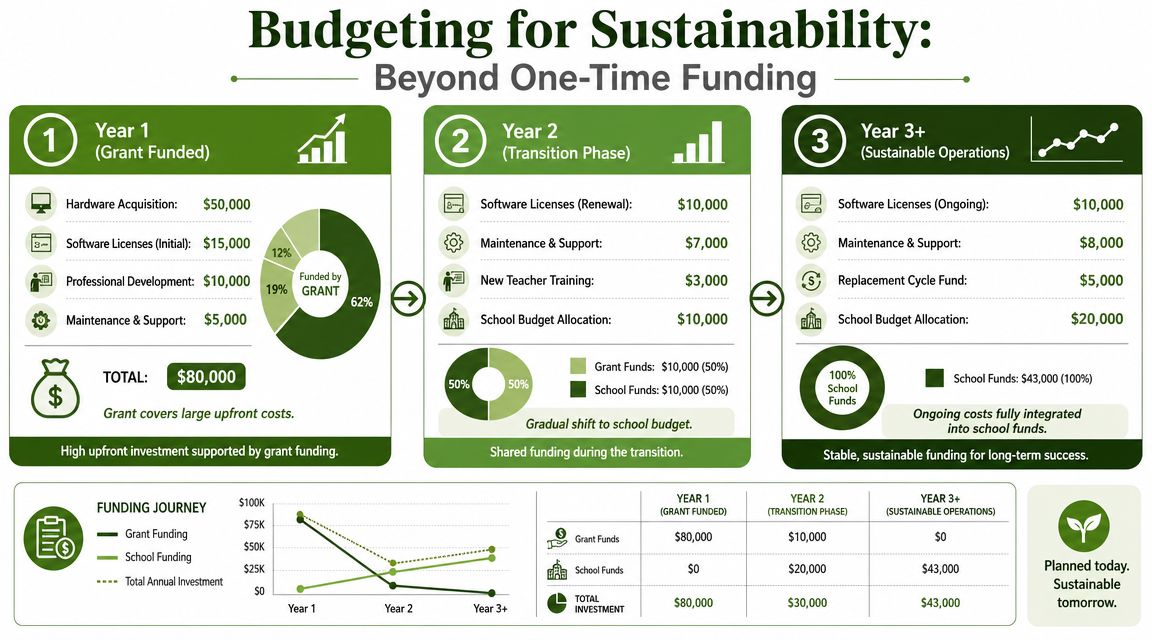
Budget the actual program, not just the shopping list
Reviewers want to see whether the project will still function after the invoices are paid. That means building the budget around what it takes to use the technology well, not just acquire it.
Include the full cost structure:
- Hardware and setup: Devices, carts, peripherals, installation, imaging, and configuration
- Software and licensing: First-year costs, renewal schedule, and any add-on modules
- Professional learning: Initial training, follow-up coaching, and onboarding for new hires
- Support and maintenance: Warranties, repairs, help desk time, and vendor support
- Evaluation and reporting: Staff time and tools needed to document implementation and results
If the grant will only cover some of those costs, say exactly how the school will cover the rest. Reviewers are less worried by a partial funding model than by a vague one.
Show who carries the cost after the grant ends
A sustainability plan does not need to promise that every future dollar is already in hand. It does need to show that leadership has made decisions about ownership.
A credible handoff plan often includes:
- Grant funds for startup costs such as equipment, initial training, and launch support
- School or district funds for recurring costs such as annual licenses or replacement peripherals
- A replacement schedule tied to the normal budget cycle, not treated as an emergency later
- Named staff ownership for training refreshers, usage monitoring, and vendor relationships
Small schools can set themselves apart. Large budgets do not impress reviewers by themselves. Clear judgment does.
A sustainable budget says, “We know what this will cost to run,” and “We know who will be responsible for it.”
Catch the mismatch before submission
I see the same mistake often. The narrative promises stronger instruction, more consistent intervention, and measurable student gains. The budget pays for devices and maybe a platform license. There is no training line, no implementation time, and no plan for renewals.
That gap makes reviewers question whether the school can deliver what it promised.
Use a final budget check like this:
| Budget question | What a strong answer sounds like |
|---|---|
| Who will train staff? | A named internal lead, district coach, or vendor partner |
| What costs repeat after year one? | Licenses, support, replacement devices, onboarding for new staff |
| Where will those future costs sit? | School operating budget, district technology budget, PTA support, or a phased absorption plan |
| Who will track usage and results? | A defined staff role with time assigned for reporting |
If your team needs a cleaner way to organize renewal dates, spending records, and reporting evidence, a practical system for grant compliance tracking software can reduce last-minute scrambling.
Make stewardship visible
The strongest budgets show restraint. They do not ask for every possible device or feature. They ask for the version of the project the school is able to maintain.
That is the strategic shift many teams miss. A grant is not just a chance to buy technology. It is a chance to build a program the school can keep running after the grant period closes.
After the Award Mastering Compliance and Renewal
The award email feels like the finish line. It isn't. It's the point where your internal discipline becomes visible. Schools that manage this stage well make renewal conversations easier, reduce stress during reporting, and build a reputation for being safe hands with grant funds.
Three habits matter most after award. Track the money accurately. Track the promised impact consistently. Keep the funder informed before they have to ask.
Set up compliance in the first days
Don't wait until the first report is due to organize documentation. Build the system immediately.
Your opening checklist should include:
- Award file creation: Store the signed agreement, approved budget, reporting schedule, and original proposal in one shared location
- Responsibility assignment: Name one person for fiscal tracking, one for program implementation, and one for report assembly, even if one staff member holds multiple roles
- Calendar setup: Enter every reporting date, procurement milestone, and internal review deadline
- Documentation standards: Decide where invoices, purchase records, training logs, meeting notes, and outcome evidence will live
Schools that skip these basics usually end up reconstructing records later. That's slow and risky.
If your team needs a more formal system for deadlines, files, and audit trails, a resource on grant compliance tracking software can help you compare what to centralize.
Track what you promised, not just what you bought
A grant report that only proves equipment was purchased is weaker than one that shows the project was used. Go back to your proposal and pull out every implementation and impact commitment. Those are now your tracking categories.
For technology grants for schools, that often includes things like teacher participation, classroom use patterns, student access, support requests, and evidence that the funded tool or setup became part of regular instruction.
Keep the system simple. Short monthly logs beat heroic year-end reconstruction.
Treat the funder like a partner
Most schools communicate with funders only when a report is due or when there's a problem. That's a missed opportunity. A brief update about rollout progress, a classroom anecdote, or a note on an early lesson learned can strengthen trust.
That doesn't mean oversharing. It means being professional and proactive.
Send the kind of update you'd want if you had entrusted your own budget to another organization.
A practical first ninety days rhythm
The strongest post-award teams usually do the same few things.
During launch
Confirm purchasing rules, approved uses, and documentation expectations. Some schools create problems early by assuming the proposal governs everything. The award terms do.
During implementation
Collect evidence while the project is unfolding. Save photos if allowed, meeting notes, training attendance, usage exports, and short stories from teachers or students.
Before the first report
Compare the report template to your records well before the due date. If something is missing, you still have time to gather it.
Renewal often starts long before the next application opens. Good stewardship creates the internal proof and external confidence that future funding depends on.
Frequently Asked Questions for Small Grant Teams
A principal finally gets approval to pursue technology funding. The team is two people, one shared spreadsheet, and very little time. At that point, the wrong assumption is expensive. It leads to poor-fit applications, weak budgets, and projects the school cannot sustain after the first purchase.
These are the questions small teams ask when they are trying to build a grant strategy they can manage.
Do we need a giant grant to make progress
No school needs to wait for a headline-sized award before improving student access to technology. Small grants often make better strategic sense for lean teams because they let you solve a defined problem, prove the project works, and build a track record for larger requests later.
The Rural Technology Fund is one example of a smaller opportunity for rural schools and assistive technology needs. Its grant application guidance explains that applications are accepted on a rolling basis and reviewed periodically, rather than through one annual deadline. For a small team, that kind of timing can be easier to plan around than a single high-stakes cycle.
A smaller first win also gives you something many schools overlook: implementation evidence.
What if we've never won a technology grant before
That is common. It does mean your first request should be tightly scoped.
Ask for something your school can purchase correctly, roll out on schedule, support with existing staff, and measure without inventing a new reporting system. Funders do not expect a first-time applicant to propose district-wide transformation. They do expect the plan to match your actual capacity.
I usually advise small schools to avoid proposals that require multiple departments to change practice at once. Those projects sound ambitious on paper and stall in real life.
Should we apply for hardware first and worry about training later
Usually, no. A hardware-only request can look incomplete because reviewers know devices do not create impact by themselves. Teachers need time, training, and a usable rollout plan. Students need access that fits the school day and the school's support capacity.
If training is not eligible as a grant expense, address it anyway. Show who will train staff, when it will happen, and what support the school will provide after installation. That makes the proposal more credible.
Our school serves students with disabilities. Should accessibility show up in the proposal
Yes. Accessibility belongs in the project design, purchasing criteria, and implementation plan.
That includes the basic question many teams skip: can students and staff use the tool you are requesting? If your team needs a plain-language overview, this guide to section 508 compliance is a practical starting point. It helps schools ask better questions before they buy, not after a problem appears.
What if we don't have perfect data
Use the data you have, as long as it is honest and specific. Baseline device access, current classroom use, student subgroup needs, waitlists for services, teacher surveys, and support logs can all help establish need.
Do not inflate the story. A modest baseline with a clear measurement plan is stronger than ambitious outcome claims your team cannot document six months later.
How many grants should a small team pursue at once
Usually, fewer than the team first hopes.
A manageable pipeline beats a crowded one. For many small schools, three active targets is enough: one quick-turn opportunity, one strong near-term fit, and one larger prospect that needs more preparation. That mix protects staff time and improves quality across the full grant lifecycle, from prospect research to reporting.
If every opportunity on your list has a deadline in the same month, the list is too long or poorly sequenced.
Can we reuse proposal language
Yes, but only the parts that should stay stable: school profile, enrollment context, mission, and a few core need statements that are still accurate. The case for support, project design, budget explanation, and outcomes should be adapted for each funder.
Reviewers can spot recycled language quickly. More important, generic language usually signals generic planning. That is where small teams lose points they could have kept with a tighter fit.
Fundsprout can help small development teams manage the full grant lifecycle in one place, from identifying matched opportunities to organizing proposal requirements and maintaining reporting records. If your school or nonprofit partner needs a more structured way to find relevant grants, draft stronger submissions, and stay on top of compliance, it's worth exploring Fundsprout.
Try 14 days free
Get started with Fundsprout so you can focus on what really matters.