Optimizing the Structure of Nonprofit Organization
Master the optimal structure of nonprofit organization. Learn legal requirements, org charts, & key roles to secure grants and scale your mission.

Abdifatah Ali
Co-Founder
You started this to solve a real problem. Maybe you saw families going without food, students falling through gaps at school, or neighbors who needed a service no one else was providing. In the beginning, structure probably felt secondary. You had urgency, volunteers, and a mission people believed in.
Then the work got bigger.
A funder asked for a board list, a clean budget, and proof that someone other than the founder oversees finances. Another grant application wanted program outcomes, reporting workflows, and clear staff responsibilities. Suddenly the question wasn't whether the mission mattered. It was whether the organization looked ready to steward outside money.
That’s where many new executive directors get stuck. They think the structure of nonprofit organization is mainly a compliance exercise. File paperwork. Seat a board. Write bylaws. Move on. In practice, structure does something far more important. It tells funders whether your organization can turn grant dollars into reliable program delivery, clean reporting, and low drama.
A shaky structure creates friction everywhere. Board members drift into staff work. Program staff write grants without budget support. The executive director approves everything because no one knows who owns what. You can still do good work like that for a while. You usually can't scale it.
A good structure doesn't make a nonprofit less human. It makes the mission durable. It gives people decision rights, protects the organization from avoidable mistakes, and shows grantmakers that the work won't fall apart the moment new funding arrives.
From Passion Project to Permanent Fixture
Monday starts with a program fire. By Tuesday, a foundation invites your nonprofit to apply for a grant that could double your reach. Then the application asks for a board list, approval process, financial controls, reporting ownership, and who will track restricted funds. For many new executive directors, that is the moment the organization stops feeling like a project and starts being judged like an institution.
Funders do not separate mission from structure. They read your structure as evidence. If roles are blurry, oversight is informal, and financial responsibility sits with one overextended founder, the proposal feels riskier no matter how strong the need statement is.
Funders rarely say, "Your org chart is the reason we passed." They say the implementation plan felt thin, reporting capacity was unclear, or internal controls looked weak.
That is the practical shift. Structure is not only about meeting legal requirements. It is part of grant readiness. It shows whether new dollars will produce stable programs, clean reporting, and decisions that do not bottleneck at one person.
What structure signals to funders
A grant-ready nonprofit structure signals a few practical things:
- Oversight exists: Someone other than the founder reviews budgets, risk, and major decisions.
- Programs are distinct from administration: Service delivery is not held together by the same person trying to manage bookkeeping and grant files.
- Roles are named: A funder can tell who owns outcomes, compliance, finance, and external relationships.
- Money has a home: Restricted funds connect to a program, a budget, and a reporting process.
I have seen small nonprofits lose good funding opportunities for a simple reason. They were doing meaningful work, but nobody could clearly answer who would monitor grant spending or compile reports. That creates hesitation for grantmakers. They are not only funding impact. They are funding an organization's ability to manage the award without confusion.
If you are still building that foundation, this step by step 501(c)(3) startup guide helps you get the setup sequence right before funders start asking harder questions. For board oversight expectations, this practical guide for strong nonprofit governance is also useful.
The shift that changes everything
Early on, flexibility helps. People pitch in wherever needed, and the work moves fast. After a certain point, the same flexibility starts causing missed deadlines, unclear approvals, inconsistent documentation, and reporting gaps.
That is usually what funders notice first.
A durable nonprofit keeps its mission at the center while assigning real ownership around it. Clear structure protects the work, makes growth less chaotic, and gives grantmakers a reason to trust that added funding will strengthen the organization instead of exposing weak spots.
The Legal Bedrock Your Board and 501(c)(3) Status
A new executive director usually feels the pressure here fast. A funder asks for bylaws, your conflict of interest policy, a board list, and proof of tax-exempt status. The program story may be strong, but if those documents are incomplete or unclear, confidence drops before anyone gets to outcomes.

Start with incorporation and governing documents
A nonprofit needs to exist as a formal entity before institutional funders will treat it like a durable grantee. Incorporation creates the organization under state law. Bylaws set the rules for how authority works inside it. They spell out voting, meetings, officer roles, board terms, and how major decisions get approved.
Funders may never read every line of your bylaws, but they often feel the effects of weak ones. Vague approval rules lead to confusion about who can sign contracts. Outdated board terms create governance drift. Missing policy references can slow down due diligence right when a grant is on the table.
If you are still building this foundation, this step by step 501(c)(3) startup guide is a useful reference for getting the order right.
Your board is part of your funding case
The board is not window dressing. It is the governing body responsible for oversight, fiduciary judgment, and keeping the organization aligned with its charitable purpose.
State rules differ, but every nonprofit needs a board that can function in practice, not just on paper. Grantmakers notice the difference quickly. They look at board composition as a signal. Does this organization have real oversight, financial review, and independent judgment, or is everything still concentrated in one founder or one overextended executive director?
A weak board creates predictable questions. Who reviews the budget before it goes to a funder? Who approves major policies? Who addresses conflicts of interest? Who is accountable if grant spending drifts away from the approved scope?
What funders want to see in a board
Grantmakers are usually not chasing prestige. They want evidence that the board governs with consistency and basic discipline.
A grant-ready board usually shows four things:
- Financial oversight: Directors review budgets, financial statements, and risk areas at a level that supports responsible decision-making.
- Mission discipline: The board helps management avoid chasing funding that pushes the organization away from its stated purpose.
- Clear boundaries: Directors govern. Staff manage operations.
- Documented action: Minutes, approvals, and core policies exist, are current, and can be produced during due diligence.
For a deeper look at those duties, this practical guide for strong nonprofit governance is worth reviewing with your chair and governance committee.
One practical test helps here. Review your last three board meeting packets. If they are heavy on staff updates and light on approvals, financial review, policy discussion, or risk oversight, the board may be meeting regularly without doing enough governance to reassure a funder.
Why 501(c)(3) status changes the funding conversation
For many community nonprofits, 501(c)(3) status is the threshold credential that moves the organization from informal startup to eligible applicant. It tells funders the IRS recognizes the organization as operating for charitable purposes, and it gives donors the tax treatment many foundations and individual supporters expect.
It also reinforces a basic structural rule. Revenue stays with the mission. A nonprofit can earn surpluses, but those resources are meant to support programs, reserves, staffing, systems, and other mission-related needs rather than private ownership.
From a grantmaker's perspective, this is important for two reasons:
- Purpose is defined: The organization exists for public benefit within a recognized charitable framework.
- Funds stay mission-focused: Awards are expected to support program delivery, infrastructure, and compliant operations.
Keep legal structure tied to grant readiness
New leaders often separate compliance from fundraising because the work feels different day to day. This separation often overlooks how intertwined compliance and fundraising are in a funder's eyes.
In practice, incorporation, bylaws, board governance, and 501(c)(3) status shape how safe your organization looks to fund. They affect eligibility, due diligence speed, reporting confidence, and whether a program officer believes your team can manage restricted money without preventable problems.
Strong legal structure will not win a grant on its own. It does something almost as important. It keeps your organization from losing funding opportunities for reasons that had nothing to do with the quality of the mission.
Your Internal Operating Blueprint
Once the legal foundation is in place, the next question is operational. Who does the work, who supports the work, and who keeps the work reportable?
A healthy nonprofit usually stands on three functional domains: governance, administration, and programs, according to this nonprofit organizational structure analysis. When those domains are aligned, organizations can map funding pipelines to program accounts and compliance calendars. When they're misaligned, delayed reporting, audit findings, and restricted-fund mismanagement become much more likely.

Think in three pillars
I usually tell new executive directors to picture a three-legged stool. If one leg is weak, the whole thing wobbles.
Programs
Programs are where the mission becomes real. This includes service delivery, participant outcomes, implementation planning, and any evidence you use to show impact. Grantmakers place great importance on this area, but they also expect it to be managed, not improvised.
A program team needs clear ownership over delivery and documentation. If no one owns outputs, timelines, and program records, grant reporting gets messy fast.
Development
Development brings in revenue and manages external relationships. In a very small nonprofit, this may still sit with the executive director. Even then, treat it as a distinct function. Prospect research, proposal writing, donor communication, and grants management need their own workflow.
When development is blurred into "whoever has time," proposals often overpromise because no one is coordinating closely enough with programs and finance.
Finance and operations
This is the support spine. Budgeting, expense tracking, grant restrictions, HR, contracts, and document control all live here. Many nonprofits underbuild this area because it isn't externally visible. Funders notice anyway.
If your finance and operations function is weak, the organization may still win grants, but it will struggle to administer them cleanly.
Why separation matters for grants
Funders want to believe your organization can separate enthusiasm from control. That means:
- Programs can describe what will happen
- Development can describe why funding is needed
- Finance can verify that the budget and reporting process are credible
When one person handles all three without clear systems, the application often shows it. Budgets don't match narratives. Timelines feel vague. Reporting language sounds generic because nobody has connected program activity to financial tracking.
A useful reference here is the Jumpstart Partners fund accounting guide, especially if your team needs to tighten the link between restricted revenue, expenses, and reporting.
A grant budget is not just a spreadsheet. It's evidence that your structure can translate money into controlled action.
What this looks like in practice
In a small organization, the names on the org chart may be few, but the functions still need to exist. One person may cover more than one area. That's normal. What doesn't work is pretending those functions are unnecessary.
A simple operating blueprint might assign:
- Board oversight to governance
- Executive director ownership of development and cross-functional coordination
- Program manager ownership of delivery and outcome tracking
- Bookkeeper or finance lead ownership of coding, reconciliation, and financial records
For teams using grant workflow software, this is also where tools become useful. Platforms like Fundsprout can map opportunities, proposal tasks, and compliance timelines against actual organizational capacity, which is helpful when the same small team is balancing active programs with new applications.
The warning signs of misalignment
Watch for these patterns:
- Program staff don't know what was promised in the grant
- Finance learns about restricted spending after commitments are made
- The board gets pulled into operational decisions because staff roles are unclear
- Reporting lives in email threads instead of a shared process
Those aren't minor inconveniences. They're structural weaknesses that funders eventually detect through missed deadlines, muddy narratives, and inconsistent financial documentation.
Defining Key Roles and Responsibilities
One of the quickest ways to weaken a nonprofit is to let titles exist without real boundaries. New organizations often say, "We all pitch in." That's fine as a cultural value. It's terrible as a management system.
Grant readiness depends on role clarity. Funders want to know who governs, who manages, who delivers, and who raises money. If your application makes those lines blurry, reviewers start worrying about execution risk.
The executive director
The executive director or CEO is the link between board strategy and staff execution. This person should not be the only person who knows everything, approves everything, and fixes everything. That's common in young nonprofits, but it doesn't scale well.
Core responsibilities usually include:
- Organizational leadership: Set direction, keep teams aligned, and make sure day-to-day work matches the mission.
- Cross-functional coordination: Ensure programs, fundraising, and finance are talking to each other before commitments are made.
- External representation: Build relationships with funders, partners, and community stakeholders.
- Staff management: Supervise staff leads and create accountability around priorities and timelines.
For grant readiness, the executive director's job is often less about writing every proposal and more about making sure the organization can fulfill what gets submitted.
The board chair
The board chair leads the board's work, not the staff's work. That's a boundary many nonprofits struggle to maintain.
The chair typically handles:
- Governance leadership: Set board agendas and keep meetings focused on oversight and strategy.
- Partnership with the executive director: Support the ED without becoming a second executive director.
- Board culture: Help directors understand their duties and stay engaged.
- Decision discipline: Make sure approvals, evaluations, and sensitive matters are handled properly.
If your chair is editing staff deliverables, negotiating minor vendor issues, or acting as program supervisor, the structure is off.
A useful board primer for this is nonprofit board member responsibilities, especially for organizations training first-time directors.
The board should ask, "Are we resourced, compliant, and on mission?" Staff should ask, "How do we deliver this well?" Confusing those two questions creates friction everywhere.
The program manager
This role often gets undervalued in small nonprofits, even though grant success depends heavily on it. Program managers turn promises into services and services into reportable outcomes.
A strong program manager usually owns:
- participant delivery and service quality
- implementation timelines
- documentation required by grants and contracts
- coordination with finance on allowable expenses
- communication with leadership when scope or staffing changes threaten deliverables
When program management is weak, development teams end up inventing narratives that operations can't support.
The development officer
Not every nonprofit can hire this role early. But the function needs a home. Development is more than grant writing. It includes funder cultivation, calendar management, proposal packaging, follow-up, and stewardship.
A clear development role helps by:
- Managing opportunity flow: Keep deadlines, submissions, and renewals from living only in the executive director's head.
- Protecting proposal quality: Coordinate with programs and finance before anything goes out.
- Tracking relationships: Maintain continuity with funders over time.
A simple way to test role clarity
Ask four questions and write down one name for each:
| Question | One clear owner |
|---|---|
| Who approves the budget before submission? | |
| Who can explain program delivery in detail? | |
| Who tracks grant deadlines and documents? | |
| Who speaks for the board on governance matters? |
If you keep writing the same name in every box, your structure isn't really distributed. It's concentrated.
Common Organizational Chart Templates
An org chart isn't just an HR document. It's a forecast of how decisions will move. The right structure depends on your size, complexity, and how many programs and funding streams you manage at once.
This visual comparison is a useful starting point.

Flat structure
A flat structure works well when the team is tiny and communication is constant. The executive director works closely with a handful of staff or contractors, and there are few formal layers between ideas and action.
That can be a strength in early-stage grant seeking. Small teams often move quickly, gather local insight fast, and pivot without much bureaucracy.
The risk is that everything depends on proximity and memory. Once grants multiply, a flat model can leave no clear owner for compliance, supervision, or final approvals.
Hierarchical structure
A hierarchical structure introduces formal reporting lines. The board oversees the executive director, and the executive director oversees department or function leads. This model is often the cleanest for grant administration because authority and accountability are easier to see.
The structure can also reassure funders. They can tell who owns programs, development, and finance, and who has approval authority when something changes.
The trade-off is speed. Decisions may take longer, and poorly designed hierarchies can create silos.
Matrix structure
A matrix structure is helpful when nonprofits run multiple programs that share staff or administrative resources. Someone might report to a functional lead for supervision and also work across a program team for delivery.
This can be useful for grant-funded initiatives that cut across departments. It allows a nonprofit to assemble a proposal team without fully reorganizing the organization.
It also requires discipline. Dual reporting only works when responsibilities are explicit and conflicts get resolved quickly.
Choosing Your Nonprofit's Organizational Structure
| Structure Type | Best For | Pros | Cons / Watch-Outs |
|---|---|---|---|
| Flat | New or very small nonprofits with a narrow program focus | Fast communication, flexibility, low formality | Role confusion, founder dependency, weak grant controls |
| Hierarchical | Established nonprofits with distinct functions or multiple staff | Clear accountability, stronger oversight, easier grant administration | Can become rigid or siloed if managers don't coordinate |
| Matrix | Nonprofits managing cross-functional programs or shared staff | Flexible staffing across initiatives, good for complex grant work | Dual reporting can create confusion if decision rights aren't explicit |
If you want a practical reference for drawing these out, this nonprofit organizational chart guide is useful for turning abstract structure ideas into something your team can review.
A short explainer can also help if you're trying to discuss options with board members or managers.
Don't choose by aspiration alone
A common mistake is adopting the chart that looks most impressive rather than the one the organization can currently support. A tiny nonprofit doesn't need five departments because a larger peer has them. It needs clarity about who does what, who approves what, and how grant obligations get tracked.
Choose the simplest structure that creates accountability. Then evolve it before strain turns into dysfunction.
Scaling Your Structure Without Breaking Your Mission
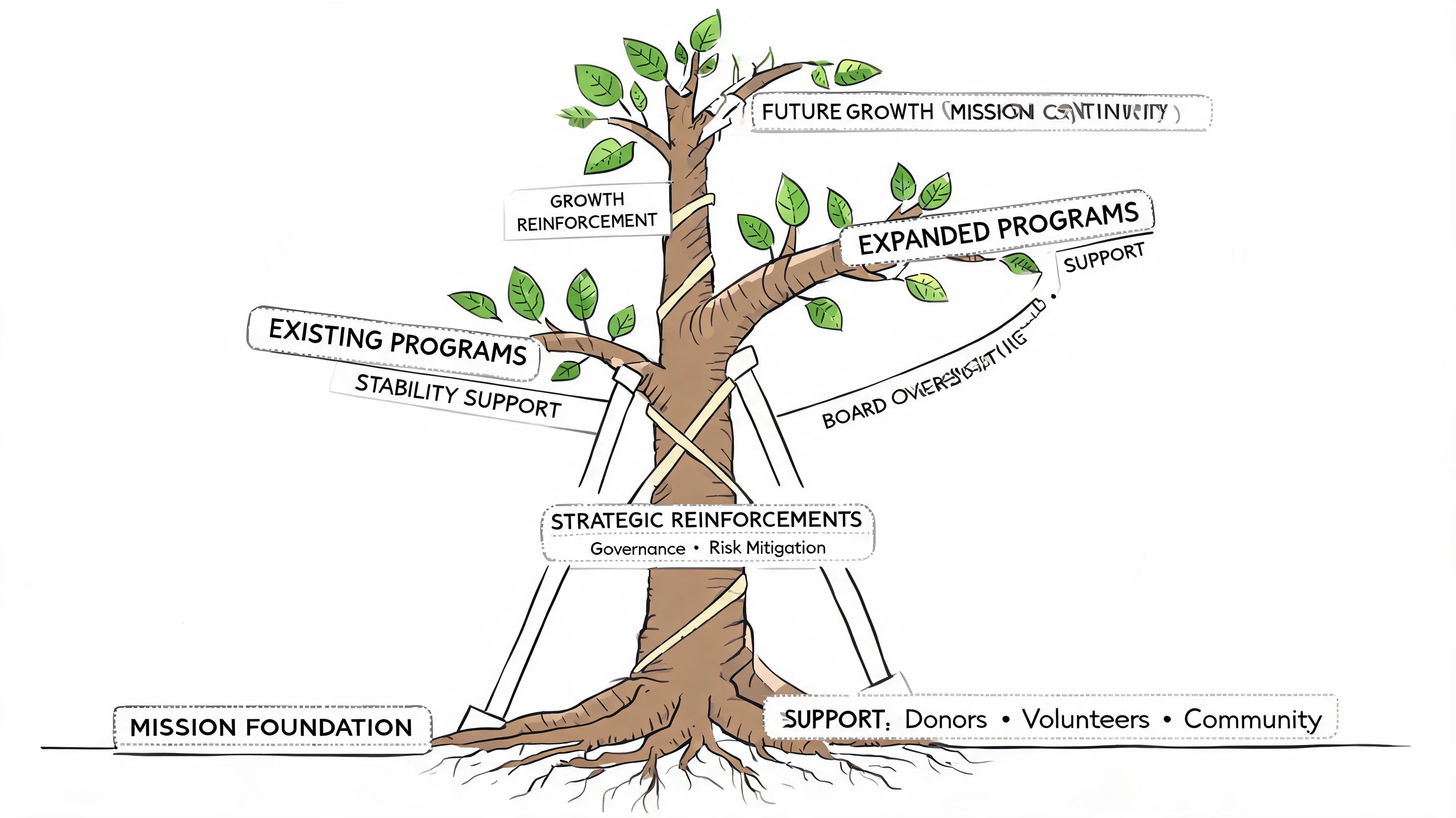
A familiar growth moment looks like this. You win a new grant, add a program, and suddenly every decision still runs through the same two people. On paper, the organization is growing. In practice, grant reporting is late, staff are unclear on ownership, and the board starts stepping into day-to-day work because no one else has clear authority.
That pattern shows up often in smaller nonprofits. As noted in this Fluxx summary of nonprofit structure challenges, growth often exposes leadership bottlenecks and role confusion. I see the same thing with new executive directors. The structure that helped a nonprofit get started rarely supports multiple funding streams, tighter reporting expectations, and closer funder scrutiny.
Know the signals before things snap
A full reorganization is rarely the first answer. Early fixes usually work better, especially when cash is tight and the team is already stretched.
Watch for these signals:
- The executive director approves nearly every budget, hire, contract, and grant decision
- Staff still ask who owns reporting, outcomes, or compliance after a grant is awarded
- Board members fill operating gaps because staff responsibilities are unclear
- Programs expand faster than finance, data tracking, or reporting systems can support
- Grant deadlines trigger last-minute scrambles instead of a planned process
Each signal matters for grant readiness. Funders are not only assessing mission fit. They are looking for signs that the organization can manage restricted funds, produce clean reports, and deliver on what the proposal promised.
Growth should increase capacity, not concentrate more risk in the same few people.
What to add first
The first structural upgrade is usually clearer ownership, not another senior title.
If grant work is scattered across the executive director, a program manager, and a part-time development contractor, assign one person to own the grants calendar, submissions, and follow-up. If finance is under strain, tighten bookkeeping, coding, and budget review before pursuing another award with heavy compliance demands. If programs are scaling, give a program lead clear responsibility for delivery, supervision, and outcomes documentation.
A practical sequence often looks like this:
- Clarify current roles before adding new ones
- Assign named ownership for grants, finance, and program delivery
- Document approval paths for budgets, contracts, reports, and restricted spending
- Reset board involvement if trustees have drifted into staff work
This is not about adding bureaucracy for its own sake. It is about showing funders that key functions have an owner and that the organization can carry a grant from application through closeout without confusion.
Protect agility while adding structure
Many nonprofit leaders worry that more structure will flatten initiative or weaken the culture that made the organization effective in the first place. That concern is reasonable. Small teams survive because people help wherever needed.
The answer is selective formalization. Formalize supervision, spending authority, grant reporting, and data ownership. Keep collaboration flexible across programs and fundraising. Staff can still work across functions, but they need clear decision rights when deadlines, compliance, and funder communications are involved.
Hybrid arrangements can also help in this situation. A nonprofit may keep a lean day-to-day staff chart while creating cross-functional teams for major proposals or large grants. That approach protects flexibility while giving funders a clearer picture of who handles budget oversight, program delivery, and reporting.
Keep the mission at the center
Good restructuring protects mission delivery and improves funder confidence at the same time.
A useful test is simple. Does the new structure reduce founder dependency? Does it lower the risk of restricted-fund errors? Does it make outcomes easier to track and reports easier to produce? If the answer is yes, the structure is probably serving both the mission and the funding strategy.
If a new chart looks polished but makes services harder to deliver, reconsider it. If it makes accountability clearer and shows funders that the organization can manage grants responsibly, it is doing its job.
If your team is building grant readiness while still wearing multiple hats, Fundsprout can help organize the work around your structure instead of around chaos. It helps nonprofits find aligned opportunities, break down RFP requirements, track deadlines, and maintain the documentation needed from application through renewal, which is especially useful when programs, development, and compliance all need to stay in sync.
Try 14 days free
Get started with Fundsprout so you can focus on what really matters.